WITHIN limits, we now know just about what will be done in building the Panama Canal. The bottom width of the cut will be two hundred feet, and the depth forty feet. The Suez Canal, averaging one hundred fifteen feet wide at the bottom and permitting a draught of only twenty-seven feet and ten inches, has proved too small. Several of the great new battle-ships of the British navy can now go through it only with hazard, and none of the largest freighters fully loaded, such as have proved most economical for the transatlantic trade, could go through. Even the larger German lines trading to the Orient often lose their steerageway and sheer against the sides. The Panama Canal will be able to admit even larger vessels.—Search-Light.
The Home Light
The light of home's a wondrous light,
So tender is its shining.
So soft it follows through the night,
Our weary road outlining;
Though lonely and for years we roam,
Far from the ones who love us,
Yet ever shines the light of home,
Like God's grace spread above us.
— St. Louis Republican.
THE WEEKLY STUDY
The Field Study was omitted this month, and it has been thought best by those in charge of the Young People's work to omit also the lessons on the life of Paul for two weeks. This will give the leaders of the Young People's Societies an opportunity to construct programs from the material that has appeared in the Review, the stirring reports and appeals given by the foreign delegates to the General Conference, and the reports of the president, secretary, and union conference presidents. By wise effort these studies may be made intensely interesting and profitable.
A New Celebration of Memorial Day
By Margaret W. Beardsley
(Concluded)
HERE was, perhaps, more bitterness than Mrs. Westing knew conveyed in her words. The world seemed hard at that moment. Some manuscript she had hoped much from had come back that afternoon, being “not exactly in the line required by our magazine at present;” and now this memorial custom seemed an intended humiliation of those she knew to have been brave and true-hearted. But, because she was the daughter of her father, and because she had chosen her heart’s dearest from among these people, she might not speak out to his child in passionate defense of their side—her father’s and hers.
“Mother,” said Frances, presently, “I think I will let Miss Clark know to-night, and if you don’t mind I’ll not go to school to-morrow.”
“Let me send a note to your teacher,” urged Mrs. Westing.
“Oh, no,” cried Frances, “you have been writing all day.” She could not thrust the responsibility of her mistake upon any one else, but the word “note” was a boon to the sensitive child.
Mrs. Flanigan, the janitor’s wife, vigorously swaying her broom in the lower hall, was startled some minutes later, by a hand on her arm, and a—
“Will you please let me into Room E for a moment?”
“And phat are yees wantin’ in Room E? Was it yer book ye wad be leavin’?” demanded the janitress. “For it’s left till mornin’ it is, then. It’s meself’s hed throuble enough wid that story, and wid other folks’ leavin’s bein’ tuck.”
“I don’t want to take anything,” assured Frances. “I just want to write something on the board to Miss Clark.”
“An’ yees wadn’t be blackguardin’ yer teacher in it?”
Frances had too indistinct an idea of the question’s meaning to answer by a plain negative.
“I don’t think I can come to school to-morrow, and it’s something that Miss Clark must know.”
“It’s in bed yees oughter be this minute,” declared Mrs. Flanigan, taking note of the child’s pale face. “Sure an’ I can’t see the hairm, ef ye signs yer name.”
And this was the message that Miss Clark read the next morning:—
“DEAR MISS CLARK: Will you please take grandfather’s name off the scroll, and tell the flower committee they needn’t make a wreath for his grave? I made a mistake. He was a soldier, but he was on the other side. “I am sorry I did not know [here a change of writing indicated a pause], but I can’t be sorry about grandfather. I know he was a brave soldier; and he never would have fought for anything he did not think right. I believe I should have thought as he did. Please excuse my not coming to school. FRANCES LANE WESTING.”
LEARNING I COR. 6:20
“Children,” said Miss Clark, when they were all seated that morning, “I should not like to feel that I had taught you to see only one side, or to be unforgiving and unloving at Memorial time. When we think of heroes, we should remember that on the other side there were men who fought bravely, giving up their lives willingly, who had brothers and sisters and little children to cherish their memories just as our brave ones had.”
With hearts throbbing in the pride of their own heroes, the children listened to the strong plea that followed for the heroes of the “Lost Cause;” and when at last their teacher moved the screen, and read the pitiful little message from Frances, not even a boy in the room pretended to have a stray eyelash, or cared who saw tears on his cheek.
There was a wildly unanimous standing vote to place flowers on the Confederate’s grave, some almost mounting the benches in their enthusiasm, and one loud whisper proposing, “A rod deep.”
Miss Clark, however, thought it might be well to get an expression from the parents, perhaps from the veterans, on the subject. If they had scruples, they should be allowed to express them before rather than after. She did not think that there could be any objection to a quiet placing of flowers.
At dinner, that day, Ruth Clayton asked her father, excitedly:—
“Would you decorate a Confederate soldier’s grave?”
The judge looked at her seriously. “My dear little daughter,” he said, “there was one Confederate—I think he can hardly be living now—whose grave I would walk many miles to cover with flowers, and stand by with uncovered head. I can not expect to have this privilege. Our opportunities of strewing flowers on Confederate graves are not frequent; but in memory of the soldier who saved your father for you, Ruth, I would advise you never to miss one of them.”
There was a clamor for a story not yet known, and the judge placed his glasses on his folded paper, and related the following incident:—
“I was very young when I went to war; much too young to endure long marches,” he said. “It was one of those engagements, not noted in history, when our men fell back for a time. I was never hit with a bullet in battle, but that day’s sun was as fatal as shot to many. I could not make the retreat. I remember only the order to fall back, and suppose I stumbled in the spot most exposed to the sun’s rays. I came to consciousness later with the knowledge that water dripped on my face. I have a confused vision of a gray-coated soldier, though I think I did not use my eyes much. I was lifted presently in strong, careful arms, and carried some distance into what seemed a heaven in its comfort of shade, though it was only some bushes by a small brook. I felt him lift my hand and actually place it into the grateful water.”
“Afterward I heard him say: ‘Aid and comfort to an enemy—if this be treason, I reckon it will have to go so. I certainly can’t be a traitor to Francis Key Lane.’”
“I kept repeating these words long after I was left alone,—not aloud, but to myself, as one does sometimes in a half-conscious state. I must finally have slept, and was awakened toward evening by a ‘Hello, boy!’ and found one of our own men with a pail in his hand, looking down at me. It had been but a few hours falling back for our men, and the Confederate must have risked something more than a charge of treason in his care of me.”
Only Ruth’s mother had observed her clap both hands to her mouth at the latter end of the narrative in a frantic struggle to keep from interrupting.
“Father Judge Clayton!” she burst out at his last word, “that’s our Confederate!” and then Ruth became the story-teller, and her father the excited listener.
The Claytons never wasted time. When the maid brought in the dessert, there was no one left at the table. The family were assisting the judge to find his hat, that he might lose no time in assuring himself of the strange coincidence between his own and Ruth’s story.
Never, never, had there been such a glorious commemoration of Memorial day in the Graydon school as that held that afternoon in Room E. The children told their stories as bravely as their heroes had fought; and both the tales and their relators were vigorously applauded.
The judge was there, and Mrs. Westing and Frances; for there had been no question of identity. It had been the very story most loved by Frances, and the judge told it himself, to the delight of the school, while Ruth held Frances’ hand and kissed her rapturously at the ending, when the boys cheered.
But the best time was next morning, when Graydon’s Grand Army Post, led by its honored commander, Judge Clayton, halted at his command, and stood with uncovered heads while Room E heaped flowers—not a rod deep, but into a beautiful mound—over the Confederate’s grave; for the widow knew at that moment that she and her child were of them and nevermore “strangers in a strange land.”—Margaret W. Beardsley, in The Wellspring.
Means by Which Diseases Are Transmitted
By Mike Rose
(Concluded)
Milk
Milk is often a means of carrying typhoid fever, or scarlet fever, or some other disease, not because the cow has the disease, but because the milk is contaminated after it leaves the cow. Perhaps the well in the barnyard has typhoid germs in the water because a patient in the house had typhoid fever, and the discharges were not properly disinfected. The milk cans and pans are washed with this water. A few typhoid germs get into the milk, and there they find fine pasture, so increase rapidly. Or sometimes some of the water from the well may get into the milk. Or, perhaps, a child has scarlet fever, and the dairyman goes from the house where he has handled things that have been handled by the child, and then milks the cows. Epidemics of typhoid fever, scarlet fever, and other diseases have thus been traced, because the people on a certain milk route get the disease about the same time, and then an investigation shows that there has been a case of the disease at the dairy. Health officers, when they learn of a case of contagious disease in a dairy, exclude that milk from the city, and in this way probably save many lives.
Another danger from milk is from the presence of barnyard germs, because of careless milking and handling of the milk. In order to insure clean milk, the cow should be carefully groomed, the milker should have clean clothing and clean hands, the milking should be done in a special room with clean, sprinkled floor so there will be no dust, and the milk should be kept cool by means of ice until it is used. It is better to use it before it is twelve hours old. Milk from a healthy cow, and treated in this way, is much more healthful than sterilized milk, as sterilizing makes it less digestible and less nutritious. Besides, the sterilization can not destroy the poisons that have been formed in the milk by germ growth.
The lives of thousands of infants are sacrificed every year, especially in summer, because of the bad condition of the milk. Summer diarrhoea is the most common complaint caused by bad milk. Health officers are doing much to lessen the evil by inspecting dairies, condemning poor milk and refusing to allow it to be sold, fining the dairymen and others who sell such milk. The dairymen think this is an invasion of their rights, but it results in the saving of hundreds of lives.
You may realize how important it is that something be done to get an improvement in the milk supply when I tell you that in some cities the milk is more than two days old when it reaches the customer, and contains more germs than ordinary sewage!
Raw Foods
What we eat and drink carries into the body most of the disease germs from which we suffer. Freshly cooked food, of course, is practically free from germs; but raw food, or food that has stood subject to dust and flies, may be unsafe.
Some people consider this matter of such importance that they will not eat any uncooked food. The fertilizer which is used in raising vegetables may contain disease germs. The man who picks fruit, or who sells it to you, may be a consumptive with not too clean hands. These are possibilities, and yet the ordinary person eats these things year in and year out without ever suffering any inconvenience therefrom. It is probably not good for the health to deprive one's self entirely of raw food. But it is wise to take the precaution of well washing all fruit. It has been recently shown that typhoid fever may be transmitted by means of vegetables.
If vegetables are eaten in a raw state, especially celery and vegetables grown in the ground, they should be washed repeatedly and thoroughly.
Oysters
It has been definitely shown that typhoid germs may live for a number of days in an oyster, even though the oyster has been, during the whole of the time, in pure sea water. As oysters are usually raised in shallow water near large cities, it must frequently happen that this sewage-contaminated water contains typhoid germs. Health officers not infrequently find cases of typhoid fever which they can trace to nothing else than to the eating of raw oysters.
MIKE ROSE.
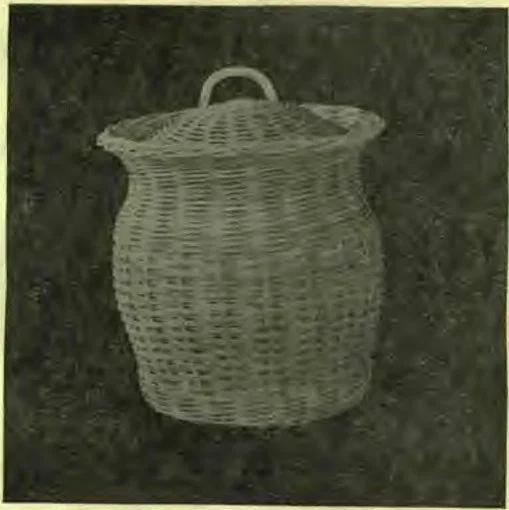
Collar and Cuff Hamper
By Mrs. E. M. F. Long
Model 8
MATERIAL, reeds Nos. 3, 4, 5, and 6. The base is six and one-half inches in diameter. No. 5 reeds for spokes and No. 3 for weavers. Thirty-eight stakes of No. 4 reed, each twenty-one inches long. Insert one each side of each spoke, and use double. Bend up sharply. Use No. 3 reed for weaving. The rope twist was not used on this basket. There are six rows of triple twist, the first being drawn very tightly. Above the upsetting are four and one-half inches of double weaving. The stakes should be slanted slightly outward until about four and one-half inches from base, then bend gradually toward the center to form the neck. The diameter of the neck is the same as that of the base—six and one-half inches. Use triple twist above the double weaving. Weave one row above the neck, with the stakes bent well outward before putting in the cover ridge. The cover ridge should be made and finished off just as directed for the darning basket in previous lesson. Above the ridge put five rows of triple twist with the stakes bent sharply outward to form the rim. Cut the right stake of each pair close to basket.
For the border turn down three stakes, each back of first at its right. Take the left one of the three turned down, pass it over the other two, in front of first standing stake at the right and back of the next, bringing it out in first vacant space. Lay the first standing stake down beside it. Repeat around the basket. This is the fourth variation of the border used on the handy basket. The height of this basket is nine inches, diameter of rim eight and three-fourths inches. The cover and handle are the same as for the darning basket.
This hamper is a very convenient receptacle for small pieces of soiled linen that it is desirable to separate from the general wash.
MRS. E. M. F. LONG.
COLLAR AND CUFF HAMPER
Alphabet to Success
Attend carefully to details.
Be prompt in all things.
Consider well, then decide positively.
Dare to do right, fear to do wrong.
Endure trials patiently.
Fight life's battles bravely.
Go not into the society of the vicious.
Hold integrity sacred.
Injure not another's reputation.
Join hands with the virtuous.
Keep your mind free from evil thoughts.7
Lie not for any consideration.
Make few special friends.
Never try to appear what you are not.
Observe good manners.
Pay your debts promptly.
Question not the veracity of a friend.
Respect the counsel of your parents.
Sacrifice money rather than principle.
Touch not, taste not, handle not intoxicating drinks.
Use your leisure for improvement.
Venture not on the threshold of wrong.
Watch carefully over your passions.
Extend to every one a kindly greeting.
Yield not to discouragement.
Zealously labor for the right, and success is certain.—Selected.
Jesus the Redeemer
By Emma S. Newcomer
1. To whom, does man belong by creation?
“And the Lord God formed man of the dust of the ground, and breathed into his nostrils the breath of life; and man became a living soul.” Gen. 2:7.
2. Did man always acknowledge God as his owner?
“For thus saith the Lord, Ye have sold yourselves for naught.” Isa. 52:3, first clause. “For we know that the law is spiritual: but I am carnal, sold under sin.” Rom. 7:14.
3. Was the Lord satisfied to have us always remain in that condition?
“And ye shall be redeemed without money.” Isa. 52:3, last clause. “For ye are bought with a price: therefore glorify God in your body, and in your spirit, which are God’s.” 1 Cor. 6:20.
4. Were gold and silver sufficient to redeem us?
“Forasmuch as ye know that ye were not redeemed with corruptible things, as silver and gold, from your vain conversation received by tradition from your fathers.” 1 Peter 1:18.
5. What, then, was the cost of our redemption?
“But with the precious blood of Christ, as of a lamb without blemish and without spot.” 1 Peter 1:19.
6. From what are we saved?
“In whom we have redemption through his blood, even the forgiveness of sins.” Col. 1:14.
7. How many will be redeemed?
“After this I beheld, and, lo, a great multitude, which no man could number, of all nations, and kindreds, and people, and tongues, stood before the throne, and before the Lamb, clothed with white robes, and palms in their hands.” Rev. 7:9.
MEMORY VERSE: “If thou turn away thy foot from the Sabbath, from doing thy pleasure on my holy day; and call the Sabbath a delight, the holy of the Lord, honorable; and shalt honor him, not doing thine own ways, nor finding thine own pleasure, nor speaking thine own words; then shalt thou delight thyself in the Lord.” Isa. 58:13, 14.
“And it came to pass on the second Sabbath after the first, that he went through the corn fields; and his disciples plucked the ears of corn, and did eat, rubbing them in their hands. And certain of the Pharisees said unto them, Why do ye that which is not lawful to do on the Sabbath days? And Jesus answering them said, Have ye not read so much as this, what David did, when himself was an hungered, and they which were with him; how he went into the house of God, and did take and eat the show-bread, and gave also to them that were with him; which it is not lawful to eat but for the priests alone?”
“And he said unto them, The Sabbath was made for man, and not man for the Sabbath: therefore the Son of man is Lord also of the Sabbath.”
“And it came to pass also on another Sabbath, that he entered into the synagogue and taught: and there was a man whose right hand was withered. And the scribes and Pharisees watched him, whether he would heal on the Sabbath day; that they might find an accusation against him. But he knew their thoughts, and said to the man which had the withered hand, Rise up, and stand forth in the midst. And he arose and stood forth. Then said Jesus unto them, I will ask you one thing: Is it lawful on the Sabbath days to do good, or to do evil? to save life, or to destroy it? And looking round about upon them all, he said unto the man, Stretch forth thy hand. And he did so: and his hand was restored whole as the other. And they were filled with madness; and communed one with another what they might do to Jesus.”
At another time as Jesus “went into the house of one of the chief Pharisees to eat bread on the Sabbath day, they watched him. And, behold, there was a certain man before him which had the dropsy. And Jesus answering spake unto the lawyers and Pharisees, saying, Is it lawful to heal on the Sabbath day? And they held their peace. And he took him, and healed him, and let him go; and answered them, saying, Which of you shall have an ass or an ox fallen into a pit, and will not straightway pull him out on the Sabbath day? And they could not answer him again to these things.”
“And it came to pass in those days, that he went out into a mountain to pray, and continued all night in prayer to God. And when it was day, he called unto him his disciples: and of them he chose twelve, whom also he named apostles; Simon (whom he also named Peter), and Andrew his brother, James and John, Philip and Bartholomew, Matthew and Thomas, James the son of Alpheus, and Simon called Zelotes, and Judas the brother of James, and Judas Iscariot, which also was the traitor. And he came down with them, and stood in the plain, and the company of his disciples, and a great multitude of people out of all Judea and Jerusalem, and from the seacoast of Tyre and Sidon, which came to hear him, and to be healed of their diseases; and they that were vexed with unclean spirits: and they were healed. And the whole multitude sought to touch him: for there went virtue out of him, and healed them all.”
Questions
1. Through what place did Jesus and his disciples pass one Sabbath day? What did the disciples do? Who were watching them? What accusation did they bring to Jesus against his disciples?
2. What did these men profess to know? What did Jesus ask them if they had never read? What rebuke was in this question? What incident did Jesus then bring to their memory?
3. Who did Jesus tell his hearers is Lord of the Sabbath day? When was the Sabbath made? By whom was it made? Read John 1:3. Of what was it a memorial?—Creation. See Ps. 111:4. What commandment has been given to the world concerning the Sabbath? Ex. 20:3. What should the Sabbath be? Memory Verse?
4. Where did Jesus go on another Sabbath? Who was also there? Why were the scribes and Pharisees watching Jesus? What did he know? What did he tell the man with the withered hand to do?
5. What question did Jesus now ask of those who stood by? Why did none answer? What did Jesus then do? With what were the Jews filled? What did they do among themselves? Why did they not work openly?
6. Into what place did Jesus go on still another Sabbath? What sick man was there? What did Jesus know? What did he ask the lawyers and Pharisees who were present? What did they say?
7. When Jesus had healed the man, and let him go, what did he ask those present? What did they answer? Why?
8. From the example of Jesus, and from his words, what may we learn about the acceptable way to keep the Sabbath?
9. After praying all night, whom did Jesus call to him? How many did he choose to be with him? Name them. Where did Jesus and the twelve then go? Who came to them there? How many were healed?
Thomas Nast, Jr., and His Work
THERE is something tellingly suggestive in Grant's aphorism, “The Sword of Sheridan and the Pencil of Nast,” for with his wonder-working pencil Thomas Nast, the inimitable caricaturist, did as effective work for this country during the Civil War as some of the leading generals in the field. And in his campaign against Boss Tweed he overthrew an autocrat as absolute in his day and way as the czar of all Russia.
It is interesting to find that his son and namesake, Thomas Nast, Jr., has also taken up the field of art. Born in 1865 in the house in which the great Tweed pictures were drawn, the younger Nast seems to have imbibed talent from its walls, and has to-day developed into an able caricaturist, while his work on some of the cover portraits of the Search-Light shows that he has something of his father's instructive ability in catching a likeness.
In 1897, while out duck shooting, he met with an accident which nearly robbed him of the use of his right arm, and obliged him to use his left arm in his work. From seeming ill good often comes, and so it proved in his case. By the time his right arm regained its powers, his left was its equal in facility, and he is now able to draw two different subjects at the same time, almost as readily as if his two hands belonged to different men and were under the control of separate brains. A lecturer as well as an artist, Mr. Nast has recently been delighting large audiences with amusing incidents in the career of the famous author of “The Democratic Donkey,” and “The Tammany Tiger,” “The Republican Elephant,” and many other well-known symbols that are in constant use to-day.
For some years Mr. Nast has been dividing his time between his own art work and the conduct of a successful correspondence school of art, a work for which he is specially fitted from his own study, coupled with the valuable hints, suggestions, and methods which he learned from his father in their days of close companionship.—Search-Light.
(June 17)
XII—Baptism
(June 17)
MEMORY VERSE: “If ye then be risen with Christ, seek those things which are above, where Christ sitteth on the right hand of God.” Col. 3:1.
Questions
1. How many baptisms are mentioned in the Bible? Eph. 4:5.
8. When baptized into Christ, what does one put on? Gal. 3:27; .
9. What did Philip preach to the eunuch? Acts 8:35.
10. What did Philip’s preaching of Christ lead the eunuch to ask for? Verse 36; .
11. What reply did Philip make? Verse 37.
12. Where did they both go to perform the rite? Verse 38.
13. Is much water needed to administer the ordinance of baptism? John 3:23. Why?
14. How should those walk who have followed their Lord in baptism? Col. 3:1, 2; Rom. 6:4.
Church-School Notes
FIVE hundred twenty-two church-schools have been in operation the past two years, with an estimated enrolment during the past year of nine thousand two hundred eighty-one pupils.
SIXTEEN church-schools are reported as having had missionary gardens, from which four hundred twenty dollars were received for missionary purposes. If all the schools had accomplished as much, the Mission Board would have received a gift of eight thousand five hundred dollars.
THE records show that during the last two years nearly three thousand persons from families not keeping the Sabbath have been enrolled as pupils in our denominational schools. This reveals the fact that our schools are not only for the training of missionaries, but are important fields of missionary effort. If all connected with these schools are examples of what this truth stands for, and if the schools maintain that high standard of education that they should, many will be brought to a knowledge of the third angel’s message, and many more will be bound by stronger cords to this truth. In Takoma Park there is a small public school that some of our Adventist children have been attending. Recently the teacher has accepted the truth, been baptized, and joined the church. She says she is indebted to the influence of some of her pupils for the truth. It was their sweet spirit, love, and earnest work that constrained her to accept their invitation to attend, on Sunday evenings, the lectures where she gained a full knowledge of the truth. Let the fourteen thousand children and youth now in our schools appreciate fully their opportunities of serving those that voluntarily place themselves under their influence.
The General Conference
By Editor
A LARGE share of the proceedings of the General Conference would be of interest to all our young people, and would cause even the children to respond in active missionary effort; but since the Review gives such full reports, it has hardly seemed wise to repeat them in the INSTRUCTOR. None can afford, however, to miss an earnest study of the work of the conference, which is distinctly a missionary conference. The reports from China, Japan, Korea, Egypt, Australasia, and South Africa are of special interest to the Young People’s Societies. The appeals for help for Greater New York, the vast Northwest Territory, the Latin Union and British fields, and really the whole world, makes every one who loves this message, feel that he must do all he can by money and life to give a knowledge of it to the waiting millions. One minister, who felt the urgency of help in a certain field, arose at the conference and said that it was impossible for him to go to that field, but that he would after this support himself, allowing Colorado to use all the money that would be paid him for labor for the support of one who could go. This, in spirit, is a response to the motto that faces every congregation of the conference, “Here am I; send me.”
True Patriotism
WHEN the war chest of Frederick the Great was exhausted, he appealed to the women to lay their jewels on the altar of patriotism, promising to return jewels of iron for jewels of gold, bearing the inscription, “I gave gold for iron for the sake of the fatherland.” Out of this response to an appeal to German patriotism, there arose the Order of the Iron Cross. What we need in these last days is a new order of living, that will mean a life of economy, a life of plainer living, plainer dressing, plainer eating, less expensive recreation, a giving up of much that we want, that we may give the gift of eternal life to those who are dead in trespasses and sins.—Selected.