Your ShelfYour Projects

Review and Herald, Vol. 65, No. 33.

THE DUTY OF BRETHREN
Earlier text: THE DUTY OF BRETHREN

THE HOME OF THE SAVED.

BY H. C. GILES.
“For thus saith the Lord that created the heavens; God himself that formed the earth and made it; he hath established it, he created it not in vain, he formed it to be inhabited.” Isa. 45:18. From this it appears that when the earth came into existence, in response to the fiat of Omnipotence, it was not for a limited space of time, at the expiration of which to be banished from the universe; but it was assigned a place among God's created works, forever to be numbered among the habitable worlds. We turn to creation's record, and there we learn who were to inhabit the earth. “And God said, Let us make man in our image, after our likeness; and let them have dominion over the fish of the sea, and over the fowl of the air, and over the cattle, and over all the earth, and over every creeping thing that creepeth upon the earth.” Gen. 1:26.
Man's dominion was intrusted to him on condition of loyalty to the government of Heaven. Gen. 2:15-17. But Satan, having instigated man's fall, and thus secured his allegiance to himself, wrested from him his dominion. See Luke 4:6. The apostle's statement affirms this: “Thou hast put [at creation] all things in subjection under his [man's feet]. For in that he put all in subjection under him, he left nothing that is not put under him. But now we see not yet all things put under him.” Heb. 2:8. No sooner had man fallen, than a plan was devised for his salvation, and a Redeemer promised, through whom he might hope for a full restoration of what he had lost by transgression. To this Redeemer, the Lord, through his prophet, declares that the first dominion shall come. Micah 4:8. This must refer to this earth; for that, and that only, constituted the “first dominion,” which was lost, as contemplated in the prophecy. As we examine the inspired record a few centuries after creation, we find a promise given to Abraham which has a very decisive bearing upon this question. “And the Lord said unto Abram, after that Lot was separated from him, Lift up now thine eyes, and look from the place where thou art, northward, and southward, and eastward, and westward; for all the land which thou seest, to thee will I give it, and to thy seed forever.” Gen. 13:14, 15. The apostle Paul, in referring to this promise, speaks of its extent as follows: “For the promise that he should be heir of the world, was not to Abraham, or to his seed, through the law, but through the righteousness of faith.” Rom. 4:13.
We now inquire, Has the promise been realized by those to whom it was given? To this, Inspiration responds: “And he gave him none inheritance in it, no, not so much as to set his foot on; yet he promised that he would give it to him for a possession, and to his seed after him, when as yet he had no child.” Acts 7:5. From these scriptures it must be evident that the promise did not refer to the earth in its present state, nor to the heirs while in possession of their natural life. Hence, to bring about the bestowal of the promised inheritance, two events must occur. 1. The earth must be purified, and freed from the curse that now rests upon it; and, 2. The dead must be raised.
The process by which the earth is to be purified is thus described by the apostle Peter: “But the heavens and the earth which are now, by the same word are kept in store, reserved unto fire against the day of judgment and perdition of ungodly men.” “But the day of the Lord will come as a thief in the night; in the which the heavens shall pass away with a great noise, and the elements shall melt with fervent heat, the earth also [shall melt, etc.], and the works that are therein shall be burned up.” 2 Peter 3:7, 10. He then adds, “Nevertheless we, according to his promise, look for a new heavens and a new earth, wherein dwelleth righteousness.” Verse 13. The “promise” to which the apostle alludes was made through the prophet Isaiah, “For, behold, I create new heavens and a new earth; and the former shall not be remembered, nor come into mind.” Chap. 65:17.
Here it may be objected that this view excludes all Gentiles from sharing the inheritance that awaits the saints. Read the inspired comment: “Now to Abraham and his seed were the promises made. He saith not, And to seeds, as of many; but as of one, and to thy seed, which is Christ.” “And if ye be Christ's, then are ye Abraham's seed, and heirs according to the promise. Gal. 3:16, 29. This language is certainly too explicit to be misunderstood. But as already noticed, this view involves a resurrection from the dead. Hear the inspired writer, “For I know that my Redeemer liveth, and that he shall stand in the latter day upon the earth; and though after my skin worms destroy this body, yet in my flesh shall I see God; whom I shall see for myself, and mine eyes shall behold and not another; though my reins be consumed within me.” Job 19:25-27. “As for me, I will behold thy face in righteousness. I shall be satisfied when I awake with thy likeness.” Ps. 17:15.
This transition from death to immortality is located by the inspired writer at the second coming of Christ. 1 Cor. 15:51, 52; 1 Thess. 4:16, 17. At this time the saints alone are raised (Rev. 20:4, 5); they, together with the righteous living, are translated; the wicked who were living having been destroyed (2 Thess. 2:8), the righteous are caught up to heaven, where they reign a thousand years in conjunction with Christ, and sit in judgment (Rev. 20:4) on the wicked, both men and fallen angels. 2 Cor. 6:2, 3. During the one thousand years succeeding the first resurrection, the earth is resolved into its primitive elements (Jer. 4:23-27), preparatory to its final purification. At the close of that period the New Jerusalem, with the saints, descends, the wicked are raised, “fire comes down from God out of heaven” (Rev. 20:9), and the earth becomes enveloped in one mighty conflagration. The wicked are consumed root and branch (Mal. 4:1); every trace of sin is obliterated, and every vestige of the curse forever removed.
The next scene that unfolds itself to the gaze of the wondering prophet is the new earth robed in fadeless beauty. Rev. 21:1. This will constitute the home of the saved. Verses 3, 4. Says the apostle, “Eye hath not seen, nor ear heard, neither have entered into the heart of man, the things which God hath prepared for them that love him.” 1 Cor. 2:9.
Reader, have you the hope of one day sharing the eternal joys that await the people of God? To you Inspiration speaks, “If ye be Christ's, then are ye Abraham's seed, and heirs according to the promise. Gal. 3:29. “He that saith he abideth in him [Christ] ought himself also so to walk, even as he walked.” 1 John 2:6. Said the Saviour, “I have kept my Father's commandments.” John 15:10. The inspired apostle declared that God has prepared these glorious things “for them that love him.” 1 Cor. 2:9. “For this is the love of God that we keep his commandments.” 1 John 5:3. God gave as a reason for making this promise to Abraham, that he “obeyed his voice and kept his commandments.” And only those who follow in his footsteps will be accounted worthy of sharing with him in the promised inheritance. Said the Saviour, “Blessed are they that do his commandments, that they may have a right to the tree of life, and may enter in through the gates into the city.” Rev. 22:14.
Cornville, Me.

GEOGRAPHY AN IMPORTANT STUDY.

BY ELIZA H. MORTON.
THERE is a tendency in this age of hurry and advancement to neglect a thorough drill in the common branches of instruction. Latin, German, and French are too often considered of more importance than arithmetic, grammar, and geography, and the result is superficial work and careless habits of thought and study. The high schools all over our land graduate yearly hundreds of pupils who have but little practical knowledge, and no real love for intellectual labor. Parents should advise their children to study those branches best calculated to discipline the mind, and to give strength of character. The value of school-work depends not so much on the number of studies pursued, or the multiplicity of facts committed to memory, as on the interest awakened, the principles taught, the thought aroused, and the preparation made for lifelong self-improvement.
Geography, when regarded as a mass of disconnected facts, appealing to the memory alone, has but little utility, but when considered in its true light as a simple science, harmonious in all its parts, and adapted to the gradual growth of young minds, it assumes importance. Certain well-defined physical laws underlie civilization, and govern the world. An understanding of these great principles and a consideration of the earth as the home of man, should be involved in the study. It is a science well calculated to arouse curiosity and awaken interest. More pleasing than tales of fiction are the wonders of earth, sea, and air. Arabian fables are not more thrilling than descriptions of real life in foreign lands. The skillful teacher can, by means of pictures, objects, and word-painting, kindle an enthusiasm earnest and abiding.
Geography is a practical study. It furnishes rare opportunities for the use of pen and pencil, and for language drill. It appeals to the judgment and common sense of the child, and gives enlarged ideas of life. It may be made to teach important moral and religious truths. What book, aside from the Bible, shows more clearly the goodness and power of God than the great book of Nature! Brooks and rivers, hills and mountains, lakes and plains, all speak of the Creator. The labor of missionaries in pagan lands may be taken as an example of unselfish devotion to noble principles. In many ways the Christian instructor can use this science as a medium by which to impart divine truths.
One well known for her earnestness in the cause of God says: “Our Saviour often preferred the fields, the groves, and the lake-sides for his temples. He made use of the lofty trees, the cultivated soil, the barren rocks, the flowers of beauty struggling through the clefts, the everlasting hills, the glowing flowers of the valley, the birds caroling their songs in the leafy branches, the spotless lily, resting in purity upon the bosom of the water. All these objects that made up the living scene around them were made the medium by which his lessons were impressed upon the minds of his hearers. They were thus brought home to the hearts of all, meeting the capacity of all who heard, and leading them gently up from the contemplation of the Creator’s works in nature to nature’s God.”
The earth is the handiwork of God; and what can be more elevating to the human mind than a careful study of the great physical laws which govern the universe?

CHRIST MY HOPE AND STAY.

BY J. M. HOPKINS.
Thou art my only hope and stay, O Christ my king; And all my comfort day by day, From thee I bring.
Through all the toilsome upward way, Be thou my Guide; O let me never, never stray From thee aside.
When trials press on every hand, Then be thou near; And as I near earth's border-land, Then may I hear
Thy voice above the breakers roar, The tempest wild, Call loudly from the other shore,— “Come home, my child!”
Chatfield, Minn.

HEARING OURSELVES AS OTHERS HEAR US.

Mrs. Lamson and Mrs. Flanders exchanged a good-morning greeting, as they stood in their respective doorways, where they had come to call their boys to breakfast.
“Come, Charley,” said Mrs. Lamson, “breakfast is all ready.”
“Come, breakfast is hot; come in now, George,” said Mrs. Flanders.
Charley smiled, and George frowned, as each started for home.
The sentences uttered by the two mothers, when written, seem to be very similar; but could you have heard them spoken, you would have found it difficult to believe the words were so nearly the same. Mrs. Lamson’s call would have the same effect upon your mind as if she had said: “Come, Charley, my son, I have been preparing a nice breakfast for you, and have no doubt you are all ready to enjoy it.”
Mrs. Flanders’ tone of voice said, “Come, come, come, I have been working hard while you were playing, to have your breakfast hot; and now it will surely be all cold before you are seated at the table.”
Mrs. Flanders did not mean to fret. She seldom did allow herself to do so in words, but she did not in the least realize that the impatience which had become habitual in her tone, would be nearly as irritating to her children as fretful words.
She sat sewing that afternoon, in her chamber, with the door ajar into the nursery adjoining, where her little six-year-old Nellie and a younger companion were playing.
“Now,” said Nellie to her visitor, “you be my little girl, and I’ll be your mother, and talk to you just like my mother does to me. You must ask me if you can go out and slide,” prompted Nellie.
“Can I go out an’ slide?” quoted Katie.
“Yes, dear, you may go, but be sure and come home in half an hour. You have your mittens on, have you not?”
Mrs. Flanders dropped her work in utter amazement, at the exact counterpart of her own voice, in her imitator. Nellie continued to herself in the same querulous tone:—
“She’ll be sure to punch a hole in her mitten, but then I shall have it to mend. O dear! what a bother children are.” (“I never said such a thing,” soliloquized the mother.) “I don’t suppose she will come home in time, either—now the half hour is gone, and I must call her.”
“Katie! come in! Let me look at your mitten. Yes, a hole, just as I expected. You are a very careless girl, Katie Jenkins. Have you sewed the square in your patch-work to-day? I thought not.”
“Now you must say,” suggested Nellie, to her very docile playmate, “But I had to do an errand for Mrs. Hyde.”
“But I had to do erran’ for Miss Hite,” promptly repeated Katie.
“O yes! I do just wish Mrs. Hyde would do her own errands.”
“My mother don’t talk like that way,” put in Katie.
“Mine does,” said Nellie, emphatically. “Now,” she continued, “you may come to supper, although it is altogether too good for such a child.”
Mrs. Flanders heard no more. She was too absorbed in listening to her own perturbed thoughts. “I never talk in that way, but certainly the words fit the tone, precisely. Is it possible that her quick little mind interprets the tone rather than the words? It seems as if she had read my very feelings.”
For several days Mrs. Flanders made a great effort to speak cheerfully; and as she noticed the quick, surprised smile in the upturned faces of her children, when the same commands were given with a different inflection of voice, her heart smote her that she had so long clouded their lives by her careless petulance. But the habit of years is not easily overcome; and as she sat sewing and thinking one evening, she was startled, as she remembered that the old fretfulness had seldom been out of her voice that day. Just then George passed through the hall, singing,—
“What a privilege to carry Everything to God in prayer.”
And to God Mrs. Flanders did carry her trouble, not for the first time, by any means; but with such a sense of her own weakness, and such faith that his strength and his alone, could enable her to conquer, as never fails to find a speedy answer of relief.
That night Mrs. Flanders dreamed that as she went about the usual work the next day, she was constantly followed, or accompanied, by a presence unperceived by all but herself, who noted every word and tone. Not once did she allow herself to speak to the children in any but the cheeriest manner; although often, in her heart, feelings of impatience had been cherished. At night she was quite happy over her victory; and as day after day of a week went by, and she still succeeded in controlling her voice, she ventured to inquire of the angel (for such she had concluded her visitor must be) if he did not think her bad habit entirely cured. He shook his head sadly. As he did so, although he did not apparently speak, these words were revealed in dazzling clearness to her mind, “Out of the abundance of the heart the mouth speaketh;” and awakening, she understood that if she did not pull the root of impatience from her heart, and plant the bulb of thankfulness, all her cutting off and breaking down, would not prevent new sprouts from unexpectedly and persistently springing up.
O fathers, mothers—husbands, wives—sons, daughters—brothers, sisters—guard the tones of your voice, as well as your words, most carefully in your daily conversation; but above all, keep yourselves in the love of God” and each other, and your “good words” will “make glad the hearts” of those about you.—Mary E. Sweetser, in Watchman.

THE LOGIC OF EVOLUTION.

BY F. W. FIELD.
That the earth has, after untold ages, been evolved from primitive matter, is a theory quite commonly held at the present time, even by many who profess to believe the Bible. But some, at least, of this class, are hardly willing to follow this line of reasoning to its logical results. Even though they may succeed (to their own satisfaction, at least) in harmonizing their theory with the Bible record, the Scripture account of the origin of life is so plain, that they find themselves unable to reconcile its explicit teachings with the theory of the evolution of life. The inconsistency of those in this position is well shown in the following quotation, from the writings of the well-known scientist, Richard A. Proctor:—
I may here remark that, even apart from the evidence which the most eminent biologists have brought to bear on this question (the evolution of life), it seems to me illogical to accept evolution as sufficient to explain the history of our earth during millions of years prior to the existence of life, and to deny its sufficiency to explain the development of life (if one may so speak), upon the earth.—Our Place Among Infinites, p. 24.
It is a well-recognized principle of logic that that which proves too much, proves nothing. If evolution logically accounts for the development of matter, it also accounts for the development of life. But this proves too much for those who decline to number tadpoles, clams, etc., among their progenitors; and so proves nothing. Let us be logical, as well as scientific.
Glendale, Wis.

God's Answer to Prayer Pleases Us

—The way wherein it pleases God to answer our prayer, if we have a right mind, will always please us well.

TO MAKE A HAPPY HOME.

LEARN to govern yourselves, and to be gentle and patient. Guard your tempers, especially in seasons of ill health, irritation, and trouble, and soften them by prayer and a sense of your own short-comings and errors. Remember that, valuable as is the gift of speech, silence is often more valuable. Do not expect too much from others, but remember that all have an evil nature, whose development we must expect; and that we should forbear and forgive, as we often desire forbearance and forgiveness ourselves. Never retort a sharp or angry word. It is the second word that makes the quarrel. Beware of the first disagreement. Learn to speak in a gentle tone of voice. Learn to say kind and pleasant things whenever opportunity offers. Study the characters of each other, and sympathize with all in their troubles, however small. Do not neglect little things, if they can affect the comfort of others in the smallest degree. Avoid moods, and pets, and fits of sulkiness. Learn to deny yourself, and prefer others. Beware of meddlers and tale-bearers. Never conceive a bad motive, if a good one is conceivable. Be gentle and firm with children. Do not allow your children to be away from home at night, without knowing where they are. Do not furnish them with much spending money.—Intelligencer.

THE TRUTH IN OTHER LANDS.

A SKETCH OF SOUTH AUSTRALIAN HISTORY.
To say that the area of South Australia is 914,730 square miles, does not, at first thought, convey to the reader an idea of the extent of the country. If every coast State of our country on the eastern sea-board, from Maine to Texas, were spread out over that colony, there would yet remain 24,000 square miles, or a territory twice as large as both Vermont and Rhode Island, unoccupied. Considering, that the entire colony has hardly more inhabitants than the city of Boston, one of two conclusions is readily formed; that the country is very sparsely settled, or that the entire population must be largely found in one locality.
The last of these conclusions would be true. Only a small portion of the territory, and that principally in the extreme south-eastern part, has been settled. The interior is entirely undeveloped, and is still the haunt of the black aboriginal. In the extreme north of the colony, bordering on Torres Strait, are a few settlements formed by those who have been drawn thither through mining excitement. The climate in that section is not the most favorable to the health of the average white man, because of the proximity of that locality to the equator, though some do live there, and thrive. The greater part of the population, however, is made up of Chinese, who do not seem to mind the high temperature, so long as they are successful in mining.
That part of the country about Spencer Gulf and the Gulf of St. Vincent, and on the ocean coast southeast of those bodies of water, has been fully settled, and proved to be very fertile. It seemed most natural to occupy this territory first, on account of its superior advantages in the way of water; but when new-comers can no longer be accommodated in these older parts, they will, of necessity, push on into the interior, where, with the assistance of artesian wells, they will cause the wilderness to blossom as a rose.
Considering that the first settlement in this colony was not made until 1836, and that the country has had to suffer almost continuously during its early history, through the greed of speculators and unprincipled adventurers, there is no question but that it has prospered as well as could be expected. At the time mentioned, the city of Adelaide was known only on paper; now it has, with its suburbs, fully 100,000 inhabitants. Three hundred thousand more are comfortably situated at easy distances from the capital city, all of whom are fairly intelligent, and easy to approach.
Some matters in this colony are regulated in a different way than they are in Victoria. In the latter colony, children not only receive the benefits of the State school free, but are compelled by law to be in school a certain number of days in every month. In South Australia, while the compulsory law exists, obliging each child under a certain age to attend school, a tuition fee of sixpence (twelve cents) per week is demanded of all. Should any parent be absolutely unable to pay the required amount, and go before the proper officer, with satisfactory proof of the same, the State then furnishes the amount demanded.
Until 1876 Victoria furnished State aid for religion, providing annually £50,000 ($242,000) for building houses of worship, and for the maintenance of the clergy. This created, as it could not fail to do, an unfair discrimination between the sects, giving to some, marked advantages over others. In South Australia this state of affairs never existed. On the other hand, no discrimination between sects was ever made in that colony. From the first, all have stood on an equal footing, as to the privileges of propagating their religious opinions; and the result is seen, not only in the more even distribution of professors among the various organizations, but in the greater simplicity and devotion of the church members in general, as well as in the display of less bigotry on the part of members of one order against those of others.
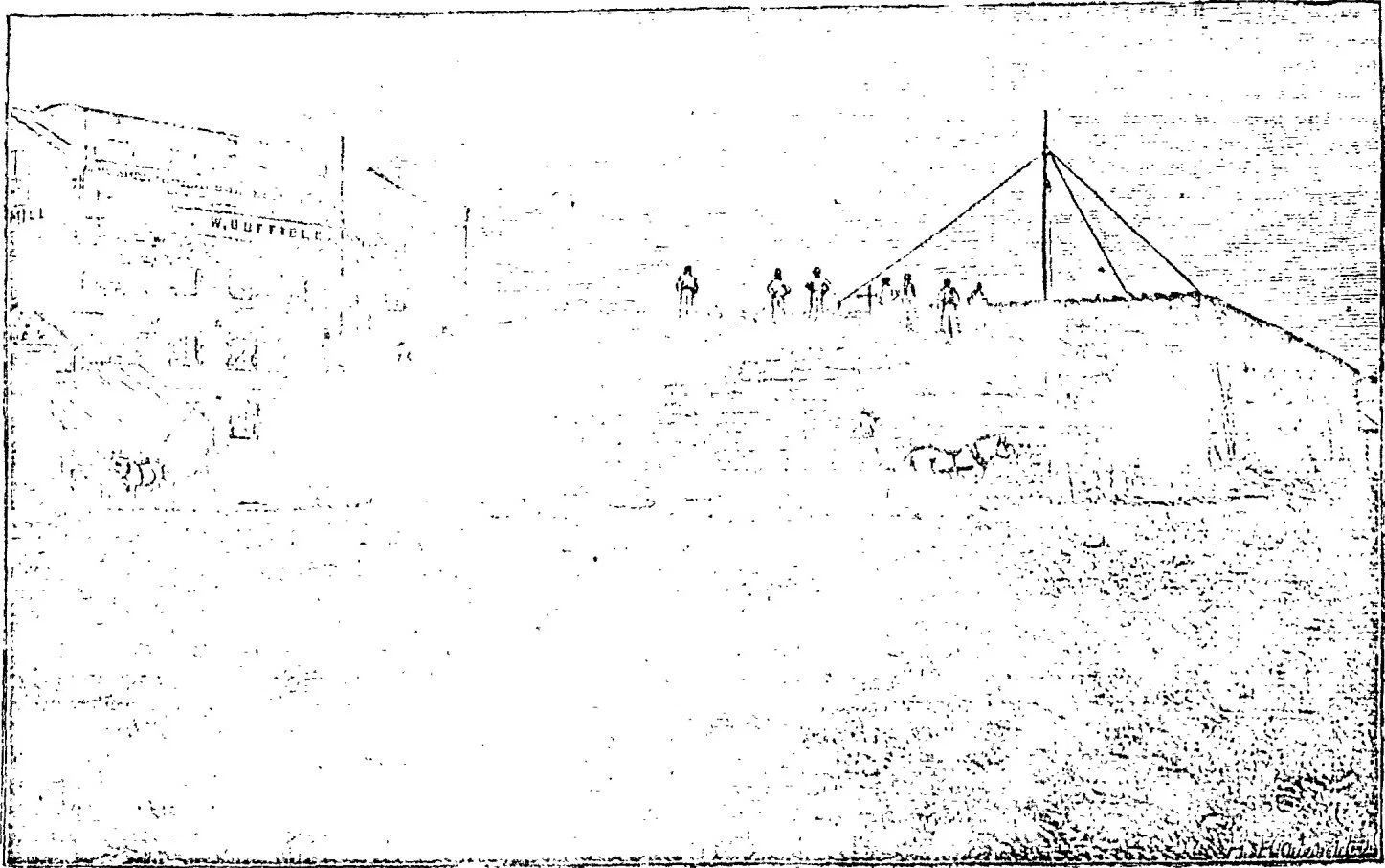
THE VICTORIA MILL, GAWLER, SOUTH AUSTRALIA.
This latter consideration makes that colony, in some respects, an easier field in which to present a new truth, than some of the other colonies. And yet the law regarding Sunday work is very rigid in all the colonies. One may go to the public baths, to the seaside, or on steamboat excursions on Sunday, without incurring the penalty of the law; but let him be found at some useful occupation on that day, and he is not looked upon with much favor. An observer of the seventh day, is, therefore, not popular among Sunday professors, because he does not reverence the day they observe. He is not popular among the employers of labor, because he will not work on Saturday, and therefore dull times become extremely dull to him; because at such times there are so many who are not only anxious to fill his place, but clamor for it.
There is nothing an English employer dislikes more than to be bound to one on whom he cannot depend. In fact, he cannot endure such a thing. And although on Saturday in the colonies a half-holiday is allowed, among high and low, yet for a laborer to be absent from work two half-days (Saturday forenoon) in succession, causes an unrest on the part of the employer; and no matter how great has been his esteem and attachment in the past for his laborer, he immediately sets about finding another to fill his place. If the workman retains his position under these circumstances, he may know that his employer has not been able to find any one to take his place. Every one in Australia who attempts to observe the Sabbath, expects the worst; and if it does not come, he is agreeably disappointed. And if one loses a situation in this way, he finds it hard to secure another, for the same reason that he lost the first; as an employer in that country will seldom hire one who he knows intends to remain away from his work on Saturday forenoon. He may, it is true, get employment for a week, if he says nothing of his custom of Sabbath-keeping, and simply stays away from work on that day; but that is of little satisfaction, when he knows he will be obliged to look for another job at the beginning of the following week. Altogether, it is a much greater sacrifice to keep the Sabbath in Australia than in America.
Some, when thrown out of employment, go to the mines on their own account, but these are not satisfactory places for a Christian to live. It is generally the rougher classes that labor in the mines, and there are scenes of recklessness constantly going on among them, which it is not pleasant to witness. One of the most prominent gold fields of South Australia is at Echunga, north of Adelaide. In this vicinity, too, have been found diamonds, and other precious stones. In other parts of the colony have been gathered amethyst, agate, beryl, bloodstone, cornelian, chalcedony, emerald, garnet, onyx, spinel, ruby, sapphire, topaz, and other very fine gems. In the southeast, bordering on a bight of the coast called the Coorong, is found on the surface a substance something like India rubber. Many tons of it lie scattered on the ground, in layers, varying from that of a sheet of coarse brown paper to an inch in thickness. Upon experimenting with it in Adelaide, a brilliant illuminating oil was obtained, which was thought to be superior to the best kerosene oil of American product.
Wheat is grown in great quantities in the colony. Near Gawler, may be seen thousands of acres devoted to this crop alone. To look over one of these vast fields of ripened grain in time of harvest is a goodly sight. Scattered here and there, are more than a score of harvesting machines, each drawn by four horses. These machines are so arranged as to clip off the heads of wheat, and to thresh and winnow the grain, ready to put into sacks. It is then drawn to the mill and tiered up, as shown in the cut, to be ground into flour for home and foreign consumption.
The wool clip of the country is simply enormous. The finest grades of wool grown in the world are produced in these parts. During the months of November, many vessels are freighted with compressed bales of wool for the English market. Comparatively little of the product reaches this country, on account of the heavy duties required by the United States Government for landing it here.
There are some pests in Australia, which are unknown in the United States. One of these is what is called the white ant. It is, however, yellow in color, and is always seen covered with a shield of glutinous earth. It uses this covering to protect itself from the attacks of the small black ants, its deadly enemies. The white ant eats whatever happens in its way—leather, wood, soap, books, clothes—it will not even refuse tobacco. Ordinarily, nothing short of sheet-iron or tin, will stop its ravages. There are, however, some kinds of wood, such as iron-bark, blood-wood, and a few others, or the jarrah of Western Australia, capable of withstanding their attacks.
The ant-hills throughout the interior are exceedingly large, some of them being from six to ten feet in diameter, and twenty to twenty-five feet in height. The larger ones have the appearance of great age, and are capable of resisting the pressure of the heavy tropical rains which prevail in that country. The ravages of the white ants, in eating through wooden buildings, have been so great that the government voted to have all public structures built of stone, with floors of Portland cement.
Another curious yet destructive insect is one about the size of a large fly, and known as the borer. It is not found near the coast, but leads an active existence in the interior, where its chief business seems to be, to see how many holes it can bore in a single tree. Neither is it satisfied with the amount of damage it can do by daylight; on a still night the noise of their operations may be distinctly heard, as they diligently pursue their avocations. On the head of this insect is a kind of augur, which it drives with considerable force into the wood. The augur being inserted, the body performs a series of rapid revolutions; and in an incredibly short time, it has bored a hole into the timber, as perfectly as could have been done by a carpenter's augur bit.
The native products of the interior are not adapted to sustain civilized life, although they afford sufficient to support the aboriginal population. And yet for hundreds of miles inland, the country plentifully yields trees, plants, and herbage, of different kinds, and in most cases of luxuriant growth. It has already been demonstrated that these unsettled lands are well adapted to stock-raising; and since the most delicious fruits, such as the banana, cocoa-nut, custard-apple, pine-apple, and tamarind, thrive near the coast, there is no doubt that, with proper cultivation, these could be produced abundantly in the jungles and swamps of this vast unoccupied territory, where are found the advantages of a genial tropical climate.
J. O. CORLISS.

WEST VIRGINIA TRACT SOCIETY PROCEEDINGS.

The first meeting of the first annual session of the West Virginia Tract and Missionary Society, was held in connection with the camp-meeting at Salem, July 25, 1888, at 5 P. M. The President, Eld. W. J. Stone, in the chair. Prayer was offered by Eld. R. A. Underwood. The minutes of the organization of the Society were read and approved.
On motion, the Chair was empowered to appoint the usual committees, and the following were announced: On Nomination, J. F. Mende, E. E. Varner, C. B. Rule; On Resolutions, R. A. Underwood, Clement Eldridge, A. A. Meredith.
The meeting adjourned to call of Chair.
SECOND MEETING, AT 5:45 P. M., JULY 26.—The Committee on Resolutions presented the following report:—
Resolved, That we adopt double entry book-keeping, as recommended by the International Tract and Missionary Society at its last annual session.
Whereas, We believe the success of the canvassing work is largely due to system and order; therefore,—
Resolved, That we will do all in our power, to place this important branch of the missionary work upon a sure and systematic foundation.
Resolved, That we will carry out, as far as possible, the plans adopted by the International T. and M. Society at its annual session at Battle Creek, Mich., in 1886.
Resolved, That we will conduct our Tract Society business on a strictly cash basis.
Resolved, That it is the sense of this body that the ministers, church elders, or leaders of companies, should seek out and encourage all proper persons to enter the canvassing field.
Resolved, That all canvassers be formed into companies, whenever it is practicable to do so, and that an efficient man be selected as leader for the same.
Resolved, That the leader become responsible for all books ordered for his company, and that he collect all money belonging to the Tract Society, and forward the same to the Tract Society.
It was moved that the resolutions be adopted by considering them separately. Remarks were made by C. Eldridge, R. A. Underwood, W. J. Stone, and others, and the resolutions were unanimously adopted.
Meeting adjourned to call of Chair.
THIRD MEETING, AT 5:30 P. M., JULY 27.—The Nominating Committee recommended the following persons for officers the coming year: For President, Eld. W. J. Stone; Vice President, H. B. Hoff; Secretary and Treasurer, Nelia M. Stone; Directors: Dist. No. 1, John A. Stuart; No. 2, C. B. Rule; No. 3, James Conely; No. 4, A. A. Meredith; No. 5, D. N. Meredith; No. 6, D. Haddix; No. 7, E. W. Metcalf.
This report, after being carefully considered, was adopted. The Committee on Resolutions further presented the following:—
Whereas, It is necessary to know just what is being done in the missionary work; and,—
Whereas, It is impossible to do so, unless all members report; therefore,—
Resolved, That we will be faithful in making out and sending in correct reports to the local Societies, who, in turn, will report to the State Secretary.
This resolution was spoken to by C. Eldridge and W. J. Stone, and adopted.
Meeting adjourned sine die.
W. J. STONE, Pres.
NELIA M. STONE, Sec.

“CAST THY BREAD UPON THE WATERS.”

“WHATSOEVER a man soweth, that shall he also reap,” not in quantity, but in kind. A few months since, while speaking with a good brother of our church, of the way in which God sometimes blesses the humblest efforts put forth in the interests of his cause, he related the following peculiar dream, which I have ever since regarded as a most singular illustration of the familiar text: “Cast thy bread upon the waters, for thou shalt find it after many days.” Eccl. 11:1.
In his dream he was standing on the shore of a great river, having on his arm a basket filled with small crackers, which, as the tide began to go out, he cast upon the waters. Handful after handful he flung on the receding waves, and then, the basket having been emptied, he stood watching them until the fast-ebbing tide had borne them all out of sight. And still he stood looking off upon the waters, as if in a reverie, when suddenly, as it seemed to him, the tide began to come in. Wave after wave continued to hasten joyously shoreward, until the tide was nearly at its height. Just then, happening to raise his eyes, it appeared as if the entire surface of the water, in the distance, was covered with strange-looking objects, moving swiftly toward the shore. On they came, like an armed and disciplined host, every wave bringing them nearer. The advance guard reached the shore, and swept up the beach, as if to surround him. The rear guard followed, until the shore was lined with them as far as the eye could reach. They piled themselves up about him like a great wall. Retreat was impossible. He was a prisoner! Judge of his surprise, however, when those strange-looking objects which had thus effected his capture, were discovered to be great loaves of bread! He had cast in a few little crackers—food for a few—and, behold, they came back a host of huge loaves—food for an army!—Boston Watchman.

GOD WATCHES THE SEED.

Millions and millions of little seeds are flung out on the soil, swept away by the winds, borne aloft on the breezes, and carried hither and thither by waves, and many of them no doubt perish; but still God watches the seeds, and some of them live, and fall on fertile soil, and bring forth fruit. So millions of tracts are sent out, and many of them are lost and many are wasted, but many of them also are like good seed on good ground, and bring forth fruit. No man can watch all the seeds that ripen and are scattered, and so no man can watch all the tracts that are printed and distributed. We may be certain of one thing, however, good seed will produce good fruit when it grows, while evil seed will produce evil fruit, if it produces anything. Hence, though we may not know that any one seed will be fruitful, we know that unless seeds are scattered, there will be no fruit, and if many seeds are scattered, there is hope of a plenteous harvest. And we also know that no bad seed will produce good fruit, and no good seed will produce bad fruit.
Satan is busy sowing tares everywhere; let Christians be equally diligent; let them see that their seed is good seed, and then let them cast it forth with courage and with faith, remembering that it is written, “Blessed are ye that sow beside all waters.” For many years have God’s servants been trying to scatter this good seed, and they are not to be weary of the work, nor discouraged in the work. But how much they desire that many others may take part in the labor, assist in bearing the burden, and have a share in the harvest, the blessing, the joy, and the reward!—Sel.
Continue reading: I WILL TELL IT