DISCORDANS. False Reasoning is the mirror in which the Jewish clergy, doctors of law, scribes, and pharisees, tried the doctrines and actions of Immanuel and all his followers. By these means they were fatally deceived, and led to reject the counsel of God against themselves; yea, hardened to that degree, as to say, the light which enlighteneth every man that cometh into the world, is absolutely darkness, and to charge the Maker of all things with being a magician; even to put forth their sanguinary hands, and murder the Lord of life.
You may think I was closely employed in those days, as there was not a pharisee in the whole world whom I had not furnished with an inverting mirror and telescope. By these means they became quite enamored with their own supposed virtue, and held all besides themselves to be accursed; that is to say, heretics, because they knew not the law; that is, they did not measure length and breadth exactly according to the standard of orthodoxy, which in all ages has been the traditions of the elders, and not the scriptures of truth, as some have erroneously asserted.
IMPIATOR. Hold, cousin, there I think you must be wrong; for I myself was wont to hear Immanuel (who you know could not lie), refer his hearers to the scripture for the resolution of all doubts.
DISCORDANS. That is nothing at all to the purpose, cousin. I readily grant, and none can honestly deny it, that the scripture is the standard of truth; but truth and orthodoxy are two things, very different, and sometimes diametrically opposite to one another. Bible doctrine is the same in all ages and nations; but orthodoxy in one nation differs at least as much from orthodoxy in another nation, as the several climates do from one another. To go no farther than Britain, you see what is south of the Tweed accounted the purest religion in the world, is, upon traveling farther towards the pole, deemed corrupt, superstitious, and antichristian. So it is vice versa. Moreover, what has been orthodox and apostolic in one age, has had the misfortune to become quite heterodox and damnable in the next; so that there is no certain standard of orthodoxy in215any nation: but truth is always the same, and knows no standard but one.
Indeed the synod of Dort, and the reformers of the English church, have done what mortal men could do to fix an everlasting standard of orthodoxy by tying all future professors to subscribe their traditions. But even that is insufficient. For, by the help of mental reservation, many subscribe contrary to their real belief; and others, who have not that address, even go without a benefice, let them believe the Bible ever so piously. Yea, I have known many deemed heretics, and burned at a stake, merely for believing the Bible. Orthodox papists, orthodox Episcopalians, orthodox Presbyterians, and orthodox Congregationalists, have all had the honor of putting people to death for their want of orthodoxy; that is, because they were daring enough to think for themselves, contrary to the known maxims of the orthodox priests, in every age. You know, it is observable, that the orthodox are condescending enough to suffer other people to have thought for them.
IMPIATOR. What, cousin, has any sect of Christians, besides our friends the papists, been found to persecute those who differed from them?
DISCORDANS. Yes, cousin, every sect which has at any time been happy enough to grasp the reins of government for the time being. The worthy papists bore the bell of orthodoxy for the space of twelve hundred and sixty years, during which time much blood was shed by open massacres, secret assassinations, pretended judicatures, acts of bloody faith; and, at last, to finish the bloody reign of antichrist, England, France, the Netherlands, and the valleys of Piedmont swam with the gore of such who would believe the Bible sooner than the voice of the priests. Queen Mary’s reign furnished the orthodox in her day with a fine opportunity of discovering their zeal for the church, by murdering those who believed and obeyed the Bible; but her reign being short, and Elizabeth ascending the throne upon her demise, the other scale rose uppermost, and the Protestants in their turn became orthodox; that is, got the government into their hands.
O, the violence of reputed orthodoxy! Those same gentlemen were no sooner emerged from prison than they also let the world know that they were not to be differed from with impunity; that the formula of their faith and worship must be regarded with as implicit obedience as that in the former reign imposed by the papists. Now the Presbyterians, Independents, and other Congregationalists, felt the weight of their rage, or, if you please, zeal for orthodoxy, and the good of the church. Now the prison-keepers, and their friend Master Ketch, had pretty near as good a run of trade as in the reign of Mary. And now the wilds of America began to be well peopled with English Protestants and oppressed dissenters; and the good Episcopalians at home, kept the fleece to themselves, and had all the good of the church before them. But those said Presbyterians and Independents had no sooner crossed the ocean for conscience’ sake and found themselves secure from Episcopalian rage, than they themselves commenced orthodox and set up their own formula as the standard of religion, to which they required as implicit submission from others as the good bishops of England had erewhile done from themselves; and now the poor anti-pedobaptists and Quakers were taught, that a mittimus is a mittimus, whether it is signed by a papist, an Episcopalian, or a Presbyterian; and that sentence of death is to be dreaded as much from the mouth of the latter as of the former.
Those same dissenters, who had so lately found Old England too hot for themselves, by the glowings of priestly zeal for orthodoxy, soon made New England too hot for the poor Quakers and anti-pedobaptists; who to escape the rage for Presbytery, fled, the one to Pennsylvania and the other to Rhode Island, that they might not be compelled to worship God according to other people’s consciences, and contrary to their own.
INFIDELIS. So then the old spirit of calling down fire from heaven upon heretics, or those who walk in a different way, it seems has prevailed in modern times as well as of yore. O what a mask is that! human rage in the character of godly zeal! It is wonderful to see people glorifying the prince of liberty, but shutting their brethren up in a dungeon for conscience’ sake; worshiping the Saviour of men’s lives by putting people to death, because they will worship him in a different form; and it is as wonderful that the ambassadors of peace, as they call themselves, should be the principal agents of this violence.
DISCORDANS. But for the ambassadors, persecution had never been known in the world, sir. The laity have so little zeal for God, that they would, if not instigated by the clergy, suffer men to worship him according to the best understanding they have of his mind revealed in the Bible. But the ambassadors are quite of another opinion; for, by them it is determined that God shall be worshiped in the very mode by them directed, or he shall not be worshiped at all, if they can help it. The hour of persecution, alias punishing of heretics, must all be ascribed to the reverend ambassadors.
IMPIATOR. By ambassadors, I suppose, cousin, you mean popish priests in contradistinction from Protestant ministers.
DISCORDANS. I mean both papists and Protestants, cousin; and with me it is not very easy to determine which best deserve the honorable appellation.
But to return to my story. I taught the respectable Pharisees in general the use of my instruments, which, as you saw in the late experiment, perfectly inverteth every object; and so, by my prudent management, those very people, held to be the most religious of the Jews, were wrought up to such a degree of self-conceit, as to fit them for executing the will of the devil; still supposing that they were doing good service to the God of Israel. Contemplated under the reflection of my ingenious instruments, those Pharisees, who were darkness itself, considered themselves as angels of light, and each became so enamored of his own personal excellencies, that all who were not of their sect or persuasion, were held in the most consummate abhorrence; as accursed, and ignorant of their traditions, yea, even enemies to the Almighty.
They viewed Immanuel, the brightness of the Father’s glory, and express image of his person, by the help of my glasses, in which, to them, he appeared as one come from Beelzebub, and performing miracles in the spirit and power of the great apostate. His immediate disciples were, indeed, men of whom the world was not worthy; yet, viewed by the help of those notable instruments, they appeared as creatures the most despicable. Although men of peaceful principles, willing to spend and be spent for the good of mankind, they were held to be enemies to the public good; men who turned the world upside down; unworthy of a dwelling in the tents of humanity, and therefore thrust out of the world with violence. Such wonderful works were accomplished of old, by the help of these amazing instruments, and still they are perfect as ever, and fit for operation.
Even at this day, when the whole system of revealed truth is examined by my inverting mirror, it is misapprehended as cunningly devised fables; a well-concerted system of falsehood; or a priestly imposition on the consciences and understanding of the laity. Yea, my fellow-destroyers, by my wise government, many who value themselves as the greatest masters of reason, are so absolutely stupid as to suppose that the eternal God has left man at large, without any given law or revelation of his mind, to which their submission is required. Being thus stupidly absurd, you will not wonder that the same masters of reason have been ingenious enough to find out, that this world, unwieldy as it is, was dexterous enough to create itself, and possesseth wisdom enough to be its own governor.
INFIDELIS. By your leave, cousin, this last part of your account belongs to my administration. You preside only over dissension and division. I want to hear some of your operations of this kind.
DISCORDANS. True, sir. But if I preside over dissensions, divisions, animosities, etc., you know I must be allowed to use proper means by which my works are to be propagated; for I am not like those human fools, who expect the end without using the means. Besides, sir, that one devil should assist another, is by no means against the laws of our fraternity. If I, to promote my beloved discord, call in the assistance of your bewildering influences, I also, in a kind return, by the divisions which I foment, greatly strengthen the slavish bands of great infidelity. Our interest being mutual, I hope the worthy Infidelis will never grumble to lend me all possible assistance, in striving to make this earth, as much as may be, to resemble the regions of the damned. — Moreover, our great prince and parent is no way careful about which of his illustrious family is the instrument in damning a soul, so that the work of damnation is effected.
INFIDELIS. I have no objection, cousin, to assist you, or any of our kindred. All I desire is, to have due notice taken of my influence. Our leading view ought, undoubtedly, to be the destruction of men, in compliance with the will of our great ancestor. But I detain you.
PROGRESS IN ENGLAND.
[Special Cable Despatch to the Sun, June 28.]
THE prelates of the Church of England are having a pretty bad time. The abandonment of the Government Education Bill, which was drafted directly in the interests of the church denominational schools, was a stinging blow; but this week witnessed the humiliation of the whole Bench of Bishops in the passing by the Lords of the Deceased Wife’s Sister Bill. It is known that nearly the whole royal family is personally interested in the bill, and it is a fact that those members who as Peers of the Realm are entitled to sit in Parliament have frequently voted for it. The Prince of Wales once travelled several hundred miles in order to record his vote. This year he went further and actively canvassed the Peers for votes to the horror and indignation of the Bishops, who, although vigorous canvassers themselves, strongly object to a prince of the blood royal doing such things. Their indignation is by no means lessened by the knowledge that the date for the second reading was fixed this week so that his Royal Highness should not miss the Ascot races. The bill has not yet214got out of the House of Lords, but Lord Dunraven, who has charge of it, is sanguine of getting it through, and hopes that the government will facilitate its passage in the Commons, where there is an assured majority in its favor.
It is difficult to see how this can be managed in view of the tangle into which the government has got business; but the Prince of Wales’ influence with his friend Mr. Balfour ought to stand the bill in good stead.
HOW SHALL WE REFORM SOCIETY?
THIS is the most important question now before the religious world. The opinions of several leaders in religious thought relative to this subject are tersely expressed in the following quotations:—
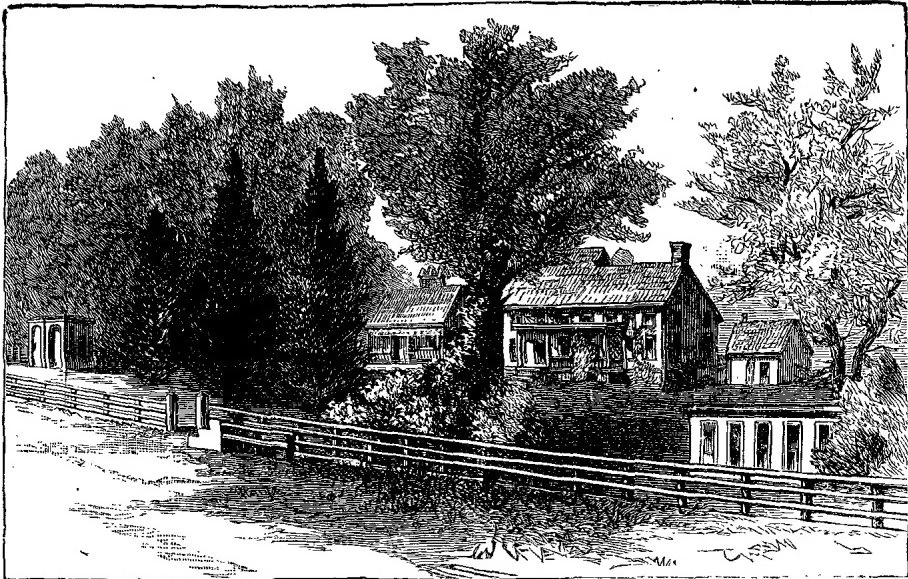
Home of Alexander Campbell.
“The gospel began its mission for the renovation of the world with the exhortation, ‘Repent, and be baptized, every one of you.’ It did not direct its efforts to institutions, but to individuals. And so it must be now. So it will be if the Spirit is poured out. To talk about a revival of civic righteousness as the great need of the times is reversing the divine order; it is putting the effect before the cause; it is trying to build the house without gathering the material. We cannot have a Christian city without Christian citizens. Men’s hearts must be renewed before we can hope for new social and civic conditions. Let us labor and pray for what people nowadays sneer at as ‘an old-fashioned revival’—of the fashion of that first revival when Peter preached in the streets of Jerusalem.”—Herald and Presbyter, Cincinnati, June 3, 1896.
“The Reformation was accomplished in the name of a spiritual principle. It had proclaimed for its teacher, the word of God; for salvation, faith; for king, Jesus Christ; for arms, the Holy Ghost; and had by these very means rejected all worldly elements. Rome had been established by ‘the law of a carnal commandment,’ the Reformation, by ‘the power of an endless life.’ Heb. 7:16.”
“Thus one of the greatest tasks of the sixteenth century was to restore the spiritual element to its rights. The gospel of the reformers had nothing to do with the world and with politics. While the Roman hierarchy had become a matter of diplomacy and a court intrigue, the Reformation was destined to exercise no other influence over princes and people than that which proceeds from the gospel of peace.”—D’Aubigne’s “History of the Reformation.”
“I should be afraid to borrow help from government; it would look to me as if I rested on an arm of flesh, instead of depending on the living God. Let the Lord’s day be respected by all means, and may the day soon come when every shop shall be closed on the sabbath, but let it be by force of conviction, and not by force of policemen; let true religion triumph by the power of God in men’s hearts and not by the power of fines and punishments.”—Spurgeon.
“It is the duty of the civil power to protect Christians against disturbance in their sabbath worship. But the power is intruding into the divine prerogative when it assumes the right to compel the subject to worship God, or to refrain from those pursuits which do not disturb others. The keeping of the sabbath is eminently a moral duty, and hence it must be a voluntary service rendered under the pressure of moral suasion only.”—Binney’s “Theological Compend.”
“However much we may deprecate the demoralizing tendencies of Sunday theaters and concerts, games and excursions, and the sale of candies and fruits and newspapers on the Lord’s day, still we ask for legal restraint upon such things only in so far as they may directly interfere with public religious worship. As Christians we ask of the State only protection in the exercise of our rights of conscience; and we will depend alone upon the truth of God and the Spirit of God to secure the triumphs of Christianity. With an open field and a fair fight, Christianity is more than a match for the world, because ‘the foolishness of God is wiser than men.’ 1 Cor. 1:25. The almightiness of the eternal God is in the cross. Hence Christ said: ‘And I, if I be lifted up from the earth, will draw all men unto me.’”—Rev. D. Read, LL. D.
“There is no precept or command in the New Testament, to compel by law any man who is not a Christian, to pay any regard to the Lord’s day more than to any other day.
“Therefore to compel a man who is not a Christian to pay any regard to the Lord’s day more than to any other day, is without the authority of the Christian religion.”
“The gospel commands no duty which can be performed without faith in the Son of God. ‘Whatsoever is not of faith is sin.’”
“But to compel men destitute of faith to observe any Christian institution, such as the Lord’s day, is commanding duty to be performed without faith in God.”
“Therefore, to command unbelievers, or natural men, to observe in any sense the Lord’s day, is anti-evangelical or contrary to the gospel.”—“Memoirs of Alexander Campbell,” by Robert Richardson, page 528.
The Present Spiritual Condition of the Church.
“Is there not some reason for the common impression that the worldly spirit in the church is weakening her power with the public? Are there not evidences at hand that seem to confirm the impression that the history of the church in the Roman Empire in the fourth century is repeating itself in the United States to-day? . . . The love of the world, the greed for wealth and the ambition for place and power, leave the church in the hands of a faithful few to bear her burdens and responsibilities, while the great body of her membership joins the world in Sunday pleasuring.”—Rev. George Guirey.
“Many of our congregations are conducted on the basis of social clubs. They are made centers of social influence. Membership is sought in order to advance one’s prospects in society, business, or politics. . . . The class books are filled with names of unconverted men and women. Official members may be found in box, dress circle, and parquet of opera and theater. Communicants take in the races and give and attend card parties and dances. The distinction between inside and outside is so obscure that men smile when asked to unite with the church and sometimes tell us that they find the best men outside.”—Dr. Moore, editor “Western Christian Advocate.”
Similar Conditions in the Fourth Century.
“Christianity became a matter of fashion. The number of hypocrites and formal professors rapidly increased; strict discipline, zeal, self-sacrifice, and brotherly love proportionately ebbed away, and many heathen customs and usages, under altered names, crept into the worship of God and the life of the Christian people.”—Dr. Schaff.
“The vast numbers who, from external considerations, without any inward call, joined themselves to the Christian community, served to introduce into the church all the corruptions of the heathen world. . . . Such were those who, without any real interest whatever in the concerns of religion, living half in paganism and half in an outward show of Christianity, composed the crowds that thronged the churches on the festivals of the Christians, and the theaters on the festivals of the pagans.”—Dr. Neander.
No well-informed Christian will deny that the spiritual condition of the church to-day is substantially as described by Drs. Guirey and Moore. No unbiased student of history will deny the truthfulness of Dr. Guirey’s statement that the religious conditions in the United States are a striking parallel of the religious conditions of the fourth century. Again, no Protestant student of history will deny that the Papacy resulted from an attempt, by church leaders, to compel a worldly church membership, by civil enactments, to conform outwardly to religious observances, instead of converting the heart by the power of the word of God wielded by the Spirit of God.
Reader, do you mourn the presence of215formality in the church? Do you mourn the failure of professed Christians and people of the world to observe the institutions of Christianity? Are you anxious to reform the church and the world? If so, we appeal to you in the name of the gospel—which is the power of God unto salvation to every one that believeth,—do not lend your influence to the present-day movement (the very image of the movement of the fourth century) to reform society by civil law! We ask you in the only name whereby men are to be saved, and in the language of the Herald and Presbyter, work and pray for an old-fashioned, apostolic revival, which reforms the heart,—the only divine way to reform society.
PERTINENT QUESTIONS FOR SUNDAY-LAW ADVOCATES.
[A writer who signs himself “Sunday-keeper,” propounds in the St. Paul Pioneer Press, of May 29, the following very pertinent questions for those Sunday-keepers who are calling for civil enactments to make Sunday observance compulsory and universal.]
St. Paul, May 28.
To the Editor: At the recent Baptist Ministers’ Conference, as published in the Pioneer Press, Rev. J. J. Crosby read a paper in which he took the position that a “Sunday law was necessary for the preservation of the sabbath.” Now as this subject of Sunday laws, change of the Constitution, a closer relation between the Church and the Government, is prominently before the country, a few questions along this line, suggested by Rev. Mr. Crosby’s paper, will not be out of place at this time.
If, as is stated in Holy Writ, God appointed the Sabbath and said it would be a sign between him and his people forever, did he mean that a condition of the perpetuity of this institution of divine appointment depended on the enactment of laws by legislatures and city councils?
The Sabbath being a religious institution, known only through revelation, and intended for those who believe in God and willingly worship and serve him, the same as baptism, prayer and the Lord’s supper, would it not be just as reasonable to say that laws were necessary for the preservation of baptism, the Lord’s supper, etc., as to say that human law was necessary for the preservation of the Sabbath?
Would it not be as reasonable to say that human law was necessary for the preservation of the law of gravitation, or the laws controlling the planets and stars, as to urge that God’s divine laws and institutions exist subject to the pleasure of politicians and lawmakers of all shades of belief and of no belief?
It is said that about 100,000 people in the United States believe from the fourth commandment that the seventh day, or Saturday, is the true Sabbath. These people are growing steadily, and among them are some of the brightest minds in the Church. Now if the Sabbath is to be preserved by civil law, may not the time come when the courts will be called upon to decide from the wording of the fourth commandment which day is the Sabbath?
If Sunday-keepers have a right to appeal to civil law, and enact laws compelling Saturday-keepers and men of no religious belief to cease labor and close their places of business on Sunday, have not Saturday-keepers, when they are in the majority in any community, State or county, the same right to compel Sunday-keepers in like manner to observe Saturday?
In all the New Testament where is the least inference or intimation, or anything which could even be construed into an appeal by the Saviour or the apostles to the civil authorities for assistance or laws to enable them to carry on the work of the early Church, or to preserve any of the Christian institutions?
If religious institutions are to be preserved by human laws, and people are forced to obey Bible commands, such as relating to the Sabbath, then what mean the words, “Whosoever will,” “Come unto me,” “He that believeth,” “I stand at the door and knock,” “We persuade men,” etc., etc.?
If Christians must appeal to the law to compel each other to preserve and obey the institutions of the Church, is it not a sad commentary on the massive granite structures and high-salaried shepherds?
When the Church allies itself to the State, and uses civil law to carry on its work, does not history show that spirituality departs from the Church, and religious bigotry, intolerance and persecution become manifest? Is this not now being illustrated in different Southern States, where pious men, and even ministers, have been sentenced to serve in chain-gangs with criminals because they quietly plowed or hoed in their gardens on Sunday, their persecutors always being so-called Christians?
If those who keep the Saturday Sabbath require and ask for no laws to preserve their Sabbath, and never complain of being disturbed in their worship on that day, the busiest and most noisy of the week, why is it that those who keep the Sunday sabbath require a law to preserve their sabbath and demand special laws to protect them from being disturbed in their worship on that day, other than the ordinary protection afforded all citizens by the police, sheriff, militia, and, if need be, by the army of the United States?
If, because a man is a Christian merchant and wishes to observe the Sabbath by closing his store on that day, must all other merchants who are not Christians, and don’t believe in, and don’t wish to observe the Sabbath, be compelled to close their stores in honor to the Christian merchant, so that his religion will not cost him anything in the loss of sales he would suffer if his store was closed and others were allowed to be open?
Is not the fact that laws are asked for by Christians, to make it easy, of little self-denial, loss, cost, and privation to be a Christian, a sure indication of the lack of that faith, zeal, honesty, self-sacrifice, unselfishness and loyalty among Christians of to-day that characterized the early Church and the martyrs of the Reformation?
Would the forced or involuntary observance of the sabbath by a man who did not believe in Christianity and the Bible be any more acceptable than the observance of baptism or the eucharist by a man who had no faith in them?
If, as is urged, Sunday laws conduce to morality, would it not be just as reasonable to enact laws compelling people to become converted and attend religious services for the same purpose?
Could not our Christian Endeavor societies and W. C. T. Unions better enhance good citizenship, temperance and social purity by studying and teaching the relation between tea, coffee, tobacco, and other narcotics, and the saloon; the relation between the “german,” “cotillion” and other dances as led by our fashionable church members, fine apparel, etc., and the brothel; the relation between progressive euchre in the churches and the gambling evil; and would it not be better if our high-salaried preachers would add to their faith courage enough to teach the young people some of the great truths of God and of life regarding their bodies, and regarding present social customs, and thus purify the fountain-head of government, thus doing the legitimate work of the Church, rather than to appeal to the civil law to do what they have not the courage to do for fear of offending the large society and social-amusement-loving element in their churches and thus lose their financial support?
Is not the weakness of our churches to-day principally the result of this semi-political, semi-social and worldly amusement-loving tendency?
Are not all civil laws compelling people to observe the sabbath or any other religious institution or ordinance un-American, unconstitutional and unchristian?
Is not all this religious-law agitation a step backward, and is not the wisdom and almost divinity of the Constitution of the United States apparent when it says: “Congress shall make no laws respecting the establishment of religion or prohibiting the free exercise thereof?”
A PROTEST ON PRINCIPLE.
[The Present Truth. London, Eng., June 11.]
At a large meeting, held at the City Temple last week, for the purpose of voicing organized opposition to the Education Bill, Dr. Joseph Parker expressed some sound principles in most unmistakable terms. He said:—
The Bill must be so got rid of that it will never come back again,—and so must be fought with the central, vital, unchangeable principle that it is no business of the State to provide religious teaching for old or young. If they did not believe that fundamental doctrine, they were by so much Non-conformists. I can understand a man being a moderate drinker; I can understand a man being a total abstainer; but I defy him to be both. If I read my New Testament aright, I cannot believe that Jesus Christ would ever say, “Support my religion by taxation, and make my kingdom a branch of the civil service,” and turn over his Cross to be a suppliant in the court of Cæsar.
In the expression of these and similar sentiments the doctor did not shrink, as far as he went, from the logical principles to be deduced from these expressions. He seemed to carry with him the entire audience; yet when others followed who were ready to palter and compromise in fact, though dealing in brave words, and whose opposition was mainly selfish bluster, the applause was equally as great. It would seem that Dr. Parker has a great educational task on his hands to bring his confreres to a comprehension of the principles which he enunciates.
THE “CYCLONE” STILL WHIRLS
Sweeping Everything Clean Before It.
SEE WHAT THE PEOPLE SAY:
Terre Ceia, Fla., Jan. 29 1896.
CYCLONE WASHER Co: I received the machine, and to say that I am pleased is too tame. I am perfectly delighted with it. I have shown it to several and they are all pleased with its work, and talk of buying it. I shall try for orders, and if successful will want one dozen at once. MRS. E. A. LENNARD.
Address, COON BROS., Battle Creek, Mich.
TREAT YOUR CATARRH WITH THE “SUCCESS” NASAL SYRINGE
Remedies are useless unless they are applied to the disease. The “Success” will do this by means of a soft rubber tube inserted in the nasal cavity, as shown by cut. Catarrh can be CURED with this syringe by the simple use of Glycerine, diluted with water. Sent postpaid on receipt of 75c. Address, A. MALLETT, 39 Bond Street, New York City.
God as the Foundation of Human Liberty
GOD is the author of liberty; and being its author, he has established man's natural right to liberty upon an immovable foundation, which could not be evolved from human customs, traditions, or creeds. The framers of the Declaration of Independence discovered this foundation when they published to the world that “all men are created equal,” and “are endowed by their Creator with certain unalienable rights.” Upon this foundation, they could (and did) successfully appeal to mankind. Were there no standard or source of authority to which man could appeal save man himself,—or in other words, outside of that which is human,—the opinion of the majority would have to prevail. Were it not that man's right to liberty rests upon the eternal and immovable fact of his creation, by an infinitely higher Being than himself, the Declaration of Independence could never have been written.
Why Religion Should Be Kept Separate From the State
WE say that religion should be kept separate from the affairs of the State. Our opponents strongly disclaim any intention of uniting Church and State, but say that a union of religion and the State is proper and desirable. In favoring this they endeavor to confound religion with morality and justice. But to say that religion should be kept separate from the State does not in the least imply that the State must act wrongfully in anything. “Religion” may be right and it may be wrong. As a matter of fact most religions in the world are wrong; indeed, all are save one, and that is the Christian religion. In joining religion with the State, therefore, the chances are altogether in favor of joining the State to error, and producing a union which, if it amounts to anything, must result in wrong doing on the part of the State.
And here an important truth ought to be stated, which is that even the Christian religion itself is true only as defined and applied by the Holy Spirit. Left to the operation of this Spirit,—a source of wisdom and power infinitely beyond any that is human,—the Christian religion comes to the individual as the perfect, saving truth; but otherwise, as when applied by the State, it becomes error in its most dangerous form. In other words, the mixture of divine truth with conceptions that are human and finite produces the most deceptive and dangerous error, since it is divine in appearance, yet because of its mixture with the human, cannot lead the soul to God. The Christian religion is God’s truth, conceived by himself and his son Jesus Christ in the counsels of eternity between them, and altogether beyond even the comprehension of angels as applied in the saving of men’s souls. Man may hold forth the word of life as God gives it to him; but to enforce or apply any doctrine of that religion to the life of any individual is a matter which only the Spirit of God can rightly do. Therefore we do not want religion—even the Christian religion—brought into the operation of the affairs of the State.
But we do want justice to be there always. We want respect for the natural rights of all men to control the civil power in all its actions. We want the State to do rightly all that it has rightfully the power to do; and what that is is defined in the Declaration of Independence. And if it does this it will not be a Godless State, for God cannot be separated from right and justice.
Truth Versus Orthodoxy
Do not fail to read the article, “Truth vs. Orthodoxy,” on page 212. The tendency to confound truth and orthodoxy was probably never greater than it is to-day.
Christian Citizenship and the Golden Rule
CHRISTIAN citizenship, in its true sense, does not mean the use of civil power to promote Christianity, but a practical recognition of the equal rights of our fellowmen. The Christian citizen will obey the Golden Rule.
Illinois Flag Schoolhouse Statute Declared Unconstitutional
THE Illinois statute requiring that the national flag be displayed over every schoolhouse in the State, has been declared unconstitutional and void. This verdict was given by Judge Wright, in the Circuit Court at Champaign, Ill., June 26.
Archbishop Ireland and the Republican Platform
ARCHBISHOP IRELAND (Roman Catholic) is credited with having eliminated from the Republican national platform, by means of his influence as a representative Catholic, during the recent St. Louis convention, a clause opposing the appropriation of public money for sectarian uses.
Civil Power Cannot Advance the Gospel
Civil power is force; all the force that is necessary to secure compliance, even to the taking of life; but the gospel cannot be furthered by force. “All that take the sword shall perish with the sword,” says the Saviour. It is clear, therefore, that the Christian citizen cannot use force for the promotion of the gospel.
How Shall We Reform Society
By Editor
The article, “How Shall We Reform Society” (page 214), giving quotations from eminent Christian men and leaders in religious thought, telling how not to reform it, is being circulated in leaflet form by the International Religious Liberty Association, at the national Christian Endeavor convention in Washington, D. C., simultaneously with its appearance in our columns. We trust it will find very many careful and candid readers.
Germany Ahead of America in Sunday Legislation
WE hear a great deal said about the danger that the “American sabbath” will give place to the “Continental Sunday,” unless we have prompt and effective legislation for the enforcement of Sunday observance. But the truth is, as appears from the article “Sunday in Germany” (p. 211), that already Germany is well abreast of this country in Sunday legislation. The only essential difference in the conditions there and here is that in Germany a lesser number of the people have any genuine regard for the day than is the case in this country. And this is something that all the legislation in the world cannot help.