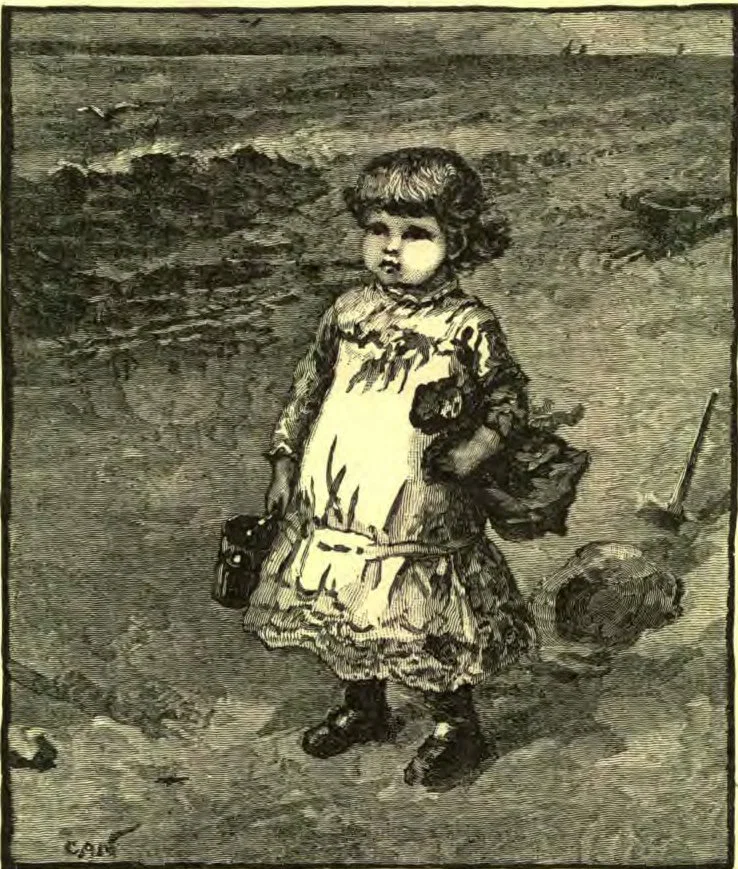
Lela had gone with her aunt, Lottie Morser, to spend the vacation in the country; but she was not always willing to do as her aunt wished her to do, nor to give up what her aunt thought was not good for her.
Lela often said, “I don’t see what is the need of doing that,” or, “I do not believe there would be any danger in going there,” or, “It seems to me I might.”
Miss Morser tried to explain to her little niece the reasons for not letting her do always as she wished to do; but, if Lela did not clearly see the wrong, she was not disposed to believe that her aunt knew any better than she did. Sometimes the little girl was almost sulky, though Aunt Lottie planned many things for her niece’s enjoyment.
One morning Miss Morser gave Lela a large rosebud, which Lela declared was the most beautiful she had ever seen. She put it in water, and left it in her room; but late in the afternoon, when again she went to her room, the lovely bud had disappeared, and in its place was a very homely rose.
Lela exclaimed: “Oh, what a horrid rose! It is the ugliest flower I ever saw. Can this be the same one that you gave me this morning, Aunt Lottie?”
And Miss Morser replied, “Yes, dear; I knew it would not be pretty after it opened.”
“How did you know, auntie? It surely looked very nice. Could you see something wrong about it?”
Aunt Lottie said that she had noticed that all the roses on the bush from which she took that bud were very ill-looking, although the buds were so fine.
Then she added: “Many things that seem all right turn out much as has this rosebud. When we see a number of such blossoms on one bush, we do not expect others that grow on the same bush to be much better; and when we have seen harm caused by a person’s doing certain things, we know it is not safe to do such things.”
Lela looked wise for a moment, then smiled good-naturedly at her aunt, and said that doubtless those who have had most chance to see how matters turn out know better what is best for one.—Mrs. A. D. Wellman.
Judith’s Fault
“There, I’ve finished my work, mother, may I go now?”
“Yes, Helen, your work is satisfactory. Here come the girls for you. I hope you will all have a delightful afternoon.”
“Thank you, mother, I’m sure we shall. Won’t Ethel be surprised?”
“O mother, mayn’t I go, too?” wailed Judith.
“Have you finished your sewing? You know you are at perfect liberty when that is done.”
“O, no, mother, I can’t sew as fast as Helen, you know.”
“I am not so sure about that, Judith. Anyhow, you had the shorter task to-day.”
“Then I’m sure I don’t see why it is that Helen always finishes her sewing before I do.”
TIRED OF PLAY
“I think I can tell you the secret of your trouble, Judith. Several times this afternoon you left your work to do something else, while Helen kept steadily sewing. You went up-stairs to look over some journals that you were speaking about; you went to the orchard for an apple; and again you laid your sewing by to call Elsie as she was passing. If you had sewed straight ahead as Helen did, your work would have been finished, and you would have time for leisure.”
It was a bitter lesson to Judith to remain at home and finish her sewing, for she was tired, and the work dragged along till evening. She had just folded it away and was putting her thimble in her work-box when Helen came up the path, rosy with her afternoon’s pleasure and because of having earned her recreation by diligent labor. It was not only in her sewing that Judith was careless, but it was so in everything she did. If she was solving an algebra problem, she would stop to do something else before she had finished it; if she was writing a composition, she would leave it for some more agreeable task, and then, returning, declare that she “just hated old composition work.” It is not strange that she found every task heavy and difficult when she went to gather up the scattered threads of her work, which was always a burden, while Helen’s was a delight. Because of this habit a discontented expression was fastening itself upon Judith’s face; but Helen’s was constantly bright and smiling.
Would you have thought that so small a fault could have made so much difference between the characters of two girls? But the fault is really no small one, and every year it strengthens.
It is almost a rare thing to find a person, young or old, who has drilled himself to stick to a task till he has finished it; and yet this very thing decides largely one’s success. It isn’t necessarily the brilliant person nor the one who remains longest at his desk or table who is most deserving of praise; but it is the one who works with all his might while he does work, who accomplishes most. Many a person who has learned the value of concentration of effort easily accomplishes in eight hours more work than another could do in eighteen. Why is this? Not because of superior brilliance, but because he knows how to work, and bends every energy to the accomplishment of duty. By long practise he acquires a strength of mind that enables him to do more and more work in a given length of time, and work of a vastly better quality. Five minutes of hard study will do more to strengthen the mind than a half day of haphazard, loose researching in the fields of knowledge.—The Young Disciple.
The Young Missionary
By H. C. Priest
AMONG the best missionaries that India has to-day are some of the children who have been or are under Christian influence and instruction. On the Tuni field a little boy about ten years of age began attending a mission school. He lived in a village where there were no Christians. The only god he knew of was that represented by the hideous images which he was taught to fear and reverence, or the rough, unshapen stone daubed with saffron under the branching tree, before which the villagers were accustomed to make their vows and offer their sacrifices.
School meant for him a walk of three to four miles a day. There he soon learned some Christian hymns, and in the evenings he would sing them, much to the delight of his parents. Soon his father became interested, not only in the music, but also in the truths expressed in the hymns, and the boy was instructed to find out what it all meant. Some time after this the father and boy walked in to see me, a distance of twenty-five miles, to ask for baptism. When I questioned the man as to how he had learned of Christ, he told me that it was through his little boy, who had brought the truth home from the mission school.—H. C. Priest.
A Child’s Influence
In a Northern hospital a little girl was to undergo a dangerous operation. She was placed upon the table, and the surgeon was about to give her ether when he said: “Before we can make you well, we must put you to sleep.”
She spoke up sweetly, and said, “Oh, if you are going to put me to sleep, I must say my prayers first.”
So she got on her knees, and said the child’s prayer: “Now I lay me down to sleep.”
Afterward, the surgeon said he himself prayed that night for the first time in thirty years. “A little child shall lead them.”—Selected.
Insects and Their Habits, and What Harold Learned About Them
By Mrs. L. D. Avery-Stuttle
“So much about that most disagreeable insect, the flea,” continued Uncle Frank. “We see that it possesses the maternal instinct in a very marked degree; and what is most wonderful is the tiny brain which controls the movements of the insect. Here is a little clipping, Harold, which I have pasted in my scrap-book, which, to say the least, is very interesting. I clipped it from a book entitled ‘Wonders of Sea and Land,’ published by one of the most reliable and best-known houses in Ohio. It reads quite like a fairy tale, and seems almost too wonderful to be credited. Still, when we consider that the fingers of man have made some such tiny things as can be clearly seen only through a glass, why might not the Almighty make the brain of even an insect like the flea capable of being taught and trained by man? But here is the clipping:—
“Mr. Mark, an Englishman, succeeded in making a gold chain, the length of a finger, with a padlock and a key to fasten it, which weighed about one grain. A flea attached to the chain pulled it easily.
“Another English workman constructed a little carriage and six horses of ivory. The coachman was on the box, with a dog between his legs. There was also a postilion, four persons in the carriage, and two servants behind, and the whole of this was drawn by one flea.
“Many years ago, for twelve cents the people of Paris were admitted to a wonderful exhibition. Thirty fleas went through military exercises, and stood upon their hind legs, armed with pikes formed of very small splinters of wood. Two fleas were harnessed to and drew a golden carriage with four wheels and a postilion. A third flea was seated on the coach-box, and held a splinter of wood for a whip. Two other fleas drew a cannon on its carriage. This little trinket was admirably finished; not a screw or nut was wanting. These and other wonders were performed on polished glass. The flea horses were fastened by a gold chain attached to the thighs of their hind legs, which was never taken off. They had lived thus for two years and a half, not one having died during the period. To be fed they were placed on a man’s arm, which they sucked. When they were unwilling to draw the cannon or carriage, the man took a burning coal, and on its being moved about near them, they were at once aroused and recommenced the performance. The learned fleas, as they were called, were the admiration of Paris, Lyons, and the provincial towns of France. The people watched this wonderful sight through large magnifying-glasses.”
“My! but I would like to see such a sight as that! Only think how cunning those little black fellows must have looked taking the place of horses,” said Harold.
“Yes, indeed; and we can learn from this that man, with all his boasted powers, is yet inferior in some respects to the very insects which he despises.”
“There is a certain kind of beetle which is said to draw forty-two times its own weight. Then, to equal the beetle in strength, a man should be able to draw at least six thousand pounds!”
NERVES OF BEETLE
“It doesn’t seem possible; just imagine a man who could lift such a lot as that! I guess people would go a long way to see him; why, that’s almost as strong as Sampson, isn’t it, uncle?”
JUST UNDER THE LOWER LEAF
HANGS A BABY BUTTERFLY.
“Yes, and not only do insects have great strength, but they also have a regular, active circulation of the blood.”
“And veins, and a little heart, uncle?”
“No, my boy, they have no veins, but they do have a heart.”
“But what good is a heart and blood, if there aren’t any veins, Uncle Frank?”
“The blood of an insect is altogether different from ours; but it is a kind of fluid answering about the same purpose that our blood does, and the heart pumps it in every direction, supplying the head and the body, without veins.”
“Well, that’s hard to understand. I wish I could see the inside of some insect, and then maybe I could understand it better.”
“Very well,” said Uncle Frank, as he slipped a thin piece of glass under the eyepiece of his instrument. “I was just about to show you this, which will give you a very good idea of the matter.”
“O, isn’t it wonderful! I don’t see how any one could manage to cut a little insect in two.”
“It is a very particular task, indeed, to prepare these tiny creatures for the glass, but the instruments used are very fine and delicate. The vessels which supply air to the insect are simply little ducts which spread out in every direction. There are so many that they are almost incalculable, and they hide away among the other organs of the body just as the roots and rootlets of trees hide and bury themselves in the earth.
The goat-moth caterpillar is estimated to contain at least fifteen hundred of these little air-tubes.
“And now, Harold, I will show you the picture of the nerves of an insect called the carabus.”
“Why, uncle, do insects have nerves? I wonder if they ever have headache like mama.”
“It may be. I dare say if little boys knew what a wonderful thing an insect is, they would never torture them needlessly, and pull out their legs and wings in cruel sport.”
“I never did that, uncle, nor I would not; but I shall always be more careful of the feelings of even a tiny bug than I have been.”
“That is right. ‘Blessed are the merciful: for they shall obtain mercy.’
“Most insects have four different stages of existence. The third, or chrysalis, state is a most interesting one. The insect then looks much like a little babe after its mother has wrapped it up tight in its blanket.”
“I don’t see how it can walk or fly or move about then at all,” said Harold.
“They can not, they lie perfectly still; they can neither eat nor move; and it is one of the great mysteries how they live, for sometimes they continue in this condition for weeks, and even for months and years. But all this time nature is at work, slowly preparing the different organs of the body for future use.
“The ways of the Creator are surely most mysterious, and, my dear boy, I believe that eternity itself will be none too long in which to study his wonderful works.”
MRS. L. D. AVERY-STUTTLE.
(To be continued)
A Dog on the Police Force
PHILADELPHIA has added a dog to its police force. While the faithful animal, whose name is Rex, is not officially recognized, he is winning honors for his faithfulness and sagacity. He is an excellent specimen of the St. Bernard breed.
His owner, a patrolman, began a few years ago to take Rex with him on the night watch. In this way the dog came to know the patrolman's rounds and what was to be done, and he proceeded to prove his efficiency in hunting out and rescuing unfortunates who might be freezing on some winter night in a dark alley. By degrees he took upon himself other duties requiring greater sagacity.
At present the dog has to his credit the finding of no less than five fires, which he discovered just in the nick of time, so that a few buckets of water were sufficient to prevent a disastrous spread of the flames.
With his marvelous scent Rex smells fire long before the presence of the smoke issuing from some crevice discloses the danger to the watchman. In this way he has saved thousands of dollars' worth of property.
The policemen on night duty value the companionship and help of the noble dog very highly. Rex has become especially sagacious in examining localities around closed doors for traces of anything wrong. Occasionally he will start off suddenly alone and return to tug at a policeman's coat, thus summoning him to the scene of danger or crime. The dog has saved scores of persons from freezing.—Selected.
A Dog Which Saves Lives
RAGS is a four-year-old dog, unkempt and ill-looking, but a heroic heart beats in his shaggy breast. Rags has saved more than forty lives. His field of service is the Klondike, where he and his master have wintered for several years. The Philadelphia North American tells of two of the dog’s exploits.
In the winter of 1901 a number of men belonging to the Pittsburg mining company were prospecting in Alaska. They lived in a little wooden hut, from which they went out in pairs to explore. They were away beyond any sign of civilization, and the weather was so severe that they endured a good deal of suffering.
One day two of the men, out on an expedition, were caught in a sudden and terrific storm. They started back for camp, but the trail was rapidly covered by the drifting snow. On and on the men plodded, each falling now and again, only to be roused from the death-dealing sleep and hustled on by his companion. At last both sank, and the snow drifted over them.
The men at the camp, alarmed by the non-appearance of their comrades, started out to rescue them. Rags went along, too. Straight as an7arrow, he followed the trail, and before long a sharp yell told the party that their friends had been found. The two men were completely buried in the snow, and help had not come one moment too soon. This was Rag’s first exploit.
At another time he went out as the leader of sixteen dogs which were dragging a rescue team to relieve a party of snow-bound miners. As the team was plodding steadily along, Rags suddenly gave a cry, broke from the traces, and bounded away. Thinking he might have found the trail, the party followed, and by the time they had reached him, Rags had dug away enough snow to allow an entombed miner to crawl out.
Rags has saved forty-six lives and made several record-breaking rescue trips. His badge of honor is a gold collar on which is inscribed a list of his deeds.—The Myrtle.
Education That Creates Thought
By William M. Thayer
THAT education only is valuable which creates thought.—William M. Thayer.
The Dogs Ate up the Church
THE Rev. E. J. Peck, a C. M. S. missionary, in the Hudson Bay district, tells of building a church at a place where almost no wood was to be obtained, by stretching sealskins over a rough frame of woodwork. This served admirably, and night after night the people came to the primitive building to listen to the missionary’s teaching. All went well until one day, during the trying winter, when the dogs of the village were on the verge of starvation because of the inability of the Eskimos to capture seals, they turned to and ate up the church.—Young Christian Soldier.
MEMORY VERSE: “Notwithstanding in this rejoice not, that the spirits are subject unto you; but rather rejoice, because your names are written in heaven.” Verse 20.
“After these things the Lord appointed other seventy also, and sent them two and two before his face into every city and place, whither he himself would come. Therefore said he unto them, The harvest truly is great, but the laborers are few: pray ye therefore the Lord of the harvest, that he would send forth laborers into his harvest. Go your ways: behold, I send you forth as lambs among wolves. Carry neither purse, nor scrip, nor shoes: and salute no man by the way. And into whatsoever house ye enter, first say, Peace be to this house. And if the son of peace be there, your peace shall rest upon it: if not, it shall turn to you again. And in the same house remain, eating and drinking such things as they give: for the laborer is worthy of his hire. Go not from house to house.”
“And into whatsoever city ye enter, and they receive you, eat such things as are set before you: and heal the sick that are therein, and say unto them, The kingdom of God is come nigh unto you. But into whatsoever city ye enter, and they receive you not, go your ways out into the streets of the same, and say, Even the very dust of your city, which cleaveth on us, we do wipe off against you: notwithstanding be ye sure of this, that the kingdom of God is come nigh unto you. But I say unto you, that it shall be more tolerable in that day for Sodom, than for that city.”
“Woe unto thee, Chorazin! woe unto thee, Bethsaida! for if the mighty works had been done in Tyre and Sidon, which have been done in you, they had a great while ago repented, sitting in sackcloth and ashes. But it shall be more tolerable for Tyre and Sidon at the judgment, than for you. And thou, Capernaum, which art exalted to heaven, shalt be thrust down to hell.”
“He that heareth you heareth me; and he that despiseth you despiseth me; and he that despiseth me despiseth him that sent me.”
“And the seventy returned again with joy, saying, Lord, even the devils are subject unto us through thy name. And he said unto them, I beheld Satan as lightning fall from heaven. Behold, I give unto you power to tread on serpents and scorpions, and over all the power of the enemy: and nothing shall by any means hurt you. Notwithstanding in this rejoice not, that the spirits are subject unto you; but rather rejoice, because your names are written in heaven.”
“In that hour Jesus rejoiced in spirit, and said, I thank thee, O Father, Lord of heaven and earth, that thou hast hid these things from the wise and prudent, and hast revealed them unto babes: even so, Father; for so it seemed good in thy sight. All things are delivered to me of my Father: and no man knoweth who the Son is, but the Father; and who the Father is, but the Son, and he to whom the Son will reveal him. And he turned him unto his disciples, and said privately, Blessed are the eyes which see the things that ye see: for I tell you, that many prophets and kings have desired to see those things which ye see, and have not seen them; and to hear those things which ye hear, and have not heard them.”
Questions
I. Who had been sent out to preach the gospel in the cities of the Jews? To whom were the twelve alone to go? Matt. 10:6. How many did Jesus now appoint to go out before him, and prepare the people for his coming?
2. How were the seventy sent out? Where were they to go? What did Jesus say to them concerning the harvest? What prayer were they to offer? Do you think there is greater need for laborers in the Lord’s harvest-field now than in those days? Why?
3. How did Jesus send the seventy forth? What does Jesus call himself? John 10:14. What disposition will be shown by those who are of his flock?
4. What were the seventy to take with them? What were they not to do? What were they to say on entering a house? If the home was one in which dwelt the spirit of the Son of peace, what would come to it? Why were the disciples not to go from house to house?
5. What were the disciples to do to the sick? What message were they to give to the people? What were they to do when their message was not received in a city? What terrible sentence was pronounced upon the cities that did not receive them?
6. What did Jesus say concerning two of the towns of Galilee? What had been done in these towns? Name two miracles that had been done in Capernaum. For what wicked cities did Jesus say it would be more tolerable in the day of judgment than for these places where he had labored so often? Why?
7. With what parting word did Jesus send the seventy forth? When they returned from their journeying, what filled their hearts? What did they say to the Master? Whose power had Jesus come to conquer? Since he could cast Satan from his place in heaven, what is Jesus able to do for each one of us?
8. What power did Jesus bestow upon the seventy? What caution did he also give them? Why is it dangerous to rejoice in the gifts that God sends to us? When alone are we strong? 2 Cor. 12:10. What did Jesus say should be the greatest cause of rejoicing to the disciples?
9. What prayer of thanksgiving did Jesus offer at this time? In what ways were the disciples particularly blessed?
I Know
By Frances Ridley Havergal
I KNOW that never blooms in vain
A flower in any woodland lair,
That not a single drop of rain
Is lost upon the desert air.
I know that never ran its race
A soul, however weak or small,
But surely found some resting place
In the great Thought and Heart of all.
— Mrs. Havergal.
XIII—The Latter Rain and the Closing Work
(September 23)
MEMORY VERSE: “But ye shall receive power, after that the Holy Ghost is come upon you: and ye shall be witnesses unto me both in Jerusalem, and in all Judea, and in Samaria, and unto the uttermost part of the earth.” Acts 1:8.
Where will his treasure be laid when the Lord comes? Luke 12:33.
What will the church be doing at that time? Luke 12:36.
What message is this waiting church to give? Rev. 14:7-12.
What experience alone can qualify one to be a witness for God? Acts 1:8.
How did the blessing of the Spirit affect the testimony of the disciples? Acts 4:13, 33.
What assurance have we of the same blessings? Acts 2:38, 39.
Of what time does the prophet Joel predict a special outpouring of the Holy Spirit? Joel 2:29-32.
What must precede the receiving of the Spirit? Luke 11:9, 13.
For what, then, should we be especially praying? Zech. 10:1.
On what ground may we claim the gift of the Spirit? Acts 5:32; note.
For what great work will the outpouring of the Spirit fit each one of God’s children? Acts 1:8; Matt. 24:14.
Note
The inheritance and the promises are to the obedient. In these days, we may ask in assurance for the gift of the Spirit only as we endeavor to walk in every command and ordinance of God. In Malachi 3:10 the Lord makes faithfulness in rendering his own to him the test of readiness to receive the fulness of blessing. This is but one obligation, of course, but the waiting church must not be found wanting in any wise, and many will be cheated out of the blessings of the latter rain by neglect to heed God’s Word concerning tithes and offerings. It is the divinely appointed means for carrying the last message to the world as the final harvest is ripened. There is a reason for lack of power, and for dearth of means to enter the mission fields.
“Upon what ground may we claim the full and rich promises of God?—We can claim them only when we have fulfilled the conditions prescribed in his Word. Have you robbed God in tithes and offerings? What treasure have you been laying up in heaven by giving to the Lord his own? Look at the days and weeks and months of the past, and see if your life service has not been one long, complicated robbery of God, because you have failed to remember him, and have left eternity out of your reckoning.
“Great objects are accomplished by this system; for if one and all accept it, each is made a vigilant and faithful treasurer for God; and there would be no want of means to carry forward the great work of sounding the last message of warning to the world. The treasury will be full if all adopt this system, and contributors will not be the poorer.”—“Testimony for the Church” No. 24, pages 83, 84.
A Nucleus for Christian Effort
IF salt is carefully dropped into a tumbler of water till the water can not hold any more, the mixture will remain in a liquid condition. But if a small crystal of the salt is now dropped in, it acts as a nucleus, or center of crystallization, and lines of crystallization shoot out from it in every direction, and in a few seconds the saturated solution is a mass of crystals, surrounded by the water in which they had been dissolved. It merely needed something to start the work.
It is the same in Christian effort. What gave us that beautiful picture of the Saviour blessing children? One heart-burdened mother who craved the blessing of Jesus upon her little ones determined to go and tell him the desire of her heart. She revealed her thought to a neighbor, who immediately wanted to accompany her. Others soon learned of the mothers’ errand, and joined their company.
They found Jesus and made known their desires to the disciples; who felt the Saviour’s work to be too important for such an interruption. But the Master, the children’s Friend, did not think so. He said to the disciples, “Suffer the little children to come unto me, and forbid them not: for of such is the kingdom of God.”
Then the Saviour laid his loving hands in blessing upon the heads of the little people. That touch thrilled them with joy, and it is safe to say that those who that day received the Saviour’s blessing never ceased to feel the touch of the hand that was laid upon them, nor to hear the sound of that voice that spoke the gracious words to them.
Many of these children in later years became workers in the cause of Christ, some even suffering martyrdom for truth.
The Wax Woman
AMONG the many interesting things observed in London by the little girl who wrote “How a Little Girl Went to Africa,” was Madam Tussaud’s Waxworks. Here is her account of what she saw:—
“Although mama thought little girls should be in bed early, even though they were traveling, my sister and I were allowed to remain up and spend one evening with the others at Madam Tussaud’s Waxworks. It is a large building filled with scenes from real life, but all the figures are made of wax, and dressed as the people really did when living. I saw here the kings and queens of England, dressed in costumes exactly like those which they had worn in life.
“There was Napoleon and his own traveling-carriage, and his favorite garden chair, which he used after he was banished to St. Helena.
“We saw, too, a group of our United States presidents,—Washington, Lincoln, Garfield, and Grover Cleveland. Beneath a great black awning draped with mourning is our late President McKinley.
“You can not think how lifelike they are. Before we visited the rooms, some of our friends told us we would find ourselves talking to wax figures before we returned, but even I was sure I should not. There were several in our party; and one lady, who had seen a great deal of the world, said she was very sure she should be able to tell figures from human beings.
“As we entered the building, she happened to be ahead, and at once went to the lady attendant, who sat near the door, selling the Waxworks’ guide-book. She laid down the money, and said, ‘A guide-book, please.’ No reply. Then louder, ‘I should like a guide-book, please.’ Just then we all began to laugh, and she saw she had been trying to buy a guide-book of a wax woman.”
Many interesting incidents are told in the same simple, entertaining way in this little book. The children all like it, and they learn many useful facts from its perusal. The price is one dollar, and it can be ordered from any of our publishing houses, or from the Review and Herald Publishing Association, Washington, D. C.
Government Anti-Fever Rules
By Search-Light
THE Post-office Department has decided to co-operate with the Marine Hospital service in the effort to prevent the spread of fever in the South. A circular has been printed by order of Surgeon-General Wyman, setting forth in concise terms the best methods of screening against and destroying mosquitoes, which are officially declared to be the only agencies of transmission of the fever.
The following are extracts from the official circular:—
It is important to screen the windows and doors of the house. It is doubly important to screen the beds of fever patients.
Mosquitoes can bite through mosquito nets, when any part of the patient's body is in contact with the netting.
If mosquitoes are found within the netting, they should be killed inside, and not merely driven or shaken out.
Mosquitoes live in the vicinity in which they breed. They do not often fly far.
Mosquitoes breed only in water—usually in artificial collections of fresh water.
The young mosquito, or wriggler, lives in water at least seven to twelve days.
Although the wrigglers live in water, they come frequently to the surface to breathe.
Coal-oil on the surface of the water prevents the wrigglers from breathing.
Destroy the breeding places, and you will destroy the mosquitoes.
Empty the water from all tubs, buckets, cans, flower pots, and vases once in forty-eight hours.
Fill or drain all pools, ditches, unfilled post holes and the like.
Change regularly every day all water in chicken coops, kennels, etc.
Put fine wire netting over the cisterns, wells, and tanks of water in every-day use.
Clean away all weeds, grass, and bushes about ditches, ponds, and other possible breeding places, since these afford a hiding place for the mosquitoes.
Clean up vacant lots and back yards of all cans, tins, bottles, and rubbish.
Inspect and treat with coal-oil, gutters, culverts, ditches, manholes, catching basins, etc., along the roadside. Manhole covers should be screened.
Success in mosquito destruction depends upon the co-operation of the community.
—Search-Light.
The Every-Day Sort of Christian
“A DEACON spoke slightingly of a man who had just come into the church, saying, ‘O, he is nothing but an every-day sort of a Christian!’ The pastor, overhearing the remark, said: ‘An every-day sort of a Christian, is he? I wish I had known it when I gave him the right hand of fellowship! I would have given him both hands. My greatest trouble is with the every-other-day sort of Christian.’ In God’s training-schools for workers the every-day sort of Christian is always in his place, ready for work, willing, obedient, persistent, and bound to make the most of the privileges of the Christian life. When God wants a man for some emergency, he selects him from the class of every-day sort of Christians.”