MISSIONARY work is the product of the true missionary spirit. The true missionary spirit is a spirit of disinterested benevolence. It is that spirit that actuates labors of love. Love labors not for reward, but reward is the sure result of all such labor. The realities of missionary work are generally different from what they are supposed by many to be. Missionary work requires much patience, for the progress is not usually very rapid. Some are not satisfied with missionary reports, or even with missionary sermons, unless they contain more or less of the picturesque and marvelous, in either personal incidents or achievement. When the gospel takes effect, there are marvels in the transformation of character, as every true worker knows, but they do not lend themselves very readily to highly wrought description. Great changes belong to the kingdom that cometh not with observation; and the record is as brief as it is important: “So is the kingdom of God, as if a man should cast seed into the ground; and should sleep, and rise night and day, and the seed should spring and grow up, he knoweth not how. For the earth bringeth forth fruit of herself; first the blade, then the ear, after that the full corn in the ear. But when the fruit is brought forth, immediately he putteth in the sickle, because the harvest is come.” Mark 4 : 26–29. Like God’s work in the natural world, it is quiet in its operation, diffusive in its influence, powerful in its working. Such are the results of true missionary labor.
What the most intelligent supporters of missionary enterprises desire, is reliable figures, moderate and accurate statements, and definitely achieved results. Such results can and always should be given, though they may be less than the supporters of the missions desire and expect, rather than indefinite predictions and great expectations lying always in the future. The results of missionary efforts may be left to take care of themselves, being watered with prayers mingled with tears. They are safe in the hands of their Founder, the Lord and Saviour, Jesus Christ. Their progress means the gradual spread of the principles of the gospel of Jesus Christ. Their success means a ripening of the wheat and the tares for the final harvest. The true missionary worker always has success, for Christ is always with him. There is no more real failure in his efforts, put forth in love, than there was in Christ’s efforts while upon earth. “Lo, I am with you alway, even unto the end of the world,” are the words of Him whose the cause is, and who has all the power in heaven and earth committed to his hands. “Now thanks be unto God, which always causeth us to triumph in Christ, and maketh manifest the savor of his knowledge by us in every place. For we are unto God a sweet savor of Christ, in them that are saved, and in them that perish; to the one we are the savor of death unto death; and to the other the savor of life unto life.” No wonder the apostle exclaims, “Who is sufficient for these things?” 2 Cor. 2 : 14–16.
As we approach the end of all things, and the final crisis comes on the world, the work of the true missionary becomes more and more important. Results are more readily seen. Every energy of the soul should be put forth, that he may accomplish all that lies in his power in the short time he has to labor. Every soul connected with God’s special work in the earth should be aroused, and prayers should follow the laborer, that his efforts be like sharp sickles in the harvest-field. No thinking person can misread the signs of the times. The words of Christ should become the sentiment of each believer, “My meat is to do the will of him that sent me, and to finish his work. Say not ye, There are yet four months, and then cometh harvest? behold, I say unto you, Lift up your eyes, and look on the fields; for they are white already to harvest. And he that reapeth receiveth wages, and gathereth fruit unto life eternal; that both he that soweth and he that reapeth may rejoice together. And herein is that saying true, One soweth and another reapeth. I sent you to reap that whereon ye bestowed no labor; other men labored, and ye are entered into their labors.” John 4 : 34–38. S. N. H.
COMPARING VIEWS.
By Uriah Smith
The Sabbath Recorder of Nov. 7, referred to the false Christ, Schlatter, lately operating in Denver, Col., and by way of accounting for the appearance of such pretenders in these days, cited Mark 13 : 22 as applicable to the case. This scripture reads: “For false Christs and false prophets shall arise, and shall show signs and wonders, to seduce, if it were possible, even the elect.” That this is spoken in reference to the subject of Christ’s second coming, is shown by the preceding verse, which reads: “And then if any man shall say to you, Lo, here is Christ; or, lo, he is there; believe him not; for false Christs . . . shall rise,” etc. Mark then names other signs of Christ’s coming, and says in verse 26, “Then shall they see the Son of man coming in the clouds with great power and glory.” In verse 28 he says that we know by the budding fig-tree, that summer is nigh, and in verse 29 adds: “So ye in like manner, when ye shall see these things come to pass, know that it [“he,” Christ, Matt. 24 : 33, margin] is nigh, even at the doors.”
From this we must conclude that the second personal, visible coming of Christ in the clouds of heaven is the subject here under discussion, with reference especially to those events which would show when that coming is near at hand; and that, when men should arise, saying, Lo, here is Christ, or there, and such pretenders as Schlatter should appear, we are instructed to know that Christ is at the doors.
In the REVIEW of Nov. 19, we noticed this paragraph in the Recorder; and to its question, “Were not just such cases as that in Denver foretold by our Saviour in Mark 13 : 22?” we answered, “Precisely,” and then inquired if we are not to know, when such men appear, that “the second coming of the true Christ is at the doors.”
In its issue of Dec. 5, the Recorder makes a kind response to the foregoing inquiry. It says that it has “not the least objection to the inquiry,” and adds, “Nor do we imagine that the Recorder and the REVIEW AND HERALD would be very greatly at variance on the general interpretation of the prophecies relating to the second coming of Christ. There are many ‘signs of the times’ indicative of the approach of important changes, and even of the second coming as foretold in Scripture.”
We are very glad to hear these words; and the object of these lines is to see if, by a further comparison of views, we may not come nearer together, and reach a better understanding of each other’s position; for some remarks, to which we will refer, would indicate that the Recorder still misapprehends in some respects the views we hold on this question.
It says: “Probably the greatest difference of views would be in regard to the stress to be laid on the confessedly uncertain time of the advent.”
But we apprehend that on this point there is no difference of views whatever. All that there is “uncertain” about the time of the advent, is the hour, the day, or the year, in which that event will occur. But on this point we lay no stress at all, any more than does the Recorder. We accept fully, both theoretically and practically, the words of our Saviour, “Of that day and hour knoweth no man;” but we feel bound just as fully to accept his words uttered right in connection, that when we should see certain signs come to pass, among which are just such cases as that of this man Schlatter, we should know that he is near, and is about to appear in the clouds of heaven.
Again: “Men should have some other incentive to righteous living than the fear of the judgment.” In a general sense this may be regarded as true, yet not wholly so; for the Bible frequently holds up the fact that every work shall be brought into judgment; that we must all appear before the judgment-seat of Christ; and that every one shall be reckoned with, and each receive according to the deeds done in the body, as if it would save men from being swallowed up in the frivolities of this present life, by reining them up to the tremendous issues of the future. But this is not the general phase of the preaching of the advent. This is the announcement of infinite good, “tidings of great joy.” The heart of every follower of the Saviour should be filled with a love for him, and a desire to meet him. To the believer, Christ should be the chiefest among ten thousand, and the one whom above all others he would be glad to meet; and the evidence that he is about to come, should be his joy and rejoicing. Love, not fear, is the ruling incentive in the Christian’s heart. And John says that “every man that hath this hope in him purifieth himself, even as he is pure.” I John 3 : 3.
Once more: “Seventh-day Baptists generally believe that the ‘second coming of Christ’ is taught in the Scriptures. But remembering the numerous times in the past which men have set for his advent, backed up by (to them) the most positive proofs of figures and prophecy, and remembering the emphatic declaration of Christ touching this question (Matt. 24 : 36), ‘But of that day and hour knoweth no man, no, not the angels of heaven, but my Father only,’ they deem it unnecessary and even presumptuous to attempt to fix the date of that event.”
Inasmuch as the Recorder is speaking of the Adventists represented by the REVIEW AND HERALD, we are a little at a loss to determine where the foregoing quotation applies. If it is designed to imply that while Seventh-day Baptists309deem it presumptuous to fix the date for Christ to come, Seventh-day Adventists do not deem it presumptuous to do so, and do try to fix the date for that event, we are greatly surprised; for we had flattered ourselves that the Recorder well understood that Seventh-day Adventists do not set any time for Christ to come, and never have done so. If it has not understood this fact, we are very happy now to impart the information in the most emphatic manner. The very principles of the Seventh-day Adventist faith utterly preclude their trying to set the time, but do not preclude their heeding the instruction of Christ, to know when his coming is near. No Seventh-day Baptist can deem it any more presumptuous than we do, for any one to attempt to fix the time of Christ’s coming.
We quote again: “It is true that Adventists generally have learned by many disappointing experiences, the folly of attempting to fix the exact date for that event; but they continue to place greater emphasis upon the nearness of the coming than we do, or than we think is wise.”
The relevancy of referring to “Adventists generally,” in this connection, might be questioned; for as the reader can see by what has already been said, it has no application whatever to Seventh-day Adventists, so far as fixing the time is concerned. As they have never fixed any times, they have had none of the “disappointing experiences” referred to.
Still another expression seems to imply a wrong idea of our position. It is this: “Still, if men can be found who will believe the gospel, reform their lives, and become faithful servants of Christ quicker by being taught that the second coming is an event liable to occur at any moment, we shall rejoice in their reformation,” etc.
There may be “Adventists” who teach that Christ may come “at any moment.” Among professing Christians, outside of Adventists, the remark is frequently heard, “No man knows anything about it; Christ may come to-day or to-morrow, or not for a thousand years.” Those who talk thus must certainly know a great deal more about the subject than we profess to know. Any man who knows that Christ may come to-morrow, knows also that he must come to-morrow; for Christ cannot come till all the prophecies and all the signs that relate to his coming have been fulfilled, and all the conditions which are to exist in the world at the time of his coming, have been met. But when the world reaches this situation, then Christ must come without further delay, unless the word of God shall fail, which is not possible. We do not know that the Recorder holds that Christ may come to-day or to-morrow; but its language would seem to imply that that is our position, which most emphatically it is not. As we hold, there are yet the remnants of some prophecies to be fulfilled. The “sick man of the East” must “come to his end,” and the wicked crisis of the union of Church and State in this country must be consummated. But this is not saying, “My Lord delayeth his coming;” for it seems to us that the eye even of ordinary intelligence, to say nothing of faith, can see that events, both east and west, are tending with lightning rapidity to these ends.
“To our mind,” says the Recorder, “it matters little whether that great event shall come to-morrow, next year, or the next century.”
We trust the Recorder does not really feel the indifference to this subject which its language would imply. It is certainly important that we know something about it, or the Lord would not have taken the pains he has in his word to instruct us in regard to it; and Christ would not have enjoined upon his people to watch certain signs, and then know that his coming was near. Paul says, “Ye, brethren, are not in darkness, that that day should overtake you as a thief.” 1 Thess. 5 : 4. This belief intensifies the efforts of the servants of the Lord to give the household meat in due season (Matt. 24 : 45–51), to warn the world, and to bring as many souls to Christ, as possible, before he comes. U. S.
COURAGE IN THE WORK.
By O. A. O.
“Behold, the Lord thy God hath set the land before thee; go up and possess it, as the Lord God of thy fathers hath said unto thee; fear not, neither be discouraged.” Deut. 1:21. These words Moses rehearsed in the ears of the congregation of Israel as they stood on the borders of the promised land, after their forty years’ journeyings in the wilderness. There is much in the history of Israel of old which is valuable to us, who are, in some respects, placed under similar circumstances, and who enjoy a similar relationship to God. They were led up out of Egypt by the hand of God, and passed through experiences in the wilderness which were to fit them to inherit the promised land. We have been brought out of Egyptian darkness, and are passing through an experience which is to fit us to stand without spot or wrinkle before the throne of God, and receive the inheritance which he has prepared for his children. God dealt with the Israelites as a kind and merciful Father, teaching them little by little the true worship, giving them his law from Sinai, and directing them to build a sanctuary, that he might dwell among them. He has dealt in like manner with his people in these days, till we now live in full blaze of the light of the gospel.
God’s purpose was then, and is now, to develop unto himself a peculiar people that would show forth the glory of his character. “I am the Lord your God, which have separated you from other people. Ye shall therefore put difference between clean beasts and unclean, . . . and ye shall be holy unto me; for I the Lord am holy, and have severed you from other people, that ye should be mine.” Lev. 20:24–26. Here we see that God would make his people of one character with himself.
What I especially wish to notice, however, is the similarity between our position to-day and that of the children of Israel when Moses rehearsed to them the words given at the beginning of this article. They passed through the wilderness, and had reached the borders of Canaan. It only remained for them to go in and take possession of the land. Where are we in our journey? and what is our position at the present juncture? Do we not also stand on the very borders of the eternal inheritance?—We surely do. This being so, the words addressed to the children of Israel at that time are applicable to us to-day.
But the children of Israel, though so near the promised inheritance, had yet to cross the Jordan, and make themselves masters of the land. They had before them the strongest foes to meet, the fiercest battles to fight. So it is with us. Our warfare will soon be over; but meanwhile the battle rages hotter and hotter, and there will be no respite till the glorious victory is won.
How, then, shall we relate ourselves to this time, in view of the prospect before us? Shall we talk of the perplexities, hardships, and dangers that await us? Shall we discuss our weakness and the possibility of failure?—By no means. That would be courting defeat. Hear the cheering words which the Lord addressed to Joshua and the children of Israel when they were about to enter upon the conquest: “Have I not commanded thee? Be strong and of a good courage; be not afraid, neither be thou dismayed; for the Lord thy God is with thee whithersoever thou goest.” Moses also addressed the people before his death, urging them to be bold and courageous, for God would surely give them the land. The basis of every appeal he made, was that God would go with them. To-day we have the same assurance of God’s presence and guidance that they had back there, and our watchword should be, “Courage and victory through our Lord Jesus Christ.”
We are entering upon the perils of the last days. These things have been faithfully placed before us. Warning upon warning has been given to this people. The true situation is plainly brought to view in the solemn words of the prophet: “Woe to the inhabiters of the earth and of the sea! for the Devil is come down unto you, having great wrath, because he knoweth that he hath but a short time.” Thank God, we are not left in doubt as to the issue of the conflict. The grand fact is also recorded, “They overcame him by the blood of the Lamb and by the word of their testimony.” Yes, victory is assured to the faithful champions of truth.
The Lord has said: “This gospel of the kingdom shall be preached in all the world for a witness unto all nations; and then shall the end come.” Laborers are to be sent forth bearing the message of truth to every nation on the face of the earth. To our finite comprehension it may seem impossible to give the warning message to the whole world, but the work is to be done by the mighty power of a God with whom nothing is impossible.
During the last two years we have been passing through what are called “hard times.” This condition of things has prevailed very extensively, and in general it may be said that difficulties are increasing on every hand. Yet at this very time, when the way seems to be hedged up before us, God is to accomplish his greatest work. He now calls upon his people to enter upon earnest, aggressive activity. With men it would be natural under depressing circumstances to slacken the effort put forth, curtail the work, and wait till the outlook was brighter, money more plentiful, and the people more favorably situated. But with God it is different. Difficulties do not stand in his way. He commands his people to-day to go forward. It may look preposterous to men; but when God says a thing, he means it, and there is power in his word to carry it out. The Lord expects us to move forward in faith, even though the way seems closed up before us. Israel stood on the banks of the Jordan, which had overflowed its banks. The Lord commanded them to go forward, and they started. To the on-looker it would appear that they were going directly into destruction, but they had learned to trust in God, and their confidence was not misplaced. As the feet of the foremost touched the water, the river opened, and they went through on dry land. So it is in God’s work to-day. When810his people move forward in the path of duty, he will open the way before them.
The experiences of the children of Israel were written for our admonition upon whom the ends of the world are come. Then let us learn a lesson of faith from God’s dealings with them. As difficulties arise and the way seems dark, let our faith and dependence in God grow stronger, and putting all our reliance on him, let us press manfully forward and fight the battles of the Lord valiantly. O. A. O.
THE PROPHETIC SIGNIFICANCE OF THE PRESENT SITUATION IN TURKEY.
By G. O. T.
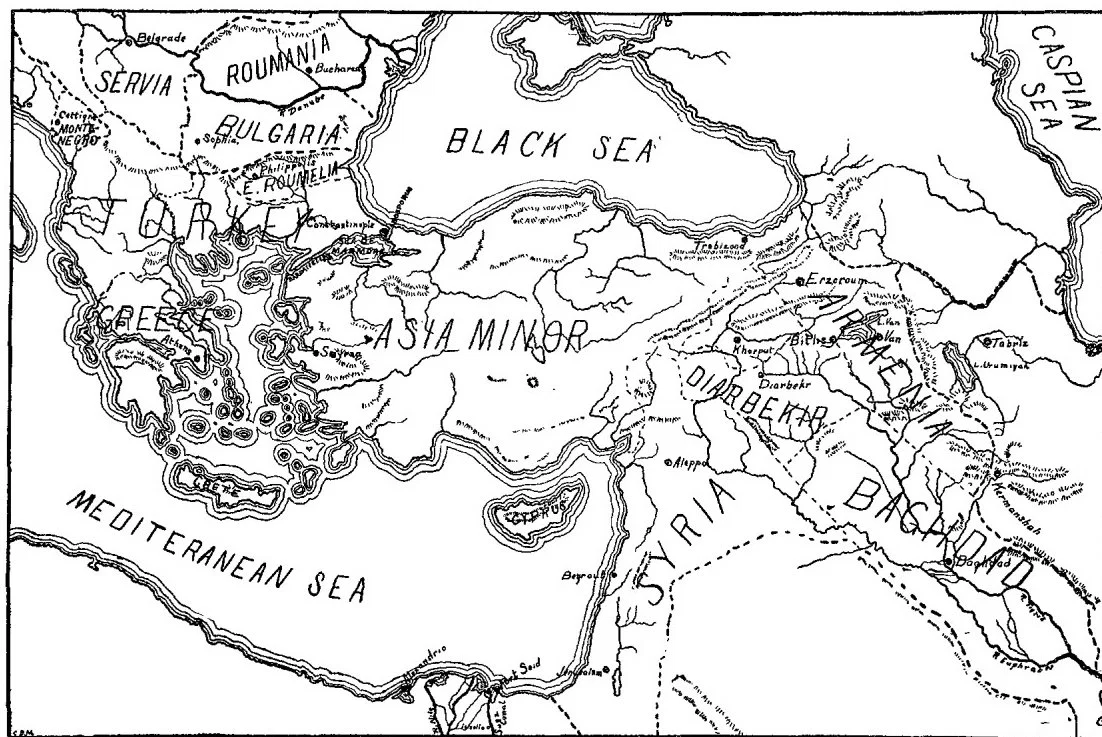
The Eastern Question has for many years been before the world as a point around which the interests of the Old World nations closely cluster. The “Eastern Question” involves the policy and attitude of the nations of Europe toward the Turkish empire; the preservation of the integrity or existence of that empire; and the disposal to be made of its territory in case of its downfall.
TURKISH EMPIRE.
In the days of its strength the Ottoman power held in its grasp a vast expanse of important territory lying in three of the great continents of earth. Northern Africa, eastern Asia, and south-eastern Europe to the southern banks of the Danube, owned allegiance to the Sublime Porte. But for two hundred years that power has been in its decadence. And through the present century the work of disintegration has been going on. It found its first rival in Russia, which has, since the days of Catharine, “before whose genius and resources it seemed as if Turkey must inevitably sink into nothingness,” hunted the Turk with a relentless purpose to accomplish his destruction.
At the close of the last war with Russia, in 1878, a treaty was agreed upon at San Stefano between Turkey and Russia, by which the former lost vast possessions, and terms were agreed upon to which England would by no means consent. Active preparations for a great war were being made when Russia consented to have the matter submitted to a congress of the nations which convened that year at Berlin.
At that time Turkey found her existence to be dependent upon the will of the powers. She had no choice but to accept the terms they chose to dictate, and to be content with the privileges they saw fit to grant. The treaty there agreed upon stipulated the independence of the provinces of Rumania, Servia, and Montenegro, and made important additions to the two latter. Bulgaria was made a tributary principality, with a Christian government; and the frontiers at the mouth of the Danube and in Armenia were readjusted to the disadvantage of Turkey. Bosnia and Herzegovina were ceded to Austria-Hungary. Reform in government and toleration in religion were also required. Prior to the Berlin treaty the Turkish empire embraced in Europe 138,264 square miles; after the treaty it included less than one half as much, or 62,028 square miles.
Article 61 of that treaty reads as follows: “The Sublime Porte engages to realize without delay those ameliorations and reforms which local needs require in the provinces inhabited by the Armenians, and guarantees their security against the Circassians and the Kurds. It undertakes to make known from time to time the measures taken with this object to the powers that will watch over their application.” Article 62 provides for religious liberty and equality in the sultan’s dominions.
It is upon the provisions of article 61, quoted above, that the signatory powers are now endeavoring to mitigate the terrible sufferings of the Armenians, and to compel the sultan to afford to them the guaranteed protection.
At the Berlin Congress a subsidiary treaty of defense, previously arranged between England and Turkey, was made known and accepted. The first article of that treaty is given here:— “ARTICLE I. If Batoom, Ardahan, Kars, or any of them shall be retained by Russia [and they all were], and if any attempt shall be made at any future time by Russia to take possession of any further territories of his imperial majesty the sultan in Asia, as fixed by the definitive treaty of peace, England engages to join his imperial majesty the sultan in defending them by force of arms.
“In return, his imperial majesty the sultan promises to England to introduce necessary reforms, to be agreed upon later between the two powers, into the government, and for the protection of the Christian and other subjects of the Porte in these territories; and in order to enable England to make necessary provision for executing her engagement, his imperial majesty the sultan further consents to assign the island of Cyprus to be occupied and administered by England.”
By the treaty of Paris at the close of the Crimean war in 1856, the Black Sea was neutralized. Russia and Turkey agreed to maintain no warships or arsenals on that sea or its shores. The sultan has also covenanted to leave the Dardanelles open to ships of commerce in times of peace and in war. But the passage of warships is at the discretion of the sultan.
Such are some of the most notable features of the Eastern Question. The continual decline of the inherent strength of the “Sick Man of the East” has rendered the relations of the powers more and more critical. From time to time it has seemed that his day had come; the world would stand in almost breathless expectation of a crash that would involve Europe in a struggle over his remains. But he has developed a wonderful vitality. The fanatical zeal with which the Mussulman is attached to his religion has proved to be a tenacious bond of national cohesion. To him the sultan is the divine agent, the supreme head of the faithful on earth. The government itself has degenerated into a scandalous farce of corruption, intrigue, and cruelty. The public credit is hopelessly buried beneath debts which the nation can never pay. Among the powers that watch around the Sick Man’s couch not one has any interest in the preservation of his life; not one sympathizes with him in his approaching dissolution. With one accord they despise his religion and protest against the bloody cruelty of his despotism. They acknowledge that for the “unspeakable Turk” the world has no further use. But yet he survives. Why he lives is one of the inexplicable problems of human affairs when viewed only in the light of human wisdom. The longer he exists the more atrocious his life becomes. The fearful record that is now being made in Armenia forms the most horrible chapter in modern history. But God has a design in these things. A hand more powerful than all the powers of earth combined, controls the affairs of nations, and works out the counsels of the divine will.
The position of the Turkish empire in prophecy, and the significance of the present situation, will further engage our attention. G. O. T.
AN INDUSTRIAL SCHOOL FOR THE SOUTH.
By O. A. O.
Of late much has been said and written with reference to our duty to the colored race. But we have made only a beginning in the consideration of this important question. Of all the different lines of assistance contemplated for that people, none have proved and are proving more feasible than education, particularly that which relates to practical industry, self-dependence, and the training of heart and hand for the duties and conflicts of life.
During the past few months a flood of light has shone upon our educational work in general. It is being demonstrated by our oldest educational institutions that our youth who have the greatest natural advantages, need training in overcoming adverse conditions, in working the soil, and in the various trades and occupations. Manual training for all our youth is essential. It is the proper exercise of mind and body that develops and strengthens all the powers.
If this line of educational work is necessary and withal exceedingly important for all our young people, how much more important is it for a people who, from whatever cause, lack executive power, and who depend upon others in a measure for food, clothing, shelter, and religious knowledge.
Closely allied with this special quality of training needed by the youth of the colored race, is the consideration of the location of their811training. All who have given this matter attention are agreed that this work must be done where these people mostly live. They have far better prospects in the South than in the North. Prejudices and disadvantages there are much more easily overcome than competition and unaccustomed surroundings in the North.
With these considerations in mind, and others equally important, our brethren, at their late council in Battle Creek, decided to open an industrial school in the South, for colored people, and appointed a committee of three to select a suitable location for the same. For a considerable length of time the superintendent of district 2, and other members of the General Conference Committee, together with several leading brethren of the South, had been collecting important data that materially facilitated the work of this committee when they entered upon their duties. But it was necessary for the brethren of the locating committee to go South, and look over several pieces of property that seemed desirable for the purpose of such a school as was contemplated. After thorough consideration of all the advantages of the several communities having desirable locations, it was decided to purchase, on the reasonable terms offered, a three-hundred-and-sixty-acre tract of land, four miles northwest of Huntsville, in the northern part of Alabama. Our brethren who have opportunity to know of the advantages of different locations for such a school, are unanimous in the opinion that the one selected is the best that could be found. The climate is healthful and free from malaria. The soil is generally productive, and nearly all kinds of crops can be raised. There are buildings on the farm, which, after receiving a little attention, will answer the necessities of the school at the start; so that expensive changes or the erection of new buildings will not be necessary for the present. We feel assured that this enterprise will meet the hearty co-operation of all our people, and that a knowledge of the work so far done will be received by them with satisfaction.
We call special attention to the necessity of careful and prayerful consideration of the articles now appearing in the REVIEW from sister White. May the Lord direct in this important work, and may it be the means of the salvation of many souls. O. A. O.
OUR ISLAND WORK.
By F. M. Wilcox
(Concluded.)
POLYNESIA.
THIS vast field witnessed the beginning of our missionary operations in the island world. The term “Pitcairn,” whether applied to the island which bears its name or to our missionary boat, is a household word in the family of every Seventh-day Adventist. By the time these lines are read, our missionary boat will be in port, having returned from its fourth cruise. There is cause for gratitude that during these four years it has been preserved from the many tornadoes, shoals, reefs, storms, and hurricanes which are encountered in the South Seas. God has had a care for this child of the ocean and for its living freight of souls. The work has gone forward, surrounded by many obstacles. At the present time the truth has been planted and we have representative laborers in the following groups:—
Pitcairn Island.—Sister Hattie Andre has been engaged in teaching school for some time in this island. By the last trip of our missionary boat, brother and sister Butz, of California, went to supplement the labors of this sister. A large school-house has been erected, also a boarding-hall for boys and one for girls. It is purposed to carry on the same system of school work that is carried on in our schools in this country.
Norfolk Island.—Elder J. M. Cole and wife were located at this place for several years, and it is only recently that they have gone to another field. A number of Sabbath-keepers are living here, and a small church has been organized. Several brethren from Australia have recently moved to this island to carry forward self-supporting missionary work, and to assist in looking after the general interests of the cause.
Society Islands.—Here Elder B. J. Cady and wife, and brother R. H. Pickett and wife, are doing what they can to advance the interests of the work. Elder A. J. Read and wife, who opened up the work in this field, are now in Ann Arbor, Mich., pursuing a medical course preparatory to future labor in some of the Polynesian islands. Brother and sister E. C. Chapman, who were associated with brother and sister Read, have now returned to their old home in California, on account of the health of sister Chapman. Elder Cady reports a growing interest in Tahiti, and also in Raiatea, where he was formerly employed. The work of necessity moves slowly, but there are omens of progress.
Rarotonga.—Here are located Dr. J. E. Caldwell and family, Elder J. D. Rice and family, brother and sister George O. Wellman, and sisters Lillian White and Maude Young. Preaching, teaching school, and medical missionary work employ the time of these laborers. While no visible results, so far as extending our membership is concerned, are seen, the outlook of our work is encouraging, and promises well for the future.
Fiji.—Our workers have just landed on this island, therefore we can speak only prospectively of the work in this group. Elder J. M. Cole and wife, by recommendation of the General Conference, have recently removed from Norfolk to this place. The letters from brother Cole are very encouraging in their tone, and we trust, from the prospect at the present time, that much good will be accomplished by these workers.
Friendly Islands.—At Tonga are located Elder E. Hilliard and wife and child, who accompanied the “Pitcairn” on its last trip. Brother Hilliard and wife have but just gone to this group. It will be necessary for them to learn the native language before they can accomplish much in their labors. Therefore, in their case the same as in the case of Elder Cole, and for that matter with the larger part of our workers, the work will seem to move very slowly until a beginning has been made in this respect.
Rurutu.—Here are located brother and sister Stringer, who went as self-supporting missionaries to this island over one year ago. Their report in the December number of the Home Missionary indicates something of the interesting experiences they are passing through in that field.
Honolulu.—In this, the key to the Polynesian world, we have several laborers at the present time. Elder E. H. Gates and family, and brother and sister Brand are doing what they can to disarm prejudice and place our work upon a substantial basis. For some time we have had a small company of Sabbath-keepers located at this place. The prospect for the future of our work is growing brighter, and with the addition of medical missionaries that we hope to send to this field soon, we trust that an excellent work may be done in these islands.
Samoa.—Dr. F. E. Braucht and wife, and brother D. A. Owen and family, have recently settled in this group. Dr. Braucht expects here to find an open and broad field in which to labor. But as in the case of brother Hilliard, they all must first acquaint themselves with the situation and the condition of the people, before they can enter upon very active labor.
Reports from all these workers are full of hope and courage. While separated from home and friends, they are cheered with the thought that those whom they have left behind are supplicating the Lord of the harvest to strengthen them for the work in which they are engaged, and this is one of the ways in which we can greatly aid in the furtherance of our missionary work. Daily should our prayers ascend to God to preserve our missionaries, and to give them wisdom and strength for the many difficulties they have to meet. And in harmony with our prayers we should contribute of our means, in order that these missionaries may be supplied with the necessary facilities for carrying forward the work in which they are engaged. Let us pray as the Spirit indites, and let us act in harmony with our prayers.