The Youth’s Instructor, Vol. 31, No. 3.

DAMASCUS

The Youth’s Instructor

Jan 17, 1883

S. D. A. Publishing Association · Battle Creek, Mich. · Jan 17, 1883

DAMASCUS
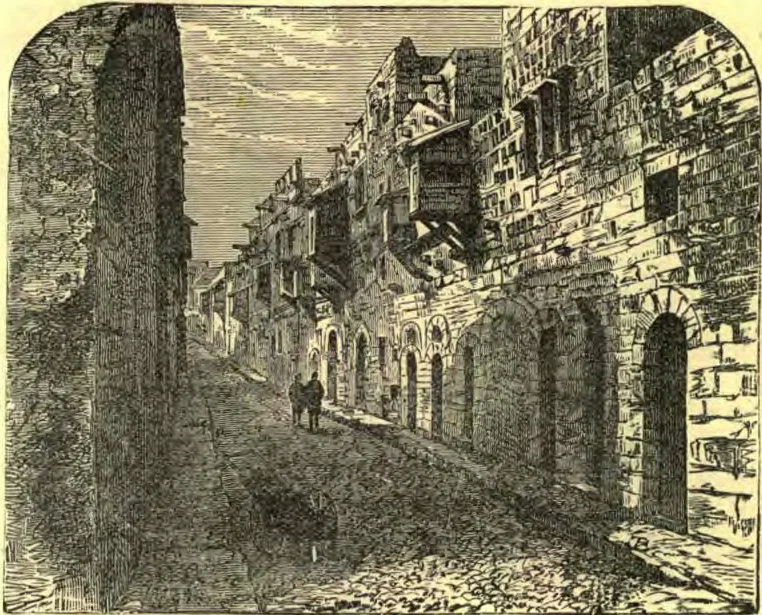
DAMASCUS is supposed to be the oldest city in the world. It was built so long ago that all record of its building is lost. The great Jewish historian, Josephus, says that it was founded by Uz, the son of Aram and great grandson of Shem. In the fourteenth chapter of Genesis it is referred to as a well-known city, and in the fifteenth chapter it is stated that Eliezer, Abraham’s faithful steward, was a native of Damascus.
This wonderful old city has seen many changes. It has passed through many hands. It has been ruled by many masters. Syrians, Persians, Greeks, Romans, Arabs, and Turks, have in turn governed or oppressed it; but it has lived and flourished under them all. Of the horrors of war it has had its full share. Not less than twelve times it has been pillaged and burned; yet it has always arisen from its ashes with new strength. Damascus is still a center of trade and one of the leading cities of the Mohammedans. It is an important stopping-place of the pilgrims to and from Mecca, the birth-place of their great prophet. The city is supposed to contain about 150,000 inhabitants.
Damascus has long been noted for its Moslem bigotry, and its bitter hatred of Christians. Fanatical outbreaks have frequently occurred, and in 1860 took place one of the most frightful massacres on record. No less than six thousand Christians were put to death, and their quarter of the city burned. Formerly a Christian could scarcely walk the streets without being insulted, but during the last ten years the Turks have learned to treat Christians with more respect, though this is probably more due to their growing dread of some of the Christian nations than from any change in their real feelings.
Damascus is situated in the midst of a large, fertile plain, which lies just east of the range of Anti-Lebanon, and on the edge of the Great Desert. This plain is crossed by the rivers of Abana and Pharpar,—broad, gently flowing streams, spreading greenness, fertility, and plenty through all their course. In looking at them with human sight, we cannot wonder that Naaman, the proud leper of Damascus, when bidden by the prophet to wash in the Jordan, should have compared its turbid, dashing waters with the clear, sparkling streams of his own fair land, and so replied, “Are not Abana and Pharpar, rivers of Damascus, better than all the waters of Israel? May I not wash in them and be clean?”
It was to this city of Damascus that Saul of Tarsus, afterward Paul the apostle, came “breathing threatenings and slaughter against the disciples of the Lord.” But that Jesus whom he persecuted met him in the way, and the stern, proud man went into the city a humble, blind disciple, breathing the prayer, “Lord, what wouldest thou have me to do?”
A long, wide thoroughfare, leading direct from one of the principal gates through the center of the city, is still pointed out as the “street called Straight,” where Ananias was sent to seek Saul as he prayed before the Lord. It is a view of this street that we have in the picture on this page. This is said to have once been the finest street in Damascus. A place some distance outside the city is pointed out to the traveler as the spot where “there shined about him a light from heaven, and he fell to the earth.” Mr. Porter thus speaks of his visit to the supposed scene of that sublime event:—
“From a somber grove I emerged on the open plain, and soon found the line of the ancient road,—the road along which Paul must have come. It crosses a low ridge which separates the valleys of the Abana and Pharpar; and on the top of the ridge is the supposed scene of Paul’s conversion. . . . I could not resist the belief that I there stood upon the very scene of the miracle. But be this as it may, the features of the landscape were the same as Paul saw;—on the left rose Hermon in all its majesty, a spotless pyramid of snow; the long range of Anti-Lebanon, gray and bleak, stretching westward to the horizon; the broad plain in front, with its many-tinted foliage; all around little villages embowered in blooming orchards; and away in the distance the bright buildings of the city. The same figures, too, gave life to the landscape; long strings of camels bearing the wheat of Bashan; cavaliers from the desert armed with sword and spear; peasants in the fields driving their yokes of oxen with sharp goads—goads which illustrated, if they did not suggest, the words of the Lord, “It is hard for thee to kick against the pricks” (goads). The same cloudless sky was there; and the same sun, pouring down a flood of light on city, plain, and mountain. ‘At midday suddenly a great light,’ shone from heaven; and the greatness of that light those only can know who have seen and felt a Syrian sun shining in its strength, and who remember that the light which shone on Paul was ‘above the brightness of the sun.’” Acts 26:13. E. B. G.

BY-AND-BY.

HALF a dozen boys and girls were sitting in front of a country school-house, during the noon intermission. They had eaten their luncheon, and while waiting for the teacher to come, were talking, half soberly, half in fun, of what they would do when they grew up.
“I am going to be rich,” said Will. “I shall go to work pretty soon, and save every cent I can get. Grandfather says, ‘A penny saved is worth two earned.’”
“When are you going to begin saving?” asked Madge, who remembered that her brother could hardly keep a cent even one day, for it almost burned a hole through his pocket, till it found its way to the confectioner’s or the toy-shop.
“Oh, by-and-by,” replied Will; “I don’t have enough now to pay for saving.”
“And I,” said Ned, who was set down as the most indolent fellow in school, “I am going to make an author. It will take work and study; but when I get older, I am going to bend right down to the work, and I will astonish you yet by my knowledge.”
“You will have to begin pretty soon,” Madge threw in again, “if you ever make a scholar.”
“Oh, there’s time enough by-and-by. Men work, boys play;” and Ned rolled over on the grass, stretched his feet into the sunshine, perfectly resigned to be a great scholar some day.
Jo was always getting into trouble. This morning he had been in dire disgrace for chalking a picture on Will’s back. During the talk he had sat very quietly, and now when Madge tapped him on the shoulder, and said, “A penny for your thoughts, Jo,” he looked up very earnestly, and said,—
“I tell you, boys, I’m going to be good when I get to be a man. I am going to make other folks happy, and always be good.”
“That’s right,” said Madge. “Now I suppose there will be no more chalk pictures and broken rules in school. How glad the teacher will be!”
“Oh, ho,” cried Jo, “I didn’t say now, but when I get to be a man. One mustn’t try to tie up boys. Let us have our good times. Chance enough to be steady by-and-by.”
“As the twig is bent, the tree’s inclined,” said Madge. “Now you boys all think you are going to do something wonderful when you grow up. I believe you will do just as you do now. You will never get to the by-and-by where Will will save his money, Ned study, and Jo be good, unless you commence right off.”
Just then the school bell rang, but after all was in order, the teacher, who had overheard the conversation, tapped on her desk, and said:—
“I heard you, just now, telling of what you would do in the future. That is all right. Your parents are giving you the advantages of this school, that you may prepare yourselves to do something good and useful when you are old enough to go out into the world and take care of yourselves. I am glad that you have set before you high ideals. You learn to write well only by imitating as closely as you can some superior penman. So in life, the higher you place your aims, the more likely you will be to make your lives somewhat near them. But from what I heard, I am afraid you look at the matter in too dreamy a way. By-and-by is a beautifully indefinite time for us to put into effect our good resolutions. It costs no effort to be self-sacrificing, industrious, or good, there. The most indolent person is willing to work hard by-and-by, and nobody ever intends to be selfish or wicked then.”
“But, boys, if you go on dreaming your dreams, and laying your plans for some indefinite future time, and never commence to prepare for the accomplishment of them, it would be better for you never to waste your time over such day-dreams. You can be, in a great measure, what you wish to be, but only by constant, untiring effort. And you must begin now. It takes a life-time to build a character. You are laying the foundation in your school-days. If you spend the first eighteen or twenty years of your lives heedlessly, indolently, forming bad habits, you will find it almost impossible by-and-by to change to earnest, upright men. Life is short enough at the longest. If we intend to do anything great or good, we must be about it at once. I would like to see Will rich, that he might do good with his money; Ned a scholar, that he might exert a wide influence for the right; and I would like, oh, so much, to have Jo consecrate himself to the Saviour, that his life might be a rich harvest in winning souls for the Master; but boys, as you wish to make real the ideal pictures of this pleasant afternoon, I implore you to begin now to cultivate these noble, manly, Christian characteristics which you admire.”
The teacher sat down. The boys and girls remained almost spell-bound by her earnest manner and words. Will studied a crack in the floor; Ned watched the teacher’s face with a new light on his own, while Jo gazed vacantly out through the open window, though the fields and distant hills were dimmed in his vision by other pictures crowding into his mind. A woodpecker tapped on an old tree by the door, a robin chirruped a few notes in the branches above.
Many years have gone by since that afternoon at the old country school-house, but whenever I hear boys and girls planning for the future, the words of that faithful teacher come back to me; and I have written them for those who are promising themselves to do better by-and-by.—Little Star.

BAD THOUGHTS.

If a bird should alight on your head, In a merry and frolicsome way, You would not be to blame for the trouble she made, If you did not invite her to stay.
If a thought from the tempter should come, And touch for a moment the mind, It might not be wrong, if you gave it no home, But drove it away on the wind.
If a bird should alight on your crown, And you should welcome it there, You would be to blame if you let her sit down And make her a nest in your hair.
If a troublesome thought come along, Returning again and again, It will be very wrong if you sing it a song, And ask it to lodge in your brain.
Then drive away every bad thought, In your mind never let it have rest; Or let it be caught, and plainly be taught That it can't have your head for a nest.
—Maxwell.

PRAISE HIM, ALL YE STARS!

Step out into the open air any clear night, and tell me, if you can, what are all those points of light sparkling above you. The ancients regarded them with a great deal of fear; their wise men pretended to foretell future events by their changes; and many nations worship the sun, moon, and stars. But learned men of the present day have found out that they are worlds, yes, more than that, each one of those glistening, twinkling specks is a sun like our own sun, having, no doubt, worlds like our earth, revolving around it. There they are, in limitless space, not motionless, but each sun with its family of worlds, revolving around one certain center. It is a beautiful thought, and it is no doubt true, that this center is the throne of God.
It may be asked, What keeps them all in their places; how are they prevented from dashing one against another? Suppose you should take a ball of yarn, and attaching a string to it, should whirl it around very swiftly; you see the string keeps it all the time at the same distance from you. Again, dip your ball in water. As you whirl it now, this water flies off in tiny drops in every direction. Should the string break, the ball too will immediately fly from you. So it is kept moving round by two forces—your arm sending it onward, the string, or other force, holding it to yourself as the center of the circle it forms in moving.
The power which sends it off is called the centrifugal force, while that which draws it to the center is the centripetal force. These two forces must be perfectly balanced, neither of them stronger than the other, or the body will either fly off or come to the center. Besides this, there is a law that every body attracts, that is, it has a tendency to draw to itself every other body. So all the stars attract one another.
Now could all the countless heavenly bodies have been so nicely balanced by chance that, though always in swift onward motion, as the earth going at the rate of sixty-eight thousand miles an hour, no collision has ever occurred? Surely the Being who made and controls all the worlds on high must be very wise and very powerful. Is he not very good also to give us the beautiful sky, which has been called the grandest object in nature. Had he not wished to please us and to elevate our characters by beholding it, he might have kept this starry dome always covered with clouds, or have prevented the light of these distant suns from reaching us. Is it not worth while, my dear young friends, to try hard to secure the favor of such a Being? M. E. STEWARD.

IN DEMAND.

One day Tommy had been asked to do several “chores” about the house. He was wanted to bring in wood, hunt eggs, run errands, etc. He grew tired of it at last, and at some new request he said, half-impatiently, half-jokingly, “Well, I think here's a boy that's in pretty good demand to-day.”
“Good articles are always in demand,” replied one who heard him.
“O yes, I s'pose so!” said Tommy, as he marched off to do this favor also, evidently thinking it was a little tiresome. The “demand” seemed to press a little hardly upon the “supply.”
Yes, Tommy, “good articles are always in demand.” This is true the world over. People like to choose the best they can find, not only the best things but the best men. Good lawyers, good doctors, good teachers, good merchants, good mechanics, good farmers, good editors, good preachers, will all find that the great world has plenty for them to do. They are in demand.
But worthless things have poor sale. They may go a-begging. Men don't want them. The lazy, the disobliging, and careless are not often asked to do much when better hands can be had.
If you would succeed in life, and be considered a useful member of society, strive to be obliging, helpful, and careful. Learn to do with your might what your hands find to do. And this must be done not merely for the sake of being praised or receiving ready pay, but because it is right, and manly, and Christ-like. Do it bravely and “heartily; as to the Lord, and not unto men.” Men will often be thankless, but the Lord's reward is sure. The pay will be all right at just the right time; God will remember all.
He who serves most shall be accounted greatest. But only he who loves much can serve much, without growing weary and “giving up.” But if we love Christ, we shall be strong to do all duties and enjoy all things.—Eva.

HOLD UP YOUR LIGHT.

OUT West a friend of mine was walking along one of the streets on a dark night, and saw approaching him a man with a lantern. As he came up close to him, he noticed by the bright light that the man seemed as though his eyes were shut. He went past, but the thought struck him, “Surely that man is blind.” He turned around and said,—
“My friend, are you not blind?”
“Yes.”
“Then why do you carry a lantern?”
“I carry the lantern that people may not stumble over me, of course,” said the man.
Let us take a lesson from the blind man, and hold up our light, burning with the clear radiance of heaven, that men may not stumble over us.—Moody’s Child Stories.

EXAMPLE

We scatter seeds with careless hand, And dream we ne’er shall see them more; But for a thousand years Their fruit appears, In weeds that mar the land Or healthful store.
The deeds we do, the words we say,— Into still air they seem to fleet, We count them ever past; But they shall last,— In the dread Judgment they And we shall meet. —John Keble.

SCENES IN THE LIFE OF CHRIST.

LESSON 104.—REVIEW.
1. What events are supposed to have taken place on the Wednesday before Jesus was crucified?
2. Tell how the disciples made preparations for keeping the Passover.
3. When, and under what circumstances, was the first Passover kept? Ex. 12.
4. What solemn things did Jesus say to his disciples before the supper began? Luke 22:14–18.
5. How did he try to remove a spirit of contention from among them?
6. How did he try to instruct them?
7. Tell how the ordinance of feet-washing was instituted. John 13.
8. What did Jesus say about his betrayal?
9. How did he point out the one who was to betray him?
10. What new commandment did Jesus give after Judas had gone out?
11. Tell how the Lord’s Supper was instituted. Matt. 26:26; Mark 14:22; Luke 22:19; 1 Cor. 11:23.
12. What were the bread and wine meant to represent?
13. What did Jesus say about the fulfillment of that scripture which says, “I will smite the shepherd, and the sheep of the flock shall be scattered abroad”?
14. What did he promise to do when he should rise from the dead?
15. How did Peter show his perplexity at this saying?
16. What conversation took place between him and his Lord? John 13; Luke 22; Matt. 26:33.
17. In the discourse that followed the Passover, how did Jesus encourage his disciples? John 14.
18. How did he inspire confidence in prayer?
19. How did he ask his disciples to show their love for him?
20. How did he console them for his being taken away? Verse 16–21.
21. What important lesson did Jesus teach by the figure of the grape-vine? John 15.
22. Why is it that people sometimes manifest such hatred toward true Christians?
23. What was the burden of the prayer that Jesus offered up for his disciples at the close of his discourse?
24. What effect would be produced by such unity of feeling among Christians?
25. Where did Jesus then go with his disciples?
26. Tell how Jesus withdrew from his disciples.
27. What charge did he give them?
28. How did they keep this charge?
29. Describe the agony that Jesus endured.
30. How was he strengthened and comforted when his disciples seemed so indifferent?
31. What did he say to them when he returned from his last prayer?
32. Who came to the garden about this time with a band of soldiers and officers?
33. How had he obtained these men?
34. Describe their approach to the garden.
35. How did Judas show them which was Jesus?
36. What miracle took place that ought to have convinced them that Jesus was what he claimed to be?
37. Tell how Peter tried to defend his Lord.
38. What was finally done with Jesus?
39. To whom did they first take him?
40. What course did this man take?
41. How did Peter and John find their way into the house of the high priest?
42. Tell how Peter denied his Lord.
43. What question did the high priest ask Jesus?
44. What provoked one of the officers to strike Jesus?
45. What success did the high priest have in trying to prove Jesus guilty of some crime?
46. On what ground did he finally accuse Jesus of blasphemy?
47. What opinion was expressed by the scribes and rulers who stood by?
48. How was Jesus then treated by the soldiers who had him under their care?
49. What insulting things did some of them say to him?

A DOUBLE NUMBER.

At the late session of the General Sabbath-school Association, held at Rome, New York, a resolution was passed to the effect that a full report of the individual Sabbath-schools be printed quarterly in the INSTRUCTOR. Now this will of course necessitate the printing of a double number at each such time, as was done year before last.
This news will no doubt be gladly received by our schools and Associations in general, and by no one more gladly than the secretary of your General Association. But while we rejoice in this step, we should realize that each and every one of us, from the pupil in the Sabbath-school up to the secretary of the General Association, should feel an added responsibility, in that he has a part to do in making it a success. The members of the Sabbath-school should do their best to be faithful in attendance and lessons, that their school may show a good record at the end of each quarter; the secretary of each school has a duty to do in sending promptly to the secretary of his State a complete report of the school for the quarter, with a tithe of the contributions received. The State secretaries will in turn be prompt and careful in getting their reports made out and sent to the General secretary in good season, not forgetting, meanwhile, to add those long tedious columns very thoroughly and carefully. In this way, we may have a good strong report which none of us will be ashamed of.
So much for the reporting. Then there will probably be something like two pages more which should be filled with the best and most thorough help and instructions for State and Sabbath-school officers, and teachers. Now we are anxious that this shall be what you most need. We want the Sabbath-school State officers especially to take an interest in the matter. We want at least a word of good cheer from every one of our Associations. Shall we not have it? If you have subjects in mind which you would like to have considered or questions to have answered in this department of the double number, send them in, that they may be presented early before those who have charge of the matter. If we have a good paper, we must begin in time.
Below is given a list of the different State secretaries and their addresses, so far as we have been able to obtain them. If it contains any errors, we should be glad to have them corrected. Now, the report to be printed in the next double number, which we hope to issue about the first of March, will be for the quarter which has just ended with December; and its completeness will depend upon the way in which the school secretaries fill out the blanks sent them two weeks ago. If any school fails to receive a blank, look in the list below and find the secretary of your State, and send a postal asking for a blank. The one already sent you may have been lost in the mail.
Now shall we not all take hold together to secure a good, earnest paper, which shall rejoice the heart of every Sabbath-school worker in the land? May God bless our efforts, and send forth a revival of interest through all our ranks!
EVA BELL GILES, Sec. Gen. S. S. Assoc.

NEW-TESTAMENT HISTORY.

LESSON 118.—REVIEW: JOSHUA; THE JUDGES; SAUL, DAVID, AND SOLOMON.
  1. By what ceremony was Joshua set apart to be the leader of Israel?
  2. What charge did the Lord give him?
  3. Describe the passage of the Jordan.
  4. Tell how Jericho was taken.
  5. In what attempt were the Israelites defeated?
  6. Why did the Lord allow them to be thus driven by their enemies?
  7. Tell how Ai was finally taken.
  8. What ceremony was performed upon Mounts Ebal and Gerizim?
  9. How and why were Joshua and the elders deceived by the Gibeonites?
  10. Into what trouble were the Gibeonites brought by making this league?
  11. How did they obtain help?
  12. Describe the battle of Gibeon.
  13. Describe Joshua’s conquests in northern Palestine.
  14. How long after the death of Joshua did the children of Israel continue faithful in keeping the commandments of God?
  15. Into what trouble were they then brought?
  16. By what judges were they successively ruled?
  17. Why did the Lord frequently allow their enemies to oppress them?
  18. What did he do for them as often as they truly repented and turned to him?
  19. Tell how Gideon delivered his people from the Midianites.
  20. Tell how they were delivered from the king of Hazor in the time of Deborah.
  21. What did the Lord enable Jephthah to do?
  22. Give a brief account of the early life of Samuel.
  23. How did he deliver his people from the Philistines?
  24. Tell how Saul was made king of Israel.
  25. How did he gain the confidence of the people?
  26. By what course of conduct did he so displease the Lord as to be rejected from being king?
  27. Tell how he persecuted David.
  28. Relate the circumstances of Saul’s death.
  29. Give the early history of David’s life.
  30. Tell how he became king, first over Judah, and then over the whole land.
  31. Give an account of Absalom’s rebellion.
  32. How did David bring a plague upon the land?
  33. What wise choice did Solomon make when he began to reign?
  34. What great work was committed to him?
  35. Why was not David permitted to build the temple?
  36. What seems to have been David’s greatest act of cruelty?
  37. Give an account of Solomon’s wisdom and riches.
  38. Tell how he was led to apostatize from God.
  39. What enemies did the Lord raise up against him?
  40. How long did Saul, David, and Solomon respectively reign?

DIRECTORY OF STATE SECRETARIES.

CALIFORNIA.—Mrs. G. D. Ballou, Oakland, Cal.
DAKOTA.—Niels Keir, Parker, Turner Co., Dakota.
INDIANA.—Leanna Morrell, Ligonier, Ind.
ILLINOIS.—Lizzie S. Campbell, Belvidere, Ill.
IOWA.—Mrs. P. A. Holly, State Center, Iowa.
KANSAS.—Mrs. Clara Gibbs, Ottawa, Kansas.
KENTUCKY.—Sallie Bransletter, Nolin, Kentucky.
MICHIGAN.—Eva Bell Giles, Battle Creek, Mich.
MISSOURI.—Joseph Clarke, Lowry City, St. Clair Co., Missouri.
MAINE.—Alice K. Hersum, Deering, Maine.
MINNESOTA.—E. S. Babcock, Cleveland, Minn.
NEW YORK.—Mrs. N. J. Walsworth, No. 2 Cherry St., Syracuse, N. Y.
NORTH PACIFIC.—R. D. Benham, Salem, Oregon.
NEW ENGLAND.—Mrs. E. D. Robinson, O. Lancaster, Mass.
NEBRASKA.—Mrs. Niels Clausen, Blair, Washington Co., Neb.
OHIO.—Verna Null, Delaware, Ohio.
PENNSYLVANIA.—Mrs. F. C. Oviatt, Wellsville, N. Y.
TENNESSEE.—Mattie Moore, Edgefield Junction, Tenn.
TEXAS.—Mrs. Susie C. King, Dallas, Texas.
VERMONT.—Ann E. Smith, Troy, Vt.
WISCONSIN.—Nellie C. Taylor, Neillsville, Clark Co., Wis.
UPPER COLUMBIA.—Mrs. M. O. Beck, Milton, Oregon.

SOW GOOD SEED.

“PLEASE, sir, I suppose some one put a good thought in the best boy’s heart when he was growing!” This explanation was given by a boy to his superintendent who asked why the subsequent careers of two boys who began life in much the same circumstances were so far severed: the one being good and the other bad; the one being happy and honored, the other being miserable and neglected. So long as the statement of holy writ is that “out of the heart proceed evil thoughts,” how careful parents and teachers should be in implanting germs in the minds of children which will produce not only purity of thought but truth of speech and action!—S. S. World.

MILLIE'S KITTEN.

MILLIE DOWNER'S father and mother had died when she was very young, and ever since she could remember, she had lived with her grandparents in a quiet country village. Their home was a quaint little cottage, and back of the house was a large, old-fashioned garden, surrounded by a stone wall. Millie had no brothers or sisters or cousins to play with her, and so when the weather was pleasant, she spent many hours a day out under the old apple-trees at the back of the garden, with only the birds, her black kitten, and her dolly for company. If you had gone slyly out there some day and overheard Millie talking to her pets just as if they could understand her, you would have certainly thought some little girl was spending the afternoon with her.
In one of the apple-trees was a robin's nest, which Millie watched with a great deal of interest. She used to take her black kitten, which she called Sukie, and talk to her very earnestly about how wrong it would be for her to climb the tree and try to catch the little young robins. And Sukie would look very wise and solemn out of her green eyes, as much as to say that she understood.
One afternoon, though, the kitten seemed to have taken a notion to climb all the trees in the garden, and her little mistress was in great trouble for fear Sukie would find the nest of robins. Millie chased her pet all about the garden, trying in vain to catch her; but at last pussy mounted the stone wall and jumped from there on the branch of a tall tree on the other side. She improved her chance to climb here; but finally when she began to think of coming down, her heart failed her for fear, and she began to mew piteously to her little mistress, who stood on the ground beside the wall. Millie called and called, and did everything she could think of to get Sukie to come down, but the kitten was afraid to come so far. At last, however, after much coaxing, Millie got her to the top of the wall, and there she staid for a long time, afraid to jump either into Millie's arms or to the ground.
Finally grandma came out to look for her little girl, and she, being taller than Millie, made out to reach the kitten and bring her down. By-and-by, when they were seated in the quiet little cottage, grandma said, “Millie, do you know that there is One who stands reaching out his arms and calling you and every other child just as tenderly and anxiously as you called your kitty this afternoon? Some children are careless and do not hear him; and others are afraid to go, like your kitty. But still the precious Saviour stands patiently waiting, holding out his arms, and calling, ‘Come unto me!’ He wants the children to be sure to understand that they are to come, so he says, ‘Suffer little children to come unto me, and forbid them not, for of such is the kingdom of heaven.’ My little girl is old enough to know what this means; and does she not want to come to him now, to-night, by beginning to love and obey him in everything she does.”
Millie had a quiet little way of her own, and when grandma was done, she did not say anything; but that night when she kneeled by grandma's side to say the little prayer she had said from baby-hood, she added, “And help me to come to Jesus when he calls, and to love him every day, like grandma told me about.” A. L. S.
Continue reading: HOW THEY MADE OUT