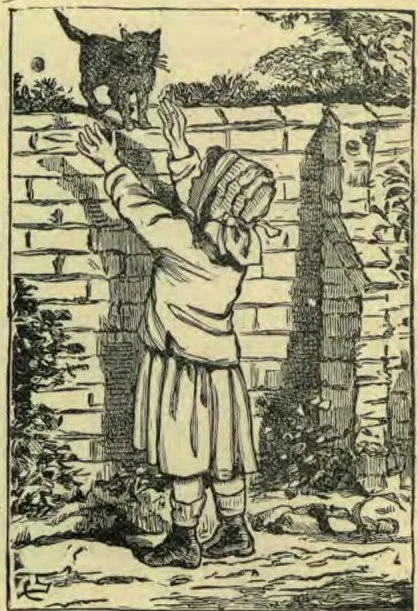
“I don’t know,” said Margaret, “how we shall make out; but we can’t let the child starve.” Margaret was the house-mother in a German home, where money was scarce, and plain food was not plenty.
A stranger had come along the street, and stopped at the door, and asked if he might have some supper with the family. He was watching the yellow-haired little girl who followed Margaret around, and it was in reply to a question of his that she had spoken the sentence with which our story begins.
“Then she isn’t your own child?” asked the stranger.
“No!” Margaret explained that she was the child of a poor neighbor who had died a few weeks before, leaving nothing for the little girl, and no friends for her to go to. So they had taken her in.
“And can’t you manage to keep her?” the stranger asked. “You have none of your own, I suppose?”
“Oh, dear, yes!” and she laughed over his queer mistake. None of their own! Why, there were ten in all.
When supper was ready, they all trooped in. What a little army of them! and how clean their faces were! their hair neatly combed, and their patched and worn clothes looking as though each of them had been as careful of them as possible. At the supper table, each of them looked out for Gretchen; she had the largest potato, carefully peeled by Margaret, the mother’s name-child; and Melchor, the father’s namesake, put a bit of butter on it, though he ate none on his own. The stranger saw all this and a great deal more, though he seemed to be talking with the father and mother.
The next day a soldier in military dress rode up to the house, and asked for the house-mother, and gave her a great solemn-looking letter which made her tremble as she broke the seal. Oh, what do you think that letter said? Why, that the man who had taken supper with them the night before was so pleased with all the ten children, and with Gretchen besides, that he had decided to make them each a present of $100, which would be paid to them each year while they lived! $1,100 a year because a strange man who took supper with them was pleased with their kindness to him, and their unselfish care for the orphan Gretchen! That sounds like a “made-up” story, doesn’t it? And yet it is true. The letter was signed, “Joseph, Emperor of Austria.” And he was the stranger who had eaten potatoes with them the night before.
Ah! I wonder if you know what this makes me think of. Do you remember who laid aside his crown and royal dress, and left his throne and came to us—not simply to amuse himself and give us pleasure, but to save us from eternal death?
Some day we shall see him with royal dress blazing with jewels, the crown of gold on his head. Will he remember us then as those who received him here? He is watching our actions, whether they are unselfish and loving, or hard and hateful. Is he getting a reward ready for us? The reward is not $100 a year; it is a home in the palace, a seat on the throne. It is to be introduced to his Father as brothers and sisters; it is to reign with him forever and ever.—The Pansay.
FORGET AND FORGIVE.
THERE exists a very beautiful custom in Germany. On the first day of the new year, whatever may have been the quarrels or estrangements between friends and relatives, mutual visits are interchanged, kindly greetings given and received—all is forgotten and forgiven.
LOVING JESUS.
By Morning Light
CHILDREN sometimes do not understand how they are to love Jesus, whom they have never seen. But it is very simple. We love a great many persons we have not seen; persons we have heard about or read about.
Have any of you a grandmother whom you have never seen? Perhaps she lives far across the sea, but you have heard your mother talk about her, until you say in your heart, How good and kind she must be! I love her dearly. Then this kind grandmother perhaps sends you a present, something she has made with her own hands, a little hood, a pair of stockings, or a little frock. How much you think of such a present, and how you love and thank the dear, kind friend who so thoughtfully prepared it!
Now you love her, though you have not seen her. And does not this help you to understand the verse, “Whom having not seen, we love”?
You read in the New Testament of Jesus’ acts of kindness and tenderness when he was here on earth; how he took the little children in his arms and blessed them; and how he suffered and died on the cross that your sins might be forgiven; and then rose from the tomb and went to heaven to plead for you and for all of us. Can you not love him?—Morning Light.
“I FORGOT.”
“I FORGOT to bring my penny!”
May, with the clustering curls,
Turned her sweet face in sadness
Away from the other girls.
A gathering shade of sorrow
Stole over the teacher’s brow;
Those “other girls” before her,
How sadly they say it now—
“I forgot to bring my penny
For the Sabbath-school to-day.”
A breathing space; then clearly
They heard her sweet voice say—
“Forgot! O children happy,
What if in very deed,
Your Saviour should sometime forget
To fill your smallest need!”