Your ShelfYour Projects

Signs of the Times, Vol. 32, No. 13.

Fundamental Principles No. 7

Earlier text: RESPONSIBILITY OF FREEDOM

GALATIANS

While other epistles of Paul were addressed either to individuals or to single churches or to the people of God in general, this one alone was written to the believers in a certain country, in which were found several churches. Galatia was one of the leading provinces of Asia Minor; a number of churches were located within its borders. To all these churches, as will be seen by the introduction, this letter was addressed.
The reasons for writing this epistle are so clearly stated in that very interesting work entitled, “Sketches from the Life of Paul,” that we will here give a few extracts:
While Paul looked with interest and hope to new fields of labor in the west, he had cause for serious apprehension concerning the fields of his former labor in the east. Tidings had been received at Corinth from the churches in Galatia, revealing a state of great confusion, and even of absolute apostasy. Judaising teachers were opposing the work of the apostle, and seeking to destroy the fruit of his labors.
Faith in Christ, and obedience to the law of Ten Commandments, were regarded as of minor importance. Division, heresy, and sensualism were rapidly gaining ground among the believers in Galatia.
Open, unmasked error was supplanting the faith of the Gospel.
Those false teachers were hypocritical, unregenerate men, unholy in heart and corrupt in life. Their religion consisted in a round of ceremonies, by the performance of which they expected to receive the favor of God. They had no relish for a doctrine which taught, “Except a man be born again, he can not see the kingdom of God.”
To substitute the external forms of religion for holiness of heart and life, is still as pleasing to the unrenewed nature as in the days of the apostles. For this reason, false teachers abound, and the people listen eagerly to their delusive doctrines. It is Satan’s studied effort to divert the minds of men from the one way of salvation,—faith in Christ, and obedience to the law of God. In every age the arch-enemy adapts his temptations to the prejudices or inclinations of the people. In apostolic times he led the Jews to exalt the ceremonial law, and reject Christ; at the present day he induces many professed Christians, under the pretense of honoring Christ, to cast contempt upon the moral law, and teach that its precepts may be transgressed with impunity.
Paul continues to vindicate his position as the apostle of Christ, not by the will of men, but by the power of God. He describes the visit which he made to Jerusalem to secure a settlement of the very questions which are now agitating the churches of Galatia, as to whether the Gentiles should submit to circumcision and keep the ceremonial law.—Pages 188–193.
The distinction between circumcision and obedience to moral precepts is thus plainly stated by Paul:
“Circumcision is nothing, and uncircumcision is nothing, but the keeping of the commandments of God.” 1 Cor. 7:19.
The same truth is set forth in the epistle under consideration:
“For in Jesus Christ neither circumcision availeth anything, nor uncircumcision; but faith which worketh by love.” “For in Christ Jesus neither circumcision availeth anything, nor uncircumcision, but a new creature.” Gal. 5:6; 6:15.
It will thus be seen that circumcision is the sign of ceremonial obligation, and all that system that was connected with it, is a very different matter from the moral duties the sign of which is the Sabbath of Jehovah. See Ex. 31:13; Eze. 20:12, 20. Circumcision is done away, so that now it is nothing, but the keeping of the commandments of God is something; yes, we may say it is everything; for Jesus kept the commandments of His Father, and through His obedience, sinful mortals are made righteous. Rom. 5:19. He came to enable us to live lives of righteous obedience to the Father’s law.
Notice how three things are put together in opposition to ceremonial observances: Circumcision is nothing; but faith which worketh by love. Circumcision is nothing; but a new creature. Circumcision is nothing; but the keeping of the commandments of God. These three—faith that works by love, a new creature, and the keeping of the commandments of God—are inseparably connected together, and constitute the essentials of Christian experience.
To further show the excellencies of the law of God, Paul says in Gal. 5:22, 23, “But the fruit of the Spirit is love, joy, peace, long-suffering, gentleness, goodness, faith, meekness, temperance; against such there is no law.” Or as the German reads, “Against such the law is not.” All these are the fulfilment of God’s holy law, and are in contrast with the works of the flesh just before enumerated, which are simply the transgression of that same law.
How can any one misunderstand the teachings of the book of Galatians in regard to the law of God? After the stirring defense of the subject of justification by faith, which is the leading thought in the book, many very beautiful and encouraging exhortations are given in the last chapter of this epistle. O, that we might ever heed them, restore those overtaken in a fault, bear one another’s burdens, sow to the Spirit, with the assurance of a bountiful harvest in the soon-coming time of reaping, and never be weary in well-doing, but do good unto all men.
We will notice in closing, two verses from this unique book which so decidedly express the true nature of Christian experience: “I am crucified with Christ, nevertheless I live; yet not I, but Christ liveth in me; and the life which I now live in the flesh I live by the faith of the Son of God, who loved me, and gave Himself for me.” “But God forbid that I should glory, save in the cross of our Lord Jesus Christ, by whom the world is crucified unto me, and I unto the world.” Gal. 2:20; 6:14.
F. D. STARR.

THE RICH MAN AND LAZARUS.

WE are often referred to the account of the rich man and Lazarus, by those who believe that the dead are conscious between death and the resurrection. The account is found in Luke 16 : 19-31. Let us give the subject a careful study, and see what we can learn from it.
In the first place, we are all agreed that Inspiration does not contradict itself. The Bible has spoken with no uncertain voice, of the condition of those that “go down into silence.”
“The dead know not anything.” Eccl. 9 : 5.
“His breath goeth forth, he returneth to his earth; in that very day his thoughts perish.” Ps. 146 : 4.
“In death there is no remembrance of Thee.” Ps. 6 : 5.
One more evidence will forever determine the condition of the mental faculties in death:
“Their love, and their hatred, and their envy, is now perished.” Eccl. 9 : 6.

A Series of Parables.

Everything in the Bible, rightly understood, must be in harmony with these positive statements. With the understanding that this is the last of five parables, given by the Saviour to teach a grand truth, it is easy to understand, and it is in harmony with the rest of the Bible.
There is the best of evidence that it is a parable spoken to the Pharisees. A manuscript of the seventh century reads, “And He spake also another parable.” Another, of the tenth century, reads, “The Lord spake this parable.”
He was talking to the scribes and Pharisees. Now turn to Mark 4 : 11: “And He said unto them [the twelve], Unto you it is given to know the mystery of the kingdom of God; but unto them that are without, all these things are done in parables.” Verses 33 and 34: “And with many such parables spake He the Word unto them, as they were able to hear it. But without a parable spake He not unto them; and when they were alone, He expounded all things to His disciples.”
When defining a parable, Dr. John Kitto says, “It denotes a fictitious narrative invented for the purpose of conveying truth in a less offensive form than that of direct assertion.”
—“Cyclopedia of Biblical Literature,” Vol. 2, p. 467. In his “Greek Lexicon,” Dr. E. Robinson defines a parable as follows: “A short relation under which something else is figured, or in which that which is fictitious is employed to represent that which is real.”
Two parables are used in Judges 9 : 8-15, and Eze. 17 : 2-8, telling the work of two kings. Both are fictitious.
Now we will consider the parables of the fifteenth and sixteenth chapters of Luke. We will first ask concerning the parable of the rich man and Lazarus, Is it proper to found a doctrine upon an unexplained parable that will contradict all the plain scripture on the subject in the whole Bible? Or is it creditable that the Saviour has taught in a parable contrary to what He has said in plain terms elsewhere?—No, certainly not.
Now let us begin at the beginning of the subject. Luke 15 : 2: “And the Pharisees and scribes murmured, saying, This man receiveth sinners, and eateth with them.” (You and I have reason to thank God that it is so.) In the parables that follow, Christ justified His action. In all these illustrations, the two classes are contrasted.
In verses three to seven is the parable of the lost sheep. The Pharisees were quick to recog­nize themselves as the favored class. They said to Jesus, “We be Abraham’s seed, and were never in bondage to any man.” John 8 : 33. They were quick to make the application that the Gentile was the lost sheep, the lost piece of money, and the prodigal son.
In this parable, Jesus gives a sharp reproof to the Pharisees. They would make special effort to find lost sheep, and lost money, and be joyful when their lost property was found, but when lost men came to Christ to be saved, they acted just like the elder brother, who was so offended because his poor, lost, prodigal brother had been received that he would not enter the house.

The Parable in Question.

In these parables, the Saviour admits that He received sinners, and says that Heaven is glad over their salvation. Passing by the parable of the unjust steward in the first part of chapter 16, we come, in verse 19, to the subject that we wish to study.
“There was a certain rich man, which was clothed in purple and fine linen, and fared sumptuously every day; and there was a certain beggar named Lazarus, which was laid at his gate, full of sores, and desiring to be fed with the crumbs which fell from the rich man’s table.”
Here again, the two classes appear in sharp contrast. Of course, this being a Scriptural illustration, the riches, or poverty, must be taken in a spiritual sense. What had the Jew?—“Who are Israelites; to whom pertaineth the adoption, and the glory, and the covenants, and the giving of the law, and the service of God, and the promises.” Rom. 9 : 4. They were rich in every spiritual blessing. Purple and fine linen was the clothing of the priests.
Now think of the poverty of Lazarus. “Wherefore remember, that ye being in time past Gentiles in the flesh . . . that at that time ye were without Christ, being aliens from the commonwealth of Israel, and strangers from the covenants of promise, having no hope, and without God in the world.” Eph. 2 : 11, 12.
No God, no Christ, no hope. Poverty unutterable. Says Dr. Bullinger, an eminent authority, in his “Critical Greek Lexicon:” “The rich man represents the Jewish nation. Lazarus represents the Gentiles. The Jews died to their national privileges in A.D. 70 [34?]. The Gentiles died to their poverty by Christ offering them salvation.”
Let us continue the parable. Verses 22 and 23: “And it came to pass, that the beggar died, and was carried by the angels into Abraham’s bosom; the rich man also died, and was buried; and in hell he lift up his eyes, being in torments, and seeth Abraham afar off, and Lazarus in his bosom.”
Both parties died, but the death they died seemed to reverse their condition. Spiritually, one can be “dead IN trespasses and sins” (Eph. 2 : 1), or “dead TO sin” (Rom. 6 : 2). Evidently the poor man died the latter death, as it brought him into the bosom of Abraham. “If ye be Christ’s, then are ye Abraham’s seed, and heirs according to the promise.” Gal. 3 : 29. The rich man by dying IN sin, found himself in Hades (meaning always the grave). The expression is often used of those who have turned away from God and become reprobate. “And thou, Capernaum, which art exalted unto heaven, shalt be brought down to hell [Hades].” Matt. 11 : 23. It was said of backslidden Israel, “Thou didst debase thyself even unto hell [the grave].” Isa. 57 : 9. If this was a literal statement of facts instead of
a parable, then heaven would be vocal with the voices and cries of the lost. Read carefully verses 24 and 25. They were within speaking distance.
It might be well to inquire how much of the Jewish nation was represented by the rich man. Evidently, those who had seen Christ and rejected Him, and were instrumental in putting Him to death. There were two tribes living in Jerusalem, Judah and Benjamin. Joshua 15 : 63, and Judges 1 : 21. Then if the two tribes represented one man, the “five brethren” spoken of in verse 28 would be the ten tribes that would hear of Christ, through the preach­ing
ing of the apostles. As they would read “Moses and the prophets,” and show their fulfilment, they could say as did the eunuch, “I believe that Jesus Christ is the Son of God.”
It is too much to hope that every part of the parable will find an exact counterpart; this is seldom true of parables, but with the view that I have presented, there is a harmony with every other part of the Bible. Finally, in closing, God gives the “poor man” a solemn warning. “Well; because of unbelief they were broken off, and thou standest by faith. Be not highminded, but fear.” Rom. 11 : 20.
L. D. SANTEE.

Be Definite

“Be definite; the hunter who aims at random has nothing.”

TEMPORAL POWER OF THE PAPACY

BY ONE ON THE GROUND

THE POPE A MONARCH.

Charlemagne, Continued.
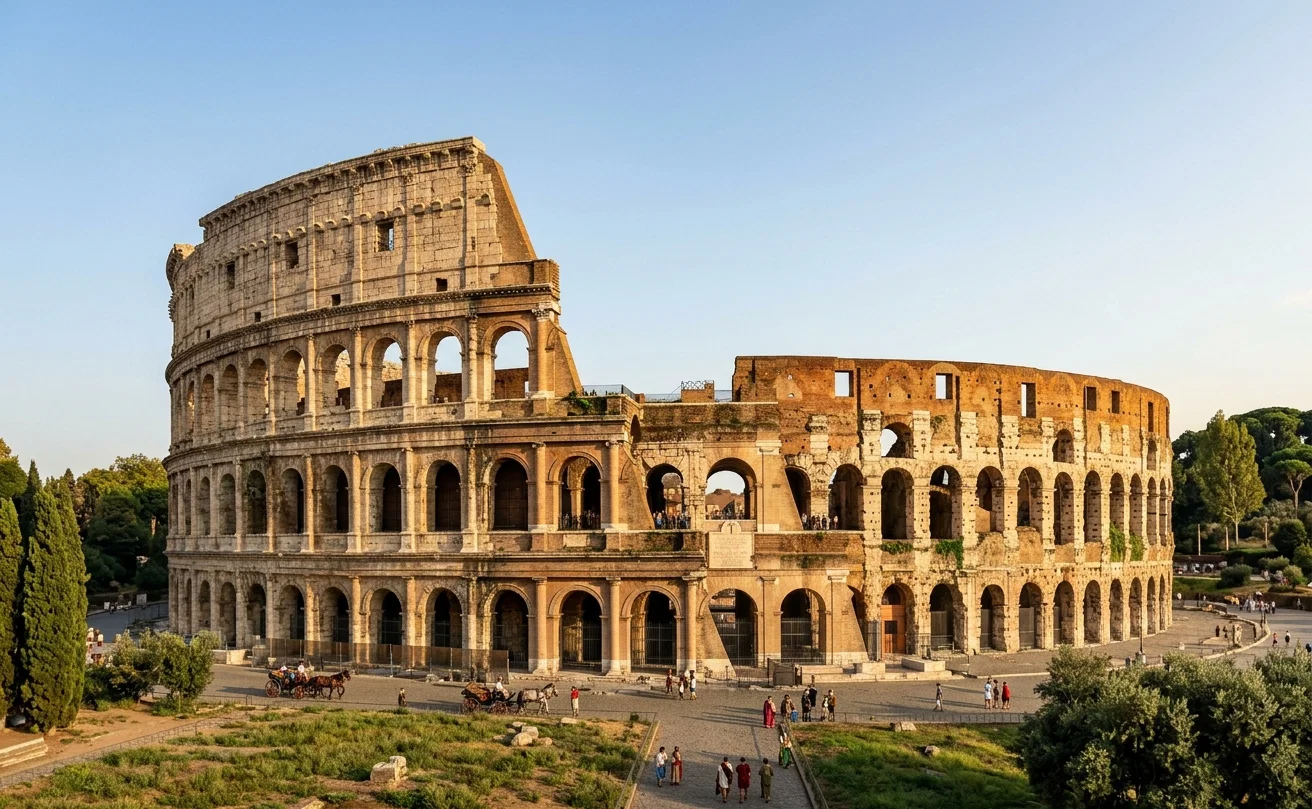
Ruins of the Colosseum, Rome.
CHARLEMAGNE again returned to Italy, and on Christmas day, 800, was coronated in St. Peter's church by Pope Leo III., who pronounced the following words: “To Charles, most pious Augustus crowned by God, great and glorious emperor, be life and victory.” And thus through the will of the pope and the French despot was renewed the Western empire, which fell into the hands of the Franks. But did the pope, then, lose the temporal power in bestowing the crown of the empire upon Charlemagne? In answer I quote as follows: “It is clear that Charlemagne, in being nominated emperor, in reality did not acquire more than the title; and the pope did not lose any of the power that he already possessed. In fact, the temporal supremacy of Charlemagne, instead of damaging the sovereignty of the pope, became a shield of defense for it. And besides that, the Roman pontiff with the placing on the head of Charlemagne the crown of the Western Empire, made him as a temporal prince inferior, and also subject to himself; and therefore he taught the world in general that he had the power to bestow kingdoms and empires, and as pontiff he was superior to the emperors themselves.” “And in this manner the pope began to found that theory that in its development likened the pope to the sun and the emperor to the moon.”
The history of the Papacy from this point onward might well be summed up in the words of the historian as follows: “The pope became then an ambitious monarch with a dominion over the people given by a foreign conqueror. He became a despot more haughty and wicked than any other, in that he invested in himself two powers, and employing the civil to the advancement of the priestly, attempted to extend his empire into the innermost recesses of the conscience. And therefore we must not be surprised that we see the pope pursuing a policy of intrigue in which he makes wrong right and right wrong in order to help those that have given him aid.”
For the next three centuries the popes reigned with such a rule of corruption, cruelty, and murder that words can not portray the condition that existed during that dark period. And still that was but the beginning of the night of woe that settled down upon the world, as a consequence of the papal misrule, and which culminated in the starless midnight when “Europe and Asia were deluged in blood.”

Hildebrand.

In 1073 Hildebrand succeeded to the papal throne, under the title of Gregory VII. He was a genius in politics, and was at the same time one of the most cruel and fanatical of the Roman pontiffs. “He claimed that the dignity of the ecclesiastical power in comparison with the regal was the difference that one finds between gold and lead; and he considered that the kings of the earth were but servants to the pope. And he well knew that as long as he continued to rule the monarchs spiritually, he then held temporal dominion over the people.”
And these principles he enacted with rigor in the case of Henry IV. of Germany in the famous transaction of Canossa. Gregory, in order to gather to the Papacy greater power, decreed that in the future all bishops should be appointed by the popes, a power that had hitherto been invested in the kings. And he began putting the decree into effect in Germany, as it was a powerful kingdom, and therefore by succeeding there he would more easily win a victory in the other countries. He made it appear that the decree had as its aim the correcting of certain abuses practised by the king. Henry IV. resented these encroachments upon his power, and threatened to make war upon the pope. But Gregory hurled against him the most terrible anathema, and, liberating his subjects from the oath of allegiance, declared him deposed from the throne.

Humbled at Canossa.

As the people would not support upon the throne a king excommunicated, the miserable Henry, forgetting for the moment his dignity, in order to preserve his crown, betook himself to Canossa and prostrated himself before the mitered tyrant, and begged for absolution and pardon. But the pope, depriving him of his royal vestures and dressing him in a suit of coarse wool, made him stand outside of his “paternal” gate in the great cold of January, for three days, alone, hungry, and with his feet bare. “In such vileness could fall a man for the avarice of command.” And thus “Rome returned again, the seat of a terrible power, and the pope recognized himself superior to every other power in the world.”
When we note some of the principles laid down by this pope we can see at what point the Papacy had arrived in its arrogant claims. I quote his rules as follows:
With those excommunicated by the pope, among other things, we should not remain in the same house.
The pope alone may wear the imperial ensigns, and to him alone it is lawful, when the times demand it, to make new laws.
All princes must kiss the feet of the pope.
His is the only name in the world, and his name alone should be recited in all the churches.
To him it is lawful to depose the emperors.
The pope can be judged by no one, and his sentence no one can revoke, but he alone can revoke it.
No one may dare to condemn the one who appeals to the apostolic seat.

Subsequent Centuries.

From this period onward until the Reformation and after, the papal rule might be summed up in the following language: “From this humanity ought to learn that when a man acquires unlimited sway, which is contrary to the laws of nature, altho he preserves the human form, yet he becomes a wild beast that ought, by force and iron bars, to be separated from society.” It was during this period that the pope instigated the bloody crusades in which millions lost their lives; and also in this epoch the Albigenses and Waldenses were mowed down by the sword of persecution; and in fact it was a time when men inspired by Satan attempted to reduce in subjection the consciences of men, and to that end invented forms of torture so cruel that they are incompatible with the basest and meanest attributes of men; and it seems certain that they must have been excavated from the slimy depths of the Satanic nature.
I shall mention but one pope, who will serve as a representative of the period. Innocent III. (1198–1214), the terrible persecutor of the Albigenses and the founder of the Roman Inquisition, “attained a political supremacy of such greatness that it seems incredible to the one reading of it to-day, and to contemplate it, really makes one dizzy. “He elevated the Papacy to a universal monarchy in the full sense of the term.” He hurled his bulls against kings and emperors, and they were deposed from their thrones at his will. Otto of Germany was coronated by him, but when the king refused submission he was quickly deposed. Peter II., of Naples, confessed himself his vassal, and Phillip II. of France cowed into subjection under his fierce anathema. King John of England was humiliated into the dust by this haughty pontiff, and he was compelled to recognize himself a vassal of the pope, and for some years England paid an annual tribute to the Vatican. In the language of Gibbon we might sum up his reign as follows: “Under this young and ambitious priest the successors of St. Peter attained the full meridian of their greatness, and in a reign of eighteen years exercised a despotic command over emperors and kings.”
From the time of the Reformation up to the present, the Papacy has ever followed the same policy of political and ecclesiastical aggrandizement, but it has been compelled, through the new spirit of liberty, to modify at times its means for obtaining this end. I shall not endeavor to speak in particular of the progress of the temporal power during this period, for lack of space, but shall simply refer to the extent of the territory of the Papacy when it lost its temporal dominion.
At the beginning of the campaign of Victor Emanuel II. and Garibaldi in 1860, the Papacy held the following territory, the provinces of Marches, Umbria, Romagne, Latium, and the cities of Benevento and Avignon (France). All of this territory fell under the successful sword of Garibaldi during his campaign of 1860, with the exception of Rome and its immediate surroundings. And on the 20th of September, 1870, the city of Rome was entered by the Italian troops after a resistance of five hours on the part of the papal soldiers, and from that point onward the pope has been deprived of the least vestige of temporal dominion, and has styled himself the prisoner of the Vatican.
Rome, Italy. C. E. MILTON.
(To be continued.)

POWER OF A HYMN.

THIRTY men, red-eyed and disheveled, lined up before a judge in a San Francisco police court. It was the regular morning crowd of “drunks and disorderlies.” Some were old and hardened. Some still hung their heads in shame. Just as the momentary disorder attending the bringing in of the prisoners quieted down, a strange thing happened. A strong, clear voice from below began singing,
“Last night I lay a-sleeping, There came a dream so fair.”
Last night—it had been for them all a nightmare or a drunken stupor. The song was such a contrast to the horrible fact that no one could fail of a sudden shock at the thought the song suggested.
“I stood in old Jerusalem, Beside the temple there,”
The song went on. The judge had paused and made a quiet inquiry. A former member of a famous opera company, known all over the country, was waiting trial for forgery. It was he who was singing in his cell. Meantime the song went on and every man in the line showed emotion. It was impossible to proceed with the business of the court, yet the judge gave no order to stop the song. The police sergeant, after an effort to keep the men in line, stepped back and waited with the rest. The song moved on to its climax.
“Jerusalem, Jerusalem, sing for the night is o’er, Hosanna in the highest, hosanna for evermore.”
In an ecstasy the last words rang out and then there was silence. The judge looked into the faces of the men before him. Every man was touched by the song; not one in whom some better impulse was not stirred. He did not call the cases singly—a kind word of advice, and he dismissed them all. No man was fined or sentenced to the work-house that morning. The song had done more good than punishment could have accomplished.—Educational Messenger.

WHILE THE TESTING GOES ON.

WHEN we know that we are “on trial” we are likely to do our best. When we think that we are not on trial, we are likely to be off our guard. But does testing-time ever cease in this life? One who was praying, in great perplexity, for strength and wisdom to act rightly in a coming ordeal, was helped by recognizing that that very difficulty was perhaps being sent only as a test. And then came the realization that every hard time is sent or permitted as a test and for no other reason.
Obstacles have no other mission, in this world of God’s love, but to be our helpers. They prove us, and God’s will is that the proving shall leave us each time stronger. When, therefore, can we afford to be off our guard? Ready or unready, we are always being tested; and only One who sleeps not can enable us to meet the tests.—Sunday-School Times.

THE LIVING WRITING.

[By Rev. L. C. Littell, in Sunday-School Times.]
WHEN Pharaoh sat upon old Egypt's throne And proudly reigned o'er all the Nilian land, Majestic grandeur rose at his command And flourished there. A Memphian wrote on stone Of his great splendor, so that not alone The present, all might see his glorious hand. To this same end, a man of Nineveh planned On fire-tried bricks, to thus engrave what shone So brightly in his day. Behold the dust! It speaketh not of either. Galilee SAW One write on the ground. None then could see How glorious was He, or worthy trust; But men to-day read o'er and o'er again His living writing on the souls of men.

CHILD-WIDOWS OF INDIA.

With the Hindus, marriages occur with infants, and are arranged by the parents. The little child-wife lives with her parents till what they consider a reasonable age, and then she is sent to her future home to live with her husband and her mother-in-law. If the husband of the girl-wife dies during her childhood, she is left a helpless widow. Often it occurs that the little girl-wife finds herself married to an old man, in which case she sooner or later enters the sad state of widowhood.
Pundita Ramabai defines widowhood as regarded by Hindus to be “a punishment for sins committed by the woman in her former existence on earth; and that sin is described as disobedience or disloyalty to the husband, or murdering him in a former existence. If the widow be a mother of sons, she is not usually an object of pity. Altho she is a sinner, yet social abuse and hatred are mitigated by the fact that she is a mother of the superior beings.”
When sixteen, or even a little later, the girl-widows suffer the full indignities of widowhood. Then her hair must be shorn, her bright clothing removed, nor can she wear jewels or ornaments which are the pride of Indian women. The red mark on her forehead, the emblem of marriage, is no longer visible. She must eat but one meal a day, and must fast on the feast days of every month. On her falls the meanest of the household duties, and by the members of her own family she is regarded as the cause of her husband’s death, and abuses too numerous to mention are heaped upon her.
For more than two thousand years the custom prevailed of Hindu wives ascending the funeral pyre of their husbands and perishing in the flames with the dead. In 1829, Lord William Bentick passed the now famous law prohibiting the suttee rite within British dominion. Thirty years before this date, William Carey witnessed the burning of a widow, which stirred his inmost soul. “He begged the woman not to throw away her life. After remonstrances, which the people met first by argument and then by threat, Carey wrote: ‘I told them I would not go. I was determined to stay and see the murder, and that I would certainly bear witness at the tribunal of God.’ And when he sought again to interfere, because two stout bamboos, always fixed for the purpose of preventing the woman’s escape, were pressed down on the shrieking woman, he added, ‘We could see no more but left them.’ The remembrance of that sight never left Carey. His naturally cheerful spirit was inflamed to indignation all his life through, till his influence more than that of any other man, at least, prevailed to put out forever the flames of the murderous pyre.”
Child-wife of India.
The law was signed on the fourth of December, 1829, and Carey was appointed to translate the same into Bengali. The request reached him as he was going to his Sunday service. “Throwing off his quaint black coat, he exclaimed, ‘No church for me to-day. If I delay an hour to translate and publish this, many a widow’s life may be sacrificed.’” Thus was removed one of the blackest clouds that had overshadowed “sunny India” for two thousand years.
But there remains still a cloud over India’s people—what is sometimes termed “cold suttee”—the living death of the poor widows, outcast as they are, and despised by the very ones who should cherish them, deprived of even a religious ceremony at her funeral if she dies childless. According to the last report there are 25,000,000 widows in India who suffer more or less some of the indignities mentioned. What can save them? What will show them that widowhood is not the result of sin? It can only be by the influence of the same Spirit that has saved thousands of Indian women and brought them to a higher plain of life.
Mrs. J. L. SHAW.
Boulder, Colo.
Continue reading: A TRUE STORY OF CONVERSION