[Mrs. E. G. White and her party on their way to the General Conference, spent five days in College View. Friday morning she spoke to five hundred students in the college chapel, and Sabbath and Sunday she spoke to large congregations in the church. Monday morning, by request, she met with the college faculty. The following is a portion of her address to the thirty teachers assembled.—W. C. WHITE.]
I WILL read 2 Corinthians, the sixth chapter:—
“We then, as workers together with him, beseech you also that ye receive not the grace of God in vain. (For he saith, I have heard thee in a time accepted, and in the day of salvation have I succored thee: behold, now is the accepted time; behold, now is the day of salvation.) Giving no offense in anything, that the ministry be not blamed: but in all things approving ourselves as the ministers of God, in much patience, in afflictions, in necessities, in distresses, in stripes, in imprisonments, in tumults, in labors, in watchings, in fastings; by pureness, by knowledge, by long-suffering, by kindness, by the Holy Ghost, by love unfeigned, by the word of truth, by the power of God, by the armor of righteousness on the right hand and on the left, by honor and dishonor, by evil report and good report: as deceivers, and yet true; as unknown, and yet well known; as dying, and, behold, we live; as chastened, and not killed; as sorrowful, yet always rejoicing; as poor, yet making many rich; as having nothing, and yet possessing all things. . . .”
“Be ye not unequally yoked together with unbelievers: for what fellowship hath righteousness with unrighteousness? and what communion hath light with darkness? and what concord hath Christ with Belial? or what part hath he that believeth with an infidel? and what agreement hath the temple of God with idols? for ye are the temple of the living God; as God hath said, I will dwell in them, and walk in them; and I will be their God, and they shall be my people. Wherefore come out from among them, and be ye separate, saith the Lord, and touch not the unclean thing; and I will receive you, and will be a Father unto you, and ye shall be my sons and daughters, saith the Lord Almighty.”
You should study also the seventh chapter, but I will not take time to read it now.
There is constant danger among our people that those who engage in labor in our schools and sanitariums will entertain the idea that they must get in line with the world, study the things which the world studies, and become familiar with the things that the world becomes familiar with. This is one of the greatest mistakes that could be made. We shall make grave mistakes unless we give special attention to the searching of the Word.
The question is asked, What is the higher education? There is no education higher than that contained in the principles laid down in the words I have read to you from this sixth chapter of Second Corinthians. Let our students study diligently to comprehend this. There is no higher education to be gained than that which was given to the early disciples, and which is given to us through the Word. May the Holy Spirit of God impress your minds with the conviction that there is nothing in all the world in the line of education that is so exalted as the instruction contained in the sixth and seventh chapters of Second Corinthians. Let us advance in our work just as far as the Word of God will lead us. Let us work intelligently for this higher education. Let our righteousness be the sign of our understanding of the will of God committed to us through his messengers.
It is the privilege of every believer to take the life of Christ and the teachings of Christ as his daily study. Christian education means the acceptance, in sentiment and principle, of the teachings of the Saviour. It includes a daily conscientious walking in the footsteps of Christ, who consented to lay off his royal robe and crown and to come to our world in the form of humanity, that he might give to the human race a power that they could gain by no other means. What was that power?—It was the power resulting from the human nature uniting with the divine, the power to take the teachings of Christ and follow them to the letter. In his resistance of evil and his labor for others Christ was giving to men an example of the highest education that it is possible for any one to attain.
The Son of God was rejected by those whom he came to bless. He was taken by wicked hands and crucified. But after he had risen from the dead, he was with his disciples forty days, and in this time he gave them much precious instruction. He laid down to his followers the principles underlying the higher education. And when he was about to leave them and go to his Father, his last words to them were, “I am with you alway, even unto the end of the world.”
To many who place their children in our schools, strong temptations will come because they desire them to secure what the world regards as the most essential education. Who knows what constitutes the most essential education, unless it is the education to be obtained from that Book which is the foundation of all true knowledge? Those who regard as essential the knowledge to be gained along the line of worldly education are making a great mistake; one which will cause them to be swayed by individual opinions that are human and erring. To those who feel that their children must have what the world calls the essential education, I would say, Bring your children to the simplicity of the Word of God, and they will be safe. We are going to be greatly scattered before long, and what we do must be done quickly.
The light has been given me that tremendous pressures will be brought upon every Seventh-day Adventist with whom the world can get into close connection. Those who seek the education that the world esteems so highly, are gradually led further and further from the principles of truth until they become educated worldlings. At what a price have they gained their education! They have parted with the Holy Spirit of God. They have chosen to accept what the world calls knowledge in the place of the truths which God has committed to men through his ministers and prophets11and apostles. And there are some who, having secured this worldly education, think that they can introduce it into our schools. But let me tell you that you must not take what the world calls the higher education and bring it into our schools and sanitariums and churches. We need to understand these things. I speak to you definitely. This must not be done.
Upon the mind of every student should be impressed the thought that education is a failure unless the understanding has learned to grasp the truths of divine revelation, and unless the heart accepts the teachings of the gospel of Christ. The student who, in the place of the broad principles of the Word of God, will accept common ideas, and will allow the time and attention to be absorbed in commonplace, trivial matters, will find his mind becoming dwarfed and enfeebled. He has lost the power of growth. The mind must be trained to comprehend the important truths that concern eternal life.
I am instructed that we are to carry the minds of our students higher than it is now thought to be possible. Heart and mind are to be trained to preserve their purity by receiving daily supplies from the fountain of eternal truth. The divine Mind and Hand has preserved through the ages the record of creation in its purity. It is the Word of God alone that gives to us an authentic account of the creation of our world. This Word is to be the chief study in our schools. In it we may hold converse with patriarchs and prophets. In it we may learn what our redemption has cost him who was equal with the Father from the beginning, and who sacrificed his life that a people might stand before him redeemed from everything earthly and commonplace, renewed in the image of God.
If we are to learn of Christ, we must pray as the apostles prayed when the Holy Spirit was poured upon them. We need a baptism of the Spirit of God. We are not safe for one hour while we are failing to render obedience to the Word of God.
I do not say that there should be no study of the languages. The languages should be studied. Before long there will be a positive necessity for many to leave their homes and go to work among those of other languages; and those who have some knowledge of foreign languages will thereby be able to communicate with those who know not the truth. Some of our people will learn the languages in the countries to which they are sent. This is the better way. And there is One who will stand right by the side of the faithful worker to open the understanding and to give wisdom. The Lord can make their work fruitful where men do not know the foreign language. As they go among the people, and present the publications, the Lord will work upon minds, imparting an understanding of the truth. Some who take up the work in foreign fields can teach the word through an interpreter. As the result of faithful effort there will be a harvest gathered, the value of which we do not now understand.
There is another line of work to be carried forward, the work in the large cities. There should be companies of earnest laborers working in the cities. Men should study what needs to be done in the places that have been neglected. The Lord has been calling our attention to the neglected multitudes in the large cities, yet little regard has been given to the matter.
We are not willing enough to trouble the Lord with our petitions, and to ask him for the gift of the Holy Spirit. The Lord wants us to trouble him in this matter. He wants us to press our petitions to the throne. The converting power of God needs to be felt throughout our ranks. The most valuable education that can be obtained will be found in going out with the message of truth to the places that are now in darkness. We should go out just as the first disciples went out in obedience to the commission of Christ. The Saviour gave the disciples their directions. In a few words he told them what they might expect. “I send you forth,” he said, “as sheep in the midst of wolves: be ye therefore wise as serpents, and harmless as doves.” These workers were to go forth as the representatives of him who gave his life for the life of the world.
The Lord wants us to come into harmony with him. If we will do this, his Spirit can rule our minds. If we have a true understanding of what constitutes the essential education, and endeavor to teach its principles, Christ will help us. He promised his followers that when they should stand before councils and judges, they were to take no thought what they should speak. I will instruct you, he said. I will guide you. Knowing what it is to be taught of God, when words of heavenly wisdom are brought to our mind, we shall distinguish them from our own thoughts. We shall understand them as the words of God, and we shall see in the words of God wisdom and life and power. . . .
We are to educate the youth to exercise equally the mental and the physical powers. The healthful exercise of the whole being will give an education that is broad and comprehensive. We had stern work to do in Australia in educating parents and youth along these lines; but we persevered in our efforts until the lesson was learned that in order to have an education that was complete, the time of study must be divided between the gaining of book knowledge and the securing of a knowledge of practical work. Part of each day was spent in useful work, the students learning how to clear the land, how to cultivate the soil, and how to build houses, using time that would otherwise have been spent in playing games and seeking amusement. And the Lord blessed the students who thus devoted their time to acquiring habits of usefulness.
Instruct the students not to regard as most essential the theoretical part of their education . Let it be more and more deeply impressed upon every student that we should have an intelligent understanding of how to treat the physical system. And there are many who would have greater intelligence in these matters if they would not confine themselves to years of study without a practical experience. The more fully we put ourselves under the direction of God, the greater knowledge we shall receive from God. Let us say to our students: Keep yourselves in connection with the Source of all power. Ye are laborers together with God. He is to be our chief instructor.
Whate’er Is Best
By Inita S. Chilson
INITA S. CHILSON
At early morn, ere a tint of rose
Falls on the fragrant, dew-bathed
flowers,
At early morn, ere the day unfolds
Its joy- or sorrow-laden hours,
I come into Thy presence sweet,
And this my one request:
Lord, in thy wisdom infinite,
Send me this day whate’er is best;
Whate’er is best, or joy or pain,
I know not what to ask;
O Master mine! I pray that thou
Wilt set for me my daily task.
When earth and sea, with golden light
Are burnished at the midday hour,
When cares of day have driven away
Some of the morning’s calm and
power,
I haste to the shade of thy sheltering
wing,
And sweet is the noontide rest.
With willing heart I gladly sing:
Dear Lord, still send whate’er is best;
Whate’er is best, or gain or loss,
I care not, since ’tis thy behest;
Safe ’neath the shelter of the cross,
I only know thy will is best.
When eventide, with silver veil,
Enfolds the earth all hushed in sleep,
When silence reigns o’er hill and dale,
And darkness broods above the deep;
So grateful for the hour of prayer,
I welcome thee, my heavenly Guest,
And give thee thanks that through the
day
Thou sentest me whate’er was best:
Come life or death, thou knowest best,
I lay me down in peace to sleep,
And calm my slumber, sweet my rest,
While angels fair their vigil keep.
Takoma Park, D. C.
China’s Awakening
By G. B. THOMPSON
G. B. THOMPSON
An ancient seer, looking down through the centuries to the time when “the day of the Lord is near,” and the nations are preparing for slaughter, exclaimed, “Let the heathen be awakened.” Joel 3:12. This suggests that in the days when the final chapters in the history of the world are being written, and the drama of sin finished, there would be an awakening among the nations known as “heathen.”
For centuries these great heathen Gibraltars have lain almost dormant. The twelfth century after Christ looked back upon the twentieth century before Christ, and scarcely a ripple was seen upon the surface that indicated a breaking away from medieval habits and customs. More than half the world seemed hopelessly chained in the shackles of ignorance and superstition for all time.
But a change has suddenly come. The light of the present civilization is piercing the gloom of the ages, and the millions are waking up. In the Chicago Tribune of Oct. 3, 1909, Mr. Frank C. Carpenter, writing from Peking, gives a most interesting account of China’s awakening, from which I take the following:—
“I write of the greatest intellectual movement of all time. This nation of four hundred million is starting to school, and thousands of teachers are already at work, beginning to instruct it along the lines of our civilization. The movement was started only four years ago by the great empress dowager at the advice of Yuan Shih Kai, Chang Chi Tung, and other progressive statesmen. By an imperial edict the old system of examinations under which China has been working for centuries was wiped off the slate, and the new education was begun.
“Now there are colleges in every provincial capital, and modern schools in the four thousand walled cities. A government department of education has been instituted, and over it is one of the great imperial boards. In the new constitution which was issued last year a system of common schools was provided, and compulsory education at the earliest possible moment. By that constitution China will have its parliament within eight years from now, and the work of training the people for self-government12is to go on by fixed steps from year to year.
“The lines of the development of the new education have been carefully laid out. The composition of text-books began in 1908, and a large number of these will be published this year. In 1910 schools for easy learning will be further extended over the empire, and by 1912 they will be in all the villages and market towns. The work will go steadily on, and in 1916 one Chinese in every twenty will be able to read and write, and will have received some education in our modern civilization.
“Scholars Will Make an Army”
“One in twenty! Five per cent! It seems small, but it bulks large. Five per cent of these people means twenty million, and this will be the educational army with which China will start on its career under the new constitution.
“At present not one in a hundred Chinese can read the simplest characters of his language, and it is safe to say that not more than one in five hundred has an education along the old lines so advanced as that of our grammar schools. All this is to be changed, and by the next generation it is safe to say that the majority of the people will all have gone to school.
“I came here from Japan. It is now thirty years since that country began a constitutional movement like this which is now being inaugurated here. I doubt whether education was more advanced there at that time than in China now. To-day every boy and girl in the Japanese empire is receiving more or less education, and more than one tenth of the whole nation is going to school. No one who has not seen the educational awakening of the land of the mikado can appreciate what such movements mean. Here in China they will be multiplied many fold by the character of the race and its vast population.
“Students Are Taught Trades”
“During my stay at Tientsin I visited an industrial school, established by Yuan Shih Kai when he was viceroy there. It has about six hundred students, who are learning weaving, sewing, embroidery, porcelain making, carpentry, wood-working, and designing. In the weaving room there were forty or fifty hand and foot looms operated by Chinese boys. The work was well done, and they made beautiful cloth. Another room was devoted to match manufacture, and others to fine chinaware and glassware.
“Those boys are receiving ten cents a day during their instruction, and this is enough for their board and clothes. They have engaged to work for the government for several years after their graduation, and they will then go out to establish industries at their various homes. Such schools are being started in every part of the empire.
“Peking is not so far advanced as Tientsin in the pushing of the new education. Still it has more than two hundred new schools, and over twenty thousand children and young men are working in government institutions.
“The schools begin with kindergartens which may be attended by children from the ages of three up to seven. At the latter age they enter the second grade primary schools, where a five-year course is taken, and then the first grade primary for a four-year course. In these schools they are taught the reading and writing of the Chinese characters, and they begin arithmetic, history, and geography. In the first stages of their instruction the children study out loud, but instead of sitting on the floor and swaying back and forth, each shouting for himself, as in the past, they now sit on benches, and read together, with one of them as their leader.
“Some Schools Well Advanced”
“After the primary is passed, the students enter the grammar or intermediate grades. Here they study Chinese, foreign languages, mathematics, geography, and history, and also the natural sciences, ethics, and drawing. In some schools there are courses in law and political economy. The most of these schools are, as yet, not far advanced, but there are about ten thousand students attending them in Peking alone, and of them four or five thousand are Manchus. The Manchus have a nobles’ school for the sons of high officials who are being prepared for further education abroad.
“High schools and normal schools are now to be found everywhere. According to the regulation every town and city has to maintain one, and every provincial capital must have a normal school of the first grade.”
In the light of the past, this reads like a fairy tale. But in the light of prophecy, it records a movement which foreshadows the end of the world. The nations are awakening from the stupor of ages and preparing for Armageddon.
Takoma Park, D. C.
The Practical Results of Prevailing Prayer
By R. D. Quinn
R. D. QUINN
PRAYER is power. The men of prayer are the men of power. It has been so in all ages; it ever will be so. “The Lord is with you, while ye be with him; and if ye seek him, he will be found of you; but if ye forsake him, he will forsake you.” In every great crisis in the development of God’s work in the earth, the altars that were broken down have been built up, and men by their faith and prayers have unlocked heaven’s storehouse, stayed the tide of evil, and brought deliverance to God’s people.
Enoch, a preacher of righteousness, walked and talked with God in the midst of a crooked and perverse generation until God took him home. “To him prayer was as the breath of the soul.” Moses prayed his way into the very presence of God. “And the Lord spoke unto Moses face to face, as a man speaketh unto his friend.” Samuel is mentioned in the book of the Psalms as chief among those that call upon God’s name, and as having been answered. Ps. 99:6. His mighty intercessions tided Israel through those stormy times between the judges and the kings. For Samuel to have lived a prayerless life, would have meant certain defeat for Israel. He said, “As for me, God forbid that I should sin against the Lord in ceasing to pray for you.”
“Elias was a man subject to like passions as we are, and he prayed earnestly that it might not rain: and it rained not on the earth by the space of three years and six months. And he prayed again, and the heavens gave rain, and the earth brought forth her fruit.” Notice that Elijah was a man of like passions with us. He was weak where we are weak; tempted where we are tempted; and he failed where we often fail when for a moment we lose sight of our Almighty Helper.
God is no respecter of persons, and with Moses we may well ask ourselves the question, “Who am I?” It is not so much a matter of who we are as who our God is. Jesus Christ prayed his way through every great crisis of his life, and for us who are in his stead he is still praying: “Neither pray I for these alone, but for them also which shall believe on me through their word.” He prayed for Peter that his faith fail not, and that he might be converted. He knows us also by name, and is praying for us. “Wherefore he is able to save them to the uttermost that come unto God by him, seeing he ever liveth to make intercession for them.” “Likewise the Spirit also helpeth our infirmities; for we know not what we should pray for as we ought; but the Spirit itself maketh intercession for us with groanings which can not be uttered. And he that searcheth the hearts knoweth what is the mind of the Spirit, because he maketh intercession for the saints according to the will of God.”
All heaven is interested in us. Jesus Christ ever liveth to make intercession for us, and the Holy Ghost, the third person of the Godhead, is making intercession for us with groanings which can not be uttered, according to the will of God. All this is done that our faith fail not, and that we be converted, or reconverted, and saved to the uttermost. Knowing all this, how can we, poor, weak, and powerless creatures of the dust, consent to live a prayerless life? God forbid that we should sin in ceasing to pray.
If Enoch, Moses, Samuel, Elijah, Ezra, Nehemiah, David, Daniel, and every other man of God who has done a definite work of righteousness in the earth, needed to pray, and did pray, how much more should we pray to whom has been given the greatest mission God has ever entrusted to men? In view of the mighty issues before us, there is one thing that every saint can do, and that is to pray.
Two classes are being rapidly developed in these closing days of earth’s history,—those who are careless, prayerless, and indifferent, and those who are “weeping and praying with agony of spirit.” O sleeper! “arise, call upon thy God, if so be that God will think upon us that we perish not.”
Bozeman, Mont.
The South England Conference
By L. R. Conradi
L. R. CONRADI
ENGLAND proper, with a population of about thirty-two millions, forms at present two conferences, only one county—Monmouthshire—belonging to the Welsh Conference. The population is about equally divided between the North and South England conferences. The latter held its annual session at Willesden, September 9-14. Willesden is a town of sixty-five thousand inhabitants. Its favorable location between London and Watford secured a good attendance of our people, three hundred fifty assembling on the Sabbath in the college building, in which the meeting was held. A tent effort had been carried on in this place; a few took their stand, and there was a fair attendance of those not of our faith in the evening services.
ST. PAUL’S CATHEDRAL, LONDON
Our churches were all well represented by delegates. The president’s report showed eighty-five souls baptized during the year, and a good growth of tithe and offerings. Three new churches were added at this time: Bristol, with thirty members; Croydon, with thirty; and Bowes Park, with twenty-nine. Though our people lifted hard on the college fund, yet as a call was made to secure four new tents, so as to continue energetic gospel work during the coming year, about £95 was subscribed. A number of subscriptions were secured for the REVIEW, also for the union paper. Several hundred copies of “Christ’s Object Lessons” were readily taken by our people, to be disposed of in favor of the school. Though this field includes the largest city in the world, with seven millions, where the twenty workers of the conference could be easily located, yet the conference willingly gave up several of its workers for East Africa. Brother and Sister Brooks, and Sister Gingell, who is betrothed to a brother already at work in Africa, were released, and will sail about October 20, with Brother Domnick, of the German Union Conference, to engage in the work around the Victoria Nyanza.
The conference was a very practical one. Much useful instruction was given. Elder J. N. Loughborough related his experiences with regard to the spirit of prophecy; Elder W. J. Fitzgerald set forth the reasons of our faith to a full house; Dr. A. B. Olsen spoke on health subjects; Elder W. H. Wakeham addressed the young people; while the writer spoke of the wonderful providence in connection with the progress of our work. On Sabbath the offerings for missions amounted to £4. A spirit of union marked all the deliberations of the conference, and Elder W. H. Meredith was unanimously re-elected as its president for the next conference year.
While God’s people were aroused to their duty, the enemy was by no means asleep. One of our former ministers, who holds a pastorate in a neighboring town, secured a chapel in the vicinity of our hall, to denounce our people, also to scatter his pamphlets against us. He first tried to get another pulpit, but, to his chagrin, was refused. On denouncing us and giving his reason for wanting the chapel, he was told that the owner of the chapel had a son who is a Seventh-day Adventist worker. Then this opponent said that if he could be introduced to this son, he would soon convert him; but the other man replied: “I know my son better than you do; and, by the way, my son has quite good Bible authority for his position.”
Six were baptized during this meeting. All the people and workers returned with a new determination, by the help of the Lord, to do more than ever to spread the precious seeds of truth in this great field. Remember them in your prayers.
Hamburg.
J. S. STEWART
By J. S. Stewart
Fiji
J. S. STEWART
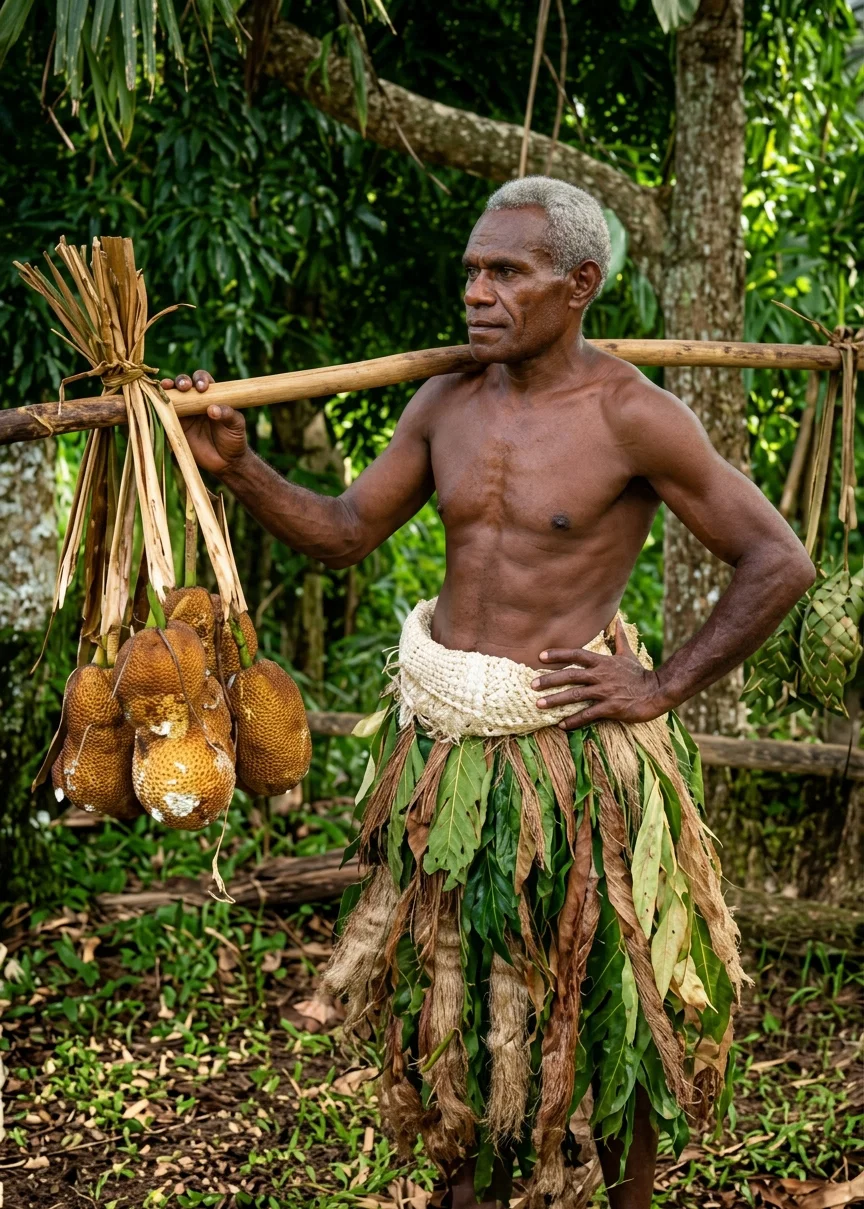
HAVING accompanied Mr. Stewart and Brother Parker and family to the Ra coast at the close of the year, it was my privilege to see something more of native life than is possible at Buresala. Knowing that our people are interested in learning about the customs of the people among whom our workers labor, I will try to give the details as we saw them, and as we have learned of them by inquiring among those around us:—14
Usually in a Fijian town New-year's day is a time of great feasting and rejoicing; but this one was uncommonly quiet, as a chief had died. Our host's brother, who lived next door, had been very ill for three weeks, and was much worse the last day of the year. He had no lack of help, but it was plain his end was near. A Fijian almost invariably has a presentment that he is about to die, and his friends generally hasten to dress him in his best clothes ere death draws on.
Early next morning we were awakened by a great wailing next door, and at once concluded that our neighbor was dead. This crying by the women was kept up for hours, then stopped, and three large conch shells were blown almost continuously in a most mournful manner. We were told that if the deceased were not of high rank, the women would have had to cry all day. By means of horns blown by the men, the friends in neighboring towns knew what had happened, and before long arrived to see the burial, and to stay several days with the bereaved wife. The day was spent mostly in preparing food, receiving and presenting mats, etc. Late in the afternoon it was our privilege to see our host present mats and whales' teeth to the wife and friends who had cared for the deceased.
A FRUIT VENDER IN FIJI
Here a whale's tooth is highly prized, as by presenting it anywhere a person can ask for and get almost anything he wants. On inquiring the meaning of this presentation we were told it was similar to our giving money to friends in need.
It seemed as if the whole town followed with the weeping wife to the grave, almost every one bringing a stone for the top of the grave.
Half-way through the ceremony, conducted by a native Wesleyan teacher, twelve or more mats were spread over the grave; on the top of these the body, already wrapped in about six mats, was placed, and at the close of the service lowered into its last resting-place. It did not take long to fold down the mats and fill in the earth. All sadness then seemed to be forgotten as the friends and relatives repaired to the feast prepared in honor of the dead.
Four days later another feast, in which the whole town took part, and which continued far into the night, was probably an outlet for the gaiety that had been repressed on the previous occasion. Later on another big feast will be made: then the relatives will be free to go back to their own houses. All this time they have, while consoling the bereaved, been living in her house and been fed at her expense. The wife is expected to stay quietly about her house for one hundred days.
It seems that these burial customs differ among the various tribes. The blowing of the conch shells is a special custom of this tribe: some persons here said that they had never heard it before.
The days of the wife's mourning differ according to rank, and love for the departed; about ten days may be sufficient for the common people. These things convince us that the power of custom is strong here in Fiji, but we can say that the truth is stronger still, and will triumph in the end.
During our stay at Namarai we were privileged to meet with our people from several small companies near. They came together for New-year, and for a small council. We believe the time was profitably spent, and all felt refreshed for the work before them. The women seemed especially grateful for the meetings held for them.
The work seems to be onward. Our school here has a brighter prospect before it, and we trust that it may be a blessing to many of our young people. We have much to make us rejoice, but we also see much to make us realize the greatness of the work before us.
Buresala, Ovalau.
E. H. WILBUR
By E. H. Wilbur
China
E. H. WILBUR
Kongmoon and Ngoi Hoi
By our removal to Canton with our evangelist, it seemed that the work in Kongmoon and Ngoi Hoi would suffer much. We sent two of our Chinese brethren down there, and they have sold literature, and kept up the interest of an intelligent class of inquirers, several of whom are teachers. Among those especially interested in the truth in this district (Sun Wooi), nine new students attended our schools in Canton the first half of the year, and made splendid growth in Christian experience. Since their return home for the summer vacation, they have been a great help to the local work. One young lady has made trips to a small near-by village, telling the gospel story. Her father accompanies her as escort and also talks to the people.
Canton
On account of the removal of several of the Hakka brethren and Brother J. P. Anderson from Canton, we closed the Hakka chapel in the northern part of the city, and also closed the building occupied as a boys’ school last year. The boarding boys and the school were transferred to the old chapel, just back of our main chapel. It seemed like retrenching, but proved beneficial to the school healthwise, as well as spiritually.
You have already learned of the large attendance and good spiritual interest in the girls’ school, under the supervision of Sister Vanscoy. The work has been very heavy for her, with the boarding school and the East Gate girls’ day-school, but the Lord has graciously sustained her.
Brother Cheung has carried on regular night meetings at the chapel. The new bund is now finished in front of our door, and has become a popular walk in the cool of the evening. Hundreds of passers-by come in and listen to the words of eternal life. Some have become deeply interested, and daily visit our evangelist for Bible study.
Fat Shan
The work at Fat Shan has been badly hampered for want of a suitable building and facilities for the medical missionary work. But Dr. Law Keem and wife have been able to reach a fine class of people, and the work there is broadening and deepening. There should be several ready for baptism before the year closes.
Hakka Work
With the release of Brother J. P. Anderson from Canton, the Hakka work has taken on new life. He has opened two new out-stations in places not yet entered by other missions. And in each of these places an evangelist and his wife are located, and a school is started, thus giving the people to understand that we are interested in their welfare, and that we have come to stay. Brother Anderson has made his headquarters in Wai Chou, one hundred twenty miles east of Canton, where he also has an evangelist located and a small chapel opened. Besides this he has three regular15canvassers in the field, who are traveling all the time from city to city and market-town to market-town. They are selling altogether about one thousand copies of the Chinese Gospel Herald monthly, besides getting annual subscriptions. Thus the message is going.
Brother Hung, at Chou Chou Fu, near Swatow, is still faithful, and is doing a good work. There is no reason why, with the arrival of a new foreign worker for that place, the message should not quickly go forth from that center.
Our little company of foreign workers in this province are now taking a much-needed rest at Macan. We have a quiet place by the seaside where we can enjoy the beauties of nature. All have greatly improved in health since coming here. While not actively engaged in missionary work, we have held a Chinese Sabbath-school in our house, which a Chinese pastor from Canton and an evangelist from Macan, with a few other native Christians, have attended. One of these Chinese brethren has been convinced of the Sabbath truth for over two years. His church is trying to hold him by having increased his salary, but he will surely take his stand for the truth soon. He is an able and worthy man.
Elder W. C. Hankins, superintendent of the South China mission field, made us a visit in July, attending a meeting of our provincial committee in Macan. We appreciated his presence and counsel very much. It was voted that we hold a general workers’ meeting in Canton, October 1-10, for which a good program was prepared. After our council Elder Hankins accompanied the writer to Ngoi Hoi, Kongmoon, Canton, and Fat Shan, where he preached to large and attentive audiences. His theme was the importance of having a real knowledge of God, and of being born again.
We are all well, and looking forward to the arrival of Elder I. H. Evans and other new workers for this field.