Your ShelfYour Projects

Review and Herald, Vol. 73, No. 11.

WHO ARE THE NOBILITY OF THE EARTH?
Earlier text: SOME PLAIN TALK

“OF THIS SORT.”

In 2 Tim. 3:6-8 we read: “For of this sort are they which creep into houses, and lead captive silly women laden with sins, led away with divers lusts, ever learning, and never able to come to the knowledge of the truth. Now as Jannes and Jambres withstood Moses, so do these also resist the truth: men of corrupt minds, reprobate concerning the faith.”
No one acquainted with modern Spiritualism can fail to see in these words an accurate description of certain classes of Spiritualists. Their most readily recognized affinities are silly, sin-laden women. They are men of corrupt minds, reprobate concerning the faith, many of them having once borne the title of “Rev.” in Christian congregations. They are “ever learning.” What wonderful strides they claim to have made in so-called scientific knowledge! How eagerly they plunge into those hypotheses and speculations which seem to conflict with the testimony of the Bible! With what an air of triumph they profess to be advancing in knowledge, when one speculation after another proves fallacious, and they are obliged to give it up for some other, equally unsound! But they are “never able to come to the knowledge of the truth,” for the very reason that they hold God’s word, where the truth is, in such contempt.
Now the significant point in what Paul here writes to Timothy is that the first five verses of this chapter (2 Timothy 3) describe the popular churches, with their catalogue of eighteen heinous sins, arrayed in the garb of a form of godliness, from which the power has departed; and then he says that “of this sort,” or “of these” (as the Revised Version has it), is this other class, which can be so easily identified as the Spiritualists of the present time.
This proves that there is not so much difference between the average professor and the spiritualist, as there ought to be. They are, in reality, all of one piece, of the same “sort.” Spiritualism is the logical landing-place of the modern church, if it shall continue to reject the power of true Christianity, and cling to the errors of its creed. Its unscriptural dogma of the immortality of the soul and the conscious state of the dead is the error which constitutes the warp and woof of Spiritualism, and without which it could not exist an hour. By this it has paved the way for the rapid progress and final triumph of this latter-day delusion. This dogma is the bond of union between Protestantism and Spiritualism, which must be broken, or the two must finally coalesce.
This is why Spiritualism is working its way so rapidly into the churches; why so many who still retain their membership there, and are counted there, are adherents of Spiritualism, and in certain circles are well understood to be such. The sins mentioned by Paul in the scripture above alluded to, appear in the churches in the last days; the very time when other scriptures foretell a lamentable religious decline, under the figure of the fall of Babylon. In those organizations where such sins are winked at, the “foul spirits” and “hateful birds” with which Babylon fills up (Rev. 18:2), find a congenial home. They become one family. “Of this sort” are they all.
And yet the Lord still has a people there, who will by and by discern their danger, and flee out of the midst of her. Isa. 48:20; 52:11; Rev. 18:4. We would that we could raise a note of warning so loud as to drown the siren song of peace and safety by which so many are lulled into a state of dangerous indifference; so loud as to overpower the jargon of error by which so many are confirmed in their deception; so loud as to rouse all to the peril of the situation, and lead them to see that either by reform or separation, they must refuse to be partakers of the sins which will soon compel God to speak in judgments from on high. Rev. 18:4-8.
U. S.

THE CHRIST OF JUDEA.

We have seen how by birth Jesus took upon himself our nature. The object of bringing this point very emphatically before the mind is that we may see the nearness of Jesus Christ as our Saviour. He has become one with us, and joined himself to us by ties which will never be broken, because to-day and for eternity Jesus Christ is one with us in humanity, still bearing this human flesh. “For there is one God, and one mediator between God and men, the man Christ Jesus.” 1 Tim. 2:5. He thus connected the human family with God once more.
Our God is a consuming fire. The manifestation of God himself is a glory before which sinful flesh cannot stand; but God gave Christ, who did not exchange his divinity for humanity, but clothed his divinity with humanity, in order that the human family might through his humanity and divinity be connected with the Father in heaven; so that we are brought nigh in Christ Jesus. This is set forth very strikingly in the dream of Jacob. The topmost round of the ladder reached up to heaven, where God was, and the bottom rested on the earth. Christ is the ladder reaching from heaven to earth, connecting sinful humanity with sinless divinity. This is the work of Jesus Christ. In its fallen condition, humanity is weak and bruised, and has no power or strength at all. It is unable to lift itself one inch toward heaven; but we find the divine Saviour right where fallen humanity is. There is none so weak that he cannot reach Jesus Christ, because Jesus Christ has come down. Our work is not to lift ourselves up, but it is simply to lay hold of Jesus Christ where he is, and he will lift us up to God.
Jesus Christ established a new family, of which he became the head. “And so it is written, The first man Adam was made a living soul; the last Adam was made a quickening spirit. Howbeit that was not first which is spiritual, but that which is natural; and afterward that which is spiritual. The first man is of the earth, earthy: the second man is the Lord from heaven. As is the earthy, such are they also that are earthy: and as is the heavenly, such are they also that are heavenly. And as we have borne the image of the earthy, we shall also bear the image of the heavenly.” 1 Cor. 15:45–49. So Jesus Christ the Lord from heaven, the last Adam, in entering into this relationship with the human family, became the head of this family just as Adam was the head of the divine-human family originally. Jesus Christ was God in heaven, and he came to this world, and was born of the flesh, and thus he who had been born of the Spirit, was afterward born of the flesh, and by this double birth this family was established,—the divine-human family of which he is the head,—in order that we who have already been born of the flesh, may by his grace and the power of the same Spirit, be born of the Spirit,—that is, every member of this divine-human family is twice born. And Jesus Christ took the same relationship to this family that the first Adam took in the beginning, in whom were found all the members of the family. As in Adam every member was created, when he was given the power to reproduce, so in Christ every member of the family which he established, of which he is the head, was in him, and he gathered into himself the whole family. The same relationship is sustained toward him as was sustained toward the first Adam. As what we receive by birth from flesh is the flesh of sin, with all the tendencies of evil,—for that which is born of the flesh is flesh,—and as by birth of the flesh we enter into all the experiences of Adam, by having his nature; so by this new, this second birth, we enter into the family of God and the nature of Jesus Christ our Saviour, becoming partakers of the divine nature. Jesus Christ identified himself so fully and completely with us in his humanity as our divine Saviour, as well as our brother in the flesh, that he said, “Inasmuch as ye have done it unto one of the least of these my brethren, ye have done it unto me.”
Now let us consider what the mission was on which he was sent to this world. We may say that his mission was to reveal God in such a manner that man could understand and comprehend him. “God, having of old time spoken unto the fathers in the prophets by divers portions and in divers manners, hath at the end of these days spoken unto us in his Son, whom he appointed heir of all things, through whom also he made the worlds; who being the effulgence of his glory, and the very image of his substance, and upholding all things by the word of his power, when he had made purification of sins, sat down on the right hand of the Majesty on high.” Heb. 1:1–3, R. V. Let us notice especially the thought that Jesus Christ is the effulgence of the glory of God, the pouring forth of his glory, the outshining of his glory, the very image of his substance. The relationship between God and the things outside of him, especially the human family, is such that God reveals himself only through his son, Jesus Christ. So complete was this revelation, that he says of himself in John 12:45, “He that seeth me seeth him that sent me.” He came in the flesh on a mission to this world, sent as an apostle to his brethren. He came that those who saw him might see the Father. Jesus Christ was God revealed and manifested in the flesh. When man so completely lost sight of the true character of God, his loving, divine, and compassionate character, even those divinely appointed sacrifices became an offense to him. Christ came in the flesh, and revealed God, that the human family might comprehend the true character of God. While he was human, he was also divine, and he revealed the true character of the true God. “Philip saith unto him, Lord, shew us the Father, and it sufficeth us. Jesus saith unto him, Have I been so long time with you, and yet hast thou not known me, Philip? he that hath seen me hath seen the Father; and how sayest thou then, Shew us the Father? Believest thou not that I am in the Father, and the Father in me? the words that I speak unto you I speak not of myself: but the Father that dwelleth in me, he doeth the works.” John 14: 8–10. His whole ministry of three and a half years, which was just closing, was for the express purpose of showing the Father to the world; to reveal God in such a manner that the human family, fallen and sinful, might comprehend him; and Jesus Christ revealed the Father not simply in his words, but his life was a revelation of God’s life. When he healed the sick, it was but showing forth the character of the great Healer. When he was lifting up those who had fallen down, he was showing forth the willingness of God to be the mighty Helper. That was the way Christ was revealing to the world the character of God. One purpose of his mission was to reveal God to the world in human flesh, that humanity might have a correct idea of the true character of God the Father.
Christ came as the outflowing of the love of God. “God so loved the world, that he gave his only begotten Son.” It was because God loved the world that he gave Christ to die. One purpose of his mission was that he might reveal to humanity God’s idea concerning humanity—not simply that he might reveal God, but that he might reveal the image of God, as God intended it should be revealed in man. So Jesus Christ, the Christ of Judea, was the ideal man; he was our example of what man should be. In the beginning God said, “Let us make man in our image,” and Jesus Christ was the one through whom this was carried out; for “without him was not anything made that was made.” Jesus Christ was the agent of God in creating the nature of man, which he himself was afterward to bear in this world.
W. W. P.
(Concluded next week.)

TO CORRESPONDENTS.

44.—In 1 Thess. 4: 16, 17 Paul speaks of the coming of the Lord, of the resurrection “of the dead in Christ,” and of the taking up of the living; but what becomes of the living wicked? C. R. B.
45.—If God is not the God of the dead, but of the living only (Matt. 22: 32), and as Abraham, Isaac, and Jacob died many years ago, does it not follow that they have an existence in another state? J. R. W.
No; we think not. By reading the preceding verses it will be seen that the resurrection of the dead was the subject in question; and Jesus was proving out of the Pentateuch, in which the Sadducees believed, though they rejected most of the Old Testament, the resurrection, which they denied. If God is still the God of Abraham, it shows that Abraham will have a resurrection. This was the argument, otherwise it would seem to have no force.
46.—(1) How long was Noah building the ark? (2) What would have been the result had Esau instead of Jacob received the blessing from Isaac? S. S. L.
I am not aware of any definite information. Noah preached for one hundred and twenty years. See Gen. 6: 3, and “Patriarchs and Prophets,” p. 96. Peter writes that Noah preached “while the ark was a preparing.” 1 Peter 3: 19, 20. It would seem appropriate that while the invitations of mercy were being held out, the means of salvation should also be preparing. (2) All through those patriarchal days we are struck by the value that was attached to the father’s blessing. This blessing was conferred by the laying on of the hands. Gen. 48: 13–19. This custom was transmitted to the gospel church. By the apostles the Holy Spirit was conferred by the laying on of the hands. By this means they were capable of transferring the blessing which they had received and enjoyed. It is probable that this was the case in patriarchal days. It rested with the father, as the priest of his own house, to place upon the son of his choice the special blessings that God had vouchsafed him. That the value of this blessing was not an imaginary thing, the bitter tears and lamentations of Esau abundantly testify. But in the case under question, I suppose that had Rebecca and Jacob trusted the matter to God, he would have seen that the blessing was placed where it belonged, on Jacob, and the long years of separation and servitude need not have been endured, and Esau would have suffered no wrong. It is thus, by taking the work out of God’s hands, that some of our most grievous mistakes are made. The case presented in the question is not supposable; or if it be so, we cannot tell how things would have been if they were not as they are.
47.—Where did the twelve tribes originate? how did they preserve their tribal relations? and how long did they continue? E. P.
The best answer to these questions is to be found in a study of the historical books of the Old Testament. Briefly, the tribes originated with the sons of Jacob. Genesis 46. The land of Canaan was parceled out to the tribes, and their boundaries clearly defined. See the book of Joshua. These distinctions seem to have been well preserved until the division of the kingdom in the time of Rehoboam. 1 Kings 12. After that the principal distinction was between Judah and Israel. The first embraced the tribes of Judah and Benjamin, and the second the other ten tribes. The Jews are the descendants of the former, while the latter became extinct as a separate people during wars and captivities with Assyria.
48.—(1) Does the expression, “And there was no more sea” (Rev. 21: 1) mean that there will not be any bodies of water called seas in the new earth? (2) To whom does the Lord refer in Job 38: 2, “Who is this that darkeneth counsel by words without knowledge?” to himself, Job, or Elihu? F. S.
(1) It is not unreasonable to suppose that the meaning of the expression is that the vast wastes of water which now cover three fourths of the earth will be no more. There will be rivers and streams there (Rev. 22: 1; Isa. 35: 6), and we may believe there will be pleasant lakes, but no oceans. It is probable that these were produced at the time of the flood. (2) To Job, undoubtedly. The Lord was answering Job’s arguments; but he had no reproof for Elihu.
49.—(1) Please explain Rev. 9: 15 through the REVIEW, as several are interested. It appears to me that this is a prophecy of time. (2) Please explain Prov. 26: 4, 5.
(1) You are right. The prophecy relates to the time of the supremacy of the Ottoman empire, and is one of great interest and value. But in this place we could hardly give space for its exposition, with the attendant facts. See “Thoughts on Daniel and the Revelation,” page 480 and onward. (2) It is difficult to know how to treat people who act foolishly, for if you answer them according to their folly, you make a fool of yourself; and if you answer them in wisdom, they cannot comprehend your meaning, and therefore consider their arguments unanswerable. Either way, there is difficulty. These are maxims, rather than commands. Solomon was not in favor of answering a fool, but of putting a rod on his back. Verse 3.
50.—Please explain Num. 28: 18. “In the first day shall be an holy convocation; ye shall do no manner of servile work therein.” A. M. H.
Reference is made to the first day of the feast, not the first day of the week. See verses 24 and 25. These were annual sabbaths. Lev. 23: 24–39.
51.—Please harmonize Matt. 1: 16 with Luke 3: 23. An infidel here says it cannot be done. He wants an answer.
A comparison of the two genealogies of Christ will show that they separate after David. Matthew gives David, Solomon, Rehoboam, etc.; and Luke gives David, Nathan, Mattatha, etc. They have no further agreement until they reach Joseph, the “supposed” father of Christ. Matthew follows the line of Joseph, and Luke follows that of Mary, both together showing that Christ was of the seed of David by a double line of descent. Joseph’s name is inserted in the place of Mary’s by Luke because the Hebrews never permitted women to enter their genealogical reckonings. When a family ended with a daughter, her husband’s name was inserted instead of hers.
52.—G. H. C. wishes the REVIEW to notice some marked paragraphs of a report of one of Ingersoll’s lectures, for the benefit of several inquirers. They are in substance as follows: (1) “The Bible says, After the flood some seventy people went into Egypt, and in fifteen years they had increased to 4,000,000. It says that there were 600,000 men of war. (2) We read that David built a temple forty-five feet high, with a porch one hundred and eighty feet high. Probably the architect was inspired. (3) Matthew says that Christ was born when Herod was king, and Luke says that it was when Cyrenius was governor; but according to Greek history and the annals of Rome, Cyrenius was not made governor until ten years after Herod was dead.”
Following up Robert Ingersoll, or any other railer against the truth, is not a profitable business. It is like following a crane, who tempts you into a swamp. He is at home in the muck and mud, while you will soon get stuck. However, these so-called criticisms are sometimes thrown into our faces in a way that it is difficult not to notice them. To criticize is one of the easiest things in the world. While the Lord has provided abundant grounds for faith, he has left sufficient room for doubt to those who choose it.
(1) This is one of Ingersoll’s mistakes. The children of Israel were in Egypt at least two hundred and fifteen years. The Bible does not give their number at the exode. The length of life was greater then than now. It is true that the result shows an unusual increase, and the Bible claims that it was so. Ex. 1: 7. But reckoning their number at 3,000,000, the ratio of increase would be by no means impossible, even if there were no miraculous intervention. (2) What of it? The portico, or façade, of the temple rose high above the main part of the building—a mode of architecture not uncommon then, nor unknown now. All the representations of the temple show it that way. (3) Various methods of explaining this apparent difficulty have been employed by commentators. One of these, which does not seem improbable, is that instead of the Greek word πρῶτη, translated “first,” we should have the two words πρὸ τῆς, in which case it would read: “This taxing was made before that when Cyrenius was governor of Syria.” But to my mind it is wholly unnecessary to twist the record to accommodate our imperfect understanding of the secular history of those days. It is not at all improbable that Cyrenius did occupy some place of authority before he was formally appointed governor. One thing is certain; we cannot afford to throw away the great weight of evidence we have in favor of the inspiration of the Bible because such men as Ingersoll can throw dust on some obscure points like the above.

Would the 1900 Date Proposition Be Correct?

53.—Would the following be a correct proposition?—God told Noah that the days of man should be one hundred and twenty years. Christ says, “This generation shall not pass, till all these things be fulfilled.” The generation of Noah was one hundred and twenty years. From the dark day in 1780 to 1900 is the same period. This would bring the end in 1900. What do you think of it? A. M.
I think it is unnecessary speculation, not sustained by the circumstances. “This generation” means the people living at the time referred to.
54.—(1) Please explain 1 Cor. 1:18, last clause. Can we say we are saved to-day? (2) Would it be right for me to cook pork for my husband, who is not a Christian?
(1) The salvation provided by Christ is a present salvation. Because some people make an extreme of that grand truth, we should not take the opposite extreme. A man rescued in mid ocean is saved if he abide in the ship, though of course he can jump overboard. Christ rescues, cleanses, saves, those who come to him. (2) Your best way will be to learn to prepare more healthful food in such a good and attractive shape that your husband will not care for swine. But if he requires it, you do not do wrong in heeding his wishes. Unbelieving husbands are to be won by the godly deportment (conversation) of their Christian wives, rather than exasperated by refusals to comply with what are to them, at least, reasonable requirements.
55.—Please harmonize John 14:19 and Rev. 1:7. One says, “The world seeth me no more,” and the other says, “Every eye shall see him, and they also which pierced him.” J. D. B.
The principal difficulty in this case, as in many others, is in not taking the Bible in its evident meaning, but putting a strained, unnatural meaning in its place. Jesus says, “Yet a little while, and the world seeth me no more.” That is, he was going to heaven, where they could not see him. And there is no occasion for putting this statement into opposition with one concerning his second coming, when all will see him. The world had seen him, and had an opportunity to believe in him, but he was now soon to go away.
56.—Is it wrong for a Seventh-day Adventist to hold a place in a village treasurer’s office? A. J. B.
It would not be inconsistent for a Christian to work for a town treasurer. The question of holding an elective office is another thing, and is frequently so beset with worldly entanglements as to make it difficult to maintain an earnest, Christian life. I do not hold that it is in itself sinful to hold an official position; but the present state of public affairs is inconsistent with pure and undefiled religion, and the drift is making it more and more so.
57.—Please harmonize the apparent contradiction found in Acts 9:7 and 22:9. S. W. S.
It seems evident that those who were with Saul heard the sound, but it did not strike them as articulate speech. Once when God spoke to Christ, those who stood near said, “It thundered.” So now; they heard the sound, but not the voice of speech. G. C. T.

BURMA

Burma lies east of the Bay of Bengal, and covers a range of country stretching from the 10th to the 27th parallel of north latitude, a distance of nearly one thousand two hundred miles. It has a very extensive seaboard, and an area of 280,000 square miles; or, in other words, it has three and one-third times the area of the United Kingdom of Great Britain and Ireland, and a population not much more than one fifth as great. Its resources are great, and the country is developing very rapidly.
It is divided into two great divisions,— Upper and Lower Burma. As a rule, the country is undulating, and the soil very productive. It is well watered by numerous rivers, the largest of which is the Irawadi, navigable throughout the year for over nine hundred miles, and for purposes of commerce forming the great artery of the province. The internal commerce is extensive, and the foreign trade large and profitable. The commerce of Rangoon exceeds that of Madras. The principal exports are rice, teak timber, cutch, and india-rubber. Many of the tropical fruits are extensively grown. Cotton, tobacco, tea, coffee, and cinchona are produced in various parts of the province, and Indian corn, millet, peas, and sesamum are extensively grown in Upper Burma. A number of the useful and several of the precious metals are dug from the earth.
Though England has had commercial connection with Burma for more than two centuries, her first permanent connection dates from 1824, when the foolish king, who was a very cruel despot, declared war against Great Britain, and prepared golden chains to bind the governor-general of India; but a mere handful of British defeated his army of 60,000 men, and England took a large portion of his territory. In 1852 England took some more territory from the king of Burma, and about ten years ago, deposed the king, and all Burma became a British province.
The rapidly growing population — now more than eight million — is said to be composed of as many as forty-seven different races, which often mingle closely together in both town and country. The Burmese are by far the most numerous, and number 6,200,000. There are 500,000 natives of India, 40,000 Chinese, and 21,000 Europeans and Eurasians in Burma. The Burmese language is generally used, being the language of the courts, of commerce, and of literature. The Burmese are smaller of stature than the European races, yet they appear to be a hardy and robust people. They belong to a race which is considered to be intermediate between the Chinese and the Malay race. Their faces have an open, wide-awake expression, and not the sleepy eyes of the Chinaman. They are polite in their manners, and most of the men are able to read.
Buddhism is the prevailing religion, and the people are free from the fetters of caste which bind their neighbors across the Bay of Bengal; thus they are much happier socially than the people in India. The women, who are far better looking than the men, dress very neatly. They are great tobacco-smokers, and very independent; they usually carry the family purse. Very few of them know English.
This presents a difficulty in my work; but the time has come, and the work must be done. The hand of the Lord is in this work, and I am having fully as good success as I had in India, or even better. I liked India as a missionary field, but I have rather fallen in love with Burma. I love to work for these people; they are so good in many respects. It is a saying among the Europeans that a Burman would divide the last morsel of food he had, if he saw a person in need, and I believe that there is a good deal of truth in it.
There are 121,000 professed Christians in Burma, making one sixty-sixth of the entire population Christian. A very large portion of these are from a tribe known as the Karens, who number 631,000. There is a tradition or belief among this people that salvation would be brought to them from the far west, and so large numbers of them readily received Christianity when it was brought to them by the missionaries; and these converts are said to be very good Christians. During the first seventy years of missionary work in Burma, but few converts were gained from the Burmese proper; but within the last decade a great change has come over them, and they are manifesting a very encouraging interest in Christianity. The spirit of God is working upon their hearts, and preparing them for the reception of the last message of mercy; and may God help us to realize the condition of the people in these far-away lands, and our duty toward them as it really is.
This nation stands with its doors wide open, and many of the people are pleading for more light. Now we have golden opportunities to spread the truth in this land, and they should be improved, for they will not last long. Soon the time of trouble, spoken of by Daniel the prophet, will burst upon us, and war, famine, distress, and perplexity will cut short the blessed privilege of rescuing souls. O let us arise and labor as never before! “For as the earth bringeth forth her bud, and as the garden causeth the things that are sown in it to spring forth; so the Lord God will cause righteousness and praise to spring forth before all the nations.” In the General Conference Bulletin, on page 373, we have the following from the pen of Sister White: “The work has been presented to me, as, at its beginning, a small, a very small rivulet. The presentation was given to the prophet Ezekiel of waters issuing ‘out from under the threshold of the house eastward . . . at the south side of the altar.’ Please read Ezekiel 47. Mark especially verse 8: ‘Then said he unto me, These waters issue out toward the east country, and go down into the desert, and go into the sea: which being brought forth into the sea, the waters shall be healed.’ This work was presented to me as expanding to the east, and to the north, and to the islands of the sea, and to all parts of the world.” Please read the ninth and tenth verses of the same chapter of Ezekiel. There is a great multitude of fish over here, and the fishers when they come to these lands will find numerous places to spread forth nets, and their fish shall be according to their kinds (nations), exceeding many. Come over and be fishers of these people. I know of no other country mentioned in the Bible where such a multitude of fish is promised as to those who fish in the east country.
Rangoon, Burma. WILLIAM LENKER.

LIFE'S DECLINE.

BY W. W. NORTON.
  • (Northfield, Minn.)
I HAVE this day completed my sixty-fourth circuit around the sun. I have journeyed far, but am now—
“Nearing the bound of life, Where burdens are laid down.”
The outward man is failing, Its strength of youth is gone; Life’s banner low is trailing, By feeble hands scarce borne. Late march is sadly tiring To those o’ertasked ere noon; Hark! sunset guns are firing, And rest now cometh soon.
We thank thee, glorious Saviour, Who called us by thy grace, And trusted us with treasure, And gave to us a place To use for thee, our Master, To work with thee, our Lord; And then, toward disaster, Became our guide and guard.
But as thou didst constrain us Through love to work with thee, Bear with us, and retain us, Who didst our failures see; For this we owe thee ever Adoring, grateful love, Which we can pay thee never, While endless ages move.
We give to thine own keeping Our life’s poor work, and pray There may be some glad reaping, Some fruit for thee, that day When, waking from their slumber, The dead to judgment come, And thou as thine shalt number All whom thy love hath won.

MICHIGAN

Grand Ledge.—Our meetings closed here yesterday with the organization of a church fully equipped with the necessary officers, taking the name of the Seventh-day Adventist church of Grand Ledge. Twenty adults were united in church fellowship. The services were conducted by Elders Evans and Burrill. Several expressed it as being the most solemn and impressive meeting of the kind they had ever attended. Seven of the number had lately accepted the faith, and all give evidence of a new conversion since the labors with them began. Several more are keeping the Sabbath, and expect to unite with the church soon.
I have become very much attached to this company, and my earnest prayer is that they may live so close to God and to each other that the enemy may never come in and divide or alienate their interests or their feelings.
J. F. Ballenger.
Fairgrove.—Our week's meeting here was quite well attended by the church and the brethren from neighboring churches. There are quite a large number of young people in this society, with whom we held separate meetings most of the time. Several found the Lord for the first time. Two or three began the observance of the Sabbath. The club of Signs was increased from eleven to one hundred. We regretted very much that we could not stay and follow up the interest that was awakened among those not of our people.
Elmwood.—Two days were spent with this little church, and it was a time of real refreshing. Deaths and removals had very much reduced their numbers. They show a commendable spirit in the missionary work, and increased their Signs club from fifteen to fifty, arranging to divide the territory and give a thorough canvass for the Signs among all their neighbors. There were two individuals that began keeping the Sabbath during these two days' meetings. If labor could be bestowed here, it seems that their numbers might be increased, and a house of worship put up. Both of these societies showed a commendable spirit in assisting the Saginaw brethren in erecting their new buildings.
Flint.—A goodly number of the brethren came in from the neighboring churches, and although we did not see as much accomplished as we desired, four or five found the Lord for the first time.
Hazelton.—Notwithstanding the weather was extremely cold, the attendance was good the most of the week. At least twelve were converted to God, and two or three began the observance of the Sabbath. They already had a club of fifty Signs, and were doing a large amount of missionary work. There was a general interest, among those not of our faith, to listen. At each of our services we would see scattered through the congregation quite a large number not of our people. We regretted that we could not stay longer with them.
A. O. Burrill, O. Soule.
Muskegon and Fremont.—Since my last report the work at Muskegon has been making some progress, and a few more have accepted the truth. There is a good attendance most of the time at our Sabbath meetings, quite a few attending who are not of our faith. The Sunday evening meetings have also been well attended, the hall which we use being nearly full; but the last two Sunday evenings we have not had as large an attendance. We think this may be the result of one who has come here in our midst claiming to be a “divine healer,” also pretending to be a Seventh-day Adventist. The whole city has seemed to be astir over the “healing” part of it, but he has proved to be nothing but a fraud. A week ago last Sunday evening he was hooted out of the place by a mob two hundred strong, and he has left the city, leaving behind several unpaid bills and a very bad reputation. Although we hope it will not permanently hinder our work, it has its effect more or less. We pray earnestly that the Lord will overrule for good.
OUR 'FIRST SOUTH AFRICAN CAMP-MEETING.
From January 16–18 we met with the church at Fremont, which is made up mostly of Holland brethren and sisters. This was the time of their quarterly meeting, and the ordinances of the Lord’s house were celebrated, in which all took part. Perfect harmony and unity exist in this church. One new member was added, and another who attended the meetings became deeply interested, and has since begun the observance of the Sabbath. It did us much good to see the church in such a good condition. Officers were elected, and Brother Reefman, who has been leader of the Holland brethren there, was chosen elder, and Brother Carpenter deacon. February 28, 29, I met with this church again for the purpose of ordaining Brother Reefman. The Lord came very near in the social meeting and also at the ordination. This church has never been in a better condition than now. Our prayer is that they may remain steadfast until the coming of the Lord.
B. F. Stureman.

TENNESSEE

UCEBA.— From the Atlanta Institute we came to Nast, which was the post-office for this valley, where we now live. We find the company of new Sabbath-keepers all of good courage and firm in the faith. We see signs of the working of the leaven of truth, and we hope others will yet obey. We have distributed scores of Signs, Sentinels, Youth’s Instructor, Little Friends, and tracts all through these hill-and-valley homes; and we know the word they contain shall not return void. We now have a Sabbath-school of twelve. Four of these are members of the church. We are included in the number. Two more are now ready to be baptized and unite with us.
Here are four souls, all of whom have been saved from the habit of using tobacco, and they have also exchanged swine’s flesh for more wholesome and perfect food. This means a great deal in a country where the use of these things is so general. Since our return, four or five of our neighbors have resolved to quit the use of snuff, because they are persuaded it hurts them. We thank God, and take courage. We hope for the presence of God in our own lives daily, and that God will use us as instruments of blessing to the very utmost possible by him. We want his gracious blessing for all around us.
CHARLES E. STURDEVANT, MRS. C. E. STURDEVANT.

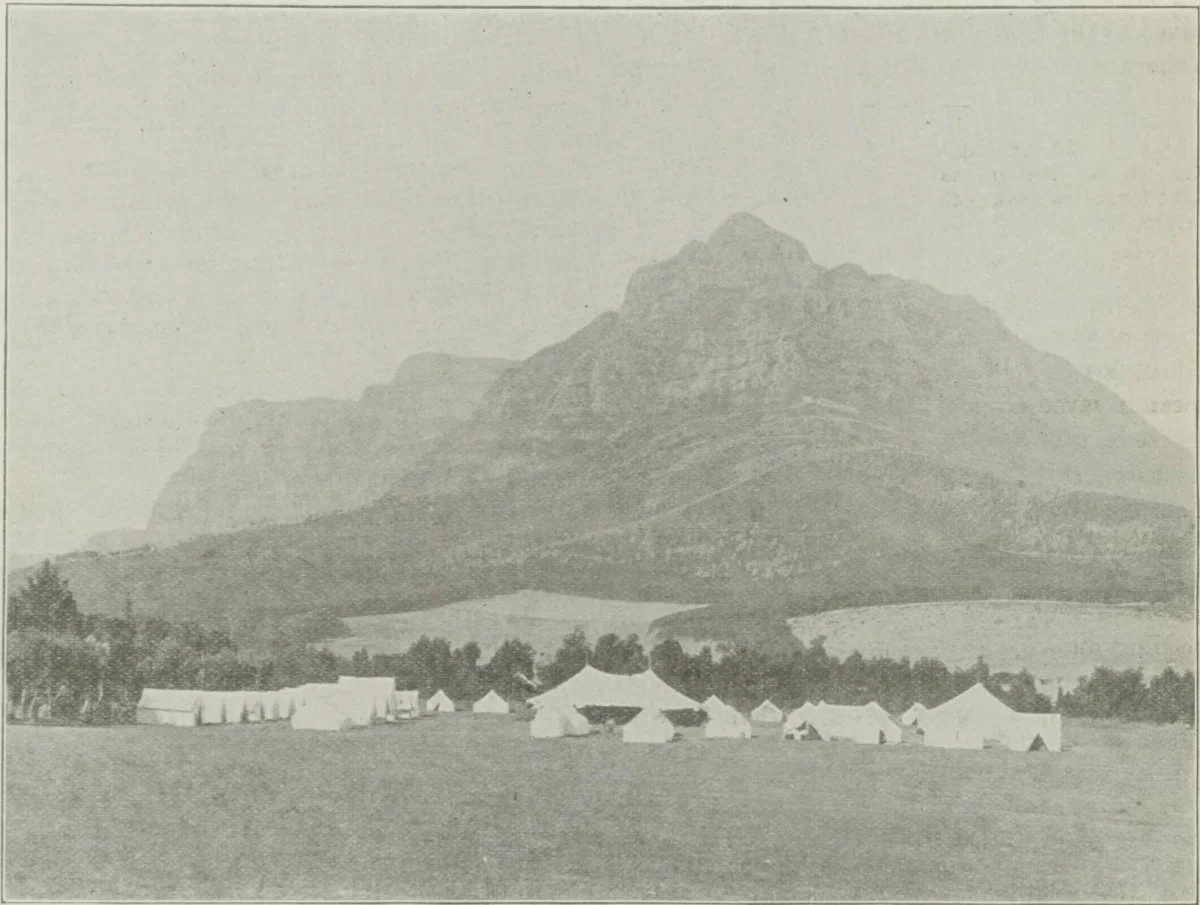
THE SOUTH AFRICAN CAMP-MEETING.

We are pleased to present this week a view of the first camp-meeting held in South Africa. Reports of this meeting have already been given; but our readers will be pleased to see how the camp looked. In the background is Table Mountain, which rises about three thousand feet above the sea. The camp is near the village of Mowbray. To the right, around the mountain, is Cape Town. To the left is situated Claremont, where the college is located. A railway connects these places. Half way up the mountain side may be discerned the signal-station from which approaching vessels are signaled by flag. From the top of the mountain an extended scene of land and ocean is before the beholder.
Continue reading: NEBRASKA