Your ShelfYour Projects

Signs of the Times, Vol. 27, No. 28.

BETHLEHEM
Earlier text: DISCARDING AGRICULTURE, AND THE RESULT OF IT

A TELLING RECOMMENDATION.

THE following incident “About Boys” in the Youth’s Companion, contains more than a hint to success in life. It says:—
“When I was fourteen years of age it became necessary for me to go out into the world and earn my share of the family expenses. I looked about with small success for a week or two, and then I saw a card hanging in a store window, ‘Boy Wanted.’
“I patted down my hair, brushed the front of my jacket, and walked in. ‘Do you want a boy?’ I asked of the clerk.
“‘Back office,’ he said.
“I walked back to the little den with a high partition around it, and, pushing open the door, which I noticed was slightly ajar, cap in hand, I stepped in.
“It was a chilly day in November, and before I spoke to the proprietor, who was bending over a desk, I turned to close the door. It squeaked horribly as I pushed it shut, and then I found that it wouldn’t latch. It had shrunk so that the socket, which should have caught the latch, was a trifle too high. I was a boy of some mechanical genius, and I noticed what the trouble was immediately.
“‘Where did you learn to close doors?’ said the man at the desk.
“I turned around quickly. ‘At home, sir.’
“‘Well, what do you want?’
“‘I came to see about the boy wanted,’ I answered.
“‘O!’ said the man, with a grunt. He seemed rather gruff, but somehow his crisp speech didn’t discourage me. ‘Sit down,’ he added, ‘I’m busy.’
“I looked back at the door. ‘If you don’t mind,’ said I, ‘and if a little noise won’t disturb you, I’ll fix the door while I’m waiting.’
“‘Eh!’ said he quickly. ‘All right. Go ahead.’
“I had been sharpening my skates that morning, and the short file I used was still in my pocket. In a few minutes I had filed down the brass socket so that the latch fitted nicely. I closed the door two or three times to see that it was all right. When I put my file back in my pocket and turned round, the man at the desk was staring at me.
“‘Any parents?’ he asked.
“‘Mother,’ I answered.
“‘Have her come in here with you at two o’clock,’ he said, and turned back to his writing.
“At twenty-five I was a partner in the house; at thirty-five I had a half interest, and I have always attributed the foundation of my good fortune to the only recommendation I then had in my possession—the file.”
And still it was not the file so much as the willingness to use it during a “spare moment,” that was the recommendation. The action was an index to the boy’s character.

HIS “GREATEST CRIME.”

It is a saying among the French that an Englishman will rise on a beautiful morning and say, “This “is a glorious morning. Let us go out and kill “something.” But I never had a fondness for the murder of animals, birds, or even fish.
But some years ago I was stopping with a friend, a doctor in a little town in Illinois, and he proposed that we go out and kill something. So giving me a gun, and taking one for himself, we started for a small grove about two miles from his house, but failed to find anything to kill. The squirrels, which were our objective game, had evidently got an inkling of our coming, and kept out of sight. After an hour or so spent in the forest, we started to return to the house.
Sauntering leisurely along under some tall elms, I heard a bird singing, and looking up I saw a wee bit of a bird perched upon a lofty limb, singing very sweetly. Without a moment’s thought, and without the slightest idea that I could hit so small a mark (for I had none of the spirit of murder in my heart), I up with my gun and banged away. I saw some feathers fly, and the little songster came dropping down from branch to branch, and fell at my feet. I stooped down and picked it up. It was a tiny little thing, not much larger than my thumb, of a yellowish-green color, as beautiful as it could be. Then like a flash the thought came upon me, what a contemptible deed I had done. Here was one of God’s beautiful creatures that had just as much right to existence as I, and its life, doubtless, was as sweet to it as mine was to me, and at that very moment that it was singing its beautiful songs to make the world more pleasant and glorious, I had brutally shot it to death.
I carefully buried it among the leaves, and then promised myself that I would never again wantonly destroy life.
I regard this the greatest crime I ever committed. —Colonel John Sobieski.

DON'T WORRY.

WHEN things go contrary, as often they do, And fortune seems burdened with spite, Don't give way to grieving all dismal and blue— That never set anything right! But cheerfully face what the day may reveal, Make the best of whatever befall— Since the more that you worry the worse you must feel, Why waste time in worry at all?
We all have our troubles, some more and some less, And this is the knowledge we gain— It's work and a brave heart that lighten the stress Of a life's share of sorrow and pain; Then face with this knowledge fate's cruellest deal, Too plucky to faint or to fall— Since the more that you worry the worse you must feel, Is it wisdom to worry at all? —St Louis Republic.

A WORD TO PARENTS.

NEXT to the highest responsibility in life is that which you sustain to your children in their earlier years. No question can be of greater importance to you than your habits of thought, and your general attitude toward your children. The sense of authority which comes to parents sometimes blinds them to the rights of children, and leads to imperativeness which easily becomes cruelty. Parents are in danger of demanding things of their children for their own sake, rather than for the sake of the child and its best good. Few mistakes could be greater than this, and few are fraught with worse results.
Your children have many rights, and most of all, the right to be treated so that their unfolding powers and distinct personality shall be given right tendencies and just development. You are to have judgment for both yourself and them, but your judgment and wisdom must be so applied to their lives that growth and unfolding will result rather than suppression.
Both observation and experience have taught us that the average parent is in danger of underrating the rights of his child, and of demanding of the child, under given circumstances, more than physical powers and general experience will justify. It must be remembered that beyond its intuitions the child has everything to learn, including that most difficult of problems, the adjusting of itself to a superior will, to stronger physical powers, and to standards of thought and action which come only with years of experience. The parent who is always looking out for some act or purpose on the part of his child which is contrary to the parent's wishes, as tho there was a natural antagonism between them, is most unfortunate, and probably he will be unjust to his child. Correspondingly dangerous is that attitude which sees only the good traits of the child, and fails to recognize the necessity of such training and pruning as will bring the child to its best in after-life. Remember that every interest of the child must be considered in the light of coming years, rather than of momentary surroundings. What the parent does for the child, and the habitual attitude he assumes toward it, go far to determine the destiny of the child for all time. This is enough to set you thinking.—Sabbath Advocate.

DANGER OF LEVITY.

ONE may laugh himself to death and into perdition. Humor, “the saving quality of sane minds,” when it becomes levity is a very dangerous thing. The home where everything is turned into a jest is not a safe place to rear a boy or girl.
Every healthy mind enjoys a certain amount of humor. A flash of wit or a ray of fun gives a stimulus to the mind and lightens labor. It is a blessing to be able to laugh, for God gave us mirth for our good. But not fun-making, nor yet fun-hunting is the business of life. This life of ours with all its struggles and battles is a serious proposition, and the poorest preparation any youth can be sent out with is a giddy head and a frivolous heart.
In many homes the child is given amusement—nothing but amusement, everything for amusement. Its play, its books, its parties are all just for fun. When its elders are together, they do nothing but joke each other and tell funny stories. At morning, noon, and night there is one constant endeavor to do or say something amusing. This they often do under the delusion of being cheerful.
The child grows up with but one taste—that of amusement. There has been but one effort, that of entertaining the child, and keeping it, as the parent supposed, a happy child, forgetting that the poorest happiness in the world for a child is mere amusement. There has been no serious purpose suggested to the child. It has not been directed toward any earnest occupation. “O, time enough for that,” say the parents with a laugh.
The child becomes a youth. He has no abiding taste for anything, no thirst for knowledge, no strong ambition. A snatch of song, a joke, a funny story, a vocabulary of slang, fills his mind, which is but a grab-bag of fun. He wants to be entertained, he wants fun. Amusement, like a joke, is soon stale when often repeated. The boy goes far and near in search of new entertainment. He has no taste for serious reading or study, and no liking for any handicraft. He becomes a fun-hunter. After testing the less harmful amusements, he tries those having more excitement. He naturally associates with people, who, like himself, are hunting some new laugh. Directly he is far down the road that leads to where “men love darkness rather than light.”
The father and mother hold a consultation; they are uneasy. The boy is called in off the streets into his father’s office, and is told it is about time for him to “settle down.” “Settle down!” What has the boy to “settle”?—A frothy mind that loves only fun, and does not want to “settle,” and an untrained body that does not know how to “settle.” A jest is dearer than the truth, amusement sweeter than the fruits of industry. The parents wonder, “How can it be possible for a boy treated as our boy has been treated to throw his family name away with a laugh on his lips!”
In early life the child should be impressed with the seriousness of life—not its gloom. It should know its business is preparation, its play only recreation. It should hear the serious questions of life discussed around the family circle. Thus it may acquire a taste for real things, a taste for serious knowledge and earnest work.
Many of us are too prone to let our fondness for amusement at times get the better of our serious work. We talk nonsense when it should be sense, leave untold an important truth that we may tell a funny story. After all, the greatest joy comes as the reward of serious effort, and the only happiness in doing purposeful work.—William H. Hanby.

HELPING TO MAKE HOME-LIFE HAPPY.

It is in the power of all young men, and even children, to help make the home bright and happy. It is not costly furniture or adornments purchased with money that make home the dearest spot in the world. It is smiling faces, gentle words, and the many little deeds that all can do, which create a true home. It is the duty of each member of the family to engage in the work of making a happy home. No one, however small, can be excused from the pleasant task. If smiles and gentle words, sustained by a loving soul, can carry sunshine into the home, then it may ever be a happy place.
Children, then help in the true work. Your parents may be earnestly engaged in procuring the “daily bread.” They need the inspiration of your loving deeds to help them in their struggles to provide the home for you. Do the little you can to assist them, and home will certainly be a happy one.
Your father and mother are growing old, and soon they will rest in the silent cemetery. They have toiled long for you, and you ought to help brighten their lives as old age comes to them. You can do this by making home bright and sweet with obedience and love.—Christian Work.

WOMANHOOD

TO-DAY a quarter century’s past, And woman’s estate attained at last. Now no more a child am I to be But in faith and sweet sincerity: Gentle, mild, in simple, childlike trust Thru patient prayer and fervent zest, Toil with purpose true, each day to seek The good; strong, courageous, constant, meek. Thou, O Christ, dost onward point the way, And glad I follow to the realm of day.
M. ELISABETH BURNS-HOWELL.
Alameda, Cal.

SHOW YOUR LOVE “NOW.”

“I HAVE a little story to tell you, boys,” our old neighbor said to the young people the other evening.
“One day—a long hot day it had been, too—I met my father on the road to town.
“‘I wish you would take this package to the village for me, Jim,’ he said, hesitatingly.
“Now, I was a boy of twelve, not fond of work, and just out of the hayfield, where I had been at work since day-break. I was tired, dusty, and hungry. It was two miles into town. I wanted to get my supper and dress for singing class. My first impulse was to refuse, and to do it harshly; for I was vexed that he should ask me after my long day’s work. If I did refuse, he would go himself. He was a gentle, patient, old man; but something stopped me—one of God’s good angels, I think.
“‘Of course, father, I’ll take it,’ I said, heartily, giving my scythe to one of the men. He gave me the package.
“‘Thank you, Jim,’ he said. ‘I was going myself, but somehow I don’t feel very strong to-day.’
“‘He walked with me to the road that turned off to the town; and as he left he put his hand on my arm, saying again: ‘Thank you, my son. You’ve always been a good boy to me, Jim.’
“‘I hurried into town and back again. When I came near the house, I saw a crowd of the farm hands at the door. One of them came to me, the tears rolling down his face. ‘Your father,’ he said, ‘fell dead just as he reached the house. The last words that he spoke were to you.’
“‘I am an old man now, but I have thanked God over and over again, in all the years that have passed since that hour, that those last words were, ‘You’ve always been a good boy to me.’”
No human being ever yet was sorry for love or kindness shown to others; but there is no pang of remorse so keen as the bitterness with which we remember neglect or coldness which we have shown to loved ones who are dead.—Selected.

Roszel Laundry Tablets

wash clothes without rubbing. Make washing easy. Guaranteed not to injure the finest fabric. Used by every woman who gives it a trial. AGENTS WANTED, either sex, city or country, to sell ROSZEL in spare moments. Very small capital needed. Send 10 cents for samples. This is worth investigating. Address, A. MALLIETT, 710 E. 171 Street, New York City

Farmers’ Names Wanted

Farmers’ Names Wanted: Send us the names and post-office addresses of Eleven Farmers who have land to clear or who have use for a Stump Puller, and we will mail Free to your address a copy of our Stories of the Great Northwest, now going to press. Write plainly, and address the W. Smith Grubber Co., La Crosse, Wis.

YE DID IT UNTO ME

Unawares

YE DID IT UNTO ME

“And He said, ‘The sin is pardoned, But the blessing is lost to thee, For, failing to comfort the least of Mine, You have failed to comfort Me.’”
Such is the closing verse of one of the two poems found in No. 54 of the Apples of Gold Library under the above title. They are very touching and very good. Price, 50c per 100.
PACIFIC PRESS PUBLISHING CO.
New York City  Oakland, Cal.  Kansas City, Mo.

Beasts, Birds, and Fishes

Will delight the children. It is a volume of 126 pages and 363 illustrations with descriptive matter in connection with each cut. Price, 50c.
PACIFIC PRESS PUBLISHING CO. Oakland, Cal.

LITERARY NOTICES.

“BIRDS OF THE BIBLE.” By Madison C. Peters, D.D. 120 pages, 12mo., cloth, price 50 cents. Baker and Taylor Co., 33 East 17th Street, New York.
This book is not an ornithological treatise, as its name might indicate. It is the publication of eight sermons, or abstracts of sermons, delivered by the author on Sunday evenings in two Baptist churches, Brooklyn, N. Y. The subjects are suggested by the birds and their character as well as by the scripture in which they are found. These chapters are termed, The Eagle, The Dove, The Swallow (two), The Partridge, The Peacock, The Stork, The Hen. It is bright, suggestive, helpful.
“WHY I BECAME A BAPTIST.” By Madison C. Peters. 12mo., cloth, price 50 cents. Baker and Taylor Co., New York.
It is sufficient to say that this little book gives the reason why Dr. Peters resigned a successful charge in the Reformed Church to become a Baptist. It is a powerful argument for Bible and believer’s baptism. One may not always agree with Dr. Peter’s arguments, even Baptists may not; but it seems to us candid investigators who believe in the Bible rule alone, must admit his conclusions, and all will admire the pleasing, persuasive way in which he presents his case.
“ORATORY: Its Requirements and Its Rewards.” By John P. Altgeld, cloth, price 50 cents. Charles H. Kerr & Co., 56 Fifth Ave., Chicago, Ill.
This well-printed, readable little monograph is well designed to be helpful to public speakers. It contains excellent suggestions for all who would put their thoughts into words.
“POOR BOYS’ CHANCES.” By John Habberton. Cloth, 12mo., ornamental burnished edges, 280 pages, 136 illustrations, 50 cents. Henry Altemus Company, Philadelphia, Pa.
The book is written to show that a man’s success in life does not depend on circumstances and environments, but on the man himself. It is a direct appeal to boys to make energetic, patient, courageous individual effort, to use common sense, to watch for what the author deems chances, but which a believer in God’s all-providence would call opportunities. The numerous illustrations given, from Benjamin Franklin to Thomas Edison, including Washington, Marshall, Jackson, Mann, Lincoln, and Grant, are encouragingly helpful, and supply not a meager fund of knowledge.
“THE CHILDHOOD OF JI-SHIB’ THE OJIBWA.” By Albert Ernest Jenks, Ph. D. American Threshermen Publishers, Madison, Wis. Price $1.00.
This little book with its sixty-four charming pen sketches is a pretty telling of the traditions and myths believed by the Ojibwa or Chippewa tribe, and told to their children. “Ji-shib” is pronounced “She-sheeb,” the author tells us. It is neatly printed.
“THE GARDEN BOOK” is the title of the April number of the Practical Farmers’ Library. It is written by T. Greiner, a practical man, and is full of good suggestions and practical instruction for those who wish to make gardens. It discusses gardening in all its phases, with the foes we have to deal with, etc. 190 pages, price 50 cents. Farmer Company, Market and 18th Streets, Philadelphia, Pa.
As a sample of fine three-color printing the July Delineator ranks No. 1. The coloring of the Buffalo exposition from the original water colors by Turner, is worthy of special mention. Good work has brought this magazine from a nominal circulation a little while ago to a circulation of over 600,000.

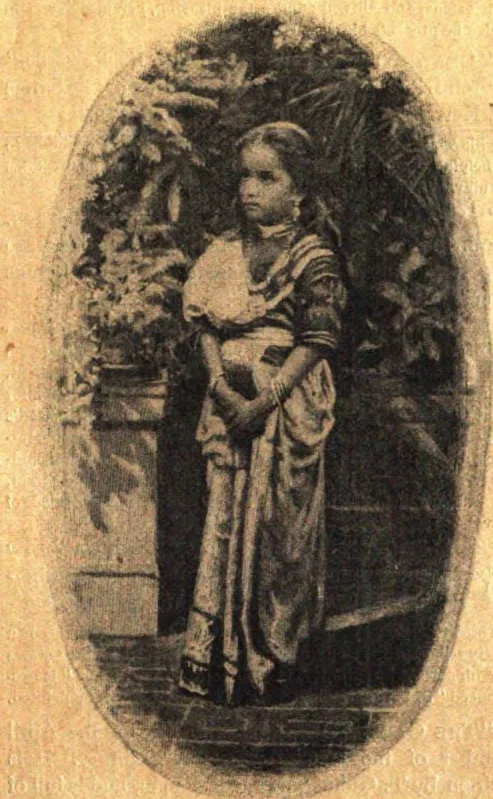
WOMEN IN INDIA.

TO THE EDITOR OF THE SIGNS OF THE TIMES—
Dear Sir: At the request of a member of your mission in Calcutta I will tell you something about the women in India, touching their practical life in regard to their various relationships in the family.
In Indian families the birth of a girl is dreaded as a calamity by the parents; but why this should be so, passes my comprehension, for in the sacred scriptures of the Hindus one comes across such teachings as, “Daughters also, like sons, are to be nourished and educated with care.” As you call a wife “better half,” the Hindu Shastras enjoin that wives are “halves of the bodies of their husbands,” and that husbands should show every consideration to their wives.
Mother and Child. The mother of this mother, the grandmother of this child, is only twenty-five years old.
A Nine-year-old Wife.
If this is so, it might be asked, Whence is the present degraded condition of the women of India?
The reason is not far to seek. Before the advent of the British, the country passed thru centuries of foreign rule of aliens who had no sympathy for the people, their languages, their customs, or religion, and everything that was good in them died out. They were constantly in danger of their lives and liberty. It was during this period that the zenana system sprang into existence. In the early days of Hindu society the people were not bound by the system of zenana, as they are at the present time. You will find that Bombay and Madras, where Mohammedan rule did not penetrate so deep as it did in northern India and Bengal, are comparatively free from it. It is an innovation that reared its head in the wake of Mohammedan rule. Much as I wish the rigors of the system of zenana abated, I would not say that it has not served its part in the days gone by. This, and some other things, in my humble opinion, have served to maintain the individual and distinctive features to this day of the Hindu society, altho subjected for over ten centuries to Mohammedan rule.
To return to the subject. Directly a female child is born, the anxiety of the family commences. The great law-giver, Manu, whose laws are considered binding by the Hindus, enjoins that a girl ought to be married before she attains puberty, failure being accounted a great sin, necessitating one's being sent to hell. To follow Manu in practical life, in a warm country like India, a girl has to be married before she is ten or eleven years of age. At such a tender age, before she can understand anything of the responsibilities of married life, she has to be married and sent off to her husband's family, among aliens, so to speak, and shut up in the zenana. And mind you, in the matter of marriage, which concerns her life and existence, her happiness or misery, she has no voice.
As regards the marriage of boys, there is no limit placed as to age. This has the effect of allowing great freedom on the side of the boys, while it places great restriction on the girls, who have to be married within ten or eleven years of age. It places the fathers in an abject position, and they have to submit to exorbitant terms as to dowry to be settled upon the girls, altho the laws of Manu enjoin that nothing but a nominal and voluntary dowry, free from compulsion of any sort, is to be exacted from the bride's side. But we live in degenerate times. The laws of the great Manu are more honored in the breach than in the observance. I have known of instances where fathers of girls have been ruined by having to meet exorbitant demands on the occasion of the marriage of their daughters. But I am happy to say that the keen struggle for existence, and the increasing inability of parents to meet such demands, is imperceptibly helping to raise the marriageable age of the girls by postponing marriage till they attain a slightly higher age. This will have the effect of allowing the parents a little more breathing time, while it will not fail to improve, at least slightly, the health and morale.
I fail to see why it should not be so. Among the Koolin Brahmins of Bengal, who are supposed to be the highest among Brahmins, the first caste among the Hindus, marriage of girls was not performed generally until a very late age in spite of the laws of Manu. I have known many instances in which girls have been kept unmarried for want of an eligible bridegroom till they were twenty or thirty years of age, or even the entire life. Among those I count some of my relatives as well.
I will relate to you how a marriage is brought about. After a girl is seven or eight years of age, her parents begin to look about for a suitable bridegroom for her. It used to be the work of professional male matchmakers, possessed of, and versed in, the genealogies of the different families, generally to the fifteenth or twentieth generations back. This was necessitated by the Hindus observing prohibited degrees of consanguinity among themselves. But with the keen struggle for existence and with pecuniary affairs claiming the larger share of attention, the Hindus are getting lax in every way, marriages not excepted. Educational qualifications, the wealth and position of the bridegroom, these are the chief factors in determining the extent of the dowry demanded from the bride's side. Whether the bride's parents are in a position to meet the demand is not taken into account. Perhaps the father has to borrow at ruinous interest or sell off whatever he has, if he has anything to sell, and then pass the remainder of his days in misery; because meet the exorbitant demands on the occasion of his daughter's marriage, he must, or the grim specter of hell stares him in the face.
I have in mind one case in which, on the occasion of the marriage of his daughter, the bride's father had to agree to give costly jewelry and golden ornaments far in excess of his means. In this case he was compelled to have recourse to deception. The poor man thought that once the marriage was over, the bridegroom's party would be considerate, and not be hard on him even if he was found out. But alas! that was not to be. Shortly after the deception was found out, the law was set in motion, and the poor man was thrown into prison.
When the terms as to cash and ornaments to be given by the bride's party to the bridegroom are settled, they fix upon a day when the auspicious event is to be celebrated. Here astrological calculations are made. The dates and hours of the births of the bridegroom and bride are calculated, so as to avoid the union of parties born within antagonistic signs of the zodiac. When these signs indicate the undesirability of a union, the matter is dropped, altho I have known of some instances in which parties veered around when an enhanced dowry was forthcoming from the bride's side.
When the date is fixed for the event, the bridegroom, with a party consisting of at least some of his relatives and friends, the family priest, and servants, starts for the bride's house so as to reach there in the evening or at night. Both sides during the day perform certain ceremonies invoking the blessing of the ancestors upon the projected marriage. At night the invited guests, relatives, and friends assemble in the outer yard of the house, it may be under some shelter in the way of tent or other structure improvised for the occasion. Exactly at the appointed hour the ceremony begins. The family priest has the bridegroom repeat certain solemn vows, tho in the Sanskrit language, which many do not know. These vows are taken in a solemn way, altho in the majority of cases they are not understood. They refer to promises on the part of the bridegroom to maintain his wife as best his position will allow, to be always charitably disposed to her, even to her faults, in a word, to consider his fortune as indissolubly bound up with hers in weal or woe. Most desirable vows indeed! Would that they were understood and literally interpreted and followed. The bride is taken round the bridegroom seven times, the hands of both are united, when the vows are repeated and assented to by bridegroom and bride. After this, they are considered united in holy matrimony.
This over, the assembled guests, the number of whom varies from a few only, to over a thousand, according to the position and circumstances of the bride's parents, are treated to a sumptuous feast, of course at the expense of the bride's father.
When the morning dawns, the bridal party return to the bride's house. On some occasions at the approaching separation from dear parents and brothers and sisters, the little creature rends the skies with her cries. But the fates are unrelenting. She must face the situation. Nor is this all. In many instances where the parents on account of their position can not keep to the letter their promises in regard to the dowries, the little-girl wife has to suffer terribly for the lack of her parents. She has not only to endure ridicule and banter at the hands of her mother-in-law and sister-in-law, but has at times to suffer from branding with red-hot irons, or similar torture, some cases of which find their way even into the criminal and other courts in the country.
It were wished that relief came to the bride's parents on the completion of the marriage; but such is not the case. In a good many cases their troubles only begin. They are expected to send presents, often costly and beyond their means, to their sons-in-law pretty frequently. These are often found fault with, resulting in the end in much suffering to the poor creatures,—the girl wives.
Such is the hard lot of the Hindu women in general. They have other sufferings as well. As they become mothers at an age when girls in your country are nothing but girls, they become weighed down with cares and anxieties and often with disease. When overtaken with disease, they would rather die than consult any doctor except one of their own sex, of whom the number in this country is very limited.
It is very much to be desired that the marriageable age of our girls shall gradually rise, so as to allow them to remain with their parents longer, and thus become better fitted to discharge their duties as sisters, daughters, wives, and mothers. May God hasten such a consummation of our desires.
KUNJA BEHARI BANERJI.
Calcutta, India.

THE CHANCE GOD GIVES

“I’LL pass this way but once,” a fool cried out, “And therefore I will laugh and take my ease; Let others toil and sweat and fret and doubt, And miss the chance God gives them, if they please; But I will journey down the careless ways, And ope my eyes to none but happy days.”
“I’ll pass this way but once,” another said, “Hence all that God laid out for me to do I must be doing as I fare ahead, That He may say, ‘Well done,’ when I am thru; By word and deed I’ll do my best to spread Good cheer along the pathways that I tread.”
The wise man did his work, and did it well; And people blessed him as he went along, And fewer tears, because he labored, fell, And higher swelled the chorus of the song— The song of joy God meant that men should raise, The splendid song of brotherhood and praise.
The useless fool went dawdling here and there, Unmindful of all feelings but his own; What if men sang or sobbed? He didn’t care. One morn he woke to find all pleasure flown! His tongue was thick and dry; he cursed his lot, And shriveled up, and passed—and was forgot.
—Selected.

RELIGIOUS RESULTS OF THE FAMINE IN INDIA.

THE present famine is sure to have far-reaching religious results. All such calamities which break up the social system greatly undermine caste, and interfere with the practise of Hindu rites. In a famine, people can not go on pilgrimages; they can not observe religious feasts; they neglect their priests; neglect attending temples, and neglect religious ceremonies; so that confidence in Hinduism and in Hindu religious guides is weakened far more than would have been the case if plenty had reigned. Moreover, people see that idols accomplish nothing, and that their religious leaders do little for them. On the other hand, respect for Christian missionaries, for Christian people of other lands, and for Indian Christian leaders has been immensely increased, so that it is practically universal. From the viceroy down to the humblest peasant, over and over again, there have been sincere and strong expressions of gratitude to Christian missionaries for what they have done. These missionaries have been wise, sympathetic, and devoted. They have co-operated wisely with officials, have avoided overlapping, and have supplemented governmental relief. In general, missionary relief-agencies are acknowledged to have been honestly and wisely administered. The fact that a large part of the one million one hundred thousand dollars from America has been administered by missionaries has made it widely known that most of the famine relief to India has been from Christian motives.—R. A. Hume, D. D.
Continue reading: GENERAL MEETINGS IN PACIFIC UNION CONFERENCE