RABBI BEN JOSEF, old and blind,
Pressed by the crowd before, behind,
Passed through the market-place one day,
Seeking with weary feet his way.
The city’s traffic loud, confused
His senses, to retirement used—
The voice of them that bought and sold,
With clink of silver piece and gold.
“Jehovah,” cried he, jostled sore,
Fearing to fall and rise no more,
“Thine angel send to guide my feet,
And part the ways where dangers meet.”
Just then a beggar as he passed,
A glance of pity on him cast,
And, seeing so his bitter need,
Stretched forth his hand his steps to lead.
“Not so,” Ben Josef cried; “I wait
A guide sent from Jehovah’s gate.”
The beggar left, thus rudely spurned
Where gratitude he should have earned.
As day wore on the hubbub rose
Louder and harsher to its close.
The old man, weary, sought in vain
An exit from the crowd to gain.
Jostled at every turn, his feet
Stumbled upon the ill-paved street.
Once more he cried, “Jehovah, where
The answer to Thy servant’s prayer?
No angel, swift-winged from Thy throne,
Has hither for the helping flown.”
Then came a whisper, clear and low:
“My messenger thou didst not know.
“For in a beggar’s humble guise
His outstretched hand thou didst despise;
Nor cared beneath his rags to find
The heart that made his action kind.
See now that thou the lesson learn,
Lest he whose face thou canst not see
Should prove a messenger from Me.”
—American Israelite.
ODD RESULTS OF CENSORSHIP.
Sultan Abdul Hamid of Turkey insists that every ruler or political personage shall die a natural death. Other manners of death are not “recognized” officially by Nischan Effendi, the censor. When King Humbert was assassinated at Monza, the Turkish newspapers announced this sad event in the following form: “King Humbert left the hall amidst the frenetic cheers of the people. The king, much affected, bowed several times and to all appearances was immediately dead.” When the late shah of Persia was assassinated the Turkish papers said: “In the afternoon the shah drove to his summer palace and there complained of illness. His corpse was sent to Teheran.” One paper, however, excelled all the others in “simplifying” the piece of news by publishing this absurdity: “The shah felt a little ill, but finally his corpse returned to the palace.” This phrase was too much even for the Turks, who have retained it even to this day as one of their proverbs.—Selected.
LITERARY NOTICES.
“Raymund Lull, First Missionary to the Moslems.” By Samuel M. Zwemer, D.D., F.R.G.S. Illustrated. Cloth, 12mo, 172 pp. Price, 75 cents, net. Funk & Wagnalls Company, New York and London.
Raymund Lull was, of all great men of the middle ages, the most versatile in character and strenuous in endeavor. His achievements in any single line of activity would of themselves make a considerable volume. He was poet, novelist, scientist, philosopher, theologian, evangelist in Christian lands, and missionary to the heathen. One of his biographers states that the works of Lull numbered four thousand. Of his writings in Latin, Catalonian, and Arabic, it is said that one thousand were extant in the fifteenth century. Less than fifty are extant to-day in printed form; the many unpublished manuscripts are to be found scattered through the libraries of Europe.
This book deals chiefly with Lull’s work as a missionary. It tells of his wonderful conversion in a church which was at that time devising the Inquisition. He was a Christian not because of his church, but in spite of it. Dr. Zwemer, whose book, “Arabia, the Cradle of Islam,” is the standard authority on that country, says in his preface to Lull’s life, “Since the twentieth century is to be pre-eminently a century of missions to Moslems, we should rescue the memory of the pioneer from oblivion. His philosophical speculations and his many books have vanished away, for he knew only in part. But his self-sacrificing love never faileth and its memory can not perish. His biography emphasizes his own motto: He who lives by the Life can not die. It is this part of Lull’s life that has a message for us to-day, and calls us to win back the Mohammedan world to Christ.” The book should be read by those interested in Moslem missions.
“The Ten Commandments and the Lord’s Prayer. A Sociological Study.” By Ferdinand S. Schenck, D.D. New edition, 246 pages. Price $1.00, net. Funk & Wagnalls Company, New York and London.
One is impressed with the loyalty of the writer to the Word of God. He brings into his book no “higher criticism,” no question as to the divine authorship of the wonderful Law. He grasps the spiritual nature of the law, and shows its far-reaching authority on all the motives and actions of the individual man, in public and private life, in personal and corporate capacity. We can not understand why he can not see that no civil power can enforce or attempt to enforce the great spiritual law. The chapter on the Fourth Commandment is everywhere Biblical in that it is applied to the Sabbath, which is ever and always the seventh day. Mr. Schenck gives no intimation that a change had ever taken place. There are but two places in the chapter which would indicate that he meant that the chapter should refer to Sunday; Sunday is named in an illustrative anecdote, and he declares that “it is clearly within the province of State laws to command the observance of the Rest Day,” something that no well-instructed Christian Sabbath-keeper could believe. Apart from this principle of religious legislation, which has crept in a few times, the book may be read with much profit.
“In Happy Far-Away Land.” By Ruth Kimball Gardiner, from Tales Told by Frances Palmer Kimball. Illustrated by Howard Smith. 108 7x9½ pages. Price, $1.50. Zimmerman’s, 156 Fifth Ave., New York.
The aim of these stories, charmingly told and beautifully illustrated, is to place on a seeming basis of truth and reasonableness a number of senseless old nursery rhymes, like “Old King Cole,” “Little Bo-peep,” etc. In a literary and artistic way the book is a success; but we know that stories based on the truth of God’s Word, Bible stories fashioned to the minds of the children, stories in real life, are better foundations for character building. The little ones get enough of semblance and make believe in every-day life to feed their fertile imaginations, without the fostering ideas of non-existent fairies, and folk lore tales. “In Happy Far-Away Land” is, however, a tremendous improvement on Mother Goose.
“Swords and Plowshares.” By Ernest Crosby. 5½x8½ in. Cloth, 126 pp. $1.00, net. Funk & Wagnalls Company, New York.
Mr. Crosby is well known from his book of poems, “Plain Talk in Psalm and Parable,” and the story which followed, “Captain Jinks, Hero,” strikingly setting forth the follies of war and so-called military “glory.” This volume is a collection of poems and word pictures against war and oppression, the overflowing of a soul filled with the hatred of bloodshed. Very strong and well-aimed, bloodless blows this American disciple of Tolstoy wields in the first part of his book, but the latter part has a deal of nonsense in his mixture of Christianity and nature-worship and pantheism.
“Pagan Counterfeits in the Christian Church.” By Charles A. S. Temple, Lebanon Springs, N. Y. Published for the author by the Pacific Press Publishing Company, Oakland, Cal.
This is a most striking arraignment of many customs in modern Christianity. In the ten chapters of which this pamphlet is composed the author presents mighty arguments and strong proof from Scripture and history against the pagan counterfeit in the church, held generally unconsciously. Emblems, festivals, days, are all treated. Every Bible teacher should have it. Every Christian would do well to read it. The price is 25 cents.
“The Gospel of Cause and Effect.” By Thos. H. Nelson, Evangelist. 120 pages. Paper covers. Price, 50 cents. Grace Publishing Company, Indianapolis, Ind.
The object is to set forth the “philosophical principle upon which God detects and rewards righteousness and punishes iniquity, through the desires of the actors; the law by which, in the very nature of things, men are forced to register their true inner lives upon their physical organism, by the penciling of their desires.” The problem of physical formation involves more than one’s desires. Sometimes there is a large inheritance of physical good or evil which an inner mental and spiritual nature constantly belies.
WAITING FOR THE LIGHT IN PORTO RICO.
By Ida M. Fischer
As the year closes, another year of fiestas has been ushered into eternity, for the people of Porto Rico.
To the student of history and of the Word of God the advancement that the church of Rome is making is full of interest. Often we lose sight of facts, when living in a country where Protestantism is in the majority; but brought constantly in contact with Catholicism, its ignorance and superstition, we are bound to think of the terrible chain with which this church binds her peoples.
The past year has been full of interest to me as I have been brought in close contact with all classes of this island. While we do not doubt the sincerity and loyalty of its people to what they believe to be a pure religion, our hearts have ached for them as we have watched them daily, seeking an entrance to the kingdom of God, through a continual round of dead ceremony. If they only knew that “salvation” is not earned; that it is a “gift,” how many would be willing to give up their rosaries, their pilgrimages, their fast days, the affliction of their bodies, and the constant payment of money for the priests’ work! Many are waiting just for this knowledge.
I have been deeply interested in their many fiestas, and have watched with interest their results, both spiritually and physically upon the people. Beginning with the first of January these holidays assume an important place in the home and hearts of the religious classes, and are a constant reminder of the obligation that rests upon them as members of the Catholic Church.
We have only selected the most important fiestas for this article, those that are celebrated in all parts of the island. Besides these each town or village has its own particular patron saint, in whose honor several days are given to celebration. The following fiestas will give one some idea of these things.
On the first day of January is the Circumcision of Our Lord. The sixth is The Visit of the Three Kings. These take the place of the so-called Santa Claus. A pile of grass is placed in the homes, and the children understand that if they have been good during the year presents will be left for them; but if bad, the mules will eat the grass, and the kings will leave no presents. February 2, The Purification of Our Lady is celebrated, and on the 22d, The Quinquagesima, or The Commemoration of the Passion of Our Lord. April 5 is the Fiesta of Ramos, or Palm Sunday, and occupies all the week, including, 9th, Holy Thursday; 10th, Holy Friday; and 11th, Holy Saturday. The 12th, Sunday, is The Pascua. May 21 is the Fiesta of The Ascension; May 31, Pentecost; June 7, Holy Trinity; June 11, Corpus Christi; July 25, Santiago or James, Patron Saint of Spain; August 15, The Asuncion of Our Lady; August 30, Santa Rosa, Patron Saint of the Indians; September 8, Nativity of Our Lady; October 2, Rosario and the Holy Angels; November 2, The Day of the Dead, or All Souls’ Day; December 8, The Pure Conception; December 24, Buenos Noches, or Good Night; December 25, The Nativity of Christ.
This makes just twenty-two of these days. At these times the people put forth the greatest efforts for pleasure. Feasting and dancing continue during the evening and night of the 24th of December and into the early hours of the following morning. It has been the custom until this year for the Catholic Church to hold a service at twelve o’clock at night. Then the people returned to their homes to eat their Buenos Noches supper, to which friends are invited. At this time I understand they make a practise of having young pigs roasted whole, baked plantain and lettuce, instead of the conventional roast turkey of the United States.
This year the American priest reversed the mass, and it was held at four o’clock on the morning of the 25th. At this mass the cathedrals are crowded, scarcely standing room being available. We were awakened early in the morning by the laughter of the dancers going from the dance to attend mass, many of them honest and sincere, only waiting an opportunity to hear the blessed truths of the Gospel.
What solemn responsibility God has placed upon us as “light-bearers” to a world of darkness. How can we close our eyes to the fact that “God requires me to bear the light of salvation to some soul in heathenism,” either in the home land or afar? There are heathen all around us, souls that are sighing and longing for a life free from sin, and yet who know not how to obtain it.
May God help us to arouse to the responsibilities resting upon us, and the opportunities that are thrust upon us. IDA M. FISCHER.
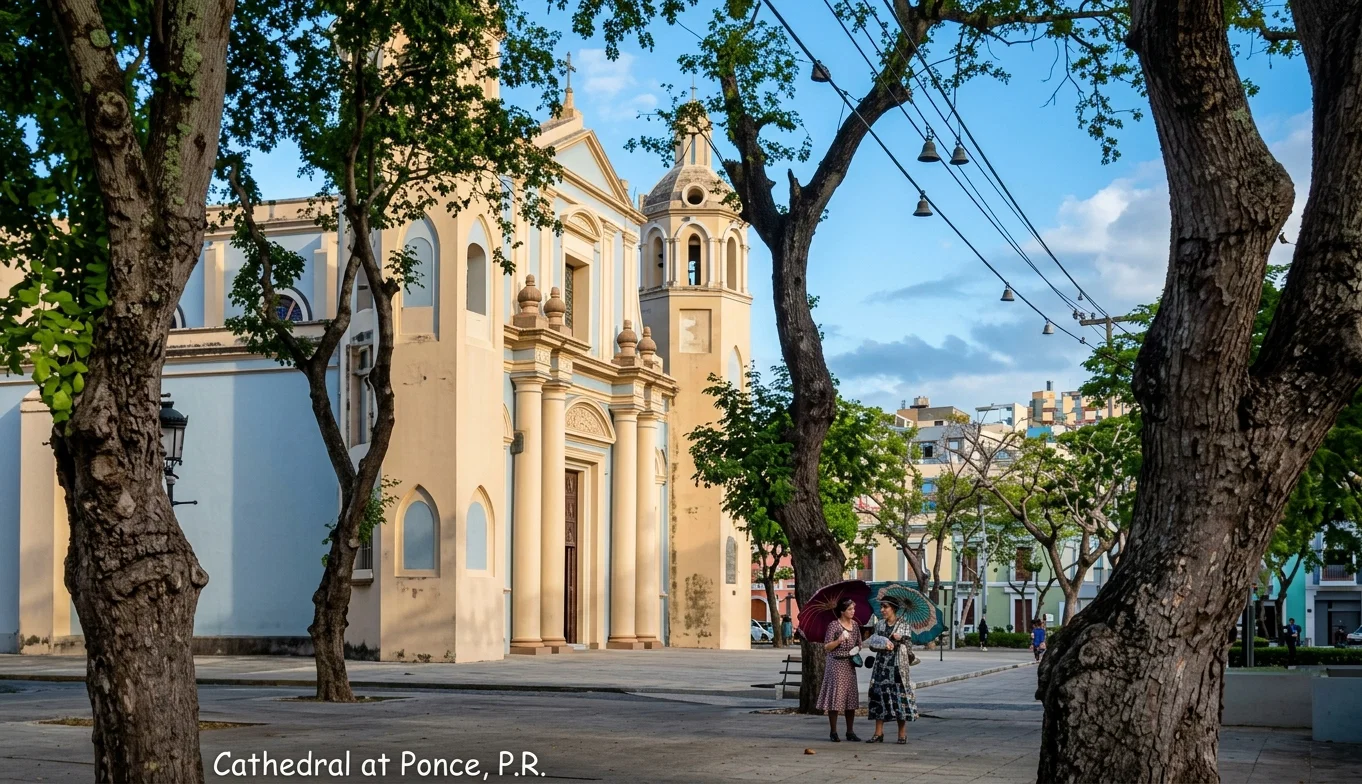
Ponce, Porto Rico.
ONE WEEK'S COLPORTER WORK IN MEXICO.
By A. G. Bodwell
I INTEND in this to give you as nearly as I can an idea of what we did in one week which we spent at Tehuantepec. Rising at daylight, and getting some tortillas and bananas, or atole (which is a kind of corn gruel), for breakfast, I then begin to canvass, and work until 12 or 1 P. M. After a dinner of tortillas and beans, I do what writing I am compelled to do, and then I start out and canvass as long as I can see.
We stopped here in what is called a meson. It is something like a wagon-yard in the States. We rent stalls for our horses and a room for ourselves, spread a blanket on the floor, and sleep on this. During our stay here and in Salina Cruz, which was about a week of solid work, I took in $67.14 from cash sales and subscriptions, obtaining 44 paid subscriptions for our paper, and selling 188 papers, many of them at 10 cents a copy. I also sold 30 “Steps to Christ,” 18 “Christ’s Object Lessons,” 1 “Patriarchs and Prophets,” 24 Bibles, and 10 Testaments. When we left Tehuantepec we had to hire an ox-cart to haul our freight to Tanala. This was 6 days’ travel. About sundown we left Tehuantepec on horseback, and rode 25 miles to Jucitan. When we arrived it was late at night, and the people were asleep. So we tied our horses to trees, spread our saddle blankets on the ground, and went to sleep. The next day we canvassed the town, finishing a little before sundown, and then rode on to Chicapa, a distance of about twenty-five miles. Here again we tied our horses to trees and made a bed on the ground. We canvassed the town the next day, and left about 4 P. M. for Izhuatan, a distance of thirty miles. At this town we had some interesting experiences. One Indian woman had a Bible which some one had given her several years before in passing through. I canvassed her for the paper, but she said that she had no time to read anything but the Bible. She said that she kept the Bible where she could read it when she stopped a few minutes to rest. I talked with her for awhile, marked some passages for her on the Sabbath question, and told her how it was that the world was keeping the wrong day, then left her a tract on the subject.
We left this place about 4 or 5 P. M., and then rode to Tapanatepec, about thirty-six miles farther. Here we canvassed all day, leaving at dusk for La Punta, a distance of thirty or thirty-five miles. We arrived there between 3 and 4 in the morning, took a nap13under some trees, and about sunrise went to work. After eating some atole and bread and feeding our horses, we left there about 4 or 5 P. M., having worked hard all day, barely stopping long enough to eat breakfast and dinner. We rode thence to Tanala that night, a distance of about twenty-five miles.
In the entire six days’ travel on the road I took 400 paid subscriptions, besides selling many papers, Bibles, and Testaments. In the four days here in Tanala I have taken in from cash sales and subscriptions over $52, and have secured 43 paid yearly subscriptions for our paper here, sold 114 papers, 29 “Christ’s Object Lessons,” 18 “Steps to Christ,” 3 “Patriarchs and Prophets,” 7 Bibles, and 4 Testaments. I sold all the books that I brought with me, so for the rest of my trip I had only papers, Bibles, and Testaments. I could have sold many more if I had had them. Several asked me for “Patriarchs and Prophets.” One man sent a boy to hunt me up, with a note and the money, asking me to please send “Patriarchs and Prophets.” The first half day I was here I took 15 yearly subscriptions for our paper.
In all this country which I have passed through the people want literature and they want the Gospel. The power of the priests to a large extent is broken. I believe that tent meetings or Bible-readings could be held at these places. Schools could also be established. The people express themselves freely about these things, and say, “We want to know the truth.” They are a very friendly and industrious people. We sowed this place before the priest knew what we were doing. He then held services and told the people that the books we were selling were bad books; that they would be condemned for buying them. He even tried to get them to burn the books. The people told what he said, and came to buy more books. They said that they believed the life of Jesus Christ was more pure than that of the priest. It makes me think that we can do nothing against the truth but for the truth.
During the month I have traveled over 420 miles on horseback, and placed over 88,000 pages of Christian literature in the hands of the people, besides taking 129 subscriptions for our paper.
A. G. BODWELL.
Tanala, Chiapas, Mexico.
THE WAYSIDE CROSS.
By Edward J. Wheeler
[Edward J. Wheeler, in Success.]
Across the blue of a summer sky
The storm-king urges his coursers black;
His rumbling chariots roll on high,
And the lightning flashes along their track.
Facing the blast and the blinding rain,
From a wayside cross, the Christ looks down,
His eyes of compassion filled with pain,
His temples torn by the cruel crown.
But, safely sheltered amid the storm,
And twittering softly, as in a nest,
Beneath an arm of the sacred form,
A bevy of sparrows has flown to rest.
They have no knowledge of rite or creed,
They raise no question of whence or why;
They know that here, in time of need,
Are shelter and peace when the storm is high.
I look, and ponder: “Were it not best,
When the storms of life obscure the sky,
To turn from reason’s unending quest,
And on as simple a faith rely?”
But lo! a rift in the cloud appears,
A gleam of heaven’s abiding blue,
And, like a rapture that shines through tears,
A flood of glory comes sweeping through.
The bow of promise its beauty flings
Above the stricken and sullen earth;
Again, with a flutter of eager wings,
The little birds flit joyfully forth.
What now, to them, is the wayside cross
When skies are clearing and earth grows gay?
With lives unaltered for gain or loss,
They chirp and chatter upon their way.
Then to my heart there comes a prayer,—
“Not like the birds would I come to Thee,
O Lord, for shelter from strife and care,
From the pain and peril of life to flee.
“Didst Thou seek shelter when, o’er Thy head,
The clouds of muttering hatred burst?
When friends were fleeing, and, in their stead,
Came cross and spear and the raging thirst?
“I ask not shelter, but ask to be
With Thine own resolute soul endowed,
In time of trial to stand like Thee,
To front the tempest, or face the crowd.
“And, when the glory regilds the sky,
Thy spirit of service to me still give,
For I would be able Thy death to die,
Were I but able Thy life to live.”
OUR WORK AND WORKERS.
A CANVASSERS’ institute is set for March 4-25 at Minneapolis, Minn.
A CHURCH recently organized at Clyde, N. M., was received into the Colorado Conference at the recent session.
THE Worker reports the recent addition of three members by baptism to the Minneapolis, Minn., English Church.
MEETINGS held in December, at Rocklane, Ind., by Brother R. S. Donnell, resulted in adding six members to the church.
DECEMBER 30, during the session of the Colorado Conference, Brethren Marcial Serna and H. A. Aufderhar were ordained to the Gospel ministry.
THE house of worship at Lincoln, Neb., was dedicated January 18. The sermon was preached by Brother E. T. Russell, president of Central Union Conference.
At Franklin, Ind., Brother F. L. Moody reports that ten persons have accepted “the commandments of God and the faith of Jesus” in connection with meetings being held there.
BROTHER G. M. BROWN has resigned the educational secretaryship of Nebraska Conference in order to take up work in the Mexican Mission Field. Brother C. R. Kite succeeds to the vacancy with address at College View.
BROTHER D. U. HALE and family of Texas Conference have been invited by the Mission Board to go to the Gold Coast of Africa to labor, and are now on their way. Brother I. G. Knight and wife, of Kansas, have been invited to go to Central America, to take charge of the work in place of Brother Hutchins, who lately died there.
At the Portland (Oregon) Sanitarium, Dr. W. R. Simmons, in the Recorder, says: “We have had with us for three months a Methodist minister who was a missionary in Japan for fourteen years. He has become interested in our work, and, as a result of making a thorough study of our faith, has decided to keep the true Sabbath.”
A BROTHER in Southern Indiana has a church-school in his house. He pays the teacher $15 per month, and gives her board and lodging. The school has only three pupils; two of them are the brother’s children, and the third is a homeless child for whom he is providing. This brother has a little house with a few acres of land in the country, and supports his family principally by labor in the railway shops. “Where there is a will there is a way.” So says the Reporter.
FROM the Southern Watchman we clip this item of a report by Brother W. C. Wales: “One sister in Georgia thought she could not sell a book [“Christ’s Object Lessons”]. She was the only one who refused to take a part in the work when the rest of the church took it up. But one brother had promised to sell thirty books, so finally she thought she would try to help him. She went out one afternoon and sold six books. She was the first one in that church to sell her quota.” So the last was first.
THE church at Perry, O. T., is building a commodious house of worship, and the hearts of the people not of our faith have been opened to help in a liberal manner.
A NEW church edifice at Brenham, Texas, was dedicated December 22. The services were conducted by Brethren H. Shultz and W. A. McCutcheon, president of the conference. Two other new churches in that conference await dedication—one at Dallas and one at Sanger. So says the Record.
BROTHER JOHN HOFFMAN writes from Borga, Finland, to the Minnesota Worker: “We now have ‘Great Controversy,’ ‘His Glorious Appearing,’ ‘Steps to Christ,’ ‘Ministration of Angels,’ ‘Christ and His Righteousness,’ in the Finnish language, and are now working on ‘Thoughts on Revelation.’ We also have a number of tracts.” Brother Hoffman adds this pitiful story, which explains one great hindrance to our work there:—
There is considerable suffering here this year on account of the crops being a total failure in many places. Many of the people are grinding bark with their flour, and in many places they are making their clothing from gunny-sacks. Besides this, the Russian yoke is pressed heavier and heavier upon the poor people. Their liberties are being roped in little by little. All the young men and many of the young women leave home to get away from the Russian military service. Of course the young women do not have to serve in the army, but when the young men go the women go, too. Those who can not secure passports go out into the Baltic Sea in open boats and are taken up by passing steamers and carried away to foreign shores. Some of these are caught by spies, and what they do with them I do not know. They took a young brother in this way over a month ago, and we have not heard a word from him since. I think they must put them in the Russian army. There are from five to six hundred people who get away every week, and most of them land in America.
ENGLISH WORK IN MEXICO.
By H. A. Bassett
[Rev. H. A. Bassett, in Northwestern Christian Advocate.]
We spend thousands of dollars annually, and much earnest work is being done in the large cities of the United States for the foreigners who come to our shores, but very little consideration is taken of the need of religious privileges for Americans who have gone to foreign shores.
The absent members of our families ought not to be forgotten. In Mexico City, temptations to dissipation are prevalent on all sides. The novelty of the allurements, and the entire lack of home restraints, induce many young men into lives of vice and crime who in other days spurned sin and walked in the ways of righteousness. Some time ago a young man came to me and said: “I have been on a drunken spree for three days and in fact for months past I have been living in sin, but I have been writing my mother at home that I was keeping up my religious experience. It would break her heart if she knew my actions.” This is but one of the hundreds of young men in this city who are going down to eternal ruin. Many Christians of all denominations come down to this sunny land every year, and about two-thirds of them say “good-by” to the Almighty when they cross the Rio Grande.
Bull-fights and races and golf and cock-fights are largely attended by Americans. If Protestantism is to make rapid progress in this “land of the Aztecs,” she must make a strong effort to influence the foreigners coming here to live as noble representatives of the Christianity which has exalted the land of their nativity. Many of the Americans in this country are bright, intelligent, and shrewd, but they care little for morals or religion. To withstand the forces of worldliness here demands grace and grit. We need grace to keep us sweet, and we need grit to do aggressive work in the midst of such adverse circumstances.
There are about five thousand English-speaking people in this city, which is fast becoming Americanized.
THE SURE FOUNDATION.
By Mrs. S. E. Lowell
Build firm and sure, O soul,
Upon the Rock that can not fail!
The storm is raging, and the gale
Shrieks round thee, fierce, and wild, and high,
The tempest mocks thy anguished cry.
Build firm and sure!
Build deep and strong, O soul!
Then shall no storm or jar or shock
Sway thee from the unswaying Rock,
For deeper than earth's mightiest tide
Thy sure foundation shall abide.
Build deep and strong!
Build broad and high, O soul!
Thy temple shall be pure and fair,
And prayer and praise shall echo there.
The songs of faith shall upward rise
Like perfumed airs from Paradise.
Build broad and high!
Build bravely on, O soul!
The Master's eye is on thee still,
Noting each triumph of His will,
As step by step, and round by round,
Thou reachest higher, holier ground.
Build bravely on!
—Mrs. S. E. Lowell.
Publications Wanted:
Tracts, papers, and second-hand books for missionary work. Address, post-paid, Mrs. E. A. Rose, Stevens Point, Wis.
Signs and Little Friend, for missionary work. Address, post-paid, Mrs. Lulu K. Levison, 1112 Florida Avenue, Tampa, Fla.
Mrs. Florence Atkins desires one copy of the Anti-cigaret Number of the Life Boat. Address West Sound, Wash.
THE GENERAL CONFERENCE DAILY “BULLETIN.”
By A. G. Daniells
ARRANGEMENTS have been made to issue a daily Bulletin during the thirty-fifth session of the General Conference, to be held in California, March 27 to April 13, 1903. A large staff of editors and assistants will be engaged in the preparation of the paper, by which we hope to make it even better than it has ever been in the past. It will contain complete statistical and general reports from our various conferences and mission fields, information regarding our organizations and institutions, as well as full stenographic reports of all Conference proceedings, and of the Bible studies. The Bulletin should be carefully studied by all our people who desire full information with reference to our work in all parts of the world, as brought out in the Conference. The subscription price is fifty cents for the session. All orders should be sent to the Pacific Press Publishing Co., Oakland, Cal., and at an early date, to insure the receipt of every number from the first. Orders may also be sent through any State Tract Society.
A. G. DANIELLS.
GOOD WORDS FOR THE SIGNS.
A SISTER writes from Australia:—
“I feel very thankful that our dear Review and the SIGNS reach this distant land. They are read with pleasure. I am particularly interested in that department, “How They Became Convinced.” With kind regards and earnest desires for the prosperity of your work, I am yours, longing for the realization of the blessed hope.” SUSANNAH SISLEY.
Another from Oregon:—
Having been a reader of your paper, the SIGNS OF THE TIMES, for years, I have learned to love its expressions of truth, and have been rejoicing in this truth for several years. SANA VINCENT.
Another writes from southern California, and this shows how one department of the paper is prized:—
DEAR SIGNS: It has been about seven years since I began, when anything came up that I could not understand, to refer it to the Question Corner of the dear old SIGNS, and now I come again. LOTTIE S. COLE.
Another from Washington thus writes:—
DEAR SIR: I like your paper very much. It is a great missionary paper. I always feel that I can do great good with it, when I distribute them among the people. GEO. W. BRISTON.
E-Z
This is the name of the original Washing Tablets. Beware of substitutes. A good thing is always imitated. This is so with
E-Z Washing Tablets
Agents, we can start you in a good paying business. Send 2-cent stamp for sample and our liberal terms. Write to-day. We have now no general agents. Our only address is
ALFRED MALLETT, Nyack, N. Y.
The Good Health Adjustable Waist
Affords ease, comfort and health. Retains symmetry and grace of the natural form. Its use will add years of pleasure to a woman's life. It dispenses with the corset. Supports all garments without harmful pressure. No stays to break. Thousands sold. Satisfaction guaranteed. Write for circular and prices. Agents Wanted.
Good Health Pub. Co.
354 W. Main St.
Battle Creek, Mich.
Take a Tourist Car
—A Santa Fe tourist car—if you would enjoy your trip across the continent.
The cars are so comfortable, the route so interesting, the people so pleasant, the excursion manager so accommodating, the porters so obliging, and the meals so good, that you simply can't help being satisfied.
Personally conducted east and west three times a week—Mondays, Thursdays and Saturdays—to Chicago, Kansas City, Los Angeles and San Francisco.
Folder giving full information furnished on request by any Santa Fe Agent.