Your ShelfYour Projects

Signs of the Times, Vol. 24, No. 18.

A LESSON FROM PETER
Earlier text: THE CHRISTIAN'S LIFE

“AN EXHIBIT IN CRIMINOLOGY.”

OUR common every-day observation convinces us unmistakably that crime is on the increase. And statistics are not wanting to substantiate our observations, as the following from the Christian Advocate of March 31, shows:—
“The Secretary of State of New York, in his annual report recently transmitted to the Legislature, gives some statistics relative to the criminology of the State for the year ending Oct. 31, 1897. The whole number of convictions reported to the department by county clerks as occurring in courts of record was 4,523, which was an increase of 755 over the reported convictions during the preceding year. The convictions thus reported were as follows: Of offenses against the person, 669; a decrease compared with 1896 of 96; offenses against property with violence, 1,130, and without violence, 2,006, both showing an increase, and the total of such increases being 630; offenses not included in the above, 718, an increase of 222. There were 248 females convicted in courts of record, an increase of 38. In courts of special sessions there were 66,402 convictions, an increase of 3,694. The sex of the persons convicted in special sessions shows 60,080 to have been males and 6,322 females. The aggregate of the statistics for both courts of record and courts of special sessions shows 70,925 convictions.”
Many good men and women are grappling with this problem of increasing criminology, and seeking a way out. We recommend to all such a careful study of the Scriptures, and they will therein learn that the “last days” are to be made “perilous” because of crime and evil. And is not the appalling list of crimes that are of daily occurrence one of the sure signs that the “last days” are reached? T.

MORMONISM IN ONTARIO.

ALARM concerning the progress of Mormonism is beginning to prevail in Ontario. In the political canvass now going on the usual forecasting of the attitude of the several religious interests is made, and the estimate based upon it, that before the year passes away there will be 100,000 avowed Mormons in the province, is now thought to be within the mark. This result is confirmed through inquiries made by the Presbyterian Review. “It is said that meetings are being held in the small halls and schoolhouses, and that they are crowded with excited audiences, who are carried away by the eloquence of the Mormon missionaries.” The method of operating seems to have been carefully planned, and “the efforts have been successful beyond what can be easily credited by the average reader.”—Christian Advocate.

THE SPIRIT OF THIS AGE.

THE spirit of this age is marked by an intense unrest. And the unrest is not of the ordinary kind, occasioned merely by dissatisfaction with present conditions. There is, it is true, an intense dissatisfaction all over the world because of present conditions. But there is more than dissatisfaction: there is a most marked uneasiness as to what will be the final outcome. So there is strongly mingled with the discontent of the present a dread and fear because of what the future may soon reveal.
But he who is viewing all these things from the correct standpoint, knows none of this uneasiness or fear. The Bible plainly tells him that all these perplexities among men are the sure tokens of the soon coming of the Saviour. And for that glad event he is patiently and gladly waiting.

THE HAPPIEST HEART.

Who drives the horses of the sun Shall lord it but a day; Better the lowly deed were done, And kept the humble way.
The rust will find the sword of fame, The dust will hide the crown; Ay, none shall nail so high His name Time will not tear it down.
The happiest heart that ever beat Was in some quiet breast That found the common daylight sweet, And left to Heaven the rest.
—John Vance Cheney.

MY LADY'S PLUMES.

You observed the hat of the lady who walked in front of you down the fashionable part of the main street the other day. You have not noticed, perhaps, that on my lady's hat are some tall, pliant plumes, long as those of the ostrich, but far more beautiful, with delicate filaments as light as frostwork on a winter window.
These long, filmy plumes on my lady's hat are the plumes of the white egret. Naturally, they are pure white, but pure white not being barbaric enough for the use of civilization—tho it used to serve Southern Indians who wore these plumes—they are dyed any color of the rainbow, losing, thereby, none of their beauty.
My lady's hat, if worn too long, will lose its purpose and cease to attract. She must, therefore, change it. The plumes in the new hat must be of different color. For these new plumes she looks to her milliner. The milliner looks to the great wholesale supply house of the metropolis. The wholesale supply house looks—and with much anxiety these days—to Thomas Jones, market shooter, or, technically speaking, plumage hunter.
Thomas Jones knows where there is an egret roost, or, as he will call it, a “white crane roost.” Really, he does not mean a roost so much as a nesting-ground, where thousands of birds nest in a small tract of the isolated, wet forest or “dead-tree swamp.” Such rookeries were once common in Florida, but are so no longer. Thomas Jones may know of one in Mississippi, Louisiana, or Texas, and holds himself fortunate if he does, for they are scarce enough to-day.
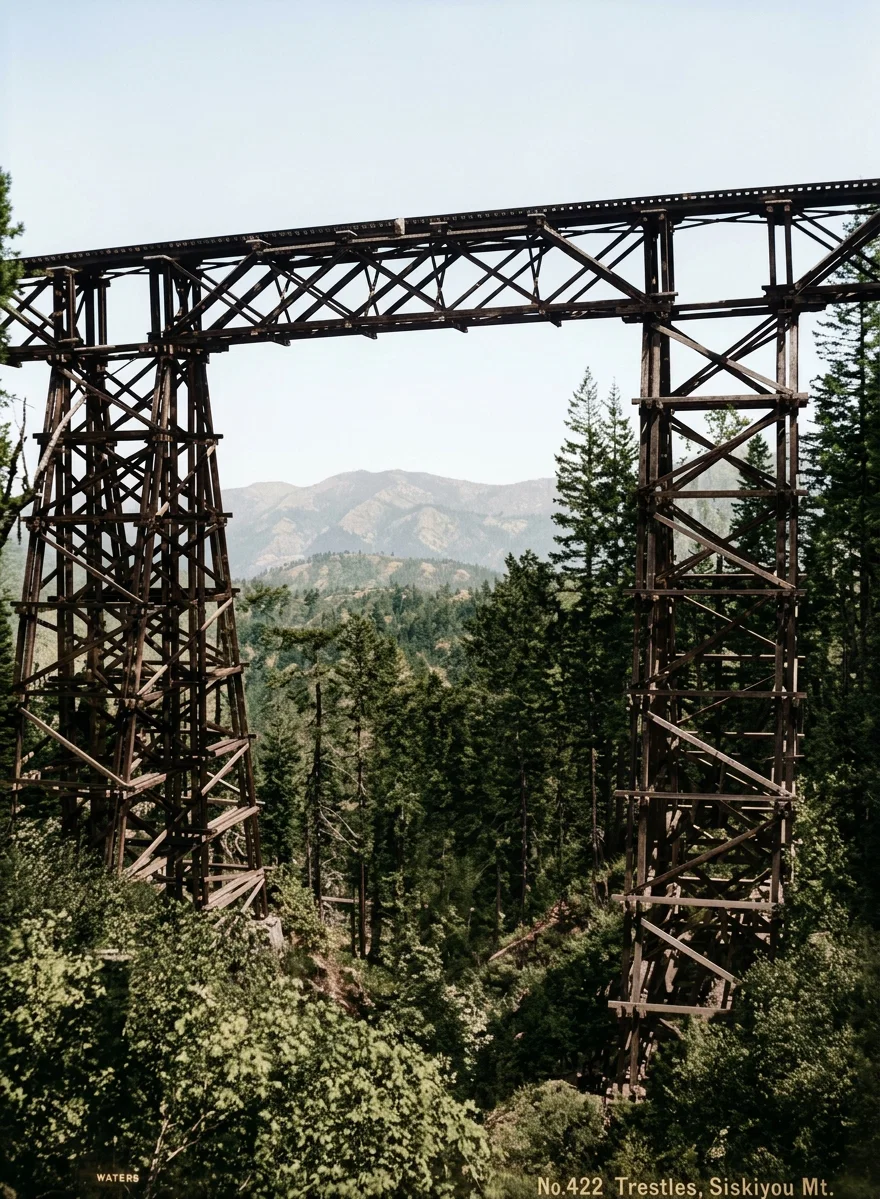
CALIFORNIA SCENERY, No. 16.—From San Francisco to the summit of the Siskiyou Mountains, the San Francisco and Portland Railway numbers its river crossings by nearly a score, and its tunnels by sixteen. The climb up the Siskiyou Mountains is one of indescribable grandeur. The road loops, and doubles, and runs in circles, and stretches back and forth, in climbing the mountain, till in one place five lines may be counted, but a few rods apart, but miles by the railway. One distance of 6 miles between Dunsmuir and Sisson climbs 646 feet; a stretch of 14 miles climbs 1,300 feet. The high trestle above is one of the many sights on the road. Of the building of this road the “Railway Age” of May 11, 1898, says: “The tremendous mountain ranges constituted a barrier not only discouraging to those who were called upon to provide money for overcoming it, but it was even believed by some would baffle the skill of the engineer and the railway builder if the completion of the work was really undertaken. The Southern Pacific Company, however, did undertake and did successfully carry through this great work; and now the traveler, by palace car between the chief cities of California and Oregon, is enabled to view, along portions of the ‘Shasta Route,’ the grandest mountain scenery of the Pacific Coast, and probably of North America.”
Mind you, the plumage hunter does not go into the roost until spring has well advanced. When he reaches the roost, the low trees, bushes, and grassy brush clumps are full of nests, and the nests are, or soon will be, full of young birds. The busy life of the colony goes on. The parents come and go, traveling, no one knows how far, to get food for the gaping young birds in the nest. Thomas Jones notes the high, projecting snag of the tallest tree near the edge of the colony. There is a white crane on that limb. It seems to him there always is one there. In short, it is a habit of the bird to alight on the highest branch offering itself.
Out of the thousands of nests in the vast colony, how can the parent egret pick its own nest, since all look so much alike? Thomas Jones often wonders about that, and sometimes laughs a little to himself. The parent egret has been out after food, and returns to the colony. Without a second's hesitation he picks out his own nest and pauses for an instant directly above it, high up in the air. Then he lets his long legs drop straight down, and, throwing his wings up, just falls down through the air, feet first, in the most comical and awkward-looking way in the world, tho he never misses his nest by an inch, but lands just where he wanted to. As he thus backs downstairs out of the air, his long plumes, attached in a little clump at his shoulders, and spreading out over his back as far down as the longest tail feathers, flare up in the air, reversed and standing up over his head as he drops, as a white garment would in the resistance of the air.
On these plumes Thomas Jones fixes his eye. He shoots an egret and satisfies himself that the plumes are “ripe,” i. e., in their prime condition. Then he builds his camp on the best ground he can find near by, and the next day is ready to go to work.
Surely Thomas Jones is not going to kill these birds right in the nesting season, when the helpless young are in the nest and must die also if their parents die! That can not be possible, you say. Yet that is precisely what he is going to do. It is not his fault, he will tell you, that the plumes are not good in the fall, winter, or early spring, and are not prime until the height of the breeding season. “Here are the plumes, found at much labor, reached at much danger,” says Thomas Jones, blind and deaf further than that, “and there is the price offered me for them, so much an ounce, perhaps $40 an ounce, or perhaps as low as $140 a pound.”
Is this right, to kill these birds at this time? I am not clear that we should ask this question any more of Thomas Jones than of the wholesale milliner's supply house, or of the retail milliner, or of every lady on the street. Only the fact remains, pitiless, horrible, unspeakable, that the gathering of the plumes is a harvest of death, a harvest untimely, disastrous, because it is reaped at the sowing-time of life. Every egret killed for its plumes is killed when it is helpless through its blind, natural love for its offspring, and when its death means the death of all its helpless young. Does the wholesale man know this? Does he care? Is it not the one thing to be remembered that my lady must have her plumes? . . . White—they are white, these plumes. It is mockery. They should be the blackest sable, and they should stain black the white fingers that caress them.
But Thomas Jones can not stop to argue. The next day he pushes quietly into the edge of the nesting-ground. He ties his boat firmly within easy range of the tall snag he saw the day before. He takes out his rifle—the 22 shot will make no noise, and it will serve his purpose perfectly. There is an egret on the tall snag. Taking a steady aim, Thomas Jones fires, and the bird whirls down, dead. One or two other birds start on their perches in the same tree, but settle back. One by one they, too, whirl out and lie in a white tangled mass at the foot of the tree. An egret raises herself up above the rim of the nest on which she sits, and the tiny bullet pierces her. She whirls down, lying white and motionless. The little ones gape and cry, but no food comes. The father was killed on the tree near by.
One by one, out of the nests, off from the limbs of the trees, here, there, anywhere—for the birds are all about, and so stupid with the breeding fever that they will not leave—the slender white birds meet their doom. That tall snag has yielded twenty victims. Thomas Jones has not moved from his boat. He has over two hundred birds down. He can tell by his cartridge boxes, for he rarely misses a shot. It is easy shooting.
After noon Thomas Jones goes out and gathers up his spoils. A cut of the knife and the clump of plumes is off. The carcass of the egret is left lying. Two hundred carcasses of egrets are left lying. That many more tomorrow. Many more than that the next day, for by that time the wailing of the dying young of the first day's victims will have ceased. From then on, day by day, increasing in three-fold ratio, the harvest of death goes on, steadily, pitilessly, on the sowing-grounds of life, out in the silent wilderness where the birds have tried to hide their homes.
In less than a month it is all over. The long, white lines no longer cross the country going to and from the feeding-grounds. The white forms no longer appear on the naked trees. Doubly naked the forest stands in silent desolation. Sodden and discolored the once white forms below the trees sinking into the slime. From beneath the trees, and from the nests up in the trees, a great stench goes up. Not a bird, young or old, is left alive. The old ones stayed till death came, bound by the great instinct of nature to remain with their young.
Jones, a little yellower, but not sick, for he is a healthy man, packs his feathers carefully and hies him to the railway for a swift and secret journey out of the country. He wonders where he can find another roost next year. Behind him is desolation.—E. Hough, in Forest and Stream.

CRACKED WHEAT POP-OVERS.

When once our sisters have learned the value of steam-cooked grains as a basis of bread-making, all desire for yeast-power or eggs will vanish.
Cook one cup of cracked wheat in five cups of water. Use cold water, and stand the vessel containing it in another vessel of cold water. Cover both carefully, and do not uncover the former until the wheat is done. Let it boil for five hours after it has reached the boiling point, renewing the water in the outer vessel as fast as it boils away, by adding more boiling water; but do not uncover the inner vessel. The wheat will swell and become light.
When done, put it away in a bowl, pouring out carefully, and smoothing the top, if it does not settle flat. Let it get perfectly cold—and better to stand overnight.

To Make Pop-overs.

Turn the wheat out on a well-floured board. Peel off the top, as you would peel a potato, and you will find the wheat of uniform lightness, easily moulded. Work into it white or whole-wheat flour until it will leave your hands and the board, forming smooth rolls. At first it will crumble, and seem as if it could never become a smooth mass; but keep on working, for the more it crumbles, the lighter it will be; and very soon you will find the whole mass getting so light that it will resume its shape when pressed with the finger. Work fast and lightly. Knead in the flour smoothly, and then cut or tear into small pieces; the size will depend on the size and shape of your gem pans. Have your oven very hot, and the gem pans (iron, not granite or tin) heating in the oven. Place them on the top of the stove to fill. Oil lightly, and press the dough into them, filling every space and making them even or rounding full. Put in the oven and avoid opening the door for ten or fifteen minutes. Keep up a good heat. I must have one side of my oven red-hot if I want them light. Moderate the heat toward the last. Give them twenty to thirty or forty minutes, according to the size of your irons.
When removing from the oven, if you want them crisp, cool on a board; if you like them soft, stand on their edges in a covered pan. You will find you can vary their texture by the amount of flour you use, etc.
MRS. A. C. BAINBRIDGE.
Fort Bragg, Cal.

TRAINING SCHOOLS IN THE SOUTH PACIFIC.

The education of native workers has justly been considered as a matter of vital importance ever since the pioneer missionaries first came to the island in the early days of modern missions. On Raiatea, workers were trained who became pioneers in carrying the Gospel to Samoa and the Cook Islands. From the school in Samoa came native missionaries and teachers to Savage Island, New Guinea, Fiji, and other places.
The various denominations that are operating among the islands are now conducting schools for the education of native helpers,—teachers, local preachers, foreign missionaries, etc.
In Nukalofa, the capital of the Tongan Islands, is located the college of the Wesleyan mission, which has, with slight interruption, been in operation for the last twenty years. The school had at the time of our visit 100 in attendance.
Adjoining the college yard are the buildings occupied by the students of the school. Upon one side of the street are the houses of the married people, and upon the opposite side the unmarried boys live. They are all under the supervision of the Wesleyan missionaries, who are thoroughly conversant with the Tongan language, having been there over twenty years engaged in the mission work. These pioneer laborers have done a good work for the natives by translating Scripture, writing and printing school-books, and also in introducing the tonic-sol-fa system of music that has enabled the natives to master difficult pieces in a way that would do credit to many American choirs. The principal of the school, who kindly showed us about the institution, stated that the native boys show special aptitude for mental arithmetic and history, but are generally poor in language.
Since the year 1867, the Melanesian Mission of the Church of England have conducted their school on Norfolk Island for the education of native teachers and missionaries for the work among the groups and islands of the western Pacific. There are sent out each year from the school about twenty-five native missionaries and workers. These are generally located on the islands they left to enter the school, that they may exert a good influence over their former associates. There were 162 boys and 45 girls in attendance at the school in 1895. New recruits are obtained for the school by the mission schooner, the Southern Cross, which makes regular cruises among the islands of the Solomon, New Hebrides, and other groups of the Western Pacific.
In no group of Polynesia are more systematic efforts being made toward educating the native youth for places of usefulness than at Samoa, where there are several fine schools, which are conducted at the expense of the London Missionary Society. One of these institutions is for boys and young men, another is for girls, and a third is for the married ones who are studying for the ministry. It was our pleasure while at Apia, Samoa, to visit the school for the girls, in company with Pastor Goward, of the London Missionary Society.
The buildings of the girls’ school are finely located on the higher ground back of the principal village. The site is magnificent, from which is obtained a fine view of the lowlands. Eighty girls find a home in the institution, where they are instructed by two experienced lady teachers. The buildings are large and well arranged, and as the work has been in progress for many years, a good degree of system has been arrived at in their efforts in behalf of the young. As the institution can not accommodate all who need instruction, their work is largely confined to the children of native pastors and to those of the most influential native families.
London Missionary Society's
School on Rarotonga.
London Missionary Society's School on Rarotonga.
London Missionary Society's headquarters at Apia, Samoa, and home of the hospitable Pastor Goward. These illustrations are kindly loaned by E. C. Chapman.
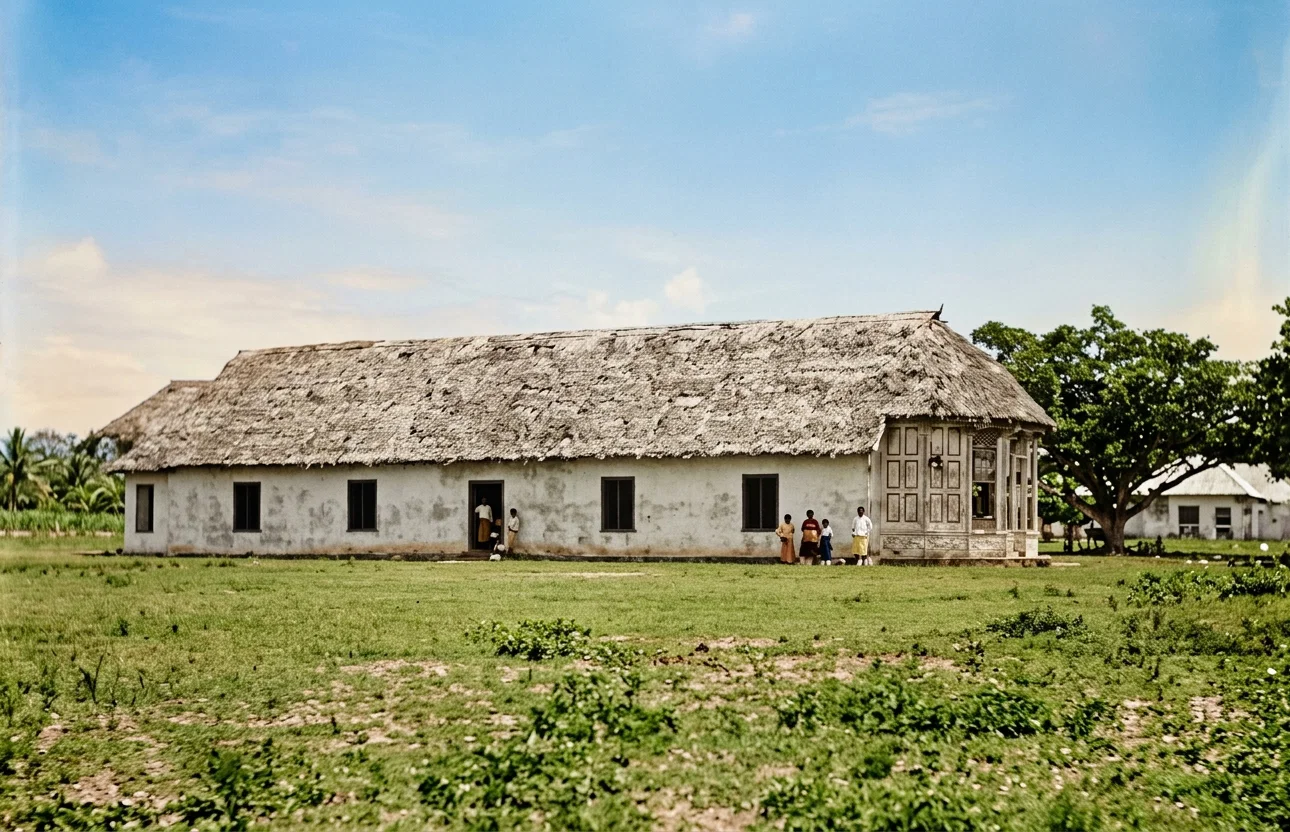
Wesleyan College, Nukalofa, Tonga Islands.
A small charge of $5.00 a year is made to each student. This does not begin to cover the running expenses of the institution, which must be mainly sustained by the society. As far as we were able to observe, excellent discipline is maintained over the students, who apparently enjoy the hours of study and the seasons of play as much as any young people. Their sleeping-room is one large apartment, where nearly every girl has a chest, with her mat and bedding, which at night is spread upon the floor. No bedsteads, bureaus, or chairs are to be seen. As the students are well looked after, and such evil habits as smoking and idleness are prohibited, we could but wish that all children of the careless islanders enjoyed such privileges as those of these institutions.
Much might be said of the work of the London Missionary Society school on Rarotonga, as from here many native workers have gone to the outlying islands to the northwest of the Cook group; some have faced the cannibals of the New Hebrides; and others have laid down their lives in the work of the Master in the unhealthful wilds of New Guinea.
The experience of these pioneer missionary societies in working for the Polynesian people all goes to show that the best results are obtained through developing the young; and in no way can this be more successfully accomplished than through the boarding-school. Manual labor is in most cases alternated with study, so that considerable quantities of produce come from the gardens of the institution to supply the needs of the table.
We feel sad at thought of the large proportion of the youth of the South Pacific who are growing up in indolence and vice, without proper home training. We long to see the day when much more of this needed work will be done. Consecrated laborers should hasten to perform it.
E. C. CHAPMAN.
Oakland, Cal.

ISN'T IT STRANGE.

Isn't it strange that men will go For miles, through mud and sleet and snow, To cast a vote for a man of State, To attend a lodge, or hear a debate; But when the words of eternal life Are to be discussed, in this world of strife, There are so few who will come together To hear God's word in stormy weather? Isn't it strange?
Isn't it strange that Christians (?) will spend Their money for things which only lend A deeper tinge to their selfish pleasures? For these they lavish their richest treasures; But ask them for money to help to win Perishing souls from the paths of sin, And they with a solemn look will say, I haven't the money to spare to-day. Isn't it strange?
The cause of this isn't hard to guess, For all aren't Christians who so profess. In the Gospel they say they have a share, For they go to church and offer prayer; But listen, my friends, to a simple test That is given by One who knoweth best; The heart is set where the treasure is, And the works will tell if the heart is His.
Wm. SIMPSON.
Brantford, Ont.

A CAMERA DETECTIVE.

THE novel feat of catching a chicken thief by means of a camera was recently performed by Ralph B. Hyam, an electrical engineer, who resides in West Philadelphia. Finding that his hen-roost was persistently raided, Hyam set up a snap-shot camera in such a way that it was focused directly on the entrance of the chicken-house. Near by on a saucer was placed a charge of flash-light powder. An ingenious arrangement of wires was then run from a battery to the camera and flash powder and thence to the door, which when opened would work the camera and ignite the powder simultaneously. It took Hyam two days to finish the job. One morning last week Hyam found that the coop had been broken open, altho the thief had evidently been scared off by the flash of powder. Anxious to see how the scheme had worked, he at once developed the plate and nearly fainted when the face of a church sexton appeared. That individual has confessed to all the robberies, and has promised to make restitution to avoid arrest.—New York World.

Qualities of a Good Companion

“GOOD-NATURE and evenness of temper will make you an easy companion for life; virtue and good sense, an agreeable friend; love and constancy, a good wife or husband.”

Offer the Best Seat

“Never fail to offer the best and easiest seat in the room to an invalid, an elderly person, or a lady.”

SEND ME.

NOT mine to mount to courts where seraphs sing Or glad archangels soar on outstretched wing; Not mine in union with celestial choirs To sound heaven’s trump or strike the gentle wires; Not mine to stand enrolled at crystal gates, Where Michael thunders or where Uriel waits. But lesser worlds a Father’s kindness know. Be mine some simpler service here below— To weep with those who weep, their joys to share, Their pain to solace or their burdens bear; Some widow in her agony to meet, Some exile in his new-found home to greet; To serve some child of Thine, and so serve Thee, Lo, here am I; to such a work send me,
—Anon.

OUR WORK AND WORKERS.

New York Conference places six tents in the field the present season.
The Colorado Conference Committee have decided to put seven tent companies in the field this season.
The Atlantic Conference Committee have decided to hold a general camp-meeting at Wilmington, Del., from June 23 to July 3.
As a result of meetings held in Cheyenne, Wyo., by Brethren O. S. Ferren and C. H. Abbott, a church of nine members has been organized.
After successful revival services at Denver and Boulder, Colo., Brother A. F. Ballenger went to Utah, and thence he goes to Walla Walla, Wash.
Further advices concerning the death of Brother G. B. Tripp and Dr. A. S. Carmichael at our mission in Matabeleland, Africa, state that fever peculiar to that country was the cause.
From the Nebraska Reporter we learn that Brother N. P. Nelson, of South Dakota, will become president of Nebraska Conference in place of Brother H. E. Robinson, who goes to Battle Creek, Mich.
Through Brother J. W. Brando, of Philadelphia, we are informed that “three whole families, besides some single persons, have stepped out on the Word of the Lord as a result of reading the SIGNS OF THE TIMES.”
Brother J. D. Pegg reports, as a result of labors at Covington, Tenn., that twenty-five are keeping the Sabbath of the Lord. Among these is a man who was on the jury that convicted Brother R. M. King, deceased, of the crime (!) of doing ordinary labor on Sunday, a few years ago.
The managing board of our Helping Hand Mission has secured a place in a suburb of this city as a home for homeless and betrayed girls. This is a feature of the enterprise which was contemplated at the beginning, but had to be deferred until the Mission in San Francisco was fairly under way. The success of that part of the work in the first two months of its operation has amply justified the further venture, and in the providence of God a very appropriate place has been found just at the right time.

ANNUAL CONFERENCE AND CAMP-MEETING.

The annual conference and State camp-meeting of the Seventh-day Adventists of California, will be held at St. Helena, Cal., June 2 to 12. Those who wish to attend this meeting can secure the usual reduction in fare by observing the following directions
Those coming to the meeting over any of the lines: of the Southern Pacific Company will purchase a first-class ticket to St. Helena, paying the regular fare, and at the same time presenting a certificate, which must be filled out and signed by the ticket agent. After these certificates have been indorsed by the secretary of the conference, on the camp-ground, they will entitle the holder to a return ticket at one-third the regular rate, at any time up to June 16, 1898. Return tickets must be used within 48 hours after they are purchased.
These certificates can now be obtained free of charge by addressing J. J. Ireland, 1059 Castro Street, Oakland, Cal.
We would suggest that where several persons are coming from one place, it be arranged to have all the certificates needed sent to one person and then passed around to those who are coming.
C. H. JONES, Transportation Agent.

PERIODICALS WANTED.

H. Evans, Box 131, Bothwell, Ont., desires clean copies of SIGNS, Instructor, and tracts for missionary work.
J. W. Brando, 523 Indiana Avenue, Philadelphia, Pa., solicits clean back numbers of the SIGNS for missionary work. Can use a large number to good advantage.

CALIFORNIA CONFERENCE OF THE SEVENTH-DAY ADVENTISTS.

The twenty-seventh regular annual meeting of the California Conference of the Seventh-day Adventists will convene at 9:30 A.M., Friday, June 3, 1898, at St. Helena, Napa Co., California, for the purpose of electing the officers of the conference, directors of the California Conference Association of the Seventh-day Adventists, a corporation, and to transact such other business as may properly come before the meeting.
W. T. KNOX, President.
J. J. IRELAND, Secretary.

UPPER COLUMBIA S. S. ASSOCIATION.

THE next annual session of the Upper Columbia Sabbath-school Association will be held in connection with the camp-meeting at Walla Walla, Wash., May 12-22, 1898.
W. W. STEWARD,
Pres. S. S. Association.

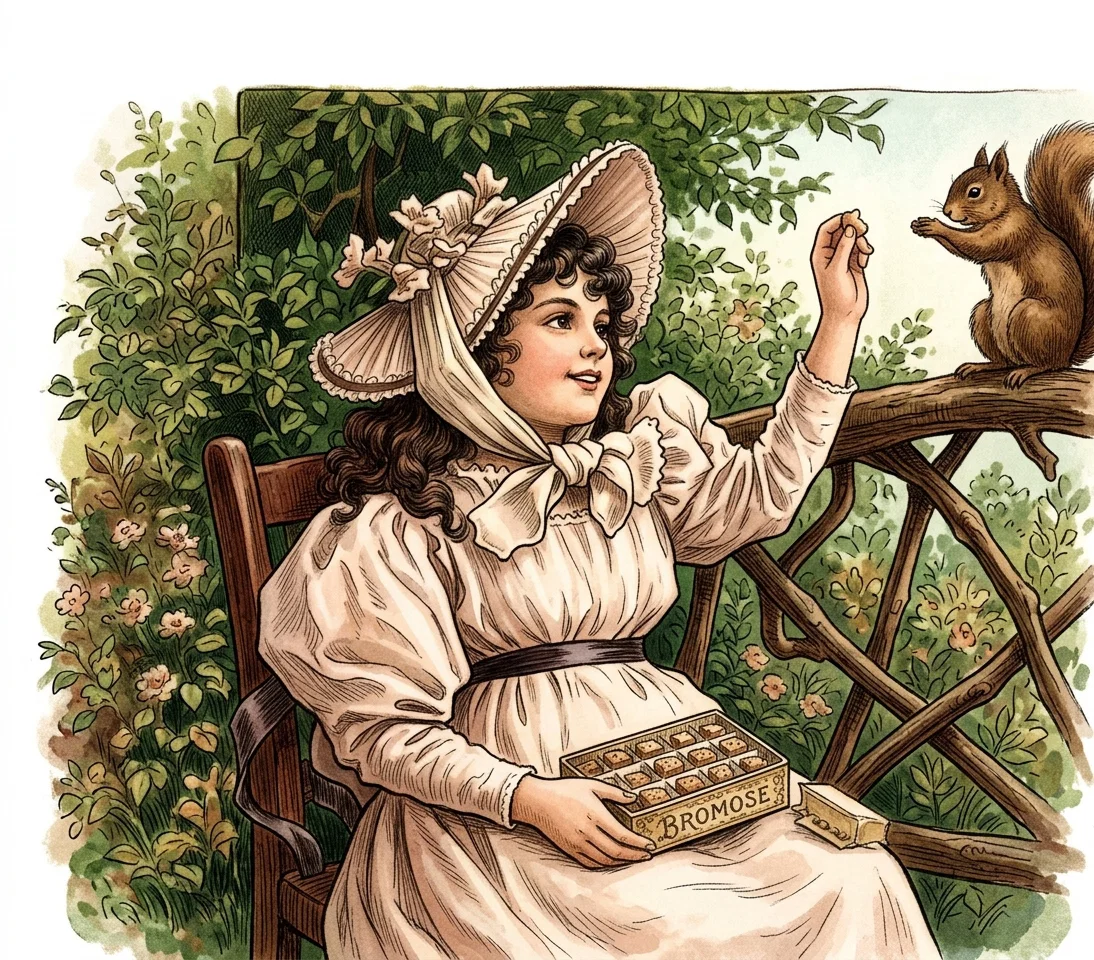
Delicious Bromose

The New Nut Food
The Food that Is all food
Delicious, healthful, easy to digest. Makes double the rich blood of ordinary food.
A Perfect Food for Children
Thin people gain two pounds a week on a half Bromose diet.
Our Booklet, “NUT FOODS,” free, tells all about our Nut Products
A Luncheon of Bromose for a 4c Stamp. Seven Samples for 25c. Full line of samples, 50c
SANITAS NUT FOOD CO., Battle Creek, Mich.
When you write, please mention the SIGNS OF THE TIMES.
Continue reading: THE DAY OF JUDGMENT