The Youth’s Instructor, Vol. 34, No. 49.

EDINBURGH

The Youth’s Instructor

Dec 8, 1886

S. D. A. Publishing Association · Battle Creek, Mich. · Dec 8, 1886

EDINBURGH
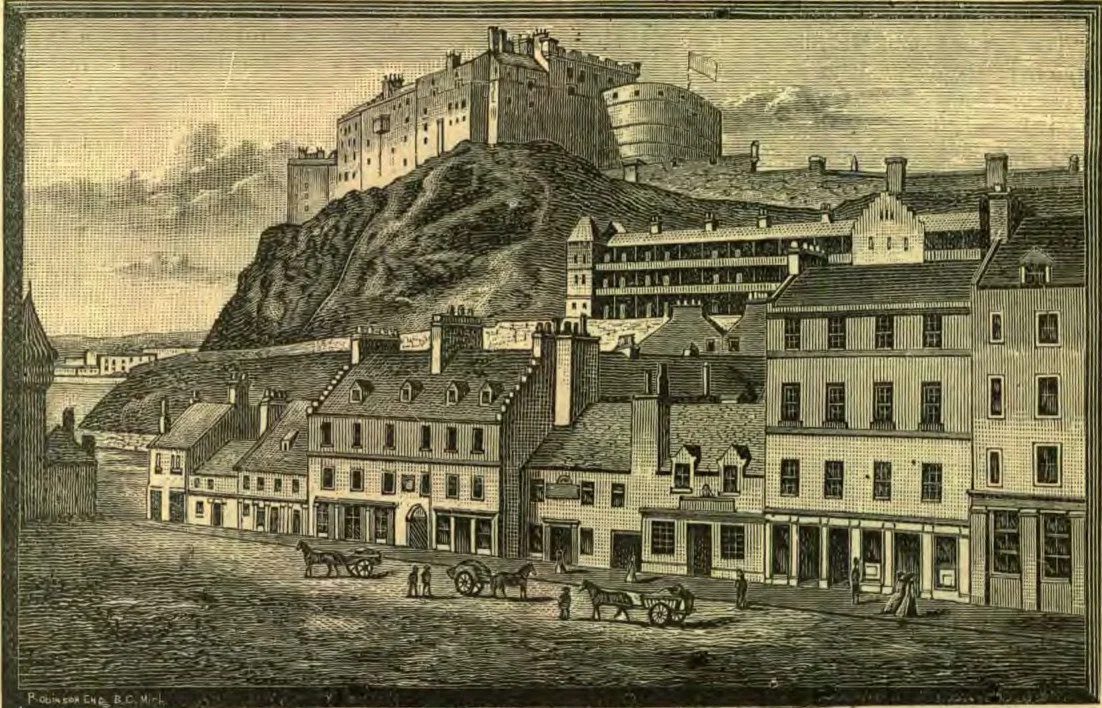
THE city of Edinburgh, Scotland, dates back so far in the past that its origin is lost in antiquity. It is commonly supposed that the city derives its name from a Northumbrian king named Edwin. The city, like many others, owes its origin to its castle, which is fabled to have been the residence of young Pictish princesses, before their marriage, and hence is called the Maiden’s or Virgin’s Castle.
Objects to admire or wonder at meet the stranger at every turn. Here stand, hallowed by the legends of by-gone centuries, buildings so old and quaint that one almost holds his breath in gazing upon them, the very stones of which they are built being black with an old, old age, and crumbled by the storms of over a thousand years; and dwellings ten and twelve stories high, and places where stood others fifteen stories in height, which, though now destroyed, were yet so strong and massive as to tax to the utmost the skill of modern engineering to level them safely.
The streets of the “Old Town,” the ancient part of the city, which was slowly built up as the centuries passed, follow the turnings of the foot and cow paths which they originally were. The Haymarket, Cow-Gate, and Cannongate, with their little closes (alleys), were once peopled by titled families; but they have long since been given over to the poor and lowly, who live in apartments, the walls, paneling, and carving of which are marvels of exquisite workmanship; the fireplaces of delicate carving, would, if transported to America, command fabulous sums among our wealthy citizens for service in their own homes.
Where High Street narrows to the Netherbow, stands the house of John Knox, the reformer. It is a well-preserved specimen of the quaintly gabled, picturesque buildings of old “Edinboro.” Only three of the rooms are now shown to visitors,—the sitting-room, bed-room, and study. They are paneled with oak taken from other old buildings of the same period, as the original paneling has disappeared. In this house John Knox lived from 1560 to November 24, 1572, when he died at the age of sixty-seven. He was buried in St. Giles’s churchyard, and over him the Regent, Morton, pronounced his famous eulogy: “Here lies he who never feared the face of man.” Along the lintel of the door on the ground floor is the following inscription in old spelling: “Lufe God Above All And Your Neighbor As Yourself.” And in front, looking up High Street, there is a rude effigy, supposed to be that of the reformer.
St. Giles is the ancient parish church of Edinburgh. It is dedicated to a saint of the name, supposed to have been born in Greece. It is an object of interest, both from its antiquity and its associations. It is supposed to date from the ninth century.
The Haymarket is of great antiquity. It was formerly the place for public executions, and a circle, inclosing a cross on the causeway, at the east end of the street, marks the spot where the scaffold stood.
Among the many fine monuments of this city is the “Scott Monument,” a cross of brown stone, one hundred and ninety-seven feet in height, erected to the memory of this author. A marble statue of Sir Walter, attended by his dog Bevis, is placed under the canopy of this monument. A stairway of 287 steps leads to the top, while from its thirteen galleries views of all parts of the city can be obtained. In the niches are statues of some of the most familiar characters in his poems and novels. The monument cost £15,650.
The beautiful old castle, perched upon the granite rock in the heart of the city, is, however, the chief object of interest. Built on a rock rising three hundred feet out of the plain, its position is both commanding and picturesque. A large part of the present building is comparatively modern, yet as a fortress it probably existed during the fifth century. In one of the rooms is deposited the Regalia, the ancient honors of Scotland,—
“The sceptre, sword, and crown, that graced the brows Since Fergus, father of a hundred kings.”
In 1255, Margaret, queen of Alexander III., and daughter of Henry III., of England, complained to the Scottish estates that she was confined in the castle, “a sad and solitary place without verdure, and by reason of its vicinity to the sea, unwholesome.” In the octagonal room, with paneled and inscribed walls, James the “First and Sixth” was born. Upon the summit of the castle over this room lies the ancient cannon called Mons Meg. At the other end is situated St. Margaret’s Chapel, not only the oldest extant part of the castle, but also the oldest building in Edinburgh. After being neglected and lost sight of for centuries, it was rediscovered and some of its shafts and pillars restored by Dr. Daniel Wilson, who regards it as the veritable Chapel of the Holy Rood, found by Queen Margaret. To the antiquarian, the city presents nothing so ancient or so interesting architecturally as this small building. W. B. C.

KEEPING STORE.

“PAPA,” said Henry, “may I be a clerk, if I can get a place in a store?”
“Why do you want to do that, my son?” said his father.
“Oh, because I think it would be nice. I want to be a merchant some day.”
“Why do you want to be a merchant?” the father asked.
“Because,” said Henry, “it is not hard work, and I can keep dressed up, and sell nice things.”
“I fear,” said Mr. Brown, “that you have a wrong idea if you think it is not hard work to keep store. Besides, it takes money to run a store, you know.”
“Oh, I have got some money,” said Henry. “I have ten dollars now, and I can sell my colt for forty, and grandpa is going to give me twenty dollars, so he said. Isn’t that enough to begin with?”
“Well,” said his father, “suppose we go down to the store, and talk with Mr. Shepard about it.”
So Mr. Brown and Henry went down to the store together.
“Mr. Shepard,” said Mr. Brown, “Henry thinks he would like to be a store-keeper. He thinks it would be easy work. What can you tell him about it?”
Mr. Shepard laughed heartily, and said: “I think if Henry tries it, he will soon find that store-keeping is not easy work. We often work from six o’clock in the morning till ten at night, and some of it is hard, dirty work, too. The whole store must be swept every day; then it must be dusted, the lamps filled and cleaned, the stove blacked, the ashes carried out, and wood brought. This and running on errands is the first thing that we set boys at.” By this time Henry’s head dropped some; he had not thought of that part of the work.
“How would you like to do that, Henry?” inquired his father. Henry seemed to be finding the bottom of his pocket, and did not answer.
Mr. Shepard continued: “Keeping the books, changing goods, writing letters, and various matters like this require much hard work. Once a year it is a big job to invoice everything in the store, and balance the accounts. This sometimes keeps us up till twelve o’clock at night. And then, when custom is good, our clerks have to be upon their feet from morning till night, with scarcely a chance to rest. I think, my boy, that you will find there is work in it if you succeed in the business.”
“What capital does it require to run such a village store as this?” the father asked.
“About ten thousand dollars,” said Mr. Shepard.
“Ten thousand dollars!” exclaimed Henry.
“Yes,” said Mr. Shepard. “We have now probably over nine thousand dollars’ worth of goods right here before you, and ours is only a common village store, having a general assortment of dry goods and groceries.”
“Your hundred dollars would not go very far, I guess,” said Mr. Brown. Henry looked disappointed.
But Mr. Shepard continued: “Twice a year we go to Chicago, to a wholesale house, where we examine the goods, post up on the latest styles and best qualities, and buy our stock. It requires long experience, and the best of judgment to buy safely. If you buy the wrong kind of goods, or too much of one kind, or pay too much for them, you are sure to lose in selling. On smaller quantities, we often buy from drummers, who come around several times a year with samples.”
“Do you have to pay cash down for goods, or do you get them on time?” inquired Mr. Brown.
“The rule is,” said Mr. Shepard, “to pay for groceries in thirty days. If we pay cash down, however, we get one per cent off. On dry goods, we are expected to pay in sixty days. Cash down, we save from two to six per cent. We are expected to pay for boots and shoes in four months; or cash down, we save five per cent. So you see it is a great saving to buy for cash down.”
“But do you not get trusted for your goods a year or more?”
“Oh, no,” said the merchant. “No good business man will do that. He would soon ruin his credit.”
“About what per cent is made on goods?”
“You see it would be hard to average it,” said Mr. Shepard. “On sugar, for instance, we make nothing. We only keep it to accommodate our customers. If we save ourselves on it, we do well. On boots and shoes, however, we make a large per cent. And on smaller things, we often double; though the sales are so small as to amount to but little. From ten to thirty per cent is a fair margin.”
“Do you get cash down?” said Mr. Brown, “or do you trade a good deal?”
“Very few stores trade on a strictly cash basis,” replied Mr. Shepard. “We could hardly do it in a village or country store. We get part cash down, from one-third, perhaps, to two-thirds. The rest we trust.”
“Do you not often lose some of these debts?”
“Oh, yes, a good many. Do the best we can, we will get out bad debts, and this is what cuts down our profit. And then, we often have to let good debts run a whole year, and sometimes much longer. This, again, lessens our profit, and makes our book-keeping difficult. There is but small profit, ordinarily, in store-keeping. You see, first, we must have a large capital, say, ten thousand dollars. The interest on this is considerable. Then the rent for a store in the best locality in town is heavy. We have to keep heavily insured, and that costs a good deal. Bad debts take out a large lump. Goods which we fail to sell in season, afterwards have to be sold under price. Eggs spoil on our hands, fruit and vegetables rot, and there are various other losses.”
“You find it, then, a great care and anxiety, I judge, to keep everything straight in your business,” said Mr. Brown.
“I should think we do,” the merchant replied. “It is one constant anxiety all of the year around.”
“What is the pleasantest part of your business?”
“I can tell you,” said Mr. Pratt, his partner. “It is when we lock up and go home at night.”
“Well, Henry,” said Mr. Brown, “You see it is not all fun in keeping store. I understand, Mr. Shepard, that people often fail who undertake it.”
“Yes sir,” was the answer. “There are probably more failures in this than in almost any other business. No man should go into the business without much experience, and careful advice, and a disposition to work hard, and be thoroughly honest.”
“Well, Henry,” said the father, “do you want to hire out to Mr. Shepard, or do you want to wait awhile?”
“I guess I’ll wait and think it over a little,” said Henry.
So Henry returned home, better informed about store-keeping, if not better satisfied with his work as a farmer’s boy.
D. M. CANRIGHT.

WE DO NOT KNOW.

DEAR child, dear child, we do not know Why sorrows come and pleasures go; Why oft we fail when most we try; But God knows why, And we shall all know by-and-by.
We do not know, we cannot tell, But oh, the Father knoweth well, Why one is sick and one is fair. One sick with care, And this world's poor are everywhere.
We walk in darkness; but he sees And shows us gently by degrees, And step by step, the hidden way, If we but pray:— "Lord, make me follow thee alway."
We must be patient till the end, And leave to him the way we wend, For never here our eyes can see The plan that he In mercy plans for you and me.
Our best is ill; our worst perhaps His pity counts a lesser lapse; But every sin is very black, And holds us back From duty's straight and shining track.
Sweet is the fear that will not dare Forget his law and spurn his care; And sweeter still the love that saith With every breath:— "Lord, make me faithful unto death."
—Selected.

DAN'S TEMPTATION.

It was a cold day in November, and the bleak wind whistled around the corners and down the streets, carrying upon its wings clouds of dust and whirling dead leaves.
Dan plied his broom briskly upon the crossing that he considered his especial property, and now and then beat his arms upon his breast to warm himself. Business had been very dull that day, and Dan found it hard work to keep up the cheery whistle with which he usually accompanied his work. It had been so cold that ladies and gentlemen had not felt like stopping to search in their pockets for stray coppers, but drew their wraps and overcoats more closely about them and hurried along.
Dan had found it a very cold day, too. His clothes were so thin and well-worn that they had poorly protected him from the cutting wind, and he was chilled through. His fingers were numb and stiff with the cold, and his teeth chattered.
And to-day he had hoped to earn more pennies than usual, for his mother was sick and needed so many little comforts that he had set his heart upon taking home to her. He did not mind the cold and hunger for himself, but it was hard to see his mother suffer when he was doing his boyish best to care for her.
His face brightened up as he saw one of his regular customers approaching, a young lady who never failed to have a penny ready for him, and a bright smile and pleasant word, which Dan appreciated quite as much as he did the coin. He was not disappointed, for the lady paused and drew off her glove to search in her pocket for the little silver coin that she knew was there.
It was some moments before she found it, and she smiled brightly in the eager, expectant face as she laid a silver dime in Dan's outstretched hand.
The boy thanked her joyfully as she went on, and he turned the money over and over, meditating upon the different ways in which he might spend it.
When he took up his broom again, he saw a dainty kid glove lying on the crossing before him. As he stooped to pick it up, he recognized it as the property of the young lady who had given him the dime.
“I 'spose it slipped out of her muff and she never missed it,” he said, as he picked it up and shook the dust from it. “I'll wrap it in a bit of paper and put it away till she comes back this way, and then I'll give it to her.”
He seated himself on the curbstone, and began to smooth the glove out carefully. There was something hard in one of the fingers, and Dan carefully drew the hard object out.
He uttered an exclamation of surprise as his eyes fell on a handsome ring that evidently slipped from the finger of the owner when she drew off her glove.
Dan was afraid lest some of the other boys should see his treasure, and he hid it from sight till he reached a sheltered doorway; then he drew it from his pocket again and eagerly examined it.
Inexperienced as he was, he knew that the beautiful, white stone that flashed and sparkled as the sunlight fell upon it was valuable, and that he could sell it for a great deal of money.
“I expect I'll get ten dollars anyhow for it!” he reflected, jubilantly; for ten dollars seemed a fortune to the little crossing-sweeper. “Then I can buy mother some medicine and some oranges, and everything she wants!”
No more crossing-sweeping for that day now, and he shouldered his broom while he set out in search of a jeweler's to convert the beautiful ring into the money which he was so anxious to obtain.
Suddenly a thought flashed into his mind, which brought a shadow in place of the bright look his face had worn. He had no right to sell the ring, for he knew to whom it belonged. It would be stealing just as much as if he had drawn it from the young lady's finger. His duty was to restore it to its owner.
“But I can't!” cried Dan, while a mist of tears dimmed his eyes, and he clasped his treasure more tightly at the thought. “I must get those things for mother. I can't give the ring up!”
It was a hard struggle between good and evil that went on in Dan's mind during the next few moments. He had been carefully taught, both by his mother and in the Sabbath-school that he faithfully attended every Sabbath, and his conscience would not be silenced.
An earnest prayer for help to do right went up from the depths of his heart, and I need not tell you that it was swiftly answered. He resolutely went back to his crossing to watch for the return of the young lady.
She had evidently discovered her loss, for her face wore an anxious expression; and when Dan stepped forward and told her what he had found, her face grew as bright as the boy's own had done when he discovered the treasure.
“It was the gift of a dear friend, and I would not have parted with it for many times its value,” she said, as she thanked the boy warmly.
Dan confessed to her how sorely he had been tempted to keep it, and she promised him that, as a return for his honesty, she would go home with him and see what his mother needed, and let him get whatever he wanted that would add to her comfort.
That was the beginning of better times for Dan, for he never went back to his hard street life again. The young lady's brother was a doctor, and wanted a boy to attend to his office for him, so Dan had a comfortable home with kind friends, who helped him to grow up to a good and useful manhood, and his wages were sufficient for him to be a great help to his mother.
Do you not think he was glad that he had resisted the temptation to be dishonest, and keep what he knew to be the property of another?—Youth's Evangelist.

ACHIEVEMENT

Not every bud becomes a perfect flower; Not every bird sings sweetly as the lark; And the swift arrow sent with certain power May cleave the air, yet fail to reach the mark.
Yet must we struggle on; nor ever be Dismayed, despondent o'er endeavors crossed; The work wrought out with patience, silently, Is worth to every heart whate'er it cost. —Josephine Pollard.

A MAORI TRIAL FOR THEFT.

In case of theft, the Maories strongly believe and earnestly advocate the doctrine of restitution; and in their practice they rigidly enforce the restitution of several times the value of what has been taken. One of our friends, Mr. Hare, had his horse stolen, and he finally found that a Maori boy had taken it. Rather than pursue the common course of law, he entered his complaint to the chief. A council was called, and Mr. Hare was requested to be present and state his grievance. Before making his complaint, however, he was asked to sit down and take a smoke. He declined to smoke, and they had a social interview. This was arranged purposely, so that his testimony should be given impartially and without excitement.
When the proper time came, he was called upon to state his evidence for thinking that the Maori boy had taken his horse. The chief asked Mr. Hare if he could recognize his horse, and ordered it brought forth. Mr. Hare said that it was his; “but,” said he, “you have ruined him by cutting off his mane and tail so that he might not be recognized.” It was finally decided that he should receive back the horse, and ten pounds as restitution for the damage done him. As they had no money, they proposed to pay him by giving him ten Kauri pine trees. One of these trees is worth more than a pound, as it furnishes very valuable timber, which is shipped to other countries.
“But,” said Mr. Hare, “ten pounds is too much; two pounds is all that would be just;” so they finally decided that he should have two pounds, or two trees. He was to select the trees, and then they were to be marked. This mark placed upon them was all the evidence he had of the transaction.
Many years have now gone by since it took place, and that portion of the country has been cleared of trees, but those two trees remain untouched; and they are known by all the natives of that section of the country as a trespass offering. An account of the transaction is handed down from generation to generation, so that should the trees stand until they decay, no Maori would ever touch them. It is said that the Europeans taught them to steal, but they will seldom take any thing from those with whom they live on friendly terms.
Next week we will tell you how some of the missionaries took advantage of them in trade.
S. N. HASKELL.

The Sabbath-School.

FOURTH SABBATH IN DECEMBER.

PARABLES OF CHRIST.

LESSON 19.—THE TWO SONS.

1. Where did Jesus spend the last Sabbath before his crucifixion? John 12:1, 2.
2. What occurred after supper? Verse 3.
3. What attracted great numbers of people when they learned that Jesus was at Bethany? Verse 9.
4. What troubled the chief priests? Verse 11.
5. How did they propose to put an end to this annoyance? Verse 10.
6. What remarkable event occurred the next day? Matt. 21:1-11.
7. What was among the chief causes for this demonstration by the people? John 12:17, 18.
8. When the Pharisees saw such honor paid to Jesus, what did they say among themselves? Verse 19.
9. On the next morning (Monday), as Jesus was again on his way to the temple, what caused him to curse a fig tree? Matt. 21:18, 19.
10. What was the effect of this curse?
11. What bold action did Jesus take in the temple the same day? Mark 11:15-17.
12. What acts of mercy did he perform? Matt. 21:14.
13. How did these things affect the chief priests and scribes? Verse 15.
14. What did they say to Jesus? Verse 16.
15. How did he answer them? Same verse.
16. How might the cursing of the fig tree illustrate the fate of these hypocritical priests and rulers?—The curse of God was about to fall upon them, because they were unfaithful, and did not bear the fruits of good works.
17. Where did Jesus lodge at night? Matt. 21:17.
18. What did the disciples notice on Tuesday morning, as they were returning to the temple? Mark 11:20.
19. What lesson of faith did Jesus draw from this? Verse 24.
20. What important condition did he lay down for the prayer of faith? Verse 25.
21. As Jesus came into the temple, and began to teach, how was his authority questioned? Matt. 21:23.
22. What proposition did he make? Verse 24.
23. What question did he then ask? Verse 25.
24. How did the priests then reason among themselves? Verses 25, 26.
25. How did the conversation end? Verse 27.
26. How did Jesus then illustrate the condition of these conceited priests?—By the parable of the two sons.
27. Relate the parable. Matt. 21:28-30.
28. When Jesus had related the parable, what question did he ask? Verse 31.
29. How did they answer him? Same verse.
30. What startling announcement did Jesus then make to them?
31. What reasons did he give for making such a statement? Verse 32.
32. Which of the sons represented the priests to whom Jesus was talking?

A CURIOUS WELL.

On the opposite side of the Nile River from Memphis, the ancient capital of middle Egypt, we find Cairo, where there are a great many interesting objects. It is here that we find the castle of Cairo, one of the greatest curiosities in Egypt, which comes down from the remotest antiquity. “The present citadel, or El-Kalah,” says the “Encyclopedia Britannica,” “was built by Saladin about 1166, but it has since undergone frequent alterations, and now contains a palace erected by Mehemet Ali, and a mosque of Oriental alabaster founded by the same pasha on the site of “Joseph’s Hall.” It is in this interesting place that the traveler finds the famous well of Joseph, which is described by Rollin, in his Ancient History of Egypt, as follows:—
“The greatest rarity in this castle is Joseph’s well, so called, either because the Egyptians are pleased with ascribing what is most remarkable among them to that great man, or because there is really such a tradition in the country. This is a proof at least that the work in question is very ancient; and is certainly worthy the magnificence of the most powerful kings of Egypt. This well has, as it were, two stories, cut out of solid rock to a prodigious depth. The descent to the reservoir of water, between the two wells, is by a staircase seven or eight feet broad, consisting of two hundred and twenty steps, and so contrived that the oxen employed to throw up the water go down with all imaginable ease, the descent being scarcely perceptible. The well is supplied from a spring, which is almost the only one in the whole country. The oxen are continually turning a wheel with a rope, to which a number of buckets are fastened. The water thus drawn from the first and lowest well is conveyed by a little canal into a reservoir, which forms the second well, from whence it is drawn to the top in the same manner, and then conveyed by pipes to all parts of the castle. As this well is supposed by the inhabitants of the country to be of great antiquity, and has indeed much of the antique manner of the Egyptians, I thought it might deserve a place among the curiosities of ancient Egypt.”—Book I, part I, chap. 2, par. 2.
W. A. BLAKELY.

PUPIL—TEACHER

He who would teach Christ’s truth to others must himself be a pupil in the school of Christ. No lesson helps, no commentaries, however learned, critical, and complete, are sufficient to give one that insight into the doctrines of the great Teacher, and that conviction of their absolute truthfulness, which are essential qualifications of an efficient instructor. To know that those doctrines are divine one must accept them, not only as theories to be assented to by the intellect, but as revelations of divine love made to the heart, as truths for faith to cling to, as spiritual conceptions giving birth to a love responsive to that infinite love which they set forth. Hence the Saviour said, “If any man will do his will, he shall know of the doctrine whether it be of God.” And all Christian experience conforms to this saying. As a matter of fact no man fully comprehends Christ’s words or feels their regenerating power until he honestly wills to do what they command. But when a man can say, “I love him because he first loved me,” he sees a meaning, a beauty, a grandeur in Christ’s words which qualifies him to teach as he never could do without that experience of faith and love. Let him, therefore, who desires to teach well enter himself as a perpetual pupil in the school of Christ.—S. S. Journal.

Our Scrap-Book.

LABOR.

LABOR is life! ’tis the still water faileth; Idleness ever despaireth, bewaileth; Keep the watch wound, or the dark rust assaileth; Flowers droop and die in the stillness of noon. Labor is glory!—the flying cloud lightens: Only the waving wing changes and brightens, Idle hearts only the dark future frightens, Play the sweet keys would’st thou keep them in tune. —Frances S. Osgood.

SIAMESE WORSHIP.

Mrs. A. H. LEONOWENS gives an interesting description of Siamese temple worship in one of the cities visited by herself. After describing the temple, she says:—
“About nine o'clock every morning the innumerable little bells that surround the temples and pagodas are heard tinkling from far and near. The narrow, crooked streets and lanes which intersect and cross each other in the most bewildering irregularity are suddenly thronged with women and children of all ages, from the tottering, feeble old dame of eighty to the two-year-old who is just beginning to feel the solid earth under her little feet.
“The princesses and ladies of high rank, dressed in many-colored silks, gay scarfs fluttering in the breeze, and laden with golden ornaments, each one followed by a host of female slaves, some half nude, and others very neatly dressed, according to their circumstances, bearing vases of flowers, perfumed tapers in golden candle-sticks, and gold and silver tea-trays, with teapots and tea-cups all ready for use, form a brilliant part of the diversified procession. In addition to these, every prince, princess, and great lady has an especial slave, whose duty it is to carry his or her betel box; for even while at prayers the Siamese may be seen chewing their betel, or indulging occasionally in a cup of tea.
“As soon as the crowd arrive at the temple, the princes and princesses rank first in order. They take their seats near the pulpit, on the silken cushions placed for them on the tessellated floor of the temple. After these, come the great ladies and female officers of the inner court, then the wives of the king, and last of all, the slaves. Before each and every worshiper stands golden vases filled with fresh, fragrant flowers, odoriferous tapers, and a small gift for the priests.
“At the appointed hour the tinkling of the pagoda bells gently cease. Two priests, attended by armed Amazons and fierce-looking eunuchs equipped with swords and staves, enter the temple at the eastern gate, veiling their faces with their jeweled fans, lest their eyes should wander towards any of the pretty women, and tempt their thoughts to stray from their sacred offices of prayer and praise. The head priest mounts a heavily gilt pulpit, and the other takes his place on a raised platform behind it.
“The Siamese pulpit, by the way, is very unlike those used in our places of worship. It is more like a throne of state. It has a high, circular back, richly carved and gilt, and towering at least four feet above the head of the priest, and inclosing him on the right and left. On the steps are engraved passages from the Buddhist scriptures, and the whole is supported on the tails of four open-mouthed dragons, which form the pedestals, producing a weird and grotesque effect.
“The sacred books of the Buddhists are composed of long strips of ancient palm leaves. The characters are in Pali, which is the language of the Buddhists' books of Ceylon, corrupted by oral and perhaps provincial use from the more perfect and polished Sanskrit, pricked in by means of a stylus, and then traced over with dyes of various hues, red, blue, and yellow. The edges are often beautifully illuminated with curious designs.
“The moment the priest has unrolled the pale yellow leaves of his palm manuscript, the assembled company of high and lowly-born women and children raise themselves on their knees, light their tapers, place them on either side of their flowers, fold their hands, and assume, with closed eyes, the most reverent attitude of worship. Many of them kneel throughout the service.
“There is first a liturgy in which the congregation joins, and then a sermon from some Buddhist text. After the service, the princesses and the great ladies crawl on all fours towards the pulpit, and present their little gifts to the priests. These are taken in charge by the eunuch, and handed to the priest attendants, who are in waiting without the gates of the inner city.”

A CHINESE PROCLIVITY.

There is no more effectual barrier to human progress than a sort of narrow self-conceit that takes possession of some minds, instilling the belief that their ideas and ways, and theirs only, are right; for it keeps one from investigation, and from the benefits of others’ research. It is the general belief that no nation has fallen so far under the influence of this deception as has the Chinese. A writer in the Christian Weekly says of this people:—
“Thinking their own opinions and ways the best, they have wilfully refused to take hints from other nations, and have naturally fallen to the rear, when, with their indisputable gifts of perseverance and industry, they might well be in the van of civilization. What they do, they do well indeed, but it is in the same style that their ancestors did it, and, as a matter of course, the article, be it what it may, is of precisely the same quality as that made by their forefathers.”
This writer verifies his assertion by a description of their manner of manufacturing paper. He says:—
“The paper we all know so well is manufactured by what appears to us a most tedious though simple process, handed down from generation to generation. The material used may be bamboo, cotton, silk, herbaceous plants, the skins or even intestines of animals, or the bark of a tree called by them ‘koon-schon’ (Arabia Papyrifera), but the process is always the same, the result being difference in form, size, color, or thickness of the paper produced. We will take the manufacture from the ‘koon-schon’ tree as a type of all the others. The bark and twigs are first ground up with a certain quantity of lime, and then cooked in an oven. The mass is then taken out and well beaten with a hammer, flattened into thin strips, which are tightly rolled and cut up into round slices like a sausage. All these pieces are now placed in a mortar and ground by means of a mechanical hammer of most primitive construction until they are worked into a lump of paste. This paste is turned into a reservoir of water, where it soon dissolves into soft pulp.”
“A bamboo sieve is now produced with all the fibers arranged in parallel lines. This sieve is plunged into the reservoir and then quickly drawn out. The water, of course, runs through, and the thicker paste lies on the sieve in a very thin layer.”
“The sieve is then turned over on a sheet of paper, to which the newly-made leaf clings. In this way one leaf after the other is added, until there are a thousand of them. The whole are then subjected to great pressure in order to dry them, and the paper is ready.”
“However we may disagree with the sentiments which have prevented the Chinese from taking a leaf out of other people’s books, as the saying goes, we may certainly, with advantage, take one out of theirs, and learn not to scamp our work, but whatever we have to do, to do it with all our might.”

WEEPING BY STEAM.

A SINGULAR discovery has just been made in Milan. In one of the districts of that city was a statue of St. Madeleine, which, from time immemorial, miraculously poured its tears on infidels and heretics. After the success of the Italian revolution, it wept copiously. It had happened that the venerated monument needed repairs, and it was necessary to remove the statue. What was the surprise of the workmen to find that it contained a little reservoir of water, which was heated by means of a furnace concealed in the base! The water, in evaporating, rose to the head of the statue, where it condensed and reached to two little tubes of the eyes, when it escaped and ran drop by drop over the cheeks.
Continue reading: Snowflakes