Falling all the night time, Falling all the day. Crystal-winged and voiceless, On their downward way; Falling through the darkness, Falling through the light, Covering with beauty Vale and mountain height. Never summer blossoms Dwelt so fair as these: Never lay like glory On the fields and trees, Rare the airy wreathing, Deftly turned the scroll, Hung in woodland arches, Crowning meadow knoll. Freest, chastest fancies, Votive art, may be, Winter's sculptors rear to Summer's memory.
—J. V. Cheney.
Letter Budget.
EMMA E. FLECK, of Washington Co., Oregon, writes: “I am a little girl eight years old, and have kept the Sabbath all my life with my parents, two sisters, and five brothers. We have Sabbath-school at our house. I study in Book No. 2. One neighbor keeps the Sabbath, and comes with her children to Sabbath-school. Our people have no church nearer than ten miles from here. Ma gave me a duck, and sold it for me. We had about four acres of onions. Pa gave us some for helping weed them. Our parents pay tithes, and we do the same. I read in the second reader, study spelling, writing, and primary arithmetic. I want to be good, and be saved when Jesus comes.”
Even some children think they cannot afford to pay tithes. The tithe belongs to God; can one rob God, and think to prosper? On the other hand, the promise is that when we bring all the tithes into the storehouse he will “pour us out a blessing, that there shall not be room enough to receive it.”
CHARLEY E. SMITH writes a letter from Oneida Co., N. Y. He says: “I am a little boy nine years old. I go to school, and to Sabbath-school every Sabbath, and have my lessons perfect. I like my teacher very much. We have a mile and a half to walk to Sabbath-school. We live in East Rome, on the east side of the Mohawk River. This is a very crooked river, and when it rains hard the water rises so high that big logs, brush, and wood come down, and are washed on to the banks and supply the people with wood for some time in the summer. Sometimes we go fishing, bathing, and take a boat ride. My stepmother, brother, and I keep the Sabbath, but pa and my two sisters do not. Pa thinks it is right, and I hope we shall all keep it before the Lord comes, and all be ready to go to heaven together.”
Do you know, Charley, that in some places poor people depend almost entirely upon freshets for their supply of fuel?
JOSIE POTTER writes a letter from Winnebago Co., Wis. She says: “I am a little orphan girl, nine years old. I have a good home where I live now. I go to Sabbath-school every Sabbath, and study in Book No. 3. Papa has gone to New London camp-meeting, so mamma and I are all alone. We expect him back next week. I help feed the cow mornings. I learn a verse to repeat at Sabbath-school, and so do the others. I want to keep the commandments of God so I can be saved.”
We are glad you have found a good home, Josie. Shall you show your thankfulness by being one of the best of little girls, and thus have a home in heaven by and by?
JESSIE STERLING, a little girl nine years old, sends a letter from Vernon Co., Wis. She says: “I have been taking the INSTRUCTOR nearly a year. I like it very much, and thought I would like to write a letter for the Budget. My parents and oldest sister belong to the Christian church. Our house of worship is about a mile from our home. I like to go to church. We have meeting every two weeks. I hope some day to be a Christian. My father’s people are nearly all Adventists. Some of them are very dear to me. I hope we may be as one family, so as not to be separated when Christ comes to gather his people.”
“Choose ye to-day whom ye will serve,” Jessie. If you mean to be a Christian sometime, the present moment is all you can claim; so don’t put off anything so important.
GEORGIE FAY, of Shelby, Oceana Co., Mich., is a little boy six years old. He told his mamma what he wanted she should write to the Budget for him, and this is what he said: “I keep the Sabbath with my mamma, and go with her to Sabbath-school always when I am well. I study my lessons in Book No. 1, and my teacher says I get good lessons. I can say the ten commandments, and the Lord’s prayer, which I say every morning. I have learned all by heart the 14th, 15th, 23d, 133d, and 134th psalms, and I can say eighteen verses of the fifth chapter of Matthew, and am going to learn the rest of the chapter. I have a first reader, in which I learn lessons for mamma. I am trying to be a good boy so I can have a home in heaven.”
We recommend Georgie’s way, to learn the Scriptures, which are able to make one wise unto salvation.
ANNIE HANSON, writing from Cook Co., Ill., says: “I am fourteen years of age. I live in Racine, but have come down here to stay because my cousin is sick. It is a very nice place, and I like to stay here. My parents, three brothers, and three sisters all keep the Sabbath, and have Sabbath-school. There are no Sabbath-keepers here, so I feel very lonely on that day; but I am reading the Bible through, and my father sends me the INSTRUCTOR and the Review so I spend the day in reading them. I wish you would print this sometime before Christmas, as it will surprise my father much to read it. I will try very hard to do God’s will, that I may see the INSTRUCTOR family in the new earth.”
Be faithful, and let your light shine, Annie; some honest souls there may be attracted by it.
SHEPHERD
By W. E. L.
It was the proudest moment of Johnnie's life when he had a dog “all his very own.” His grandpa had sent it to him one Thanksgiving Day, and you may be sure Johnnie kept that day in the spirit of it. Shep he concluded to call him.
You never saw such a cunning little dog as Shep was when grandpa first brought him over. He was only three weeks old, and he made such comical work trying to run and play with Johnnie. He grew very fast, and was soon able to understand all he was told to do. Johnnie taught him to go to bed the first time he was told, which was more than he himself was always willing to do, and Mrs. Brown told him she thought he might learn a good lesson from his faithful dog. Soon he learned to be a dead dog, and would lie perfectly motionless until Johnnie called “rats,” when he would jump up and run to some corner in the room, making as much fuss as if he thought a rat were actually there.
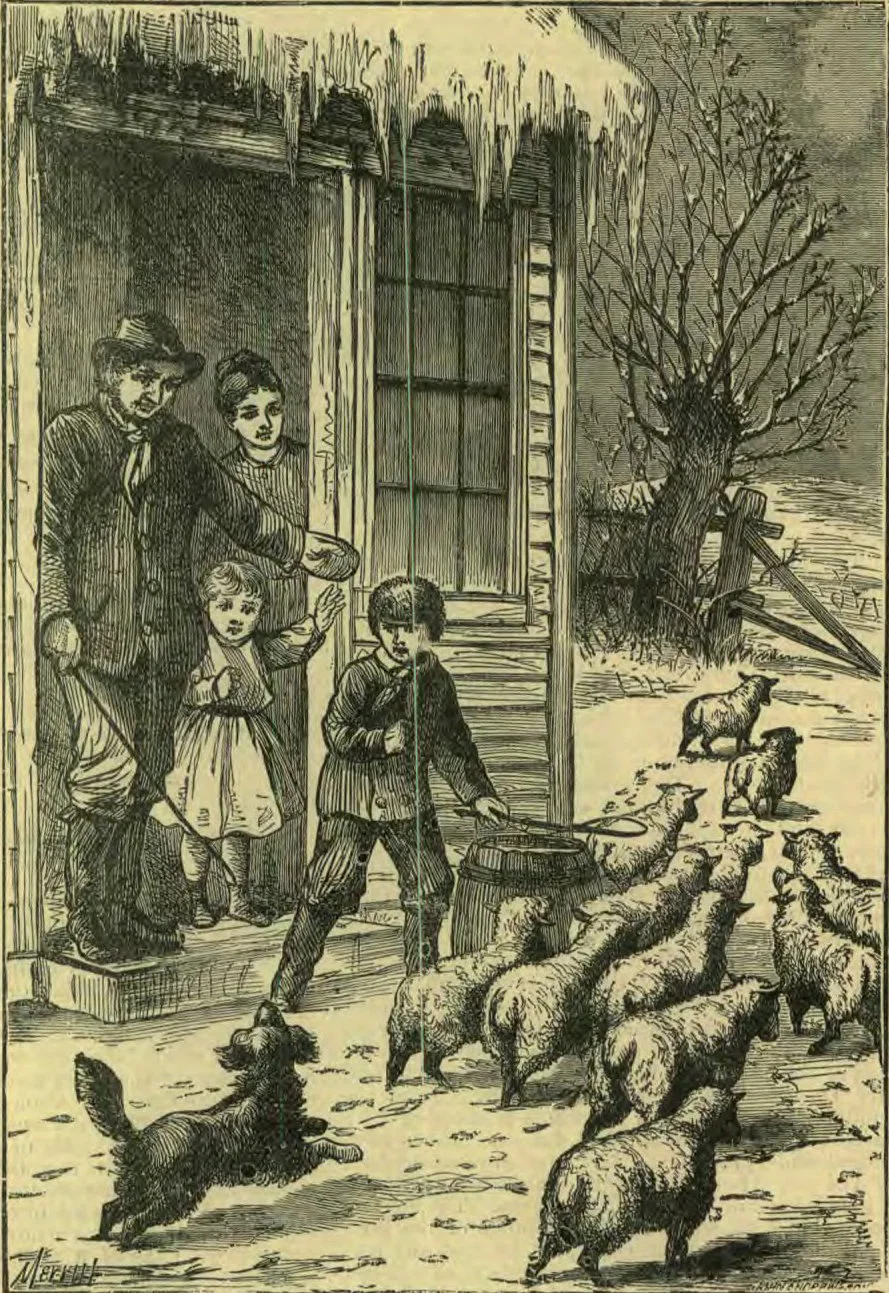
By and by Johnnie taught him to drive the sheep down the long lane to the trough in the door-yard for a drink. Shep soon learned to do it so well that all Johnnie had to do was to let down the bars. Johnnie was sure he could count, for he always seemed to know when a sheep was missing, and would hunt for it until he found it.
When the Sabbath came, Shep was always shut up in the house while the family went to church. He did not like this very well. So one day, when Johnnie went to hunt for him, Shep was nowhere to be found. Mr. Brown waited until the very last minute, and finally went off without finding him. But when the meeting had begun, and the minister was reading the hymn, in walked Shep with one of the neighbor’s dogs; and marching solemnly up the isle, sat down before the front seat, facing the minister. Every Sabbath after that Shep was missing when it came church time, but was always found in the front seat during the service, and paid the closest attention to the minister.
Shep always slept at the foot of Johnnie’s bed, in a willow basket that had a woolly blanket in it. In the summer time the blanket was too warm for comfort, and he made a great fuss over it, getting in and out of the basket and walking around it. At last he found out he could take the blanket in his teeth and pull it out, lying down on the cool willow; and Johnnie taught him to put it in again when the nights were cool. Just as soon as five o’clock came in the morning, Shep would leave his basket bed and run to wake Johnnie up. Johnnie used to wonder how he knew when five o’clock came. But one night a neighbor’s barn caught fire, and the farm bell rang; whereupon Shep sprang out of bed, and waked Johnnie up as usual. So he knew that Shep waited for the bell to ring every morning, in order to tell the time of day. But at last Shep grew too old to go to church, or to crawl away from the warm fireside. He fell ill with all sorts of dog disorders. Johnnie tended him faithfully. Shep was very patient, and took all the bad-tasting medicine without making any fuss. He seemed to know that it was meant to make him well, and he only made a low whine when he felt the worst. But in spite of all their care he grew worse and worse, and at length he died. Johnnie buried him under an apple tree, and put a white board with the one word “Shep” on it at the head of the grave. He has had other dogs since then, but he thinks he never had one that knew quite as much as Shep. W. E. L.