Your ShelfYour Projects

Review and Herald, Vol. 89, No. 23.

Resting With Jesus

Earlier text: Forces in Active Antagonism to the Fundamental Principles of the American Government

Pleasure Abiding

L. D. SANTEE
MULTITUDES seeking an earthly treasure, Pressing and crushing the grapes of sin, Will find but pain in the wine of pleasure, And a heart of sadness the breast within; And the glittering snares of the world, alluring, Are apples of Sodom and grapes of gall. Ah! there's no joy on this earth, enduring, Only to come when the Lord shall call;
Only to look with eyes anointed, For the wondrous gladness so soon to be; Only to wait for the time appointed, When Christ shall come and the soul be free; Only to wait till our loved ones breathless, Waken to beauty when God shall call; Only to wait for the life all deathless That comes to the ransomed, each and all;
Only to come with prayers most fervent, Working for Jesus as seasons fly, Laboring earnest, a faithful servant, Hoping reward in the by and-by. Ah! there's a joy beyond all telling, Waiting for us on the farther shore. Ah! there's a rapture, the bosom swelling, To know that the gladness is evermore.
Moline, Ill.

Through to India by Train

It will not be long until missionaries can enter India by overland route. The Transcontinental Railway through Persia to India seems to be assured now that England is ready to join with Russia in submitting the proposal to the Persian government. India agrees to the enterprise, and Persia is not likely to refuse the right of way. The road as now surveyed is 1,883 miles in length, and will cost approximately $110,000,000.

Walk in Christ

"As ye have therefore received Christ Jesus the Lord, so walk ye in him."

Some Things About the Philippine Islands
(Concluded)
ELBRIDGE M. ADAMS
THE houses are made largely of bamboo. They are usually raised about ten feet from the ground. The roofs are thatched. Glass is not used for windowpanes, a window consisting of an open space covering nearly the whole side of the house, which is closed by means of a light, sliding shutter. The natives think that the night air is bad for them, so they close their houses at night. The floors are made of light bamboo strips, which are about three quarters of an inch wide and one quarter thick. They are not placed together, but spaced about one-half inch apart.
These people are great gamblers, betting chiefly on cock-fights. Sunday is the great day for the cockpits, to which hundreds of the natives go, and either gain or lose money. To make the fight still more barbarous, they fasten a sharp-edged blade about three inches long to the foot of the rooster. I suppose that the Americans did not want to incense these people by taking away their chief sport. Almost any time of the day men are to be seen carrying their cocks around in their hands. They keep them in a fighting mood by letting them fight a little each day, but not with the blade.
Many of the venders are women. Around our meeting-tent at night there were three or four women selling their produce. They sat on the ground near their tray-like baskets, and sold peanuts, roasted chestnuts, boiled eggs, etc. They also had corn on the cob, which they were roasting on charcoal coals to sell.
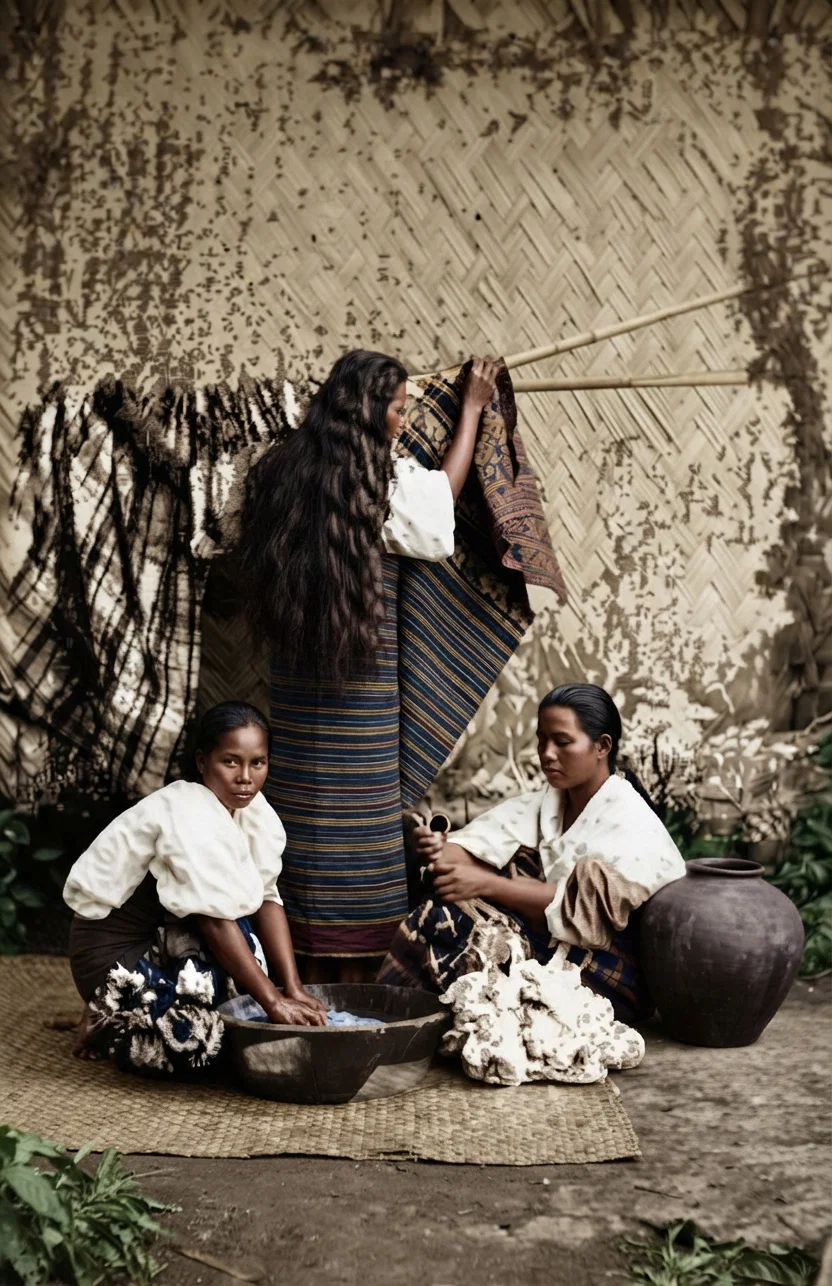
A PHILIPPINE WASHERWOMAN
The coals were kept alive by means of a fan in the woman's hand. The people bought that corn and ate it as we would candy.
We dare not drink water that has not been either boiled or distilled. The vegetables must be cooked, and the only kind of fruit that is safe to use is that which grows on trees and has a thick peel. Then, to avoid the malaria, we must sleep under netting.
Manila is divided into two parts,—the Intramuros, or old walled city, and that which has been built beyond it. The walls are about twenty feet high, and nearly as thick. They are broken down in places for the streets.
The women of the higher class dress artistically. They wear a skirt of heavy material, about like our linen or grass-cloth, or perhaps not so heavy. This is of a bright color or black, never white. Over a white undergarment they wear a low-necked waist, made of very thin material, which comes to the waist line. The sleeves are very large and are starched, so they stand out like a balloon.
They reach to a little below the elbow. In addition to this, there is a kind of scarf, usually made of the same material as the waist. It is just a square folded triangularly and then folded two or three times again. It is placed on the neck, and pinned together in front. This, with the big sleeves, makes the women look odd to the newly arrived American. Their hair is straight and black. Their shoes are leather soles, without heels, but usually with plush toe-pieces. The house shoes are the same, but made of grass. Most men dress like the Americans. The poorer class of men wear trousers and undershirt, with a very thin top shirt outside of the trousers, which takes the place of a coat. The small boys wear a one-piece garment, which is a tight shirt reaching to about the waist line. This is usually all they wear. The little girls wear a slip, which comes to the knees or a little below.
One reason why our living is so expensive is because we have to buy our food in small quantities, for food does not keep well. We get tomatoes and other fruits by the dozen, and potatoes by the kilo (2.2 pounds). Bananas are plentiful. Mangoes are a tropical fruit that we had never eaten till coming here. They are about the size and shape of a turkey egg, only a little flatter. The one seed in the center is long and flat. The meat is a rich golden color, and is very good; in fact, mangoes are thought to be the best fruit. When they first ripen, they cost seventy-five cents a dozen. Papaya is another fruit new to us. It grows on a tree about the size of the coconut-tree, and is very nearly the size and shape of the coconut in the husk. Its meat is yellow, and seems very much like a muskmelon. Canned fruit is twenty-five cents a can, and dried fruit is from fifteen to eighteen cents a pound. Everything in the store is high. Most foods must be kept in tin, sealed up. All kinds of dried fruit, and also beans, peas, cereals, and crackers, have to be packed in tin, or they are likely to spoil before reaching this place. We can get tomatoes, onions, eggplants, green butter-beans, sweet potatoes, etc.; but they are expensive. The native foods that we care to eat furnish so little variety as to be trying on the appetite in this warm climate. We buy distilled water in two-quart bottles, costing us two cents each.
Just a word about the religion. The Roman Catholic has been and is still the largest church. The Catholic churches, with their bells, are to be seen everywhere. In the small places where the people have only bamboo houses, there are very large stone churches towering high above all else. A few years ago, Aglipay, a native Catholic priest, withdrew from the church, and established what is called the Filipino Independent Church. In about two years this church took from the parent church about three million members. The various Protestant churches are quite well represented.
Manila, P. I.

Argentina, South America

C. E. KNIGHT
Our union conference meeting in Chile was the best of the kind that I ever attended. The hearts of all the delegates and workers who were privileged to be there are greatly encouraged. Certainly all are better prepared to go forward with their work than ever before.
We have just planned to open work in a new field, a portion of the conference that has been untouched, lying to the south and southwest.
In some places the financial conditions are much better than they were last year, the harvest being good, while in others the condition is worse. I am hoping for a better tithe this year than last, when we went behind a thousand dollars.
The political conditions in the world are intensely interesting from the viewpoint of our message, especially those of China. We would be skeptical if any one were to predict such changes a year or two before they take place; yet they come to pass, and we look upon them in a matter of fact way, having become accustomed to what we formerly thought impossible.
Our work is progressing well, considering the few laborers we have. Here in Buenos Aires some are constantly becoming interested, and we have baptisms quite frequently. Eight or ten persons have recently requested baptism.
I am glad to know of the progress of the truth in all lands. This success is truly an encouragement to us to hasten forward the message.

The Weak Things

ELIZABETH MAC HUGH
God takes the tiny grains of sand To stop the mighty ocean waves, So proud and crested, tossing high; Hence when they reach the sands, they die. His voice gave forth the sound; They can not pass the bound: On ev'ry shore they ceaseless break, And prove the power of him who saves.
Thus Satan came to our world, And in great waves his wrath is hurled, In ev'ry nation, land, and sea, On those who'll not with him agree: The faithful, tried, and meek, And those considered weak, God lifts by them his sword—the Word, The Spirit's standard—'gainst this flood.
The ocean, calm or angry waves, Th' resisting sands it always laves; So they who stand 'gainst Satan's power, The waves break round them in that hour. Then as the waves recede, Who stands is tried indeed; He sees things all unseen before, And with new vision leaves that shore.
Greenville, S. C.

Dressing Children

MRS. JOHN ANDREWS
THE question of dressing children is not merely one of covering the body from the extremes of the weather, or even doing it beautifully or economically. The question has its moral side.
Through the medium of clothes, habits of personal neatness and cleanliness may be instilled into the minds of children. In the words of another, "Mothers ought to awake to the fact that the great moral educative factor in youth is imitative, and that there is an imitation that is derived from things as well as from persons."
Some features of a child's environment can not always be controlled by the mother, but there are others that can be; and as the mother puts the stamp of her individuality—her character—on these things, so the child will be morally influenced. The matter of clothes is one feature of the child's environment that certainly is controlled by the mother, and that distinctly affects the child morally through its sensitiveness to moral impressions from visible objects.
It is a curious, but observable fact that children do, after a fashion, imitate their clothes. Dress a child gaudily every day, with bright colors, ribbons, and fancy frocks, and you will surely develop in that child a display-loving disposition, vanity, forwardness, and self-consciousness. Mothers who dress their children thus are introducing an element of weakness into their characters, something that by and by may grow into unlovely selfishness, pride, or pretense.
Untidy clothes, too, are character formers. A slovenly dress will induce slovenly habits; for it is a fact that untidy dress and untidy habits go together.
Mothers should dress their children with character formation in view. Dress them quietly, for that promotes modesty; dress them cleanly, for that induces cleanness of mind and impulse; dress them comfortably and loosely, for that will guard against body consciousness; dress them fittingly and properly for every occasion, for that relieves children from mental disquietude.
When we realize what a great influence clothes exert on our children, we shall see what a great responsibility rests on us as mothers. How careful we should be how we choose and make clothes for them, trying to instil in their hearts a love for the pure and beautiful, rather than a desire for the things that are fancy and gaudy. And especially should we impress on their minds the truth that they should never enter the house of God with dirty clothes, hands, or face; for our God is a God of purity, and desires cleanliness in our apparel as well as in our hearts and minds. Teach them that it is not the fine, fancy clothes they wear when they go to church that will please their Heavenly Father, but neatness, tidiness, and purity of heart are pleasing to him.
How careful we should be to let them see that we desire the approval of our Heavenly Father, rather than the approbation of the world.
College View, Nebr.

The Great Insect Pest

MARGARET ROSS EVANS, M. D.
THERE are a number of species of flies commonly found in houses, but the house-fly proper (Musca domestica) composes more than ninety-eight per cent of them all. This insect is gray in color with streaks of blackish gray. Fine hair covers its body, but especially its feet and legs. The mouth parts are arranged for lapping. The fly which bites is not the true house-fly, but the stable-fly, which is identical in shape and color with the house-fly, but whose mouth has a piercing proboscis enabling it to bite severely.
The cluster-fly is another species frequenting houses, but it is slightly larger than the house-fly, and is more sluggish. In the fall it is very liable to attacks of an epidemic fungous disease, which causes it to die on the windowpane or elsewhere.
The so-called blue-bottle fly, or blow-fly, sometimes makes its appearance in houses. This fly breeds in decaying meat.
A small fly quite similar to the house-fly is responsible for the erroneous idea that a fly grows, this species being looked upon as the young of the larger fly, which is not the case.
A still smaller, jet-black fly known as the window-fly breeds in the dust under the carpets and in the curtain hangings.
The fruit-fly is a little fly that finds its way into the kitchen and dining-room during the fruit season.
The true house-fly, however, as we have before stated, far outnumbers all other species. Its distribution is worldwide. No more important insect pest is known to man. The farther south we go, the more numerous and troublesome this fly becomes. More than ten million dollars every year is expended in the United States alone for screening purposes.
The enormous numbers in which flies occur can readily be accounted for when we study into their life history. At the approach of winter the adult fly hibernates, hiding in crevices and out-of-the-way places. As the warm spring advances, it comes out from its hiding-place, and begins to lay its tiny white eggs. The average number of eggs laid by an individual fly is one hundred twenty. The egg hatches in about eight hours. It then remains in the larval state for four or five days, at the end of which it becomes a pupa. In another five days there issues forth from the pupa a full-grown adult fly, ready to lay its quota of eggs.
The average life of a fly is still a question, but there is plenty of time during the ordinary summer season for the development of more than a dozen generations.
The eggs are laid on a great variety of substances, particularly on spoiled foodstuffs, meat broths, dead animals, manure heaps, and human ejecta. In the larval stage the fly thrives on all kinds of filth. Horse-stables form the principal breeding-places. A single stable where a horse is kept will supply house-flies for a neighborhood.
The writer has attended camp-meetings where unprotected closets were daily breeding house-flies by the thousands. Many of these selfsame flies, after swarming over the pits and feeding upon the infected material, proceeded to the kitchen- and dining-tent to crawl on the food prepared to be eaten. Not only the entire camp, but the surrounding neighborhood as well was subjected to this vast multitude of disgusting creatures.
The fly is not merely an annoying inhabitant of the home; it is a dangerous disseminator of disease germs. It is a deadly enemy to human beings. The feet and body of the fly are particularly adapted to carrying germs. Experiments have shown that the number of bacteria clinging to a single fly may range all the way from a few hundred to several million. These microscopic organisms adhere to food over which the fly walks.
Moreover, investigators have shown us that the fly feeds on typhoid bacilli, and that during a period of two weeks after eating them these virulent germs may be found in fly-specks. Milk, water, foodstuffs, and store products are often contaminated in this way. Cholera germs also pass uninjured through the intestinal tract of the fly.
Eggs of tapeworms are eaten by the fly. The eggs are not destroyed, but may be excreted days later.
Flies feed on sputum, and when the tubercular sputum is eaten by the fly, active tubercular bacilli have been found in fly-specks dropped on food fifteen days later.
Epidemics of intestinal disorders of children are most frequently caused by flies. The milk is infected somewhere during its transportation from the cow-stable to the baby's bottle.
Abating the fly nuisance is a matter well worthy of more serious attention than is usually given it. All possible means should be employed to exclude flies from the kitchen and milk-room. Doors and windows should be carefully screened during the summer months. Proper disposal of garbage and dooryard rubbish is of the utmost importance. A prompt gathering of horse manure, which may be treated in various ways or may be collected in an especially prepared fly-proof bin, will do much to lessen the number of flies in a given neighborhood.
At our camp-meetings closet vaults should be so constructed as to prevent the ingress and egress of flies and the hatching of eggs. When the pit is dug, wooden frames with wire nettings may be erected. An arrangement of lids or double doors is necessary to render it fly proof. Aside from these rigid precautions the vault should be daily treated with a thin layer of chlorid of lime.
Lime can be purchased by the barrel for two or three cents a pound. While this may seem expensive, it is well worth while. Every city, every community, and every health officer should conduct a campaign against this insect pest and its breeding-places.
Eternal vigilance should mark our efforts in eradicating it from the land. A flyless home should be our aim.
Washington, D. C.

Mission School at Atlanta, Ga.

The closing exercises of the mission school were conducted in the church, May 13, at 8 P. M. Flowers were freely contributed, and the room was beautifully decorated. Long before the appointed hour, friends began to assemble. The hall was well filled, and every detail of the program was carried out in a pleasing manner.
The work of the students has been most gratifying. This year has been the best of the six since the school was established. As I look back over the past and see how God has led and blessed in the work, and how he has sustained it, causing it to grow in favor as well as in proficiency and equipment, my heart overflows with gratitude to him, and to the many dear friends who have aided in the work. I am deeply interested in these mission schools, and to my mind, it is through them that we can best come in touch with the people of Atlanta.
The tuition and small donations received during the year amount to $109.49, the desks, fuel, etc., have cost $107.25, leaving a cash balance to the conference of $2.24. We desire the prayers and support of all God's people that we with them may triumph with the message. To God we will give all the glory.
ANNA KNIGHT.

The Columbia Union Conference

THE third biennial session of the Columbia Union Conference was held in Pittsburgh, Pa., April 11-21, 1912. The meetings were held in the Carnegie Library auditorium in Homewood, one of the suburbs of the city. The location of the meeting was excellent. The place was central, and easily accessible from any part of the city, and the large auditorium made a splendid place for the public meetings. Besides this, other rooms in the building were made available for committee work.
We are glad to see the advance steps that are being taken by some of our conferences to hold their large and important meetings in good, first-class halls, centrally located, where the people can attend and be favorably impressed. In New York City our churches occasionally hold union meetings in one of the large Y. M. C. A. auditoriums in Brooklyn on the Sabbath. They also had an excellent hall for their recent conference. More careful consideration should be given to the locating of our general meetings than has been done in the past. Greater publicity is being given to our work than formerly, in consequence of its growth and extension. Through the agency of the press, the attention of the world is being turned more and more to this movement. I feel sure that it will be advantageous to our cause to go to any reasonable expense, as the brethren did in the Pittsburgh meeting, in securing a good location for our meetings.
Some of the distinctive truths of the message were presented at the evening services during the conference, and some have since embraced the Sabbath as a result of these meetings, and others are interested. Brother W. L. Burgan, secretary of the Press Bureau, attended the meeting, and secured the publication of a number of splendid reports of the proceedings in the daily papers of Pittsburgh. In this way the attention of a large number of persons was called to our work.
The reports rendered during the conference indicated an encouraging growth in various lines of work. Over five hundred persons were reported as having accepted the truth the past year. The total tithe paid in the union showed an increase of about forty thousand dollars over that of the previous biennial period. There was also quite a marked increase in the funds raised for the advancement of our work in both the home and foreign fields over that of the previous biennial period. In the sale of our literature a gain of about thirty thousand dollars was reported over that of the previous period.
This union has the largest population of any union in the United States. Some of the larger and more important cities are in this territory.—Philadelphia, Pittsburgh, Cleveland, Cincinnati, Richmond, etc.,—and a strong, aggressive work must be continually carried forward that the message may be firmly established in all these strong, populous centers. There is a constant demand for earnest, consecrated workers to answer the calls coming from many places. It seems that the need of devoted, prayerful laborers was never so urgent as at the present time.
During the session of the conference the boards of the Review and Herald, Washington Sanitarium, and the Foreign Mission Seminary held their annual legal meetings. They were thus able to lay the reports of the various institutions before a large gathering of the constituency, and have the benefit of counsel in forming plans for the future. All the reports submitted were very encouraging.
Prof. B. G. Wilkinson was reelected president of the union conference, and the other officers chosen were practically the same as for the past term.
During the most of the meeting, daily studies were given by the writer on the sacred work of the gospel ministry and the responsibility of accepting a call to be a laborer in the vineyard of the Lord. Much interest was shown in these studies, and a desire was expressed on the part of all in attendance to put forth earnest efforts to reach the high standard set forth in the Word of God for those who labor for souls. May the special blessing of the Lord attend the proclamation of the message, and lead many souls to obey the truth. This message is designed by the Lord not simply to warn men, but to save them. A. G. DANIELLS.

Do the Best You Can

"If you will do the best you can As each day comes along, You'll find it a most excellent plan To keep from doing wrong. And, when the month is gone, you'll be A joyous child, and glad and free."
Continue reading: Gospel Workers' Department