“Practical Lessons from the Experience of Israel,” for the Church of To-day. By F. C. Gilbert, a converted Hebrew. 390 octavo pages, 19 chapters, illustrated; price, cloth, silver side and back stamp, $1.00; two shades of cloth, gilt edges, gilt side and back stamp, $1.25; half morocco, full gilt trimmed $2.00. Handled by the author, South Lancaster, Mass. (Can also be obtained at this office.)
The above work is the development of the thoughts of years of study and speaking on the part of an earnest Christian young man. Many of these studies have been placed before large congregations in various Protestant churches, and always warmly received by pastor and people. It begins its publication with 500 advance orders. Its scope is well set forth in the following chapter headings: “God’s Purpose with the Jews;” “The Talmudic Writings;” “The Different Sects of the Jews;” “The Teachings of Christ vs. the Teachings of the Rabbis;” “The Wearing of the Garment and the Phylacteries;” “Jesus Teaching the Law;” “God’s Purpose in the Building of the Sanctuary;” “Why the Law Was Given on Sinai;” “The Articles of Furniture in the Sanctuary;” “The Priesthood and the Offerings;” “The Festivals and the Fasts;” “Daniel’s Prophecy of the Messiah and Its Fulfilment;” “The Yoke of Bondage;” “The Value and Inspiration of the Scriptures.” What is implied in the above and much more is set forth in these chapters and the valuable Appendix. Sufficient care has not been given to its editing and punctuation; doubtless from too much haste in its preparation. But we have noted nothing serious; and we gladly and warmly recommend this little book to all who are interested in God’s dealings with His people in all ages.
“Maternity Without Suffering,” by Mrs. Emma F. Angell Drake, M.D. Cloth, 50 cents, net. Vir Publishing Co., Philadelphia, Pa.
The author of this little work is herself a wife and mother and a practising physician of large experience. She has furnished in this little volume a most valuable guide and handbook to the large class of women who need that varied and helpful information which allays anxiety when approaching maternity and which delivers from peril in that critical period. She elevates true motherhood to the high place God gave it, and strikes some telling blows against some of the prevalent secret crimes of this fashionable day. And yet the plain facts are told in a purity of diction that leaves no tainting reflections. While not in the noted Self and Sex series, published by the same company, it is very properly associated with them. May its circulation be large.
“A Vacation with Nature.” By Frank De Witt Talmage. 276 pp. 16 chapters. Funk & Wagnalls Company, New York and London.
The author of this readable little book, the son of the late Dr. Talmage, has taken some sixteen different common things of nature, and drawn therefrom spiritual and often beautiful and striking lessons for the Christian. Some of the common things which have been made to give forth their treasures are the autumnal leaf, the mighty hills, the eternal stars, the tireless ant, the conquering locusts, the peaceful streams and the vanished seas. Others equally striking are made to pay tribute to useful lessons.
“The Lost Wedding Ring.” By Cortland Myers, D.D. 5x7½ inches. Cloth, 181 pp. Price 75 cents, net; postage, 5 cents. Funk & Wagnalls Company, New York and London.
By “the lost wedding ring,” the author means “lost sanctity, security, and salvation.” He shows that marriage is neither a failure nor a necessity. He forcibly portrays the evil results of broken promises, and “commercial marriages,” and clandestine escapades; and then tells us what marriage ought to be in “The Kingly Husband,” “The Queen of Home,” and Love “Strong as Death.” “The Home,” he truly tells us, “is at the foundation of human society, and the marriage altar is the center of the home.” It has a good, true ring in these days of lewd, discordant notes.
“The Story of a Living Temple: A Study of the Human Body.” By Frederick M. Rossiter, B.S., M.D., and Mary Henry Rossiter, A.M. 348 pp. Fleming H. Revell Company, Chicago, New York, Toronto.
This little book of thirty-eight chapters describes in a very simple and beautifully entertaining way the parts and functions of that marvelous temple, the human body. The manner of the telling makes it as interesting as a story, and the children and youth are few—and we may include many of the old—who are not entertained, as well as instructed, to the very close. The way the subject is treated is not new, but the words and style are thoroughly original. It makes prominent the hygiene and care of this wonderful temple, and so is a book with a noble purpose, which ought to find a place in every family ignorant of the important truths it presents.
The Herr Doctor. By Robert MacDonald. Illustrated, 5 x 7 in., cloth, 138 pages. Price, 40 cents, net; postage, 5 cents. New York and London, Funk & Wagnalls Company.
For those who like this sort of thing it is about the sort of thing they would like. It has no particular good in it, except to entertain. Its chief evil is the waste of time in this short life in reading it.
Sunday in History, by C. H. Edwards, is a striking compilation from various authorities of what Sunday really is, and the claim it has upon us. It shows also by these testimonies what the true Rest-day is. There are 15 striking chapters. Every one who has to do with the Sabbath controversy should possess a copy. Paper cover, 232 pp. Price, 50 cents. Address Pacific Press Publishing Company, Oakland, Cal.
The Paternity of Jesus Christ. Was He the Son of God or the Son of Joseph? By William N. Pile, Brooklyn, N. Y. Price, post-paid, 10 cents. Mr. Pile affirms that Jesus was the Son of God.
Refreshing Sleep Comes after a bath with Glenn's Sulphur Soap
It heals while it cleanses. Its meditative qualities render the skin free from impurities. Prickly heat, burns, cuts, dandruff, submit quickly to its healing effects.
CAUTION:—Glenn's Sulphur Soap (the only “original”) is incomparable and wonderful in its remedial effects. Take no other.
At all drug stores, or mailed on receipt of 30 cents by THE C. N. CRITTENTON CO., 115 Fulton Street, New York
Save Your Clothes
Save your time; save your strength; by using E-Z WASHING TABLETS
They save half the labor—the hard work of rubbing.
“Every one that bought the Tablets is after more. One lady says she would do without her washing machine sooner than be without the Tablets.”
“MRS. R. N. MOODY, Aberdeen, Wash.”
Samples for ten cents.
Address, ALFRED MALLETT, Nyack, N. Y.
OCEANIC S. S. CO.
SAILING REGULARLY TOHAWAIISAMOANEW ZEALANDAUSTRALIA
and
TAHITI
Under mail contract with the United States, Tahiti, New Zealand, and Commonwealth of Australia.
Steamers sail THREE TIMES a month to Honolulu; every TWENTY-ONE days, via Honolulu to Samoa, Auckland and Sydney. Every THIRTY-SIX days to Tahiti.
TALOFA, illustrated in colors, tells something of Samoa, 20c in postage.
HAWAII, in colors, by STODDARD, 10c.
TAHITI, The Golden, by CHAS. KELLER, send 20c in postage.
“Round the World” folder, time-table, etc., free upon application.
J. D. SPRECKELS & BROS. CO.
643 Market St.
San Francisco, Cal.
The QUESTION of COOKING
is settled by the ROTARY STEAM COOKER. It economizes fuel—one burner will cook a number of different kinds of food at once. It economizes space. It retains the nutrition of the food by cooking it thoroughly by steam heat, and thus avoiding the burning, stirring up, and evaporating process of boiling. It is unlike other steam cookers, as the various dishes are easily accessible without separating parts of the cooker. Notice accompanying cut. Write for leaflet, “Cooking for Health.”
ROTARY STEAM COOKER COMPANY, 103 Main Street, Battle Creek, Michigan.
Heralds of His Coming
Is the end near? May we know the time? are important questions deserving of the most serious consideration. These, together with many others bearing on Christ’s second advent, are fully answered in this tract.
A. G. L. No. 51 :: 1½c each :: 98c per hundred
PACIFIC PRESS PUBLISHING COMPANY
OAKLAND, CALIFORNIA
11 W. Twentieth St., New York 18 W. Fifth St., Kansas City, Mo.
MISSIONARY WORK IN FIJI
By A. Currow
Perhaps there is no field in the Pacific where so much missionary effort has been put forth as in the Fiji group. For over sixty years missionary operations on a systematic scale have been carried on there, until every little community has its appointed missionary and teacher. Churches and schools are to be seen in every town. So far the government has not undertaken to educate the natives, the matter being solely in the hands of the missionary societies, who receive no State assistance. There is one exception, however, in favor of the Catholics, who conduct one school on a larger scale than others. The natives in the district are taxed to support it, whether of that faith or not. The Wesleyans, I am informed, have resented this, and last year refused to pay.
To see people neatly robed and going to worship carrying their Bibles is a sight that does one good, especially when it is called to mind that a few years past many were cannibals of the worst type. How marked is the contrast! How great the change! What a glorious transformation effected through the Word of God!
But while there is much to admire and be thankful for, there still remains a great work to be done. The people are in need of devoted laborers who will teach them how to be cleanly and refined. They also need literature, that they may investigate for themselves. Here is where there has been a failure in many respects. For years they have been taught a form of belief, a form of public ceremony, and a form of home religion. There is no progression from year's end to year's end. Having but little exercise of thought or reason, the people are apparently lapsing into a form of godliness without the power. The vital spark of godliness is lacking or absent. The same condition that prevails in evangelical churches in civilized countries is also prevalent here, and a revival of genuine faith—which alone comes from God as a result of intelligent service—is the one remedy to save the people from stagnation mentally, morally, and physically. The Third Angel's Message supplies this need.
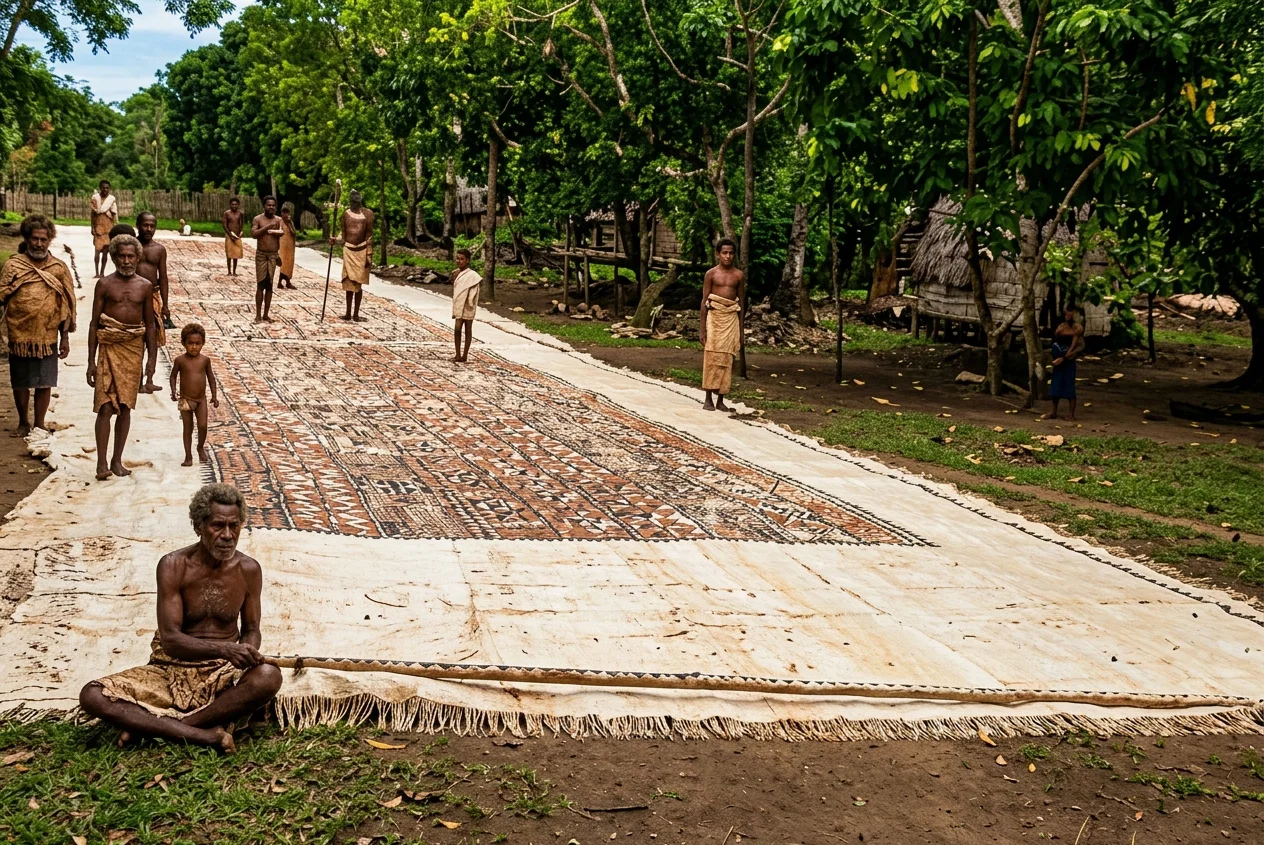
A Piece of Native Cloth Spread Out, 18x75 Feet, Made of the Bark of Trees.
A Scene Near Our Mission.
Recently we have had abundant evidence that God is working in the midst of these people, to make known this message for this time. The Macedonian cry, “Come over and help us,” is coming from several islands, as the following will show:—
Paulisa Bunoa, our native minister, left Suva at the end of the year 1901, to visit his native island in the eastern part of the group, known as Lua. He took his family with him, intending to stay for some time. On arriving at the island of Vanua Balava, he made known his desire to present the truth. The buli of the district invited him to hold meetings in his large house. He did so. Numbers attended, and such an impression was made that in a few weeks over thirty took their stand for the truth. This aroused bitter opposition; pressure was brought to bear on the buli, and he became bitter towards the new lotu (church), refused to allow Brother Bunoa to build a house or church, and ordered him away from the island. This was a step ahead of his rightful authority. However, Brother Bunoa firmly stood for his rights, being a native of the port, and quietly continued his work of preparation for building. One of the new brethren gave a piece of his land for a home for him. The buli, becoming enraged, again ordered him away, and acted very hostile, confiscating illegally some of his property. This hindered the work for a time, but only served to advance the cause of truth later.
In response to a call, Brother Bunoa then visited a small neighboring island—Thikombia—his birthplace. As a result of meetings held there, all but two of the inhabitants accepted the message. This increased the prejudice of the buli. The matter came up before the roko, or highest chief to decide, and a determined effort was made by the opposing faction to exclude the new religion. It was urged that division would be caused, and unpleasantness result. But the roko wisely gave judgment that in matters of religion all were free to believe and act as they chose; there could be no compulsion; it was outside his sphere of rule. “Let the new lotu stay,” he said; “I like new ideas; we need more knowledge. Let them teach us new ideas; it will be for our good to learn.”
The European magistrate, while this was going on, thought best to let things develop to a definite head, so that he could intelligently act in the matter. He waited our arrival, before taking any decided move. Then an appointment was made, and as the result of several inquiries, he determined to administer justice and to see that our rights were respected. Proceedings have since been taken against the buli on a charge of larceny, and a sentence of one month's imprisonment imposed.
At the request of the magistrate, a meeting of our brethren was convened, at which an expression of their wishes was called for and put down in writing, on the receipt of which full liberty and authority to establish and equip a mission in this locality was granted, and the land pegged out.
There is a general desire that we receive justice, and that we stay and carry on the work. The white people have expressed themselves personally as desirous that new life be introduced into the community. Had we a good school here or at Suva, there would be no difficulty in securing students. Several have intimated their desire to see a good school established and are ready to send their children. Shall we not be ahead in this, since the way is opened? Or shall we delay until others take up the work? It is true, “There should be one hundred workers where there is but one.” A. CURROW.
Sava, Fiji.
RELIGION IN THE DANISH WEST INDIES.
MR. A. GODET LIGHTBOURN has been making a study of the Danish West Indies for the Churchman, especially of the religious conditions prevailing there. In the great mixture of races he finds adherents of most of the Christian sects, some Jews and a few non-believers. The population of the three islands of St. Croix, St. Thomas, and St. John is about 30,000, one-half of which is composed of negroes and mulattoes of the laboring class, the other half of foreigners representing fifty-one different nationalities.
The Church of England has the largest following, the Roman Catholics coming next, followed by the Moravian Brethren (“Unitas Fratrum”), the Lutherans (State church), the Wesleyan-Methodists, the Dutch Reformed, and Jews. Very recently the Baptists and Seventh-Day Adventists started missions in St. Thomas, and now claim a few converts. The Roman Catholic mission maintains an asylum in St. Thomas and a few schools there and in St. Croix. The Moravian Church conducts day schools for children and until a few years ago had here an excellent theological seminary, where negroes were trained for the ministry, and from which many able workers have gone forth to labor in the cause of Christ. This seminary is now located at Antigua, British West Indies. The Jews, who number 125 souls, have a synagogue in St. Thomas. In the Lutheran or State church, services are conducted in the morning in Danish and at noon in English for the natives. The pastor is appointed from Copenhagen and his salary is guaranteed by the State. The offerings of the congregation are made for three objects: the “Prost” (pastor), “Faltige” (poor), and “Kirke” (church), and the collection box passed around during the service is divided into three sections marked as above, so that one may contribute to whichever fund he elects. There are Sunday-schools in connection with all of the churches. The Lutheran ministers occupy positions of importance. The islanders, in their Acadian simplicity, will go to their pastor for the adjustment of a dispute, rather than to the law courts, and will abide by his decision.
Just how the religious conditions of these islands will be affected by annexation is a question of considerable moment in the minds of those interested. Whether or not the State church will be placed on the same basis with the other denominations is a much discussed topic. Mr. Lightbourn ventures nothing on this subject beyond the statement that all sects are looking to the United States for aid.—Public Opinion.
PRESENT CONDITIONS IN THE PHILIPPINES.
Bishop F. W. Warne, Methodist, in a communication to the Christian Advocate, has the following to say concerning present conditions as he finds them in the Philippines:—
Our Native Fijian Evangelist, Pauliesi Bunoa, and Wife.
The improvements during two years are very marked. An English merchant, who has been here ten years, said to me, “Manila under the Americans has improved a century in two years.” In sanitation, roads, business enterprise, and in the provision for the education of the people, there are certainly very marked improvements. I visited the Teachers'13Training Institute one morning, and found 500 of the brightest young people of the islands, representing twenty-five provinces, present, getting lessons in the best methods of instruction and learning English. They were to be together for about six weeks, and then were to go to their homes and teach what they had been taught, and were to return again. I was interested to note that the educational department of the government had adopted precisely the same method of getting education started in the islands as we had for getting religious education among the villagers of India. We bring in our brightest and teach them for a term of weeks, and then send them back to teach what they have been taught. It reminds one of the proverb about “great minds.” There have been improvements in the regulation of the liquor traffic, and there are not so many drunken soldiers on the streets of Manila as when I first visited it. Nevertheless, the saloon and canteen stand out as the blots on the American occupation of the Philippine Islands. There are, after all the improvements, eighty-eight licensed American saloons in Manila for about 5,000 Americans. Is that equaled anywhere else? The Filipino people, up to date, scarcely patronize the American saloon.
TRUE CHARITY.
By Ella Wheeler Wilcox
I GAVE a beggar from my little store
Of well-earned gold. He spent the shining ore,
And came again, and yet again, still cold
And hungry as before.
I gave a thought, and through that thought of mine
He found himself, the man, supreme, divine.
Fed, clothed, and crowned with blessings manifold;
And now he begs no more.
—Ella Wheeler Wilcox.
OUR WORK AND WORKERS.
The addition of three to the church at Elmira, N. Y., is reported in the Indicator, by Brother J. W. Raymond.
The brethren at Joplin, Mo., are erecting a new house of worship. The work was begun while tent-meetings were in progress, conducted by Brethren W. S. Cruzan and D. P. Zeigler.
The late session of North Dakota Conference recommended that some of our books be placed in the public library of Fargo, and that the Sentinel of Christian Liberty be sent to all members of the State Legislature.
Sister Alice Rider, of New Salem, North Dakota, has adopted a practical plan of medical missionary work—that of transforming her house into a hospital for the sick. This is a Bible hospital, and true hospitality. I. Peter 4:9, 10; Heb. 13:2. Surely no class needs such service as much as the sick.
The missionary society of the church at Carthage, Mo., have decided to devote one evening in each month to the study of Christian education. They have recently started a church-school, and it is deemed important that the entire church make the matter of proper education a subject of prayer and study.
Meetings recently held at Lebanon, Ohio, by Brethren J. O. Miller and W. E. Bidwell, have resulted in eight names to the covenant to “keep the commandments of God and the faith of Jesus.” A Sabbath-school of twenty-eight members has been organized. A school-house has been secured for permanent meetings.
The first year of the Southern California Conference showed the following items of progress: increase in membership, 150; tithe received, $12,996.47; annual offerings, $992.26; first-day offerings, $592.52; for India, $105.02; “Object Lessons” fund, $1,125; Sabbath-school donation to missions, $381.17; Christiania Publishing House, $392.22; Southern Field, $79.57; Skodsborg Sanitarium, $43.56.
Brother W. D. McLay recently held a few meetings with Mexicans at Elmendorf, Texas, speaking through an interpreter, and reports three converts to the faith. He also notes that a lady mission school-teacher of San Antonio is keeping the Sabbath of the Lord, having decided the question without suggestion from others. She is well educated in both English and Spanish.
The following note from Sister P. W. Baker of Grinnell, Iowa, breathes the true spirit of our message to the world: “I enclose to you a small help for the work in Barbados, W. I. The article from W. A. Sweany, in the SIGNS OF THE TIMES, October 29, is truly very touching, and I feel that I want a part in that island work. My heart is in the missionary cause. . . . I am, as ever, in love with the message, and hope to triumph with it.” Accompanying this testimony is five dollars for the cause specially referred to.
The organization of branch Sabbath-schools is becoming an important factor in our church work. One minister testifies: “Nearly all the members of our regular school have something to do in branch Sabbath-school work. Even the children seem to feel a responsibility in bringing others to the schools. I do not know of anything we have taken hold of yet that has in it the possibility of developing workers as this work has.” This is a sample of many experiences recently related concerning this work; but, like everything else, it requires missionary zeal to make it a success.
PUBLICATIONS WANTED.
CLEAN back numbers of the SIGNS, Review, Life Boat, and Youth’s Instructor. Address, post-paid, Mrs. M. A. Carlock, Redding, Cal.
LATE clean copies of the SIGNS, Pacific Health Journal, Life Boat, Little Friend, and Youth’s Instructor; also tracts, for missionary work. Address, post-paid, W. L. Sims, Redding, Cal.
DONATIONS FOR BARBADOS.
By Editor
IN our issue of October 29 we printed a letter from our missionary in Barbados, Mr. W. A. Sweany, setting forth the pitiful need of the people in that overcrowded, smallpox-ravaged island. Through sickness and quarantine many were on the verge of actual starvation. It was stated that one penny a day would keep a person from starving. The last news from the island was that the smallpox plague had in no way abated, and that the island was practically quarantined, a vital necessity, but adding greatly to the suffering. We have received to date the following:—
Pacific Press Employees........................................$ 6 00
J. R. Reed........................................................ 1 00
Robt. Blackwood................................................... 1 00
A friend.......................................................... 2 00
A. Rogers........................................................ 2 00
Cheyenne......................................................... 3 00
Mrs. C. Green.................................................... 5 00
P. M. Peterson................................................... 2 00
A friend.......................................................... 3 00
Henry Timm....................................................... 2 50
Quincy Church per O. S. Thompson................................ 1 48
Mrs. Scott........................................................ 5 00
Mrs. M. Kingsley.................................................. 5 00
Mrs. Perry Sherman................................................ 1 00
Mr. and Mrs. E. H. Little......................................... 5 00
Etta Carnahan....................................................... 50
Mrs. O. O. Holmes.................................................. 6 70
M. L. Andrus....................................................... 1 00
Mrs. J. M. Sampson................................................. 1 00
Friends at Batesville, Ark......................................... 1 20
J. N. Loughborough................................................. 3 00
Mrs. P. W. Baker................................................... 5 00
$63 38
FOR PRINTING IN FIJI.
By John Norton Loughborough
J. N. Loughborough $3.00
A LETTER FROM PASTOR S. N. HASKELL.
The following letter will be of interest to many of the readers of the SIGNS, and especially those who have contributed to the support of the missionary work in New York City:—
NEW YORK CITY, OCTOBER 22, 1902.
PACIFIC PRESS PUB. CO., Oakland, Cal.
Dear Brethren:—
We appreciate very much the publications that the Pacific Press have furnished for our work here in New York City, and we write to tell you that we are going to move to Brooklyn. For a good while the Brooklyn people have urged us to locate on that side of the city, and a few weeks ago we lost our hall on 59th Street. Since then we have been looking for a suitable hall, but could not find one on the Island of Manhattan. Finally last week Mrs. Haskell and myself, after much prayer, went over to Brooklyn to spy out the land, and had not been searching an hour until we found a lovely location, much pleasanter rooms than we had in New York City, at much less rent, and also in the best part of the city. So we felt as if the Lord had opened the way for us to move over there. We will move the first of the week. I write this new change of address so that if you wish to continue to send us the publications, we would receive them on that side. Our address will be Vendome, 363 Grande Avenue, Brooklyn, New York. We are moving next week so as to get nicely settled before the first of November, when we expect to start a vigorous campaign.
We will have a strong company with us. Five graduate nurses wish to take the Bible course, and at the same time engage in the health work. We also will have some Bible workers who will engage in Bible work, holding Bible readings, cottage meetings, etc. We hope by the blessings of the Lord to see many souls coming in as a result of the work.
We have located in a part of Brooklyn at a distance from the English church, and we will expect to raise up a church entirely out of new material.
The churches in New York City that have been organized since we came, Nos. 3 and 4 (colored brethren), will continue, and we will give them what help they need. During the summer many of our people were out of the city, and the missionary work lagged a little; but now as the winter approaches we hope to get the missionary society in Nos. 3 and 4 to work again. No. 3 has taken a club of 100 SIGNS during the most of the time since the church was organized, and we hope that they will take the same club during the winter. There is a good interest in the colored church, and we will do what we can to get them to make an arrangement for a permanent club for the winter.
Yours in the work, Elder S. N. and Mrs. Haskell.
It is now nearly two years since Brother Haskell, together with a corps of workers, commenced work in Greater New York. Some of the visible results of their work will be seen in the two new churches which have been organized since going there. And now these workers go to a part of Brooklyn which seems to have never been entered before. For some time they have used, with good success, the SIGNS OF THE TIMES as a “pioneer” in helping to gain entrance to the homes of the people. During the past year the SIGNS office has been furnishing a club of seventy-five papers each week, free of charge, for the use of these workers; and as their club has now expired, and the work is being commenced in an entirely new field, we hardly feel like discontinuing it. However, it will be necessary to do this, unless friends will assist in paying for the papers. A club of seventy-five copies for the coming year will cost $52.50. All those who feel able may send donations direct to the SIGNS OF THE TIMES, Oakland, Cal., and the papers will be forwarded as long as the donations received will pay for them.
OLD STAMPS
Wanted to buy, collections of old postage stamps, also used stamps from old letters, United States or foreign. Address “Collector,” Pacific Press, Oakland, Cal.
THE NEW GOOD HEALTH BATH CABINET
ONLY $5
A portable appliance for stimulating the activity of the skin by hot vapor, causing profuse perspiration. Beneficial for “breaking up a cold,” “breaking chills,” relieving soreness of the muscles, rheumatism, inactivity of skin, diabetes, and disorders of the liver, kidneys, and other chronic ailments.
Full directions for use sent with each cabinet. Our cabinet is well made, and we guarantee satisfaction in every way.
THE NEW GOOD HEALTH BATH CABINET
Sold by the Good Health Publishing Company, is the only cabinet indorsed or used by the physicians of the Battle Creek Sanitarium. Order to-day.
Write for descriptive circulars with full information. Agents wanted to represent us.