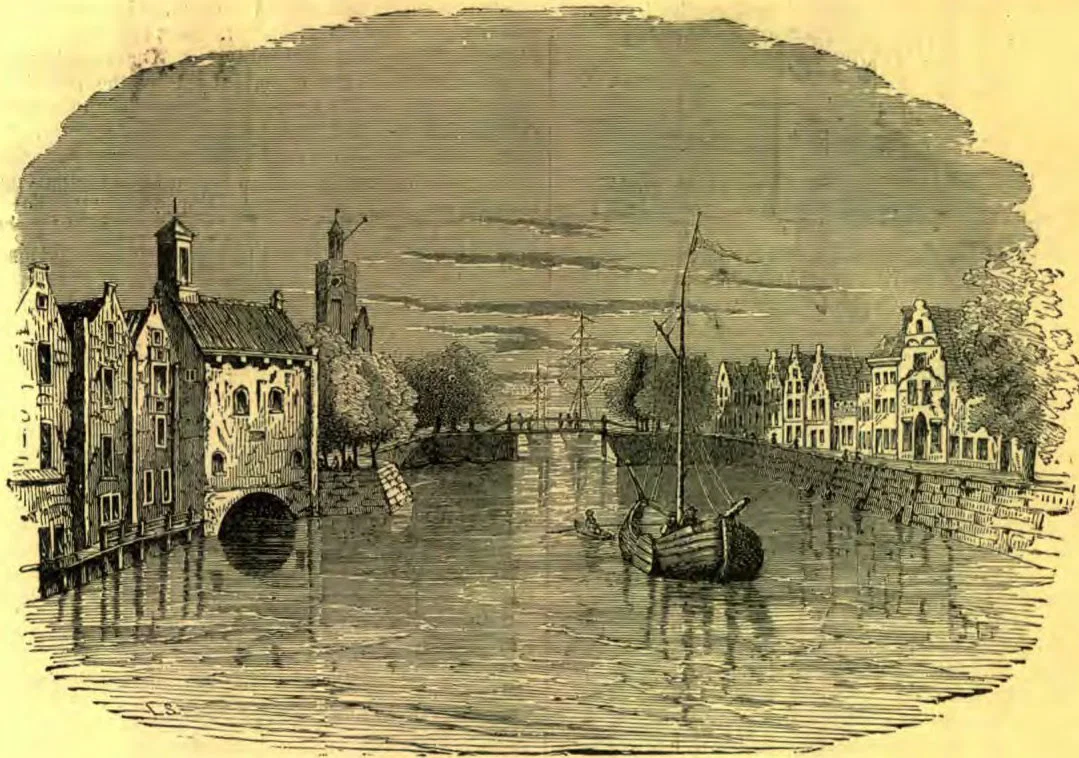
The Youth’s Instructor, Vol. 33, No. 19 (Pacific Coast Edition).
DELFT HAVEN
Page 1
The Youth’s Instructor
May 27, 1885
S. D. A. Publishing Association · Battle Creek, Mich. · May 27, 1885
DELFT HAVEN.
By M. J. C.
DELFT HAVEN, which is shown in the picture, is a spot memorable for an important event in the lives of the “Pilgrim Fathers,” who, to escape religious persecution, were compelled to leave their homes, and seek an asylum in a strange land. But the place is of no special interest to us only as connected with the lives of these persons; so it may be well to give you a bit of their history previous to the event referred to.
Immediately following the Reformation of the sixteenth century, the struggle in England was principally between Catholics and Protestants. When Edward VI., a Protestant, came to the throne, the religion of the state was revised, and the Church of England reformed in many particulars. A “Common Book of Prayer” was prepared, also a “Book of Homilies,” or sermons, to be read for instruction in the churches. The Bible was translated at this time, and copies procured at public expense, and distributed in the several places of worship, that all might have access to them. Articles were drawn up, defining the position of the Church of England, and setting forth their determination not to submit to the corruptions of the Catholic church.
Although the Reformed Church was in advance of the Romish church in point of purity of doctrine and morals, yet many errors still clung to her, which the more devoted Protestants realized. These contended for freedom, and simplicity in worship, and that her forms and ceremonies, so much like the Romish church, should be set aside. Because these persons thus urged reforms in the Protestant church, and a return to primitive simplicity in religious faith and practice, they were called Puritans.
But more serious difficulties were soon to occupy the attention of the Puritans; for at the death of Edward VI., which happened about this time, his sister Mary, a bigoted Catholic, ascended the throne. It was her constant aim to bring everything under Catholic rule, and to undo the good which had been accomplished by her predecessor. She punished as heretics all who would not bow to the Catholic yoke; and to save their lives, a number of Protestant ministers fled to Geneva, Switzerland. During her reign of five years, two hundred and eighty-five persons, including children, were martyred. Five of these were bishops at the time she took the throne.
But though the Puritans were at variance with the government in church matters, in its struggle with the Catholics during the reign of Mary, they were ready to help defend the country against the invader, and at once enlisted their sympathies in the government’s behalf.
“Bloody Mary,” as she was called, was succeeded by her half sister, Elizabeth, a Protestant. Elizabeth went right to work to restore what the Catholic power had overthrown during Mary’s reign. She re-established the Reformed faith and customs, their articles of faith, and “Book of Common Prayer.” The Protestant religion began once more to revive.
No immediate danger being feared from the Romish power, the Puritans redoubled their zeal in advocating their reform views, hoping to bring about what they termed a “Re-reformation.” By the aid of the printing press, they issued many tracts for distribution; and when refused the use of the public press, they purchased one for themselves, which they carried secretly from place to place.
The Protestant ministers who fled from Mary’s persecutions now returned to their homes. During their seven and a half years’ stay in Switzerland, with partial reformers, they had accepted views contrary to the system of church government adopted by the Established Church. Before this had become known, they were employed as clergymen, as of old; but they did not hesitate to advocate their new views, and consequently did not long retain their situations.
The persecution waged by the Reformed Church against the Puritans became more and more severe, and their only hope now was that when James I. should succeed Elizabeth upon the throne, he would in some way give them relief. But in this they were disappointed. The following extract will show the spirit he cherished toward them: “At a conference held in 1603, to consider the grievances of this class of his subjects, James I. boasted, in a letter to a friend in Scotland, that he had ‘kept such a revel with the Puritans these two days, as was never heard the like; where I have peppered them so soundly as ye have done the Papists.’”
Persecuted Puritans were scattered all through the kingdom, quite a number of them about London; but where the borders of the counties of Lincolnshire, Nottingham, and York united, there were several hundred, composed of “the great middle class of England, the firm foundation on which the state rested.” They were educated and intelligent, and their religious convictions were the result of careful and conscientious study and observation.
In North Nottinghamshire was the village of Scrooby, where a good many Separatists, or Puritans, resided. The principal one of these was William Brewster, a man of considerable note, and a particular friend of a distinguished Secretary of State in Elizabeth’s reign. He was postmaster at Scrooby, occupying the old manor-house belonging to the Archbishop of York’s estate. Here Brewster kept an inn, as was the custom for postmasters to do in England at that time; and this house he opened once every week for the meeting-place of the Scrooby Puritans, thus making the house of a first-class bishop in the Church of England free to those who bitterly opposed Church and state!
This company chose Brewster for their leader; but they were not long left undisturbed. Brewster was dismissed from his office, and with others would have been further punished had they not escaped before the officers had time to take action in their cases. From this time, Separatists were hunted, persecuted, and imprisoned; often having to leave all their possessions to save their lives. There seemed no way of escape from their afflictions other than by flight to another country.
Some years before, a party had fled from Gainsborough, in Lincolnshire, to Amsterdam, Holland. The Scrooby company now turned their eyes thither, where, they had been informed, they could serve God as one’s conscience said was right. But how to dispose of their property and get away unobserved, was a perplexing problem.
At one time a company attempted to leave Boston, Lincolnshire. During the night they got safely on board ship, but only to be treacherously turned over to the officers, who ransacked their goods and searched their persons for their money and other valuables. Being left destitute, they were led back to town amid the jeers and jests of a wicked crowd; and then, after being tormented and kept in suspense some time, they were imprisoned a month, when all but seven, who were kept for trial, were released.
This party, and others with them, in attempting to get away afterward, were worse dealt with than at first. They had engaged to be taken on a Dutch vessel between Hull and Grimsby. All arrived, as proposed, and one boat load of men had gone onto the ship, when suddenly a mob came rushing upon them, frightening the captain, who put off without the remainder of the party.
It is touching to read what befell these persons during the next few weeks. But their blameless lives attracted the attention and excited the sympathy of many citizens, who searched out their cause, and were instrumental in having them finally united with their friends in Holland.
In the winter of 1607-8 and the spring following, the Scrooby church, at different times and through much tribulation, came together at Amsterdam. But trials awaited them here. The country and language were new and strange to them; they were poor, so that it was only by the closest management and the strictest economy they could earn a livelihood. But a greater trial was in store for them. Tired of strife and turmoil, they had anticipated pleasant communion with those who had gone before them to Holland, when they should join them. But instead, they found the Gainsborough church, under a restless leader, one John Smith, at variance among themselves. The Scrooby church could not unite with this disaffected party, and after a year’s stay at Amsterdam, quietly withdrew to Leyden.
They lived in the city of Leyden twelve years; and by74hard labor made a comfortable living. They were very happy in their spiritual relations, and were favored with the labors of Wm. Brewster and other men equally talented, and devoted to the interests of religion.
But it began to be a question with them what the future demanded of them. There seemed to be no prospect that they should exert any great influence for good with those outside their own party should they remain in Holland; and as time passed on, the young, who did not realize what their freedom had cost, were yielding to the spirit and customs of the foreigners. Therefore, with the fathers, it seemed only a question of time that they would lose all they had gained by sacrifice and suffering for Christ’s sake, unless other advance moves were made.
Whither shall we flee? was the subject agitated. For a time, various opinions as to what was duty were entertained and discussed; but there is not space in this already long article to tell how it was decided where they should go, neither the long process of scheming and planning that was gone through before arrangements were matured which finally resulted in their departure for America.
Provision could not be made for all to embark at once, so it was decided who should go, and who should remain to follow afterward. They were to sail from the port of Delft Haven, which is located a little way south-east of Leyden, whither their friends accompanied them. They spent one night there, “not to sleep, but in friendly entertainment and Christian discourse;” for on the morrow the separation must be made. And it was indeed a sorrowful parting, and with many it proved to be the last.
You have learned that Delft is in Holland, that country the Dutch have made on the water. One writer calls Holland “a raft of mud and sand;” another says it is “an immense crust of earth floating on the water.” It is a country of windmills, and you would be interested to read how they will dry up streams that they may make use of the soil beneath.
The word Delft means ditch, so called from the water canal which leads to it from the Meuse River. Delft is one of the prettiest cities in Holland; but unfortunately it has met with some sad catastrophes. Once it was nearly destroyed by fire, and twice has been terribly shattered by the blowing up of powder mills. It was in this city that William the Silent, or the Prince of Orange, was so cruelly assassinated. Delft is not now a manufacturing or commercial city. It has a population of about twenty-two thousand inhabitants, who live very peacefully.
M. J. C.
MAY
By Wide-Awake
NOT the word but the soul of the thing! Not the name
but the spirit of spring!
And so, at morning early, through hedge-rows fresh and pearly,
Bedecked with hawthorn branches and apple blossoms gay,
Her golden hair around her, as if some god had crowned her,
Across the dewy woodland comes dancing in the May.
O spirit of hope and of truth! O spirit of beauty and youth!
Thine still the olden glory; thine still the song and story
Of joyous lads and lasses, of birds upon the spray,
Of perfumed airs a-blowing, of green things glad with growing,
Of all the world grown young again to welcome in the May.
—Wide-Awake.
A STORY FOR WET WEATHER.
It was Bert Jackson’s first day at the store. He was a bright, young fellow, sixteen years old. He had just entered the high school, but the sudden death of his father, and the consequent change in the circumstances of the family, obliged Herbert to give up his hopes of further education in school, and he had secured a place in a wholesale jewelry establishment. After all, it was very satisfactory to feel that he was going to earn his own living. He meant to be very saving, and he had begun by resolving not to use the horse-cars, but to walk the mile from his home to the store.
It was a perfect morning in early October. The sparkling sea air gave a briskness to everybody. Bert walked along, thinking of his grandmother’s parting words at the door. She was a peculiar old lady, rather brusque, but sensible. This is what she said:—
“Don’t be afraid of style, Bert. Don’t let it master you. Be honest, and never do anything to lose your self-respect. It is no shame to wear an old coat, but it is a shame to wear a new one that isn’t paid for.”
Everybody liked Bert, and he received nothing but kindness that first day at the store.
Two or three days of golden weather followed. Everything went smoothly in business, and it was a proud feeling to come home like a man, and speak of “our store.” Toward the last of the week an autumn rain set in.
“Better ride this morning,” said Mrs. Jackson.
“Oh no,” said Bert, “mustn’t break my resolution so soon.”
“Well, take an umbrella, then.”
Bert rushed to the rack in the little entry.
“Why, mother, there is not a decent one here. No matter. This old green one will keep off the wet,” and away he ran.
The book-keeper was on the steps as Bert reached the store; and, surveying the boy with a quizzical air, he exclaimed, “My! but we look as fresh as a rose under a cabbage-leaf. Better not let Alloy & Co. see that spread, or you’ll get your discharge. They like their clerks to look stylish.”
“I don’t care!” said Bert, stoutly. “If they want me to carry silk umbrellas, they must raise my wages.”
“Don’t get mad,” said the book-keeper. “I’m your friend. You’d better cultivate Em. Bradford’s acquaintance. He can give you a point or two on ways and means, and put you in the way of an umbrella at low cost. Here, Emmett!” as a boy dressed in a neat gray overcoat, with kid gloves of the same shade, met them. “Have you seen our new clerk, Mr. Jackson?”
“Had the pleasure the other day,” said Emmett, cordially extending his hand. Then, stepping within the vestibule, he closed an umbrella that did for the moment cause Bert a pang of envy. He felt ashamed to stand his faded green cotton friend beside its aristocratic neighbors of silk and ivory. All the while the book-keeper stood smiling, and Emmett, drawing off his gloves, was smiling, too.
“You must shingle yourself in better style to-morrow, Jackson,” said Emmett. “I’ll tell you how. Don’t mention it out, of course. Business is business, and if we want to keep our places in an establishment like this, we must cultivate style, of course. Listen! every man Jack of us, except old Ridley here, who has pay enough to buy what he likes, get umbrellas at the same emporium. Cost nothing but a little brains and cheek. I’ll do this favor for you, and very likely you’ll have a chance to do one for me in some other line. I’ll run down to one of the large railway stations sometime to-day, and inquire for an umbrella that was left in the cars yesterday. Baggage man says, ‘Describe it.’ So I make up a description like this, perhaps: ‘Brown silk, with natural wood handle.’ He takes me into the baggage-car where, stacked up in one corner, is a heap of all sorts and kinds. If I see an umbrella answering to my description, I claim it, and present it to you. If I don’t see one like that, I get my eye on a tip-top article, say black silk with hammered silver handle. I go back and tell you. Down go you for the umbrella you left in the train. You describe it—‘hammered silver,’ etc. Baggage man hands it over. You’re all right. Every fellow in the store is provided for in this pleasing manner. What say?”
“No, I thank you!” said Bert stoutly. “Very kind of you, I’m sure; but I guess I’ll sail under my own colors a while first.”
“All right, if you prefer green,” said Emmett. “When I make you another offer, you’ll know it.”
Mr. Ridley walked off whistling, “Wearing of the Green.” Bert felt alone and unpopular, and sometimes asked himself, “What is the use of trying to be better than the rest? What do I lose by it? A nice umbrella, and lots of other things probably, besides the good-will of the fellows. What do I gain? Nothing, as I see, but I keep my self-respect. Guess I will hold on to that and the old green umbrella for a while longer.”
Business was lively in Boston that autumn, and soon the force at Alloy & Co.’s was increased by half a dozen new clerks. Bert could but notice that one after another was supplied with nice umbrellas, and from the sly allusions that he heard, he suspected where they were obtained. Among the new clerks was a boy of shy, frightened appearance, named Johnnie Fay. He was taken up at once by Emmett and his set. Bert had been severely let alone since that first rainy day. One morning there was a sensation in the store, caused by the report that Johnnie Fay had been arrested for stealing an umbrella.
“Greater fool he!” cried Emmett, indignantly. “He had the umbrella in his possession, and he was flat enough to let another party take it and look up some initials on it, and then he was not bright enough to say, ‘Beg pardon. The blundering baggage man gave me the wrong one,’ or something of that sort. But he must needs cry for mercy, say he ‘never stole before,’ and all that sort of thing. It was a hard-hearted old party that it belonged to, and he said the boy must be made an example of, and his case is up before the police court. We shall be lucky if he doesn’t ‘peach on us,’” added Emmett.
How much Alloy & Co. found out about the matter, Bert could only guess. He kept his own counsel, said nothing, and was asked nothing. But it was a fact that Emmett was discharged at Thanksgiving; or, as he expressed it, “I wanted a long vacation, and old Alloy has given it to me.”
At Christmas, Herbert received from his employers a fine English umbrella with his name graven on a silver band, and underneath the motto: “Honesty is the best policy.”—S. S. Advocate.
WALKS ABOUT BOSTON.—5.
By Dudley Marvin Canright
BOSTON COMMON.
A LARGE city is always a very crowded place, often with narrow, dirty streets, and low, dark tenements. I pity children who have to live here till they are grown up. They know nothing about the green fields, hills, woods, and streams, which are so dear to every country child. I am glad that I spent my boyhood on a farm, where there was fresh air, clean water, and lots of room to run, jump, and tumble about in to my heart's content. City children know little of these pleasures. However, Boston, like most other large cities, has provided several fine parks, where people can get away from the houses, and be in the woods, as it were. We will describe one which will give you some idea of all the rest.
Boston Common is one of the most noted places in this old city, and is situated nearly in the center of the city. It covers forty-eight acres of ground, which would make quite a good-sized farm. Ask your father how large his farm is; then you can have some idea as to the size of Boston Common. It is not just a level piece of ground, but is undulating, that is, some places are low, others quite high, in fact, good-sized hills. It is covered with green grass, and is shaded by over one thousand fine old elm trees. There are five broad walks, running in different directions across the Common, and there are trees all along each side of these. The entire Common is surrounded by an iron fence, with entrances here and there. There is a very fine monument on a high point of land, and there is a beautiful fountain in another place.
Frog Pond is a bright little sheet of water, on which the boys skate in winter, and in which they wade in summer.
In one corner of the Common is a deer park, inclosed by a high wire fence. Here are kept quite a number of tame deer, old and young. In another part there is a band stand where, in summer evenings, free open-air concerts are given at the expense of the city. So you see that poor children can attend the concerts and hear good music, if they do not have any money. All over the ground there are numerous benches where the people sit when they are tired, and there are also many drinking fountains for those who are thirsty.
This Common was long used as a pasture for cattle, and after that as a parade ground for the soldiers. Our troops that captured Louisburg assembled here, and those that took Quebec were recruited here. Can you tell where Quebec is? Is it in Mexico? Or South America? Or is it up north, where it is very cold? The taking of Quebec was a famous event in history, so you ought to know where the city is.
Boston Common was a noted mustering place for the soldiers who fought in the Revolution. Here the British encamped in 1775. Here the Boston boys had a quarrel with these soldiers, and went to Gen. Gage to have him protect their right to coast down the hills of the Common. That was a brave thing for those little boys to do, and the General granted their request. Here witches were hung; and here the eloquent Whitefield used to preach. Now they have here balloon ascensions, fire-works, etc. This is also a great place for the boys to meet to play ball, and have fun generally. On a warm summer day you will see scores of people sitting under the trees, riding, visiting, or talking business. On the whole, it is one of the most interesting places in the city. D. M. CANRIGHT.
MY BIBLE.
By J. M. Hopkins
WITH great delight I think of thee,
My Bible;
Of words of holiness in thee,
My Bible.
Thou tellest me from whence I came,
Thou tellest me just what I am,
And pointest me to Calvary’s Lamb,
My Bible.
O precious word of light and love!
My Bible;
Sent down to earth from God above,
My Bible.
Without thy blessed rays of light
To guide my feeble steps aright,
I soon would stray in sin’s dark night,
My Bible.
A casket full of richest gems,
My Bible;
More precious than earth’s diadems,
My Bible.
The proud and sinful man may hate,
The unbeliever may berate,
Still I will love and call thee great,
My Bible.
How cheering are thy words to me,
My Bible;
Those promises so full, so free,
My Bible.
I love thy blessed book, my Lord;
Correction, wisdom it affords,
And points the way to heaven and God,
My Bible.
I’ll ever press thee to my heart,
My Bible.
From thee I’ll never, never part,
My Bible.
And when my Lord shall take me home,
Beyond this world of sin and gloom,
I’ll praise him for this precious boon,
My Bible.
J. M. HOPKINS.
MIND THE LITTLE THINGS.
ALL evils have a beginning; and often the beginning seems small. Children should mind the little things. A lie is a little thing. Have you told a lie? just one single word that is not true? Let us see, then, what else you have done. First, you have broken the law of God. If it is a sin to break a law made by man, how great a sin it must be to break a divine law—the law of our Creator. Second, you will have to tell many more lies to maintain the first one. Third, you lose the love and friendship of your acquaintances. Fourth, if you practice lying, that will lead to something worse. Lying is the door by which other and greater vices enter the heart. Fifth, “all liars shall have their part in a lake that burneth with fire and brimstone.” Think of it—all these terrible consequences from one false saying!
Words are little things, but they accomplish great things sometimes. A kind word or act might have saved many a boy or girl from ruin who is now at the lowest point of degradation.
THREE BAD BARGAINS.
ONCE a Sunday-school teacher remarked that he who buys the truth makes a good bargain, and inquired if any scholar recollected an instance in Scripture of a bad bargain.
“I do,” replied a boy; “Esau sold his birthright for a mess of pottage.”
A second said, “Judas made a very bad bargain when he sold his Lord for thirty pieces of silver.”
A third boy observed, “Our Lord tells us that he makes a bad bargain who, to gain the whole world, loses his own soul.”
SOWING FOR REAPING.
One wrote of a great general’s plan, “It was a bold one, full of danger in case of defeat, but he intended to conquer.”
Doubtless the expectation of success is a great element in securing it. The great Master, wishing his workers to have every helpful motive to patient, persevering work, has given them abundant encouragement in the promises of his word. St. Paul’s words are, “Be ye steadfast, unmovable, always abounding in the work of the Lord, forasmuch as ye know that your labor is not in vain in the Lord.” Thus, too, he says earlier in the same epistle, “He that ploweth ought to plow in hope, and he that thresheth to thresh in hope of partaking.” (R. V.) It is to be feared, however, that many workers are not thus hopeful; they expect scarcely any results to flow from their labors, at all events, not for a long time to come. They sow, but seem to have no thoughts of reaping. Perhaps it was not so when they first took up their work. May be they then rushed forward to it eagerly, expecting at once to grasp the prize; but hope deferred soon made the heart sick. They are tempted to give up the work in despair or disgust, because the results they expected are not apparent at once.
The one hundred and twenty-sixth psalm seems to refer to a similar case. When the Children of the Captivity heard of the promised return to their sacred land, the idea was at first so overwhelming in its joyousness that it seemed like a dream—“Our mouth was filled with laughter, and our tongue with singing.” But soon they realized that the desired end was yet remote, and the way difficult. Great hardships and grievous toils had first to be encountered. There were to be bitter tears before abiding joy. This is God’s rule in nature as in grace. Present self-sacrifice leads to future benefits. God would also thus encourage the Christian workers who are seeking to bring pilgrims to the promised land. They must not lose heart, for then their efforts would be paralyzed. God would have their hearts steeped in hope. They must be “looking unto Jesus, who, for the joy that was set before him, endured the cross, despising the shame.” The promise is, “In due season we shall reap, if we faint not.” It is for the Master, not for us, to judge when the season is due.
When the disciples could not cure the lad with the unclean spirit, they came to Jesus apart, and said, “Why could not we cast him out?” If workers who bemoan the lack of success did so, they would soon hear the reply, “Because of your little faith,” little faith being a road to failure, as well as no faith. With full faith in the Master, his promises, his resources, his Spirit, the blessed results must be secured. The worker carried forth a few seeds; he will bring home sheaves. He may toil, assured of success—and joyous success, for he shall “reap with joy;” he “shall bring his sheaves rejoicing.”—The Church Worker.
SOMETHING ABOUT PAPER.
It is commonly said that paper is made of rags; and so some of it is, but not all. Other substances are used to a very great extent. Straw and wood-pulp make very excellent paper. In most parts of Sweden, enormous quantities of blanched and bleached mosses are found, that grew ages ago. These old mosses are now gathered and made into paper, which is found to be very fine in quality. A manufactory of paper from this material has begun operations near Jönköping, and is turning out paper in all degrees of excellence, from tissue to sheets three quarters of an inch in thickness. These latter are as hard as wood. What they do with such thick sheets we are not told. It is certain, however, that they are not used for printing books. They are more likely to be made into water-pails or car-wheels.
The paper on which Bank of England notes are printed comes from Laverstock, in Hampshire. It is hand-made, and comes up to the Bank in reams of five hundred sheets, each sheet being of a size for two notes. The water-marks are different in the paper for notes of different value, and each kind comes wrapped in a particular colored wrapping—five-pound notes pink, ten-pound yellow, and so on. It is a curious fact that so firm in texture is the paper of a genuine Bank of England note that even burning can hardly destroy it. The authorities have in a little glazed frame the remnants of a note which was in the great fire of Chicago. Though completely charred and black, the paper still holds together, and the printing of the note is said to be sufficiently legible to establish its genuineness and to warrant its being cashed. There are some other notes at the Bank which were cashed after having gone down with the “Eurydice” a few years ago, and reduced to little better than a pulp. Indeed the scraps and fragments which sometimes come into the Bank to be cashed have a really ridiculous appearance. But that makes no difference so long as they show that they are really bank-notes. If the officers of the Bank are satisfied of this, they are ready to pay the money, no matter what may be the appearance of the paper. A genuine bank-note, even though torn and blurred and charred, is worth more than a piece of blank paper, no matter how fresh and beautiful it may be.—S. S. Classmate.
IMPORTANT BIBLE SUBJECTS.
LESSON 46.—INHERITANCE OF THE SAINTS.
(Continued.)
THE PROMISES RENEWED TO ISAAC AND JACOB.
[NOTE TO THE STUDENT.—Do not consider the lesson learned until you can give at least the substance of every text, with the correct reference for each. The references in black letters indicate those texts that should be committed to memory. A little diligent application each day will enable you to do this.]
1. To whom besides Abraham was the inheritance of the earth promised? Gen. 13:15.
2. From which one of his sons was his seed to be reckoned? Gen. 17:19; 21:12.
3. Where do we find the promise to Abraham explicitly renewed to Isaac? Gen. 26:1-4.
4. How do you know that Isaac alone was not the “seed” referred to in the promises to Abraham? Gen. 26:4.
5. Upon what condition was the promise to Abraham based? Gen. 26:5.
6. Since the same promise was made to Isaac, must it not also have been on the same conditions?
7. Where do we find this promise again repeated? Gen. 28:13, 14.
8. On what occasion and to whom were these words spoken? Verses 10-17.
9. Who besides Jacob was at this time included in these promises? Verses 13, 14.
10. Where are Isaac and Jacob expressly called the heirs of the promise made to Abraham? Heb. 11:8, 9.
11. Did they, then, receive the fulfillment of the promise? Heb. 11:13.
12. From this last verse, what would you conclude as to their understanding of the promise and the time of its fulfillment?
13. Quote the texts already learned, which prove that these promises will yet be literally fulfilled to Abraham, Isaac, and Jacob.
NOTE.
We know that neither Isaac nor Jacob as an individual was the “seed” referred to in the promise to Abraham, because when the promise was made to them, it also included their seed. We know also, from Heb. 11:13, that they, as well as Abraham, understood the true nature of the promise, and did not expect its fulfillment in their lifetime. Had it been otherwise they could not have died in faith, believing that the promises would be fulfilled, while they confessed themselves to be strangers and pilgrims on the earth.
INFLUENCE
There is no end to the sky,
And the stars are everywhere,
And time is eternity,
And the here is over there;
For the common deeds of the common day
Are ringing bells in the far away.
A REMARKABLE INSTANCE OF DEVOTION.
ANY one who knows much about Holland knows that this nation’s favorite bird is the stork, and that it is considered by the people an omen of good luck to have these birds build nests upon their premises. To attract them to their homes, the peasants plant long poles in the ground, at the top of which they fasten round pieces of wood. In some towns the storks are so tame they may be seen walking the streets.
These birds were very numerous in the city of Delft before the great fire which nearly destroyed the town more than three hundred years ago, and travelers who write about the city, mention a remarkable instance of the stork’s self-sacrifice in defense of its young at the time of the fire. One traveler wrote:—
“There were in Delft innumerable storks’ nests. When the fire broke out, which was on the 3rd of May, the young storks were fledged, but could not yet fly. Seeing the fire approach, the parent storks attempted to carry their young ones out of danger; but they were too heavy; and after having tried all sorts of desperate efforts, the poor birds were forced to give it up. They might have saved themselves by abandoning the little ones to their fate, as human creatures often do under similar circumstances. But instead, they stayed upon their nests, gathered their little ones about them, covered them with their wings as if to retard as long as possible the fatal moment, and so awaited death in that loving and noble attitude.”
MEXICAN WATER-CARRIERS.
The readers of the INSTRUCTOR may never have an opportunity of seeing a Mexican water-carrier; but presuming they would be interested to know how they do their work, we give you a description, as copied from an exchange:—
“The city of Guaymas, Mexico, has no wells, and as yet, no water-works, with the exception of the pipes of the railway company, from which the houses of its officers, besides its shops and tanks, are supplied. The water-carriers are a curious local spectacle. The public wells are at the upper end of the town, and nude Yaqui Indians may be seen there all the day pulling up the water in buckets, standing on a staging beneath which donkeys are coming and going with enormous sacks of raw hide, riveted and water-tight, hanging down almost to the ground on either side.”
“When the donkeys arrive, the bags are flabby and light. The naked Yaqui above pours down the water in a glistening stream, and the skins swell up until they hang heavy and distended, like a full paunch. The donkeys then depart down the street into the town on a slow, deliberate walk, the large water-bags swinging slowly as they go. Scantily clad boys, happy looking and brown as berries, sit astride the hind-quarters, and kick their bare heels incessantly against the donkeys’ flanks.”
“There is a bullock’s horn in the bottom of each bag, and when the horn is pushed up, it lets the water out into a bucket, also of raw hide. Water is sold for one real (twelve and one-half cents) a bag, or by the bucketful for a cent or so.”
“Altogether these water-carriers are about as oriental in aspect as anything on this continent; and the lover of the picturesque might regret the establishment of the water-works, which, with many other new things, are to be introduced under the awakening of the land by railway.”
THE LANGUAGE OF INSECTS.
A MICROSCOPE is an instrument for examining objects which are too small to be distinctly seen with the naked eye. It reveals most wonderful things to the sight, as many of our readers can testify from what they have seen through one. A microphone is used to magnify sound, or to make weak sound stronger. “The microphone acts for the ear of man as the microscope does for the eye.” The Scientific Reporter says of the microphone:—
“An English scientist has made the surprising discovery that flies have a language of their own, inaudible to unaided human ears, though, no doubt, distinctly audible to the ears of insects. This is not the buzzing tone common to all flying insects, which is produced by the rapid movement of their wings, and is but a mere incidental effect, as meaningless as are the sounds of our footfalls while we are walking and conversing with a friend; but it consists of other tones, made voluntarily, no doubt, for the purpose of limited communication with one another.
“This discovery was made by means of the newly invented microphone, while magnifying the tramp of a fly, walking on a table, till it sounded loud as that of a horse passing over a wooden bridge. By close observation during these experiments, sounds were heard different from those of its footfalls and wings, which proved to be its trumpeting calls, issuing from its proboscis, resembling, somewhat, the distant whinnying of a horse.”
NOT A BOY!
How would the INSTRUCTOR girls like to exchange places with the Algerian daughters? One who was lecturing about the Algerians recently, in Paris, related the following incident:—
“Some of the ladies, seeing our admiration of the Moorish children, surprised us by the visit of a beautifully dressed and lovely little girl of seven or eight years of age. ‘The child is lovely as a rose,’ I said to her father. ‘Does she read and write?’ ‘No!’ said he, ‘my daughter—why, she is a girl.’ ‘And because she is a girl, thou teachest her nothing?’ ‘Nothing, for a woman is happy only when she knows nothing.’ ‘But she cannot read the Koran, which speaks of Allah, who made her so beautiful?’ ‘So much the better; my daughter has nothing to do with the mysteries of the Koran.’ ‘But I believe, with the great prophet Christ, that she has a soul, even as you and I.’ ‘Ah,’ cried he desperately, ‘my daughter is not a boy!’”