It is a too common belief, especially among the young folks, that “poor company is better than none,” and the proverb is worn threadbare by those who use it as an excuse for putting up with inferior associates. There is no telling when or under what circumstances the proverb originated, or in what severe strait the person may have been who declared that “poor company is better than none;” but in these days of many resources, the occasions are rare that would furnish an intelligent creature with sufficient excuse for making such a declaration. It is far better and safer to be alone than in poor company.
Poor company has been the ruin of many a fine character. Poor company has kept many a one down who had the ability to reach an honorable position. The state-prison convict, the fallen woman, the reckless renegade, may trace their first steps in the annals of crime to the influence of poor company.
He who is born with a low taste, naturally drifts toward low companions, and it not infrequently happens that the son or daughter of a titled family will develop traits of character that would disgrace respectability. The poison is in their system, and can only be got rid of by careful culture and association with good people.
Bad books are poor company. Impure thoughts are poor company. Never be misled into fancying that poor company is better than none, but “gather to thy heart such friends as are worthy of honor and attention; for the company a man chooseth is a visible index of his heart.”—Selected.
HIS PASSPORT.
A story is told of Petrarch, the poet, that once when a number of witnesses were being sworn, of whom he was one, the officiating magistrate administered the oath as usual until he came to the poet, when he passed him at once with the remark, “As for you, Petrarch, your word is sufficient.” This was an extraordinary tribute to character. Here follows an example of tribute to genius quite as pronounced and quite as remarkably deserved.
It is related of Gustave Doré that many years ago, while on a tour in Switzerland, he happened to lose his passport. Arriving at Lucerne, he asked to be allowed to speak to the mayor, to whom he gave his name.
“You say you are M. Gustave Doré,” replied the mayor, “and I believe you; but,” he added, producing pencil and a piece of paper, “you can easily prove it.”
Doré looked around him, and perceived some women selling potatoes in the street. With a few touches, he cleverly reproduced the homely scene, and appending his name to the sketch, presented it to the mayor.
“Your passport is perfectly in order,” remarked the official, “but you must allow me to keep it as a souvenir, and to offer you in return one in the ordinary form.”—S. S. Advocate.
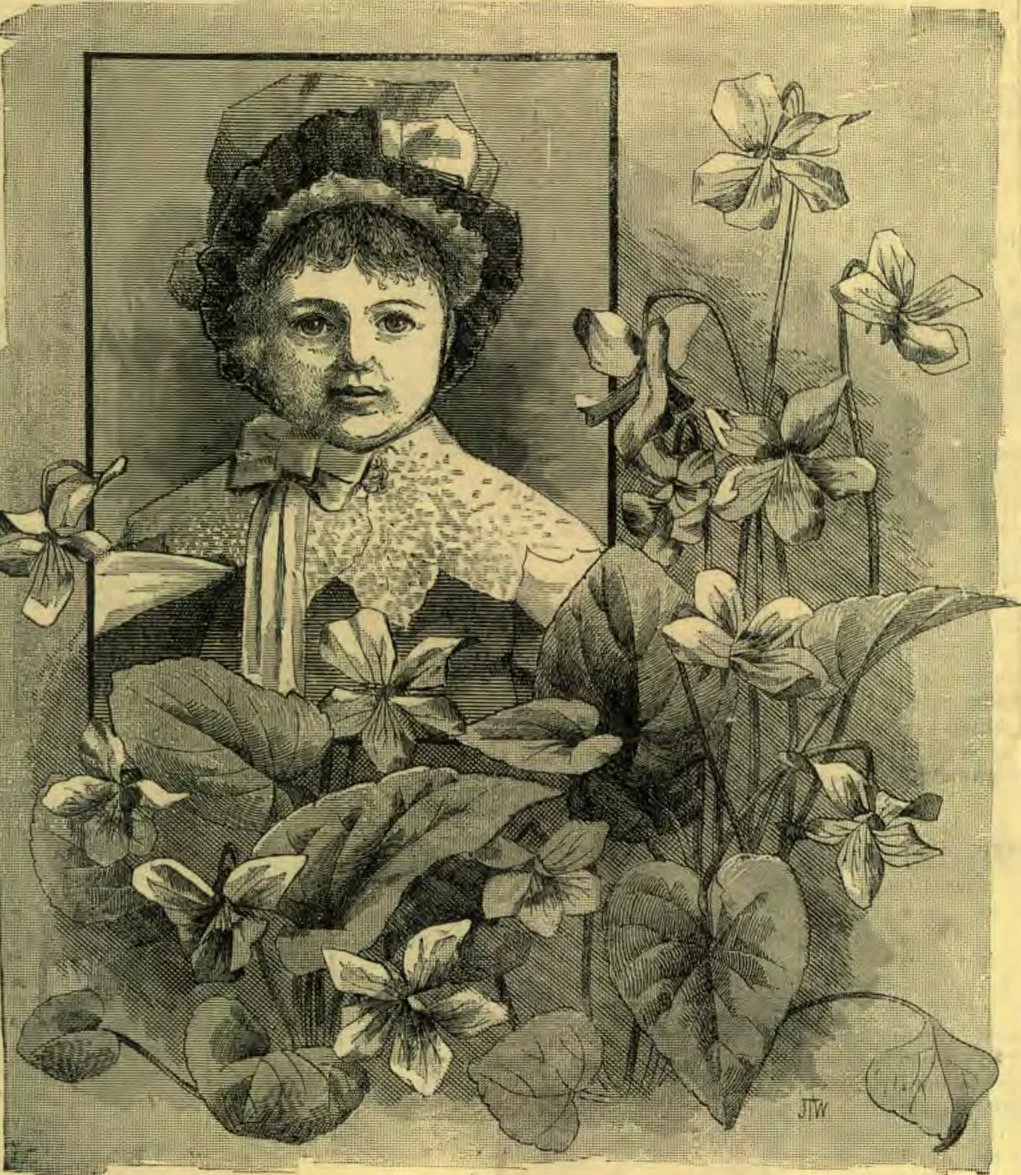
LITTLE NELL AND THE VIOLETS.
By S. Isadore Miner
I've brought you some flowers, grandma,
I found them down by the brook;
I guess they have been in wading,
For just see how wet they look.
Jack says they're Johnny-jump-ups;
It's as funny as can be.
What do you s'pose they jumped up for?
Perhaps they wanted to see.
If spring was ever a-coming,
For 'twas getting late, they knew;
Perhaps 'twas to catch a sunbeam,
Or to dance when the south wind blew.
Some are white as my Snowball kitty,
Some yellow as her eyes,
But the rain must have given the prettiest ones
The color it washed from the skies.
And they smell like a breath from
heaven; I smelled of them o'er and o'er,
'Till it seemed as if I would go to sleep,
And never wake up any more.
I love the birds and the sunshine,
And the trees, and the green fields too;
But I think when God made flowers, he made
The sweetest things he knew.
S. ISADORE MINER.
WORMS THAT LIVE IN THE SEA.
THERE are worms in the sea, as well as on the land. The worms that live in the sea belong to a class called annelides.
They have very pretty names given them besides this family name. One is called Nereis; another, Eunice; and another, Euphrosyne. They are called so because they are so beautiful.
Their bodies shine with all the colors of the rainbow. A writer once said that we need not talk of the violet as the emblem of modesty because she hid herself in the green leaves. Here are these shining worms, as beautiful as can be, that hide down deep in the tufts of sea-weed, and at the bottom of the ocean.
Some of the annelides wander about, and glide hither and thither as they choose. They have neither house nor cell to carry with them, and on that account they are said to be naked worms.
Little tufts of hair-like bristles grow down each side of the body. These are the breathing apparatus, by which the creature draws in air.
You know very well the construction of the common worm. Its body is made up of a number of rings, with soft flesh between.
Just so it is with the worms in the sea. One worm has as many as three hundred rings round its body, and thousands of muscles to help it to move about. For in the tropics, these worms grow to a great size.
The tangled worm is sometimes nearly forty feet long. Its long, smooth body is a little like a ribbon, of a violet or brown color. It lives in the hollows of the rocks, or among loose stones. It eats tiny shells for its food, and it seems to amuse itself by tying its long, ribbon-like body into knots and untying them again. Every now and then it sets out in search of food. It has no muscles, like its relative, the worm that I have just told you about; but it glides along by means of a number of hairs, or cilia, with which its body is covered.
The cilia move backward and forward in the water, and help the giant worm on its way.
By and by it comes to a stone, like the one it has left; here it stops, and begins its old game of tying knots in itself.
This great worm has only a little hole for its mouth, and a head somewhat like a snake.
Nature has not given it feet; but she has done so to some of its tribe.
Some of the more perfect annelides have bristly feet, and they make good use of them.
When any little creature comes swimming by, the annelide will dart upon it, seize it with its jaws, and squeeze it to death.
Others go wandering about, looking for their prey among the sea-weeds and corals. They are very quick, and arrest the poor little victim before it has time to bury itself in the sand.
But though the worm is so voracious, and devours so many minute creatures, it has enemies of its own to contend with.
The fishes pursue it without mercy, and so do the crabs and lobsters. This is why it likes to hide itself in some snug hole or corner.
While it keeps in its hiding-place, it is tolerably safe; but if it puts out its head, a fish is sure to be passing by, and will snap it up in a minute.
There are some creatures with hard shells, called whelks, that will even dig the annelides out of the sand.—The Sea and its Wonders.
THE ROYAL FAMILY OF ITALY.
By F. A. Humphrey
When it was known that Victor Emmanuel was very sick, the peasants and farm-laborers gathered in crowds about the Quirinal Palace, at Rome. They lingered there, asking hourly for news of him, until he died. Then, indeed, all Italy mourned. This was in 1878.
He was greatly beloved, for he had freed the States of Italy from foreign rule and united them into one kingdom. Of this kingdom he was the first king—Vittorio Emmanuele I. He was fond of hunting, and was “every inch a soldier.” He did not mind the hardships of the camp or hunting-field. He slept always on a little iron camp-bedstead.
The present King of Italy, Umberto I., is his son. When he first began to reign, he was not so much beloved as was his father. But he is becoming dear to his people because he is so kind. When the cholera was raging in Naples, in 1884, he went among the sick fearlessly. He helped them both by his presence and with money.
Margherita, Queen of Italy, is a beautiful and amiable woman, much beloved by the Italians.
They have one child, Vittorio Emmanuele, named for his grandfather. His title is, Prince of Naples; the Italians call him principino (little prince). When I went to school and studied geography, it used to be said that Italy was shaped like a boot. If you look on the map, you will find in the ankle of the boot the city of Naples, where the principino was born, November 11, 1869, and where he has a palace of his own. This palace overlooks the lovely Bay of Naples, perhaps the loveliest bit of water in the world. From it, you can also look out upon Vesuvius, that volcano which sends up its ceaseless smoke and flame, day and night.
Italy is a land rich in beauty—beautiful skies and lovely landscapes; rich in what we call “art,” too—in beautiful paintings and statuary; rich, too, in cities of great beauty. Did you ever hear of Venice, that city which looks as though it had just risen from the sea? It has canals instead of streets; and boats called “gondolas,” in place of carriages; there are no horses in Venice. It is a silent city.
So you see that the principino (little prince) is born to a wonderful inheritance; he may some day be king of this beautiful land. He is said to be a manly little fellow, and he is being carefully educated, as most princes are. He can read and speak English.
Educated people in Europe are generally fine linguists. That is, they understand a good many languages besides their own. They are taught these when they are young children.
In the winter the principino lives in Rome. Visitors at Rome often see him, driving on the Corso with his beautiful mother or his tutor.
(The Corso is a fine street and is the principal street in Rome.)
The Romans all know him and love him. They lift their hats to him as he passes, and he bows in return.
The principino, like many an American boy, is making a collection—not of postage stamps, nor buttons, nor birds’ eggs—but of coins. He has not only collected the coins, but he knows a great deal about them. There is a deal of history in coins.
Should the principino ever be king of Italy, may he be worthy of the name the people gave his grandfather—Il Re Galantuomo (King Honestman).—F. A. Humphrey.
Letter Budget.
DEAR LITTLE PEOPLE:—
Tardy spring has at last scattered the ice and snow, and brought us her beautiful treasures,—the blue sky, the warm sunshine, the singing birds, the rippling streams, and the green trees and grass and flowers. Don’t you hear them all saying, “God is good”?
If God made the earth so beautiful where so much sin is, what will he not delight to make it when the sin is all taken out of it, never to return again?
You all want a home in the bright new earth; then try every day to obey God, so that he will fit you up to live with him.
We have such a great many letters, and only room for a few this time. We will print them as fast as we can.
ADA M. BLISS, of McLean Co., Ill., writes: “I am ten years old. I walk three miles to Sabbath-school. I have two brothers, but they are too small to walk so far, so I go one Sabbath, and ma the next. I get my lessons in Book No. 2. My papa is a minister, and is away from home most of the time. When it gets warmer, I am going to canvass for the INSTRUCTOR. This is my first letter to the Budget. I read all the INSTRUCTOR through. I am trying to be a good girl, and want to meet the INSTRUCTOR family in heaven.”
CHARLIE W. BRENNER sends us a letter from Colfax Co., Neb. He says: “This is my first letter to the Budget. I am nine years old. My little sister two years old and my little brother four years old died this winter from diphtheria. We could hardly endure parting with them, they were so nice; but we are six weeks nearer the resurrection than before they died. Time is flying, and I want to be a good boy so that when Jesus comes, I can go with them to that heavenly home, where there is no parting. My little brother would often come in from play and ask mamma if Jesus would give him wings, and if he could pick nice flowers where Jesus was. I have only one sister now. She was very sick too with the same disease. She has been almost blind for five weeks. We keep the Sabbath with papa and mamma, and were baptized last fall. We are striving to be an unbroken family in the kingdom of God. Will the INSTRUCTOR family pray for us?”