The Youth’s Instructor, Vol. 37, No. 49.

THE SINGER'S ALMS

The Youth’s Instructor

Dec 4, 1889

S. D. A. Publishing Association · Battle Creek, Mich. · Dec 4, 1889

THE SINGER'S ALMS.

IN Lyons, on the mart of that French town. Years since, a woman leading a fair child Craved a small alms of one, who, walking down The thoroughfare, caught the child's glance, and smiled To see, behind its eyes, a noble soul; He paused, but found he had no coin to dole. His guardian angel warned him not to lose This chance of pearl to do another good; So, as he waited, sorry to refuse The asked-for penny, there aside he stood. And with his hat held as by him the rest, He covered his kind face, and sung his best. The sky was blue above, and all the lane Of commerce, where the singer stood, was filled; And many paused, and, listening, paused again To hear the voice that through and through them thrilled. I think the guardian angel helped along That cry for pity, woven in a song.
The hat of its stamped brood was emptied soon Into the woman's lap, who drenched with tears Her kiss upon the hand of help; 'twas noon, And noon in her glad heart drove forth her fears. The singer, pleased, passed on, and softly thought, “Men will not know by whom this deed was wrought.”
But when at night he came upon the stage, Cheer after cheer went up from that wide throng, And flowers rained on him; naught could assuage The tumult of the welcome, save the song That he had sweetly sung, with covered face For the two beggars in the market-place. —Henry Abbey.

A HARVEST SCENE.

ONE need not go back half a century to learn that harvesting is conducted very differently now than in years gone by, modern machinery having superseded the early method of gathering grain with the sickle and the scythe. None of us question the advantages gained by the change, but we may well doubt the power of machinery to impart the fascination that usually attended an old-time harvest scene, such as, indeed, your parents were familiar with in their early days, or as others have witnessed in this and foreign lands. One who was forty-five years a missionary in Palestine and Syria was particularly impressed with some such harvest exhibitions there. Upon one occasion he said:—
“No description can produce such a tableau as I witnessed in riding, in early harvest time, through the fertile fields from Ramleh to Ludd. A thousand reapers and gleaners were abroad and busy when the morning sun shot his first rays down through the olive-trees, which half hid, half revealed the merry harvesters,—men, women, and children,—the first reaping, the second gleaning, and the children at play or watching the flocks and herds which were allowed to follow the gleaners.”
In witnessing a similar scene he says that “all seemed to be in good humor, enjoying the cool air of the morning. There was singing alone and in chorus, incessant talking, and laughing long and loud.”
“Hundreds of men, women, and children were reaping, gleaning, and carrying the grain to the great threshing-floors. Long lines of camels, carrying on their backs burdens of unthreshed wheat larger than themselves, were slowly converging to the villages from every part of the plain, and the grain lay on the threshing-floors in heaps mountain high.”
Instead of binding the grain in sheaves, the Syrian method is to gather it in large bundles. “Two of these, secured in a network of rope, are placed a few feet apart. A camel is made to kneel down between them, the bundles are fastened to his pack-saddle, and at a signal from his driver up rises the patient beast and marches off toward the threshing-floor near the village. Arrived there, he kneels down again, and is relieved of his awkward load only to repeat the same operation all day long, and for many weeks together; for in some places there the harvest extends through at least two months.”
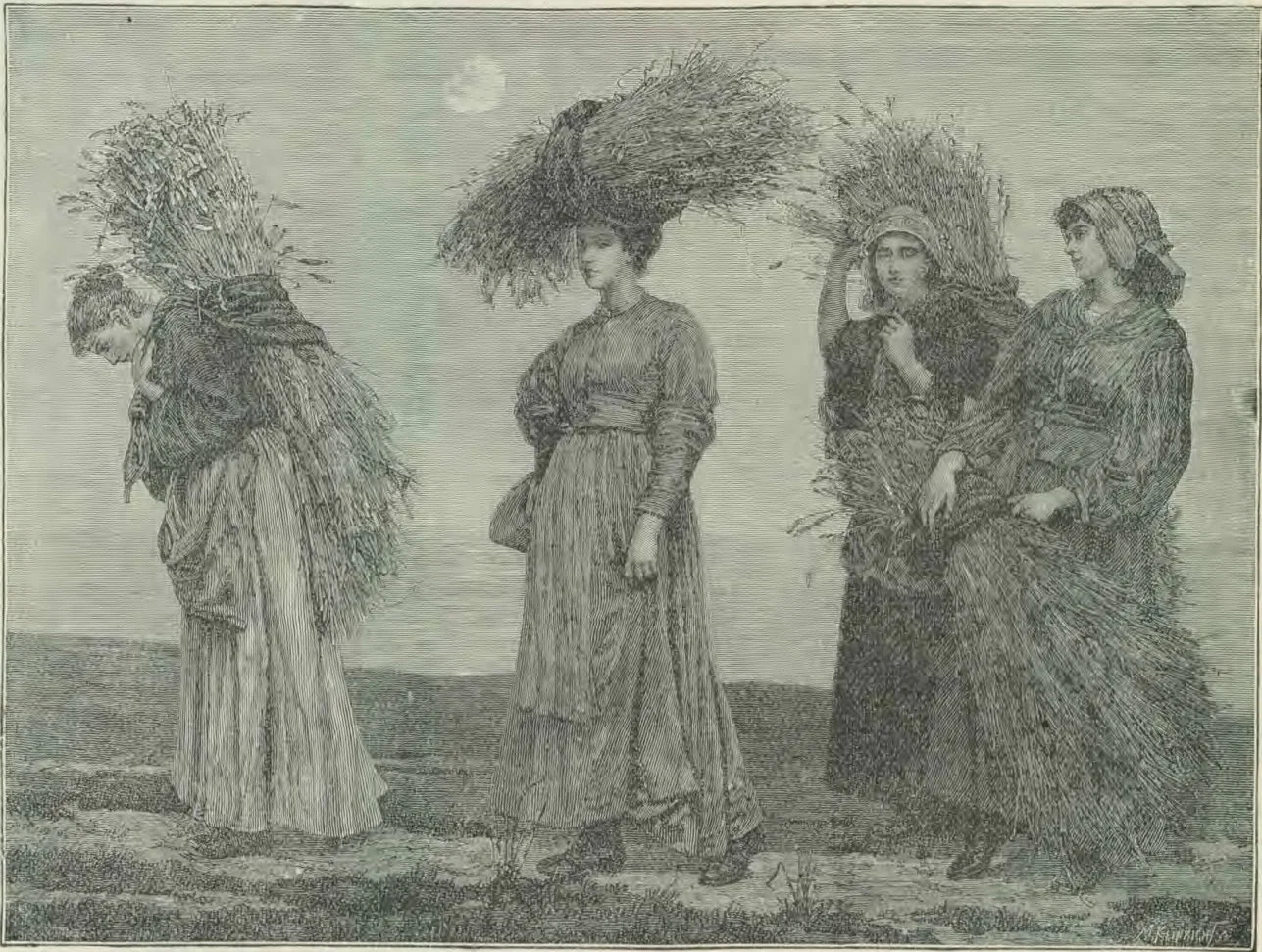
The missionary saw that the women did the gleaning; but they were paid wages for it, as were the men for reaping. Anciently the custom differed in that instead of gleaners’ receiving wages for their work, they were entitled to what they gathered, as evidently were the misses shown in the accompanying engraving. This custom was introduced for the benefit of the poor, by the Lord himself away back in the days of Moses. His instructions to the Israelites were:— “When ye reap the harvest of your land, thou shalt not wholly reap the corners of thy field;” “neither shalt thou gather any gleaning of thy harvest. Thou shalt leave them unto the poor, and to the stranger, the fatherless, and the widow.” The Israelites were also commanded to leave a portion of their fruit unpicked in time of grape and olive harvests. What was so left belonged to the poor, and they had a right to take it away from the fields. It was because of this provision that Ruth so freely entered the fields of Boaz to glean.
After a time it was decided by law that the portion of the corners of a field equalled about a sixtieth part of the crop in the whole field, so that thereafter the owner might reap all the grain, and separate a sixtieth part for the poor.
I suspect many of our readers have gleaned after the reapers the scattering grain in their father’s harvest fields. I well remember the first sheaf of my own gleaning, in a neighbor’s field; and I have but to revert to it in thought now to experience something of the same pleasure that the picking up of those heads of wheat gave me upon that occasion.
But there is a broader field in which we may all work. Our heavenly Father invites us to labor in his great harvest-field, which is the world. Both reapers and gleaners are wanted; for every precious head of wheat must be garnered. What is unavoidably missed by the reaper, must be picked up by the gleaner. The work of the latter is just as necessary as that of the former, and as the lighter work of gleaning belongs to children, here “is something for children to do.”
In every way that you help to carry the light of truth to others, either by sacrifice or labor, you may consider yourselves gleaners; and if you gather all the sheaves you can, according to your several ability, you may by and by come rejoicing, bringing your sheaves with you. Who will begin work to-day as never before for the Master? Who?
M. J. C.

THE ELECTRIC PLANT.

In the forests of India a strange plant has been discovered. It possesses to a high degree magnetic power, and conceals within its leaf and flower many mysteries and botanical problems. Nature thus describes it:—
“The hand which breaks a leaf from it receives immediately a shock equal to that which is produced by the conductor of an induction coil.
“At a distance of six meters a magnetic needle is affected by it, and it will be quite deranged if brought near.
“The energy of this singular influence varies with the hour of the day. All-powerful about two o'clock in the afternoon, it is annulled during the night.
“At times of storm its intensity augments to striking proportions. During rain the plant seems to succumb, and bends its head during a thunder shower; it remains there without force or virtue even if one should shelter it with an umbrella. No shock is felt at that time in breaking the leaves, and the needle is unaffected beside it.
“One never by any chance sees a bird or insect alight on the electric plant; an instinct seems to warn them that they would find a sudden death. It is also important to remark that where it grows none of the magnetic metals are found, neither iron, nor cobalt, nor nickel; an undeniable proof that the electric force belongs exclusively to the plant.”—Youth's Companion.

REVERENCE FOR THE AGED.

It was a cold, stormy day in December. In the night, when all was still, flakes of beautiful snow had fallen to the earth, slowly and gently at first, but gradually thicker and faster, until the earth was robed in a mantle of white. The full moon peeped from under a cloud, and witnessed the wonderful work of God. The angels of heaven beheld it, and worshiped him.
In the morning, the village children started for school as usual, full of mirth and glee. For an hour and a half, all were busily engaged with lessons; and when at last the kind old teacher gave the order to put books away, every care was thrown off, and marching out in soldierly fashion, they entered upon their sports as only children can.
There were about sixty boys and girls, ranging in years from six to sixteen. Charlie Long, the eldest, was leader in all games and adventures of the pupils. Having a disposition to tease, he often caused much trouble in the school.
While they were all merrily at work making a snow man, Charlie looked up, and exclaimed,—
“O, boys, look at that old saint coming down the road! Let’s play a trick on her. She walks as though she were afraid to step on the ground for fear of going through to China. Come, George, get on the sled with me, and we will ride down the path. I’ll take my whistle along, and so be sure to make her hear.”
“Why, Charlie Long, you ought to be ashamed of yourself. That may be a very good woman, that we ought to help. Mother has always taught me to be kind to the aged and feeble,” replied George.
He was the only one in the school who dared speak so to Charlie, and when he made this reply, sneers and jeers met his ear from every side.
But George had a brave heart. Having been taught to pray, he silently lifted his heart to God, asking wisdom to do just the best thing. He then left his companions, and walked towards the old lady, with the intention of offering her help.
The boys, half ashamed, half angry, called after him, but he did not heed them. When he had once made a good resolution, not one of them could turn him aside.
“Please, ma’am, may I assist you home?” asked George, after greeting her with a cheery “Good morning.”
“Thank you, my dear boy,” she replied, struggling to keep back the tears. “May God bless you for your willingness to aid the feeble,” and she caught hold of his strong arm.
“It is quite wintery to-day, and the walks are so slippery, I thought it might be hard walking for you.”
“It has only been a year since I could walk nearly as well as you; but my dear husband died of fever, and then I was stricken, but the dear Lord saw fit to spare my life, and I can still trust him.”
“Where do you live now?” asked George.
“In the small white house yonder,” said she. “It is all I have left, and I am afraid I shall have to give that up to buy something to eat.”
They were now at the door, and with a “God bless you” following him from the old lady’s lips, George sped back to the school.
The teacher had witnessed the whole scene from the window, and when George returned, he called the school to order, related to them the story, and then dismissed all except George.
Turning to him, the teacher said,—
“George, you have done a very brave deed, both in answering Charlie as you did, and in assisting Mrs. Barton.
“As I saw it, tears of joy, mingled with those of sadness, came to my eyes,—tears of joy because you so tenderly helped her,—tears of sadness because I remembered how, upon a morning similar to this, I spoke an unkind word to my own dear mother, and before I reached home in the evening, she was dead. Always do right. Never show any disrespect to the aged, and you will develop into a noble man. Nor should you forget that the angels are pleased with you, and what you have done is made known in heaven.”
We all have opportunities every day for doing good, and should improve them for Christ’s sake. We may not be rewarded here on earth, but angels record it in the books of heaven, where we shall receive our reward by and by.
The poet has beautifully expressed the sentiment of filial love, in the following lines:—
“And can’st thou, mother, for a moment think That we, thy children, when old age shall shed Its blanching honors on thy weary head, Could from our best of duties ever shrink? Sooner the sun from his high sphere should sink Than we, ungrateful, leave thee in that day To pine in solitude thy life away, Or shun thee, tottering on the grave’s cold brink. Banish the thought! Where’er our steps may roam, O’er smiling plains or wastes without a tree, Still will fond memory point our hearts to thee, And paint the pleasures of thy peaceful home; While duty bids us all thy griefs assuage, And smooth the pillow of thy sinking age.”
L. M. S.

HOW COTTON CLOTH IS MADE.

I WONDER how many boys and girls have any idea of how cloth is made; or how many ever went into a big factory where it is woven?
Take the print or cambric, for instance, from which your shirt-waists or dresses are made. It has to go through a multitude of processes before it gets from the cotton, as it is picked and bought by the great cotton factories, to be the pretty printed cloth you see. The first thing they do, in a great cotton factory, is to spin the cotton into thread for warp and woof, or “filling,” as the latter is sometimes called. Possibly some of you may have seen your grandmother spin wool, or even weave the yarn into cloth. If so, you will understand better what has to be done.
In a factory the cotton is passed through several machines, which pick it to pieces and throw out the seeds and other foreign substances. From each one of these machines it comes out a little finer than before, until, at last, it is fine enough to spin. The spinning is done in another room, on a machine called a “mule” or a “Jenny.” Then this fine thread is taken to another floor, and woven in the brisk and busy looms into unbleached cotton cloth. But it is not then ready for market. Even if it is to be sold as unbleached cloth, it has to go through the process of singeing. That is, it is passed over a big cylinder, close to a row of gas-jets, which scorch off the fuzzy lint which makes the cloth rough. This, of course, is a delicate operation, and after it, if the cloth is to be sold as brown sheeting, it is ready to be done up in great bales for the stores. If it is to become bleached cloth, however, it has to be passed through a solution of chloride of lime and other ingredients, and take several baths. This takes some time, but is a very necessary process, just the same. When it is over, the cloth is ready to be sold and made up into under-clothing, sheets, and pillow-cases.
The most interesting thing about a big cotton-mill is the printing department. Every mill has its own designers. They have a pleasant room at the top of the building, with plenty of light, and they make their designs with water-colors. Of course one must be something of an artist to be a successful designer. One must also have very careful and exact training, as the designs have to fit perfectly the cylinders upon which the cloth is printed. The variation of a design one hair’s breadth from the requirements of the cylinder renders it useless. Colors must be prepared from dyestuffs in immense vats, to color prints which do not have a light background. Then dyes must be prepared to match every tint in the design. Copper sheets are also stamped with the design, and fastened upon great cylinders in such a way that, when the cloth is pulled through, the figures are printed upon the cloth like the original designs. Sometimes the cloth has to go through this process many times, in order to receive all the colors necessary to the pattern.
After it is printed, the cloth is ready to be measured off into “cuts” of forty or fifty yards, and packed into boxes for the wholesale dealers. Even then it has to pass through several hands before you ever see it. What should you say if I were to tell you that it has probably taken over a hundred people to make your shirt-waist, my boy; or that all those hundred people worked for days to make your print apron, my girl? If ever you get an opportunity to go through a great cotton-mill, from the engine up through to the designer’s room (where, by the way, very few people are admitted), don’t refuse it.—The Interior.

A SMILING FACE.

Does any one like a drizzling rain As well as a sunny sky? Does any one turn to a frowning face If a pleasant one is nigh? Oh, give to us all the look that springs From a kindly nature's grace! We do not care if he's dark or fair— The boy with a smiling face.
Does any one like a lowering cloud As well as the shining light? Does a peevish word have power to please, Like a laugh that is sweet and bright? Oh, the girl that is gloomy with tearful scowls, Though she dresses in silk and lace, Hath never such art to charm the heart As the girl with smiling face.
Dear boys and girls, remember this,— You are apt to meet with loss, No matter what thing you undertake, When you're sullen, and sour, and cross.
Dear girls and boys, I would say it twice, 'Twill help you in every case: If you'd win success and the world would bless, You must wear a smiling face.
—Golden Days.

DOING ANOTHER'S DUTY.

The true lady shows her training in every word and gesture, but the pretender is too often found napping. A little girl, shopping with her mother one day, was sitting contentedly on a counter-stool, and watching the people as they came and went.
Presently she saw a lady elegantly dressed, who stopped at their counter, and handed a waterproof and umbrella to the young girl in charge.
“Take care of these things till I call for them,” she said in an autocratic tone, and sailed away.
The bright eyes of the child followed her. The little face wore a look of distress.
“Why, mamma,” she whispered, “she didn't even say ‘please.’”
Sooner than she expected, the lady returned.
“I will take my things,” she said.
There was some little delay in finding them.
“I hope you haven't lost or misplaced them,” she said to the young girl in a severe tone.
Neither misfortune had occurred; the articles were found, and taking them without a word, the lady walked out. This was more than the child could bear. Leaning over, so that her sweet face came close to that of the clerk, she said, graciously, “Thank you!”—Detroit Free Press.

ONE STITCH AT A TIME.

“WHAT is the secret by which you do your work so beautifully?” The questioner held in her hand an exquisite piece of crochet work, wrought by the lady to whom the question was addressed.
“There is no secret about it,” replied the lady; “I only make every stitch as perfect as I can, and am careful to put it in exactly the right place. There isn’t one wrong or careless stitch in all that work. If I make a mistake, I ravel it out and correct it.”
One perfect stitch at a time! So the marvelous fabrics of lace at fabulous prices are made. So the intricate and exquisite embroideries are wrought. So the costly garments of men and women are put together. One perfect stitch at a time.
The noblest lives are lived—one moment at a time. No moments wasted; no moments carelessly spent; no moments viciously spent. Wrong stitches in crochet can be raveled out and made right. Wrong stitches in garments can be picked out, and put in again right. But who can reverse the tide of time, and undo a wrong act, and make it right?

DON'T GIVE UP.

If you tried and have not won, Never stop for crying; All that's great and good is done Just by patient trying. Though young birds, in flying, fall, Still their wings grow stronger; And the next time they can keep Up a little longer.
Though the sturdy oak has known Many a blast that bowed her, She has risen again, and grown Loftier and prouder.
If by easy work you beat, Who the more will prize you? Gaining victory from defeat, That's the test that tries you!
There's the magic in the power Of an unbended will, That makes us stronger every hour For greater efforts still; Then banish from you every "can't." And show yourself a man, And nothing will your purpose daunt, Led by the brave "I can."
—Eliza Cook.

TEASING TOM AND THE PARROT.

Nettie and Dolly and Tom and Ned had never been away from their quiet country home. One summer Cousin Frank came there on a visit. He lived in the city. The children thought he knew everything, because he lived in town, and went to college. Nettie and Dolly very much admired him, and Tom and Ned imitated him as far as they could.
Mr. Frank liked his small cousins, and told them all he could think of about his city home. The children listened in open-mouthed wonder. It seemed like a tale of fairy land. They were sorry when the visit came to an end; but Mr. Frank promised to come again next summer.
When summer came, however, Mr. Frank was too busy to leave home, so he sent Aunt Fannie in his place. She brought several strange-looking parcels with her, which she set down on the table, while she went out to tea, with the children’s mother.
Dolly and Tom were anxious to know if Cousin Frank had sent anything to them, and they waited impatiently for Aunt Fannie to get a little rested from the journey.
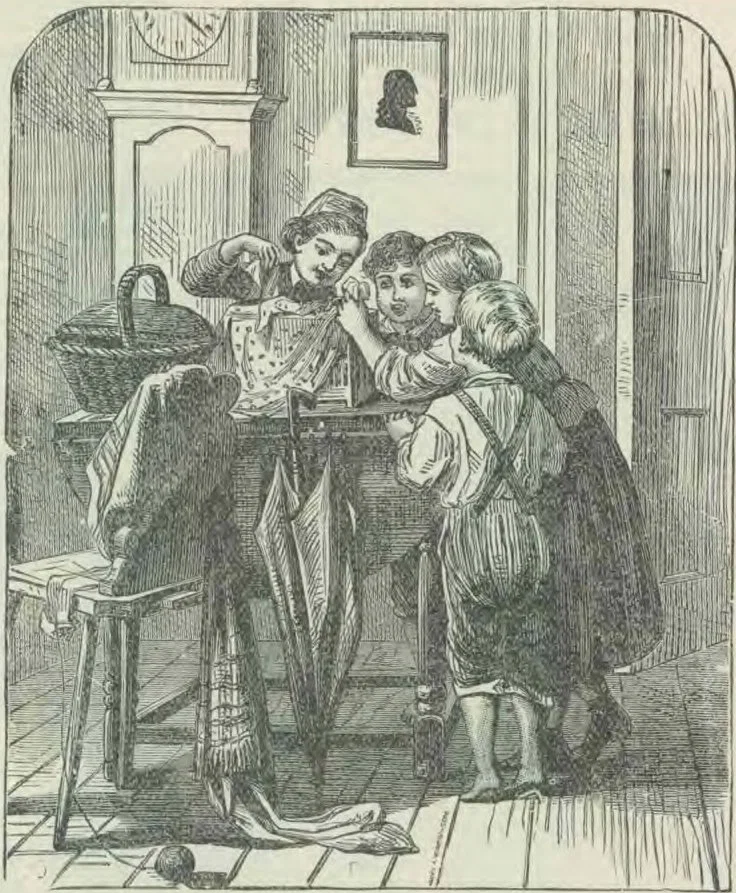
While they were wandering around, they heard a strange noise in one of the parcels. It came from a square package tied up in a spotted cloth.
“What is that?” said Tom; “did you hear it, Dolly?”
“Yes,” said Dolly. “There it is again. I wonder what it can be.”
“Oh, dear!” a voice seemed to say. It sounded as if it came from the parcel.
“Goodness!” exclaimed Tom, “it’s something alive! Let’s look and see.”
“I daren’t,” said Dolly in an awe-stricken voice.
“You need not feel afraid,” said Aunt Fannie, coming into the room; and the children gathered around the table. They quickly uncovered the bundle. It was a parrot in a cage. The children had never before seen a bird that could talk.
Polly sat with ruffled feathers and angry eyes, in one corner on the perch; she was very cross; the long journey on the cars had not agreed with her.
“I’m mad!” she croaked, hopping from one side of the perch to the other.
“Get out! get out!” she cried, flying at Tom, as he thrust his fingers through the bars of the cage to touch her feathers.
“Polly has lost her temper entirely,” said Aunt Fannie, laughing to see Tom start back from the cross bird. “This is Frank’s present to you, Tom, and he said he hoped you would be kind to her. We will hang her cage up now, and let her rest; for she has been teased all the way out here.”
Tom was very much delighted, and eagerly promised to take the best kind of care of Miss Polly.
Polly had a fit of sulks after she was hung up, and would not talk any more that night. But in a few days she seemed to have become used to her new home, and the saucy speeches that fell from her tongue filled the children with delight.
Tom especially liked to tease, and if his cat and dog could have talked, they would have told many things that he had done to vex them and make them uncomfortable.
He soon found out that Polly was afraid of the cat. Whenever Grimalkin came into the room, Polly would cry out, “Scat! scat!” or, with ruffled feathers, sit on the perch trembling with fear, repeating, “I’m scared!”
This amused Tom, and he coaxed the cat into the house very often. Aunt Fannie told him he must be careful not to frighten Polly, and make her angry, for it would make her a cross, disagreeable bird, and he might frighten her so much that she would die. Tom laughed at the thought of Polly’s dying of fright,—just a bird like that!
Not many days afterward, Tom heard a great noise from Polly’s corner. She was screaming and scolding, her feathers were ruffled up; she was so angry she had forgotten how to talk. Looking around, Tom discovered the cat sitting on the floor, intently watching Polly. An evil spirit possessed him. He held Grimalkin up by the cage, and laughed to see how frightened Polly became. The poor bird trembled so that she fell from the perch.
Then it was Tom’s turn to be frightened, for he remembered what Aunt Fannie had said. He put the cat out, and tried to soothe the bird, putting her back on to the perch again.
But it was too late. Tom had teased Polly once too many times. She sat dumpishly in the corner of her cage a few minutes, and soon died.
Then Tom had to tell Aunt Fannie what he had done. She talked to him a long while about kindness, and told him what a cruel man he would grow up to be if he allowed himself to tease and vex the animals that depended on him for their happiness. With Polly’s dead body lying before him, Tom felt very sorry, and promised not to be so thoughtless again. It would seem that he has remembered; for Towzer and Grimalkin wear a more contented look, and do not run when they see him coming round the house.
W. E. L.

JENNIE AND JIM.

JENNIE and Jim are twins. They walk to and from school together, they play together, they pore over the same lessons at night. Both rejoice in this close companionship, and neither dreams of giving it up.
“Come, Jim, come along with us,” called one of the boys, as they came out from school on a snowy afternoon. “Don’t hang around there waiting for Jennie. She can take care of herself.”
“Perhaps she can,” said Jim, stoutly; “but she shan’t so long as I’ve got an umbrella and she hasn’t.”
“Then leave it for her, and come along with us. I’d be ashamed to go round with a girl under an umbrella!”
“I say, Jim,” said another, “I should think you’d get awfully tired of that sister of yours!”
Jim had been growing more and more crimson. He seemed to consider whether he should resort to words or blows.
“I tell you what, fellows,” he burst forth, at length, “I am not tired of her, and I shouldn’t be if the days were twice as long, and there were two of her instead of one!”—Selected.
Continue reading: REAL POOR