The Youth’s Instructor, Vol. 33, No. 46.

SIR WALTER RALEIGH
Earlier text: SIR WALTER RALEIGH

ORIGIN OF THE BAYONET.

In the short reign of James II. the first step was taken toward the abolition of the use of pikes by the introduction of the practice of sticking the dagger into the muzzle of the musket, in order to protect the men when charged by cavalry immediately after they had fired. It is said that this practice, which was borrowed from the French, was the origin of the bayonet. The daggers were for many years affixed to the muskets by having their long handles, in some cases a foot in length, jammed down the muzzles. At what time the mode of fixing the bayonet so as not to prevent the loading and firing of the piece was adopted in England it is not very easy to discover; but the improvement is said to have originated in France; and the following anecdote in Grose’s “Treatise on Ancient Armor,” seems to support this.
“In one of the campaigns of King William III., in Flanders, there were three French regiments whose bayonets were made to fix after the present fashion, a contrivance then unknown in the British army. One of them advanced against the 25th regiment with fixed bayonets. Lieut. Colonel Maxwell, who commanded it, ordered his men to screw their bayonets into the muzzles of their muskets to receive the enemy; but, to his great surprise, when the French came within proper distance, they threw in a heavy fire, which for a moment staggered his people, who by no means expected such a greeting, not conceiving how it is possible to fire with fixed bayonets. They nevertheless recovered themselves, charged, and drove the enemy out of the line.”
The word “bayonet” is believed to have been derived from the town of Bayonne, in the extreme south-west of France, the first weapons of this description—used to convert muskets, as it were, into pikes—having been made there.—S. S. Classmate.

A HORSE SHOD WITH SILVER.

In the stable of a man of wealth, in Pittsburg, Pa., there is a cream-colored horse with a flowing, snowy mane. This horse stands so still that those who peep into the stable wonder what is the matter with him, until by and by they see that he is not a live animal at all. And sure enough, he is only a dummy-horse; but once he was real,—one of a span of silver-tipped carriage horses. When he died, the body was sent to a taxidermist in New York, and there it was mounted, with silver horse-shoes on the hoofs.—Golden Days.

NOVEL USE OF A SNOWBALL.

WILLIAM PENNANT, who made a tour in Scotland in 1769, of which he afterward published an account, mentions a singular condition upon which a landed proprietor, Sir Henry Munro of Foulis, held a forest of the crown. This condition was that he should deliver a snowball on any day of the year on which it should be demanded. How such a ridiculous bargain ever came to be struck, Dr. Pennant does not explain. It seems, however, that there was little danger that Sir Henry would lose his forest, for the snow lay all the year round in the hollows of Ben Nevis, near to which mountain the estate was situated.

TIM'S MISSIONARY PLEDGE.

THE Sabbath-school lesson in Mr. Farrand's class for the next Sabbath was about the widow's mite. The boys in this class always met at their teacher's house one evening early in the week to talk over the lesson. They were there now, and Mr. Farrand had been talking to them about the importance of giving, and reading them a few verses here and there in the Bible about it.
He had given them a talk about tithes some time before, and ever since, each boy had carefully saved out a tenth of his pocket money for this purpose. Now he went on to explain the difference between tithes and offerings, as the Bible calls gifts or presents.
“It is your duty to pay your tithes,” said he, “because they belong to God in the first place, and never are yours to give, only in the way that a person pays a debt; but it is your privilege to make offerings from anything that really is your own. This is not of necessity, for God says that it is not acceptable unless given willingly; and this is why I call it a privilege and not a duty. But I believe we concluded in one of our talks that God holds us responsible for the way in which we live up to our privileges.”
“But how can we give? and what will we give to? and where’ll we get the money?” said the boys all together.
“Only one question at a time,” answered Mr. Farrand, smilingly. “As for your having something to give to, I think you have a fine opportunity to live up to your privileges. You must have all heard the superintendent read that letter from a poor teacher out West who needs lesson books and papers in a mission Sabbath-school she has just started, where the scholars are too poor to buy their own. Here is a chance to send to other children the light of the gospel which you enjoy. I think it would be a good plan for you to each pledge something toward sending them these books and papers. And now about paying these pledges. I don’t think it would be just the right thing for you to ask your parents for the money. No doubt they would be willing to give it, but that would make it their offering, not yours. But I think there isn’t one of you but what can earn it in one way or another. Of course you will have to sacrifice some to do it, but that is what makes it acceptable to God, if done willingly. You will have to cut short your time for play, and for reading pleasant books; but it should not hinder your studying. Now how many can and will do this?”
Every hand was raised. It was then decided that the cost of the papers should be divided equally among them. Each pledged to pay his share, and then set to thinking of some plan to earn the money. The first thing that Tim Mills thought of was making brackets with his scroll saw.
“I can stain them nicely, and sell them. Aunt Hattie told me a long time ago that she’d pay me for two pair, if I’d make them. But there’s Jimmy Nichols,” and his face fell. “Jimmy’ll want to make brackets I know. He can make them as well as I can, and that’s all he can do, shut up in the house as much as he is.”
Jimmy was an invalid, and was only able to be outdoors in the best and brightest weather. Tim had quite a struggle to give up his plan; but he was glad afterward that he said nothing about it when it was his turn to speak, for Jimmy said on the way home, “I’m glad you other fellows didn’t say anything about brackets, because I can’t get along spry outdoors like the rest; but I can do that as well as not at home.” Tim even told him that he would help him sell them. He guessed his Aunt Hattie would take two pairs.
“I suppose I can sell the evening papers for Uncle Howard,” thought Tim, “but that will be such cold, sloppy work this wet fall; and when the snow comes, worse yet. Besides, it’s most dark when school is out, now.”
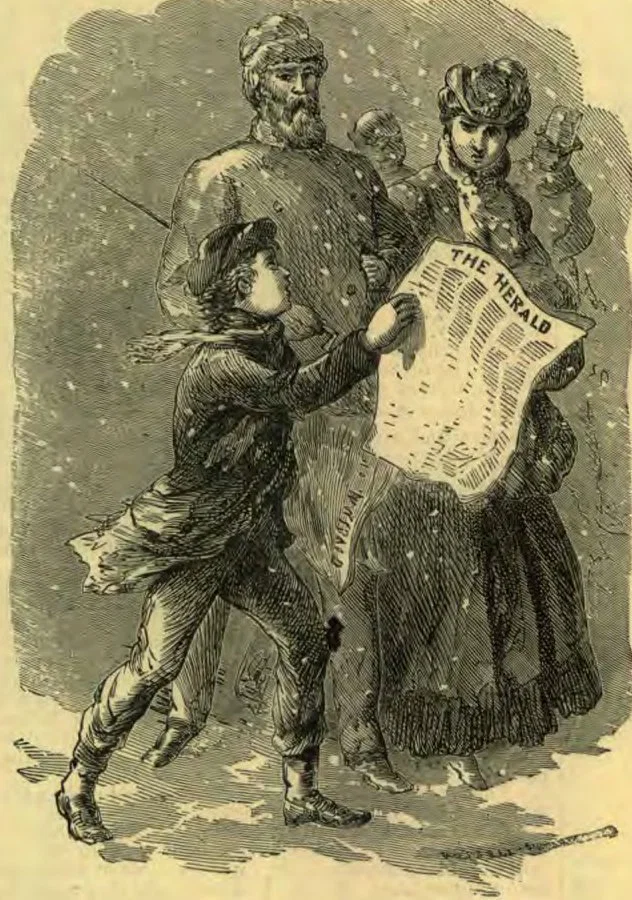
“But whatever you do, boys, do it as unto the Lord,” said Mr. Farrand, and Tim went on thinking. “Well, it won’t be doing it unto the Lord if I keep grumbling about it; but what will the boys at school think? They make so much fun of the newsboys, and they’ll think it’s queer work for me.” Presently he added out loud, “I’ve made up my mind, Mr. Farrand. You know my Uncle Howard is editor of the Evening Herald, and he always has a lot of boys to sell papers for him. I know he’ll let me if he sees I want to; and if mother’s willing, I’ll begin to-morrow.”
“Success to you,” said Mr. Farrand, “and you may bring me a copy of your paper every evening.”
Mother was willing when she heard all about it, though she cried a little bit, but I guess it wasn’t because she felt bad; and so every evening for nearly two long months, Tim walked up and down the streets, through rain or snow, crying, “Evening Herald, only two cents!”
Sometimes it took all Tim’s good resolutions put together to leave the cozy sitting-room with its bright fire, interesting books, and cheerful company for the dark, cold street outside; but he never failed. It was hard work, too, and sometimes Tim wished himself at home with the rest; but he found that when he felt discouraged, he did not have such good luck selling his papers. Then he would say, “I guess it was because I didn’t do it as unto the Lord.” This helped him many times. The best place on the route was Mr. Farrand’s, where he always stopped on his way home. He always had a cheerful word for Tim, and seemed to think the Herald was a very good paper, indeed; for sometimes, especially when Tim’s pile looked rather large, he would buy two or three papers.
The pledge was at last paid, and Tim could say with honest pride that he had earned every cent himself. He also helped Jimmy sell his brackets, which were finished very beautifully. The other boys did equally as well; and as the books and papers had been sent by Mr. Farrand some time before, with a letter telling how and by whom they were sent, they had the satisfaction of hearing from the West shortly after their pledges were paid, and to hear that the school was doing nicely, thanks to their self-sacrifice and industry. The teacher also stated that she read the letter to the school, which so encouraged the scholars that they were working in somewhat the same way to pay for their own books and papers in future.
S. ISADORE MINER.

ALFRED'S THREE PRAYERS.

“Mamma,” said Alfred one night, as he was going to bed, “I prayed three prayers, and the Lord has answered two of them. Do you think he'll answer the other?”
“I think he will, my dear. But tell me about these prayers; what were they?”
“One was that he would make you well; and you're not sick any more. Another was that he would make papa more kind; and he has been more kind lately, hasn't he?”
“Yes, dear. Now what's the third?”
“I prayed that God would keep us children from quarrelling. But he hasn't answered that yet, for Daisy and I quarrelled dreadfully to-day.”
“Ah, my son, you will have to help the Lord to answer that.”
“Help the Lord, mamma? Can't he do everything?”
“He won't make you good against your will. If you choose to be a naughty boy, God will be sorry for you, but you will be naughty still. But if you earnestly wish to be a good boy, and when Satan tempts you to quarrel, if you turn right to God for strength to resist him, and then fight like a good little soldier to keep down the naughty temper, God will give you the victory. But he won't do the work for you.”
“Oh, I didn't understand,” said the little boy.
“Yes,” continued mamma, “you have something to do yourself, when you pray such a prayer, to help God to answer it. You must watch and pray, and fight against temptation; and if you do this, you will be able by and by to come and tell me that God has answered all three of your prayers.”—Kind Words.

Letter Budget.

Myrtle Cline, of Noble Co., Ind., writes: “I am eleven years old. I go to Sabbath-school every Sabbath, and get lessons in Book No. 5. There are eight scholars in my class. We have such a good school. Miss Helen Morse has been with us over two weeks, and has encouraged us very much; but she is going home in the morning. My father is dead. I have a step-father, who is very kind. I have one own brother and sister, and two step brothers and sisters. We all keep the Sabbath but one brother who is not at home. We hope he, too, will keep it sometime. My oldest sister is in Battle Creek. Our dear old grandma is eighty-six years old, and is quite smart yet.”
Your grandma has lived many years, and yet compared with the number of years the righteous shall dwell upon the new earth, they are as nothing. She can no doubt testify with others, that the years of her life have been full of trouble and sorrow, and that the resting comes by and by.
Ethel Lane Jones writes from Miami Co., Ind. She says: “We have taken the Instructor ever since I can remember. We have Sabbath-school, Bible readings, and prayer-meeting every week. The church is near our house. We have a nice class. My sister Grace is teacher. She attends both day-school and Sabbath-school regularly. I send love to all the readers of the Instructor.”
We trust Ethel is a worker too, in some part of the vineyard; and that Grace has the help of our Saviour, to make her teaching effectual.
From Kankakee Co., Ill., we have a letter from Mary L. Schepler, who says: “I once wrote a letter for the Budget, but did not see it in print. I hope you will print this one. I am twelve years old. I have three brothers and one sister. We keep the Sabbath with our parents. We have a good meeting and Sabbath-school of twenty members. I study my lessons in Book No. 3. We belong to the French church. We have to cross the river to go to the church, which is about twelve miles away; so we cannot go very often. When the water is high, so that we have to cross the bridge, it is about twenty miles to church. There are four families on this side. We have held meetings together from one house to another. I have been taking the Instructor over a year. I like it very much; it is a nice little paper. When it comes, I always read the Letter Budget first. I am trying to keep all God’s commandments, and hope to be saved in the kingdom of God.”
The Saviour says: “He that hath my commandments, and keepeth them, he it is that loveth me; and he that loveth me shall be loved of my Father.” Blessed promise! May we all be commandment-keepers in very deed, and in truth.
Elmer E. Vaughn, of Todd Co., Minn., writes: “I have waited to see if any of the children were going to write about their missionary gardens; but not seeing anything, I thought I would write about mine. Mamma gave me thirty-five cents for my cabbages, forty cents for my turnips, twenty cents for my peppers, and twenty cents for my onions. I will give one-tenth of the sum to the Lord. After I read my Instructors, I send them to my sister in New York. Some of the leaders of our Sabbath-school are going away to be missionaries. The little band that will be left need your prayers, that they may not weary in well doing.”
Your report is welcome, Elmer; we are glad your garden yielded you some fruits for your labor. Others, if successful, may not have found such ready sale for their crops, and wait to sell before reporting. But successful gardening is so uncertain in these days of severe storms and drouth, very likely many had no luck at all. But let us hear from all, whether you had gardens or not.
Anna Russell writes from Aroostook Co., Maine. She says: “I am nine years old. I have one brother, but I am the only girl in the family. My parents have kept the Sabbath seven years. We do not drink tea nor eat pork. I go to Sabbath-school, and get my lessons in Book No. 2. I like to go to Sabbath-school. I hope to meet all our readers in the earth when it is made new.”
Most everybody would give up tea and pork if they knew how injurious they are, wouldn’t they?

THE LITTLE LEAVES.

“WE must go,” sighed little Ruby, Orange, Topaz, Garnet, Gold; “For the chilly breeze is calling, And the year is growing old. Good-by, quiet, sunny meadows That we never more shall see; Good-by, winding brooks of silver, Snowy lambs, and dear old tree— Dear, old, loving mother-tree.
From the branches down they fluttered, Like a rainbow scattered wide; And the old tree looked so lonely, That was once the woodland’s pride. But the wind came wildly piping, And they danced away with glee. Ruby, Topaz, Garnet, Orange, Soon forgot the poor old tree— Poor, old, loving mother-tree.
But when skies of drear November Frowned upon their wild delight, All the little leaves grew lonely, And they wandered back one night; And they nestled in a hollow At the foot of the old tree. Sighing, “All the long white winter We shall now so quiet be Near our dear old mother-tree.”
—George Cooper.

You have reached the end of this edition.

The Youth’s Instructor · Dec 2, 1885