SOME months ago when the Australasian Union Conference began to lay plans for opening a mission in New Guinea, the secretary of the Queensland Tract Society asked that the young people of the Brisbane churches might have the privilege of sending a native missionary to that place, and of supporting him for a year.
A letter just received from the secretary tells of a deep interest in this mission enterprise on the part of the youth and children of these churches. Our people in the Queensland Conference are nearly all poor, on account of the hard times that have been experienced in that State for many years, due to the droughts that have prevailed there. The amount that the young people started out to raise was thirty pounds to send into the field and support for a year a native worker from our school in Fiji. This letter from the secretary states that when she made up the figures at the end of ten months, she found that fifty pounds had been collected. Now they have set out to make this up to sixty pounds by the end of this year (1907), and have already a part of this amount.
As soon as the amount is raised,—which I am sure will be soon,—the young people propose to donate a quarter's collection to the different island enterprises. The first thing on their list is Singapore. This will be very welcome to the workers here, as it has been a heavy expense to get this school enterprise on its feet. Everything is expensive here, and few of the students can pay cash for their board and tuition.
Now I am sure that if the youth and children of this poverty-stricken State (Queensland), and in one city too, can in a year collect sixty pounds (three hundred dollars) for the opening of a new mission, the more highly favored people of the United States could raise several funds the size of the one that is being raised for the important enterprise in that great country.
* Singapore, Straits Settlements.
Aids for Bible Readers
By A. H. Sayce
Historical quotations and extracts from various writers which may assist the thoughtful student of the Scriptures.
Newly Discovered Jewish Documents in Egypt
And How They Say “Hands off” to Destructive Criticism of the Bible
EGYPT is continually furnishing fresh surprises to the archeologist and historian, as well as to the student of the Old Testament. The latest discovery has been that of a series of Jewish documents written by the contemporaries of Ezra and Nehemiah, and throwing unexpected light on the later historical books of the Hebrew Scriptures.
The town of Assuan, the Seveneh of Eze. 29:10, is built at the southern frontier of Egypt, and immediately opposite to it lies the little island of Elephantinê. An important city once stood at the southern end of Elephantinê, from which came the Pharaohs of the fifth and sixth dynasties, and which lasted down to the age of the Arab conquest of Egypt. Its site is now marked by mounds which for many years past have yielded a rich harvest to the sebakhin—that is to say, the searchers for the nitrogenous dust which is used as manure in Egypt. Hundreds of potsherds have been found in them, covered with Greek writing, and containing receipts for the payment of taxes in the Ptolemaic and Roman periods. One or two ostraca, as these inscribed potsherds are called, have also been found with Aramaic inscriptions upon them instead of Greek. The alphabet of the inscriptions was that used by the Jews in the centuries immediately preceding the Christian era, while the language of them resembled the so-called Biblical Chaldee. But they were very difficult to decipher, owing to their broken and obliterated condition and the very small number that were known.
Seven years ago I rescued from the hands of the sebakhin, who were about to destroy them, two of these ostraca, larger and more legible than usual, with a papyrus that had been discovered along with them. The papyrus proved to be a12document written in the Aramaic (or “Chaldee”) dialect and alphabet, by two Jews who were settled at Assuan and Elephantinê, where they carried on the business of banking and money lending under the Persian kings. The persons mentioned on the ostraca were the same as those whose names occurred in the papyrus.
Persia’s Friendliness to Judaism Strikingly Proved
Three years later the sebakhin made a still more important discovery. A wooden box was found, containing a number of large papyrus rolls all tied round with string which was fastened with clay seals. The rolls were bought by Lady William Cecil and Mr. Mond, who gave them to the Cairo Museum, and Mr. Mond generously bore all the expenses of their publication, which was undertaken by Mr. Cowley and myself. The documents were all dated, the earliest in the reign of Xerxes I (471 B. C.), the latest in that of Darius II (411 B. C.), and they all belonged to the Jewish colony at Assuan. This colony was large and wealthy, and owned a great deal of house property in Elephantinê. The papyri throw considerable light on the laws under which they lived, more especially upon those relating to marriage and inheritance, and they also explain the origin of Biblical “Chaldee,” which was the official Aramaic language of the western provinces of the Persian empire, as spoken and written by Jews. But the most curious fact disclosed by the papyri is that there was a temple of Yahu—the Jehovah of the Authorized Version—by the side of the public street in Elephantinê, where the stated ritual and sacrifices of the Mosaic law were performed. The temple was not a synagogue, but a temple like that of Jerusalem, or the temple afterward built by Onias at Tel el-Yehudiya in northern Egypt, for which, therefore, as we now know, there had already been a precedent.
The discovery of the “Assuan papyri” at once excited the attention of the learned world, and in 1904 I superintended some excavations for the Egyptian Service of Antiquities on the spot where they were said to have been found. But unfortunately I was obliged to close the work after a few days, as the season was getting late, the Nile was low, and I had to return to El-Kab in order to finish the excavations I had been carrying on there for some years with Mr. Somers Clarke. A year or two later, however, the German and French governments obtained concessions by which the mounds of Elephantinê were divided between them, and in the spring of 1907 a German expedition under Dr. Rubensohn was exploring the northwestern portion of them, while the eminent French scholar, Professor Clermont-Ganneau, was at work at the southeastern end. The place where the papyri had been found fell within the German lines, and here, accordingly, further discoveries of even greater interest awaited the explorers.
In the ruins of two adjoining houses two collections of papyrus rolls were again found, all belonging to the Jewish colony, and written in Aramaic. Among them are narratives and poems or psalms which have not yet been thoroughly examined. But three of them have turned out to be of such surpassing historical interest that their editor, Professor Sachau, determined to publish them at once.
Two of the papyri are copies of the same document, a memorial sent by the Jews of Elephantinê to Bagoas, the governor of Judea, complaining that their temple there had been plundered and destroyed, while the third contains the order for its restoration. The memorial is dated November, 408 B. C., only twenty-four years after Nehemiah’s second visit to Jerusalem (Neh. 13:6), and is written in the name of “Zedoniah and his companions, the priests in Elephantinê.” It begins by praying that “our Lord, the God of heaven,” may grant peace to Bagoas, and “mercy in the sight of King Darius,” and goes on to say that the priests of the Egyptian god Khnub, or Khnum, had taken advantage of the temporary absence of the Persian governor of Assuan to bribe his deputy, Vidrang, who accordingly had given permission for the Jewish temple in Elephantinê to be destroyed. Thereupon Vidrang’s son, who was in command of the garrison, “led out the Egyptians with other forces,” “they entered this temple and razed it to the ground, breaking in pieces the pillars of stone.” They also destroyed its “seven great gates of hewn stone,” as well as “the bronze hinges of the doors,” and “they burnt with fire” the roof of cedar-wood and the stucco of the walls. “And the bowls of gold and silver, and whatever else was in the temple, they took and appropriated to themselves.” Then comes the important statement that the temple had been built “in the days of the kings of Egypt,” before the Persian conquest, so that its builders must have been either the Jews who came into Egypt with Jeremiah, or their sons. “When Cambyses came up into Egypt,” the memorial goes on to say, “he found this temple built; and, though the temples of the gods of Egypt were overthrown, no one injured anything in this temple.” In these words we have a complete verification of the favorable attitude toward Jewish worship and religion ascribed by the Old Testament writers to the Persian kings.
Ezra and Nehemiah Confirmed
After the destruction of their temple, the Jews at Assuan and Elephantinê, with their wives and children, “put on sackcloth, and fasted, and prayed to Yahu, the God of heaven,” who heard their prayer, and punished the evil-doers, Vidrang losing all his possessions, and “all the men who wished evil against this temple” being slain. Meanwhile, the Jews had written “to Jehohanan, the high priest, and his companions, the priests in Jerusalem, and to Ostanes, his brother, whose [Jewish] name is Anani, and to the nobles of the Jews; but they sent no letter” in reply. Jehohanan is called Johanan in Neh. 12:22, and a few years later was heavily fined by Bagoas for the murder of his brother in the temple at Jerusalem. As he returned no answer to the communication from Egypt, the Elephantinê Jews determined to apply directly to Bagoas, telling him that if he would give permission for the restoration of their sanctuary, “we will offer meal-offerings and frankincense and burnt-offerings upon the altar of Yahu the God in thy name. And we will pray for thee at all times, we and our wives and our children, and all the Jews who are here, if thou doest thus, until this temple is rebuilt. And thou shalt have a portion before Yahu, the God of heaven, from every one who offers to him burnt-offering and sacrifices, of the value of one thousand silver talents.” The memorialists conclude by saying that they have already written on the matter to Delaiah and Shelemiah, “the sons of Sanballat, the governor of Samaria,” whose date, which has been disputed, is thus finally fixed.
There is no space here for discussing the many questions which this remarkable document raises. At all events, it proves that the prohibition to erect a temple and carry on the regular temple service elsewhere than in the central sanctuary at Jerusalem was not considered to be binding outside of Palestine itself. But we can easily understand that the high priest and his companions at Jerusalem would not be anxious to see the Elephantinê temple restored. That it was rebuilt, however, we learn from the third papyrus, which contains the answer of Bagoas, and reads as follows: “Thou shalt say in Egypt before Arsames [the governor] concerning the altar-house of the God of heaven, which was built before our time, before Cambyses, in Elephantinê, which Vidrang . . . destroyed in the fourteenth year of King Darius, that it is to be rebuilt in its place as it was before, and that meal-offerings and frankincense shall be offered upon this altar, as was done formerly.”
The answer of the Persian government shows how true to historical fact are the statements of the books of Ezra and Nehemiah in regard to the relations between the Persian kings and their Jewish subjects. The Jews and their religion, it is clear, were looked upon with special favor at the Persian court. As orders were issued for the restoration of the temple at Jerusalem, so a similar order was issued for the restoration of that at Elephantinê as soon as the story of its destruction became known to the higher authorities. So, too, when the temples of Egypt had been plundered and overthrown by Cambyses, that of the Jews at Elephantinê alone remained untouched. Henceforward skeptical criticism will have to keep its hands off the official documents contained in these two historical books of the Old Testament. —Prof. A. H. Sayce, D. D., L. L. D., D. C. L., in The Sunday School Times, for Feb. 15, 1908.
Drugs
By L. J. Otis
L. J. OTIS, M. D.
We include under this head substances that, owing to certain action (usually poisonous) on the human system, are used as medicine. As these have to enter the system in order to have such effect, what is said here will refer only to the internal use of drugs.
With people generally, drugs, no matter how vile, disgusting, and nauseating, are considered an indispensable necessity in treating the sick, so that each disease has certain drugs for its cure. Just how the cure is brought about they do not attempt to explain, but, after taking the medicine, somehow, in some mysterious way, the patient gets well, which is attributed to the drug taken, of course.
This idea used to be held generally by doctors. But now, we see a change coming. Physicians scoffed at the idea that nature cured the patient. Drugs were given to restore the patient in spite of nature. But they recognize now that nature cures, and cured then. So now, drugs are given supposedly to assist nature, but, as a matter of fact, they come about as far from it as they used to, in most cases.
The drug is recognized as an invader. Increased action is brought to bear to protect the system from the offending drug and to destroy or expel it. By this increased action other poisons may be expelled or destroyed, nature assisted, and the patient improved in one way. But there is left, owing to the poison of the drug, a benumbed, narcotized effect on the fine nervous structures, which, as the drug is repeated, becomes more and more permanent. This action not infrequently leads to other diseased conditions, from which the patients often suffer more than from the original disease. Some of these drug-produced diseases are never cured; the patient is peevish, irritable, and always sick.
This is the action of a large class of drugs. There are others that are entirely devoid of even this much good. Those that so poison and benumb the patient that he no longer recognizes the distress and the diseased condition, but is able to rest, cause him to be deceived into thinking that his condition is better, when, in reality, it is worse.
The history of this class of patients is much the same. More of the drug, or similar drugs, are demanded, the patient fails, goes from one doctor to another until outraged nature calls a halt, and the patient dies—not from the disease, this was a small part of the trouble, and would long since have ceased of itself, had nothing at all been done; but the patient dies in the way that thousands of others have been and are dying,—of drug poisoning. Then the report is published, that everything that medical science could suggest was done, but to no avail. Had medical science only thought to leave nature to itself, yes, even to do nothing, the patient in most cases would have lived. But don’t misunderstand me. I am no advocate of a do-nothing policy—there is so much that will help the patient, apart from drugs. But do nothing always, rather than do that which will injure your patient. “God’s servants should not administer medicines which they know will leave behind injurious effects upon the system, even if they do relieve present suffering.” It is a fact that more have died from drug poisoning than from all other causes combined. All poisons taken into the human system have their baneful influence. They affect the stomach, liver, kidneys, and lungs, besides deranging the system generally.
If the individuals themselves were the only sufferers, it would be bad enough, but these same persons are bringing into the world children who are sick and feeble, or otherwise suffer from the parents’ transgression. Yet in the face of this, there will be found plenty who will say that they were sick and took such and such a medicine and it cured them. A part of this positive statement that they were sick and took medicine and got well, is doubtless true. But it is not true that a drug ever cured any one, and had they known that at the time they took the medicine, there was a force much more potent for good already at work, credit might have been given where it was due. As we have previously stated, nature cures. And what is more, aside from cases of divine healing, nature only cures.
In Ps. 103:3 we learn that the Lord is the one “who healeth all thy diseases.” The laws of nature are the laws of God; and when he restores to health from disease, it is either through these laws, or as in cases of divine healing, by his immediate creative power, and hence miraculous. In either case the Lord heals. Nor does any man possess this power, no matter how many have become well after taking his medicine.
When the body is overcome by disease, nature immediately begins a process of fortification against, and destruction and expulsion of, disease poisons, which, if there is no hindrance, soon brings back conditions of health. But suppose that the patient takes medicine that lessens pain and enables him to sleep. He has constitution enough so that nature can handle both the disease and the medicine. He is sick longer or is more seriously sick, but in no sense ought it to be said that the medicine cured him.
There are many whose false logic prevents their seeing this, and to these this quotation is given: “Those who will gratify their appetite and then suffer because of their intemperance, and take drugs to obtain relief, may be assured that God will not interpose to save health and life which is so recklessly periled. . . . God does not see fit to answer prayers in behalf of such, for he knows that, if they should be restored to health, they would again sacrifice it upon the altar of unhealthy appetite.” In these cases so often is the following true: “They will live fashionably and suffer with disease as the result, be doctored with fashionable poisons, and die a fashionable death.”
Grand Rapids, Mich.
President Lincoln as a Temperance Man
LEONARD SWETT tells us that Lincoln told him not more than a year before he was elected president that he had never tasted liquor in his life. “What!” said Swett, “do you mean to say that you never tasted it?” “Yes,” replied Lincoln, “I never tasted it.” When we take into consideration the habits of the times, this is a most remarkable testimony to Lincoln’s principles, the stability of his character, and the iron quality of his will power.
Mr. C. C. Coffin, a most distinguished journalist of the day, who accompanied the notification committee from the Chicago convention to Springfield, at the time of Lincoln’s first nomination for the presidency of the United States, related in his newspaper an incident that occurred on that occasion. He says that after the exchange of formalities Lincoln said:— “Mrs. Lincoln will be pleased to see you, gentlemen. You will find her in the other room. You must be thirsty after your long ride. You will find a pitcher of water in the library.”14
The newspaper men crossed the hall and entered the library. There were miscellaneous books on the shelves, two globes, celestial and terrestrial, in the corners of the room, and a plain table, with writing materials upon it, a pitcher of cold water and glasses, but no wines or liquors. There was humor in the invitation to take a glass of water, which was explained to Mr. Coffin by a citizen of Springfield, who said that, when it was known that the committee was coming, several of the citizens called upon Mr. Lincoln and informed him that some entertainment must be provided.
“Yes, that is so. What ought to be done? Just let me know and I will attend to it,” he said.
“O, we will supply the needed liquors!” said his friends.
“Gentlemen,” said Mr. Lincoln, “I thank you for your kind intention, but must respectfully decline your kind offer. I have no liquors in my house, and have never been in the habit of entertaining my friends in that way. I can not permit my friends to do for me what I will not myself do. I shall provide cold water—nothing else.”—Youth’s Temperance Evangel.
My All and in All
By DAN D. LYONS
DAN D. LYONS
I COME to my Saviour, bowed low with
my sin,
My heart aching sore with its woe;
I know if I touch but the hem of his
robe,
The joy of his peace I shall know.
O, he is my Saviour, my all and in all!
He proffers me pardon to-day.
I plunge in the flood of Emmanuel's
blood,
And it washes my sins away.
I came to the cross, and I left there my
load,
My Saviour spoke peace to me there;
My heart leaped for joy in the bliss
that hour;
No peace with that peace can compare.
I know there is healing and pardon for
all,
Since Jesus spoke peace to my soul;
And I'll sing of his goodness forever
and aye,
His love and his glory extol.
The North German Conference
By GUY DAIL
GUY DAIL
One year ago this field was cut off from the West German Conference. It has a population of 5,162,600. Its territory is composed of Hannover, save the extreme southern end of the province; Schleswig-Holstein, except Altona Wandsbek; the grand duchies of Oldenburg and Mecklenburg-Schwerin; and the free cities of Bremen and Luebeck.
January 15-19 the nearly fifty delegates representing the four hundred ninety members of the North German Conference assembled for their second annual meeting at Kiel, one of the oldest cities of Holstein. This town has one hundred seventy thousand inhabitants. It stands at the head of the Kaiser Wilhelm Canal, which was finished in 1895, at a cost of thirty-nine million dollars; it is the center of a brisk trade between Denmark and the Continent; and it has a university, a naval academy, and the chief war harbor of the empire.
On Sabbath about eighty or eighty-five of our people were in attendance at the service of special consecration, after an earnest sermon by Elder Conradi. A fair and continually increasing outside interest was manifested in the public lectures. Brethren J. Erzberger, H. F. Schuberth, and Dr. Petersohn gave valuable assistance and counsel to those who came to hear the word. The workers’ meetings were of especial value.
The reports rendered by the local field laborers plainly showed that God is at work in this part of his vineyard. One hundred eight new members have been received; the net gain was thirty. The tithe for 1907 was $5,450, the offerings amounted to $838, and the book sales to $8,500.
Some claim that the people here are more conservative than in other parts of Germany. Prejudice against our message is certainly increasing. One of the small grand duchies (which is entirely Protestant) has refused to renew our canvassers’ permits for 1908, as the authorities maintain that our literature is of such a nature as to be likely to give offense to the religious feelings of the people.
However, there is one thing in which this part of the German field takes the lead: it was in the province of Schleswig-Holstein that the first permission to hold tent-meetings was granted to us in the German empire. The police were so well pleased with the general tone of these services that our brethren secured a written statement from the mayor, expressing satisfaction at the manner in which the tent effort had been conducted. This took place in the early nineties. Last summer another tent was purchased, and the Danish-American brethren who assisted in raising the means for this enterprise, received a hearty vote of thanks from the delegates at this meeting.
North Germany, as well as the other German Conferences, pays two tithes to the union, for carrying the gospel into the union mission fields. After deducting this from its income, the conference lacked about seven hundred fifty dollars of paying its expenses for 1907, and had to draw that much on its capital. Plans were laid to guard against such a shortage in the future. About seventy-five dollars was raised in cash and pledges toward the North German tent fund. The Sabbath-school donations amounted to fifteen dollars. The collections taken during the session of the conference more than paid the hall rent.
Elder L. Mathe was again chosen president. He will be assisted by one ordained minister, six licentiates, and three Bible workers. They rejoiced that three new companies could be received into the conference at this meeting,—one at Schwerin, another at Norden, and a third at Sonderburg. At the good closing meeting the laborers were of excellent courage, and expressed their determination to put forth more consecrated and untiring efforts to win souls for the Master than ever before. We feel sure our readers will wish them God’s rich blessings, and many souls for their hire the present year, both among the Germans and among the Danes, for many Danes live in Holstein. To this end let the work and workers of the North German Conference be remembered in prayer.
Hamburg, Germany.
General Meeting in Siang Cheng
By A. C. SELMON
A. C. SELMON
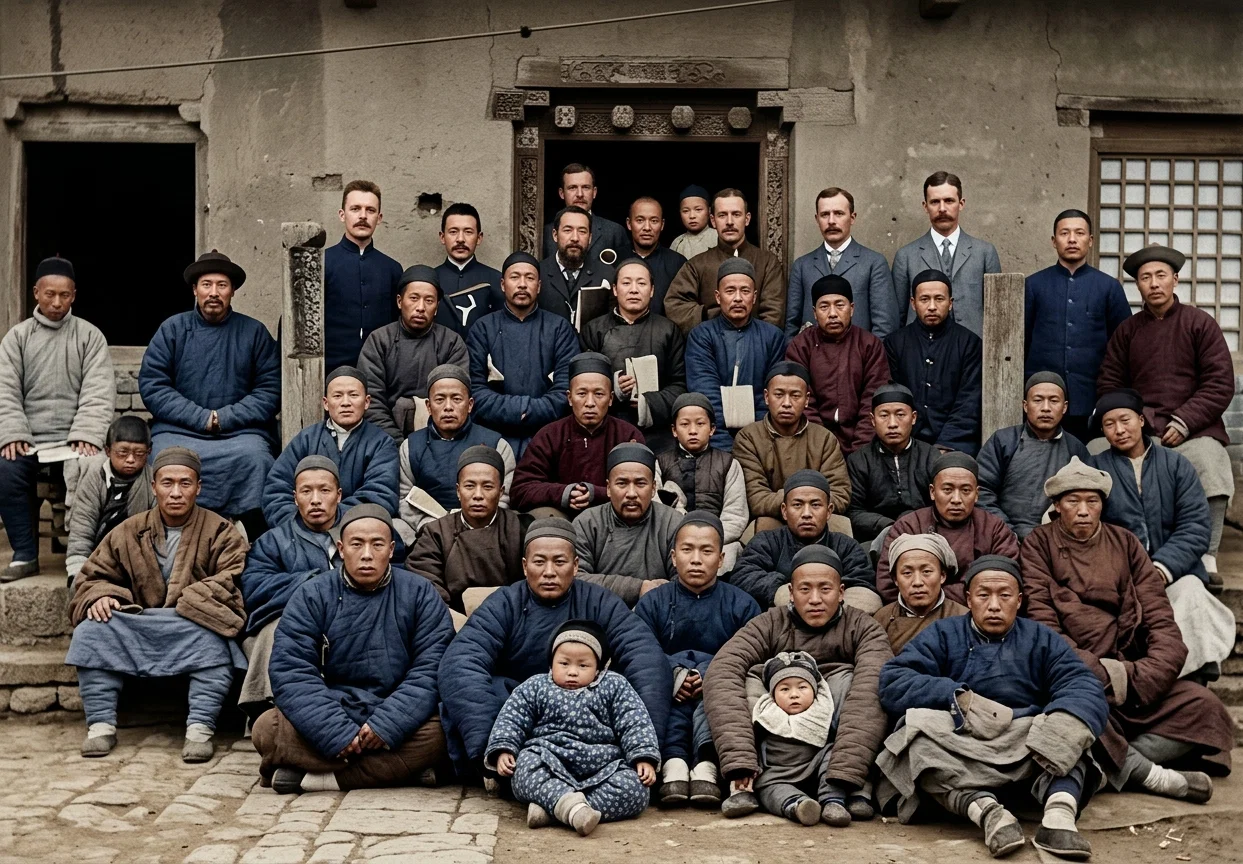
From December 8 to 14 the Sabbath-keepers and enquirers from Shang Tsai, Brother Westrup’s station, united with those of Siang Cheng in a general meeting held at this place. The believers at both stations are more or less scattered in villages from ten to twenty miles away. They had not had the opportunity of meeting others of like faith, so the meeting was a blessing to them in many ways. In addition to the instruction from the Word, the interchange of experiences proved to be a great help. Brother and Sister Westrup, Brother and Sister Allum, and Brother Esta Miller were present, and helped in the meetings. The time of all our workers, since coming to the field, has been so taken up with the language study that it was a great encouragement to see a company of fifty Sabbath-keepers come together. Many of those who attended came a distance of forty to sixty miles.15Evangelist Chen, from Sin Yang station, walked seventy miles. The weather had been stormy for some time, but the Lord gave us good weather and good roads for the gathering. Our brethren in the home lands, who can go by railroad to and from camp-meeting, can hardly appreciate what it means to go by wheelbarrow or by ox-cart a distance of forty miles. It requires about fifteen hours with good roads to cover the distance by cart.
BRETHREN ATTENDING GENERAL MEETING, SIANG CHENG
Of those present some had been keeping the Sabbath for two years or over, and yet others were just coming out of heathenism, so the subjects taken up were intended to meet the needs of all. The testimony meetings gave evidence that the Holy Spirit was at work. After considering the subject of the use of tobacco and wine, many testified that when this truth came to them, they were led to give up the use of tobacco and wine at once. Although the other societies discourage the use of these, yet among their converts there are many who drink wine and smoke tobacco, and some even use opium. The message of Christ’s soon coming and the judgment led them to see that the sanctification mentioned in the Bible takes in the whole man; spirit, soul, and body must be preserved blameless unto the coming of our Lord Jesus Christ. To see a man saved who has been a slave to opium for ten or fifteen years, seems very much akin to a resurrection from the dead. Some who had formerly used tobacco still had a pipe or two about the house. One man, who had not smoked for over three years, brought his big brass water-pipe into the meeting, and destroyed it publicly. This led others to declare that since they did not use a pipe, they would not keep one around so that others could use it.
One unacquainted with Chinese life can have no idea of the place the pipe has here in social intercourse. The proverb says, “Tobacco and tea prevent a breach.” In other words, if a guest comes and you do not offer him the pipe, he would consider it as an open insult. It is considered so indispensable that we have heard of gospel-hall guest-rooms, where guests are offered the pipe. Among the people the salutation most commonly heard when they meet is, “Have a smoke.” It may be seen from this what a hold the vice has upon the people, its use being almost as common among women as among men.
Among the women some had unbound their feet, and others took their stand during the meeting. For a woman here in the interior to unbind her feet, is the greatest departure from Chinese custom that she could make, and brings upon her persecution and all kinds of slanderous reports. One young woman, who accepted the gospel a little over a year ago, has read all the New Testament and as far as Ezekiel in the Old. She unbound her feet in spite of the opposition of her own family and relatives. It is the general testimony that the members of the native church are very lax in keeping Sunday. It is not uncommon to see them attend meeting in the forenoon, and take some market product along with them to town, and in the afternoon some even feel free to go about their regular work.
Some of those who attended had formerly been Sunday-keepers and had not met with persecution, but when they received the Sabbath truth and began keeping it according to the commandment, it caused division in families.
On the Friday preceding the last Sabbath of the meeting seven were baptized, four men and three women. These, together with those previously baptized, enable us to organize a church of eleven members at Siang Cheng. The last Sabbath of the meeting the ordinances of the Lord’s house were celebrated. The Chinese sisters, all having unbound feet, also took part in the ordinance of humility. This was the first opportunity any of us have had of meeting with a company of Chinese Christians to celebrate the ordinances. It was a touching service; the testimonies as well as the tears of those who took part testified of the Spirit’s presence.
We all realize that the time has come for a great onward move in the work in China. Interest is awakened wherever the truth is made known. Up to the present time we have had practically no literature to use, and enquirers who can not come to our stations have no way to learn of the truth fully. Literature is greatly needed at once. To appreciate our situation one should consider what the work would be in the home lands with no tracts, papers, or books to help proclaim the message. It could hardly be expected that the work would progress rapidly. For the message to reach China’s four hundred twenty-six millions there must be large printing facilities, and a large increase in the force of workers in the field. The Lord is showing how the work may be done if we will only consecrate ourselves and our all to his service.
Siang Cheng, China.
Dangers Attached to Eating Raw Foods and Fruit Skins
PROFESSOR METCHNIKOFF, in his Harben lectures delivered at King's College, London, on the “Hygiene of the Alimentary Canal” (reported in the Lancet, June 2, 1906), warns us of the perils of eating certain vegetables and fruits unless previously boiled.
The professor said: “Among fruits, it was principally strawberries which introduced parasites, ova, and infectious germs into the intestinal canal. It was therefore necessary to boil them. Even cherries, although growing on trees and far from the soil, should be carefully scalded or boiled, because the birds which took a bite out of them frequently contaminated them with contagious matter.
“As it could not be doubted that salad, radishes, and other raw vegetables transmitted entozoa and pathogenic microbes, their surveillance from a hygienic point of view became indispensable. Washing these vegetables, even with boiled water, was not sufficient, and it was necessary at least to scald them with boiling water, or better still, to boil them.”
Appendicitis, he declared, was frequently caused by bites, from intestinal worms lodging in the cæcum, carrying microbes into the tissues of the appendix. The eggs of the worms adhere to the raw vegetables, and when introduced into the alimentary canal, afterward develop. Hydatis may be caused in the same manner.—Selected.