It is astonishing to contemplate the growing tendency toward paternalism in government in our country during the last ten years. The demand is that the Government shall be everything and do everything. In a recent discourse before the Young Men's Christian Association, Rev. Thomas Dixon, appealed for the legal abolition of strikes. He would have the Government raise its hand against them, even to the expediency of bringing the railroads and their operations and responsibilities, including the actions of their employes, under its indisputable power of management and restraint. “The public has the right to demand the cessation of strikes,” Mr. Dixon thinks, and the simplest way would be for the Government to enforce this demand by depriving the strikers of the freedom that now makes strikes possible.
Commenting upon this, the Sun says—
This would be the tyranny of slothful despotism. There is nothing that a despot hates so much as disturbances of any sort, except those of his own making, and force is his means of preventing or suppressing them. If there is a principle established in great manufacturing countries, it is the right of men to organize labor unions. The right to strike and to exert all the pressure upon employers which a strike carries with it, is just as incontestable. It would be a fine commentary on a land like the United States, if we should extend the rigor of military discipline over our various great enterprises; with the result that a man might be shot for leaving his post. The freedom which lies beneath the right to strike is one of the most vital concern to the public. Its preservation, and seeing that strikes are conducted according to the rules of public order, constitutes the State's entire duty.
The Hon. James G. Blaine, at the time when the commotion of the Missouri Pacific strike of 1886 had scarcely subsided, laid down a remarkably concise form of the fundamental law by which all labor unions and their demonstrations must be regulated. It was: “One man's right ends where another man's right begins.” While that principle is observed strikes represent a right at the very root of liberty.
And this is sound. The Government cannot undertake to regulate all the business of the country, but it can and should protect from violence the person and property of all its citizens.
The Young Men's Christian Association of Trenton, New Jersey, has committed itself to an open affiliation with the American Sabbath Union. The following item is published by the Pearl of Days:—
Last Sunday was a field day for the Sabbath cause in the capital city of New Jersey. In addition to sermons and addresses by the secretaries of the American Sabbath Union, the Rev. Drs. Knowles and Taylor, and by Rev. Dr. Dunn, a great meeting was held at 4 P. M. in Taylor's Opera House, under the auspices of the Young Men's Christian Association, at which Col. E. F. Shepard, president of the American Sabbath Union, eloquently addressed over two thousand one hundred men, on “The Sabbath for man.” Resolutions were unanimously adopted in favor of changing the inauguration of the President of the United States from the 4th of March to the first Wednesday of that month, and also for the closing of the Columbian Exposition on Sundays. The last resolution was adopted by a rising vote of the whole assembly. This series of meetings was marked by the profound interest and enthusiasm of the thousands of hearers. Similar meetings will also be held in other cities during the coming season.
It is by these slow approaches and imperceptible degrees, that the Young Men's Christian Association will be at last captured for the National Reform party. In Chicago it has allied itself with the movement for the closing of the World's Fair on Sunday. Through their gradual advances, beginning first with those things which seem in themselves so harmless, and, in fact, from a mistaken view, so necessary to be consistent in their profession of Christianity, the Young Men's Christian Association will be led into the realm of politics at last. Heretofore they have steadfastly avoided an alliance so fatal to the true Christianity of the Association, but the American Sabbath Union and the National Reform Association are proving too subtle and too strong for them.
Important.
By Alonzo T. Jones
The Pearl of Days, some weeks since, printed what it called “two important letters,” one of which was from Bishop Littlejohn, of the Protestant Episcopal Church, and the other from Patrick T. O’Hare, Rector of St. Anthony’s Catholic Church. Both letters were written to the Sunday Observance Association, of Kings County. Mr. O’Hare says:—
With regard to the observance of the Lord’s day, you will kindly permit me to give you an extract from the decrees of the Third Plenary Council, held by our bishops a few years ago, in Baltimore. The decree may be found under title 3, chapter 3, and No. 113. It is known as the decree on the “Liquor Traffic and the Observance of Sunday.” It reads as follows: “A Christian should carefully avoid not only what is positively evil, but what has even the appearance of evil, and more especially what commonly leads to it.”
This is an important letter, and it touches upon a matter that will prove in the end to be much more important than these so-called Protestant advocates now imagine. Mr. O’Hare simply does in this letter what all the Roman Catholics do when referring to Sunday observance; that is, for authority he quotes the decree of the Baltimore council. And when Protestants receive these letters as official communications, and put their indorsement upon them by printing them, and otherwise, they will find that one of these days they will be held as subject to the authority which they have thus recognized; and if they undertake to reject that authority they will be held strictly to answer for it. If Protestants would not be held amenable to the Roman Catholic Church, they must keep as far from any recognition of it as the east is from the west. It is true they do not intend this, but that matters not; the Roman Catholics intend it, and if the Protestants do not, the thing for them to do is to let this be known by keeping far from it. A. T. J.
What constitutes a State?
By Sir William Jones
Not high-raised battlement and labored mound,
Thick wall and moated gate;
Not cities proud with spires and turrets crowned.Not broad-armed bays and ports,
Where laughing at the storm, rich navies ride;
Not starred and spangled courts,
Where low-bred baseness casts perfume to pride;
No, men, high-minded men—Men who their duties know,
But know their rights, and knowing dare maintain.
These constitute a State.—Sir William Jones.
THE American Sabbath Union, of the United States, has its peer in the “Lord’s Day Alliance,” of Canada, in which most of the Protestant denominations of the Dominion are said to be represented. The Presbyterian Church seems, there, to take the initiative, as it does here. At a late meeting of the Presbyterian General Assembly the Committee of Sabbath observance presented a set of resolutions which were adopted. The following are the fourth and fifth resolutions in the series:—
4. That the Assembly records its approval of the effort now being made to obtain from Parliament a Sabbath law for the whole Dominion, recommends presbyteries and kirk sessions to take action in support of it by petition or any other way that may be deemed efficient, and that the Assembly again forward to Parliament a petition in favor of such legislation.
5. That the Assembly expresses its gratification at the cordial co-operation of all the Protestant denominations, as manifested in the Lord’s Day Alliance of Canada, and appoints as its representatives in the Alliance the members of the Sabbath Observance Committee.
NATIONAL RELIGIOUS LIBERTY ASSOCIATION.
DECLARATION OF PRINCIPLES FOR
DECLARATION OF PRINCIPLES.
We believe in the religion taught by Jesus Christ.
We believe in temperance, and regard the liquor traffic as a curse to society.
We believe in supporting the civil government, and submitting to its authority.
We deny the right of any civil government to legislate on religious questions.
We believe it is the right, and should be the privilege, of every man to worship according to the dictates of his own conscience.
We also believe it to be our duty to use every lawful and honorable means to prevent religious legislation by the civil government; that we and our fellow-citizens may enjoy the inestimable blessings of both religious and civil liberty.
OFFICES.
43 BOND STREET, NEW-YORK CITY;
325 A ST., N. E., WASHINGTON; 28 COLLEGE PLACE, CHICAGO;
C. ELDRIDGE, President.
W. H. McKEE, Secretary.
“It is this ‘innocent recreation,’” says the New York Observer, “advocated by Cardinal Gibbons and Liberal Protestants, that destroys the idea of Sunday being a holy day.” The inference is that the State should forbid innocent recreation. It is this thought that inspires the demand for Sunday laws on the part of churches and church papers.
A Candid Prohibitionist.
WRITING to the California Voice, Mr. John Robinson, of Guerneville, California, says:—
The Adventists do not ask that their day be selected as the day of rest, but demand that legislation on the matter be omitted entirely.
To this the Signs of the Times adds this comment:—
Adventists consistently oppose all Sabbath legislation. They have the privilege and right of a day of rest; no one ought to ask more. What hinders our Sunday-law people from resting on Sunday, if they so desire?
Again, Mr. Robinson, who, by the way, is a Prohibitionist, and not an Adventist, says:—
The “toiler” does not ask for this legislation, and no effort is being made to prevent the masses from resting one day in seven.
And this is simply a plain statement of a well-known fact: the demand for Sunday laws comes not from the working masses, but from those who are inspired by a mistaken religious zeal.
Of the Sunday-law plank in the Prohibition platform, the same gentleman says:—
You may proclaim as long and loudly as you desire that this plank does not mean Sunday law, but simply a day of rest, on Monday, Tuesday, or on any day, but so long as the masses believe it means Sunday, the effect will be the same, viz., to prevent the success of our party. The fact is, Sunday is the day generally intended; there is no use denying this. Sunday is a religious institution; laws to enforce a religious institution is religious legislation and will not be indorsed by a majority of the voters of this country.
Would that all Prohibitionists were as candid.
The Hervey, or Cook, Islands are five hundred miles from Samoa. They are of volcanic origin, and the population numbers about 20,000. Although missionaries found them very ferocious, they are now nearly all Christianized, and have the Bible and other books translated into their language.
The natives of the Austral Islands, numbering about 3,000, are all Christians. The Low Archipelago consists of eighty-one islands. Most of the islanders profess Christianity.
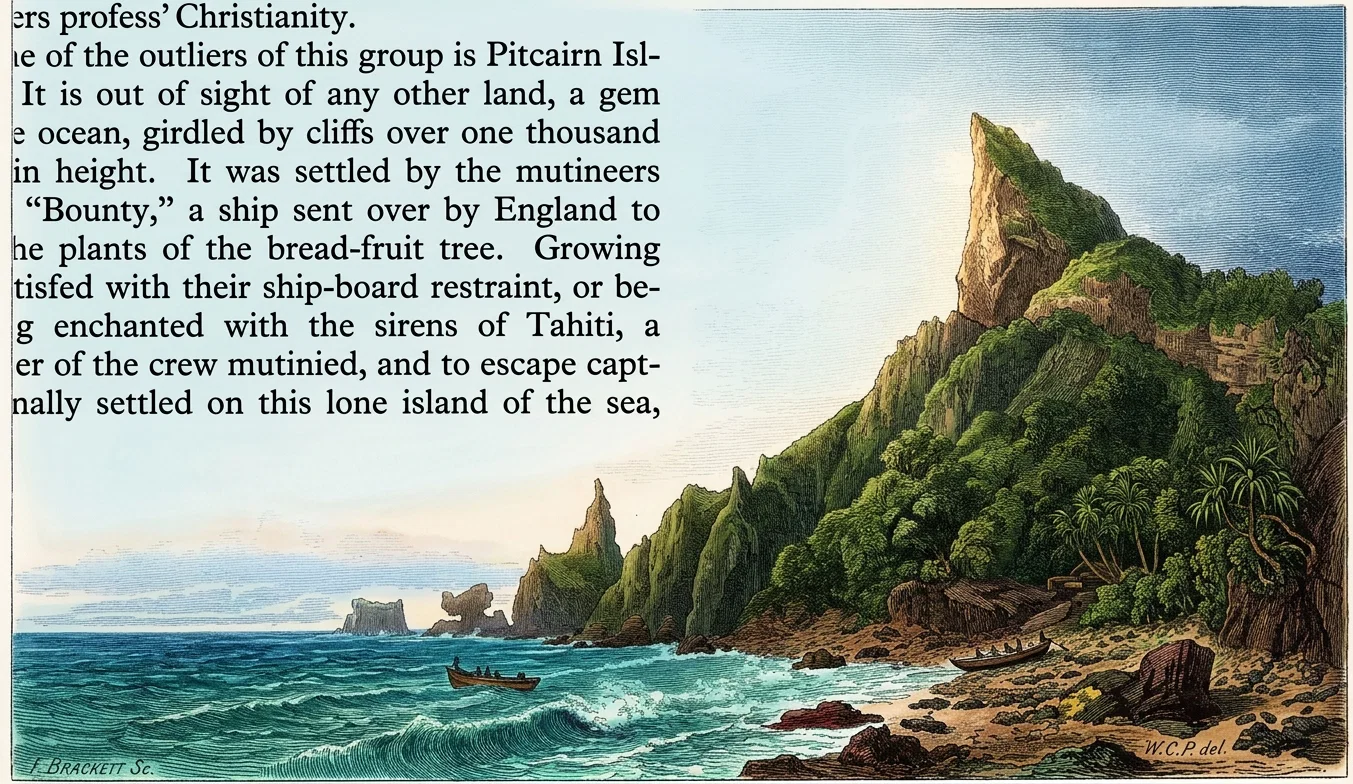
One of the outliers of this group is Pitcairn Island. It is out of sight of any other land, a gem of the ocean, girdled by cliffs over one thousand feet in height. It was settled by the mutineers of the “Bounty,” a ship sent over by England to procure plants of the bread-fruit tree. Growing dissatisfied with their ship-board restraint, or becoming enchanted with the sirens of Tahiti, a number of the crew mutinied, and to escape capture finally settled on this lone island of the sea, with their Tahitian wives. It was not until 1808 that an American ship touched the island, and in 1814 a British man-of-war came, and then the long-forgotten story of the mutineers was revived in the world.
LANDING PLACE, PITCAIRN ISLAND.
The Pitcairners became so numerous that a colony was removed to another island. At the time of their discovery, only one of the mutineers was alive, a man named John Adams. He had sincerely repented of his evil course, and was not only living a model Christian life himself, but by his example and instruction, he was leading the children of the deceased mutineers into an upright, Christian life. John Adams died, honored and
The Illustrations have been prepared with great care and at large expense, many of them being engraved especially for the work, or selected and imported from choice foreign collections.
FIRESIDE SKETCHES OF SCENERY AND TRAVEL
On the Pacific Coast, in Alaska, South Sea Islands, Sweden and Norway, Japan and China,
With a Beautiful Department for the Children. A Handsome and Attractive Book for the Center Table.
192 Large Quarto Pages, Beautifully Illustrated With Nearly 200 Fine Engravings of Home and Foreign Scenery.
One of the BEST SELLING BOOKS out, and SOLD only by SUBSCRIPTION.
AGENTS WANTED EVERYWHERE.
FOR DESCRIPTIVE CIRCULARS, TERMS TO AGENTS, ETC., Address
PACIFIC PRESS PUBLISHING COMPANY, OAKLAND, CAL.;
CENTRAL MANUFACTURING COMPANY, BATTLE CREEK, MICH.,
Or,
PACIFIC PRESS PUB. CO., 43 BOND ST., NEW YORK CITY.
FIRESIDE SKETCHES
most handsome of the oceanic people. The higher classes of natives are well educated. Vices have come in with civilization. The drinking of rum, with its attendant evils and the former corruption, is fast diminishing the population.
At the semi-annual meeting of the bishops of the Methodist Episcopal Church, in this city, in May, the Pearl of Days says the following resolutions were unanimously adopted:—
Resolved, That we are gratified at the information received concerning the organization of the American Sabbath Union and approve of the work thus far accomplished, and we look to it for efficient aid in rescuing the land from the curse of Sabbath desecration.
“Resolved, That we respectfully call the immediate attention of the officers of the society to the growing evil of Sunday receptions and Sunday dinner parties in Washington, D. C., and in other cities of the Republic.
It is in order for the bishops next to state how they intend that the American Sabbath Union shall stop, or even check, Sunday receptions and Sunday dinner parties. The object of the Union is, to secure laws for the preservation of Sunday observance. Do the bishops intend that the American Sabbath Union shall secure the enactment of laws forbidding the giving of receptions or dinner parties on Sunday? This shows plainly enough that a law prohibiting work on Sunday, would not be by any means the end of the Sunday tale.
SOME time since, Mr. Crafts visited Denver, and delivered several discourses upon the Sunday-law question. In an editorial notice of his work, the News of that city says:—
The difficulty arises when we come to define rest, and to specify what may and what may not be done. It would be interesting to catechize Dr. Crafts on that subject in the presence of one of his large audiences. When he approaches it he has a habit of generalizing, and if he becomes specific he hastens his gait and touches his points lightly. It needs no analysis, however, to see the drift of the legislation he advocates. He would have the civil power enforce a religious conception of Sunday observance, save that he would forego compulsory attendance at church. He would ostracize Sunday amusement, no matter how innocent, and entertainments, no matter how instructive. He would interdict the masses of city population from going to any suburban resort on the only day of the seven when it is in their power to breathe country air. Just where he would draw the line who can tell? Modern rapid transit has wonderfully favored metropolitan resorts, and our cable and electric lines would clearly have to stop on Sunday to meet Mr. Crafts's requirements, or at least shorten their run on that day so that the toiling classes should not be taken beyond the murky atmosphere that characterizes most of our large cities.
The News is in favor of a Sunday law that would close saloons, factories, etc., but it is not prepared to agree to Mr. Crafts's so-called “civil Sunday” scheme. It sees very plainly that what he is really working for, is, as it says, a law that would enforce a religious rest, and it wants nothing of the kind. And this opposition, it appears, is not because of opposition to religion, but simply from opposition to State interference in matters of religion.
TROUBLE over the reading of the Bible in the public schools is reported from the Western Reserve, in Ohio. A parent complains that the teacher to whom his children are sent, persists in devoting a portion of each day to scriptural reading, and, as his children are compelled to be present, according to the school-room rule, he demands to know whether he cannot legally withdraw his children during that hour.
In an article in the Evangel of Rest, Rev. J. M. Hamilton quotes Lev. 19:30: “Ye shall keep my Sabbaths and reverence my sanctuary,” and applies it to Sunday-keeping and attendance upon church services! Ps. 87:2, and 132:14, are wrested in like manner; while Isa. 66:23, is tortured into a command for everybody to go to meeting upon the first day of the week! And that he calls teaching divine truth!
COMMENTING upon the Tennessee Sunday-law cases, a London, England, paper says:—
“All things whatsoever ye would that men should do to you, do ye even so to them: for this is the law and the prophets.” Matt. 7:12. If this rule of conduct were followed, we should have no occasion to report such cases as these prosecutions in Tennessee under the Sunday law. This State has had a bad record for a few years past, in this respect.
This is true, but the Golden Rule has no place in the code of those who make and enforce Sunday laws.
ONE of our exchanges, the Loyal American, notes the fact that "the prisoners in the Stillwater prison, Minn., publish a weekly paper, the Prison Mirror, at one dollar per annum. It is edited and printed by the convicts." And yet like a great many other people, the editor of the American insists that the State should educate its citizens to prevent crime! Education is a good thing, a very good thing, but as a preventive of crime it is not much of a success. Thousands of men in the penitentiaries of the various States, and thousands more who ought to be "doing time," are educated men. If only the illiterate were dishonest and vicious, the amount of business transacted by our criminal courts would be very much less than it is.
It is stated that Secretary Dickinson of the World's Fair Commission, is deluged with letters and protests against Sunday opening. So numerous are they that he has been compelled to have circulars printed acknowledging their receipt. In the number of petitions the Christian Endeavor Society heads the list, half the petitions and remonstrances coming from branches of that organization; then comes individual churches, then the Woman's Christian Temperance Union. “Already,” says the Mail and Express, “it is evident that the opposition to Sunday opening will be the most formidable demonstration of its kind ever made in the country.” We wonder if in this, as in the matter of a national Sunday law, the petitioners are to be counted several times.
THE Sabbath Harbinger is the name of a new 24-column monthly, “religious family paper, devoted to missionary work and Sabbath reform in the South.” It is published by the Southern Sabbath Publishing Association, Beauregard, Miss. “It will be,” says the publishers, “uncompromisingly opposed to anything tending toward the encroachments, usurpations, and assumed authority of a hierarchy, either in name or in fact, let it come from whatever source it may.” If this promise is redeemed, the Harbinger will oppose the work of the American Sabbath Union, and the schemes of the National Reform Association.
A REPORT of a committee at a recent Sunday-law meeting in California, contains this statement: “The public ought to be thoroughly informed of the reasons for the Sunday closing of saloons.” Well the reason is not far to seek, nor hard to state; it is simply a desire on the part of one part of the community to honor the first day of the week because they regard it as the Sabbath by divine appointment. If the motive were purely or even primarily a temperance one they would demand the closing of saloons on all days.
Are there many people in this country who would be pleased to see the United States governed as Ecuador is? Perhaps not, but there are many thousands of people among us who are striving to bring about a union of Church and State, and if they are successful it will only be a question of time—a comparatively short time—when the only difference between the United States and Ecuador, will be in the number of population and the area of territory.—American Standard.