Your ShelfYour Projects

Review and Herald, Vol. 81, No. 12.

Tracts That Will Answer
Earlier text: Washington, D. C

The Call to Missionary Work

AND what about the being “sent”? The duty of the church to send out missionaries is often urged on the basis of this expression, but personally I doubt very much whether it refers to the church at all except in a very secondary sense. Jesus Christ taught us a great lesson in Matt. 9:36-38, when he looked abroad and saw the multitude fainting, being harried as by wolves, as sheep that had no shepherd, and his great heart went out in infinite compassion for them. What did he say? “Go and urge men to tell the story?”—Not a word of the sort. “Go and make missionary appeals, and what some people call ‘rousements’?”—No. “Pray ye therefore the Lord of the harvest, that he will send forth laborers into his harvest.” If I, by the turning of my hand, could induce every one of you to go to a foreign mission field, I would not dare to do it; it might be a damage for some of you to go. I am not saying this except in deepest seriousness. No man is competent to judge of the gifts and graces of any believer, and especially of the field to which any believer might appropriately go; but our Heavenly Father makes no mistakes. He knows the man, the woman, the field, the circumstances, the exposure—climatic exposure, exposure in the way of false faiths, persecutions, oppositions. God alone knows the needs, he knows the demands, the requirements, and he knows the capacity—mental, physical, and spiritual—of any disciple to meet those demands. Therefore our Lord turns all attention to him who alone can thrust forth into his harvest-field laborers that are fitted to endure the burden and heat of the day. And in the thirteenth chapter of the Acts the principle of the ninth of Matthew is illustrated and enforced. The church at Antioch was spending its time in fasting and praying, and during this period the Holy Spirit said: “Separate me Barnabas and Saul for the work whereunto I have called them,” and when the Spirit had first designated Barnabas and Saul, then the church sent them forth with blessing. But the last glimpse we have of them is in these words: “So they, being sent forth by the Holy Ghost, departed.” One great mischief and mistake of the church’s history has been that of deciding too much on the qualifications of candidates by human wisdom, and not sufficiently waiting on God to know what men and women he had sealed and anointed and is ready to send forth. There is no time when the church needs to wait on God in lowliness of spirit, and with profoundest prayer and most humiliating fasting, more than when looking around for men and women to go to the foreign field. One of the greatest of modern missionaries told me that, in a projected tour round the world, which I had in mind at that time, I would be bitterly disappointed. And he said: “I want to prepare you in one respect for disappointment. A great many, attracted by the romance of missions, have gone out to missionary fields without proper waiting upon God and without any true anointing of the Spirit; and when the romance fades away, and they have to face the bold, bare, rugged crags of what had been to them a violet-clad prospect in the distance, they are too proud to acknowledge that they are not in their place and come home, and so they stay, and go round in a perfunctory fashion doing the duties that require an angelic devotion to perform properly.” God’s method of missions is for him to do the sending, and for you and me to do the waiting to find out whom he will send; and there is no question that if he sends, he will raise up the means to support.—Rev. A. T. Pierson, D. D.

The Little Child

“THE wolf also shall dwell with the lamb, and the leopard shall lie down with the kid; and the calf and the young lion and the fatling together; and a little child shall lead them.” Isa. 11:6.
Here is a picture of life in the new earth. The Spirit of God unites the elements that are now most discordant, so that they dwell together there as brethren. Ferocity and cunning disappear, and love and sympathy take their place.
The central figure of the new creation is the little child. He is the type of a redeemed humanity, the leader of the world to come. “Except ye be converted, and become as little children, ye shall not enter into the kingdom of heaven.”
The condition of entrance is also the secret of achievement there, and the measure of success. “Whosoever therefore shall humble himself as this little child, the same is greatest in the kingdom of heaven.” He shall lead by virtue of his childhood. It is upon the shoulder of the Child who is born unto us that the government is laid. Isa. 9:6.
If a man would learn, he must become a child. No others can enter God’s school. “Thou hast hid these things from the wise and prudent, and hast revealed them unto babes.” Matt. 11:25. “Whom shall he teach knowledge? and whom shall he make to understand doctrine? them that are weaned from the milk, and drawn from the breasts.” Isa. 28:9.
In their self-sufficiency and ignorance, men grow away from God’s plan for them. As the years come and go, instead of deepening in them the trustful love and earnest simplicity of little children, they banish these from the life. Cold, calculating selfishness takes their place, an unlovely, grasping spirit is developed, and every effort is made to glorify self. But the effect is to impoverish the life, to dwarf the noble powers of the mind, to take away the capacity for learning and leading.
God calls for a reform. The hearts of the fathers are to be turned to the children, and the hearts of the children to the fathers. Mal. 4:5, 6. We must cease to grow away from the little ones, of whom the Saviour said that they were to teach us of the kingdom of heaven. They ought not to learn anything of us that will rob them of their purity and innocence. As we seek to guide their little feet in right paths, we ourselves are to renew our youth in association with them, and learn deeper lessons of childlike trust in God. If God should grow away from us as we have grown away from our children, he would have been out of all touch with us many generations ago. He delights in the little ones, and he bids us learn of them his ways.
The world is poor to-day, and the work of the gospel halts, because there is so little of the childlike spirit in the church. To be converted is to become as a little child, and to continue in that spirit. At the end of the pilgrimage, when the gates of heaven are opened wide for the ransomed throng, the welcome is not for those who were once as little children, but for those who remain such.
If the early church had not lost the spirit of little children, there would have been no development of the papacy. The very beginning of this was the growth of self, the attempt to draw away disciples after human leaders who desired the pre-eminence. Now, when the fruit of this spirit of self-exaltation is with us, and has permeated the professed followers of Christ, so that the church is filled with the strife for position, the only way to fight the evil is to be converted and become as little children.
When the Lord contrasts his way with the way of Babylon, he declares that his people never cease to be his little children. “Hearken unto me, O house of Jacob, and all the remnant of the house of Israel, which are borne by me from the belly, which are carried from the womb: and even to your old age I am he; and even to hoar hairs will I carry you: I have made, and I will bear; even I will carry, and will deliver you.” Isa. 46:3, 4.
God wants his children, young and old, to walk hand in hand, one in spirit, alike tender hearted and unworldly. “And all thy children shall be taught of the Lord; and great shall be the peace of thy children.”—Present Truth.

The Boy That Says “No”

HERE'S a hand to the boy who has courage To do what he knows to be right, When he falls in the way of temptation, Or has a hard battle to fight! Who strives against self and his comrades Will find a most powerful foe; All honor to him if he conquers; A cheer for the boy that says “No.”
There’s many a battle fought daily The world knows nothing about; There’s many a brave little soldier Whose strength puts a legion to rout. And he who fights sin single-handed Is more of a hero, I say, Than he who leads soldiers to battle, And conquers by arms in the fray.
Be steadfast, my boy, when you’re tempted, And do what you know to be right; Stand firm by the colors of manhood, And you’ll overcome in the fight. “The right” be your battle-cry ever, In waging the warfare of life; And God, who knows all the heroes, Will give you the strength for the strife.
— The Evangelical.

Children and the Theater

THAT those parents who took or sent their children to the Iroquois theater on that fatal afternoon of December 30, did a terribly unwise thing, no one will dispute. That it is unwise to take children to the theater anywhere, many parents might not be ready to admit. Such forms of amusement for children are, however, to be condemned upon physiological and moral grounds, aside from the danger of accident and the unchristian character of the play. So says Dr. Mary Wood-Allen in the February issue of American Motherhood. We quote the following statements from this authority:—
“Is the theater a proper place for children?” This query will arise in the minds of many as they read of the appalling disaster at the Iroquois theater matinee.
“It is probable that the discussion of this question will, in most instances, be conducted from the standpoint of morality. But, leaving entirely out of consideration the morality of theater-going in general, or of any one play in particular, there still remains a large problem before us in this question.
“In attempting its solution, we may safely lay down as an indisputable proposition, in order that the child may develop harmoniously, that his life should be simple and wholesomely natural. The life of the city child has in it, inevitably, many elements that can not be classed under these heads. Lack of pure air, unnatural restraint, undue nervous stimulation, are unavoidable concomitants of life in cities. The child brought up under these conditions is deprived of a full share of the most important food of the body, oxygen, of his ‘right to liberty and the pursuit of happiness,’ and is subject to the reflex influence of the strenuous life around him. The clang and clamor, the rush and whirl, the unrest and irritability all about him, must make its impress on his susceptible nature. An afternoon trip to see the holiday displays in the windows is more filled with excitement and stimulation than is a whole year of the life of the country child.
“It may be urged that the city child, being accustomed to the nervous strain, would not be as much injured as the country child, to whom all would be new and unusual. But the very fact that his nerves are already wrought to a high pitch by his daily life may be an added element of danger to the city child. His country cousin would be, in a measure, stunned and dazed by the novelty of the experience, and so to a degree protected from its dangers; while the city child, alert, excited, turning with lightning-like rapidity from one brilliant spectacle to another, experiences to the full the evil resulting from the constant shifting of the attention, the brain stimulation, and the rapid succession of varying emotions.
“The actual journey to the theater and home again would furnish to the child an amount of excitement sufficient for many days. In attending the play, we add other elements of danger.
“First, the impure air of the crowded theater is a direct menace to the health even of the most robust adult; and how much greater to the delicate organism of the child! Even had the children sacrificed in the holocaust of the Iroquois returned to their homes apparently uninjured, there would still have been an incalculable amount of injury done through poisoning by bad air; and doubtless lives would have been sacrificed as a result.
“There would have been, also, two or more hours of physical restraint, accompanied by the keenest of attention to the kaleidoscopic effects of the stage and the stimulation resulting therefrom, the exciting music, as well as the reflex excitability from the nervous state of those around him. Two hours of such nerve-strain would be enough to exhaust utterly the immature nerves and brain of the susceptible child.
“In all probability a surfeit of sweetmeats or other indigestible articles would be added to further disturb the overtaxed organism.
“The child who goes often to the theater becomes possessed by a craze for such amusement. It is actually a species of intoxication, a craving for excitement that is positively dangerous. I have seen children of four or five years of age fairly delirious over the prospect of going to see a play, and also so excited afterward that it took days to restore their mental equilibrium and good temper.
“Still keeping clear of the theological view of theater-going, we may question the moral effect of the plays upon the children. The life presented may seem child-like, seen from the standpoint of the adult, and yet may give to the child-mind unreal and undesirable views of life; and, following out its suggestions, he may be led into wrong views and objectionable conduct. It is difficult for mature minds to measure the influence upon a child of the suggestiveness of a play that to the parent seems only entertaining. Again, artistically the education of the play is not likely to be true to the highest ideals. Crude, grotesque, if not absolutely coarse and vulgar, it presents not the most artistic pictures; and the child’s taste becomes vitiated at the outset, instead of being developed along worthy lines.
“Like the colored supplement to the Sunday paper, the play is apt to be a caricature, perhaps not influential in forming the artistic sense of mature minds, but dangerous to the inexperience of the child, who imbibes lessons in life and art that, if clearly discerned by the parent, would arouse his alarm. That the child is pleased by the play or the colored supplement is an argument against rather than for them.
“The country or village children who, on the afternoon of December 30, were coasting down hill were in truth surrounded by some dangers; but they were far safer than at any play; for their lungs were filled with life-giving oxygen, their nerves exhilarated by natural activity and childish companionship; and the hills and snow-covered fields, the bare trees and fleecy clouds, gave them only pictures of true beauty. A wholesome appetite, satisfied with simple food, and a refreshing sleep, burdened with no dreams of demons or fairies, of glancing lights and shifting visions, naturally follow the normal outdoor life of the child: and through normal gradations he advances to the enjoyment of mature pleasures.
“But the play-going child is hurried out of the domain of real child-life into a field of delectation unsuited to his development, and therefore undesirable. He is overstimulated, unbalanced, and thrown out of poise, is led to crave unnatural excitement, is defrauded of his rest, his mind filled with a whirl of changing scenes, accompanied with exhilarating music and nerve-taxing, dissolving color views. He is overwrought and strained by an effort to project himself into a world beyond his knowledge, and the effect must be disastrous.
“It would seem there can be but one reasonable answer to the query with which we started. Whatever may be said in favor of the theater for adults, it is certainly no place for the child.”

People Who Throw Away Their Experience

“I HAVE no idea why that baby should have died,” said an old-time physician, who had more zeal than skill; “for I tried everything, gave it every remedy I ever heard of, and yet it died.”
A great many people who fail in life are like this old physician. They say they don’t know why they have failed, because they have tried everything. They do not realize that it is this very “trying everything” that has ruined them. Young men everywhere, who have plenty of success material in them, are killing their possibilities by constantly changing from one thing to another, shifting about without any definite purpose or plan, “trying everything.”
Take, for example, one of those bright, typical youth who may be found in every community. He gets a job in a store, and works there for a month or two. Then he begins to grow restless; he thinks there are better opportunities in railroading than in storekeeping, so he secures work on a railroad. After a while he tires of this also, and goes to work on a farm for a season. He abandons the farm for the district schoolhouse. After teaching school for a term or two, he studies law awhile, and after that, surveying. Then he throws up everything, and goes to the West. There he works a short time in the mines; but he doesn’t strike “pay dirt,” and he begins to grow disheartened, and to wonder why he doesn’t succeed.
Succeed! How could he? Could the most versatile genius that ever lived succeed in becoming a practical storekeeper, railroad man, farmer, school-teacher, lawyer, surveyor, and miner, all within the space of a few years?
A boy who attempts to do everything is like the one who tries to roll a hundred snowballs at once. He takes a turn at each, but by the time he gets back to the one with which he started, he finds that it has lost in bulk, and so on through the whole number. But he toils away, and presently boasts to a companion, who has rolled up one huge ball: “Oh, see! I have made a hundred little balls while you have made only one!”
“Yes, that is true,” replies the other, “but I don’t want a hundred little balls; I couldn’t do anything with them. I want one large ball that I can use as a fort,—one that will protect me, if need be, from the biting cold and the falling snow! While you were scattering your efforts on a hundred different points, I concentrated mine on this one. I don’t see what use all those little bits of things are to you, and you’ve spent just as much time on them as I’ve spent on my fort. You see every time my ball turns over once, it accumulates a hundred times more snow than all of yours. It gains force and momentum with every turn, while all the energy that you expend on your hundred balls is practically thrown away. They do not gather force and momentum as mine does. They will never amount to anything.”
The principle involved in making a big, practical, effective snowball and a big, practical, effective man is the same. Concentrate your efforts, and be something; scatter them, and be nothing; you can take your choice.
If you want to amount to anything worth while, in the first place, go into the thing that nature intended you for as soon as you can. Then stick to it, through thick and thin. Don’t go into it for a few months or a year or two, but for a lifetime. Stick and hang on, no matter how hard it goes with you. Broaden, deepen, and enlarge your vocation, whether it is farming or building up a newspaper, until its expansion is equal to the abilities within you. This is the way to succeed. Hold on to your experience. It is valuable capital, and you throw it away every time you change your occupation.—Success.

Woman's True Kingdom

THE home is the true kingdom of woman, where her rights can never be dethroned. All pure love, all right thoughts, all religion, if you would have them live, must have their roots beneath its altar. This conviction impels me to say to every woman who has a home, let home stand first before other things. No matter how high your ambition may transcend its duties, no matter how far your talents or your influence may reach beyond its doors, before everything else, build up a true home. Be not its slave, be its minister. Let it not be enough that it is swept and garnished, that its silver glistens, that its food is delicious. Feed the love in it, feed the truth in it, feed thought and aspiration, feed all charity and gentleness in it. Then from its walls shall come forth the true woman and the true man, who together shall rule and bless the land.—Mrs. Henry Ward Beecher.

Getting Ready to Enjoy

SHE was a little old woman who came on at a country station for her first journey by railway. The other passengers smiled as they watched, while she settled herself and her belongings as if she expected to travel round the world.
A young relative who was with her called her attention to a beautiful view of the river, but she was so busy in tucking a veil over her bonnet that she gave it scant notice.
“Presently, John. As soon as I get everything all right, I’m going to sit back and enjoy myself,” she said. “I always have been longing for a long ride in the train.”
But her satchel, basket, and box were not easily arranged to her liking, and the forty-mile ride was brief.
“Already?” she exclaimed, as the name of her destination was called. “Why, I’ve hardly had a moment of pleasure from the journey yet. If I’d thought we were goin’ to stop so soon, I wouldn’t have wasted all my time fussing about things.”
The passengers smiled again, but doubtless some of them were taking their life journey in much the same fashion. The world holds many who spend their days in getting ready to live, who sacrifice sweetness, ties, and pleasures of the present to amass goods for the time when they can “sit back comfortable,” and enjoy themselves; but before it comes, the journey is ended.—Selected.

Relieving Cough

A SUDDEN and wearing attack of coughing often needs immediate attention, especially in consumption and those chronically ill. In an emergency, that ever useful remedy, hot water, will prove very effective. It is much better than the ordinary cough mixtures, which disorder the digestion and spoil the appetite. Water almost boiling should be sipped when the paroxysms come on. A cough resulting from irritation is relieved by hot water through the promotion of secretion, which moistens the irritated surfaces. Hot water also promotes expectoration, and so relieves the dry cough.—Health Magazine.

Cultivate Cheerfulness

If we but make up our minds to it, we can be cheerful under any circumstances, no matter how adverse and discouraging they may appear for the time being. And by how much we do this, by so much we increase our own and the happiness of those around us. Charles Lamb used to say that “a laugh is worth a thousand groans in any state of the market.” Dr. Johnson maintained that the habit of looking on the bright side of everything was “better than a salary of one thousand pounds a year.” Cheerfulness and diligence, says Samuel Smiley, are the life and soul of success, as well as of happiness; perhaps the very highest pleasure in life consists in clear, brisk, conscience-working. Bishop Hall wrote: “For every bad there might be a worse; and when one breaks his leg, let him be thankful that it was not his neck.” There are few, if any, persons who find things just as they would like to have them. Annoyances, vexations, and trials are incident to the life of every one. We may allow them constantly to fret and irritate us, souring our dispositions, and making us unhappy generally; or we can rise above them, and be cheerful in spite of them.
It should be the aim of all to cultivate a habit of cheerfulness; to look upon the virtues and not the faults of those around them; to refrain from brooding over the past, and study how the future may be bright and cheery. We should keep depression and low spirits at a distance, and not permit ourselves to indulge in melancholy moods or repinings because matters are not so and so.
As cheerfulness is essential to happiness, so regular habits and plenty of sleep are essential to cheerfulness. We can not violate physical laws with impunity. There is such an intimate relation existing between the body and mind, that the former can not be out of gear without disarranging the latter.—Australasian Good Health.

Will It Pay?

IDA E. THOMPSON
WILL it pay? is the question we ask ourselves as often as we propose a new undertaking. This question in its relation to gospel work among women in China was forcibly impressed upon my mind a few evenings ago, as I listened to a woman relate her neighbor's experience in the school for Chinese blind girls in Kowloon, just across the bay from Hongkong.
What led to the opening of the school?—an expenditure of which many good financial calculators would have said, “What a pity! We just sank that money we invested in her.” “Who?” “Why, that Miss ——, whom we sent to China. She was there only a few months, and now has returned, wrecked in health. Had she remained at home, she might have done a good work; but as it is, both the money invested and a bright woman's life have been wasted.
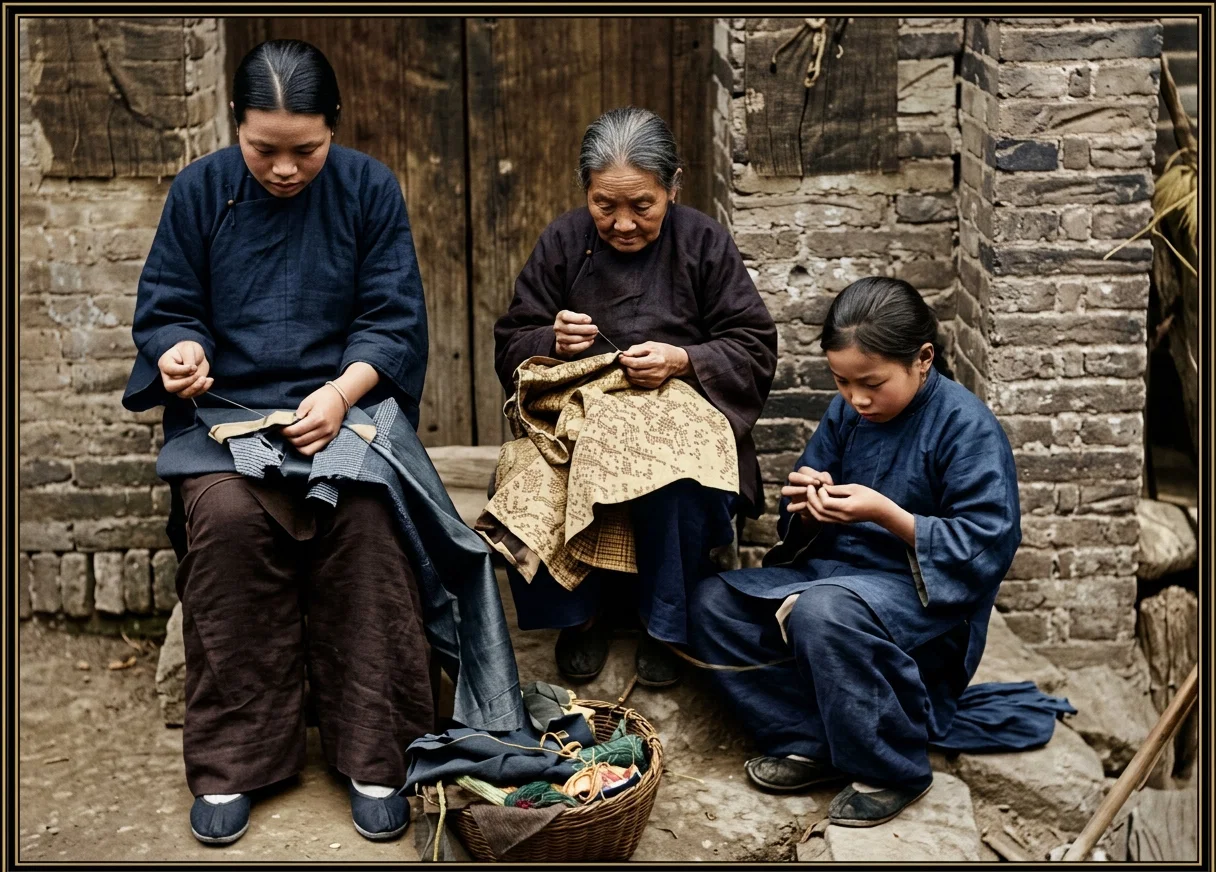
CHINESE GIRLS LEARNING TO SEW
Was it wasted? Did it pay to send her? During her brief stay in China, her life was fired by what she saw and heard, and she determined to bring relief to a class who, up to that time, had received little or no attention from missionaries—the Chinese blind girls.
If she herself could not remain in the field, she would stir others to activity. So she wrote a book, giving expression to her convictions, and it was through the influence of this book that the founders and present managers opened the school for blind girls in Kowloon. In this school these little girls are taught to read, write, do all kinds of housework, sewing, and fancy work, and, above all, learn of Him who said, “Suffer little children, and forbid them not, to come unto me.”
The fact that a child is born a girl in many native homes is considered a calamity. Adding blindness to this, it becomes almost unbearable. The picture drawn by Joel—“They have . . . sold a girl for wine, that they might drink”—finds its living counterpart in daily life in China. Girls, and the blind in particular, are not infrequently sold for a trifling sum—bound into slavery, and that of a most shameful type. Poor child! just because she is a girl.
Just a brief account of some of these little ones' treatment in their homes may give you a slight idea of their estimated value there. One born into a family not far from here, when less than six years of age was betrothed to a little boy; but before the marriage, the little boy died. The girl was charged with his death. They said she must have done some great wrong, which brought this sadness into the home. She was beaten, her eyes burned out, and her whole body dreadfully bruised and burned. Now, matters were worse than ever, so she was cast into the river. But again and again the little body came to the surface, and was as often thrust back, until death came to her relief.
Another mother was just about to throw her little girl into the sea, when a missionary spied her, and told her of this school where her little blind girl would be welcomed and taught to become useful. Others thus unfortunate are laid near homes of missionaries, who it is supposed will care for them. Naked, covered with sores, and loaded with vermin, they are brought. But after a little attention has been given them, they change into merry-hearted children.
There were many such stories told, which are facts. Was it a waste of money? Was it a pity that young lady came to China? How many lives have been and shall be blessed as a result, heaven alone will reveal. But is it sufficient to begin or end here? The life of the oak is in the acorn; so the nature of the child is an inheritance from its parents. We can not change all now, but there is opportunity to help some. When shall we begin?
“The do-nothing system is the greatest curse that has befallen our race.” The Chinese women in the so-called “best” homes are brought up in idleness. Servants are provided for all duties, and very few are the children who have a mother able to read at all. It can not be said of these, as of Timothy, “When I call to remembrance the unfeigned faith that is in thee, which dwelt first in thy grandmother Lois, and thy mother Eunice.” They have not been taught by a mother from youth.
You can not well imagine the emptiness of most Chinese women's lives. Is it because they can not be taught?—No, it is because they are not. It is considered useless to expend money on a woman's education—she is to sit in some little dark room, only a housewife. This being the case not merely for a decade, but for generations, will it pay to try to remedy matters now? Are these women at all religiously inclined? Just here is where the inclination to religion, if such it may be called, lies. These hearts are aching and reaching out for help. Day after day and night after night is spent with hands uplifted to Joss, pleading for deliverance from this awful wretchedness. To be sure, it is not Christianity they are seeking; and yet it is, for this is their only remedy. It will require time, means, patience, and, above all, a heart that can beat in sympathy with theirs, to accomplish anything. But read Isa. 49:24, 25: “Shall the prey be taken from the mighty, or the lawful captive delivered? But thus saith the Lord, Even the captives of the mighty shall be taken away, and the prey of the terrible shall be delivered: for I will contend with him that contendeth with thee, and I will save thy children.” Whose children? Verse 22 of this same chapter tells: “Behold, I will lift up mine hand to the Gentiles, and set up my standard to the people: and they shall bring thy sons in their arms, and thy daughters shall be carried upon their shoulders.” Has God not promised to gather from Sinim? Moses charged Joshua, when about to take the leadership of God's people, to gather men, women, and children who had not known anything, and teach them to fear God. This is our present privilege. Here in China these very conditions are met. Shall we teach them? Shall we have schools? Shall we teach them in their homes and wherever we can find entrance? God's creatures, bound by the adversary of souls, are hurrying on to destruction.
At present there are many open doors. Again and again you have read Isa. 44:17. We see it daily practised here in China. We are studying the language of this people; and while we study, we pray God to give us wisdom to set before them, in an intelligent manner, the crucified and risen Saviour who saves to the uttermost. If God says to any of you, “Ye have compassed this mountain long enough; away to regions beyond!” do not fear to heed; for his presence shall go with you, and you will find rest and joy.
Hongkong.

Christian Boarding School in India

In a Christian boarding-school in Madura, India, pupils representing sixteen different castes sit upon the same benches, and eat of the same food.
Continue reading: In Holland and Flemish Belgium