God alone is without beginning. At the earliest epoch when a beginning could be—a period so remote that to finite minds it is essentially eternity—appeared the Word. “In the beginning was the Word, and the Word was with God, and the Word was God.” John 1:1. This uncreated Word was the being who, in the fulness of time, was made flesh, and dwelt among us. His beginning was not like that of any other being in the universe. It is set forth in such mysterious expressions as these: “His [God’s] only begotten Son” (John 3:16; 1 John 4:9), “The only begotten of the Father” (John 1:14), and, “I proceeded forth and came from God.” John 8:42.
Thus it appears that by some divine impulse, or process, not creation, known only to Omniscience, and possible only to Omnipotence, the Son of God appeared. And then the Holy Spirit (by an infirmity of translation called “the Holy Ghost”), the Spirit of God, the Spirit of Christ, the divine afflatus and medium of their power, representative of them both (Ps. 139:7), was in existence also.
This Son was in the likeness of the Father, and was equal with the Father. So Paul testified to the Philippians (Phil. 2:5-8): “Let this mind be in you, which was also in Christ Jesus: who, being in the form of God, thought it not robbery to be equal with God: but made himself of no reputation, and took upon him the form of a servant, and was made in the likeness of men: . . . and became obedient unto death, even the death of the cross.” The word “robbery” here signifies something to be “grasped after,” “held fast to,” or “preferred,” to some other thing placed in comparison therewith.
Man had sinned, and must perish unless some means for his redemption could be devised. No one but Christ, the only being, save God, above law, and therefore able to meet the demands of the law in behalf of the sinner, could rescue him. But would he do it? This was the question, so momentous to the human race, that trembled in the balance. Christ was there, the associate Majesty of heaven, equal with the Father, and sharing equally in the glory; and he could have “held fast to,” and “preferred” to remain in, that condition. But in that case man must perish. Shall he retain his position, and leave man to die? or shall he yield up his station, and go to the help of a rebel world? This was the question that was to manifest to an amazed universe the “mind of Christ.”
Rejoice, O earth! He did not think it “robbery” or something to be “chosen” or “preferred,” to hold fast his position of equality with his Father in heaven, to which he was justly ordained, and leave the world to its ruin; but by a boundless impulse of love, he sprang at once to the relief of the perishing. He left his high and heavenly station, divested himself of all his celestial environment, emptied himself of his glory and honor, made himself of no reputation, assumed the nature of the seed of Abraham, took the form of a servant among men, and obeyed, in man’s behalf, the demands of the law, even to the death of the cross, that whosoever would believe in him might not perish but have everlasting life.
The apostle, in this passage, is contrasting the original exaltation of the Lord Jesus with the humiliation he was willing to suffer for the sake of man; but one whole side of the contrast is lost unless Christ was, before he undertook man’s redemption, in a position of equality with God. That he did hold such a position, therefore, Paul must be understood as plainly affirming. He corroborates the declaration of John that “the Word was God.”
Such was the “mind,” or choice, of Christ. He surrendered all his glory to bring help which was not sought for, and would often be spurned, to those who, without that help, must perish. He left the congenial influence of home to go out among strangers; left friends to go out among foes; left warmth for cold; left light for darkness; left sunshine for storm; left the pleasant air of reverence and adoration for the bitter blasts of rage, rebuffs, and scorn of men. And all this because he could not forsake the creatures of his hand, even though they had, under the most favorable circumstances which his love could supply, and in the most uncalled-for and daring rebellion, become hostile against himself.
Do we, then, realize what attitude we are called upon to take toward those whom it is possible for us to help, and what we are called upon to do if we have the mind of Christ?
U. S.
VIEWS IN SCANDINAVIA AND RUSSIA.
By H. P. Holser
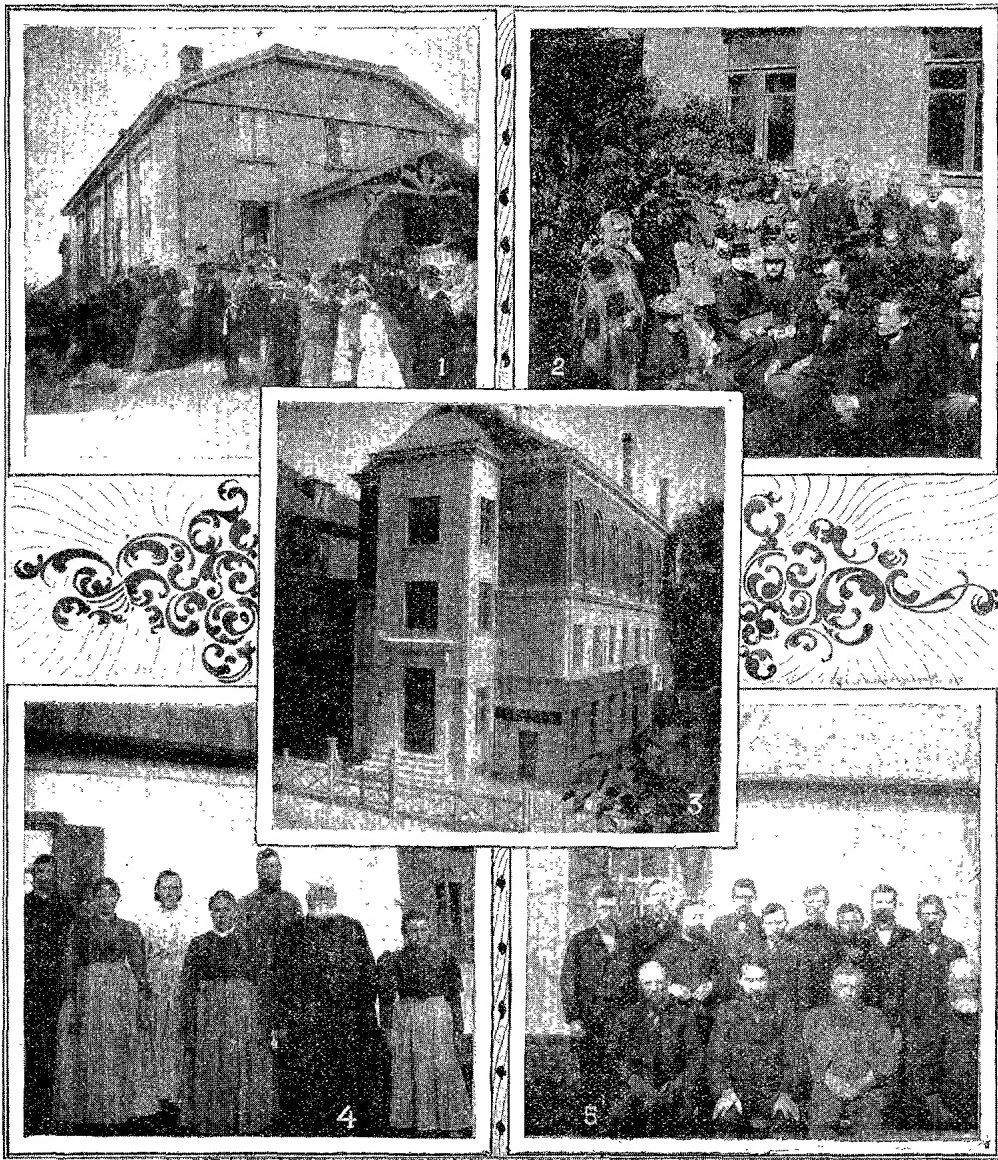
The accompanying engraving contains pictures taken in Russia and Scandinavia at the time of the general gatherings held last summer. No. 1 shows the Seventh-day Adventist meeting-house at Frederikssstad, Norway, which was dedicated during the general meeting. The building has a seating capacity of about three hundred, and is peculiar in being both frame and log in structure. The logs are placed the same as in ordinary log houses, but are hewn four-square, and covered on the outside with boards placed perpendicularly, or “up and down” as it is sometimes expressed. Like the true church, this house is built upon the solid rock, a huge granite mass more than half a mile in extent; and thus it combines two prominent features of Norway,—hewn-log houses and great masses of barren rock. Among the interesting features of the conference held in this house was the plea of a delegate from Iceland for publications in the Icelandic tongue, and the decision to send a laborer to this distant field.
No. 2 of the group represents a portion of those gathered in general meeting at Helsingfors, Finland. This country is a Russian province enjoying partial independence. It is a sort of shading off from the exclusiveness of Russia toward the freedom of Sweden. Our work has been in operation in this field about two years. It began among the Swedes, and is now opening among the Finns. The group is composed of both Swedes and Finns. The one at the extreme right, front row, is Brother Sandberg, who is in charge of our publishing work at Helsingfors, and who conducts our Swedish and Finnish journals published at this place. The Finnish journal was started Jan. 1, 1897. The third in the row is E. J. Ahrén, editor of our Swedish paper published at Stockholm. The tallest man at the center of the back row is a Finnish laborer. During the meeting he translated the sermons from Swedish to Finnish.
No. 3 presents a good view of the new mission house and chapel in Copenhagen, dedicated during the conference last July. The building is quite centrally located in the picturesque Danish capital, and admirably meets a variety of wants. The ground floor contains rooms for the Danish Tract Society, a small assembly hall, with baptismal font, and a schoolroom for the Copenhagen church school for children. The second floor is all devoted to dwelling apartments; and the third floor constitutes the large169chapel, with gallery and two committee-rooms, which may be joined to the chapel by folding doors. This chapel is seated with chairs, and accommodates about five hundred. This building is wisely planned, well constructed, and neat in appearance. The first and second floors bring sufficient rent to make the cost of the large hall for the Copenhagen church comparatively light. The house meets a deep want.
Picture No. 4 shows a Russian German family of the Caucasus territory, east of the Black Sea. Their home is about as far east as Babylon. It will be observed that the corset has not made much impression on this family. The girls are able to keep up their end with men in farm labor. The father was for many years mayor of the colony, and is now a member of our Russian Mission Board.
No. 5 gives a view of our missionaries in Russia who were in attendance at our general meeting held in the Caucasus last May. Some laborers were prevented by long distances from being present; others were in banishment. Those in the front row, with the one standing in the center, constitute the Russian Mission Board. Three of these are ordained preachers, and two are lay brethren. Of the remainder in the group, two are ordained preachers, two are licentiates, and the rest are colporteurs and Bible readers. As our right to preach the gospel is not recognized by the Russian government, our laborers cannot usually remain long in a place before they are interfered with by the priests and civil authorities. Often they can remain but a few days, and sometimes only one day, when they must choose between moving on to another village or being taken in hand by the authorities. As a result, the work is not so fully developed, but more wide-spread. Many who embrace the truth suffer much persecution; nevertheless the message continues to spread. Thousands are groping for light, and welcome even the faintest rays. Among the Russians, especially, a great work is in progress, and there is a prospect that many of this people will be prepared to meet the Lord at his appearing.
H. P. HOLSER.
CHRIST OUR BROTHER.
By Uriah Smith
TAKING upon himself our nature, Christ brought himself into a position where he can call us brethren. Heb. 2:11. He can therefore be touched with a feeling of our infirmities; for he was tempted in all points like as we are, yet without sin; and having been thus tempted, he is able to succor them that are tempted. Heb. 4:15; 2:18.
He came down to pass with us through the school of life, and show us the way. He comes down among his pupils, to work out in their presence the intractable problems by which they have been hopelessly baffled. He planted his feet in every spot which we can be required to tread. He was in all points tempted like as we are, and in all points was a victor in our behalf. He bore our griefs and carried our sorrows. He made himself of no reputation. He was despised and rejected of men because they would not deny the carnal heart, but had pleasure in unrighteousness. They saw in him no form nor comeliness nor beauty, because the ways of virtue, purity, and peace, which only he could sanction, they would not follow. The darkness would not comprehend the light. His path did not lead to honor, luxury, or riches; and men turned away their faces from him. “A man of sorrows, and acquainted with grief,” is not such a one as the world esteems. He was wounded, bruised, and chastened; but it was for our transgressions and iniquities; and these are the stripes he bore by which we are healed. He had travail of soul, and resisted unto blood, striving against sin. Heb. 12:4; Isaiah 53.
In all these experiences we are to “consider him,” and learn from him, lest we become weary and faint in our minds. “Wherefore,” says Paul, “in all things it behooved him to be made like unto his brethren, that he might be a merciful and faithful high priest in things pertaining to God, to make reconciliation for the sins of the people” (Heb. 2:17); and the assurance of chapter 4:15 naturally follows: “For we have not an high priest which cannot be touched with the feeling of our infirmities; but was in all points tempted like as we are, yet without sin.” Thus Christ left a life for our example. He taught us to do well, and then, if we suffer for it, to take it patiently. “For,” says the apostle Peter, “even hereunto were ye called: because Christ also suffered for us, leaving us an example, that ye should follow his steps: who did no sin, neither was guile found in his mouth.” 1 Peter 2:21, 22.
His character and relationship he did not lose by coming into this world on the grand errand of redemption; hence this sinless life lived in our behalf, may, by faith in him, be appropriated as his own, by any of the class he came to redeem, who are all his creatures. This life, manifested here in our nature, vindicates the government of God, and clears his throne from all charges of inconsistency in demanding of men, or as if he demanded of men, more than they could do, and condemning them for not meeting requirements which it was impossible for them to perform. This is very clearly stated by Paul, in Rom. 8:3, 4: “For what the law could not do, in that it was weak through the flesh, God sending his own Son in the likeness of sinful flesh, and for sin, condemned sin in the flesh: that the righteousness of the law might be fulfilled in us.”
God’s throne is charged with guilt. It is claimed that no man could keep the law God had laid upon him, by any possible power in himself, or any power placed at his command; that it was not just that man should be required to keep such a law, and he never should have been condemned for breaking it. The law, as the apostle says, was “weak through the flesh;” that is, the flesh, man’s carnal nature, basely yielded to temptation and broke the law; but there was no power in the law to redeem; and so, though ordained to life,—that is, to keep men in the path of obedience, which is the path of life,—it had no power to bring them back when they stepped over into the way of death; therefore, so far as the law was concerned, man was then doomed to death. But God sent his own Son into the world to show that the whole trouble lay in the base surrender of the flesh to sin, and not to any injustice in the law.
Christ came in the likeness of sinful flesh, to demonstrate before all parties in the controversy that it was possible for men in the flesh to keep the law. He demonstrated this by keeping it himself. On our plane of existence, and in our nature, he rendered such obedience to every principle and precept, that the eye of Omniscience itself could detect no flaw therein. His whole life was but a transcript of that law, in its spiritual nature, and in its holy, just, and good demands. He thus condemned sin in the flesh, by living himself in the flesh and doing no sin, showing that it is possible for man thus to live. It was a complete and triumphant vindication of the fact that God is not unjust in his demands; that he required of man nothing more than he could do, nothing more than he should have done, and for the not doing of which he was justly condemned.
If Christ here as a man could keep the law, fulfilling perfectly the Father’s will, man, by the nature of God within him in his unfallen state, could have done so, too, and by the freely-offered help of Christ in his fallen condition, can do so still: and so every guilty one will stand at last speechless before a throne which is shown to be a throne of equity; before a law which is shown to be holy, just, and good; and before the blameless life of Christ, which is shown to be possible in a world like this, and in a condition vastly worse than that in which Adam was placed when he basely yielded to a temptation, the nature and result of which he might and should have understood. U. S.
DOINGS OF THE CONFERENCE.
By G. C. T.
No report of the transactions of the great meeting that has just closed at College View, Neb., has appeared in the REVIEW, that brings the proceedings down later than through the first week of the Conference proper. The former report was intended to appear a week earlier than it did, but as it arrived at the Office a little late, its room was taken by other matter. Hence no report was written for the following week. We are well aware that most of the readers have already informed themselves, through the Bulletin and other mediums, of the transactions of the meeting. In different respects it was a remarkable occasion; in fact, it is thus distinguished above all that have ever preceded it in our denominational history.
It will not be possible in this article to give even an outline of the proceedings. For this we must refer the reader to accounts already published. The tendency to centralize our work, and concentrate responsibilities upon a few, was clearly pointed out and severely commented upon by the Testimonies of the Spirit of God; and it was felt that some decisive steps must be taken to obviate this growing difficulty. The subject of authority also received considerable attention, both from the Testimonies and from the teachings of the Bible which were brought out in the lessons. It was clearly demonstrated that there is no rightful authority but that which comes from God; that each one is accountable directly to him for the use of his talents; and that while organization for the purpose of concerted action is proper, the control of one man's mind or strength by another man is opposed to the principles of the gospel.
As these things were brought out, and the mistakes of the past came up, it resulted in a feeling of self-humiliation and a spirit of earnestness and seeking the Lord on the part of all. It caused more or less perplexity as to what the future course should be, as to the character of the steps to be taken to bring matters into a proper situation. This condition existed for some days, and it was an occasion of deep trial of spirit. We had every reason to believe that God was directing and watching over his cause, and that he loved his people. The Testimonies170that were read were warm and glowing with the spirit of heavenly love and wisdom, indicating to our minds, beyond possible question, that they were of more than human origin. It therefore remained for the delegates to seek God and obtain light; and to do this there was an earnest purpose. The absence of personal criticism, and the presence of a spirit of union and brotherly love and confidence, have been commented upon before; and this spirit prevailed to the end. Oftentimes opinions differed, and they were freely expressed. There was a great deal of talking done, sometimes, perhaps, more than was necessary; but it was all in a good spirit, and was all received in the same way; and the decisions which were finally arrived at were in nearly all cases unanimous and satisfactory.
It was decided to divide the General Conference work into three grand divisions,—the General Conference of North America, the European Union Conference, and the Australian Conference, each of these to have its own president and executive committee, the president of the American Conference to take precedence as the president of the General Conference at large; and it devolves upon the General Conference in its biennial sessions to elect the presidents of the two other conferences. All the territory not included in these three divisions, passed under the direction of the Foreign Mission Board, which is an organization entirely distinct from that of the General Conference, having its own chairman and treasurer, with its headquarters established in some Atlantic State.
Elder G. A. Irwin was elected president of the American Conference, Elder O. A. Olsen of the European Conference, Elder A. G. Daniells of the Australasian Conference, and Elder Allen Moon, chairman of the Foreign Mission Board. A. G. Adams is recording secretary and treasurer of the General Conference, and L. A. Hoopes, of Nebraska, is corresponding secretary. Elder F. M. Wilcox is secretary of the Foreign Mission Board, and W. H. Edwards, recording secretary and treasurer. Elder G. A. Irwin is president of the International Tract Society, and L. T. Nicola is secretary. The General Conference districts of this country remained unchanged, and their superintendents are as follows: No. 1, R. A. Underwood; No. 2, N. W. Allee; No. 3, J. H. Morrison; No. 4, N. W. Kauble; No. 5, R. M. Kilgore; No. 6, A. J. Breed.
The committee of distribution of labor, in making its report, consulted the delegates of the districts interested, and in nearly every instance made their recommendations accordingly. An abstract of its report is as follows:—
Your committee on distribution of labor would respectfully suggest the following:—
1. That Miss Birdie Watson, of Kansas, go to Manitoba to engage in Bible work.
2. That we concur in the request of the Colorado delegation, that Elder J. M. Rees, of Oklahoma, take the presidency of the Colorado Conference and Tract Society.
3. That we concur in the judgment of the Oklahoma brethren, that Elder E. T. Russell take the place made vacant by the removal of Elder Rees.
4. That Professor C. B. Hughes and wife, of Keene, Tex., be asked to answer the call for teachers from Australia.
5. That Elder D. C. Babcock, of West Virginia, be requested to go to Virginia to take the place made vacant by Elder W. A. Mc Cutchen, whose resignation is occasioned by ill health.
6. That Elder G. B. Thompson be requested to go to West Virginia to take the place made vacant by the removal of Elder D. C. Babcock.
7. That H. J. Duerksen, of Wisconsin, be asked to go to Manitoba to engage in the German work.
8. That Elder J. J. Graf, of Minnesota, be requested to labor among the Germans of Wisconsin.
9. That we concur in the judgment of the Minnesota delegation for Elder C. W. Flaiz to take the place made vacant by the removal of Elder N. W. Allee.
10. That Elder G. W. Anglebarger, of Colorado, be requested to labor in the New Mexico Mission Field.
11. That Elder George O. States, of Colorado, be requested to make Arizona his field of labor.
12. That Elder W. A. Alway, of Minnesota, be requested to make Utah his field of labor.
13. That Elder C. P. Frederickson, of South Dakota, in harmony with the consent of the Colorado delegation, be requested to labor in Colorado, taking a place on the Conference Committee.
14. That, in harmony with the consent of Colorado, Elder G. F. Watson, of the Dakota Conference, be recommended to labor in Colorado.
15. That L. C. Sheafe, of Ohio, go to District 2, to labor as the district superintendent may direct.
16. That Elder D. E. Scoles, of the Upper Columbia Conference, be asked to connect in labor with the Minnesota Conference.
17. That Elder Frank Armitage and his wife, of Nebraska, be requested to go to Matabeleland, Africa, to engage in missionary work.
It was stated that the work of the committee was not yet finished, but that other matters pertaining to the changes of laborers would be left with the executive committees.
One series of Bible lessons ran through the institute and Conference. This was conducted by Elder E. J. Waggoner at 3:30 in the afternoon. This was called a Study of the Epistle to the Hebrews; and while it is true that the first few chapters of this book formed a basis of these studies, the studies took a wide range, and the thoughts brought out were traced in many scriptures. They led to an exalted view of the power and goodness of God. The feeble dependence of the creature upon the Creator was dwelt upon, and the diffusion of the life and power of God in all creation, both animate and inanimate, was forcibly set forth. The messages, “All flesh is grass,” and, “Behold your God,” were the principal features of Brother Waggoner's teaching. Followed out to their legitimate conclusions, these principles embrace the whole plan of the gospel. The Spirit of God was present to make impressions as these great principles were illustrated.
The evenings were most all occupied with discourses by different speakers. Elder A. T. Jones occupied most of the evenings of the last week, in bringing out important and timely lessons of sacred truth.
During the course of the meeting there were times when the Spirit and power of God were manifested in a marked degree. This was especially true of the last Sabbath. The day began with a discourse by Elder Jones, on Coming out of Egyptian Bondage. “Out of Egypt have I called my Son.” Never have we seen the truth on the line of this prophecy shine out so clearly as on that evening. Egyptian bondage was made to represent the spiritual bondage of sin. The lesson of the experiences of Israel was forcibly placed before us, and a very deep impression was made.
Sabbath afternoon Brother Waggoner spoke on the theme of Witnesses for God, taking as a basis of his discourse the words recorded in Acts 1: “But ye shall receive power, after that the Holy Ghost is come upon you: and ye shall be witnesses unto me.” The speaker stated that in the Judgment, not only our cases were pending, but God himself was on trial. His character and reputation were at stake, and the whole universe would be called upon to witness the vindication of the justice and goodness of his government and character. The work of testifying to his character, God has committed to us. Several texts of scripture showing this were adduced, prominently the forty-third chapter of Isaiah. “Ye are my witnesses, saith the Lord.” It is expected of a witness that he will bear true, faithful testimony; that he will not misrepresent; and that he will tell the truth, the whole truth, and nothing but the truth. We testify of God's character, not by the profession we make, but by the work of divine grace manifested in our hearts and lives. We are living epistles, “known and read of all men;” and while nature testifies of the goodness and glory of God, man is left to testify of his power as a Saviour, of his mercy, and of his justice. But we can bear witness of the character of God only as that character is reproduced in ourselves.
As these heart-searching truths were brought out in a quiet, calm manner, the Spirit of God witnessed to them in great power. So far as our memory serves us, we have never attended a meeting in which there was such a large measure of the Spirit of God manifested, with no effort made to create any extraordinary impression; simply the truth being spoken in a calm and earnest manner. At the close of the discourse it was difficult for the audience to restrain their feelings. Weeping was general throughout the house; and as the benediction was pronounced, many were in tears, and lingered, weeping, in the house. In fact, throughout the entire meeting God was very near his people, and in loving kindness and tender mercy waited to lift up, and guide, and to receive those who came to him. The afternoon was improved in bringing the Christian Help work forward, and uniting it more firmly to the message, of which it forms an important part. Dr. Kellogg occupied the time, and all felt that it was a profitable occasion.
At another time, we distinctly remember, during the Conference proceedings, when engaged in the election of officers, and perplexity was upon the minds of many, the Spirit of God suddenly moved upon the meeting in power, and a spirit of union and clearness of sight came in; and it was, indeed, a blessed occasion, in which hearts were subdued in tenderness and humility.
Two meetings of the Conference were held in Battle Creek, after the return of the delegates; but no business of special significance was transacted beyond the finishing up of some legal matters that required attention. The legal meetings of the General Conference Association, of the Publishing Association, and Educational Society were also held here, and the account of these will be given elsewhere.
Looking upon the meeting as a whole, we cannot but recall it as one of the most important, if not the most important, ever held by our people. We believe that its particular lessons are yet to be learned by many of us. The principles brought out in the soul-stirring Testimonies and in the Bible studies, are those which underlie our success. And as we succeed in the work of God, it will be by the adoption and practical carrying out of these principles. It requires time to make changes, and it is perhaps best that important changes be made slowly and deliberately; but we believe that the General Conference of 1897 will mark a new era in the advancement and cause of the third angel's message. The work inaugurated there will doubtless go on. Although it may seem to some that not all was done in the way of rectifying the past that ought to have been done, there is reason for gratitude that advance steps have been taken to place the work of God under divine leadership more fully than has been the case in the past. And in the light we now have, we anticipate the full consummation of God's plan concerning his people. G. C. T.
WORKING FOR JESUS.
'T is sweet to work for Jesus,
In this life's little day;
To spread around the joyful sound,
As those forgiven may;
To tell his loving-kindness,
His promises so true;
To urge the young that they may come
And trust this Saviour, too.
'T is sweet to work for Jesus;
Be this our one desire,
Our purpose still to do his will,
Whate'er he may require.
No action is too lowly,
No work of love too small;
If Christ but lead, we may indeed
Well follow such a call.
'T is sweet to work for Jesus,
O weary not of this!
But onward press with cheerfulness,
Though rough the pathway is.
Hold on, unmoved and patient,
Till he shall call thee home,
With joy to stand at God's right hand
To serve before the throne.
— Selected.
THE GERMAN MISSION.
By L. R. Conradi
The quarter ending December 31 has been a very good one to us in many respects, and we have every reason to be grateful to the Lord for his continued blessings. The work has made steady progress in the different countries of this mission, and our people have supported the cause more liberally than ever. We are also glad that our canvassers have had good success, and that our tract societies are more diligent than ever in circulating the truth. The days of prayer were seasons of blessing to most of our churches and companies. We were especially glad to enjoy the labors of Elder Loughborough for some four weeks; and his visits in Rhenish Prussia, Holland, and Central and Eastern Prussia were seasons of great profit to our people. In November five candidates were baptized at Magdeburg, eleven at Berlin, and seven in Eastern Prussia. Besides these a number who had previously been baptized, united with us.
During the days of prayer we organized a Polish church of fifteen members near the Russian border. They formerly belonged to the Stangnowsky party, but have stood alone for some years. The present elder told me that for a number of years he had felt that the Lord must have more truth for his people, and he has often prayed and fasted; and when finally the third message reached him, he at once recognized in it the answer to his petitions. This again demonstrates what Sister White has seen about the work in Europe,—that souls were praying for the light, and were ready to receive it the moment it should reach them. There is another company of about as many more Poles ready to unite with us. On account of lack of conveyance and time, I had to pass them at this visit. The Polish work lacks laborers and publications. We have now over fifty Sabbath-keepers who speak the Polish language, and their number is growing. At Angerburg four united with us; and at Gerdauen, where Brother Pieper has been laboring, five were baptized. We also had a good visit with our companies at Königsberg and Stargard. At Jägunowken the organization of a church was completed by the ordination of an elder and a deacon. An elder was also ordained at Gumbinnen. Elder Frauchiger has baptized several at Stuttgart and at Munich, and the truth is spreading there also.
Elder Klingbeil is laboring with good success in Holland, and a number have been baptized there. We have now two strong companies at Rotterdam and Amsterdam, the two leading cities of Holland, and Brother Klingbeil reports well-attended meetings at Winschoten, in the eastern part of the country; and in other places, Sabbath-keepers are springing up. Under the new law in Germany our canvassers under twenty-five years of age cannot secure the necessary license; hence several of them have been sent to Holland, and in spite of some difficulty on account of the language, they secure orders. Brother Oblinder reports that some have taken a stand for the truth near Frankfurt, and Brother Mathe writes the same from Elberfeld. In Bremen, where Brother G. Schubert is at work, four have commenced to keep the Sabbath. At Halle, where Brother Krum is laboring, some fourteen have embraced the truth, also some at Magdeburg, Berlin, near Cassel, and in Northern Sleswick. The total increase of last quarter is seventy-one, of whom thirty-six received baptism. This brings for the first time the number of Sabbath-keepers in the German field to upward of one thousand. Our tithe and donations have doubled during the last two years. This last quarter the sum of twenty-seven hundred dollars was paid in tithes and donations. Our missionary societies take over twenty-three hundred Herolds in clubs; and while our Herold list has risen above four thousand, we print from ten thousand to eleven thousand of each issue, the rest being sold by our workers. The effect of this work is being felt.
About the first of the year we commenced meetings in one of the suburbs of Hamburg, and several are deeply interested. Twelve persons, representing Russia, Bohemia, and different portions of Germany, attend the mission school. At present we are busy in getting out various publications. The book entitled “Christian Temperance” is now completed in the German language; and by spring we hope also to have “Rise and Progress,” by Elder Loughborough, ready. Thus our people have every chance to keep in touch with the rise and progress of this work and its leading principles.
Some of our people have suffered imprisonment for refusing to send their children to school on the Sabbath; and the only privilege they gained, after a long struggle, was that the children would have to attend the school in order to fulfil the letter of the law, but they would not have to study, but could read in their Bibles. Thus they testify for the truth among the other pupils. As spring opens, we expect to have baptism in some fifteen different places. While we do not lack opposition of all kinds, the Lord grants grace to overcome it all, and quietly to advance the work.
L. R. CONRADI.
CAPE COAST, WEST AFRICA.
By G. T. Kerr
Since writing my last report to the REVIEW, we have all been sick. Brother Hale and I had fever last week, but I managed to work most of the time. Brother Hale is now well. My wife is able to be up, and take charge of her school. I had a light chill and fever this morning, but kept up. You see we work, get sick, get well, go to work again, and so on, but still the work is onward and upward on the West Coast. Our house is advancing slowly. The lack of water has been a great drawback; but we asked the Lord to bless in the last well we dug, and we now have sufficient water. We are building right along in faith, knowing that the Lord does hear and answer prayer, and that in due season means will come to the aid of the work here.
Our hearts were made to rejoice to-day as we opened letters telling us of donations made to this field. Praise the Lord, we know not what he has in store for us. It is our business to pray earnestly and fervently for the things that we need, and especially for the needs of the cause. Each one of us should love to give, as in this way the Lord permits us to help to answer prayers that are ascending to him. We are laying up rich stores in heaven. Now is the time to send rich treasures on before us. Time is short, but life is shorter for many. Soon Jesus will come. It is the desire of the workers on the Gold Coast that he should come quickly.
About three weeks ago I was taken very sick. I had no more pain than would naturally attend violent vomiting; after it had lasted for some time, I grew very weak, and it looked as though I could not endure it much longer. No food would remain on my stomach. As we could not understand what had caused the sickness, and everything we did was of no use, I called my wife to the bedside, and told her I knew nothing else to do except to pray to God, the source of all strength. She then led in prayer, and I followed, asking the Lord to forgive if we had sinned a sin of ignorance; and if it was to his glory, to hear and heal. I was healed from that hour. Brethren, the Lord is in Africa, and there is a great work to be done here. We know we are not doing it alone; for your prayers are helping us. G. T. KERR.