Your ShelfYour Projects

Review and Herald, Vol. 88, No. 33.

God Is Over All
Earlier text: Philippine Islands

The New Mexico Camp-Meeting

I wish to speak to every one in this Territory who loves the solemn message for which this people stands.
We are in a new field. Although it is sparsely settled, it is filling up at a rapid rate and developing its resources marvelously. Soon these broad plains, where a house is seen now and then, will be covered with prosperous communities. How important, then, that adequate plans be laid at once to meet these growing conditions!
Many of you, like the writer, came from the more populous conferences, and you may reason that since this is so small a conference, the camp-meeting will necessarily be a small affair, and hence it is not worth while to go to much expense and put forth great effort to attend it. The fact that the conference is at present small is one important reason why you should attend this annual meeting, and assist, to the extent of your ability, in laying plans for the most effectual aggressive work.
The writer well remembers when the annual camp-meeting in Iowa was no larger than ours in New Mexico will be, and nearly all came with teams, some a distance of three hundred miles. It is the unanimous testimony of those who put forth great effort to attend camp-meeting once a year that the blessing received is proportionate to the effort put forth in faith.
It is according to God's order that these annual gatherings are called, and the appointments are his own. Hence we know he will not disappoint us, but will be first on the grounds.
Come, dear people who belong to God's remnant church. We are entrusted with the greatest responsibility, even the giving of this, the last warning to a perishing world. Come to this annual meeting at Corona, August 17-27. Come to get a blessing, to be a blessing, and to take a blessing home. Your presence, your cooperation, your prayers, your cheerful testimonies, will be a great encouragement to those upon whom the burden is lying heavily, whose hands must be stayed up to carry the burden of the work against all opposition.
By request of the conference president I write this appeal, with a hope that some hearts may be stirred to come even through much difficulty.
C. McREYNOLDS.

J. W. WESTPHAL

Bolivia

The work in Bolivia has been intermittent, and has not covered so long a period as that in Ecuador. Some months after Elder E. W. Thomann left, more than two years ago, Brother F. A. Stahl came to take his place. Less than a year ago Brother O. Schulz and wife came, and he has since been engaged in the canvassing work. About six months ago Elder I. Kalbermatten and wife came to assist in the work. As Brother Stahl now takes up the Indian work on the border of Bolivia, in Peru, he will be able to do but little in Bolivia.
Brother Stahl knew no Spanish when he came to Bolivia, so could do but little for some time. Between studying the Spanish language, canvassing, and nursing, he has kept himself busy. In a very adventurous trip to the Yunges (the tropics of Bolivia), he succeeded in disposing of considerable literature. Both Brother and Sister Stahl have been successful in their work as nurses. At the time of my recent visit they had more than they could do, and Brother Kalbermatten was called on to assist. By means of this work they have gained an influence among a large number of the wealthier and better-educated class, which extends far beyond La Paz. This will be worth much to our work. As they are both real missionaries, those with whom they have come in contact have learned more or less about the truth.
In their work for the wealthy they have not forgotten the poor and the Indian. Their sympathies and work have touched every class, and on the street they receive greetings from them all. Owing to the influence gained, it has been thought best that Brother Stahl should still retain the superintendency of the Bolivian Mission. Through Brother Juan Juanc, of Chucuito, Peru, as interpreter, street meetings have been held for the Indians in La Paz. For this, as well as for nursing, Brother Stahl has full liberty. As far as we know, this is the first time that Protestants have been given written permission, with full police protection, to hold street meetings in La Paz or in Bolivia. While no Indian has as yet obeyed as the result of the effort, an estimable Bolivian woman has begun to keep the Sabbath, and in spite of opposition and persecution is remaining firm.
Brother Schulz is doing excellent work canvassing. In spite of many difficulties, he has had splendid success. Sister Barr is still engaged in teaching English, and has made good progress in learning Spanish. Thus far she has been able to do but little real missionary work. Elder Kalbermatten is canvassing, visiting the people in their homes, and holding Bible readings. He and his wife have the missionary spirit, and the Lord will surely give them success. In these various ways the seed is being sown and watered. We look to the Lord for the increase. With the exception of Brother and Sister Schulz, who live in Cochabamba, the workers are living in La Paz, which is also the mission headquarters. They are all enjoying good health, several of them better than before coming to Bolivia. They find, however, that in their efforts in this high altitude they must be moderate. They ask for the prayers of our brethren and sisters in behalf of their efforts.

J. W. WESTPHAL

The Gospel Ministry—No. 5

(A synopsis of Bible studies given at the Philadelphia ministerial institute.)
By what should a minister be governed in selecting a city, town, or rural district in which to labor?
First, he should take into account the calls that may come. We have an illustration of this in the experience of the apostle Paul. On one occasion when he was endeavoring to go into the interior of Asia, he was prevented from going, and while in perplexity as to what he should do, a call for his services came from another place. Acts 16:6-10. The minister should as earnestly inquire of the Lord regarding his place of labor as he does regarding the message he delivers.
As far as possible, we should push into localities where the message has never been preached. We should not hang around the camp-fires too closely. We should avoid, as much as possible, building on the foundations of others. We all like the courageous, aggressive spirit of the apostle Paul. He says:—
“I have therefore whereof I may glory through Jesus Christ in those things which pertain to God. For I will not dare to speak of any of those things which Christ hath not wrought by me, to make the Gentiles obedient, by word and deed, through mighty signs and wonders, by the power of the Spirit of God; so that from Jerusalem, and round about unto Illyricum, I have fully preached the gospel of Christ. Yea, so have I strived to preach the gospel, not where Christ was named, lest I should build upon another man's foundation: but as it is written, To whom he was not spoken of, they shall see: and they that have not heard shall understand.” Rom. 15:17-21.
This should be the program of those who are called to give the third angel's message to all the world in this generation.
In selecting a field a minister should take into account his qualifications as regards age, experience, ability, etc. There are places where many young preachers would not be qualified to work. As a rule, they should not be assigned to our old, experienced churches or to large cities, where the people are accustomed to hear able, experienced men. The young minister should seek the rural districts and the small towns. There he will be appreciated, and his efforts will have influence with the people. In the early days of our cause, when we did not work so much in the cities, our young men got their first experience in country schoolhouses, or in tent work in small towns. I believe that some of our young brethren are really hurt by being allowed to go into some of these larger places, and advertise themselves as evangelists from some prominent city. This leads the people to look for some able, experienced, public speaker, and to be disappointed when they see that the evangelist is a young inexperienced man. We should use great discretion in this matter of locating our young men. Again, some ministers have not the same kind of ability for public effort that other men have, and in some places they would not be appreciated. I do not believe we ought to put such men in these hard places where they will have to work against such great difficulties. We should place them where they will be able to work along the lines of least resistance for effectual service.
When we have selected our town, city, or country district, we must give heed to even smaller details; for instance, the hall in which we are to work. We should be careful to secure the best hall we can afford, situated in the best place possible. I do not mean by this that we should at all hazards rent the best halls in our cities; but we should secure the best we can manage. The results of our work will be influenced very largely by our location in a city, the purpose for which the hall is generally used, its surroundings, etc.
If the meetings are to be conducted in a tent instead of a hall, we should study just as carefully the location of the tent, and secure as good a spot as we can in the town. In the larger cities, we sometimes have great difficulty in securing a suitable location. It is not a matter of choice, oftentimes, but a matter of getting any place at all on which to pitch our tent. But the majority of our ministers are located in the States where it is not so difficult, and my counsel is, Secure the best place you can afford, in a clean, tidy neighborhood; and if possible, locate in the direction in which people usually go to public services. We should be careful, however, not to pitch our tent under the shadow of a church. I think it does not look well to do that. Endeavor to locate your tent far enough from any church building so that you will not in any way disturb the services, and where it will not appear as if you were crowding yourself in for the purpose of taking another minister's congregation. If it is absolutely necessary to pitch your tent in the immediate vicinity of a church, I would advise that you go to the pastor of the church and explain the situation, expressing regret for having to locate there.
It is better to pay a little more, and secure a good lot, than to choose a poor location simply for economy. There are many towns in which we have to pay nothing for a lot, but there are other places where we have to pay a good price for a suitable place. The cause of God deserves the best.

Preparation

First, see that the hall or schoolhouse is put in proper condition for a religious service. If possible, have a few nice plants or ferns on the stand. Put up some attractive, appropriate mottoes. See that the building is well lighted and well ventilated. All this preparation is essential. It is a duty to look after the minutest details, and see that they are all properly attended to.
When it comes to the matter of a tent, I would say, Have a good tent, good, comfortable seats, and good lights. It makes a great difference whether a tent is well lighted and cheery, or whether it is so dingy that people have to sit in semidarkness. And then, too, the very energy, and care, and thought that we put into these matters, make us more energetic and wide-awake in the preaching.
The ground around the tent should be cleared of all weeds, stones, briers, etc., so it will be a spot where the Lord can meet with the people.
Another very important thing is good music and plenty of hymn-books. It is good to get a congregation to singing. A great deal of the success of Mr. Sankey's work in revival meetings with Mr. Moody, was due to the fact that he got the people to join in the singing. In olden times the Lord had his people give much attention to singing in the sanctuary and temple service.

Securing and Holding an Audience

We must let the people know we are among them, and why we are there. Hence we must announce our meetings. There are several ways in which this may be done:—
First, through the public press; second, by invitation cards; third, by bulletin-boards; fourth, by our public efforts.
In the matter of advertising, we must be governed by the conditions prevailing where we are at work. In some places the paper seems of little value, and the invitation card is everything; in other places the invitation card is almost useless, and the paper is the thing.
In the case of the invitation card, it should be distributed by the minister and his coworker, rather than by boys who are hired for that purpose. There are places and conditions where it would not be best for the minister himself to distribute the cards.
Another point is this: Make the services very interesting and impressive. We may spend large sums of money advertising, and put forth great efforts in making preparation; we may get everything in good order, and secure an audience, and then spoil it all after the people get there. Here is the point that we should give more study to than any other one in the matter of securing and holding an audience: We must study to make the service what it ought to be. Make it bright, cheerful, and impressive. Then when the people are impressed, they will do more and better advertising than we can possibly do. Even though the audience may be small, the sermon should be just as bright, cheerful, uplifting, and powerful as though hundreds were present. The way to get a large audience is to make the meetings good for the few who attend.
How can the services be made attractive?—First, give the people a cheerful welcome when they come. Of course, we must be governed by conditions in this matter. In some places the people come late, and it is difficult for the minister to do this. But in places where the people come early, the minister should be at the door to welcome them. All preparations for the service should be looked after before time for the people to arrive.
Another thing which is a great help in making a service cheerful is a song service of fifteen minutes before the meeting opens. If the minister is not so fortunate as to have an organist and a choir, he should endeavor to draw them from his congregation. Singing is a most important part of the service, and it should be well managed.
A. G. DANIELLS.

Gospel Workers’ Department

Their divine calling, qualification, and preparation. Methods of labor, plans, etc.
Conducted by A. G. DANIELLS

The Holy Life

There is a faith unmixed with doubt, A love all free from fear; A walk with Jesus where is felt His presence always near.
There is a rest which God bestows, Transcending pardon’s peace; A lowly, sweet simplicity, Where inward conflicts cease.
There is a service, God-inspired, A zeal that tireless grows; A being “crucified with Christ,” Where joy unceasing flows.
There is a being “right with God” That yields to his commands Unswerving, true fidelity, A loyalty that stands.
There is a meekness free from pride That feels no anger rise At slights, or hate, or ridicule, But crosses count a prize.
There is a patience that endures Without a fret or care, But joyful sings, “Thy will be done,” My Lord’s sweet grace I share.
There is a purity of heart, A cleanness of desire, Wrought by the Holy Comforter, With sanctifying fire.
There is a glory that awaits Each blood-washed soul to come When Christ shall come and take his bride To an eternal home. — Selected.

The One Thing Needful

THE one thing needful for the church of Christ in our day, and for every member of it, is to be filled with the Spirit of God. This experience, when realized, will bring all other blessings in its train. Christianity consists in God's clothing men with power and authority, that they may make disciples of all nations. If Jesus himself, 'leaving us an example, that ye should follow in his steps,' did not venture upon his ministry until thus definitely baptized with the Holy Ghost and with power, how could men dare to do it?
But this is not all. When our Lord was about to go away, he said to his disciples, 'And, behold, I send the promise of my Father upon you: but tarry ye in the city of Jerusalem, until ye be endued with power from on high.' He had just commissioned them to be his witnesses to all nations, but before they were to undertake this work, they were to receive the infilling of the Holy Spirit. Now, who were these men whom Jesus commissioned not to depart from Jerusalem, but to wait for the promise of the Father?—None other than the disciples whom Jesus had chosen and trained for the work. They had continued with him for more than three years, living in the closest fellowship with him, studying daily his methods and beholding his miracles. They were ordained ministers, and had returned from their evangelistic work rejoicing in the power and authority they had over all devils, to cast them out and to cure disease.
They were converted men, for between the cross and Pentecost they had been thoroughly humbled, and all strife and differences and love of preeminence had been put away. Their mission was simply to go and declare unto the world what they had seen and heard and handled of the Word of Life; and they alone knew the saving truth, for the want of which the world was perishing. Still, with their altogether exceptional fitness for the work, they were commanded not to stir a step from Jerusalem until they were fully equipped.
In the light of what Jesus required of these first disciples before undertaking the work committed to them, could there be a stronger testimony to the absolute necessity of our waiting upon God for a similar infilling before undertaking not only a similar work, but one that is far more extended and difficult of accomplishment? To dare to undertake the finishing of this work with any less power than marked the lives and labors of the early church would seem to be unpardonable presumption.
But this is not all yet. The disciples upon whom the Spirit came were not satisfied until their converts had received the same blessing. And so we read, in Acts 8: 14-16, that 'when the apostles which were at Jerusalem heard that Samaria had received the word of God, they sent unto them Peter and John; who, when they were come down, prayed for them, that they might receive the Holy Ghost.' In Acts 19: 1, 2, R. V., we read: 'And it came to pass, that, while Apollos was at Corinth, Paul having passed through the upper coasts came to Ephesus: and finding certain disciples, he said unto them, Have ye received the Holy Ghost since ye believed?' And when Paul learned from them that they had not received the Holy Spirit, he did not go on with the campaign for outsiders in that city until that little company of believers was thoroughly equipped for service.
Then followed a mighty work in Ephesus. A flourishing church was raised up, and it became the center of missionary activity throughout the province of Asia for many years. But how different it all might have been had not Paul called the attention of that little company to the one thing needful before beginning their efforts in that important city? No time was really lost in Jerusalem or in Ephesus by waiting on God for the Spirit's infilling. But could it not be truly said of many of us who have lived and labored since those days that much time has been lost by our going forth without it?
The universal testimony of Scripture after Pentecost is that the preaching of the disciples mightily stirred the masses. Multitudes of men and women were converted, and a great company of the priests were obedient to the faith, 'so mightily grew the word of God and prevailed.' Even their enemies testified that they had filled Jerusalem with their doctrine, and 'turned the world upside down.'
The word has come: 'Study the first and second chapters of Acts.' Light has been given me that our work must be carried forward in a higher and broader way than it has ever yet been carried. We need to come to God with faith in all that he has promised in the Word, and then walk in all the light and power that God gives.' We gather from the instruction to study these chapters in Acts that Pentecost was simply meant to be an object-lesson, or type, of all the days of all the years of the present age. In other words, God did not give a Pentecostal experience which he either would not or could not maintain. The fact that our times have fallen far below the blessed standard of those early days is not because of any failure upon God's part, but because the church in a large degree has lost sight of this holy doctrine. We never can regain or hold our true position until we see that the infilling of the Holy Ghost is as surely for us as it was for the first Christians. We can not dispense with the definite anointing of the Holy Ghost for service.
R. D. QUINN.

The Holy Spirit’s Daily Presence

“God does not give the Holy Spirit at one time in such power that we can forever afterward dispense with his presence and purifying power. We must be renewed day by day in the inner man. The mission of the Spirit is that he may abide with us forever. For we need daily cleansing. In the daily cleansing of the heart there must be a willingness to take life's experiences as God sends them. It is easy to be lovely when every experience is pleasing. But it is not easy to keep a sweet temper and an equable spirit when experiences are harsh and disappointing and painful. The Holy Spirit's presence is given for just such needs as this. He will help us to keep a happy heart, and will cleanse away complaining and discontent.”

The Friend of the Smoking Flax

“THE smoking flax shall he not quench,” however dimly it may burn. Though there be even a spark of fire left, he will fan it, and feed it, and encourage it in every way to woo it back into flame. He knows the heart from which the last dim ray of hope has almost fled, and to which there seems but darkness and despair ahead. But he takes that weary, worn heart into his great compassion, speaks tenderly to it, soothes it through some ministering spirit, some hand of love, and revives the hope that was dying. He is ever the friend of the bruised reed, ever the friend of the smoking flax. When the reed is torn by the storm, he is there. When the lamp is about to die out, and only the smoke of the vanished flame is left, he is there with the oil of joy for mourning.— United Presbyterian.

Religion

RELIGION is a matter between two persons: The individual human soul is one, and God is the other. It is a most high and holy fellowship, or, if one prefers the term, partnership. And our Lord is not the dependent partner, nor will he suffer any of his children to outdo or excel him in generosity or in love. We never throw a crown at his feet that he does not take it up, and remake it into a chaplet of beauty and glory for our own brows. We never sing a heartfelt song to his praise that he does not sometime, somehow, whisper it back into our souls as a word of deathless hope and peace. We never render him a service that he does not transform that service into enrichment of honor and increase of power for ourselves. He hath said, “Them that honor me I will honor,” and this word can not fail.—Selected.

The Home Foreign Mission Field

(First Reading)
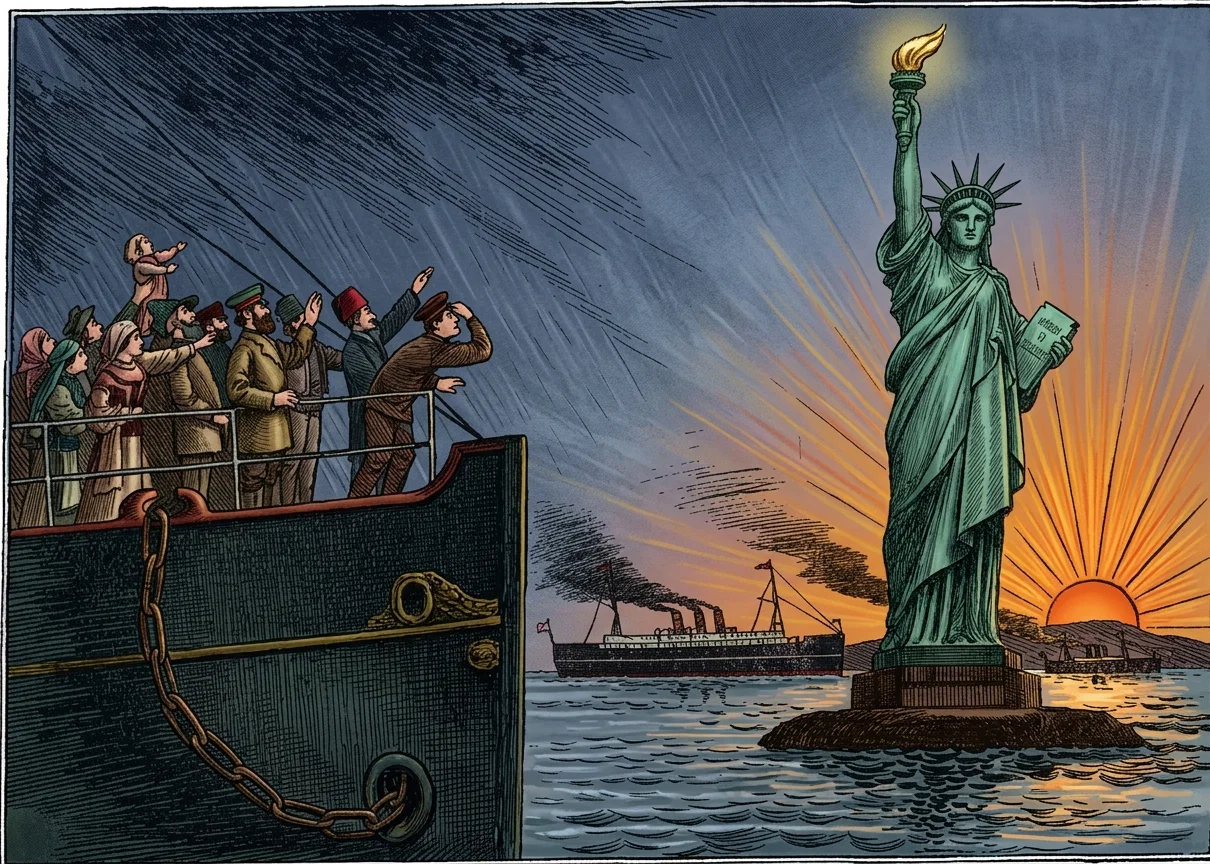
The United States of America is in many ways a unique country. Its population is largely made up of people from every nation and country in the world. According to government statistics, one third, or about 30,000,000, of our population is counted as foreigners. One hundred years ago the immigration from Europe began to trickle into this country like a tiny stream. This little stream has gradually increased until it has become a veritable flood.
THE ARRIVAL
THE ARRIVAL
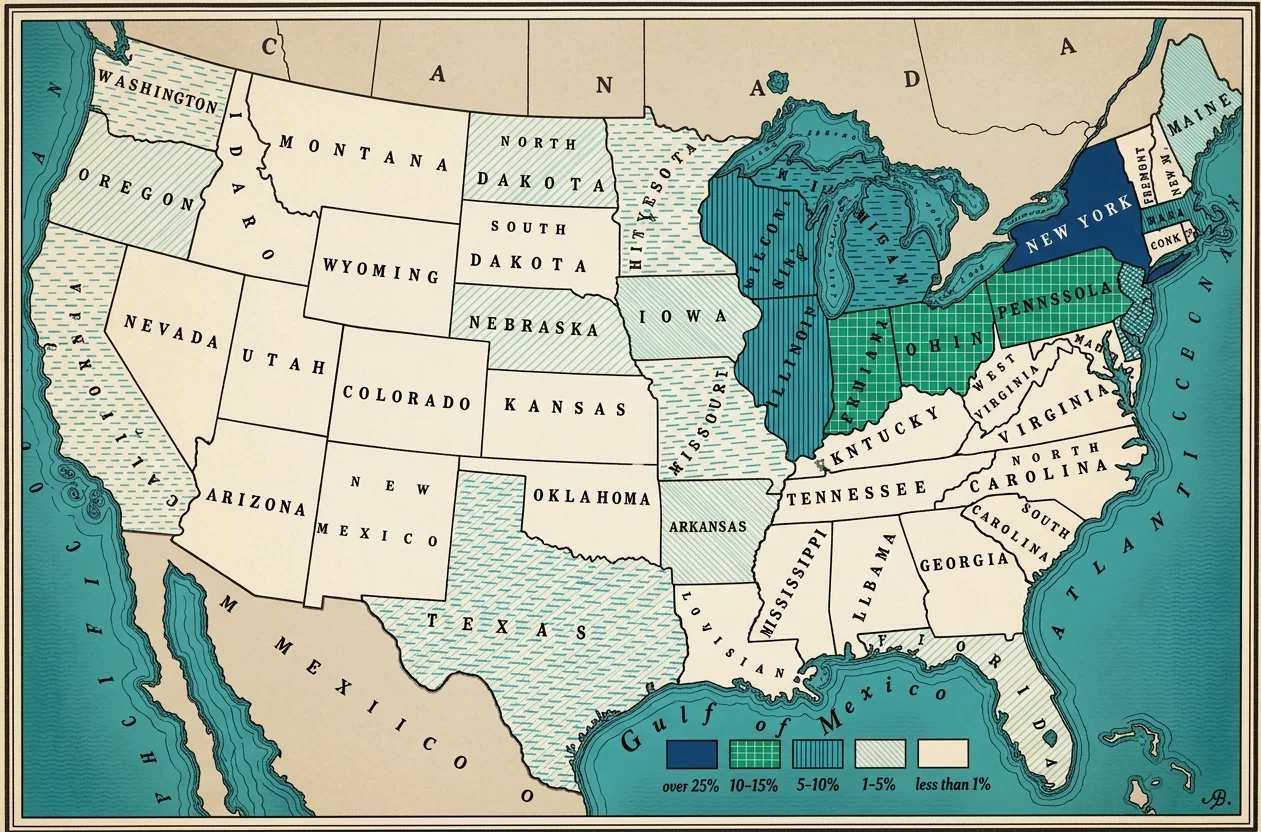
PERCENTAGE OF IMMIGRANTS GOING TO EACH STATE
During the ten years from 1821 to 1830, 143,439 immigrants landed on our shores; the next ten years, from 1831 to 1840, brought 599,125; and from 1841 to 1850 the number increased to 1,713,251; while the next decade, from 1851 to 1860, brought 2,598,214. You will note the steady increase, every following decade nearly double that of the former one. We now pass on to the ten years from 1881 to 1890, during which time 5,246,613 immigrants arrived; while the last decade, 1901 to 1910, brought the enormous total of 7,795,380. The largest number coming any one year was during 1907, when 1,285,349 souls, representing some thirty nationalities and languages, entered this country.
It is very difficult for us really to comprehend these figures. To illustrate: If you were to divide these people into groups and put them into cities by themselves, you would have an Italian city as large as Minneapolis, containing 220,000; an Austro-Hungarian city the size of Detroit, 270,000; a Jewish city as large as Providence, R. I., with 180,000; and you would have one hundred cities of from 2,000 to 22,000 people without an English-speaking person in them. This will give you a little idea of the vast multitudes of foreigners that are pouring into our country year by year. Such a situation is certainly worthy of our study and attention, and we can not close our eyes to the fact that right here is a foreign mission field of no small magnitude.
This influx of foreigners year by year, has quite transformed our country. Frank M. Goodchild, D. D., makes the following statement: "New England is foreign to-day. Not only the great cities, but the small towns as well; not only the small towns, but the hillsides; not only the hillsides, but the valley farms are peopled with men and women who have strange faces and strange ways." And we may add that it is not only New England that is thus foreignized, but the whole country; for the same conditions that exist in the East prevail also in the Middle and Western States to a large extent.
Take a look at our cities. In New York sixty-three languages are spoken. In 1906 it was stated that there were nearly 450,000 Italians, about as many as in Rome; and since then, thousands more have come. At that time, there was said to be more than 789,782 Germans, 200,000 more than the population of Hamburg was then, which, next to Berlin, is the largest city in Germany. There were also 725,000 Jews in New York City, so that New York is the capital of the Jewish world, and they are adding to their number at the rate of 50,000 a year.
But what we see in New York is repeated in Chicago, Boston, Milwaukee, and in nearly all our larger cities, whose populations are from fifty per cent to eighty-five per cent foreigners. Surely this is a condition to be considered; and as far as one can see, this tide of immigration is still on a rising scale. It is no wonder that this situation is engaging the serious attention of thoughtful men in both church and state, and it ought to engage our attention most of all, to whom is committed the special message to every nation and people.

The Foreign Immigration Our Opportunity

An Appeal

(Second Reading)
We stand face to face with a tremendous problem in the matter of giving the message to the hundreds of thousands of immigrants from all the nations of the world already in our country, and to the hundreds of thousands that are still flocking to our shores year by year.
By a divine providence the advent movement stands for a great work to be done in a short time. The third angel's message is to be proclaimed to every nation, kindred, tongue, and people in this generation.
In a marvelous manner the Lord has thrown wide open the doors of nearly every nation for the entrance of the gospel, thus giving us the opportunity to carry to them the last solemn message of salvation. Indeed, we have inaugurated a mighty missionary effort, and already the sound of the third angel's message has reached the uttermost parts of the earth. Still, when we remember the hundreds of millions in China, India, and other countries, we realize that the work is only begun.
While a divine providence has thus opened a wide door in the regions beyond for the proclamation of the gospel for this time, and missionaries have gone forth, the same providence, as if doubly to hasten the spread of the message, has sent hundreds of thousands of foreigners from every nation on earth to our shores; yes, to our very doors. Thus, while at the best but few comparatively can be sent abroad as missionaries, our entire denomination can take a direct part in giving the message to these foreigners in our home land.

How to Work

The best laborers must be set to work among these foreign people,—among the Italians, Bohemians, Hungarians, Slavonians, Poles, Russians, Finns, Chinese, etc. This great immigration is no accident, but the real meaning has not been comprehended. It is time that there should be an awakening. The urgency of the case is great.
Aside from what has been done among the Germans and Scandinavians, and a slight work among the French, what have we done?—We have done nothing, and must confess to have been very negligent.
Have you stopped to consider that fully one third of our population are foreigners; that we have State after State where more than half the people are foreigners and speak a foreign tongue? Have you known that we have city after city where from fifty per cent to eighty-five per cent of the inhabitants are foreigners? You may not have given this matter much thought in the past, but this is the situation, and it calls for an awakening.
What effort has been put forth to bring the message to these people? How many laborers have been set apart by our various conferences to give the truth to these people of foreign nationalities whom God has brought to our very doors? Alas, we have done virtually nothing. We plead for an awakening; we plead for our local and union conference officers to take this matter in hand without delay; we urge that properly qualified persons who have tact and ability, and above all a real missionary spirit, be set apart to labor for Italians, for Hungarians, for Poles, for Bohemians, for Chinese, etc., in this country.
Such laborers should lead out and develop native laborers from among these nationalities themselves, the same as we do in lands abroad. This is what is needed, and what is called for.

The Production and Circulation of Literature

Another line of work is the circulation of literature. Here is an open field for the rank and file of our people. At present we have publications treating on present truth in sixty-seven different languages, and we have foreigners of different nationalities scattered all over the land in our cities, villages, and rural districts. We come in contact with them everywhere. Now, why should not our people everywhere make it a business to form a friendly acquaintance with these foreigners? Many among them can speak a little English. Here is a great mission field for the individual members in our churches. The publications in these many languages will do no good while they lie on the shelves of the publishing-house; but they can not take themselves to the people. Men and women are needed to carry them. Even though they can not speak the Italian or the Bohemian or the Chinese, they can hand out tracts or papers to people of those nationalities who may be their neighbors or live in their community. Will not our church officers consider this matter? Will you not bring this subject promptly before our churches? As church-members, shall we not improve this opportunity? We plead with you to consider this matter and to come to the help of the Lord in this time of such need by circulating our literature in many languages among these people for whom it has been prepared.
The situation calls for a general revival in the circulation of small literature. We rejoice in the success of the colporteur and of the canvasser, and their success gives evidence of the fact that the mission of our literature is being especially blessed of God. But we are not circulating our smaller literature as we should, especially that in foreign languages. We plead for a revival of the old-time missionary spirit. This is a matter that must receive more and more attention from our conference officers and from all our conference workers. The mission of our literature has wonderful possibilities when taken hold of in real earnest.

Bible Work

Our foreign population also presents a wide-open door for our sisters, who can visit the homes and hold Bible readings with the women and children. There is the greatest need for just such work. In the homes, our sisters can come in touch with these mothers, and by kind, sympathetic association can turn their hearts to Christ. There could hardly be a more needy mission field than that which presents itself in the homes and families of these foreigners.

How This Home Foreign Mission Work Would Affect the Work Abroad

This is another phase of the situation that should not be overlooked. The fact has been demonstrated over and over again that every stroke of work put forth for any one of the foreign nationalities here reaches the home land of that people. It is like a stone thrown into the pond which causes a ripple that does not stop until it reaches the farther shore.
When an individual gets a tract or a paper in which he is interested, his next thought is to send it, or write about it, to some relative or friend in the home land; and if he should accept the truth, he would write letters and send literature to a large circle of relatives and acquaintances, and thus the light would spread. This is not only one of the most efficient ways, but also the most natural way of doing foreign missionary work.
This was the way the truth first went to Scandinavia and to Germany, and we now see the results. What would have been the result if we had in the past put forth earnest efforts for the Italians, the Hungarians, the Chinese, the Japanese, and all the other nationalities who are represented by thousands of foreigners here? Do you not see that it would not only have simplified our foreign missionary work, but also greatly facilitated the same? Can you not see that we have not only neglected, but literally let go to waste the most fertile field, the one where best results might be expected from foreign missionary efforts? Cultivate the foreign field at home, and you will reap a double harvest,—one at home and one abroad.
A terrible indifference has existed with reference to the foreigner at home, and as a result we have had much harder work abroad. We plead for a change; we urge our conference officers to study this question, and work for a revival. Do nothing less for foreign missions abroad, but on the other hand, give the foreign mission work abroad a new impetus by doing vigorous work in the foreign field at home. Not only will letters be written and literature be sent from this country to the home land, but missionaries who will have accepted the truth here will return home with it, and laborers will be raised up from among these nationalities to proclaim the truth to their own people both here and abroad.
In this way a fresh impetus will be given to the message in the home land and in the world-wide field abroad. I submit this plea with an earnest prayer that this great subject may receive its proper attention, and the work be hastened to its final and glorious consummation. O. A. OLSEN.

The Missionary and Publishing Work

Notes, plans, reports, statistics, and other information regarding missionary endeavor and the circulation of gospel literature.
Conducted by the Missionary and Publishing Department of the General Conference
E. R. PALMER        —        Secretary
N. Z. TOWN        —        —        —        Assistant Secretary

Suggestive Program for Fourth Sabbath Service (Aug. 26, 1911)

OPENING SONG: No. 616, “Christ in Song.”
SCRIPTURE READING.
PRAYER.
SECOND SONG: No. 715.
FIRST READING: “The Home Foreign Mission Field.”
SECOND READING: “The Foreign Immigration Our Opportunity.”
DISCUSSION of points in the readings, and of how you can help the foreigners in your neighborhood.
MONTHLY REPORT of missionary work.
PASSING REPORT BLANKS.
TAKING COLLECTION.
CLOSING SONG: No. 773.
Continue reading: N. Z. T