The Youth’s Instructor, Vol. 27, No. 38.

JOHN'S OTHER ACCOUNT

The Youth’s Instructor

Sep 1879

S. D. A. Publishing Association · Battle Creek, Mich. · Sep 1879

JOHN'S OTHER ACCOUNT.

Ah, John, what are you doing? Looking over your accounts?"
“Yes, trying to. I have many. December, you know, and I must fix up things. I deal with many people.”
“Are you square with them all?”
“Yes, I believe so. Let me see. There's Tubbs, the butter-man; square with him. There's Shears, the tailor; square with him. There's Sawyer, the joiner; square with him.”
And John turns over the well-thumbed leaves of the old account-book, whispering, as he goes along, “Square with him.”
John shuts the book, puts his spectacles back upon his forehead, and looks up jubilantly, as if saying, “I don't owe anybody a cent.”
John is an honest fellow. We would trust him with our last dollar. Indeed, he makes so much of honesty that some one has said that honesty is John's religion. It is an excellent record, as far as it goes, but it will never do to stop there. And we think also we can show that there is one account which John has never tried to settle, and to that extent he is dishonest.
“John, you say you owe nothing. Are you sure?” He looks up, his eyes flashing as if a candle-light were in each.
“What say?”
“John, I—I think you haven't looked at one account.”
“What? Another account?”
“Yes, that other account; please look at it.”
John murmurs, “That other account! that other account!” He lowers his spectacles to the bridge of his nose, and looks again through his book.
“Have I missed one? No, I have gone through them all. No ‘other account’ here.”
“That is so. You are right. And still there is another account somewhere.”
“Not that I know of.”
“I mean that other account—with God.”
John turns in his seat, gives a faint little cough, and shows that he is uneasy.
That other account! How it broadens and stretches out! How it covers all the year! How it seems to grow till its pages cover all the past! So vast is this account that most of the items are blurred, dim, lost in the distance thereof.
“It is all down, John, all your life. My life is down, too, in God's books. It has been said that we carry a record also in our own memories, forgotten and lost though our lives may seem to be. In the sixteenth century, Mary of Guise sent a note to Leith, apparently asking medicine of a physician. In reality, there was a message to the French besieged there. The note was given to Lord Grey, the English general, and he was asked to forward this innocent-looking note. Grey held the letter to the fire. The invisible ink turned black, and the real contents appeared! There was a message of importance designed for the French, but it went no farther than the fire. The secret message coming up out of the note, spread out in characters of black, what does it suggest but that account in the soul, forgotten and apparently lost, yet living on and sure to come up in the light of God's day of reckoning! John, have you thought about this other account?”
John is not looking up. He is silently resting his head on his hands. His child comes into the room. He calls her “Little Golden-hair.” I think John in his strong attachment to the child could echo the words of a parent in “Stepping Heavenward:” “What this child is to me, I cannot tell.” It suggests how much John owes God for this blessing alone.
“Did you ever think what a debtor to God you were, John, for this child? Did you ever try to balance it by anything on the opposite side of the account? Did you ever put a prayer there, a prayer of thanks?” John told us not long ago that he never prayed.
“Your child suggests your home. Around that one blessing of your home, John, cluster others. In a country where rare stones are found, diamonds have been seen, imbedded in the mud walls of a house, and unappreciated by the natives living there. Take the surroundings of a very lowly home even, what diamonds are imbedded there, qualities, possessions, blessings, that are priceless. For these things, for the diamonds at home, do you ever make a prayer of thanks to God, and let that go into the account in your favor?”
Little Golden-hair is up in John's lap now, stroking his bowed head.
“Suppose, John, that this child should turn from you, be indifferent to you, neglect your wishes, ignore you as you do the street-dust,—what would you say of Little Golden-hair? Is not that the way you, God's offspring, have been treating your Heavenly Father? Is not this a fearful list of sins in the account, and is it not time to attempt a settlement?”
John is feeling all this. He looks up and exclaims, “I can never settle that account.”
“Ought you not to call in the help of One who can settle it, that Almighty Saviour ‘once offered to bear the sins of many,’ by faith in whom we are justified?”
John is still bowed in deep feeling, and motions to be left alone.
At night there are two bending before God, both children in spirit, though one is a strong man, and the other is Little Golden-hair. She is saying, in tones like the warbling of a bird, “Our Father.” At its close comes John's tearful, sincere response, “God be merciful to me a sinner!” It is the cry of a heart broken in sorrow for sin.
John is trying to settle that “other account.” Rather, let it be said, there is an Almighty Saviour settling it for him.—American Messenger.

AUTUMN

Hurrah for the woods! Come, boys and girls! There’s joy in the air to-day; In crimson and yellow the flowers and leaves Are keeping a holiday.
Down in the meadow the golden-rod Is marching in bright array, With a corps of asters on either side, In a mingling of blue and gray.
The cardinal-flower beside the brook Like a red-coat sentinel stands, While the road that runs through the yellow fields Is guarded by sumach bands.
Like a Roman phalanx, tall and grim, The cat-tails guard the pond, And the creeper throws out his banner bright From the mossy wall beyond.
Do not think there is war in this martial scene; It is only a gay parade; They are making a festival out in the woods For the flowers that soon must fade.
There are purple grapes for the holiday feast, And dogwood-berries and haws, And the birds are invited to peck their fill, And the squirrels to fill their paws.
Next month, when the nuts begin to drop, They have bidden good-bye to fun, For the birds have gone on their weary flight, And the squirrels’ work begun.
Come, join your thanks at the festival For the beautiful summer days, And add to the chorus of autumn-song The children’s hymn of praise.
Go lift your eyes to the deep blue sky, And your hearts to the God above; Let the golden sunshine that floods the world Speak to you of his great love. —S. S. Visitor.

From Sea to Sea: Train Journey from Chicago

FROM SEA TO SEA.—NO. 15.

The time for us to leave Chicago has arrived. Our train of twenty-four cars, each about sixty feet in length, is made up. We are conducted by the porter to our car, and the train slowly moves out of the city. Twelve of these cars are sleeping-cars, arranged with two tiers of berths, or beds, on each side. The berths are much like those in the state-room of a steamboat, but are wider, each furnishing room for two persons instead of one as in the steamer. In these cars the traveler can sleep comfortably at night, and as the beds are made into seats in the day-time, he can remain in the same car to the journey’s end, even if it be many hundreds of miles. Attached to our train is a large car, a regular dining-hall, going only fifty miles. Hand-bills are passed through the train, stating that passengers can buy a warm supper if they wish.
Our stay in Chicago was so short that we could visit but few places of interest. The great slaughter-houses, where thousands of cattle, hogs, and sheep are killed every day, and shipped to all parts of the world, would have interested many; but when I thought of the numerous diseases produced by eating diseased meat, infected with trichinæ, etc., I confess that I had no great desire to visit these places.
In passing from State to State we hear curious names given to places and things, and sometimes to people. As all these names originate from some fact or circumstance, it may be of interest to note them. We must be brief, however, as we can glean but little in our rapid trip. We are just now passing around the south end of Lake Michigan, in the State of Illinois, and we hear the expression, “Ah, this is the Sucker State.” We learn that this name, not a pleasing one we confess, originated from the fact that in early times travelers, obliged to drink the surface water which had collected in holes in the ground, often sucked it through a reed or straw.
After leaving the State of Illinois we pass through the extreme northern part of Indiana, which name, as its spelling indicates was derived from the Indians who flourished here in earlier times. Because of their fondness for rough sports the people of this State were once called hushers, or boxers, which was finally changed to “Hoosiers.” The advance of civilization, however, has been as rapid in this State as in any, and the refining influence of education has done as much for it as for other States; and Indiana now furnishes as noble specimens of genius and literature as many of the older States.
We now come to the State of Michigan. This name is derived from two Indian words, michtao, great, and sageigan, lake. It was formerly given to Lake Huron as well as to Lake Michigan, but was afterward restricted to the latter, and the country lying between them. Michigan is often called the Lake State, referring either to the great lakes, Michigan, Superior, Huron, and St. Clair, by which it is partially surrounded, or to the great number of lakes in the State, of which a recent estimate says that “Michigan contains 5,173 inland lakes,” some of them very beautiful.
The State of Michigan, which was my home for ten years before going to the Pacific coast, now contains 1,500,000 inhabitants. It is indeed what is implied in its motto, Si quæris peninsulam amœnam, circumspice, meaning, “If thou seekest a beautiful peninsula, behold it here.” Night again settles upon us, and therefore we cannot “behold” much of it now, but we know of what we affirm, having seen much of the State in the past.
It is now eleven P. M., the eleventh day from the time we left San Francisco, Cal. We have arrived in Battle Creek, and once more greet mother and only living brother and sister, from whom we have been separated a little more than ten years. It is good to meet again on earth, but what is this compared with the final meeting of the faithful in Heaven, when life’s probationary journey shall be ended! J. N. L.

THE SAFE RETREAT.

The people of the Sandwich Islands now enjoy the blessings of civilization, and the light and privileges of the gospel; but seventy years ago they were heathen, a savage and cruel people, continually at war with one another. Property, life, everything, was in the hands of the chiefs, who often caused their subjects to be put to death for some slight offense, or as an offering to their idols.
A singular custom, which is said to have prevailed among them, furnished protection against such cruelty. Certain places were appointed, to which those whose lives were in danger might flee for safety. At one of these places are still found the remains of a wall twenty-three feet high, and equally broad, inclosing a large open space. In this space were a temple and altars, at which the priests performed their heathen rites. It was believed that the gods protected all who came within these walls, and the most powerful chiefs dared not harm them. In time of war, the women and children of both parties assembled here, and they were safe, whichever side might gain the victory.
This custom reminds us of the provision for cities of refuge among the Israelites; indeed, it may have been borrowed from them. And what a forcible illustration of the refuge which God has provided for his children! David, though hunted from place to place by cruel foes, could sing, “The Lord is my refuge and my fortress.” “Thou art my hiding-place and shield.”
We, too, need a place of safety. Dangers surround us on every hand; an enemy, strong, cruel, and cunning, is pursuing us; and associated with him are hosts of evil agents, seen and unseen. Christ is the city of refuge to which the helpless ones of earth may flee. “Whosoever will,” may now secure a hiding-place in him, where no enemy can ever harm. Soon, we know not how soon, it will be too late.
Dear children, will you not seek this “safe and sure retreat,” and seek it now?
M. A. D.

A STRIKING INCIDENT.

A young German countess who lived about a hundred years ago was a noted unbeliever, and especially opposed to the doctrine of the resurrection. She died when about thirty years of age, and before her death gave orders that her grave should be covered with a solid slab of granite; that around it should be placed square blocks of stone; and that the corners should be fastened to each other and to the granite slab by heavy iron clamps.
Upon the covering this inscription was placed: “This burial-place, purchased to all eternity, must never be opened.”
All that human power could do to prevent any change in that grave was done; but a little seed sprouted, and the tiny shoot found its way between the side stone and the upper slab, and grew there, slowly but steadily forcing its way until the iron clamps were torn asunder, and the granite lid was raised, and is now resting upon the trunk of the tree, which is large and flourishing.
The people of Hanover regard it with almost a kind of superstition, and speak in lowest tones of the wicked countess; and it is natural they should, for as I stood beside that grave in the old church-yard, it certainly impressed me more deeply than I can express.—Standard.

The Path of Life: Guides of God in the Wilderness

THE path of life we walk to-day Is strange as that the Hebrews trod; We need the shadowing rock as they, We need, like them, the guides of God.
God send his angels, Cloud and Fire, To lead us o’er the desert sand; God give our hearts their long desire, His shadow in a weary land!

LESSONS FOR CHILDREN.

LESSON XXXVIII.—THE PHILISTINES SEND BACK THE ARK.

WHEN the Philistines heard that David had been anointed king over Israel, they came up, and spread themselves in the valley of Rephaim. “And David inquired of the Lord, saying, Shall I go up to the Philistines? . . . . And the Lord said unto David, Go up.” Then David and his men went out and smote them, and the Philistines fled so suddenly that they left their images behind. And David and his men gathered the images and burnt them.
After this, the Philistines came up again; and when David inquired of the Lord, he was told not to go directly forth to meet them, but to take a circuit and come up behind them over against some mulberry-trees, and there to wait until he heard the sound of a going in the tree-tops, when he was to bestir himself, for then the Lord would go out before him to smite the host of the Philistines. “And David did so, as the Lord had commanded him; and smote the Philistines from Geba until thou come to Gazer,”
We have seen that the ark of the Lord was taken by the Philistines at the battle in which Eli’s sons were killed. They took it to Ashdod, and put it by the side of Dagon their god; but when they looked in, the next morning, Dagon had fallen upon his face before the ark of the Lord. Now Dagon was an image, having a head and arms like a man, and a body and tail like a fish. On the second morning, when they looked in, they found that Dagon had fallen again, and had broken off his head and both his hands. And because of the presence of the ark, the men of Ashdod were afflicted, and some of them died. Then they sent the ark away, but wherever it went, the people were afflicted in the same way.
By the time the Philistines had kept the ark seven months, they were glad to get rid of it. So they made a new cart, and put the ark upon it. Then they hitched two cows to the cart, and let them go where they would; and although their young calves were shut up at home, they drew the ark away to Beth-shemesh, which is only fifteen miles from Jerusalem.
The men of Beth-shemesh were astonished at seeing the ark, and a great number of them were smitten for looking into it. Then they said, “Who is able to stand before this holy Lord God? . . . And they sent messengers to the inhabitants of Kirjath-jearim, saying, The Philistines have brought again the ark of the Lord; come ye down, and fetch it up to you. And the men of Kirjath-jearim came, and fetched up the ark of the Lord, and brought it into the house of Abinabad in the hill, and sanctified Eleazar his son to keep the ark of the Lord.” Here the ark remained many years.
NOTE.—These facts concerning the ark were brought out in Lesson 26, but since they form a part of the history of the Sanctuary, it may be well to repeat them.

QUESTIONS.

  1. What did the Philistines do, when they heard that David had been anointed king over Israel? 2 Sam. 5:17, 18.
  2. What inquiry did David make of the Lord?
  3. What did the Lord tell him?
  4. What did the Philistines leave behind them when they fled?
  5. What did David and his men do with the images?
  6. When the Philistines came up at another time, how did the Lord tell David to proceed?
  7. Why was he to bestir himself when he heard the sound of a going in the tree-tops?
  8. In what battle was the ark taken by the Philistines? 1 Sam. 4:11.
  9. To what city did they take it? 1 Sam. 5:1.
  10. Where did they put it?
  11. In what condition did they find their god the next morning?
  12. What was Dagon like?
  13. In what condition did they find him the second morning?
  14. What happened to the men of Ashdod on account of the ark of God?
  15. How long did the Philistines keep the ark in their land? 1 Sam. 6:1.
  16. Why did they wish to get rid of it?
  17. How did they send it away?
  18. To what place did the cows take it?
  19. Why were so many men of Beth-shemesh smitten? Verse 19.
  20. Where was the ark next taken? 1 Sam. 7:1.
  21. How long did it remain there?

BIBLE LESSONS FOR YOUTH.

LESSON LXIV.—SAUL'S DISOBEDIENCE.

  1. DESCRIBE the attack which Jonathan and his armor-bearer made upon the Philistines. 1 Sam. 14.
  2. Who afterward joined in the battle, and who in the pursuit?
  3. What unreasonable command did Saul give that day?
  4. How was he kept from taking the life of Jonathan?
  5. With whom did Saul have war? 1 Sam. 14:47, 48.
  6. What people was he finally commanded to destroy? Chap. 15:1-3.
  7. How did he fail to carry out the instructions which the Lord gave him by Samuel?
  8. What did Samuel say when Saul told him that the cattle had been brought as a sacrifice to the Lord? Repeat verses 22, 23.
  9. What did Samuel do to complete the work which Saul had been sent to do? Verse 33.
  10. What course did Samuel pursue toward Saul after this?
  11. About sixteen years after Saul had been sent to destroy the Amalekites what did the Lord tell Samuel to do? Chap. 16:1.
  12. Describe Samuel's visit to the house of Jesse.
  13. How is David described?
  14. What change took place in him after he was anointed?

SYNOPSIS.

Saul was afraid of the Philistines, for he knew that the Lord was not with him; but Jonathan, Saul's son, accompanied only by his armor-bearer, went into the enemies’ camp, and boldly attacked them, believing that the Lord was able to give the victory to few as well as to many. The Lord did indeed help them; for a strange fear came upon the Philistines, and there was trembling in the host, in the field, and among all the people, and the earth quaked. The confusion was so great that the Philistines fell to beating down one another. When Saul and his men heard the confusion, they came on to battle; and as soon as it was known that the Philistines fled, the men of Israel came out of their hiding-places, and joined in the pursuit. Saul issued a foolish command that no one should taste food that day, thinking that this would promote the destruction of the Philistines. Jonathan, not knowing that the command had been issued, ate some honey, and would have paid the penalty with his life, had not the people rescued him from the cruelty of his father.
After this, Saul fought with the different nations around him, and prevailed against all his enemies. Then the Lord, by the mouth of Samuel, told Saul to destroy the Amalekites, and leave nothing alive of all that they had. So Saul raised an army of over two hundred thousand men, and proceeded to obey the command of the Lord. He slew all the people except Agag, their king, whom he brought home as a prisoner. He also brought away the best of the cattle and sheep.
When Saul returned to Gilgal, Samuel visited him, and reproved him severely. On learning that Saul had brought the cattle of the Amalekites to sacrifice them to the Lord, Samuel said, “Hath the Lord as great delight in burnt-offerings and sacrifices as in obeying the voice of the Lord? Behold, to obey is better than sacrifice, and to hearken than the fat of rams. For rebellion is as the sin of witchcraft, and stubbornness is as iniquity and idolatry. Because thou hast rejected the word of the Lord, he hath also rejected thee from being king.” Then Samuel called for Agag, and hewed him in pieces before the Lord.
“And Samuel came no more to see Saul until the day of his death; nevertheless, Samuel mourned for Saul; and the Lord repented that he had made Saul king over Israel.”
About sixteen years after Saul was sent to destroy the Amalekites, “the Lord said unto Samuel, How long wilt thou mourn for Saul, seeing I have rejected him from reigning over Israel? Fill thine horn with oil, and go, I will send thee to Jesse the Bethlehemite; for I have provided me a king among his sons.” When Samuel came to Bethlehem, Jesse made seven of his sons to pass before him. “And Samuel said unto Jesse, The Lord hath not chosen these. And Samuel said unto Jesse, Are here all thy children? And he said, There remaineth yet the youngest, and, behold, he keepeth the sheep. And Samuel said unto Jesse, Send and fetch him; for we will not sit down till he come hither. And he sent, and brought him in. Now he was ruddy, and withal of a beautiful countenance, and goodly to look to. And the Lord said, Arise, anoint him; for this is he. Then Samuel took the horn of oil, and anointed him in the midst of his brethren; and the Spirit of the Lord came upon David from that day forward.” G. H. BELL.

OHIO CAMP-MEETING SABBATH-SCHOOL.

The Sabbath-school work was introduced at the Ohio camp-meeting, Thursday afternoon, Aug. 21, by a half hour's talk from Bro. Reavis upon the importance of Sabbath-schools, showing how they assist us in obeying the injunction, “But grow in grace and in the knowledge of our Lord and Saviour Jesus Christ.” The evening sermon was preached by Eld. St. John, from the text, “Train up a child in the way he should go; and when he is old, he will not depart from it.” Following this discourse, Eld. Canright appealed to the brethren in Ohio to enter into the work of training the young.
On Friday, preparations were made for a camp-meeting Sabbath-school. The number there would be in each division was ascertained by visiting each family tent, and taking a census of its members. A teacher was appointed for every eight students in the different divisions. These teachers were called together at evening, and all the exercises of the school, and the manner in which they would be conducted, were made known to them, that they might work in harmony with the superintendent.
Sabbath morning the teachers were at their post fifteen minutes before the school commenced, to assist in the classification of the school. Two hundred and ninety-seven students were arranged in thirty-seven classes, and at 9 o'clock the school opened with singing; remarks and prayer by Eld. James White. The report of the Indiana camp-meeting Sabbath-school was read, after which the recitations were entered upon with much zeal and energy. All seemed to enjoy them. In general exercises the answers were prompt and intelligent. Synopses were given by several members of each division. The little ones gave a synopsis of their lesson for the day, and also of the history of the world from creation to the ascension of Christ. Sr. White closed the exercises of the school with excellent remarks, which were heartily received by all.
At the commencement of the meeting, nearly all the record books in the State were deposited at the book-stand for examination, and were found, with few exceptions, to be model books. The annual meeting of the Ohio S. S. Association was held on Monday, when officers were elected, reports read, resolutions passed, and other important matters considered. All through the meeting a deep interest was manifested in the Sabbath-school work. E. H. Gates.

LETTER BUDGET

SEDALIA, MO.
Dear Editors: Bro. Butler lectured here about three months last year; and as a result we have a Sabbath-school composed of about forty-five members. We take twenty copies of the INSTRUCTOR. I think it is an interesting paper, especially the Children’s Corner. May God bless the INSTRUCTOR family, and all those who try to obey his commandments, and gather them together in his everlasting kingdom. FLORA W.
CHRISTIE, WIS.
Dear Editors: I am ten years old. I have one brother, Clinton, and a sister, Mabel, both younger than I. I take the INSTRUCTOR, and like it very much. I have one pet, a kitten. Clinton’s poor kitty died. We do not go to Sabbath-school, but learn our lessons at home. I want to be good and meet you all in Heaven. I have never written for the INSTRUCTOR before. HARRY B. ROBBINS.
LITCHFIELD, MINN.
Dear Editors: I thought I would write a letter for the YOUTH’S INSTRUCTOR, as I have not seen any letters from Litchfield. I am twelve years old, and have kept the Sabbath with my father and mother five years. Our Sabbath-school has begun to learn the INSTRUCTOR lessons. We are very much pleased with them. We take the weekly INSTRUCTOR, and I like the Letter Budget best of all. Yours respectfully, CARRIE L. BENSON.
COUNCIL GROVE, KAN.
Dear Readers of the INSTRUCTOR: I have been keeping the Sabbath about four months. I was formerly a Catholic, but when I read the twenty-fifth verse of the seventh chapter of Daniel, I saw that I had been in darkness all my life, and that the pope had no right to change the Sabbath. I prayed that God would show me the right way, and my prayer was answered. I saw the truth, but I knew that if I should accept it, I would lose all my friends. This troubled me much, until I decided to take it to the Lord in prayer, and ask him to make the way easy for me to enter. With his help, I chose the narrow path, and though I have had to give up many friends, it has been a pleasure to me to obey God.
I was baptized at the Kansas camp-meeting, and have united with the Elm Creek church. I am quite young to decide for the truth against the wishes of my friends, and I need the prayers of God’s people. ELIZABETH MOYNIHAN.

DROLL DOINGS.

Is it because they live on the other side of the world, that the Japanese do almost everything opposite from what we do? Their day is, for the most part, our night; and, except that they do not walk on their heads instead of their feet, everything seems strangely topsy-turvy. Their books begin where ours end, and are written from top to bottom, from right to left, and in perpendicular instead of horizontal lines. Keys turn in their locks toward the left; and the kitchen is in the front of the house, while the parlor is in the rear. Horses stand in the stables with their heads where we place their tails; bells to the harness are always fastened on the hind-quarters instead of the front; and men mount the animals from the off-side. Old men fly kites, and children look on. The carpenter draws his plane toward him; the tailor stitches from him. Ladies blacken their teeth instead of keeping them white; and gentlemen have trains to their trousers. This fashion gives them an irresistibly comic air. Their feet look as if thrust into the knees of the garment, and they shuffle along much like a man walking upon stumps.
If it were only their manners that appeared to us strange and twisted, we should be amused; but the thought of the crooked lives which grow out of an ignorance of the true God must make us sad, and fill us with a longing to send them the gospel.—Well-Spring.

CENTAL

THAT is an odd-looking word, and it is not to be found in “Webster’s Unabridged.” But we shall all have to get used to it. It will be as familiar to us, probably, in a year or two, as bushel is now. As long ago as when Gen. Washington was a farmer, men complained of the unfairness of selling grain by the bushel. The best wheat weighs sixty pounds to the bushel; very good wheat, fifty-eight pounds; inferior, fifty-four, perhaps; but all the qualities are sold by the same measure, just as twelve big eggs bring no more than twelve little ones, merely because a dozen is a dozen. The British Parliament has authorized the selling of grain by the cental, or one hundred pounds, and the Produce Exchange of New York recommend the grain-merchants of the United States to adopt the same system. So it is probable that our next grain-harvest will be sold by the cental, instead of the bushel.

SHORT SPEECHES.

ONE morning a woman was shown into Dr. Abernethy’s room. Before he could speak she bared her arm, saying, “Burn.” “A poultice,” said the doctor. The next day she called again, showed her arm, and said, “Better.” “Continue the poultice.” Some days elapsed before Abernethy saw her again; then she said, “Well. Your fee?” “Nothing,” replied the great surgeon; “you are the most sensible woman I ever saw.”

SUPPOSE

How dreary would the meadows be In the sunshine warm and bright, Suppose there wasn't a bird to sing, And suppose the grass was white.
And dreary would the garden be, With all its flowery trees, Suppose there were no butterflies, And suppose there were no bees.
And what would all the beauty be, And what the song that cheers, Suppose we hadn't any eyes, And suppose we hadn't ears!
For though the grass were gay and green, And song-birds filled the glen, And the air were purple with butterflies, What good would they do us then?
Ah! think of it, my little friends; And when some pleasure flies, Why, let it go, and still be glad That you have your ears and eyes.

“I CAN DO WHAT I AM BID.”

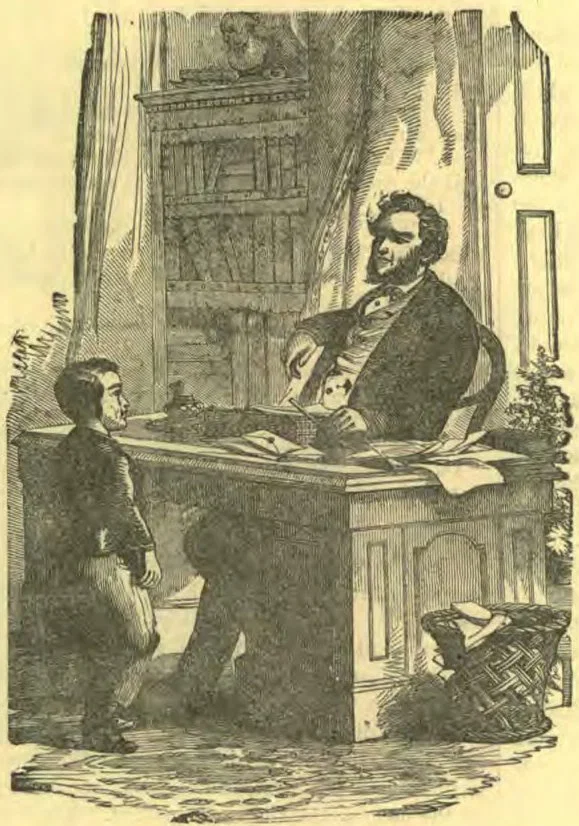
A POOR little boy was seeking a situation in order to earn a living. He went into a rich man’s office, and inquired if he wanted to hire a boy. The rich man, who was sitting at his desk, leaned back, looked at the child before him, and asked,—
“Why, what can a little fellow like you do?”
“I can do what I am bid,” was the reply, promptly and respectfully given.
The man was so pleased with the boy’s answer and manner that he hired him at once. The little fellow was diligent, honest, and faithful. In course of time he became a clerk, then book-keeper and partner, and is now rich and respected by all.
Boys, be willing to work, and to do what you are bid cheerfully and promptly. Be faithful and diligent, too, and you, also, will succeed in life.

You have reached the end of this edition.

The Youth’s Instructor · Sep 1879