1. The destruction of earthly kingdoms and the wicked.
"When the Lord Jesus shall be revealed from heaven with His mighty angels, in flaming fire taking vengeance on them that know not God, and that obey not the gospel of our Lord Jesus Christ: who shall be punished with everlasting destruction from the presence of the Lord, and from the glory of His power; when He shall come to be glorified in His saints." 2 Thess. 1: 7-10.
"And the seventh angel sounded; and there were great voices in heaven, saying, The kingdoms of this world are become the kingdoms of our Lord, and of His Christ; and He shall reign forever and ever." Rev. 11: 15.
2. The raising of the righteous dead.
"For the Lord Himself shall descend from heaven with a shout, with the voice of the Archangel, and with the trump of God: and the dead in Christ shall rise first." 1 Thess. 4: 16.
"For as in Adam all die, even so in Christ shall all be made alive. But every man in His own order: Christ the first-fruits; afterward they that are Christ's at His coming." 1 Cor. 15: 22, 23.
3. The translation of the righteous living.
"We shall not all sleep, but we shall all be changed, in a moment, in the twinkling of an eye, at the last trump: for the trumpet shall sound, and the dead shall be raised incorruptible, and we shall be changed. For this corruptible must put on incorruption, and this mortal must put on immortality. So when this corruptible shall have put on incorruption, and this mortal shall have put on immortality, then shall be brought to pass the saying that is written, Death is swallowed up in victory. O death, where is thy sting? O grave, where is thy victory?" 1 Cor. 15: 51-55.
4. Then, and not till then, will God reward His people.
"For the Son of Man shall come in the glory of His Father with His angels; and then He shall reward every man according to his works." Matt. 16: 27.
"Behold, I come quickly; and My reward is with Me, to give every man according as his work shall be." Rev. 22: 12.
5. The setting up of His everlasting kingdom.
"When the Son of Man shall come in His glory, and all the holy angels with Him, then shall He sit upon the throne of His glory." Matt. 25: 31.
If we wish to succeed in life, we must learn to take men as they are, and not as they ought to be; making them better if we can, but at the same time remembering their infirmities. We have to deal, not with the ideal man of dreaming poets, but with the real men of every-day life, men precisely like ourselves. This fact of common aims, ambitions, and infirmities, ought to create constant sympathy and forbearance. While every man has his own burden to bear, he may at the same time in some way help another to bear his peculiar burden, and be himself helped in turn. God has mysteriously linked all men together by this curious fact of mutual dependence, and this wonderful possibility of mutual help.
Prayer
By Richard Chenevix Trench
Lord, what a change within us one short hour
Spent in Thy presence will avail to make!
What heavy burdens from our bosoms take,
What parched grounds refresh as with a shower!
We kneel, and all around us seems to lower;
We rise, and all the distant and the near
Stands forth in sunny outline, brave and clear.
We kneel, how weak! we rise, how full of power!
Why therefore should we do ourselves this wrong,
Or others,—that we are not always strong;
That we are ever overborne with care;
That we should ever weak or heartless be,
Anxious or troubled, when with us is prayer,
And joy and strength and courage are with Thee?
—Archbishop Trench.
The Balkan War
By Editor
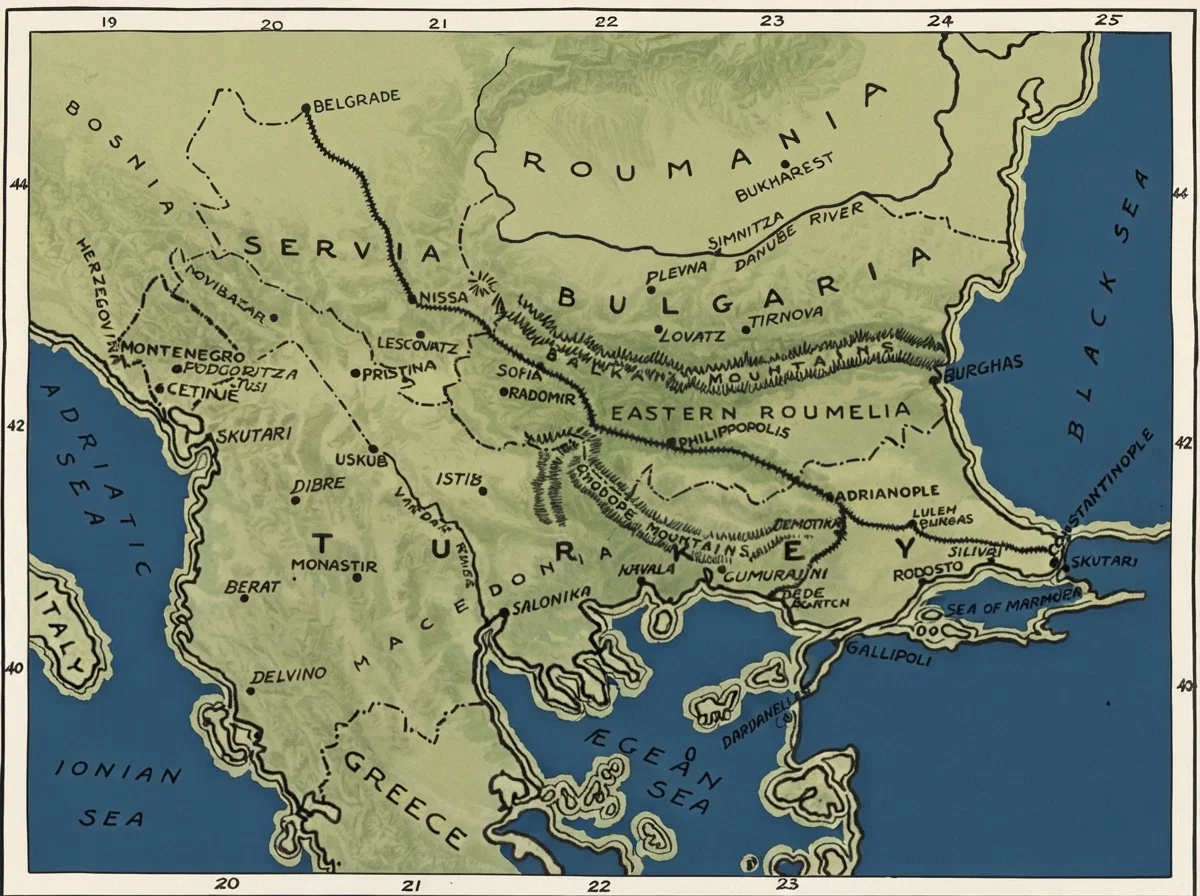
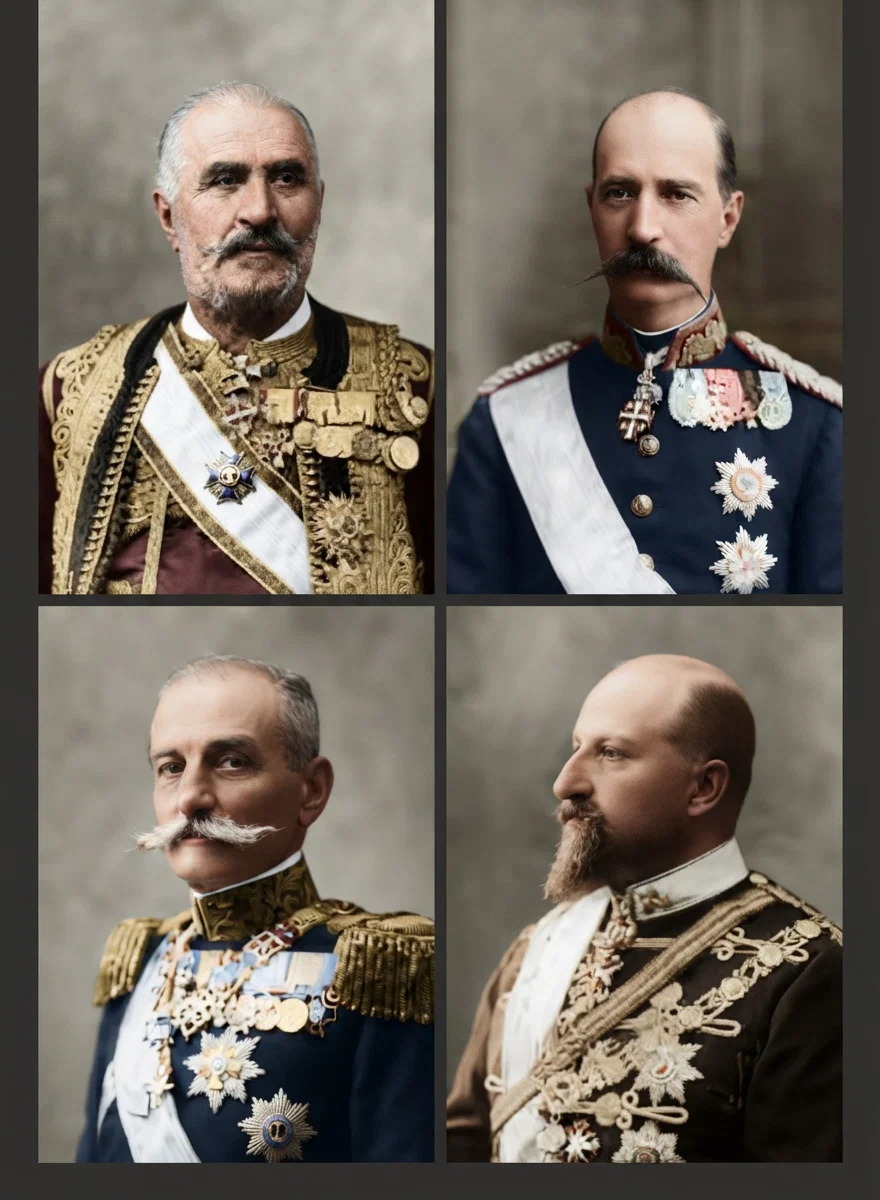
HERE is presented in this department a small war map of the Balkan territory, including Turkey and the little powers which have arisen against her, and the portraits of the kings of the four smaller countries which have allied themselves against their old tormentor, Turkey. These little countries are not able to cope with the Turk separately. It was not believed that they would be together. They have, however, surprised the world.
Montenegro is not a large state. The whole country holds only 225,000 people, and its capital city, Cetinje, has a population of only 4,500, but every able-bodied male citizen between 18 and 62 is subject to military service, making the maximum military strength of the country about 50,000 men.
For four centuries the little kingdom has maintained its independence against Turkey. It opened the conflict October 8, when the Montenegrin minister took his leave from Constantinople.
Montenegro has been the only Balkan State which has never bowed the knee to Moslem domination. The aged King Nicholas and three of his sons led their army to the front, and his son Prince Peter is said to have fired the first shot at Podgoritza.
Montenegro had some pretext for declaring war, we are told, but not so with the other states; and yet they have seemed to think that their only hope was to stand together, or fail separately.
Bulgaria is larger, really the strongest of the four states. It has a population of 4,284,844, less than the population of the city of New York, with an area of 37,200 square miles. Its capital is Sofia, its king Ferdinand, who seems to be certainly a vigorous and forceful ruler. The armed strength of Bulgaria is 52,500 in peace, with 297,000 reserves, or total war strength 350,000.
Servia, the capital of which is Belgrade, and whose king is Peter, has a population of 2,493,770, about the same as Chicago, with 18,630 square miles. Its total war strength is listed as 175,000. Its peace army is 35,000.
Greece has a population of a little less than Servia, with a few more square miles of territory. Its peace strength is 25,000, with available for duty, but unorganized, 200,000.
European Turkey has a population of 6,000,000, and 65,000 square miles of territory. Its military strength in peace is about 375,000, its war strength 725,000; available for duty unorganized, 2,000,000. Its ruler is King George.
All this war strength is on paper. Its accuracy is tested in time of war.
Dr. George Washburn, ex-president of Robert College, Constantinople, in an article in the New York "Independent" of October 31, lays before us some of the real grievances existing in the Balkans. In the treaty of Berlin, some form of autonomous government was granted by the Turkish government to Macedonia (a province within the borders of Turkey), but the Turks declined to carry out the provisions of the twenty-third article, and the powers could not agree to enforce it. Old Sultan Hamid was too clever for them, and the new Young Turkish government has failed to effect the reforms. "During all these years there has been a reign of terror in Macedonia which has not only been a disgrace to Europe but has aroused the indignation of the neighboring Christian states."
The Christians of Macedonia are divided among the Bulgarian, Greek, and Servian races, and are kindred to the Montenegrins. Naturally they would unite, and yet it was a surprise to Europe when it was found that they had united. Dr. Washburn thinks that nothing but the cold-blooded neglect of the great powers to listen to the cry of the Macedonians could have brought about such an alliance. The Turks entered the war with light hearts and wild enthusiasm. The declaration of war was welcomed in Constantinople with as much joy as the revolution of 1908. They seemed to think it would be a very easy matter to crush the small powers. And yet many of the wiser ones among the Turks hesitated. One old Turk remarked, "Whenever the pot boils in Europe and blows off the cover, it always falls on our heads." And this has seemed to be the case at the present time. It has seemed strange, to many, that the powers did not step in and prevent this war; but the difficulty has been that the powers of Europe could not agree. Each one has special interests of its own, and its own sympathies and point of view, as the London "Times" expresses it. Had they been united, they could have ordered the Balkan States to abandon their warlike intentions. But this must be accompanied with some program of settlement which would be satisfactory to the smaller powers; and no solution, the "Times" tells us, of the Macedonian question would be regarded as satisfactory that did not involve the disappearance of direct Turkish rule over the greater part of European Turkey. But no European power wished to undertake that task, and that was especially true of France and England, who have so many Mohammedan subjects under their flags. Austria is opposed to any change in the Balkan11peninsula which does not leave the way open for her to come down to Saloniki and annex Macedonia to her own empire, and is therefore opposed to any enlargement of Montenegro, Servia, Bulgaria, or Greece.
MAP OF THE BALKAN STATES
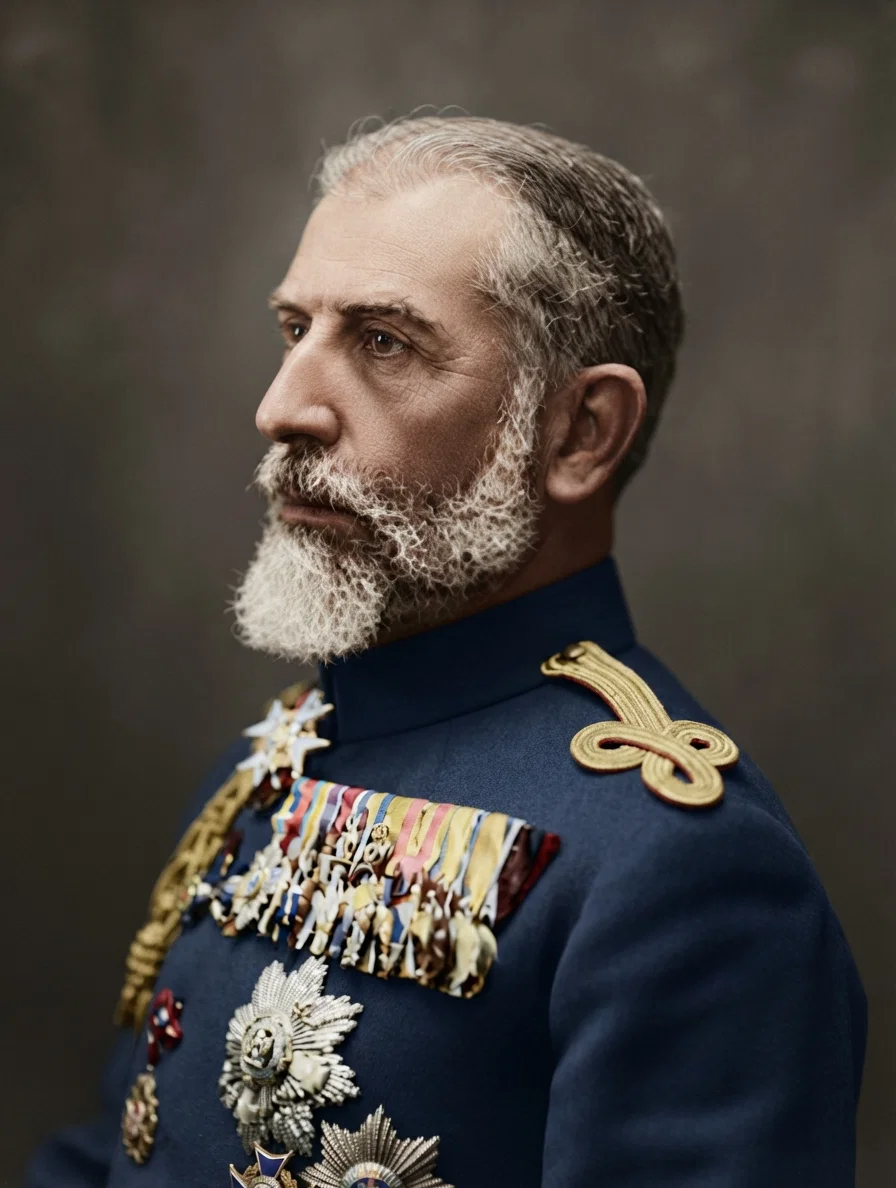
Charles, king of Rumania, who keeps out of the Balkan war, remaining neutral (From the "Illustrated London News")
Dr. Washburn declares that she would be glad to see the country peaceful and better governed by the Turks until her time comes, and that she would rather see the whole population massacred than to see the territory divided among the neighboring Christian states.
And opposing her is Russia, whose great ambition is to secure Constantinople, and Austria is the great object in the way. German ambition, Dr. Washburn tells us, seems to be confined to the exploitation and perhaps the annexation of Asiatic Turkey.
France is recorded as a special protector of Greece, and has friendly relations with Bulgaria, and both English and French are generally in sympathy with the Christian population of Macedonia; and yet since the Crimean war, the governments have professed to defend the integrity of the Turkish Empire. Still we are told, in the same article, "The truth is that Turkey has no protectors." Every power would be glad to see the last of the Turkish rule in Europe. It is only a question of who shall have the spoils of the empire. As England and France do not covet any of these, they are in a limited sense their best friends. All this is an old story.
Dr. Washburn says: "The only foreign soldier of whom the Turk is afraid is the Montenegrin. These mountaineers have never been conquered. A Turkish soldier once said to me, 'I am not afraid of men, but these Montenegrins are devils.'"
THE ALLIED KINGS OF THE BALKANS
The Turkish army has been greatly improved of late years, under the direction of the distinguished German officers loaned to Turkey by the emperor. The Bulgarian army was thought to be fairly well trained and disciplined, but has had no experience, so it was not known what it would do. The Greek army was considered an uncertain quantity. The Servian army was supposed to be composed of good fighters, but not very well disciplined or reliable. However, the last week has been full of revelations to the surmisers and guessers of the relative strength of these various powers engaged. Take, for instance, the city of Adrianople, considered to be one of the Turks' strongholds, one of the defenses of which had been planned and carried out by German engineers, and the Turkish commanders had for years devoted their grand maneuvers to the problem of the defense of that city against an invading army from Bulgaria, but the Bulgarians defeated them on that very practise ground.
From the time that Bulgaria began her southern march toward the strongholds of Turkey she has gone straight on. Battle after battle she has fought with tremendous power and vigor, but in every case she has conquered. As one paper expresses it, the Bulgarian commander had flung out a battle line of fifty miles, and within a week had coiled his right wing closely about Adrianople.
In the meantime little Montenegro had enveloped Scutari, Servia had marched forward toward the south, captured towns like Uskup and others, uniting finally with the Bulgarian army. Greece had climbed up from the south and invested Saloniki. In fact, all of the outposts of the Turkish Empire have fallen, and the Bulgarian army stands victorious at this writing at the gates of Constantinople, while Turkey is herself suing for peace. In fact, she is demanding peace, under friendship to the powers. Unless peace is granted, she threatens to massacre the Christians within her borders. This she would hardly dare do, in view of what might come afterward. Angry and desperate as she may be, she would hardly care to take the responsibility of meeting the tremendous vengeance which would follow in such case.
Germany seems to be more favorably disposed than the other nations to intervene in behalf of the Turks. She certainly wishes to keep intact her own interests in Asiatic Turkey. But there is no union between the powers. Some of them, it would seem, would be perfectly willing to see Turkey divided up among the smaller Balkan States. Austria alone is not in favor of permitting the Balkan allies to divide the fallen Turkish territory among themselves. And so the powers are alining themselves on either side, regarding the future of the Balkan States, so despatches from London under date of November 5 inform us. If this were done, it would check Austria's path to the Aegean Sea, a port upon which she is determined to have. Montenegro, Servia, Greece, and Bulgaria are all claiming big portions from the captured Turkey. None of them will be content with a mere wish-bone. One correspondent declares that the emperor of Russia will be taken as arbitrator between Servia and Bulgaria, in regard to these conquests.
But there is another element that enters into it: the Balkan allies are themselves somewhat divided as to the respective portion each shall have. Out of this the greater powers may find an opening wedge for stronger intervention. However it is, Turkey is conquered. The Bulgarian army has already cut off the capital's (Constantinople's) water-supply. The advance guard of the Bulgarians are under the very guns of the last stand of the Turks. The Turks themselves are endeavoring to flee from Constantinople, but are held there by practical force. The fall of Saloniki, the Biblical Thessalonica, is expected at this writing. Strong Greek force is at the very gates, while another combined detachment of Bulgarians is making enforced marches toward the city. The sultan's soldiers are in bad condition. There are hosts of wounded, thousands have dropped out of the ranks exhausted from want of food, and most of them have thrown away their rifles. Many of their reserves had nothing but the old muzzle-loading rifles at the best, and these some of the soldiers were too ignorant to load. Sometimes when they fired them, they fired into the backs of their comrades, and sometimes over the heads of the enemy. All the correspondents tell us that the Turkish troops fought well, but were outmatched by the Bulgarians in every conflict.
The world will look on with interest at the outcome. Certainly it looks as tho the world would be better if Turkey were eliminated from Europe, the Moslem power humbled, and more religious freedom given. This would permit the heralds of the gospel, which have naught to do with politics but everything to do with soul saving, to do much more rapid work than they have been able to do in the years hitherto. This is the one hopeful thing which we see in this war, which, like all other wars, is horrible. We pray that further cruelties and barbarities may be averted, that the lives of the innocent may be preserved, and that the European powers may have that wisdom, and act with that agreement, which will bring liberty and strength to the peoples of that long-suffering region. Sometime the war of Armageddon will open upon the earth, but that time is not yet. God's message must go to all the nations of the earth. His gospel of the kingdom must be preached as a witness to all nations, "and then shall the end come." And then no power will hold the winds of strife, or stay the fearful battles of the war of Armageddon. Beyond that comes the Lord Jesus Christ, the Sovereign of that kingdom which shall never fall, nor give way to another.
A World Conflict Impending.
By special cable to the World-Herald from Berlin, under date of October 7, Frederick Werner declares that the fear of a war in Germany with France is dispelled by greater fears of a much larger conflict, and one of the reasons given for this is that there are many disturbances in all the various governments, and that the government of more than one country is tempted to rush into some foreign adventure in order to avert the attention of the people from disturbing events at home. Everywhere, he declares, there is a feverish activity to perfect a military machinery so that a mobilization may be effected almost immediately, and that these so-called maneuvers are virtually mobilizations undertaken under the impression that real war was near. And of course all this is in harmony with many prophecies of the Scripture which clearly predict the war of Armageddon in the near future.
—★—
Ecuador Revolution and Guayaquil Sanitation
Ecuador has her revolution, altho the South American revolutions are likely to be forgotten in view of other bigger troubles. However, just recently, led by Colonel Saavedra, who fought with Alfaro in an unsuccessful revolt a few months ago, an army has now captured the city of Limonez. In connection with this we read that our government has reached an agreement with Ecuador for the sanitary improvement of Guayaquil, a port that has been called "the pest of the whole Pacific." American experts will take hold of the matter to clean up the town.
The Children in the Home
By Mrs. L. D. Avery-Stuttle
By Mrs. L. D. Avery-Stuttle
JUST as long as the home proves to be, in the opinion of the youth, the brightest and most cheerful place on earth, just so long there need be no fear of their wandering after forbidden pleasure.
The theater, the dance hall, and even the saloon, are each, in their line, attempting to outrival the home. And it is a sad fact that in many instances, they are only too successful. It surely becomes parents to study the cause or causes which produce such effect.
Children and young people—yes, and older ones, too—like life, and warmth, and color, and good cheer, and music, and flowers, and books, and pictures; and if they can not find some or all of these at home, the chances are that they will go where they can.
“O, well,” says one, “I am a poor man. I can’t have everything dainty and pleasant at my home. I have to work hard for a living; and I consider that what is good enough for me, is good enough for my children.”
Granted. But in my opinion, the very best that you can furnish is none too good for your own family. The idea that almost anything is good enough for the children at home, is a most mischievous and mistaken one.
Do not misunderstand me. It would be very foolish in Mr. A to undertake to furnish his humble home in the same elegant manner that Judge B adorns his splendid mansion. But there are very few even among the poorest, who can not have a few flowers in summer-time at least; and in this day when good pictures can be purchased for little, the very poorest of us may be able to afford a few cheerful and instructive ones, I am sure.
Some artistic soul may arise in indignation at the very suggestion of “cheap pictures.” But better cheap than none at all—only if the thoughts they suggest be clean and pure and elevating. It is wonderful how a bright picture will enliven a bare, comfortless appearing room.
Then, O ye home builders, hear me: If you would have your homes attractive for the children, have plenty of windows, and don’t keep the shades drawn down. I have stepped from the sunlit outer world, into rooms which were so dark that I could not tell the color of the carpet. One might discern the frames of a few pictures, but the pictures themselves were invisible. And little children live—or try to live—in such homes as these!
Did you ever turn over a stone or a piece of board in the back yard, and notice the color of the grass which struggled to grow under it?
God has given us the beautiful sunlight; let us appreciate it. He knows that it means health and happiness and rosy cheeks and bright eyes for the children.
“Yes,” says Mrs. More-nice-than-wise, “and it means faded carpets, too, and streaked draperies.” “Indeed it does,” agrees Mrs. Careless; “and besides, the dust and dirt are so much more visible when the sunlight comes in.”
But sunlight is the best remedy in the world for “the blues,” and the children love it. Watch a group of little ones at play indoors. They will be likely to choose the sunniest corner of the room. Children cluster about the light as naturally as bees around a flower.
Then, too, children like color. It seems to me that their fancies should be consulted and gratified as much as is reasonable. If Eliza has a particular liking for pink, why should we insist that the new dress or ribbon shall be brown? These may seem to be small things. Maybe they are. But little things are those which children notice most. And little things make up the sum of life. If I wanted a child to become weary of home, then I would have dark curtains, and heavy, opaque shades, and very dark draperies at the doors; and I would have dark pictures in dark frames on a dark wall, with no hint of color or brightness anywhere.
But that is not what we want to do. We are anxious to make home a pleasant place, one which is desirable to live in and to stay in. We want our children to grow to love it so much that when at last it becomes necessary to leave the old home, fond memory will ever picture and repicture its sunny rooms and its pleasant, homelike atmosphere, and most and best of all, its loving words and its evening and morning songs of praise.
And this thought brings another: There is nothing which appeals to the children, with stronger attraction than music. Now I am sure that by no means every home can afford the luxury of the more expensive instruments. But believe me, there are none of them—not even the very best—which can begin to equal the human voice.
Then, O, let the children learn to sing! encourage them in it. There is not in all the world its equal as a dispeller of gloom, unless it is prayer. Let the songs which lull the little ones to sleep at bedtime be soft and sweet. They like this kind best of all. I know a tiny blue-eyed lassie who teases with earnest insistence for that quaint, old-fashioned cradle song,—
“Hush, my dear! lie still and slumber!
Holy angels guard thy bed.”
Yes, let there be some good instrumental music in the home if possible; but in any event, forget not to sing. Let young and old join in some cheerful chorus frequently. Singing is the sunshine of the soul. Gloom and melancholy and “blues” can not long stay in its cheering presence; and it is a good antidote for many of the ills of the body as well as for those of the soul.
We must not forget the flowers. They speak to the soul through the eye, as music does through the ear. They are elevating and refining in their influence. Let John have a little section of ground in which to raise vegetables if he wants, but don’t forget to leave generous space for Lucy’s flowers.
Once when I was very ill in a strange land, a single flower sent me by a friend, preached a louder sermon to my listening ear, of the love of the All-Father, than almost any I ever listened to from the pulpit.
There are sweet peas, and roses, and morning-glories, and bachelor’s-buttons, and tall, stiff hollyhocks, and old-fashioned sweet pinks. Each possesses a peculiar attractiveness of its own.
When the frost comes, encourage Lucy to transplant some of her choicest flowers to the sunny bay window—just a few of them, not a wild jungle.
I remember a most beautiful window-garden which I once had in the south bay window. It was just a strong, thrifty, old-fashioned red nasturtium. I placed a large, thrifty slip in a glass of water. When the little rootlets appeared in plenty, I planted it carefully in a jardiniere under the window, across which, back and forth, I wove some strong cord. It was not very long before my plant had covered the entire window, and was a mass of beautiful red and yellow blossoms. How we all enjoyed its sweet, bright radiance!
Then, of course, we must have books—and books suitable to all ages. How can we reasonably expect John, who has just celebrated his tenth birthday, to become absorbed in the scientific treaties which we may enjoy so much? If we expect anything so illogical and unreasonable as this, we shall be disappointed.
But whatever the home must lack, let it not be deficient in these two things,—light and love. Both are cheap; but like many other things which cost little, they are priceless. Their worth can not be estimated.
If Johnny’s room has only one little window, opening on the back alley, don’t decide that it’s good enough for Johnny. Let in the13sweet, pure air and sunshine. They will do more for the children than any amount of costly furniture and elegant surroundings. Let us not forget that if house plants can not grow and thrive in a cellar, neither can children live healthy and normal lives in the dark.
Plenty of Time
By Margaret E. Sangster
I hear you complaining, dearest,
You have ever too much to do;
Your temper is worn with trying
To make old things look like new.
You sew for the little children,
You mend for the rollicking boys,
You were never a shirk, and you always work
Till your life is shorn of joys.
If the day were longer, dearest!
If you never need go to bed!
But the time goes racing by you
Till the hurrying week has sped;
And your basket's overflowing,
And your tasks are never done.
Poor, weary friend, will they never end,
Till the sleep of death is won?
It's time you are needing, dearest!
Ah, yes! but there's time to spare
If you'd let our Father carry
One end of your load of care;
If you'd tell Him all your trouble,
And ask from His tender hand
The gift of His peace, your pain would cease;
His way you would understand.
There is time for loving, dearest,
If we take the time there is,
And fill that up with sweetness,
Whatever beyond we miss;
Let the little frocks be plainer,
Let the dust alone for a while;
Let the goodman see how blithe can be
His home in your tender smile.
—Margaret E. Sangster.
At the Table
The temper of the family is often indicated by the atmosphere of the table. Three times a day all gather there to have the body fed. If there is at the same time an animated conversation, pure and dignified, it will prove stimulating to all, and an educator to the younger members. Thus three times a day something is added to the stock of information. If, on the other hand, the family drop in one at a time, as the manner of some is, and each one hurriedly disposes of what is set before him, as if eating were a burden, then hurries away, there is an unsatisfied feeling, an uneasiness which will develop nervousness and irritability, aside from the irreparable loss of regular, healthful conversation. Whitelaw Reid, in referring to the wonderful conversational powers of Reverdy Johnson, said it was his habit to rise early, read two hours before breakfast, and rehearse at the table what he had read. The act of repeating impressed on his memory what he had to read, so that he could go over a chapter of history, giving the most minute details and almost the style of the author. Pleasant repartee in moderation is stimulating. It promotes good feeling. But sensational or gossipy small talk narrows the mind, and tends to friction and ill-humor; and that family who are led in the social table-talk by wise and cultivated parents will have little time to give to the failings of neighbors or weak-minded members of the community. It will prove very profitable to give some attention to this important question.—Herald and Presbyter.
Kisses on Interest
A FATHER, talking to his careless daughter, said: "I want to speak to you of your mother. It may be that you have noticed a care-worn look upon her face lately. Of course, it has not been brought there by any act of yours; still, it is your duty to chase it away. I want you to get up to-morrow morning and get breakfast, and when your mother comes and begins to express her surprise, go right up to her and kiss her on the mouth. You can't imagine how it will brighten her dear face. Besides, you owe her a kiss or two. Away back, when you were a little girl, she kissed you when no one else was tempted by your fever-tainted breath and swollen face. You were not as attractive then as you are now. And through those years of childish sunshine and shadows, she was always ready to cure, by the magic of a mother's kiss, the little, dirty, chubby hands whenever they were injured in those first skirmishes with the rough old world. And then the midnight kiss with which she routed so many bad dreams as she leaned over your restless pillow, have all been on interest these long, long years. Of course, she is not so pretty and kissable as you are; but if you had done your share of the work during the last ten years, the contrast would not be so marked. Her face has more wrinkles than yours—far more; and yet if you were sick, that face would appear more beautiful than an angel's, as it hovered over you, watching every opportunity to minister to your comfort, and every one of those wrinkles would seem to be bright wavelets of sunshine chasing each other over the dear face. She will leave you one of these days. These burdens, if not lifted from her shoulders, will break her down. Those rough, hard hands, that have done so many necessary things for you, will be crossed upon her breast; those neglected lips, that gave you your first baby kiss, will be forever closed; and those sad, tired eyes will not be able to see. And then you will appreciate your mother; but it will be too late."—Selected.
Signs of the Times Magazine
By Editor
(Published Monthly)
The Magazine with the Message
DEVOTED to the study of present-day affairs, world-wide. The place of these events in the great plan of God as revealed in His Word. The right setting for each. The Bible furnishes the only dependable solution of present world problems. You ought to know their meaning. Several evenings of real, uplifting study for thinking people every month. There is a satisfaction in studying these subjects of world-wide import from this standpoint. It is the satisfaction of knowing — knowing something that can be depended upon.
The SIGNS MAGAZINE is $1.00 a year. Ten cents in coin or stamps will bring you a current copy.
Signs of the Times Magazine
Mountain View - - - California
The Message Is in the Contents
Parowax
(Pure Refined Paraffine)
Washes clothes cleaner and whiter. Cannot possibly hurt the daintiest fabric.
Parowax has the cleansing power of naphtha and benzine. It is nature's concentrated cleansing force refined into pure white wax.
Just add a little shaved Parowax to the soap in the wash-boiler. It does away with all the hard, destructive rubbing on the washboard.
Parowax is also invaluable for sealing jellies and preserves.
STANDARD OIL COMPANY
(California)
461 Market St. San Francisco
Just try Parowax. Pound and half-pound cartons. Grocers and department stores everywhere.
Do You?
THEY were sitting together in the streetcar. "I do hate people that are forever talking about their neighbors," said the woman with the peaked hat. "So do I," coincided her companion in the cashmere shawl. "There's Mis' Green," continued Peaked Hat, "continually a carryin' things back and forth. Think she'd better look to home. Goodness knows she and her husband live a regular cat-and-dog life." "Yes, indeed," said Cashmere, "and her daughter Sarah isn't half cared for. I was tellin' Mis' Jones only yesterday that the way Mis' Green neglected that girl was a cryin' shame. O, by the way, did you hear that story about Tilda Smith?" "No. What is it?" exclaimed Peaked Hat, turning half around in her seat in her eagerness, her eyes sparkling in anticipation of the coming treat. But, gentle reader, never mind what it was. Neither you nor I care anything about it. We hate tattling as bad as Peaked Hat and Cashmere did.—Selected.
Keep Still in Trouble
By Dr. Burton
WHEN trouble is brewing, keep still. When slander is getting on its legs, keep still. When your feelings are hurt, by all means keep still till you recover from your excitement, at any rate. Things look different through an unagitated eye. Silence is the most massive thing conceivable, sometimes.—Dr. Burton.