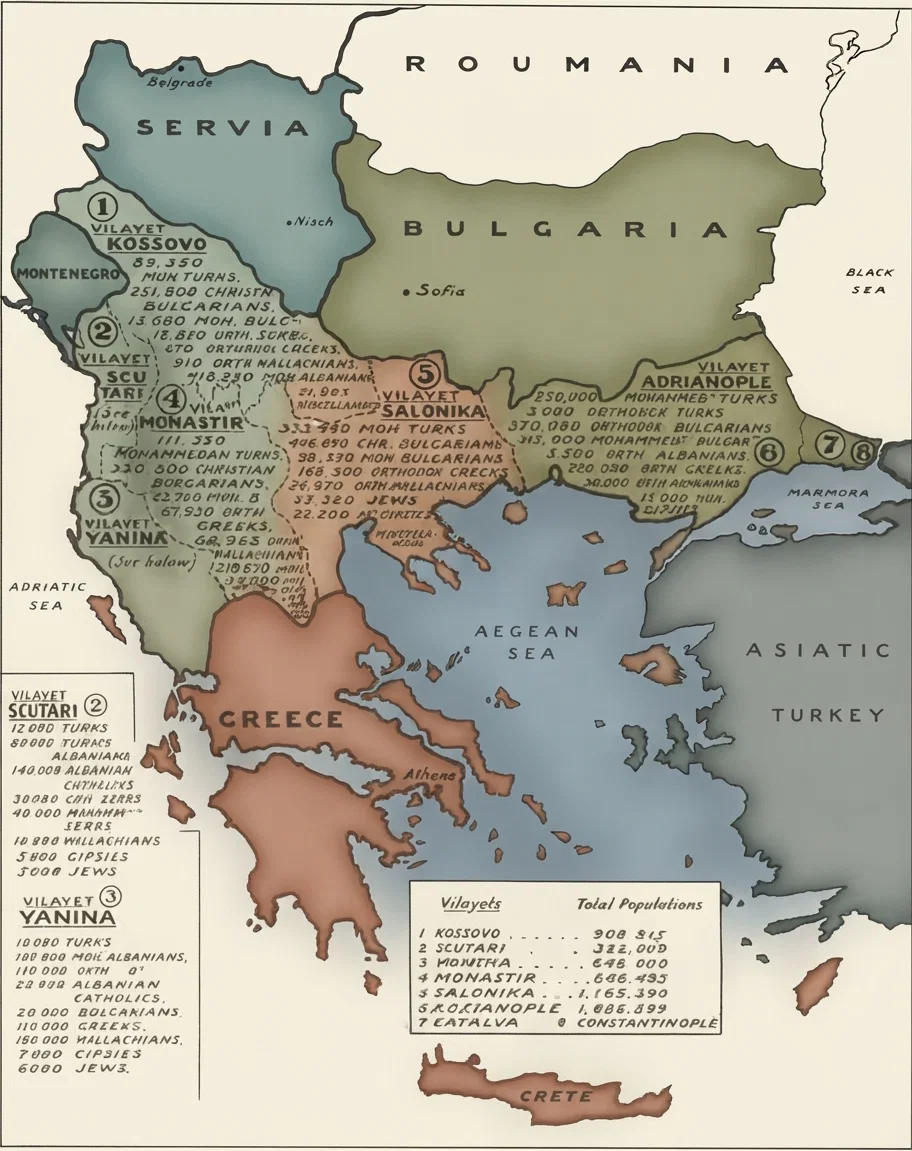
At this writing matters are still uncertain in the southeast of Europe. So far as the smaller Balkan powers are concerned, all have sent their representatives to London to the Peace Conference, including Turkey, but Austria still menaces the peace of Europe. December 10 it was reported that the entire Austrian navy had been concentrated at their chief naval station, evidently in order to overawe Servia in her attempt to appropriate the port of Durazzo on the Adriatic Sea.
From the "Illustrated London News"
One report declares that the newspaper "Provda," voicing the feeling of Servia, says: "If Austria desires war with Servia, it will come, and will be the most bitter fight in history. Every Servian man and woman, young or old, will take part in it, and Austria will have to exterminate the entire Servian nation before conquering."
Russia's attitude, it is said, is unchanged, and yet she feels that there is no irreconcilable difference between Servia and Austria, that if there were any kind of conciliatory disposition at all, the peace would be made.
December 9 it was reported that Austria had seized a ship loaded with flour, on its way to the Servian army, and that this flour had been taken for the use of the Austrian army. These, however, are reports, which need confirmation. Under date of December 10, it is said that the Austrian minister at Belgrade has been instructed to present a note to Servia on December 11, "couched in sharp terms," inquiring as to whether Servia proposes to bring her policy into line with that of Austria. It is not, however, an ultimatum. The "Daily Mail" of London, in a despatch from St. Petersburg, declares that five Austrian army corps, consisting of about 40,000 men each, are placed on a war footing. The authorities are alarmed. Many of the troops are ready to take the field.
From Vienna, the same date, it is said that the Servian ex-Premier, M. Novakovitch, in passing through the Austrian capital on his way to London to take part in the peace negotiations, said that the antagonism between the standpoints of Servia and Austria were so great that it appeared hardly possible it could be bridged, but Dr. Daneff, the Bulgarian peace delegate, says there is no cause for alarm as long as the powers are in agreement, and Servia is ready to recognize the interests of others. And so we have it on both sides.
From New York, the same date, comes a report said to be from the bankers — Kuhn, Loeb & Company and the National City Bank of New York — who have recently negotiated a loan of $25,000,000 to Austria, that the money was loaned under the express understanding that the political situation is much improved, and that there is no reason for apprehending warlike developments between the great powers.
The American ambassador at Constantinople intends leaving Constantinople soon, and has expressed his belief that the Peace Conference at London will reach an amicable settlement. What will be asked of Turkey, news from Paris states, is all the lands which the allies have conquered, with the exception of Adrianople eastward to Midia by way of Visa, and from Adrianople southward along the railroad to Dedeaghatch on the Aegean Sea. It is stated that the diplomats, during their discussion at Baghtche, agreed on this basis of negotiation. It is also stated that Austria and Germany have refused to join in the conference if the Adriatic seaport question is to be brought up against their will. Any peace arrangements made by the delegates of Turkey and by the Bulgarian nations at the Peace Conference, will probably have to be ratified by the ambassadors of the great powers who will meet, first in London, to consider political affairs, and afterward in Paris, to discuss purely financial problems.
The best that can be said is that peace is not assured as yet, that conditions are still quite critical as between Austria and Servia, but that the other powers are working for peace, and hope that matters between these two nations may be patched up. The conditions, however, show on how slender a thread the peace of the world hangs.
An Immoral Invasion
By Editor
As an illustration of the sentiment upon which the apostle Paul places a "God forbid," an occurrence in Minneapolis, December 1, is in point. A minister in that city took for his text, "Praise Him with the dance," and then brought in two girls of the world, to reveal to his audience the character of the immoral dances of the present time. The report declares that "the most amazing and bold dances were executed by the girls." The so-called "Turkey Trot," and "Crab Crawl," and "Tortoise Tango," and "Jelly Wabble," the "Angleworm Wriggle," the "Grizzly Bear," and other dances, were given. The pastor declared that these dances were not at all exaggerated, that they "would make the devil blush,—he would hesitate to introduce them into hell;" that the very names of the dances were a "libel upon the animal world;" and that "children had come to be postgraduates in ragtime tunes and dances before they could sing a hymn or repeat the Lord's Prayer." Coins were thrown upon the pulpit platform by some in the audience, while the girls were dancing.
Now what this minister said may have been all right. We did not hear the sermon, and have only the newspaper report of it; but to bring such a scene as that into a church set apart to the worship of God, would do more harm than for the dances to be conducted in buildings that are used by the world for that purpose.
The world has always been lying in wickedness. The unregenerate heart is at enmity with God, and is not subject to His law, neither indeed can be; and this is true, whether that heart calls itself Christian, or whether the name is on the church books,11or not. That is one thing which the church needs to recognize, that the only hope for humanity is in the regenerating power of the Lord Jesus Christ. If the individual is born again, there will be no place for these kinds of dances, or the other kinds which merge into them, and which are considered 'respectable,' in his life. The great difficulty has been that the church itself has yielded to the influences of these worldly entertainments.
This pastor is reported to have said that there is a decent dance, helpful to the body, pleasant to the mind, and harmless to the soul; but the great difficulty is that just as soon as dancing between the sexes begins, they grade down and down to the wretched, immoral dances that we have at the present time. And it is pretty difficult to say as to whether these grotesque, indecent dances are more immoral than the 'respectable' waltz which has held dominion in society for so long a time.
The awful thing is that such things as that should be allowed in the church of God. Logically, to show the evil of thievery, it would be well to have some one steal. To show the evil of blasphemy, why not hire two experts at such a transgression of God's commandment, to get up on a pulpit and hurl oaths at each other? To show the evils of idolatry, why not bring some of them in, by hiring some heathen to offer there his oblations? And so on through the whole category of the transgression of the Ten Commandments. Think of the Lord Jesus Christ, or Paul, or Peter, or John, or, to come later on, John Wesley, or Alexander MacLaren, or Charles Spurgeon, using any such means as this! The world knows of all these evil things, and it knows the power of evil to entrap men and women. What the world does not know, and the people of the world do not know, is the power of the Lord Jesus Christ to save.
The impressions made upon that audience will never be forgotten, and it is safe to say that they will bear evil fruitage in the minds of some, who never would have seen it otherwise. 'Shall we do evil, that good may come? God forbid.'
Why Constantinople?
Why the struggle for Constantinople? Why especially does Russia want it? Why are the great powers determined that she should not have it?
Because of its strategic value. If Russia possessed the little peninsula, she could so fortify the Dardanelles and the Bosporus—the narrow straits which lead from the Black Sea into the Mediterranean—that she could shut out the navies of the world, while she could within the Black Sea build an invincible fleet which could go or come at will.
She would in such case possess advantages which no other nation having dominion on the Mediterranean would or could possess.
Therefore Russia must not be permitted to hold or control Constantinople. The Turk may possess that strategic point; he has nominally held it since 1453. But now Turkey is not an independent power, and is no menace to any great power when internationally controlled. For that reason, it is maintained, solely to give the Russian bear no other free outlet for his navy save that of the frozen north on the Baltic Sea.
The founder of the Turkish, or Ottoman Empire, saw Constantinople in a dream about the year 1290. He saw all the leaves of a mighty tree—his family tree—like simitars pointing toward Constantinople. "That city, placed at the junction of two seas and two continents, seemed like a diamond set between two sapphires and two emeralds, to form the most precious stone in a ring of universal empire. Othman thought that he was in the act of placing that visioned ring on his finger when he awoke." But it was not till 1356 that permanent foothold was gained on the European side of the Hellespont.
How long will the Turk still hold it to preserve the balance of power between the rivals of Europe?
Austria-Hungary’s Discontented Slavic Races
The Austrian Empire has not an easy time to govern its own subjects. If there is a heterogeneous mass of people in any empire on the face of the earth, unless it be the Turkish, it is in Austria-Hungary. There are Slovaks and Czechs (Bohemians) to the number of 8,574,792; Poles, 4,952,387; Ruthenians, 4,210,944; Slavonians, 1,492,709; Serbo-Croats, 6,295,912. All these are Slavs, a total population of more than twenty-five and a half million. Other races are, Germans, 11,606,722; Magyars, or Hungarians, 9,041,744; Italians less than a million; Rumanians, 3,000,000; Turks, 600,000; mixed races, 400,000; a total non-Slavic race of 25,400,000. In other words, the Slavic and non-Slavic races are about equal; and Mr. Cosulie, a Serbo-Croat of San Francisco, tells us that the Slavic races in general are not satisfied with the government of the empire. He declares that tyrannical despotism of the worst type is practised by the government against the Slavs, particularly against the Serbo-Croats, and is worse than any Russian czar, or the recently overthrown Manchus, were ever guilty of.
A Fat Hog Versus a Consumptive Woman
Dr. Harvey W. Wiley recently said, with some show of truth, that it was better to be a fat hog than a woman with consumption; and gave an instance of where a woman with a child, stricken with tuberculosis, applied to the state and then to the Federal Government, for assistance, but was told that there was no appropriation to cover her case. But in the same town, there was a farmer who had a fat hog that was taken sick with cholera, and he sent a wire, "collect," to the Department of Agriculture, and received a reply, "Keep your hog alive for twenty-four hours, and one of our men will be there." And within a day, three representatives from the Department of Agriculture arrived, treated the hog, and the animal recovered.
Panama Canal Rates Fixed
President Taft has fixed the rates for the Panama Canal, on merchant vessels carrying passengers or cargo, $1.20 per net vessel ton — each 100 cubic feet — of actual earning capacity; and on vessels in ballast, without passengers or cargo, 40% less; upon naval vessels, other than transports, colliers, hospital ships, and supply ships, fifty cents per displacement ton; upon army and navy transports, colliers, hospital ships, and supply ships, $1.20 per net ton.
An Actress Experiments With Intoxicating Hens
A beautiful French actress is trying the experiment of keeping a farm, and feeding her hens all the exciting condiments and intoxicating liquors in which the fashionable set indulge; and she has found that the lower animals take to it quite readily, altho not with that greediness and abandon, seemingly, that is manifest in the human biped. They have to be educated to indulge in it.
Carnegie’s Pension Fund for Ex-Presidents
Mr. Andrew Carnegie is finding another avenue by which he can use his wealth, and that is to set aside $125,000,000 of it as a fund for pensioning ex-presidents. The proposal is to give each ex-president, if he will receive it, without asking, $25,000 a year during his life. This will be paid from the accrued interest on the fund.
Argentine Corn Exports to Great Britain
As showing how the Argentine Republic is increasing its products and exports, it is worthy of note that the imports of Great Britain in Indian corn, or maize, from the Argentine Republic amounted to nearly four hundred million hundredweight for the month of October, 1912, as against nothing in October, 1911.
Chinese Cabinet Members From California
A circular from the University of California states that one third of the members of the new Chinese Cabinet were former students of the University of California, and these students were brought into the university largely through Dr. John Fryer.
The Cost of High Living
A noted Catholic prelate, lecturing in San Francisco, touched an important point when he said: "I look around, and I notice that there is something more prevalent than the high cost of living, and that is the cost of high living, the ruinous expense of living beyond your means. It is pleasure that is robbing duty; it is this inordinate craving to run away from work, to swing on your merry-go-round, that is cheating life and health, efficiency and strength."
A Gift to Evansville
It is a strange kind of gift that Adolph Mulzer has bestowed upon Evansville, Indiana. He has given that city $1,000, which must be placed at compound interest. In 250 years, at 4 per cent per annum every six months, it would amount to the sum of almost $20,000,000, at the expiration of which time it is to be paid to the city of Evansville. The certificate of deposit is not transferable.
Fraud Through the Mails
United States inspectors, the "Atlanta Constitution" tells us, are making arrests in twenty-seven states, involving prominent men who are using mails to promote criminal practices. Within two years, it is said that the people of the country have been muleted to the extent of $100,000,000 by frauds perpetrated through the use of the mails.
A Straw at a Time
Doing a little at a time and keeping at it accomplishes great things, if persisted in. Human beings, however, are slow to learn the lesson. An illustration of this is given in what was found in a church in St. Louis recently. A half ton of hay had been transported into the belfry by sparrows, a straw at a time.
Cincinnati Fire Losses
A fire occurred in Cincinnati December 10, in which three of the city's leading establishments and more than 100 offices were destroyed, causing a loss of $690,000. The upper ten floors of the Union Trust Building, a seventeen-story fire-proof structure, were ruined.
Millennial Dawn Literature
When "Millennial Dawn" literature reaches a greater circulation than the "combined circulation of the writings of all the priests and preachers in North America," it is time the Christian world was stirred. Professedly Christian, it is decidedly unchristian.
The World's International Business
The world's international business for the year, according to a report from Washington, will reach the enormous total of $35,000,000,000—$4,000,000,000 greater than the trade in 1910, and more than double that of 1890, twenty-two years ago.
The Tables Are Turned
Ammath, a noted Turkish ruler, captured the city of Adrianople in 1361, five hundred and fifty-one years ago. In 1376, five hundred and thirty-six years ago, Servia was suing Ammath for peace. The tables are turned now.
People’s University at Tomsk
A Russian, Peter Makoushin by name, is the founder of the People's University at Tomsk, Siberia, open to all, regardless of race or religion; and poor Siberia needs it, 80 per cent of whose people are said to be illiterate.
Joseph Devonport’s Death
Joseph Devonport, inventor of the locomotive cab and pilot, and builder of the first iron-wrought bridge in the United States, died November 27, at Massillon, Ohio, at the age of ninety-seven.
Russia and Constantinople
Russia will never give up her desire to possess Constantinople as long as she is Russia, nor will she let slip any pretext which would enable her to seize it. But the time may not now be ripe.
China Seeks War Funds
China is appealing to her friends in America for war funds to prosecute, if necessary, a war against Russia, because of her refusal to withdraw from Mongolia.
Snowstorm on the Atlantic Coast
While the Pacific Coast was basking in sunshine on November 28, a severe snowstorm was falling on the Atlantic Coast.
Crown Prince Danilo Wounded
The Crown Prince Danilo of Montenegro has been seriously wounded in the effort to take Scutari.
HOME AND FIRESIDE
By Mrs. L. D. Avery-Stuttle
The Use of the Minutes in the Home
We have all of us heard the trite saying, that "Satan finds some mischief still for idle hands to do." We have heard this so often that it is quite possible that we may forget, and imagine that there can be no spiritual danger to our souls, if we only manage to keep our heads and our hands busy enough.
But I tell you, there was never a greater mistake.
This is an age of hurry and rush and excitement. There is something constantly demanding our attention, until sometimes we can hardly choose between the seemingly important duties of the hour. The wheels of life turn so rapidly, and the duties, either imaginary or real, demand our attention so constantly, that the calmest of us sometimes become caught in the whirlpool, and forget that real duty never calls in two directions at once.
But the necessity of making a wise use of every moment, can not be overestimated. Opportunities for doing good are constantly presented. "No man liveth to himself, and no man dieth to himself." In other words, we each have an influence over some other soul, either for good or ill. It has well been said that we should
"Count that day lost whose low descending sun
Views from thy hand no worthy action done."
We can improve our moments to better advantage, without undue haste. There is almost nothing so fatal to spirituality as a constant feeling of hurry. Hurry, worry, and impatience generally go hand in hand. We are too busy to read our Bibles; too hurried to commune with our God. But Martin Luther used to say that the more he had to do in a day, the more time he must spend in prayer.
Now if we all adopted these sentiments and lived up to them, there would be fewer days of hurry and nervous haste, and far fewer exhibitions of impatience.
But our lives are slipping away, moment by moment. The present hour is all that is assured us, and each should be spent as wisely, as usefully, as carefully, as intelligently, as prayerfully, as if it were the last which was to be granted us.
Some of us remember the story of the prisoner, who was sentenced to die on the very day when the supply of water, which was contained in a huge cask in his cell, was gone. Yet from this supply, he must draw all the water for his daily needs. Of course he was not informed whether the cask was full, half full, or nearly empty. Had the prisoner been a sensible man, with what care he would have calculated his needs, and with what infinite pains would he have husbanded every drop of the precious liquid.
Instead of this, however, one of his guards discovers him in the act of idly opening the faucet, and allowing the water to escape, simply for his own silly amusement.
Now let us beware how we condemn this foolish man, until we are certain that we are not—at least some of us—equally as foolish. A precious hour in the morning is spent in idle gossip with a friend; another in reading an unprofitable book; another in ministering to an inordinate love of display; another in the preparation of unhealthful and indigestible food; another in listening to, or repeating the latest scandal; another in reading the minute and harrowing details of the latest sensational murder.
All this is repeated day after day, month after month, year after year. One moment of hurried prayer to ease the conscience, preparatory to an evening spent at the bijou! Five minutes of Bible study, and half an hour in reading a silly story! One hour of useful labor, and many hours of frivolity!
And all this, while Death crouches in every doorway, and peeps at us through every window, and leers at us when we start upon our journey, and when we take our seat in the comfortable car or steamship.
"Ah, yes," we say; "but when we are safely home—when we cross our own threshold—he will depart. Surely the grizzly terror will go away then and leave us in safety."
No; he stands noiselessly by our chair as we seat ourselves in the pleasant sitting-room. When we enter the cozy dining-room, he is there.
He is only waiting. Perhaps the delicate little gatekeeper who so jealously guards the esophagus may for once become careless—just for a moment. If so, death waits for us. It may be that a particle of blood from one cause or another, may tarry too long in the brain. Who knows! Who knows when some part of the delicate machinery of these wonderful bodies of ours may become clogged, and refuse to do its work! We know the liability, and we know the result. A sudden fright, a hot spasm of anger, a little extra exertion, a little too much heat, a trifle too much cold, an unlooked-for accident—and the busy, laboring heart ceases to throb—the work is done.
"But," you say, "I do not expect to die. The Lord Jesus is coming very soon, and we need not be looking into the dark grave at all, but instead, up, into the waiting skies,—waiting only for the hands of the angels to draw aside the dark curtain which hides from view our blessed, coming Lord."
Even so; we are waiting, too. But while we wait for the King, we must not be waiting idly. Indeed the glorious prospect before us of seeing Him in His matchless beauty very soon, even as Enoch and Elijah saw Him, without tasting death, should stimulate us as nothing else could do, to put every moment to the best use.
Sometimes our hearts are fired with a longing to make a special study of, perhaps, music or botany or the languages or literature or some other particular line which appeals very strongly to us. "O," we say, "I have so long desired it, but alas, I have no time to spare. Sterner duties crowd thick upon each other, and I must minister to the needs of those about me."
Then, unless God gives us special grace, a feeling of deep sadness and unrest almost overcomes us, and we come very near murmuring. We are so sure that we have abilities and talents which should be developed.
Well, it may be so; but can we not trust the great Master Builder with the construction of His own building?
One day I was under a deep cloud of discouragement, and I cried out in sorrow, "Why has the Lord given ability without granting opportunity?" I complained that I was unfitted for the work which I must do, and that I was fitted for an entirely different work, which came not. I said: "A carpenter would not undertake to plane a board with a chisel, nor to smooth a surface with a saw. Why then does the Master thus deal with me?"
The question puzzled me, and lay on my heart day by day. At last the Lord gave me an answer:
"The Master gives to every man his work. He is not using the wrong instrument,—only sharpening the edge. When it is ready to do the work for which it was made, the work will be given."
Ah, the Master knows better than we, what work we are best fitted for. It may be He is only waiting for us to develop a patient, tractable spirit, and a humble heart. He knows. And if we seek to improve every hour to His glory, and to the betterment of our fellow men, He will say to us finally: "Well done; thou hast been faithful in the use of a few years of earth life, enter thou into the joys of an eternity of happiness."
The Quilt's Message
A POOR boy lay ill in a Southern hospital. Over him was a quilt made of bits of calico and white squares, on which were written texts of Scripture. It was the gift of a Northern woman whose son was in the army. The boy was seen to kiss over and over a bit of the calico, a crimson leaf with a dark background. They thought his mind wandered. After a little he asked, "Where did the quilt come from?" "It was sent by a good woman with a note pinned to it." At his request they brought the note. His hand trembled and his cheek grew white as he saw the writing. "Read it slowly, please," he said; "it is from my mother; that bit of calico was part of her dress." When they finished, he pointed to the text, "I have sinned, and am no more worthy." They read the parable to him. A few days afterward, he said, "I was a great way off, but God met me, had compassion on me, and His love fills me with peace."—New York Observer.
Always Say a Kind Word
By Arthur Helps
ALWAYS say a kind word if you can, if only that it may come in, perhaps, with singular opportuneness, entering some mournful man's darkened room like a beautiful firefly, whose happy convolutions he can not but watch, forgetting his many troubles.
The Signs of the Times
By Editor
From January to July, 1913
Some of the Good Things Which It Will Contain
THE SIGNS OF THE TIMES does not deal in philosophic speculation, nor ramble around the outskirts of higher criticism.
Its object is not to set forth a human religion.
It does aim to be loyal to the Word, to the great truths of the gospel, to that religion which is a life—the life of Christ brought down to a needy world.
It holds that there are great truths which should be considered in these our days.
It does not present as its writers great names, but earnest, devoted students of the Word.
It does not appeal to human authority; it believes the Word which has stood the test of ages is still the test of divine truth.
It will, however, deal with the great, stirring questions of the present time, and their relationship to the divine word of prophecy.
Thoughtful, earnest men are wondering as to what will be the outcome of the strife, or the preparation for strife, among the nations of the world. The affairs in the East have affected many minds, and led to inquiry as to what they mean.
Earnest, thoughtful men are amazed at the lawlessness that there is manifest in Christian countries, the utter lack of all reverence and regard for morality, which is continually growing, the setting aside of all great moral standards. They wonder at what the outcome will be.
The white-slave traffic, a great vice propaganda, has stirred the minds of millions.
The unrest and the uncertainty which exist in religious, political, and social circles, are raising mighty questions of import, in many minds. Men are stirred as to the outcome.
The evangelical churches are dividing as to what these signs mean. Some men are declaring that it means the second coming of our Lord Jesus Christ. Others endeavor to laugh down the evidences.
With all these things and more, the SIGNS OF THE TIMES will deal during the next six months. Here are some of the subjects that will be presented:
OUR COMING KING
The Knowledge, Promises, and Prophecy of the First Advent
The Resurrection and Translation of the Righteous
The Hope of the Ages
The Personal, Visible, Literal Coming of Christ
Christ's Coming to Sinners, and the Kingdom
With this series there will also be discussed the Greek words relating to His coming,—“parousia,” “epiphany,” “apokalupsis.” Is His coming a secret coming?
GOD'S WITNESS OF THE AGES; HIS TESTIMONY CONCERNING HIS PURPOSE, HIS SON, AND HIS CHURCH, including a study of God's law of witness, His twofold witness in His works and Word; His Word twice written—in prophecy and law; His twofold witness to and in Jesus Christ; His twofold witness to and in the believer; His twofold witness concerning the early church, the early apostasy, the medieval church, and the last-day apostasy; His twofold witness to the remnant church, the fruitage of it all through the eternal ages.
Our departments will be thoroly filled with up-to-date matter, as in the past.
Our Outlook department will give reviews of the great world,—the European field, the Far East, and all the various striking things which are holding the attention of the world at the present time. It will be filled full, every number, with matter of this kind, considered in the light of the most up-to-date Book in the world, the Bible.
Our Home department will be helpful to the families of our readers.
There will be twenty-five Bible readings on various subjects connected with the Word of God, bringing out in simple, short, clear readings vital truths of Christianity.
From the great mission fields of the world will come letters and articles from workers in these fields, telling of the triumphs of the gospel among the heathen, as well as the needs of the field.
Our Bible Band will give schedules from week to week of suggested readings for home circle and private study.
Our Question Corner, interest in which is always increasing, will answer questions on Bible truth and various subjects helpful to our readers.
The above is only a part of what we hope to tell our readers in the six months to come.
We are sure that there is no paper published in the world which will present more of simple, vital, easily understood, practical Bible truth than will this journal. We are grateful for the number of appreciative readers that we have; we wish to increase that circle.
We desire that the SIGNS OF THE TIMES shall be a messenger of light, a blessing in every home it enters; and we want it to enter many more homes during the year 1913.
The subscription price for six months is 90 cents, for one year $1.75, for one year with the book “Questions and Answers” $2.00.
We earnestly solicit the help of our own readers and friends who have been with us so long to greatly increase our subscription list.
Turkey and His End
By Editor
THE series of articles on this subject, opening in this number of the Signs (page 6), is also published in a tract of 32 pages. It contains a two-page map showing Turkey 100 years ago, as compared with its dwindled possessions of to-day; also a map showing the original territories occupied by the kings of the north and of the south.
Price $2.00 a hundred. Order of your tract society or the
Pacific Press Publishing Association
Mountain View, California