The Youth’s Instructor, Vol. 27, No. 41.

A GLIMPSE OF CALIFORNIA

The Youth’s Instructor

Oct 1879

S. D. A. Publishing Association · Battle Creek, Mich. · Oct 1879

A GLIMPSE OF CALIFORNIA.

At the present time, when so many people are leaving their homes and traveling in other lands, either for pleasure or profit, no country, perhaps, is visited with greater interest, or presents to the tourist more of the beauties and wonderful works of nature, than the far-famed State of California. Its awfully grand and sublime mountain scenery, its beautiful and fertile valleys, its marvelous natural curiosities of almost every conceivable kind, have given it a world-wide fame, and made it a favorite resort for tourists from nearly every land.
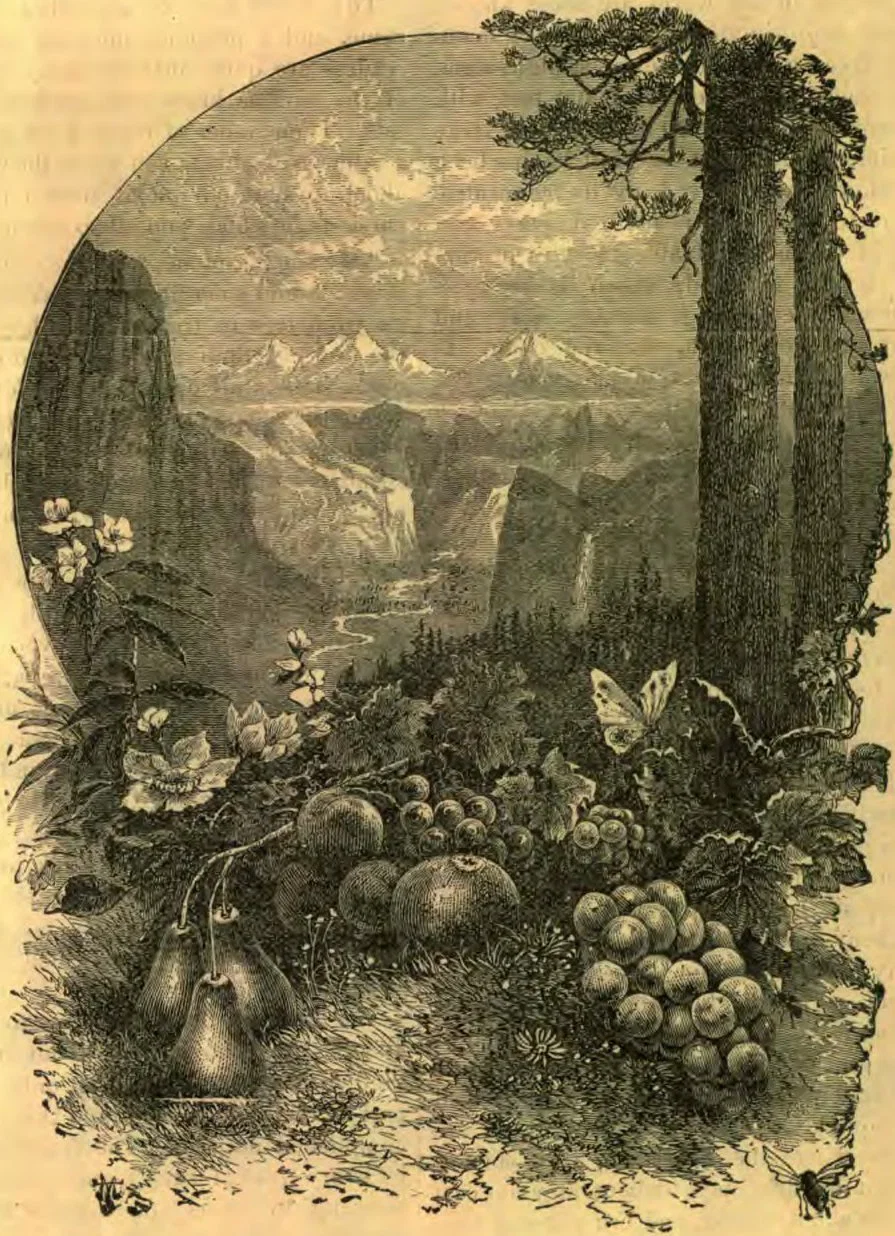
In the accompanying engraving the artist has endeavored to give us a limited view of some of these wonders. In the distance are seen the lofty mountains, rearing their snow-capped summits thousands of feet above the level of the sea. A little nearer appears a waterfall, dashing and plunging down the side of the mountain; and in the valley we see a beautiful stream dancing merrily along, making music in the solitude. In the foreground of the picture are represented a few of the flowers and luscious fruits which grow in such profusion in the “Golden State.”
The wild flowers of California are varied and beautiful, vying in loveliness with the treasures of the florist. In spring and early summer, fields and even mountain sides present for miles the appearance of one vast garden. Cultivated flowers also, roses, oleanders, geraniums, and many other choice varieties, here attain unusual size and perfection, and in many places bloom throughout the year.
The climate varies greatly in the different parts of the State, and Nature with lavish hand bestows upon the husbandman the choicest fruits of every zone. Besides the apple, peach, pear, nectarine, quince, grape, etc., such semi-tropical fruits as oranges, figs, citrons, olives, almonds, and pomegranates, are produced in great abundance, while along the southern coast the pine-apple, banana, plantain, and cocoa-nut flourish. Much of the fruit is shipped to other States and countries, but to appreciate its delicate flavors it must be eaten where it grows, and not long after it has left the parent stem.
The fruit-trees of California grow much more rapidly, and bear much earlier, than those of the Atlantic States, and are not so subject to early decay. Especially are the soil and climate adapted to the cultivation of the grape. The yield of the grape is larger, its freedom from disease greater, than in the most celebrated European vineyards. The product is seldom or never less than one thousand pounds per acre, and has been known to reach even twenty thousand pounds.
The most remarkable trees of California, the largest in the world, are those known as the Sequoia gigantea. These mammoth trees grow with a clear, straight stem, sometimes to the height of 400 feet, with a diameter of from 30 to 40 feet in large specimens. A tree of this kind, having been cut down, was proved by its concentric layers to be thirteen hundred years old. One of the most valuable varieties of timber is the redwood, which is straight-grained, free-splitting, durable, soft, and light, and of a rich, dark-red color. It grows in dense forests, often reaching 275 feet in height, with a diameter of 18 or 19 feet. The growth of these trees in the State covers an area of 10,000 square miles.
Among the most wonderful natural curiosities of the State, are its immense falls, the Yosemite, whose whole descent is 2,600 feet, but not all made at one leap. The water first falls over a granite ledge 1,600 feet high, then in a series of cascades 600 feet, and finally makes its last plunge of 400 feet. Then there are the Nevada Falls, 700 feet high, the Vernal, the Bridal Veil, besides many others.
And here the tourist finds those curious springs, where, prepared by the hand of Nature somewhere in the depths of the earth, are boiling up hot and cold water, chicken broth, hot lemonade, ink, and many other strange substances. Soda enters so largely into the composition of one spring that the water is used instead of yeast or baking powder in the manufacture of bread; flour mixed with it rises well and quickly. It is said that there are places where the fisherman, after having caught his fish, may, without moving, cast it into a hot spring, and bring it out done to a turn and ready for eating.
But lack of space prevents a further mention of these wonders of California. Pen cannot justly describe them. To be appreciated, they must be seen. To the lover of the beautiful, the marvelous, and the sublime, this privilege is one of the most precious of his life, and one which all who can, should enjoy. J. W. B.

A HARVEST PSALM.

This day, two hundred years ago, The wild grape by the river’s side, And tasteless ground-nut trailing low, The table of the woods supplied.
Unknown the apple’s red and gold, The blushing tint of peach and pear; The mirror of the Powwow told No tale of orchards ripe and rare.
Wild as the fruits he scorned to till, These vales the idle Indian trod; Nor knew the glad creative skill, The joy of him who toils with God.
O Painter of the fruits and flowers! We thank Thee for Thy wise design, Whereby these human hands of ours, In Nature’s garden work with Thine.
And thanks that from our daily need The joy of simple faith is born; That he who smites the summer weed, May trust Thee for the autumn corn.
Give fools their gold and knaves their power, Let fortune’s bubbles rise and fall: Who sows a field or trains a flower Or plants a tree is more than all.
For he who blesses most is blest; And God and man shall know his worth, Who toils to leave as his bequest An added beauty to the earth.
And, soon or late, to all that sow, The time of harvest shall be given; The flower shall bloom, the fruit shall grow, If not on earth, at least in Heaven! — Whittier.

COMETH A BLESSING DOWN.

Not to the man of dollars, Not to the man of deeds, Not unto craft and cunning, Not unto human creeds, Not to the one whose passion Is for a world's renown, Not in a form of fashion Cometh a blessing down.
Not unto land's expansion, Not to the miser's chest, Not to the princely mansion, Not to the blazoned crest, Not to the sordid worldling, Not to the knavish clown, Not to the haughty tyrant, Cometh a blessing down.
But to the one whose spirit Yearns for the great and good; Unto the one whose storehouse Yieldeth the hungry food; Unto the one who labors Fearless of foe or frown; Unto the kindly hearted Cometh a blessing down.

“STICK TO YOUR TREE.”

The merry time for gathering nuts has come, and I presume most of our little readers are quite anxious to lay in a store of the various kinds that grow in our forests. I remember of reading the advice of a father to his little son when the boy was about to start on one of these nutting excursions in which you all so much delight.
“My son,” said he, “stick to your tree, if you would soon fill your basket; do not go from tree to tree as most boys do, in the hope of finding the nuts more plenteous. Gather all on one tree before going to another, and you will come home with your basket well filled, while those who spend their time in wandering about will obtain but few nuts, and will come home quite discouraged.”
This is good advice, and I hope you will all remember it, not only while you are gathering nuts, but in whatever you do. “Stick to your tree.” If you have a difficult task to perform, stick to it until you accomplish it. If your school is your “tree,” stick to it, that your mind may be stored with knowledge, and that you may become useful members of society. Whatever vocation you choose, stick to it faithfully, and you will gather nuggets of gold as a reward of your integrity, besides gaining the approval of God, which is of far more worth.
We often see those who seem to have no aim in life, who wander about from one kind of business to another, until the best part of their life is spent and they have accomplished nothing. The fruitless, unsatisfactory lives of such persons should be a warning to others not to make the same mistake.
Children, the Lord has promised a reward to the faithful. Let us strive to do all things well, perform all the little duties, bear all the little crosses, overcome all the little sins, that we may receive a crown of life which “fadeth not away,” but will grow brighter as the eternal years roll on.
C. N. STUTTLE.

HOW TO READ.

HAVING recommended reading as one of the most important employments of the young, we now give some suggestions in regard to how to read.
Never read in a hurry, nor for the purpose of going over many books. Keep the undivided attention on the subject considered, and read slowly enough to comprehend the meaning. When you meet with words of which you do not know the definition, do not think it too much trouble to turn to the dictionary. It will be time well spent; you should, however, do this with the firm resolution never to be under the necessity of looking for one word the second time, but to fix it in the memory the first time found.
After a sentence or paragraph has been read, look away from the page and review the thought contained, either mentally or by expressing aloud the substance of it, in your own language. After a page or chapter has been thus read, pause to see if you have the general idea all in your mind and in order. This will be no waste of time; for by these efforts the memory is strengthened, and what you have read is made your own, as permanent knowledge, instead of being soon forgotten. To read to forget is a waste, both of time and of mental strength.
Do not feel that the course recommended will be too taxing. It simply requires patience and perseverance for a time; but when the habit is thoroughly established, all seems comparatively easy. You will thus have strengthened the powers of attention and memory, which will be an invaluable preparation for school study, as well as for profitable home reading. And while this careful practice takes more time at first, it will repay you a hundred-fold in a few years.
After a time, it will not be necessary to pause for review at the end of every sentence or paragraph, but, if carefully read, the contents of pages will be found traced in the faithful memory; and in history, if not too much condensed, a whole chapter can be made your own by a single reading. Still, it is best, at the end of each chapter, to pause and review while it is fresh in the mind, so as to fix it permanently in the memory.
It is very important in reading, especially in reading history, to write out an abstract or summary of the principal facts, in some systematic order, and preserve it for future reference. When the book has been read through, see that you are able to recall a complete, general idea of the whole, by the aid of the notes. If this cannot be done, review parts not clearly retained in the mind, and make the whole your own before passing to other reading. This method, faithfully pursued, will make reading a success, and, as it should be, a fruitful source of knowledge.
S. M. SPICER.

Deliberate with Caution, Act with Decision

Deliberate with caution, but act with decision; and yield with graciousness, or oppose with firmness.

LESSONS FOR CHILDREN.

LESSON XLI.—DAVID'S CONQUESTS.

AFTER this, David had many wars, and in all of them the Lord was with him, and gave him good success. He subdued the Philistines on the west, and the Moabites on the east. Then he went farther on toward the river Euphrates, and fought with Hadadeser, the king of Zobah, taking from him a thousand chariots, seven hundred horsemen, and twenty thousand footmen. And when the Syrians came to help Hadadeser, David slew twenty-two thousand of them.
David put garrisons in the cities of Syria, and in Edom. In these wars, David took much silver, and gold, and brass; and all of it he brought to Jerusalem, and laid it up to be used in building the house of the Lord.
Then David inquired diligently if there were any left of the house of Saul to whom he could show a kindness. And Ziba, who had been one of Saul's servants, told David of Mephibosheth, who was a son of Jonathan, and was lame in his feet. Then David sent for Mephibosheth, and gave him all the land that had belonged to Saul, appointing Ziba with his sons and servants to till the land, and bring to Mephibosheth a proper share of what was raised on it. Mephibosheth himself David kept in his own house, and had him eat at his own table.
David also sent messengers to comfort the king of Ammon for the death of his father; but the king of Ammon took the messengers for spies, and treated them very cruelly. Then David sent out an army that subdued the Ammonites, and made a great slaughter among them.
So David kept on till he had conquered all the land that the Lord had promised to give his people.

QUESTIONS.

  1. How did the Lord favor David in all his wars with the nations around him? 2 Sam. 8.
  2. Whom did he subdue on the west?
  3. Whom on the east?
  4. Where did Hadadeser reign? Verse 3.
  5. What did David take from him?
  6. What did David do to the Syrians that came to help Hadadeser?
  7. Where did he put garrisons? Verses 6, 14.
  8. What did he do with the gold, and silver, and brass, which he took in these wars?
  9. What inquiry did David make in regard to the family of Saul? 2 Sam. 9:1.
  10. Who was Ziba?
  11. What did David learn from him?
  12. What did he give to Mephibosheth?
  13. Whom did he appoint to till the land?
  14. What did he do with Mephibosheth himself?
  15. What kindness did David show to the king of Ammon? 2 Sam. 10:2.
  16. How were the messengers regarded by the Ammonites?
  17. How were they treated by them?
  18. How were the Ammonites punished for this insult?
  19. How long did David continue his wars?

BIBLE LESSONS FOR YOUTH.

LESSON LXVII.—DAVID'S REIGN ESTABLISHED.

  1. Who bore the news of Saul's death to David? 2 Sam. 1.
  2. What did he claim to have done?
  3. Was this true?
  4. What did he expect?
  5. What did David say to him?
  6. What was the fate of this wicked impostor?
  1. How did David give expression to his grief for the death of Saul and Jonathan?
  2. Repeat 2 Sam. 1:19, 20.
  3. What did he say to the mountains of Gilboa?
  4. What did he say of Saul and Jonathan?
  5. What touching words did he address to Jonathan, speaking to him as though he were alive and present?
  6. Of whom did David seek counsel?
  7. What did the Lord tell him to do?
  8. What honor was conferred upon David at Hebron?
  9. How long did he reign at Hebron over the tribe of Judah?
  10. Who reigned over the other tribes at this time?
  11. By whose influence was he made king?
  12. What relation existed between these two nations? 2 Sam. 3:1.
  13. How were they prospered?
  14. What did Abner finally do?
  15. Who was jealous of Abner?
  16. What did his jealousy cause him to do?
  17. What was the fate of Ish-bosheth?
  18. How did David become king over all the tribes of Israel?
  19. What city was made the capital of his kingdom?
  20. How long did he reign in Jerusalem?
  21. How long was he king in all? 2 Sam. 5:4, 5.
  22. How did the Lord prosper his reign?
  23. With whom did he have war?
  24. How was he enabled to overcome his enemies?

SYNOPSIS.

After the death of Saul, an Amalekite bore the news to David, claiming to have killed Saul with his own hand, and expecting a reward for his deed. But David said unto him, “How wast thou not afraid to stretch forth thine hand to destroy the Lord's anointed? And David called one of the young men, and said, Go near and fall upon him. And he smote him that he died.”
Then David mourned for Saul and Jonathan, giving expression to his grief in the most touching and beautiful words. The following are some of the expressions left on record:—
“The beauty of Israel is slain upon thy high places: how are the mighty fallen! Tell it not in Gath, publish it not in the streets of Askelon; lest the daughters of the Philistines rejoice, lest the daughters of the uncircumcised triumph.”
“Ye mountains of Gilboa, let there be no dew, neither let there be rain, upon you.”
“Saul and Jonathan were lovely and pleasant in their lives, and in their death they were not divided: they were swifter than eagles, they were stronger than lions.”
“I am distressed for thee, my brother Jonathan: very pleasant hast thou been unto me: thy love to me was wonderful, passing the love of women.”
David sought counsel of the Lord, and was told to go up to the city of Hebron. There he was anointed king, and reigned over the tribe of Judah seven years.
Through the influence of Abner, the chief man of Saul's army, Ish-bosheth, one of Saul's sons, was made king over the other tribes. Between these two kingdoms there was almost continual war; but David's power and influence constantly increased, while that of Ish-bosheth grew weaker and weaker. Finally, Abner, deserting Ish-bosheth, went to Hebron, and made a treaty with David, promising to bring all the tribes under his rule. Joab, the captain of David's army, hearing of this, became jealous, and slew Abner treacherously.
Soon after this, Ish-bosheth was killed in his bed by two men of his own kingdom; then the chief men of all the tribes of Israel united in asking David to become their king. Jerusalem was made the capital of the united kingdoms, and there David reigned thirty-three years.
The Lord prospered David, and he became a great king. He had many wars with the Philistines and other powerful nations, but he always sought counsel of God, and by following it, was enabled to conquer his enemies.
G. H. BELL.

SECOND ANNUAL SESSION OF MICH. S. S. ASSOCIATION.

FIRST MEETING.—This meeting was called Sunday afternoon, Sept. 28, 1879, on the camp-ground at Lyons, Mich. Meeting opened with prayer.
Seventy-seven delegates were received, and all ministers present were invited by vote to take part in the deliberations.
The Secretary’s report of the last year’s work was read, after which Eld. White made remarks, expressing his interest in this work, and relating his own experience in Sabbath and Sunday schools. He spoke of the vivid impressions made upon his own mind by his first Sunday-school lesson, learned fifty-seven years ago. Elders Jones, Miller, Kenyon, and other brethren, gave encouraging reports from the schools in their districts.
W. C. White spoke of the increase of interest in our S. S. work during the past year. Only one year ago our first camp-meeting Sabbath-school was held on the Battle Creek camp-ground. This was an experiment, and was entered upon with many fears. This season a Sabbath-school has been held in connection with every camp-meeting. The well-filled tent at our teachers’ and officers’ council this morning gave evidence of the interest in Michigan.
It was then moved and carried that the Chair appoint a committee on nominations, and also one on resolutions. During the consultation in regard to these committees, Eld. E. B. Lane made remarks, in which he spoke of the part which the S. S. work will have in preparing men and women to carry this last message.
The Chair now reported the following committees: On nominations, E. H. Root, Wm. Ostrander, Richard Coggeshall. On resolutions, M. B. Miller, E. B. Lane, H. M. Kenyon.
Meeting adjourned to call of Chair.
SECOND MEETING.—The committee on nominations being called, the chairman gave the following report: President, W. C. White; Secretary, Eva Bell; Executive Committee, W. C. White, J. Fargo, G. H. Bell. The report of the committee was accepted, and after remarks from W. C. White, the officers recommended were separately elected.
The report of the committee on resolutions was as follows:—
Resolved, That all schools which have not obtained a full set of record and class books should do so at once, that they may be enabled to keep proper records and make necessary reports to the State Sabbath-school Association.
Resolved, That we recommend that each school take a club of the weekly INSTRUCTOR sufficiently large, not only to supply its members, but to give to visitors and new scholars who may be induced to come into the school.
Resolved, That our schools should manifest a special interest in securing the attendance of the children of our neighbors, and should form branch Sabbath-schools and Sunday-schools wherever it is practicable.
Resolved, That it is the duty of each school to pay one-tenth of its Sabbath offerings or regular contributions to the State Sabbath-school Association, and that it is the duty of the Association to pay one-tenth of its receipts to the General Sabbath-school Association.
Whereas, The efficiency of officers and teachers would be greatly increased by frequent consultation, therefore
Resolved, That we deem it expedient for each school to hold a teachers’ meeting on the fourth Sabbath in each month.
The report having been accepted, the resolutions were put to vote singly, and unanimously adopted. Remarks were made by different ones in support of the several resolutions.
Suggestions in regard to conducting a teachers’ meeting were called for. G. H. Bell and W. C. White responded by a few brief remarks.
A resolution was now passed that a vote of thanks be extended to our State Secretary, Mrs. Lettie Marvin, for her faithful and untiring labors in the S. S. work during the past year.
The meeting was then adjourned sine die.
W. C. WHITE, Pres.
EVA BELL, Sec. pro tem.

A THORN IN THE PILLOW.

LITTLE Mabel went to visit her grandmother. She seemed happy all day; for she had everything to make her happy; but when her grandmother went to look at her after she was asleep, she saw tear-drops on her eyelashes.
“Ah,” said the old lady the next morning, “you were a little homesick last night, my dear?”
“Oh, no, grandmother!” Mabel replied, “I could never be homesick with you.”
It was just the same the next night, and the next. At length her grandmother thought, as the child seemed troubled, she would sit in the next room until she went to sleep. Presently, although Mabel was tucked up, she began to rustle the quilt, and shake her pillow; and her grandmother heard a little sob; so she went to her and said, “Mabel, my child, you have a thorn in your pillow; what is it?” Then the little girl hid her face, and began to cry aloud. Her grandmother was very much troubled.
At length Mabel answered, “O grandmother! when I am alone here I cannot forget how I said ‘I won’t, mother;’ and I cannot unsay it. Mother is so good, and loves me very much! and—I—I was so naughty, grandmother!”
The tears streamed afresh down the child’s cheeks. Here, then, was the thorn in the pillow; and she could not withdraw it. And so it will be by-and-by with the little boy who is at home now. When he is away among strangers he will think of the home of his childhood, and the recollection of some unkind word or action will be a thorn in his pillow when he retires at night. And the little girl who does not care to help her mother now, and looks cross when told to do anything, will find a thorn in her pillow when that mother sleeps in the grave.—London Children’s Friend.

LETTER BUDGET.

FENTON, MICH.
DEAR EDITORS: I take the INSTRUCTOR and like it ever so much. I don’t see how I could get along without it. I like my book, The Hard Way, too. I think it worth fifty cents. I haven’t got any subscribers for the INSTRUCTOR yet, but am not going to give up trying. I keep the Sabbath with my mother and sister. I have no brothers, and have only one sister. Her name is Nettie. She is ten years old. Yours truly, IDA CHATFIELD.
RIO, KY.
DEAR EDITORS: I am keeping the Bible Sabbath with my father, mother, and two little sisters. I attend Sabbath-school at our new church, and learn the lessons for the youth, and the lessons on prophecy, which interest me very much. There are twenty-three pupils in my class. I was baptized by Bro. Osborn last fall, and united with the church. I want to so live that when Jesus comes I may hear the welcome, “Enter into the joy of thy Lord.” Pray for me, that I may prove faithful. MATTIE WILLIAMS.

DISCOVERY OF ILLUMINATING GAS.

GREAT was the amazement of all England when, at the close of the last century, William Murdoch discovered the use of combustible air, or gas, for illuminating purposes. So little was the invention understood and believed in by those who had never seen it in use, that even great and wise men laughed at the idea. “How could there be light without a wick?” said a member of Parliament, when the subject was brought before the House. Even Sir Humphrey Davy ridiculed the idea of lighting towns with gas, and asked one of the projectors if they meant to take the dome of St. Paul’s as a gas-meter. Sir Walter Scott, too, made himself merry over the idea of illuminating London by smoke; though he was glad enough, not long after, to make his own house at Abbotsford light and cheerful on winter nights by the use of that very smoke.
When the House of Commons was lighted by gas, the architect imagined that the gas ran on fire through the pipes, and he therefore insisted on their being placed several inches from the wall, for fear of the building taking fire; and members might be observed carefully touching the pipes with their gloved hands, and wondering that they did not feel warm. The first shop lighted by the new method was Mr. Ackerman’s, of the Strand, in 1810; and one lady of rank was so delighted with the brilliancy of the gas-lamp on the counter that she asked to be allowed to take it home in her carriage.
Mr. Murdoch was too busy with his other pursuits to study the uses of gas, and though he was undoubtedly the first to apply it to practical purposes, many others laid claim to the honor, and other people quickly reaped the benefit of his cleverness and ingenuity. In this he shared the general fate of inventors.

Monkeys, Gourds, and the Snare of Riches

IN Brazil, monkeys are caught by filling gourds with Brazil-nuts. The monkeys put in their little paws, but get them so full of nuts that they cannot pull their paws out of the gourd. They do not know enough to open their paws and let the nuts go, and so are easily caught. In like manner, rich people put their hands in their pockets, clasping the dollars so tightly that they cannot—at least do not—get their hands out, and so they are caught. Who is the catcher? Who, indeed! Any Sabbath-school scholar can answer that question.—S. S. Visitor.

The Name Dandelion and Its Origin

THE word dandelion is made up of three French words, dent de lion, a lion’s tooth. It receives this name because its leaves are of the peculiar form called by botanists runcinate, the lobes or teeth of the leaf inclining backward, as the teeth of the lion do. It is in this way that flowers, plants, animals, and almost all things, get their names; the most prominent characteristic or peculiarity is taken, and a corresponding name given.

FATHER'S DINNER.

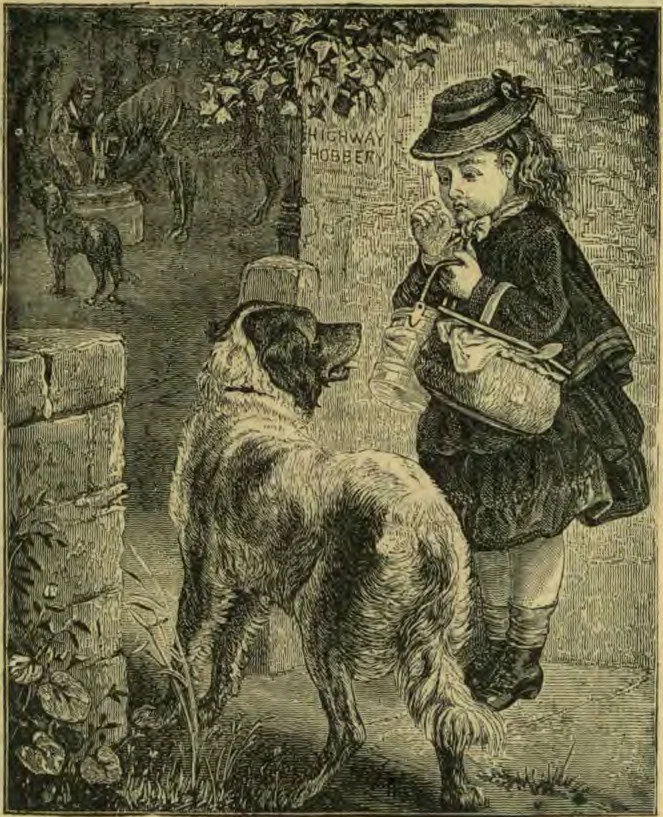
She is off to the fields where her father is working, No flowers has she lingered to pluck by the way; He waits for his dinner, and duty not shirking, A dear little daughter will bring it to-day.
Don't frighten her, Rover; it is not for you, sir; All ready at home are nice bones for your share; Come, let her pass by, as she's wanting to do, sir; The clock has struck twelve, and she ought to be there.
Fear not, little maiden, he never will harm you, Though Rover is hungry and dinner smells good; He is gentle at heart, though his looks may alarm you, Not like the sly wolf that once roamed in the wood.
Then off to the fields where kind father is sowing. He'll welcome you gladly, he tired must be! And on your way home you can get, if they're blowing, Some flowers to deck mother's table at tea.

You have reached the end of this edition.

The Youth’s Instructor · Oct 1879