Signs of the Times, Vol. 35, No. 15.

Love for the Erring
Earlier text: Love for the Erring

In His Presence.

THIS world forms a part of God's great universe. In its orbit and station in the heavens it forms as much a part of the great heavenly universe as does any other world. And while sin has entered this once beautiful and perfect world, even this fact does not shut us entirely away from God's presence.
Somehow we have been educated by the artful deceiver to believe that we can hide away from God down here in this darkened corner of His universe, and get entirely out of His presence. But this is not so. The psalmist wrote: “Whither shall I go from Thy Spirit? or whither shall I flee from Thy presence? If I ascend up into heaven, Thou art there: if I make my bed in hell [the grave], behold, Thou art there. . . . If I say, Surely the darkness shall cover me; even the night shall be light about me. Yea, . . . the darkness and the light are both alike to Thee.” Ps. 139:7-12.
There is a peculiar charm that takes possession of one when in the very presence of his friends and loved ones. There is a power for good or evil that takes hold of the very life, influencing it either in the right or wrong direction. Even an evil-minded person is often restrained from deeds of violence or of shame by the presence of some noble-minded, pure-hearted one. The good mother's presence in the home is a constant benediction, full of encouragement, helping all to do right, and repressing the evil.
But what about the presence of God? If the presence of some good person has such blessing in it for good, what should the very presence of God do for us?
There is a sweet little story told of how the tiny daughter of an atheist unconsciously brought this thought home to her father's heart with great force. The father did not want his little girl to form any idea of God, so wrote out these words on a bit of paper, “God is nowhere.” He then asked her to read it to him. She began, and so spelled the sentence out as to make it read, “God is now here.” It is said that this so startled the man that he was brought to the feet of Jesus, to acknowledge Him whose very existence he had heretofore denied.
Ah! he learned, as all sooner or later must, that we are living and acting in the very presence of the great I AM. “Neither is there any creature that is not manifest in His sight: but all things are naked and opened unto the eyes of Him with whom we have to do.”
Well will it be for those who profess to be His children not to forget in whose presence we constantly dwell. T. E. BOWEN.

With Our Inquirers

"If ye will inquire, inquire ye."
[All questions to this department will be answered which to the editors will seem to minister to the good of the readers and to the mission of the paper. The same question can not be answered repeatedly in the same volume. The name and address must accompany question, not for publication, but as an evidence of good faith, and that answer may be made by letter if deemed advisable. It is well always to enclose a stamp for reply.]

2648.— Heb. 9: 9, 10, and the Types.

Heb. 9:9, 10 refers to sacrifices which pointed to the Crucifixion, but not to the seventh year, nor to the year of jubilee, which pointed to eternity. Are these fulfilled? K.
They are all, in Christ Jesus. "It pleased the Father that in Him should all the fulness dwell." Col. 1:19. Every moral and every typical truth finds in Him its fulfilment. Every moral truth of which we come in actual possession must come through the righteousness of God in Him. In His work is the fulfilment of every type. He gives us the earnest of the jubilee in our experience of freedom from sin now; He will give us the fulness when we enter upon our eternal inheritance. But all were potentially in Him when He rose a victor from the grave.

2649.— The Extent of the Gospel Message.

How far has the Gospel message been preached? S. W. H.
We do not know. Practically every nation has been reached. There are a few places still where the Gospel missionary has never gone. The statement quoted from the Christian Herald is doubtless correct, so far as we know; but God often carries His work beyond the visible sight of man, so that these unreached places may have some natives who are preaching this Gospel. We can not measure or estimate God's word and work by our worldly senses.

2650.— The Levitical Law.

Is all the Levitical law done away? If so, how can we teach health reform or tithing from the Bible, since where there is no law, there is no sin? Were not the laws of clean and unclean beasts and the laws of tithing a part of the Levitical law? And are these laws done away? C. M. M., M.D.
The Levitical law is done away. It was given to the Jewish nation and the Levitical priesthood. Many of its civil and statute laws were based upon eternal principles which shall exist as long as the things to which they apply exist. They are founded in the relationship between the creature and his Maker, between sinful man and his Redeemer. The Levitical precept is gone, but the principle abides, and is obligatory now. Clean and unclean beasts existed before the Levitical laws were given. They were recognized in Holy Writ as early as the Deluge. So also the law of tithing, or rather man's duty to acknowledge God's sovereignty and ownership antedated the time of Moses. It was recognized by Abraham and Jacob and doubtless by all the holy men of God. God tests His people on the matter of time by His Sabbath; on the matter of means by the tithe. Both antedated the Levitical law; both survived it. All the moral law was interwoven with the Levitical laws. All survives. Jesus indorsed the duty of tithing even in small things (Luke 11:42), and Paul tells us that those who minister in spiritual things should partake of the things of the altar, "even so" as did the priests of old; namely, by the tithes (1 Cor. 9:13, 14).
The matter of diet is not a matter alone of clean and unclean beasts. Some are in their very natures unclean and unwholesome, and ever will be, law or no law. God has clearly taught this, and the soul who transgresses sins against his own body. Our God did not say that certain animals were clean and unclean arbitrarily, but because they were so in very nature. In these days even the clean animals are becoming frightfully diseased. Better to know the higher teaching of the word and go back to the non-flesh diet. The best diet law in the world is 1 Cor. 10:31.

2651.— Gold and Silver. Job 28:1.

Please explain Job 28: 1. Is gold not in veins as well as silver? Was there any difference in the old time? W. J. M.
Please read the text as in the Revised Version: "Surely there is a mine for the silver, and a place for gold which they refine." See also the margin of our Common Version; "a mine" instead of "a vein." That is a beautiful and poetical way of expressing it, that there is a place for these things which men themselves find, and they find everything but wisdom. Silver is found in the mine, gold is found in its place; men gather it from these places and refine it. That is the thought of the text. As Boothroyd translates: "Truly there is a mine for silver, and a place for gold which men refine." Then, too, in most of the gold-mining of the past has not the gold been found in pockets, or in placers?
Our Bible Band
Our Bible Band

"Not Weary."

ONE of our Bible-Band readers says about following the readings:
"I haven't grown weary yet, I enjoy it more every day. I enjoy reading the blessed pages of the SIGNS, so full of the Gospel. It surely has taught me the narrow way, which I did not know before."
*
Schedule for Week Ending Nov. 21, 1908.
Sunday, Nov. 15 Amos 7, 8 1 Cor. 12
Monday, " 16 " 9 " 13, 14
Tuesday, " 17 Obadiah " 15
Wednesday, " 18 Jonah 1-4 " 16
Thursday, " 19 Micah 1, 2 2 Cor. 1
Friday, " 20 " 3, 4 " 2
Sabbath, " 21 " 5-7 " 3, 4

Suggestive Notes.

In the Old Testament our lessons cover Amos 7-9 and the books of Obadiah, Jonah, and Micah. Amos concludes with some striking prophecies, typical also of last-day conditions, when the wicked, having rejected God's word, will in time of calamity wander from sea to sea, and from north to south to find it, but will not be able. Then will God save His people and build up the tabernacle of David that is fallen.
*
"Obadiah" means "Servant of God." He lived in the time of Jeremiah. But one of his prophecies has come down to us, that of one chapter, against the Edomites. The sixteenth verse very clearly shows that those who abide in the class of the oppressors of God's people, the wicked among the nations, shall be utterly destroyed so that they shall be as tho they had not been.
*
"Jonah" means "dove." All that we know about this prophet besides what is told in the book written doubtless by himself is found in 2 Kings 14:25, which refers to a prophecy he made concerning Jeroboam II. Jonah is one of the first books which was questioned by the higher critics, and yet there is nothing in it at all which is in any wise unreasonable if God chose so to do. The book is a witness of the remarkable power of the Spirit of God through humanity when man will yield himself to God's work. It clearly shows that we can not run away from the presence of God.
*
"Micah" means "Who is like Jehovah." He was born at the little village of Moresheth, southwest of Jerusalem, and prophesied in the reigns of Jotham, Ahaz, and Hezekiah; an early contemporary of Isaiah, whose prophecies Micah's resemble. This is especially seen in the prophecy of the fourth chapter of the latter days. The closing chapter of the book is a stirring last-day prophecy, when God will gather His people. It contains one of the most wonderful expressions of God's loving mercy to His children. It gives the lie to all those who would have us understand that the Old Testament treats of wrath alone, while the New treats of mercy. No appeal can be stronger than that of the eighteenth and nineteenth verses of Micah 7.
*
Our New Testament readings conclude the book of 1 Corinthians with the apostle's masterly argument on the resurrection and cover 2 Corinthians 1 to 4. What wonderfully encouraging chapters those are! The first records that the apostle's reproof in the first epistle was heeded, for the sinning one had repented.
A better understanding of chapter 3 can be had in the tract entitled "What Was Done Away in Christ?" On sale at this office, price, two cents. Chapter 4 is an expression of the apostle's faith under all kinds of discouragement.
Our Bible Reading
Our Bible Reading

Sowing to the Spirit.

1. How many good overruling spirits are there? "There is one body, and one Spirit, even as ye are called in one hope." Eph. 4: 4.
2. In order to be Christ's, what must we have? "If any man have not the Spirit of Christ, he is none of His." Rom. 8: 9.
3. How may we obtain that Spirit? "Receive the promise of the Spirit through faith." Gal. 3:14. "Ask, and it shall be given you. . . . If ye then, being evil, know how to give good gifts unto your children; how much more shall your heavenly Father give the Holy Spirit to them that ask Him?" Luke 11: 9-13.
4. What will that Spirit received do for us? "The love of God is shed abroad in our hearts by the Holy Spirit which is given unto us." Rom. 5: 5.
5. What will be the fruit borne in the life? "The fruit of the Spirit is love, joy, peace, long-suffering, gentleness, goodness, faith, meekness, temperance; against such there is no law." Gal. 5: 22, 23.
6. Why is there no law against such fruits? Because "the righteousness of the law is fulfilled in us, who walk not after the flesh, but after the Spirit." Rom. 8: 4.
7. Who possessed the Spirit of God in its fulness? "God anointed Jesus Christ of Nazareth with the Holy Ghost and with power." Acts 10: 38. "God giveth not the Spirit by measure unto Him." John 3: 34.
8. How did He regard God's law? He said, "I delight to do Thy will, O My God; yea, Thy law is within My heart." Ps. 40: 8. "I have kept My Father's commandments, and abide in His love." John 15:10.
9. How will those who have the Spirit regard God's law? "For this is the love of God, that we keep His commandments; and His commandments are not grievous." 1 John 5: 3. "Ye are My friends, if ye do whatsoever I command you." John 15:14.
10. What will thus sowing to the Spirit bring? "He that soweth to the Spirit shall of the Spirit reap life everlasting." Gal. 6: 8.

Efforts to Save Others

EVERY one will put forth an effort in saving others according to the estimate which he places on his own salvation.—William Covert.
“It is a fact that at least 30,000 human beings in China, 30,000 human beings in India, and probably 15,000 in Africa, die every day, and that the great majority of these die without ever hearing what the Son of God did for them.”

The Houses of Fiji

The Fiji Islands—No. 2

By J. E. Fulton

The Houses of Fiji.

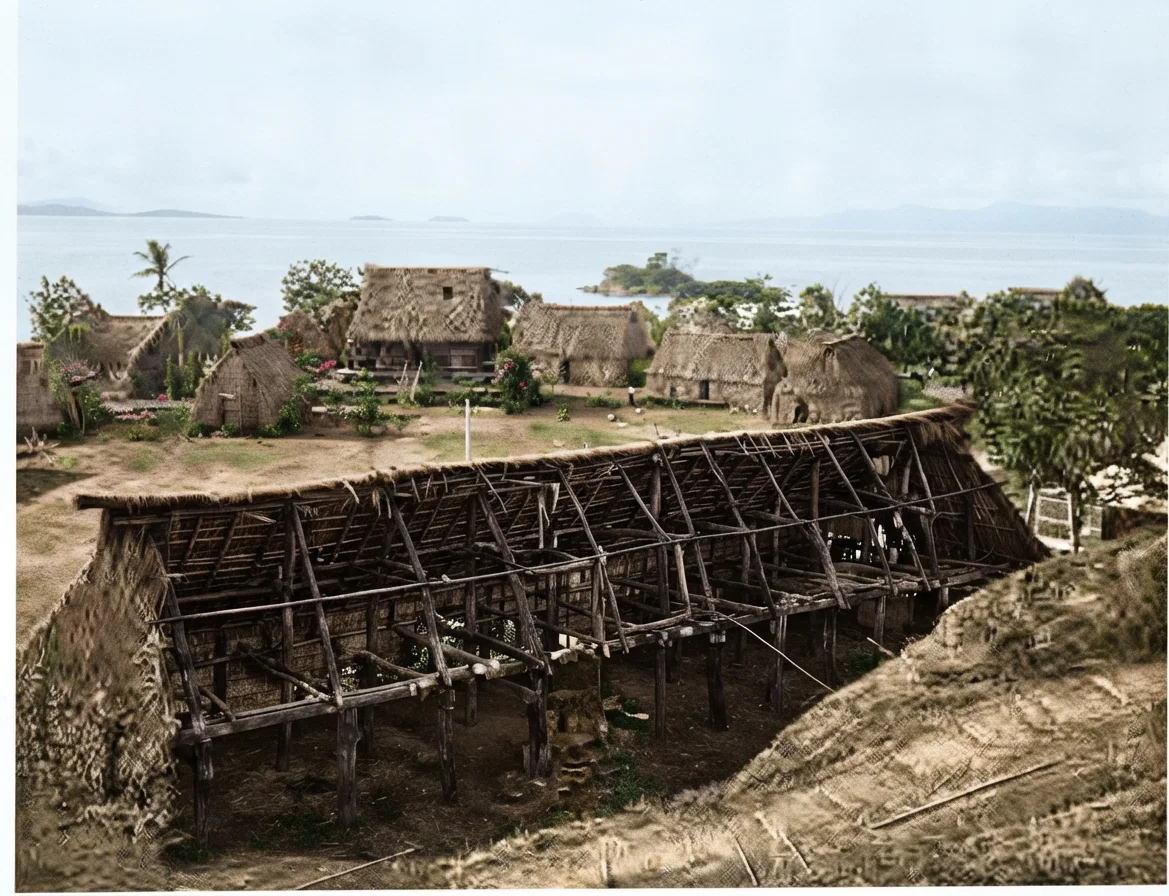
THE houses of the Fijians are of an oblong form, except in the Lau group, where they are oval. The average-sized house is about twenty-five feet long and fifteen feet wide. The houses of the chiefs, however, are usually much larger, and some of the houses built for various purposes have been two hundred feet in length. The framework consists of hard-wood posts set deep into the soil, and sills, and rafters ascending to a ridge-pole. The roofs are steep, and are thatched with reeds and cane. The sides are neatly woven with reeds. All the lashings are of sinnet, a string or rope made from the husk of the coconut. The better houses and the houses of the chiefs are built on a high foundation.
Interior View of Native Fijian House.
An interior view shows the style of Fijian architecture. Note that instead of nails, sinnet is used to lash the great posts and rafters. The houses are cool and inviting in the hot, sunshiny days.
Inside the houses there is usually a good supply of mats and tappa cloth. Tappa is made from the bark of a tree. Earthen jars and bowls, and wooden pillows are the ordinary articles to be found in their houses. There are no chairs or tables. Meals are taken while sitting tailor-fashion on the mats, and a clean mat serves as table.
The men are the carpenters, and the women make the beautiful mats and the tappa cloth. The houses are not very durable, and as the islands of the group are often visited by hurricanes, they are often thus destroyed.

Fiji Then and Now.

The accompanying picture shows a partial view of the town of Bau. This was the old cannibal capital, and brings to the minds of those who have read Fijian history many records of wars of the most abhorrent nature. Here was their beautiful little island, only a little removed from the mainland of Viti Levu, and in full view of lovely neighboring islets; in the midst of all that can please the taste, or charm the fancy, or gratify the imagination, where everything is fair and bright and beautiful, where the dreamy haze of a tropical clime rests lovingly on hilltop and sea, where the sun smiles in gladness upon landscapes buried in foliage and flowers—here man alone was found debased. Where nature had displayed her greatest charms, God's image was most loathsome and deformed!
All has been greatly changed. The reformation was wrought by the blessed Gospel. Many had become weary of useless wars, and longed for peace for soul and body. The old cannibal ovens are cold, or are used for other purposes; the old drum that summoned the people to the terrible feast, now sounds out the hour of worship or of school. The old heathen priest no longer holds his incantations, directing or commanding human sacrifices. In the picture is seen a house on a high foundation. This was the old foundation of an old heathen temple. Only recently would any one dare to build thereon.
Here polygamy was common, every man having as many wives as he could afford to keep. The high chief sometimes had several score, while the middle class contented themselves with ten or a dozen. The marriage ceremony was performed by the priests, who enjoined upon the parties the duty of loving, obeying, and honoring, very much as is done in civilized countries.
When a chief died, many of his wives were strangled to be buried with him. Old persons were often put to death at their own request to escape decrepitude, and sometimes they were forcibly strangled, or buried alive by their children.
Bau, Fiji, formerly the royal headquarters.
Frequently on the occasion of the erection of chiefs' houses, men were buried alive clasping the great posts which were sunk deep in the ground.
House of Fijian Chief.
Bau stood as the place where the worst of all these practises were rife. Old Cakobau was then the king of Fiji. He long resisted the influences of Christianity, but later he became favorable, tolerated the Christians; next he embraced the new lotu, and apparently lived quite a consistent life. He handed over his war-club to Great Britain in 1873 when Fiji became an English possession.

DATE OF EXPIRATION.

The SIGNS' wrapper bears date of last issue due on your subscription. Unless renewed in advance, paper stops with expiration date.
If herewith is an order-blank, you will know you have overlooked sending renewal. You will not wish to miss a single issue. Back numbers often can not be furnished.
CHANGE OF ADDRESS.—When a change of address is ordered, both the new and the old address must be given. The notice should be sent one month before the change is to take effect.
HOW TO REMIT.—Remittances should be sent by Draft on San Francisco or New York Express-order, or Money-order, payable to order of SIGNS OF THE TIMES. Cash should be sent in Registered Letter.

The China Printing-Press Fund

Wanted—a Book.—Have any of our readers a book or pamphlet on the Lord's coming by Josiah Litch, published in 1838? If so, will they kindly let us know? We should like to negotiate for the loan or purchase of the volume. Address the editor of the Signs of the Times, Mountain View, Cal.
Some persons' patience under exasperating slowness and perplexing difficulty is only simple laziness or utter lack of interest.
News comes by way of Paris that Menelik, Emperor of Abyssinia, is dead and that grave troubles have followed his death. We hope that it may result in the free preaching of the everlasting Gospel in that land.
Two towns—Cathro and Bolton—in northern Michigan, are almost wholly destroyed by forest fires, and twenty-two lives are lost in the northern part of the southern peninsula. It is believed that the loss of property will reach immense proportions, and that many more persons are burned and killed.
The Eastern Question is unsettled at this writing. The ambitions of smaller powers involved, and jealousy and covetousness of the great European powers, postpone the day of settlement. It is well to remember the assurance of Holy Writ that God's "eyes observe the nations," that "He removeth kings, and setteth up kings." He will overrule all things for the progress of His work and the good of His trusting children. Therefore, whatever the outcome, we may trust and not be afraid.
The Pacific Mail Steamship Company is in a deadly commercial conflict with a strong Japan company, the Nippon Yusen Kaisha, for the carrying trade between this coast and the Orient. The Japanese have been cutting rates and the order of the Pacific Mail is to meet every slash in prices. It is said that the Japanese are not only working for the carrying trade of the Pacific, but also for the Atlantic-Oriental trade by the way of the Suez Canal. Such strife as this will not help peace conditions between the two countries.

The China Printing-Press Fund.

A faithful sister sends us a liberal donation to the China Printing-Press Fund, with the remark, "I often think if I were educated and younger, how I would love to distribute literature over there in that needy field, but as I can not do that, I will try to do the next best thing, that is to help with my means."
Week by week the list of gifts to this fund grows, but much more is needed, and we trust that many more will do as this sister has done, help with their means. The appeals which come from China are pitiful in their accounts of ignorance and sin-blindness. Nothing in all the world can lift these millions from their condition except the Gospel of a sin-pardoning Redeemer. Every gift to this fund, however small, will help in this work. Send to the Signs of the Times, Mountain View, Cal.
The Pope at the Head.—A writer, "Junius Junior," in the London Weekly Times, of Aug. 14, 1908, the author of a book on the reunion of Christendom, suggests a scheme for that union with the pope at the head. He thinks that "if a pope were willing to lead such a movement and at the same time to allow liberty of conscience to all, his accession would clearly add great strength to the movement because of his enormous following, and—granted liberty of conscience—will my critics explain wherein lies their objection to his leadership?"
"Junius Junior" is not a Catholic or a high church ritualist. He is a very liberal thinker. He thinks there are many "guessers" at truth, and he feels that these "guessers" should "work together in furthering the spread of Christianity which is common to all." The question of the leadership of such a movement he holds to be subordinate, but the strongest one would be the pope. Well, the pope is leading a movement for the reunion of nominal Christianity, and it will be outwardly successful, tho only outwardly so. True union is first of all life union with Christ Jesus, and life union with Him can never compromise vital truth. There are great divisions on utterly non-essentials at present. The false union of Christendom will be made over dogmas the acceptance of which will make void the word of God. With unutterable longings for union, one must remember that Christ is first. He is the Way, the Truth, and the Life. There is no other Way.
The Unemployed.—The papers are continually discussing what is to be done with and for the unemployed. England has a big problem on her hands in caring for her dependent old people and her unemployed men; Germany, France, Austria, and the United States all have their problems in caring for the men who are out of work. Efforts have been put forth to get the exact statistics in regard to the number of men who have no employment, and while the exact number is hard to ascertain, yet it is known that there are hundreds of thousands in this country alone who have nothing to do. These vast armies of men with no work become active agents in creating and extending discontent and strife. And the problem is not merely one of finding food and shelter for these idle men and their families, but how the revolutionary sentiments that they are stirring up may be properly dealt with.
For the last half century the inventions and improvements of the age have created a great demand for factories, and we have gradually drifted into two classes: those who have money to build factories or establish industries to employ labor, and those who are dependent upon some one to employ them. The men who can employ themselves and also set others to work are becoming fewer in number, and there is a growing army of those who are utterly helpless unless some one will give them something to do.
If these men who are out of employment would begin to think seriously of getting for themselves independent means of livelihood, they would find that many avenues could be opened so that they could get started with but very small capital; indeed, about all the capital needed is a disposition to work and be economical. But in the first place, the idea must be discarded that we are to depend upon some one else to hire us. We must learn how to employ ourselves.
In the line of self-employment there is no more promising field than agriculture. Many people think that the farmer has about all the hard time of work and trouble that there is. But there was never a greater mistake. The farmer has the most independent and happy life, provided he brings intelligence and industry to bear upon his work. And he does not need to have two hundred or three hundred acres in order to succeed. Some of the most successful and happy agriculturists are on just from three to ten acres of land. They have no worry about getting out of a job, and are making a far better living than many of the mechanics who are steadily employed.
The government has done an immense amount of experimental work in all lines of farming and stock raising, and it furnishes literature that will enable any one to start upon his work intelligently. A line to the Secretary of Agriculture, Washington, D. C., will bring you back a catalog of all the publications that are helpful to the farmer. And the man who will get these documents and study them may take hold of his work in such a way as to win success. Then there are numerous good papers and books, gotten out by private publishers, which may be very helpful to those who can afford them. But the government gives, absolutely free, enough information to enable any reasonably intelligent person to get started and make a success. And why should people hover around the cities in the "army of the unemployed" when the broad acres and the good air and sunshine of the farm are beckoning to them to come out and be free?
"Peach Leaf Curl," "Yellows," "Rosette," and "Little Peach" are the subjects discussed in Bulletin No. 26 of the Georgia State Board of Entomology. This bulletin is ably prepared, well illustrated, and will be very useful to those interested in that topic. Address, E. L. Worsham, State Board of Entomology, Capitol Building, Atlanta, Ga.

You have reached the end of this edition.

Signs of the Times · Nov 11, 1908