Review and Herald Publishing Company · Battle Creek, Mich. · Dec 7, 1899
DAVOS, SWITZERLAND
By H. P. Holser
In these days, when consumption is making such fearful inroads that it is regarded by some as one of the last-day plagues, every remedy is tried in the hope of effecting a cure, but of all the legions of medicines and nostrums now in use, none is found of lasting help. The greatest benefit is derived from a change of climate. In Europe it has for many years been the custom to send invalids, especially those having weak lungs, to the warm, sunny shores of the Mediterranean during the winter, and to the mountains and cooler regions of the North during the summer.
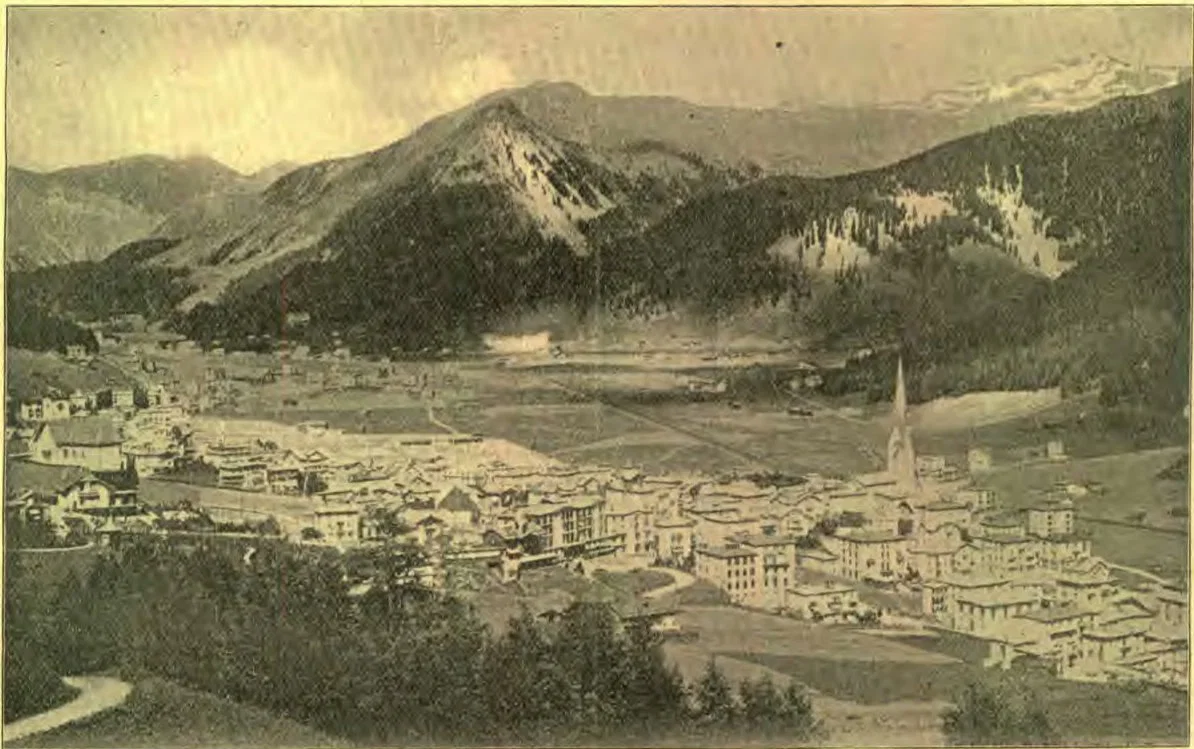
DAVOS, SWITZERLAND.
Of late years, attention is turning to elevated mountain regions, where there is plenty of sunshine, and dry, pure air; and at present, localities of this order that have gained some reputation are sought by thousands. Such a place is Davos. In the Swiss Alps are many high valleys more or less famed as resorts for consumptives; but Davos now ranks first. It is annually visited by about fifteen thousand persons, a large majority of whom are consumptives, from Switzerland, Germany, England, France, Russia, and nearly all other European countries.
Attention was first called to Davos as a favorable place for consumptives by the fact that natives of this valley who went to lower regions for employment, and were attacked with tuberculosis, soon recovered on returning to their mountain home. Physicians who observed this began to recommend the place for other consumptives, and these also found relief. As early as 1864, Davos enjoyed some fame as a resort for those afflicted with lung diseases; but owing to the prejudice of physicians, its popularity increased only gradually until recently. At the present time, however, it is enjoying a considerable boom.
Davos is near the Rhine Valley, south of Lake Constance, not far from the Austrian frontier, in the Alpine region known to tourists as the Engadine. The valley is five thousand two hundred feet above sea-level, and is about ten miles long, and nearly a mile wide. On both sides of the valley, mountains rise precipitously from two to three thousand feet; pine forests growing on these heights as far as six thousand five hundred feet above sea-level afford many winding walks for patients; and the numerous brooks dashing down the steep mountains furnish music to the lover of nature, and bring sadness to the heart of the lonely and home-sick.
Besides several large and well-equipped sanatoria (which the Germans in their native love of simplicity call “cure-houses”), numerous villas and pensions adorn the hillsides. Twelve physicians, several of them foreigners, are practising here. While it is generally admitted that the air is the chief remedial agent, there are various ways of treating patients. As in other places, the physicians here are “in one another’s hair,” as the Germans express it. Those of most experience and best success use little or no medicine, and prescribe a moderate, three-meal diet, and absolute rest in bed, not even allowing the patient to feed himself till all fever is gone. Others prescribe a certain amount of exercise; but nearly all are alike cautious about allowing patients to climb, for fear of hemorrhage. The majority keep their patients out on sunny balconies from morning till ten o’clock at night, well wrapped up, on reclining chairs; this they call the “lying cure.” Many follow the system of “stuffing” their patients, having them take food six times daily; in addition to three regular meals, some are advised to drink from two to three quarts of milk a day, the idea prevailing that the patient must be made fat.
Many patients who come to Davos in advanced stages of consumption are cured, though such must remain from one to several years. Some return to low altitudes to follow their former occupation, but many of these are obliged to return after a time; some find it necessary to live always in a high altitude, in order to avoid a return of the disease. There are some now living in Davos who came there as consumptives twenty-five years ago.
The purifying effect of the air in Davos is truly remarkable; this place might be termed a “washerwoman’s paradise.” Linen carelessly washed, and hung out full of spots, soon becomes pure-white in the sun; in fruit which has already begun to spoil when sent here, the process of decay ceases, and the decayed portion dries up.
But while the air, the Lord’s life-giving medicine, is doing so much to keep marked victims of the dread disease out of the grave, it is sad to see them counteracting its good influence by wrong habits of eating, drinking, dressing, and amusement. Such are working against the Lord’s healing agents. Could the principles of right living, as revealed in the gospel, be made known and followed in such places as Davos, how much good would result!
H. P. HOLSER.
Being Understood Through a Simple, Sincere Life
“ARE we always ‘misunderstood’?” The only sensible remedy is to make our life and character so simple and plain and helpful and sincere and sunny that any one can understand them. Nobody misunderstands sunshine or fresh air.”
Address and Accomplishments Open Doors for Young Men
“Give a boy address and accomplishments, and you give him the mastery of palaces and fortunes wherever he goes; he has not the trouble of earning and owning them; they solicit him to enter and possess.”
BEREAN LIBRARY STUDY
“Thoughts on Daniel,” pages 32–41
The regular Outline of this study is published in the Review and Herald and also in the Missionary Magazine. What is here given is only supplementary, and should be studied in connection with the Outline.
NOTES ON LESSON 2
(December 10–16,)
1. Magicians and Sorcerers.—These ancient wise men, so called, abounded in Babylon. They professed to be able to reveal hidden things, to foretell future events, and to make known mysteries entirely beyond human wisdom. The sorcerers boldly claimed to derive their superior wisdom by holding communication with the dead. Daniel must have been quite familiar with the falseness of such claims; and as he came in contact with those who made them, he no doubt remembered the warnings against them that the Lord had before given to his people. See Lev. 19:31 and Deut. 18:10–14.
2. Modern Spiritualism.—That there is a striking similarity between the sorcery of ancient times and the Spiritualism of these days is evidenced by the very meaning given to the latter term. Look up the definition of Spiritualism in the dictionary, and note especially the means by which the pretended wisdom is supposed to be obtained. N. F. Ravlin, a Spiritualist lecturer, says: “The very central truth of Spiritualism is the power and possibility of spirit return, under certain conditions, to communicate with those in the material form.” J. J. Morse, in “Practical Occultism,” page 85, thus connects modern Spiritualism with the sorcery of the past: “The phenomenal aspect of modern Spiritualism reproduces all essential principles of the magic, witchcraft, and sorcery of the past. The same powers are involved, the same intelligences are operating.”
3. The Only Safeguard.—“Now the Spirit speaketh expressly, that in the latter times some shall depart from the faith, giving heed to seducing spirits, and doctrines of devils.” 1 Tim. 4:1. There is no power to save any one from being completely overcome by these seducing spirits, except the power that is in the truth of God. A Seventh-day Adventist minister was unexpectedly brought into contact with the power of a Spiritualist medium. Every sense that he had told him that what he saw, and heard, and felt, through the power of the medium, was true. Faintly realizing his danger, he repeated, first in a whisper, and then aloud, “The living know that they shall die: but the dead know not anything.” With each repetition of the blessed words of truth, the hypnotic influence upon him was lessened, and soon was entirely overcome. With the hope of helping the readers of the INSTRUCTOR to fix in mind a few important texts upon this subject, a little study is here suggested. Find texts of Scripture which answer the following questions:—
(a) Does a person who is dead know anything?
(b) Can the living hold communication with the dead?
(c) What word did Jesus use to describe the condition of some who were dead?
(d) Are the righteous dead saved if they are never raised from the dead?
(e) Which is true,—that which we see or hear, or that which God has said?
4. Answers to Prayers.—Note especially No. 7 of the questions in the regular Outline of the Reading Circle studies. In reading the lesson for this week’s study, one is forcibly impressed with the unusual faith shown by Daniel in claiming so certainly an answer to his petition. Unanswered prayers are a cause of much discouragement, many people say. That so many prayers are unanswered is due to no failure on God’s part; for he is just as able and just as willing to answer prayer to-day as he was in Daniel’s time. However, the conditions upon which he answers prayer are the same now as then. Those who are perplexed about this matter should study into the real merits of the question. As a starting-point in this study, see 1 John 3:22; Ps. 66:18; John 15:7.
5. Sketch of Nebuchadnezzar.—If the INSTRUCTOR readers have access to a Bible dictionary, they should study the account there given of Nebuchadnezzar, who is so prominently connected with this portion of Bible history. The following brief sketch may be a help to those who have no more complete account: Nebuchadnezzar became king of Babylon about 604 B. C. He had previously been associated with the affairs of the empire, and had been active in subduing the surrounding countries. He removed the captive Israelites to Babylon, and caused Daniel and his companions to be educated in the language and learning of the Chaldeans, that they might be employed at court. He besieged Jerusalem several times, and finally subdued it, taking the king in chains to Babylon. During his reign the kingdom and the city of Babylon attained their greatest splendor. He constructed great reservoirs, canals, and palaces, and fortified Babylon with triple walls. He took great pains in adorning the city, and it was the supreme object of his pride. See Dan. 4:30. One of the famous structures ascribed to Nebuchadnezzar was the “hanging gardens.” His wife grew homesick for the elevated groves of her native country, Media. To please her, the king constructed an artificial mountain, seventy-five feet high and four hundred feet square. This was carried up in successive terraces, each being adorned with trees, shrubbery, and flowers. The whole was watered from the Euphrates River, by machinery within the mound. Nebuchadnezzar is supposed to have died B. C. 562, after a reign of forty-three years. In his last days, God vanquished his pride, afflicting him with that strange form of madness called “zoanthropia,” under which a man imagines himself changed to some beast, and acts accordingly. After seven years he was restored.
“LORD, TEACH US TO PRAY”
By Ellen G. White
“And it came to pass, that, as he was praying in a certain place, when he ceased, one of his disciples said unto him, Lord, teach us to pray, as John also taught his disciples.” Jesus answered them in the words of the Lord’s prayer. “When ye pray,” he said, “say, Our Father which art in heaven, Hallowed be thy name. Thy kingdom come. Thy will be done, as in heaven, so in earth. Give us day by day our daily bread. And forgive us our sins; for we also forgive every one that is indebted to us. And lead us not into temptation; but deliver us from evil.”
Christ did not give us this prayer to repeat as a form. He gave it as an illustration of what our prayers should be,—simple, earnest, and comprehensive. “Our Father which art in heaven.” The word “our” expresses a sense of human brotherhood; “father,” that of child-like trust.
In ancient times there was usually associated with the name “father” all the affection and tenderness now centered in the word “mother.” Affection and strength were combined; the exalted and stronger served the weaker. When we say, “Our Father,” we worship God in truth. When we say, “Who art in heaven,” we worship him in spirit. This petition carries the suppliant away from earth and human beings, to One who is unerring in judgment, compassionate, merciful, pure, and holy.
“Hallowed be thy name.” Thus we give expression to our reverence for the divine nature. All true prayer will first recognize the presence of God, whose eye is open to all that his creatures do. The supplicant’s first work is to honor God by giving expression to his reverence.
“Thy kingdom come. Thy will be done, as in heaven, so in earth.” In heaven the will of God is perfectly carried out. Love to God makes his service a joy. On earth there are rebellion and variance. The disobedient and rebellious can not understandingly repeat the Lord’s prayer. Their will has never been submitted to discipline; and until they are brought into conformity to the will of God, they can not intelligently pray that his will may be done in earth as it is in heaven. It should be the prayer of every true follower of Christ that God will subordinate everything in this world to his will.
Our temporal necessities are also to be the subject of our petitions. We are to call upon God for the very bread we eat. “Give us this day our daily bread,” Christ said. But we are not to ask God for food, and then sit idly down, and do nothing. In order to supply our wants, our Heavenly Father puts work into our hands, that we may co-operate with him in answering our prayers.
“Forgive us our sins; for we also forgive every one that is indebted to us.” We can not repeat this prayer from the heart, and dare be unforgiving; for we ask the Lord to forgive our trespasses against him as we forgive those who trespass against us. Very few realize the true import of this prayer. If those who are unforgiving comprehended the depth of its meaning, they would not dare repeat it, and ask God to deal with them as they deal with their fellow mortals.
Strength of character consists of two things—power of will and power of self-control. Many youth mistake strong, uncontrolled passion for strength of character; but the truth is that he who is mastered by his passions is a weak man. The real greatness and nobility of the man are measured by the power of the feelings that he subdues, not by the power of the feelings that subdue him. The strongest man is he who, while sensitive to abuse, will yet restrain passion, and forgive his enemies. Such men are true heroes.
“Lead us not into temptation.” God sometimes allows Satan to tempt his children, that he may prove them. If they rely on their own strength, they will fail under the trial; but while they realize their inability to help themselves, and trust wholly in God, he will provide a way of escape for them. There are times when it is necessary for men to be exposed to dangers, and be placed amid corrupting influences, but a sense of their dependence on God will lead them to keep their hearts uplifted in prayer every hour for strength to resist and grace to overcome. The experience gained in these conflicts will fortify the soul to pass unscathed through more trying scenes.
Christ prayed to his Father in behalf of his followers: “I pray not that thou shouldest take them out of the world, but that thou shouldest keep them from the evil.” Sin and pollution abound on every hand; and daily, hourly, the prayer should go forth from hearts that realize the dangers. “Deliver us from evil.” The Christian who offers this prayer, realizing his weakness, makes the temptation of the enemy powerless.
“Men ought always to pray, and not to faint,” Christ said. To every child of God the words of inspiration are spoken: “Continue in prayer, and watch in the same with thanksgiving.” “The end of all things is at hand: be ye therefore sober, and watch unto prayer.”
MRS. E. G. WHITE.
LEARN TO GIVE
LEARN to give, and thou shalt bind
Countless treasures to thy breast;
Learn to love, and thou shalt find
Only those who love are blest.
Give, for God to thee hath given;
Love, for he by love is known.
Child of God and heir of heaven,
Let thy parentage be shown.
— Selected.
DECEMBER STUDY: PART II
(December 10–16)
1. The Basis of Study.
— Read “The Scandinavian Work in Argentine,” “Voyage and First Impressions,” and “Nickerie, British Guiana,” pages 496, 501, and 495 of the Missionary Magazine, November number. Questions upon these articles will be found in the December Magazine and the Review and Herald of December 5. We would encourage those having access to these publications to follow the instructions suggested as far as practicable. The results will amply repay. “Study to show thyself approved unto God, a workman that needeth not to be ashamed.”
2. Missionary Work in the Argentine Republic.
— Next to the Empire of Brazil, the Argentine Republic claims rule over the largest extent of territory in South America. It covers an area of one million one hundred twenty-five thousand square miles. The population is more than four million, about three fourths of which is made up of Indians and half-castes. The entire missionary force in the republic numbers between sixty and seventy. Our own work is represented by eleven laborers.
3. Early Missionary Work in South America.
— Missionary work was begun among the natives of British Guiana in the early part of the eighteenth century. After twenty years of faithful labor it was unexpectedly brought to an end by the death of the workers. The first fifty years’ work in Paramaribo resulted in the baptism of two thousand four hundred and seventy-seven persons. With this early work will always be connected the name of Allen Gardiner. Out of the melancholy circumstance of his death, with that of six associates, from starvation, while trying to found a mission on the inhospitable shores of Terra del Fuego, grew the South American Missionary Society. For years the aim of Captain Gardiner’s life was to become the pioneer missionary to the most abandoned heathen. In his search for a field he was led to the natives of South America. Being defeated in his attempt to reach the mountain tribes, by the jealousy of Roman Catholic priests, he finally decided to begin his work on the southernmost corner of the continent. Sept. 7, 1850, this brave man, with six no less heroic co-laborers, sailed for his chosen field. One by one the little band passed away, until one year, less one day, from the date of sailing, Gardiner himself, probably the last survivor, succumbed to the hardships they had undergone. The heroic death of these men accomplished what in life they had failed to do. The South American Missionary Society was reorganized, according to a plan left by Gardiner, and has missions now established not only in the Falklands and Terra del Fuego, but in several countries of South America.
4. Indians of South America.
— It is impossible to estimate the number of Indians in South America, but it is certain that there are at least several million. They retain the mode of life, customs, habits, and pagan religion of their forefathers. Where they come under the influence of Catholicism, they are married by the priests, who look well after the fees. They adopt the outward ceremonies and rites of this church, which suits them exactly, as it never interferes with their feasts and semisavage or heathen practices. Although the Indian, from centuries of oppression, has developed cunning and deceit in dealing with his master, from whom he has received most cruel and wicked treatment, still, on the other hand, he is industrious, frugal, and to one who treats him well, very faithful. In family life he is moral and chaste. In all the vast regions inhabited by these millions, scarcely a Christian missionary can be found to-day. Much of the little that is being done is the continuation of the work begun by Captain Gardiner. Here we find vast multitudes of heathen who are as devoid of true religious instruction as any other people upon the earth.
5. Our Work among the Indians.
— Thus far our organized efforts among these people consist of the Bethany Indian Industrial Mission, and two smaller missions, in British Guiana. In the Bethany Mission, land was secured, and the Sabbath-keeping Indians were taught to assist in its cultivation. At one time about fifty were settled there; but this number has been somewhat reduced recently, as efforts have been made to engage the Indians in systematic labor. Those who remain are firm in the truth, and of good courage, and have taken up with interest the farming of the little plots of ground that have recently been assigned them. Until last summer the work was carried on promiscuously. In June the farm was divided, so that each family had a certain amount of soil to till, and a spot upon which to erect a house if not already owning one. These people desire a school. Elder Hale, in writing of them, says: “I believe if ever a people needed teaching, they need it. And that is not all. They are teachable. Why can we not have some of those church-school teachers?” At another time he wrote: “My last visit to Essequibo was very interesting. In the Sabbath meeting one of the Carib tribe said: ‘I am so glad to come back to this God’s house [place of worship]. Before time when I come, nobody here; I just come in here, and sit down and cry. My wife come with me, and we just cry. And when we were in the bush, I cry many times for God’s house; but now, praise God, we are here in God’s house once more.’ Brethren, these are the words, but you lose the pathetic tone of his voice. O, I do so pity these poor children of the forest! Their hearts seem so earnest, and they are so simple in their ways. . . . As I looked at these poor Indians, and thought of their utter ignorance before, and now saw what the Spirit of God had done for them,—how he had lifted them from their miserable life,—my heart went out with a burning desire for the thousands, yes, millions, of them still in the bush, without God and without hope in the world.” Does not their need touch other hearts?
6. How the Message Travels.
— About thirteen years ago, Brother Peverini saw in a paper that came from Italy, an adverse criticism of the work of Elder Bourdeau. The paper ridiculed his preaching that the end was near, suggesting that if his doctrine was true, it hardly seemed necessary to print Les Signes des Temps on such durable paper. Being an ungodly man, Brother Peverini was somewhat frightened to hear that the end might be near, and was anxious to see what the paper mentioned taught. So his wife ordered Les Signes des Temps through her brother in Italy; and from their study of the truth presented therein, they began the observance of the Sabbath. Later they purchased “Great Controversy;” and as soon as opportunity afforded, were baptized. Thus were the first seeds sown in the Gran Chaco of Argentine. The company now numbers forty.
7. What Can Young People Do?
— “Young men should be qualifying themselves by becoming familiar with other languages, that God may use them as mediums to communicate his saving truth to those of other nations. . . . If young women who have borne but little responsibility would devote themselves to God, they would qualify themselves for usefulness by studying and becoming familiar with other languages. They could devote themselves to the work of translating.”
INTO THE LIGHT
By Lena E. Howe
“Why, wife, what makes you look so sober? Here you and May have been talking for a week about the ‘new light’ you were receiving, and to-night you come in looking as if you were returning from the funeral of a dear friend. What has that minister been saying?”
“O John! Elder Barnes showed so plainly to-night that the Judgment has been going on since 1844.”
“The what!”
“The Investigative Judgment. Christ entered the most holy place of the heavenly sanctuary in 1844; and ever since then he has been investigating the cases of those who have professed to be his followers. If they have proved faithful, their names are retained in the book of life; but if they have by their lives denied him, their names are blotted out, and they are eternally lost.”
“What about those who have never made any profession?”
“Their cases are investigated by the righteous during the thousand years between the two resurrections; that is, their punishment is decided upon. Of course they can not be saved.”
“Well, it will be a long time before my case will be called,” said Mr. Thurston, trying to make light of the matter.
For years his wife had been a devoted Christian, and he knew she was not one who was carried away by every wind of doctrine. Every night she had told him what she had heard at the tent; and it had moved him strangely, although he would not admit it, even to himself.
Tears were in Mrs. Thurston’s eyes and voice as she said, “O John! you know that the Saviour is knocking at your heart. Why do you not open the door and let him in? He says that he will in no wise cast out any who come to him. My heart aches as I think that perhaps you may wait until it is too late to have your name recorded in the book of life. It seems to me I could not be happy, even in heaven, if you were left out.”
“Well, my dear,” was the reply, in a voice hardly steady, “keep on praying for me; and perhaps I’ll come out all right, in time.”
The next evening, after praying over the matter, Mrs. Thurston, whose voice trembled a little in spite of her faith, said, “We are just ready to start to the evening meeting, John. Will you not come with us?”
“I did think about going with you,” was the reply, “but just at the last moment I remembered these accounts. They must be straightened out before I go to the city in the morning, and I am afraid I can not do that, and go with you.”
“O papa!” said May, “you know I can straighten them out just as well, or even better, than you can; and if you will come with us, I568will get up early, and have them all done before you are ready to start.”
“It’s a great advantage to have so bright and unassuming a daughter,” said Mr. Thurston, with a smile, as he closed the book, and locked his desk.
May put her arm around his neck, and laughingly replied, “You darling! I just knew you would go; for you almost always do what we want you to.”
“None of your blarney, or I won’t go a step,” said her father, going to the hall, and putting on his hat.
It was a happy trio that entered the tent twenty minutes later.
As Elder Barnes arose, he said: “Several have asked that I repeat the study of last evening; but as there are many points of truth still to be brought before you, and as my stay here will be short, I will lend to all who desire it this little tract, ‘The Sanctuary and the Judgment.’ This not only explains the work in which we are all so vitally concerned, but it also shows by plain figures just when the work began. All who wish may obtain a copy after the meeting.”
“Our subject for this evening will be ‘Eden Restored,’ and by ‘Eden’ we mean the whole earth, which will finally be restored to more than Eden beauty. Sin and sinners will be destroyed, and God’s original purpose, a clean universe, will be at last accomplished. Please turn with me to Isa. 45:18: ‘For thus saith the Lord that created the heavens; God himself that formed the earth and made it; he hath established it, he created it not in vain, he formed it to be inhabited: I am the Lord; and there is none else.’”
“In 2 Peter 3:10–12 we learn that the earth will be melted, or dissolved, and that the works that are therein are to be burned up; but in the very next verse the apostle adds: ‘Nevertheless we, according to his promise, look for new heavens and a new earth, wherein dwelleth righteousness.’ John also speaks of this new earth, in Rev. 21:1; and in the thirty-fifth chapter of Isaiah we have a description of it: ‘The wilderness and the solitary place shall be glad for them; and the desert shall rejoice, and blossom as the rose. It shall blossom abundantly, and rejoice even with joy and singing: the glory of Lebanon shall be given unto it, the excellency of Carmel and Sharon, they shall see the glory of the Lord, and the excellency of our God. . . . Then the eyes of the blind shall be opened, and the ears of the deaf shall be unstopped. Then shall the lame man leap as an hart, and the tongue of the dumb sing: for in the wilderness shall waters break out, and streams in the desert. . . . And the ransomed of the Lord shall return, and come to Zion with songs and everlasting joy upon their heads: they shall obtain joy and gladness, and sorrow and sighing shall flee away.’”
“In the twenty-first chapter of Revelation, John describes the city of many mansions, which Christ is preparing for those who love him. It is fifteen hundred miles in circumference. The jasper wall has twelve foundations, which are garnished with ‘all manner of precious stones;’ the streets and mansions are of ‘pure gold, like unto clear glass.’ Through the midst of the city flows the river of life, clear as crystal. On each side of this river is the tree of life, which bears twelve manner of fruits, and yields her fruit every month. The gates, of which there are twelve, are of pearl. ‘Every several gate was of one pearl.’ But over all the streets and mansions of gold, the beautiful river of life, the tree of life, the gates of pearl, shines the light of the glory of God. Beautiful city! reflecting from street and mansion the glorious rainbow colors of the walls,—city where there is no more night, no more curse, ‘but the throne of God and of the Lamb shall be in it: and his servants shall serve him.’”
“This city is to be the capital of the earth made new. Besides our mansion there, we shall, out in the new-earth country, have a home of our own building; for Isaiah says: ‘They shall build houses, and inhabit them; and they shall plant vineyards, and eat the fruit of them. They shall not build, and another inhabit; they shall not plant, and another eat: for as the days of a tree are the days of my people, and mine elect shall long enjoy the work of their hands.’”
“All who fulfil the conditions may share in the joys of the redeemed. ‘He that overcometh shall inherit all things; and I will be his God, and he shall be my son.’”
“Dear friends, the best wish I could wish for you is that you may dwell in this earth made new, where there is no death, neither sorrow nor crying, neither shall there be any more pain. In the last chapter of God’s letter to fallen man, he says, ‘Blessed are they that do his [the Father’s] commandments, that they may have right to the tree of life, and may enter in through the gates into the city.’ May we all have that right, and dwell together through the endless ages of eternity.”
“Well, dear, how did you like the talk to-night?” asked Mrs. Thurston, on the way home.
“Very much indeed. I never could understand how Christians get any satisfaction out of the thought of going to the heaven that so many of them picture; but an earth where real beings plant, and eat the fruit of that planting, and build houses and inhabit them, is something tangible. I should like to live there myself.”
And so we leave them. Surely their feet are turned Zionward, and if faithful, we shall meet them in the glorious earth made new.
LENA E. HOWE.
CHOSEN
By Hope Onslow
“Chosen before the world was,”—
Weapon to go to the strife,—
Though men and demons deride us
With the failure of all our life.
Though bleeding, my soul shall conquer
By the hope of this precious word:
“Chosen before the world was,”
By the infinite love of God.
“Accepted in the Beloved,”
However unloved thou art;
Cast out, as a soul reproved,
Yet borne on the Infinite Heart.
By the cross, by the crown of thorn-prong,
By the spear-mark in his side,
I shall hold to his love amid earth wrong,
And abide in the Crucified.
HOPE ONSLOW.
The Sabbath and Nature
By M. E. Cady
When the earth was first created, it was in a chaotic, or confused, condition; but day by day, for six days, new creations were made, which gradually changed the earth into a place of beauty. As each new thing was created, God pronounced it good; but when the machinery of nature was completed, and in its perfection and harmony was carrying out the divine will, the Creator pronounced it “very good.” He spent the seventh day in viewing the works of his hands, and he was so pleased with what his eyes beheld that he was refreshed. Ex. 31:17.
We can picture in our minds something of the joy of the Creator as he beheld his wonderful works, when we think of the joy we experience when we have made some simple machine, such as a water-wheel, wind-mill, cart, or sled. As we make each piece, we call it good; but when all the parts have been made and put together, and it carries out our design, we pronounce it very good, and take delight in watching it. We call our friends, that they may enjoy it with us. Thus it was with the Creator, only in an infinitely greater degree; for he is infinitely greater than we are. When the angels beheld the wonderful creations of God, they sang together, and shouted for joy. Read Job 38:1-7.
After God had rested on the seventh day, he blessed and sanctified it, and called it the Sabbath. Read Gen. 2:1-3; Ex. 20:8-11. The Sabbath is the birthday of our world. It can no more be changed from one day to another than can our own birthdays.
For whom did the Lord make the Sabbath? Christ answered this question when he said that the Sabbath was made for man. For what purpose does man need the Sabbath?—He needs it in order that he may, once each week, lay aside his own business and cares, and meditate more fully upon the power, wisdom, and love of God, as expressed in his works. The Sabbath was given to man that he might study nature, and thus become more fully acquainted with nature’s God. Parents and their children should spend a portion of this holy day amid the scenes of nature, beholding the flowers, shrubs, and trees, and listening to the songs of the birds and the babbling of the brooks. All these proclaim the love of the great Creator, and will awaken in our hearts love for him. How many of us are keeping the Sabbath in the right way? Let us study not only God’s word, but also his works on the Sabbath.
M. E. Cady.
A HEAVEN IN WHICH TO GO TO HEAVEN
By David Paulson
The devil was in heaven a long while after he fell, before he was cast out, but it was heaven just the same. In other words, you can have heaven with the devil in it. Can we not have a heaven on earth with the devil in it? If the Lord once maintained a heaven with a devil in it, can he not maintain a heaven on earth with the devil in it? If we do not get a heaven to go to heaven in, we shall never have an eternal heaven. We can have a liberal sample of it while here below.
We can have some of our future freedom here on earth, in spite of the fact that the devil camps here. The devil is not such a large circumstance that he can change this earth into a hell, as far as God’s children are concerned. It often looks like it, but it is not so. We can have heaven born in our hearts, for God is as anxious to live there as he ever will be.
There are as many angels about us now as we shall ever have. The principal reason you and I are not over there just now is because our spiritual specific gravity is not just right; and while it is being adjusted, we have a most glorious opportunity to tell others of what has been done for us. God knows we could not endure a heaven yet. The same fires that are burning up the dross in us now will by and by appear to us as a glorious cloud.
None of Satan’s agents, men or demons, can do anything to us, except as the Lord permits it. God keeps the wicked people making roads to heaven for the good. He keeps them pounding rock to make pavements for the good people. Joseph’s eleven brothers were wicked men; but they were making a good, substantial road for Joseph to the throne of Egypt, and God knew they were making the nearest road for him. No matter what mistakes are made, no matter what the circumstances, God will make them in some way pave the road for us. Sometimes God brings us face to face with what seems to be a terrible experience; but just as soon as we are willing to go through it, it will be a terrible experience no longer, for it will have become transformed into a glorious paradise for us. DAVID PAULSON.
A LITTLE SERMON
Never a day lost, dear,
If at night you can truly say
You've done one kindly deed, dear,
Or smoothed some rugged way.
Never a day is dark, dear,
Where the sunshine of home may fall,
And where the sweet home voices
May answer you when you call.
Never a day is sad, dear,
If it brings, at set of sun,
A kiss from mother's lips, dear,
And a thought of work well done.