We have seen how the horizon line itself is entirely dependent upon the position of the observer.
The point on the horizon where all receding lines appear to vanish, called the “vanishing-point,” or “center of vision,” is just as dependent upon the position of the observer as is the horizon line.
Fig. 5
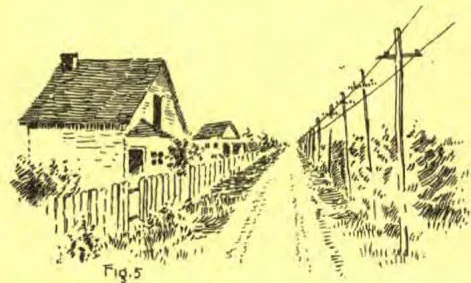
If we stand in the middle of any country road, which extends straight before us for some distance, as in Fig. 5, the wagon tracks go off directly in front of us. These lines, with those of the fence and the edge of the road, appear to meet at a point on the horizon. All the lines we notice proceeding in the same direction—the telegraph wires and the receding lines on the houses—seem to meet at this point also.
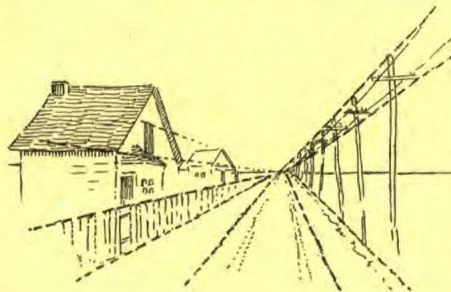
By drawing lines along all the receding lines in Fig. 5, we shall find that they all meet at one point. This point is the center of vision, or vanishing-point. By drawing a horizontal line across the picture at the same height as our point of vision, we can see where our horizon would be, were it visible.
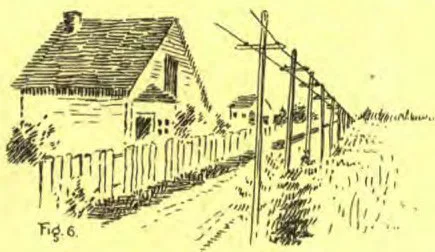
In calling this point the center of vision, it does not necessarily mean—the center of our picture; because if we step to one side of the road, as in Fig. 6, every line at once changes its direction. We can see more of the front of the houses than when standing in the middle of the road; and, again, all lines seem to meet at a point opposite our eyes, but more to the right, on the horizon line, thus showing that the center of vision does not mean the center of the picture, but the center of what we see.
Fig. 6.
If we walk along the street, and observe the direction taken by the receding lines of the buildings and pavements, we shall notice that all lines retreating above our eyes appear to run down, and all below the eyes appear to run up; and these lines, if continued far enough, will seem to meet at our point of vision on the horizon.
Suppose you stand at one end of the longest room you have access to, and test this principle in another way. Notice the ceiling and floor lines of the side-wall, as they go away from you. Does not the higher one appear to run down as it goes away, and the lower one to run up? and can you not imagine that if the wall was continued out as far as the eye could see, these two lines would seem to converge at one point?
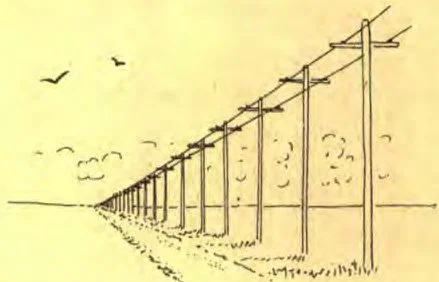
Stand near a line of telegraph poles. Notice how the lines formed by the top and bottom seem to draw together. Test this matter for yourself, until you are sure of the fact, and can point it out clearly to some one else.
PEDRO LEMOS.
CLIMBING
Now eyes aloft! Look up, and see.
That ladder straight and tall,—
But not the property of one,
God's ladder, raised for all.
To every duty in the home,
Give thought and love and time:
For duties are but upward steps:
Then, young folks, up and climb!
At school each study is a round;
At church each song and prayer:
Such rounds as these are more like wings
To waft us through the air.
And what of trials rough and hard?
Each cross is but a round;
It lifts toward heaven every soul
That to the earth seems bound.
Wouldst have God's angels climb for you?
Then make for them a place:
They ladders climb, as Jacob found;
He met them face to face.
But what if you who climb should slip?
Turn, climb as ne'er before!
And if your neighbor fall, hands out,
And help him climb once more!
From day to day in patience climb,
Let love and trust abound;
The King's own palace door will be
The topmost, golden round.
— Young People's Weekly.
ELSIE'S NEW ORNAMENT
By Mrs. F. A. Reynolds
“How queer! I never noticed that before; I wonder what it means,” murmured Elsie Dunham, half aloud.
“What did you say, dear?” asked Aunt Alice, who sat mending by the rose-shaded window.
“Why, this Bible verse,” said Elsie. “I just came across it, as I was reading. I presume I must have read it before, but I don't remember it; it certainly never struck me as it does now. I don't understand it.”
“Read it to me, and let's see if two heads are not better than one,” said Aunt Alice, with her ready smile.
Elsie bent over her Bible again, and read aloud, “‘That they may adorn the doctrine of God our Saviour in all things.’ Now I suppose that means us as much as the servants Paul was speaking of, but I don't see how we can possibly adorn the doctrine of Christ. Isn't it already perfect? How can we adorn it?”
Aunt Alice snipped off a thread, and folded the garment she had just mended, before she replied, thoughtfully: “Well, dear, I do not suppose we are to make the doctrine any more perfect, for, as you say, what God has given us is already perfect; but it is given to us to illustrate in our lives, and we each illustrate it according to our own ideas of it. The more we see in it of worth and of beauty, the more we can and shall make of it. And remember this, Elsie: we, as professing Christians, are read by others, and their idea of the value of religion is made by the idea they get of it from our lives; so you see it is of the utmost importance that we should interpret the doctrine aright, and illustrate it as perfectly as possible.”
“Yes,” responded Elsie, promptly, “but what does it mean to adorn the doctrine?”
“Well, child, what does it mean to adorn anything?” asked Aunt Alice, quizzically.
Elsie looked up in surprise. “Why, to trim it up, of course,” she replied, in a tone that implied that auntie could not apply the definition, after all.
Aunt Alice folded another garment, where a slight break had been repaired, before she replied; and when she did speak, it was only to say, “Elsie, will you please run over to the store, and get the butter I forgot to order this morning? And when you come back, just come to the kitchen door; I shall be there. We will talk more on this subject.”
Elsie closed her Bible, and was soon on her way across the little park to the store, which was on a street beyond.
She was not gone long. It was a beautiful afternoon, and the atmosphere in the early September day was free from the extreme heat and dust of the previous month. Elsie thought, as she tripped lightly home from her errand, of her pleasant vacation visit with Aunt Alice, of the family at home, and of school and church duties awaiting her the coming year. Remembering her aunt's directions, she went around the neat winding walk, and found herself at the kitchen door, which stood open, revealing the pleasant, sunny kitchen, and Aunt Alice flitting about the room.
Elsie handed the package to her aunt, and was going into the hall to hang up her hat, when she heard her name called.
“See here a minute, Elsie,” called Aunt Alice; “will you look at this table?”
Elsie looked, a little surprised at the request, and saw a common kitchen table shoved back against the wall, covered with a coarse red tablecloth. Upon the table were the necessary common white dishes, with some black-handled knives and forks and pewter spoons. There was plenty of food, but it looked as if pitched on anyhow. As Elsie looked, she opened her mouth to speak, but Aunt Alice said, quickly, “Don't say anything yet, dear; but come into the dining-room, and look at this table.”
Elsie obeyed in silence.
In the center of the pretty room stood a round table, covered with a glossy, snow-white cloth. The dishes were glass, decorated china, and shining silver. A plate of neatly piled, evenly cut slices of bread, a glass dish of strawberry preserves, and a plate of delicate cake, with other food, were artistically arranged upon the table, and a beautiful bouquet of flowers graced the center.
“Which table do you like best, Elsie?” asked Aunt Alice.
“Why, this one, of course!”
“Why?” demanded her aunt. “The other table is quite comfortable to sit down to, and it has upon it a sufficient variety of food to sustain life.”
“Oh, yes,” assented Elsie, “but this one looks nicer.”
“Just so,” was the reply. “If you were invited to choose where you would eat, you would choose this table, because it ‘looks nicer;’ in short, it is more attractive. When I asked you what it means to ‘adorn,’ you said, ‘To trim up,’ but I suppose you will agree with me that the trimming up is for the purpose of making a thing attractive. You adorn yourself in order to make yourself attractive. You adorn a table or a room to make it attractive. We all choose to look at a pretty room, to570eat at a neat table, to be in the company of attractive people. Now that, I think, is the meaning of the verse you read a little while ago. Paul says, Make the doctrine of God your Saviour attractive in all things. It is attractive, when understood and lived out, and it should be our duty and privilege to make our religion so attractive that people will desire to have it themselves. It is possible, I suppose, for one to accept Christ, and be saved,—for he has promised to save all who trust in him,—and yet be so unattractive, and even disagreeable, as to repel others, and so make them dislike the beautiful religion founded on the belief in Christ. Do you see what I mean?”
“Yes,” said Elsie, slowly and softly; “but, auntie, just to come to the point, how can we—how can I—adorn the doctrine of my Saviour?”
“Well, let me see,” replied her aunt, reflectively. “It seems to me that Peter tells us that women should seek to put on the ‘ornament of a meek and quiet spirit.’ He also says, in another place, that we should add to our faith, virtue, and knowledge, and temperance, and patience, and godliness, and brotherly kindness, and charity. Paul tells us to be kind and courteous. All these qualities are attractive, and beautifully adorn our Christian profession. If we should keep this thought in mind, and Christ within, all the time, our very presence would be a sort of magnet, drawing people to Christ. It would be the best work we could do for our Saviour, to let our lives adorn his doctrine.”
“Yes,” said Elsie, “and I see that I might be more attractive if I were less hasty in speech, and more courteous,—and,—oh, well, I see! I mean to try it. I never thought about that before.”
It was nearly time for Uncle Morton to come in, and Aunt Alice hastened away to finish preparing supper; while Elsie went on to the hat-rack, and then to her own room, where a few minutes' steady thinking brought her to her knees; and she could never be quite the same girl again.
The next day she went home, and was soon in the whirl of a busy school year; but she could not forget the impressive lesson she had had the last day of her vacation, and she really endeavored to adorn her Christian profession. It would not be possible for us to follow her, and see how and where she failed, and where and how she succeeded, for she did both; but on the whole, she was greatly changed. Her own home friends and her schoolmates noticed a growing sweetness of disposition, and commented upon it, and one day Elsie had the satisfaction of overhearing a friend say, “Well, if I thought being a Christian would make me like Elsie Dunham, I would try it for myself!”
Did this make Elsie proud?—Ah, no! With tears of gratitude and humility, she went straight to her room to thank God for the little victory, and to pray for the friend who was almost persuaded.
MRS. F. A. REYNOLDS.
LAND AND WATER LIFE
A HASTY glance at a terrestrial globe is sufficient to show how remarkable is the difference in the distribution of land and water in the northern and southern hemispheres. We live in the land hemisphere; the southern is essentially the water hemisphere. Just as remarkable is the distribution of life in the two hemispheres.
“No land animal and no trace of vegetation — not even a lichen or a piece of seaweed — has been found on land within the antarctic circle.” Such is the graphic statement of an authority on antarctic exploration.
But as if to offset the absence of life from the lands around the south pole, the waters in that part of the globe abound with a profusion of animal and plant life. Some minute forms of crustaceans are so abundant that the waters of the Antarctic Ocean are colored red by them in places, and the number caught in the tow-nets of the exploring ship “Challenger” was occasionally so great that the nets burst while being hauled aboard.
Larger animals are proportionately numerous there. Seals, whales, and a great variety of fishes inhabit the far southern ocean. The floor of that ocean is said to be occupied by more abundant and peculiar forms of animal life than any other known part of the sea bed.
A very interesting example of the manner in which some kinds of animals depend for their existence upon the destruction of others is furnished by the fact that large numbers of the inhabitants of the surface waters of the tropics, having drifted so far south as to come into contact with the cold Antarctic currents, are, so to speak, frozen to death; and their bodies, sinking to the bottom, afford a supply of food to the remote inhabitants of the ocean floor.
But while the peculiar conditions described above now prevail within the antarctic circle, there is, at the same time, much evidence that things were once very different there, and that the supposed continent surrounding the south pole once abounded with animals and plants as varied, beautiful, and interesting as those of the northern hemisphere.
On this antarctic continent, it has been surmised, some of the characteristic life-forms of Australia and South America may have originated. There is, in fact, a growing curiosity in the minds of scientific men concerning the secrets that are apparently locked in by the encircling ice of the southern pole.— Selected.
1. Continuing his instruction to his disciples, to what did Jesus liken his kingdom? Matt. 25:1. What was the character of the young women? V. 2. As with their characters, how did their practises contrast? Vs. 3, 4. In what respect did they all seemingly act alike? V. 5.
2. What stirring cry awoke them from their slumbers? V. 6. What did they all at once do? V. 7. What did a part of them say? and why? V. 8. What answer was given them? V. 9.
3. While they were gone to purchase oil, what took place? V. 10. When the foolish virgins returned, what appeal did they make? V. 11. What did the bridegroom say from within? V. 12; note 1. What admonition does Jesus again give on the strength of this parable? V. 13.
4. To what did Jesus further liken his work? Vs. 14, 15. What use did the respective servants make of their talents? Vs. 16-18.
5. What finally took place? V. 19. What was the response of the first servant summoned? V. 20. What benediction did he receive from his lord? V. 21. What similar experience did the second servant have? Vs. 22, 23.
6. What returns did the third servant make? What did he say? Vs. 24, 25. What did his lord say to him? Vs. 26, 27. What command concerning the one talent was then given? V. 28. Why? V. 29; note 2. What order was issued with reference to the unfaithful servant? V. 30.
NOTES
1. The parable of the ten virgins is a divine picture of the experiences of God’s people, especially during the memorable year of 1844. The going forth to meet the Bridegroom represents the time when Christ was first expected, in the spring of 1844, when with their lamps (their Bibles) the people of God went forth, (prepared themselves for his coming, by earnest study and prayer) to meet the Bridegroom. But the time passed, and Christ, the Bridegroom, did not come. This was the first disappointment. The result was that a large number who had not at heart truly loved his coming went back upon their belief, and again became cold and formal. Others, however, were only stirred to search the Scriptures more carefully, to discover, if possible, the cause of their disappointment. They rested on the promises. During this time of waiting, or while the Bridegroom tarried, the Saviour says, they “slumbered and slept.” All slumbered and slept; the first class in open unconcern, the others in a degree of discouragement. But finally it was discovered that the true time for the coming of the Bridegroom would be in the month of October. Immediately the message went with almost electric speed from one place to another, “Behold the Bridegroom cometh; go ye out to meet him.” Then all arose, and trimmed their lamps, or began again to study their Bibles. But those who had lived in unconcern during the waiting time had no oil with them—they had not the Spirit of the Lord—as they went forth. They never again found joy in the message of Christ’s coming. But the wise virgins regained their experience, found their first love, met the Bridegroom, and entered in. The entering in of the Bridegroom to the marriage represents the beginning of Christ’s work in the Investigative Judgment. True, the people of God were not right in supposing that Christ would come to the earth in 1844, and they were disappointed in consequence; but they kept on studying, and God brought them to see the truth of the Judgment and the third angel’s message as a whole. By holding fast their faith, they truly met the Bridegroom in an understanding of his work; and, understanding it, they entered by faith into the work of the Judgment. They were ready. But those who rashly denied all because they were disappointed, were left in darkness, and could not see the truth as it is for to-day. Because of their stubborn unbelief, they were shut out. Those who “went in” are all who, from 1844 onward, understand Christ’s work in the sanctuary, and live by faith in his mediatorial work.
2. The question has been asked, How could the lord take away from him that had not? In reply, it may be said that reference is not made to one who has nothing in possession; for the unfaithful servant did have one talent. But he had not improved the one talent. The idea of the text is, Take away the talent from him who has not made good use of it, and give to him who has put his money out to usury, even to him who has ten talents; for to every one that has made good use of his talents more will be given.
THE LITTLE STREETS
“To-morrow I’ll do it,” says Bennie;
“I will, by and by,” says Seth;
“Not now — pretty soon,” says Jennie;
“In a minute,” says little Beth.
O dear little people! remember
That, true as the stars in the sky,
The little streets of To-morrow,
Pretty-soon, and By-and-by
Lead, one and all,
As straight, they say,
As the king’s highway,
To the city of Not-at-all.
— Selected.
A TINY HORSE
WHAT is supposed to be the smallest Shetland pony in the world is three years old, and though perfectly developed, is only thirty-two inches high. It is black in color, and is in the same shaggy condition in which it came from its native hills.
Dr. Worst's New Scientific CATARRH INHALER ON TRIAL FREE!
By Dr. E. J. Worst
DR. E. J. WORST, ASHLAND, OHIO.
DR. E. J. WORST, ASHLAND, OHIO.
It cures Catarrh, Colds, Pains and Roaring in the Head, Bronchitis, Sore Throat, Headache, Partial Deafness, and all diseases of the Air Passages.
CURES BY INHALATION.
Air is the only agent fine enough to carry any medical influence into the small air cells and homes of the living germs, that will effectually destroy the causes of these diseases. It was the agent that carried the disease there, and it must be the one to successfully remove it.
SPECIAL OFFER.
For a short time I will mail to any reader, naming this paper, one of my new Scientific Catarrh Inhalers, with medicine for one year, on three days' trial, free.
If it gives satisfaction, send me $1.00; if not, return it after three days' trial. If you are willing to comply with such reasonable terms (agents wanted), address—
DR. E. J. WORST, 402 Main St., Ashland, O.
ON TRIAL FREE!
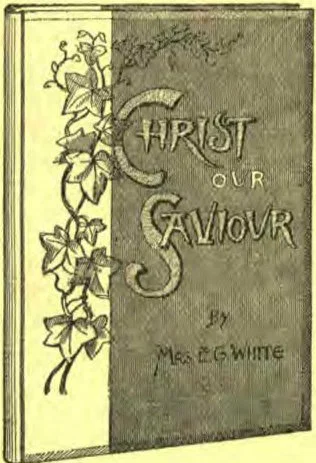
Christ Our Saviour....
By Editor
Gives a graphic description of the birth, early training, baptism, ministry, death, resurrection, and ascension of Christ our Saviour. The book contains 160 pages, profusely illustrated, handsomely bound in three styles of binding.
Prices, $1.25, 75, and 50 cents.
We offer this book, post-paid, to INSTRUCTOR subscribers at the following rates:—
Cloth back, board cover, for three new yearly subscriptions, at 75 cents each; or with the INSTRUCTOR one year for $1.00.
Fine English cloth, for four new subscriptions, at 75 cents each; or with the INSTRUCTOR one year for $1.25.
Presentation edition, for five new yearly subscriptions at 75 cents each, or with the INSTRUCTOR one year for $1.50.
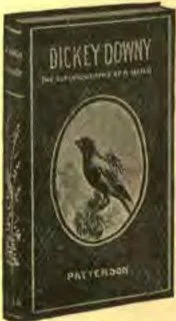
“Dickey Downy.”
By Virginia Sharpe Patterson
By Virginia Sharpe Patterson.
This little volume is charmingly written, its object being to teach the children to love and protect the birds. That it is interesting, the following selected chapter-headings will abundantly show:—
The Orchard.
Dickey Downy’s Meditations.
Dickey’s Cousins.
A Winter in the South.
The Prison.
The Hunters.
Polly’s Farewell.
The book is bound in cloth, and contains 192 pages, with four beautiful colored plates. Price, post-paid, 60 cents.
We offer this book, post-paid, for three new yearly subscriptions to the YOUTH’S INSTRUCTOR, at 75 cents each, or with the INSTRUCTOR one year for only $1.15.
“Beautiful Joe.”
An Autobiography
By
Marshall Saunders.
Beautiful Joe is a real dog, and “Beautiful Joe” is his real name. He belonged during the first part of his life to a cruel master, who mutilated him in the manner described in the story. He was rescued from him, and is now living in a happy home, with pleasant surroundings, and enjoys a wide local celebrity.—Author’s Preface.
This story awakens the interest of the reader in the first chapter, and sustains it to the end. It must make an impression for good, and in the interests of kindness and gentleness, upon all who read it.
The book is well bound in cloth, with gilt side-stamp; 304 pages; illustrated. Price, 75 cents. Bound in paper, 50 cents.
It will be sent, post-paid, for four new yearly subscriptions to the YOUTH’S INSTRUCTOR, at 75 cents each; or with the INSTRUCTOR one year for only $1.25. In paper covers, with the INSTRUCTOR one year, for $1.00.
Making Home Happy.
By Mrs. L. D. Avery-Stuttle
By Mrs. L. D. Avery-Stuttle.
This subject is presented in an interesting story form, and every reader will feel inspired to strive to make his home cheerful. Happy homes are needed everywhere, and “Making Home Happy” is a good little book to help bring about this result.
The book contains 206 pages, with four full-page illustrations, besides smaller ones. Price, bound in cloth, 50 cents.
We will send it, post-paid, for three new yearly subscriptions to the INSTRUCTOR at 75 cents each; or with the INSTRUCTOR one year for $1.00.
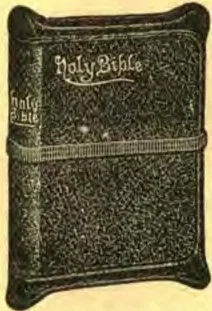
Self-Pronouncing S. S. Teachers’ Reference Bible.
By Editor
CONTAINS the celebrated Teachers’ Helps, comprising nearly 400 pages. Also a complete series of fifteen new maps.
Description.— Imperial Seal Binding, Tuck Edges, known as “Divinity Circuit,” Rounded Corners, Full Red under Gilt Edges.
We offer this Bible, post-paid, for only SIX NEW YEARLY SUBSCRIPTIONS at 75 cents; or TWELVE NEW SIX MONTHS’ SUBSCRIPTIONS at 40 cents.
We will also send it, post-paid, with the INSTRUCTOR one year for $2.25. For 20 cents extra we will stamp your name in gold upon the cover.