We Should Ourselves Go to the Fountainhead — We Should Not Depend upon a Fallible Fellow Man
By J. W. LOWE
IN matters of religion and religious doctrines, do not resort to the theories and writings of men for instruction relative to what is truth, but go directly to the Bible itself. To know what the Bible itself says, is worth a thousand times more than to know what any man may say with respect to what the Bible teaches.
WHICH IS RIGHT?
Even the most intellectual and conscientious persons differ widely in opinion concerning Bible doctrines and Bible teaching in general. And if we depend on mere human authority for our religious faith and belief, how can we know for a certainty which of these individuals or classes have the truth?
SCENE IN MILAN, ITALY
The word of God — the Bible — is the truth. And the Bible is its own exposition of the truth. If we believe what the Bible says, and believe it says what it means, we shall have no serious difficulty in coming to a knowledge of the truth. But if we persist in believing that God does not mean what He says, and put our own construction upon as much of the Scriptures as we possibly can, we will be likely sooner or later to possess more error than truth.
BIBLE HELPS
I do not mean to say that Bible helps of every description have no value, for many of them are exceedingly valuable to the Bible student. But the writings of men who spiritualize away the real meaning of some of the plainest statements of God's word are most dangerous to read. These writings are surely indited by the spirit of Satan, and for this reason, are hypnotic in their influence.
Remember there are two separate and distinct spirits at work in the world,— the Spirit of God, and the spirit of Satan. Not all the impressions that men have, come from God. Satan can impress the minds of people, and lead them to believe a lie. We are to test the suggestions and impressions that come to us, by the test given us in the Bible: "To the law and to the testimony: if they speak not according to this word, it is because there is no light in them." Isa. 8:20.
THE INFALLIBLE INTERPRETER
It was never given to man to interpret the Scriptures. That is the office of the Holy Spirit. And the Holy Spirit will not lead one person to believe one thing, and another person to believe something different, relative to the same matter. If two persons differ widely concerning some Bible doctrine, one of them at least is not fully taught by the Holy Spirit. They may both be in error, but both cannot be right.
When we take into consideration the great number of religious denominations, and their differences in opinion as to what the Bible teaches, it ought to serve as a warning to us against placing our confidence in mere human wisdom for our knowledge of Bible truth, or even in any line of intellectual thought. God's word is the truth; and it is so very abundant in true knowledge, that it has light and truth for every soul. And if you desire knowledge that is free from adulteration, search your Bible for it.
The Salutation of Peace
By Eliza H. Morton
"Peace be unto you" was a common salutation among the Hebrews. It was often a mere form, having no meaning aside from the custom of the day. Jesus, however, did not thus use it. When He said to His disciples, "Peace be unto you," He meant something more than a mere conformity to a worldly custom. When He uttered the words, "Peace I leave with you, My peace I give unto you: not as the world giveth, give I unto you" (John 14: 27), He taught a great truth, which comes down through the ages to us like a benediction.
ELIZA H. MORTON.
The Prophet Foresaw the Papacy
By Jean Vuilleumier
Three Kingdoms Fall Before It—A “Little Horn” with Stout Look—“The Eyes of a Man”—A Persecuting Power—Assumes Right to Change the Bible—Time It Was to Continue—Its Apparent Destruction
By JEAN VUILLEUMIER
In reading this article, keep in mind that Elder Vuilleumier presented last week that portion of the prophecy of the seventh chapter of Daniel which tells of the four world monarchies that were to exist, and that the last one of the four was to be broken into ten parts. The prophet saw that among these ten kingdoms, another power would arise. The last named, the ecclesiastical empire, is the subject of this article.
Next week, the theme will be the eternal kingdom that is soon to supplant all these governments of earth. Incidental mention will be made, in the article, of the reestablishing of the papal power that seemed broken in 1798.
“I CONSIDERED the horns, and, behold, there came up among them another horn, a little one, before which three of the first horns were plucked up by the roots: and, behold, in this horn were eyes like the eyes of a man, and a mouth speaking great things.” “Then I desired to know the truth concerning . . . the other horn which came up, and before which three fell, even that horn that had eyes, and a mouth that spake great things, whose look was more stout than its fellows.” Dan. 7: 8, 19, 20.
The foregoing describes the vision the prophet had concerning that mysterious power.
INTERPRETATION IS GIVEN
“Thus he said, . . . And another shall arise after them [the ten kings]; and he shall be diverse from the former, and he shall put down three kings. And he shall speak words against the Most High, and shall wear out the saints of the Most High; and he shall think to change the times and the law; and they shall be given into his hand until a time and times and half a time.” Verses 23-25.
Let us briefly compare the salient point of this prediction with a few historical facts that will show the marvelous exactness of this vision.
Next to the division of western Europe into the different states, living side by side for over a thousand years, the most conspicuous fact in the history of the Middle Ages and of modern times is the supremacy of the bishop of Rome. This power, both political and ecclesiastical, answers exactly to the description of the eleventh horn, which represents another king, different from the other ten, endowed with almost superhuman insight, surrounded with greater pomp, whose utterances are more startling even than its deeds, who lays its hands upon the saints of God and upon His law, who is to exercise a supremacy over Europe nearly until the coming of Christ.
THREE KINGDOMS FALL BEFORE THE RISING PAPACY
“Before which three of the first horns were plucked up by the roots.” Verse 8. Few persons are acquainted with the fact that the triple crown worn by the pope represents really three kingdoms that had to yield their place to the growing papacy, at the end of the fifth and the beginning of the sixth century; namely, the Heruli in 493, the Vandals in 533, and the Ostrogoths in 538.
SMALLER AND YET GREATER THAN THE TEN
“That horn . . . whose look was more stout than its fellows.” Verse 20. “At the outset, the bishops of Rome were very humble and retiring, having nothing else in view but the propagation of the religious, moral, and democratic teachings of the Nazarene. They played no rôle in the state until the time when Constantine, after making Christianity the religion of the empire, made Constantinople the new capital of the Roman world. . . . The bishop of Rome, protected by the emperor, gained influence over the masses, and this influence grew still more during the invasions of the barbarians. . . . Great is the contrast between the humble beginnings of this Christian republic and the spectacle offered by Christianity a few centuries later—that of an absolute monarchy, in which the clergy forms a separate class, enjoys special privileges, and in which the bishop of Rome, heir to the authority of the councils, sovereign arbiter of nations, assumes the right of governing consciences, of distributing kingdoms, and of ruling over both soul and body.” (“Larousse Dictionary,” article “Papacy.”)
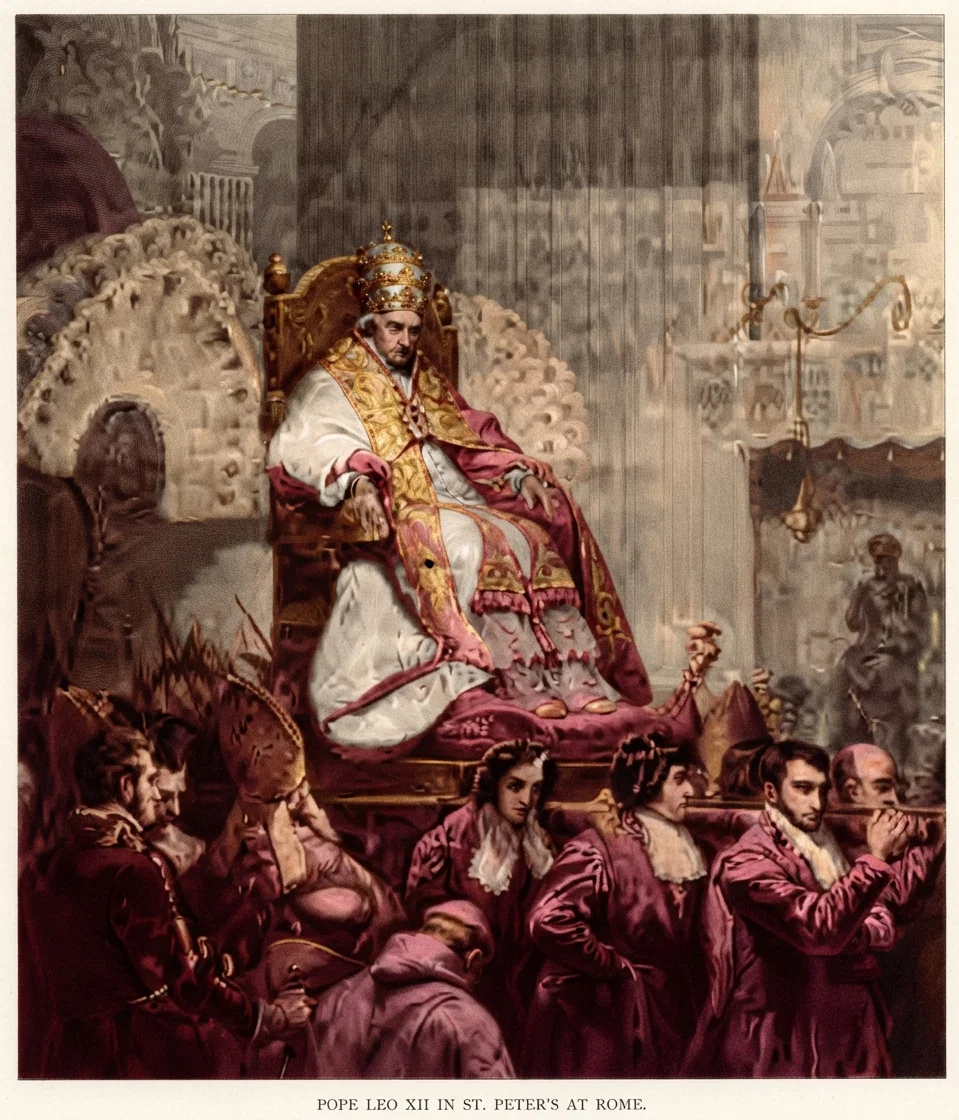
POPE LEO XII IN ST. PETER'S AT ROME
A MARVELOUS INSIGHT
“In this horn were eyes like the eyes of a man.” Verse 8. Heir of the shrewd diplomacy of the Roman Senate, the papal government has for hundreds of years exercised its policy with astuteness and sagacity. This wisdom can be attributed to four main factors: the confessional, the celibacy of the clergy, Jesuitism, and the unbroken papal succession,—factors that have enabled the papacy to place itself in intimate relationship with the common people, and to follow up its schemes from generation to generation.
ASTOUNDING WORDS
“In this horn” was “a mouth speaking great things. . . . And he shall speak words against the Most High.” Verses 8, 25. It is a well-known fact that the pope is commonly called by his followers “holy father,” “most holy father,” “sovereign pontiff,” “head of the church,” all of which are the names of God the Father and of Jesus Christ. John 17: 11; Eph. 1: 22. In Heb. 8: 1, the words “high priest” are translated “sovereign pontiff” in some Catholic versions.
Pope Gregory VII says, in his “Maxims,” “There is only one name in the world, that of the pope.” This is what the apostles Peter and Paul said of Jesus Christ. Acts 4: 12; Phil. 2: 9. Pope Martin V called himself “the most holy and happy, who is the arbiter of heaven and the lord of earth, . . . the master of the universe, the father of kings, the light of the world.” Again these are names and prerogatives that belong to God alone, and the usurping of which, on the part of a man, brands him as a blasphemer.
With reference to earthly powers, the popes have made utterances that no other human being has ever dared to make. In his “Maxims,” just quoted, Pope Gregory VII wrote: “All earthly princes must kiss the pope’s feet. . . . He has the right of deposing emperors.” Innocent III compared his power in relation to that of other kings to the light of the sun as compared with that of the moon.
PAPAL GRANDEUR
“Whose look was more stout than its fellows.” Dan. 7: 20. Several kings had to experience the bitterness of these claims. Robert, king of France, excommunicated by Pope Gregory V, had to humble himself to the dust before him in order to retain his throne. Henry IV, emperor of Germany, had to take the famous trip to Canossa before he could resume his imperial dignity. His son, Henry V, and Frederick I, called Barbarossa, went through the most humiliating ceremonies in the presence of Popes Pascal II and Adrian IV respectively.
The culmination of papal grandeur was reached under Innocent III, in the beginning of the thirteenth century, half way between the rise and the fall of papal supremacy. “The pontificate of Innocent III is only a moment in history,” says Larousse Illustrée. “But what a moment! . . . What glory! Everything around it is magnificent, as if to enhance the brightness of this throne of thrones occupying the center of the scene. . . . The pope is not only the greatest of popes; the other kings, the events, the genius of the century, everything, is in harmony with his grandeur.”423
A PERSECUTING POWER
"The same horn made war with the saints, and prevailed against them." He "shall wear out the saints of the Most High." Verses 21, 25. Sadly notorious are the barbarous persecutions organized and carried on by the papal government for more than a thousand years. The massacres of Waldenses, of Albigenses, Hussites, and Calvinists, the Saint Bartholomew, the "holy Inquisition," the dragonades, the revocation of the edict of Nantes, are too well known to require more than a passing mention.
The victims of persecution under pagan Rome have been estimated at three millions, while the victims of papal Rome for conscience' sake, according to a moderate estimate, mount up to fifty millions.
HERETICS MUST BE EXTIRPATED
Far from denying the facts of history branding her as a persecuting power, the papacy has erected persecution and bloodshed against heresy as a dogma; to wit, clause 5 of the act of abjuration (June 2, 1697) of Frederick Augustus, a Saxon prince, when he took the throne of Poland under the name of Augustus II: "I profess that . . . all heretics . . . must be extirpated by sword and by fire without exception or consideration, and that they must all be sent to hell body and soul."
A similar declaration is embodied in the oath of allegiance of all the Roman bishops. Intolerance and persecution as a doctrine is taught to-day by many authorized Catholic books and periodicals, and preached from Catholic pulpits.
LAW OF GOD CHANGED BY THE PAPACY
"He shall think to change the times and the law." Verse 25. This accusation of the prophecy is corroborated by the papacy itself. The above quoted abjuration, framed by the high clergy, says:
"I profess that a decree made and proclaimed by the pope, however new it may be, whether or not based on the word of God, is of divine origin, and must, as such, be respected by believers, more highly than a command of the living God." (Clause 2.)
"I profess that the reading of the Bible is the origin of all pernicious sects and associations, as also the fertile source of all blasphemies." (Clause 6.)
"I profess that the Roman pontiff has the power to change the Holy Scriptures, to add thereto, and to take from." (Clause 10.)
From such assertions, we may confidently expect that the papacy has not failed to change the law of the Most High.
What are these changes? Read the Ten Commandments in the Roman Catholic catechism "prepared and enjoined by order of the third plenary council of Baltimore" (Boston, 1885), and compare them with the divine text in Exodus 20. The wording of those holy statutes spoken by the voice of God on Mount Sinai has not been faithfully transcribed in this catechism for the Catholic people who have no access to the Bible.
THE COMMANDMENTS MUTILATED
The second, third, fourth, fifth, and tenth commands are mutilated. The second is joined to the third, and the tenth cut in two, thus changing the numbering, so as to make it match with European catechisms, where the second commandment is completely left out. In the second commandment, the words "Thou shalt not bow down thyself to them" (graven images) are changed into "Thou shalt not adore them," which is an unwitting admission that to bow before an image is to adore it.
The fourth commandment, numbering more than ninety words in the Bible, has only seven in the catechism. All specifications about Sabbath keeping, all mention as to what day of the week is the Sabbath, and all reference to the creation of the world as a basis for the commandment, are left out. In the explanation of the second commandment, the same catechism justifies the invocation of saints, the honors paid to relics, and the kneeling before pictures, images, and crucifixes. And in the explanation of the fourth commandment, it justifies "the church" in "commanding us to keep the Sunday holy instead of the Sabbath."
TWELVE HUNDRED SIXTY YEARS OF SUPREMACY
"And they [the law and the saints] shall be given into his hand until a time [one year, or 360 days, a Jewish year] and times [two years, or 720 days] and half a time [half a year, or 180 days,—in all, 1,260 days]." Verse 25. These are prophetic days, each of which represents a literal year, according to the rule given in Eze. 4: 6. The whole period, therefore, equals 1,260 literal years, during which the papacy was to exercise its baneful power over the saints and the law of God.
The supreme power of the pope was asserted by churches, bishops, and councils as early as the fourth century. From that time onward, the Roman emperors of the East ordered, in their laws, that all should "embrace the religion of the Roman pontiff." In 534, Pope John thanked the emperor Justinian for "submitting all things to him," the pope, and for "publishing an edict requiring the destruction of heretics." In 538, Vigilius caused Pope Silverius to starve to death, and became pope in his place, thanks to a party in the empire which had pledged to elevate him above the council.
The year 538 A. D., therefore, is the starting point of papal supremacy. This supremacy European nations accepted and submitted to until the end of the eighteenth century, when it disappeared in a storm, but not without having undergone a process of decay.
FORCES THAT OVERTHREW IT
The Reformation of the sixteenth century gave the papal theocracy an irreparable blow. In the eighteenth century, the prestige and influence of the church were seriously undermined by the philosophical movement led by Rousseau and Voltaire. At that time, most of the Catholic kingdoms of Europe expelled the Jesuits; and in 1773, Pope Clement XIV was compelled to sign the suppression of this order, loathed by all intelligent people.
And now a great storm breaks out. The French Revolution in 1793 vents its rage upon the French clergy, and in 1798 upon the pope himself. In February of that year, Rome was entered by the French, and the pope was taken away as a captive, while a republican government was proclaimed in the "eternal city." Pius VI, at the advanced age of eighty-two, and though afflicted with many infirmities, was driven through Italy in a carriage, carried in a litter over the bitter cold passes of the Alps, and finally left in Valence to die, 1799.
The papacy remained beheaded for nearly a whole year. Thus exactly 1,260 years after it had begun, this power that had been lent the papacy to lord it over the world, had suddenly disappeared. Thus, through a long course of centuries, had every detail of this prophecy met its fulfillment, bringing us finally to the threshold of eternity, and proving to us the absolute certainty of God's promises.
More Acceptable than Sacrifices
By J. W. Rich
The Thing Desired Above Everything Else
By J. W. RICH
"To obey is better than sacrifice, and to hearken than the fat of rams." 1 Sam. 15:22. To Saul had been given the commission of destroying the Amalekites, both man and beast, for the part they had taken in hindering the passage of the children of Israel in their desert wanderings.424The critical moment came, and Saul was brought to the test as to whether he would listen to the voice of God, or yield to his own short-sighted reasonings. The sound of the bleating sheep, and the lowing of the cattle, reminded him of what he thought would be a great offering to God—devotion to His cause. What an opportunity to show one's allegiance! What a great sacrifice can be offered to God! And would this not be better than uselessly slaying these animals and casting them aside? Then, too, there was the king, a goodly personage; why should he die, when he could just as well be spared?
Thus Saul reasoned, and thus he acted upon his reasoning. How often do men and women reason thus in these days! It is true that the Lord has told us what we should do; but after all, we get the idea well grounded, in some way or other, that the Lord does not mean exactly what He says, and that a large latitude is given us in deciding what we should do and what we should not do.
COST HIM HIS KINGDOM
Thus did Saul reason, and it was that very reasoning which cost him his kingdom. When the prophet came into his presence, and heard the noise of the flocks, his first inquiry was: What meaneth this bleating and lowing that I hear? Have you obeyed the Lord in the destruction of the Amalekites, as He gave word?
Undoubtedly Saul trembled at the scathing question. ("Thy backslidings shall reprove thee," Jer. 2:19); but thinking that an offering to the work of God would be an acceptable tribute for his disobedience, he endeavored to shield himself from further criticism.
It was not because Saul misunderstood or did not know the Lord's directions that he went astray, but because he presumed upon God's word, and thought to substitute his own ideas for a plain "Thus saith the Lord." Then it was that the kingdom slipped from under the control of Saul, and passed to one who would obey. Then were those memorable words uttered, "Behold, to obey is better than sacrifice."
Those words were spoken to Saul, but they carry a weighty message to every man and woman to-day. We are not to obey merely when everything is favorable to our compliance, but we are to obey Him when it is difficult. Obedience, and not personal convenience, is the test of allegiance. Hear the venerable man Job saying, "Though He slay me, yet will I trust Him." Obedience is the highest type of worship. Simply trust Him.
SLIPPING FROM THE GRASP OF THOUSANDS
How many there are to-day who are meeting with the same conditions, and — shall we say it? — with the same results! The kingdom of God is slipping from the grasp of thousands because they presume that a substitute service will be accepted. Do not be deceived into believing that God will accept a number of versions as to what His requirements are, when He has spoken plainly so that all may understand.
"The seventh day is the Sabbath of the Lord thy God." No amount of reasoning will ever change the wording or its meaning. God has spoken, and let the puny ideas of men be kept veiled so long as God is God.
To offer a substitute to God in this matter will only mean ruin and disaster, just as it did to Saul. God is particular as to what He says, and will allow no human reasoning to discount His word.
"Judgment also will I lay to the line, and righteousness to the plummet: and the hail shall sweep away the refuge of lies." Isa. 28:17.
It will make a difference through all eternity whether we take God at His word or not. "Forever, O Lord, Thy word is settled in heaven." Ps. 119:89. May it be with us each and all!
No Need of Law?
By Ruth Lees Olson
By RUTH LEES OLSON
Men say: "We have no need of law, for all men are free-born,
Supreme within themselves; free as the orb of day
That sweeps across the sky with an effulgent light,
Luminous within itself until it sinks into the night.
"We have no need of law, for heights and depths
Will open wide their portals at the touch of him who holds the key
To that mysterious life that dwells within, and speaks imperiously,
And, listening, we obey; for such as heed the voice of inmost soul,
Can reach as high as heaven, or sink as deep as hell, and yet beyond,
Where life is self-existent, and death enters not."
No need of law? And yet the planets in their course must bow before
Omnipotence in answer to "Thou shalt" and "Thou shalt not."
E'en mighty suns that sweep their satellites in train,
Must yield obedience to the voice of Him who rules on high;
And as Arcturus guides his sons across the starlit sky,
His steps are guided by the law that thunders from Jehovah's throne.
The star-eyed daisy smiling up from dusty wayside road,
Or timorous violet peeping from her dark green shade,
Must follow laws that bid them bloom in spring,
Or slumber soft 'neath winter's snow.
All things in heaven above or in the earth beneath
Obey the law of seedtime and of harvest fold.
Yea, man himself is governed by the laws of birth and death.
The very breath of life that fluttered on his lips
When first he opened eyes upon a newborn world,
Came as a law that bade him "live and grow."
And ringing through the ages, soft as time's footfall,
The echo of that law is heard, and, listening, men are born.
And so from earliest time, adown the little span of life,
We follow on until at last we sink into the arms of Mother Earth,
From which we came, there to abide, safe resting in her fond embrace
Until the dawn of that great day when from Jehovah's throne
The word goes forth, and man shall live again.
A mighty throng shall rise from dusty bed,
Or come from cradled depth of ocean wave.
The earth shall tremble 'neath their tread,
The heavens echo back triumphant shout of victory;
And blazoned high in burning scroll of fire,
Jehovah's law shall reign supreme.
Was Paul Mistaken?
By Adelaide D. Wellman
SOME superficial readers of the Bible have concluded that Paul expected the second advent of Christ in his time. As evidence that the great apostle cherished that fallacious hope, reference is sometimes made to 1 Thess. 4: 15, where he uses the expression, "We which are alive and remain unto the coming of the Lord."
A more correct understanding will be gained of the import of the pronoun "we" in this text, if we note its use in certain other instances. Thus Isaiah, prophesying seven hundred years beforehand of the Saviour's first advent, wrote: "When we shall see Him, there is no beauty that we should desire Him. . . . We hid as it were our faces from Him. . . . We esteemed Him not."
Lest any should be disposed to maintain that both these Bible writers misapprehended the chronology of the events they predicted, let us observe the positive assertion of Paul in 2 Thess. 2: 2, 3, that the coming of Christ was not then near.
It is not unusual for present-day writers and speakers to class themselves with those whom they address. An instance of this sort occurs in the preceding paragraph, where, by way of inviting the attention of the reader to a scripture, the writer says, "Let us observe." ADELAIDE D. WELLMAN.
The Liquor Interests Scared
By L. A. R.
ONE of the greatest signs of the progress of the prohibition movement is the genuine panic of the liquor interests at the present time. Whatever the average newspaper reader thinks of national prohibition, the liquor men themselves believe they are facing a really pressing problem. According to their own story, ruin stares them in the face. Everywhere they are sounding the alarm against the approaching fire of what they call fanaticism.
Having had abundant experience in fighting the temperance workers, they certainly take at face value the claims now set forth by the reformers. Brewers' and liquor dealers' associations everywhere are collecting money for what they regard as the fight of their lives. In their publications are premonitions of approaching woe. The National Liquor Dealers' Journal, for example, last September detailed the circumstances which it described as spelling doom to the liquor interests. "The prohibition fight henceforth," that article declared, "will be nationwide, and contemplates writing into the national constitution a prohibition of the manufacture and sale of alcoholic beverages. To us there is the handwriting on the wall, and its interpretation spells doom. For this the liquor business is to blame; it seems incapable of learning any lessons of advancement or any motive but profit. To perpetuate itself, it has formed alliances with the slums that repel all conscientious citizens. It deliberately aids the most corrupt political powers. Why? — Because it has to ask immunity for its own lawlessness."
The liquor interests have reason to feel thus alarmed. Last fall, nine states had state-wide prohibition. The elections since that time have exactly doubled the number. There are now eighteen states. The anti-liquor forces had been working sixty years to get the first nine prohibition states. Their labors seem to have been justified even so; but suddenly, in six months, nine more were added to the prohibition column. The first nine were Maine, Kansas, Oklahoma, North Dakota, North Carolina, Tennessee, Mississippi, Georgia, and West Virginia. Now Virginia, Arizona, Colorado, Oregon, Washington, Alabama, Arkansas, Iowa, and Idaho are added to the list. Other states, too, that have not gone in for state-wide prohibition, have county option on a scale that amounts almost to the same thing.
In the last twenty years, thirty million votes have been cast for prohibition; and as a result, forty-six million American citizens, nearly one half our total population, are living under no-license laws. One half the American people have outlawed so cherished an institution as the rum shop. A temperance map of the United States shows the larger part of our territory white.
L. A. R.
GOING BACKWARD TO SUPERSTITION
By John O. Corliss
JUST before the recent Easter season, great preparations were made by various classes of society to celebrate the advent of Good Friday with becoming ceremonies. Accordingly, in some parts of California, throngs led by church pastors climbed the highest neighboring hills before daylight, to greet the first rays of the rising sun. With the first struggling gleams of light shining through the mists of the distant horizon, the crowd dropped upon their knees, with faces toward the orb of day, and joined in hymns of praise.
SUPERSTITION OR WORSHIP
Was this superstition, or was there in it genuine worship of Jehovah? A guess that a large portion of those so gathered, went through the ceremony according to instruction, without any particular thought of devotion, would not be far from the mark. Reformers of the sixteenth century would have scorned such ceremonies, because they knew too well that the origin of such an attitude was in paganism.
One may say, O, well, this is altogether different from pagan sun worship; it is simply a form by which to worship the Lord of glory. Then why go to the top of a hill so early in the morning to perform the ceremony? And after arriving there, why await the appearance of the sun before beginning the observance, and then go through it with the face toward the sun? Again, if that is a proper form of worship, why delay it for a whole year, when there are so many sunny mornings throughout the passing seasons?
ZULU WOMEN GRINDING CORN
The fact is, in such performances, the church harks back to the days of dark superstition, when sight, instead of Biblical faith, was the basis of worship. Indeed, so strongly426has the religious world begun to lean toward the externals of ancient days, that in the absence of these, very few care to take part in even the formalities of religion. A certain measure of dry rot has eaten the vitals out of the church, until little sympathy for its external forms is shown by the world.
NO DRINKING ON GOOD FRIDAY
Indeed, it was reported in the San Francisco Call of March 31 last, that in that city by the Golden Gate, so strong was the endeavor to have Good Friday decently recognized, according to church ideas, that the Police Commission of that exhibition municipality issued an order forbidding the hilarity commonly indulged in liquor resorts during Good Friday. But here is the reported order. It only need be read to see how ready civil power is to enforce supposed Christian ordinances:
“POLICE BAR GOOD FRIDAY DANCING IN CAFE, HOTEL
“No dancing will be permitted in cafes, hotels, or other places where liquor is sold, on the evening of Good Friday. This order was made to owners to-day by the Police Commission. Failure to comply with the instructions will result in revocation of dancing privileges. This is the first time in San Francisco that the Police Commission has lent its aid in the support of Good Friday observance.”
J. O. C.