The Youth’s Instructor, Vol. 34, No. 44.

A GOOD CHARACTER

The Youth’s Instructor

Nov 3, 1886

S. D. A. Publishing Association · Battle Creek, Mich. · Nov 3, 1886

A GOOD CHARACTER.
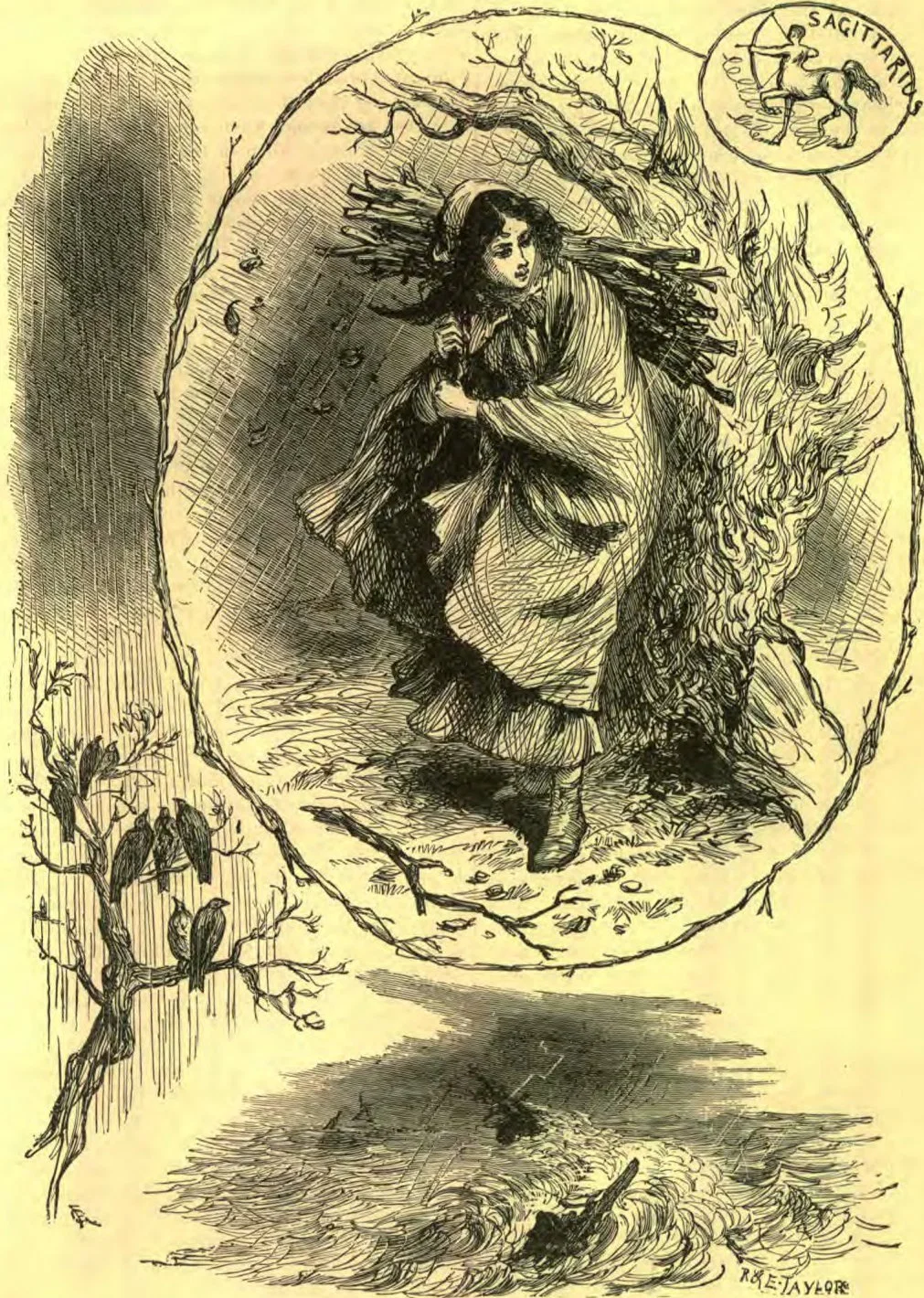
A good character is of slow but steady growth. Mental ability and genius are not character; for these are often possessed by those who have the very opposite of a good character. Reputation is not character. True character is a quality of the soul, revealing itself in the conduct.
If the youth rightly appreciate this important matter of character-building, they will see the necessity of doing their work so that it will stand the test of investigation before God. The humblest and weakest, by persevering effort in resisting temptation and seeking wisdom from above, may reach heights that now seem impossible. These attainments cannot come without a determined purpose to be faithful in the fulfillment of little duties. It requires constant watchfulness that crooked traits shall not be left to strengthen. The young may have moral power; for Jesus came into the world that he might be our example, and give to all youth and those of every age divine help.
God has been very merciful in giving you reasoning faculties, which he has not bestowed on the brute creation. But if with these God-given endowments, man is not faithful in his sphere, God will call him to account for the abuse of those gifts which place him above the beasts. The lowest of the brute creation, in making the best use of their instinct, sometimes do far better than many men who are never grateful to God for their reasoning faculties. If man, by sinful practices, lessens the power God has given him, he must render an account to God for this. Let young men and young women conscientiously study how they can meet the expectations of God, and there will be far less weakness and indecision, and far greater strength of purpose to attain a symmetrical character. If they will place themselves in connection with Jesus, they will become like him.
The inspired record concerning Christ is: “And the child grew, and waxed strong in spirit, filled with wisdom; and the grace of God was upon him.” “And Jesus increased in wisdom and stature, and in favor with God and man.” Of John the record says: “For he shall be great in the sight of the Lord, and shall drink neither wine nor strong drink; and he shall be filled with the Holy Ghost, even from his birth. And many of the children of Israel shall he turn to the Lord their God. And he shall go before him in the spirit and power of Elias, to turn the hearts of the fathers to the children, and the disobedient to the wisdom of the just; to make ready a people prepared for the Lord.” “And thou, child, shalt be called the prophet of the Highest; for thou shalt go before the face of the Lord to prepare his ways; to give knowledge of salvation unto his people by the remission of their sins, through the tender mercy of our God; whereby the dayspring from on high hath visited us, to give light to them that sit in darkness and in the shadow of death, to guide our feet in the way of peace.” “And the child grew, and waxed strong in spirit, and was in the deserts till the day of his showing unto Israel.” The record concerning Samuel is: “And the child Samuel grew on, and was in favor both with the Lord and also with men.” These examples are given for the young to imitate. If they make this their aim, they will see the necessity of a close connection with the Source of power and grace. Christ has said, “Without me ye can do nothing.” Solomon spake to the youth in God’s stead: “My son, forget not my law, but let thine heart keep my commandments; for length of days and long life and peace shall they add unto thee. Let not mercy and truth forsake thee; bind them about thy neck; write them upon the table of thine heart, so shalt thou find favor and good understanding in the sight of God and man. Trust in the Lord with all thine heart, and lean not to thine own understanding. In all thy ways acknowledge him, and he shall direct thy paths.” In these words of inspiration the youth have encouragement and counsel.
Children and youth should begin early to seek God; for early habits and impressions will frequently exert a powerful influence upon the life and character. Therefore the youth who would be like Samuel, John, and especially like Christ, must be faithful in the things which are least, turning away from the companions who plan evil, and who think that their life in the world is to be one of pleasure and selfish indulgence. Many of the little home duties are overlooked as of no consequence; but if the small things are neglected, the larger duties will be also. You want to be whole men and women, with pure, sound, noble characters. Begin the work at home; take up the little duties and do them with thoroughness and exactness. When the Lord sees you are faithful in that which is least, he will intrust you with larger responsibilities. Be careful how you build, and what kind of material you put into the building. The characters you are now forming will be lasting as eternity.
Let Jesus take possession of your mind, your heart, and your affections, and work as Christ worked, doing conscientiously the home duties, little acts of self-denial, and deeds of kindness, employing the moments diligently, keeping a careful watch against little sins, and a grateful heart for little blessings, and you will have at last such a testimony for yourself as was given of John and Samuel, and especially of Christ: “And he increased in wisdom and stature, and in favor with God and with man.”
MRS. E. G. WHITE.

NOVEMBER

THE wild November comes at last Beneath a vail of rain; The night wind blows its folds aside— Her face is full of pain.
The latest of her race, she takes The Autumn's vacant throne: She has but one short moon to live, And she must live alone!
A barren realm of withered fields; Bleak woods and falling leaves; The palest morns that ever dawned; The dreariest of eves.
It is no wonder that she comes, Poor month, with tears of pain; For what can one so helpless do But weep, and weep again?
—Selected.

HOW FLOUR IS MADE.

Bread is called the “staff of life;” and probably it is the most essential article of food we have. We hardly ever think of eating a meal without it. We can do without fruits, vegetables, meat, or almost anything, but not without bread. We know that our flour is largely made of wheat, but how many children understand how it is made?
Going back to the most ancient times, flour was first made by pounding the wheat between two stones. Afterward it was pounded in an iron vessel.
But in Bible times, we read about grinding, and the mill, and the nether millstone, and the upper millstone. These mills consisted of two flat stones about two feet in diameter. They were fitted so that one was turned around on the top of the other. The handle was fastened in the outer edge of the upper stone, and a hole made in the center of the stone. Then the wheat was put into this hole, and two women sat down on the ground and turned the mill. Of course the wheat came out bran, middlings, and flour, all together. At first it was cooked in that way; but afterward a sieve was invented, by means of which the coarser particles were sifted out. But even then the flour was dark and coarse compared with what we now have. But it was just as healthful, for all that.
Flour mills have now been brought to great perfection, so that fine work can be done. The latest invention is what is called the roller-mill process. In this process the miller first takes a bushel of wheat and puts it through a machine that will take out all the chaff, poor kernels, chess, and the like. Then he puts it into another machine which takes off all the fuzz, splits the kernel open, cleans out the dirt in the crease, and takes the germ out, that is, the soft part in the kernel, which grows when planted. Then he takes these broken parts of the kernel, and puts them into other machines, which take them all to pieces, the bran going in one place, the coarser flour in another place, and the very fine in another place. The machinery for doing this is very fine, and too complicated to be described here.
But let us take the ordinary process. The wheat is carried into what is called the hopper, a box that will hold five or six bushels. There is a hole in the bottom of this box, through which the grain gradually runs into the center of the upper millstone. These two stones are about four feet across and nearly a foot thick. They are extremely hard. There are none in this country fit for the purpose, hence they have to be brought all the way from France, and of course cost a good deal. The lower one lies flat on the floor, with an iron projection in the center. The upper millstone fits over the lower one, and rests on the iron projection. It is balanced exactly, and runs so closely to the lower stone that a hair could not go between them, and yet it does not touch the other. The wheat works in between these stones, and as the upper one revolves rapidly, it is ground very fine between them. It comes out from between these stones on one side, and is conveyed in a spout to another part of the mill, called the bolter. Here, by means of this machine, the fine flour is separated. First comes what we use for bread. Then the coarse part of the wheat, the bran, is taken out in another place. Of course, there is a very little flour remaining in the bran. But between the bran and white flour is another part, called the middlings. It is darker than the flour, but lighter than the bran. It is generally fed to cattle, but may be used for bread.
There are sixty pounds of wheat in a bushel. Every child should remember this fact. Forty-two pounds of flour is what it is estimated a bushel of wheat will make, and four pounds of middlings, and eleven pounds of bran. That leaves two pounds for waste. This is the amount that you will get back for a bushel of wheat, if you take it to the mill and pay for grinding it; but commonly the miller takes what is called the “toll,” for his part, that is, one-tenth. In this case, you will get back thirty-eight pounds of flour, ten pounds of bran, two of middlings. If the mill is run by steam, the law allows the miller a higher rate of toll. In that case, he can take out one-eighth. Generally, mills are very costly affairs. An ordinary mill costs several thousand dollars. In early days, milling was a very profitable business, but now it is not, except in a few favored localities.
D. M. CANRIGHT.

THE ABORIGINES OF AUSTRALIA.

The natives of Australia resemble in some respects the African negro. They have the same dark, sooty-brown complexion, though the color of their skin varies somewhat according to the part of the country in which they live. In the cooler parts, they are of a chocolate color; while in the hot district, their color is a deep, earthy black. Generally they have long, coarse, raven-black hair; though with some of the tribes it is soft and curly, and with still others it is of a wooly nature, exactly like that of a negro. They are rather small in stature, never being more than five and a half feet high, and often not more than four and a half feet. They have wide mouths, with thick lips and large, white teeth; the nose is broad and flat, with wide-spread nostrils; the forehead is low, the cheeks sunken, and the eyes large, far apart, and half closed by the upper lid.
It cannot be said that the native black man of Australia is pretty, by any means; yet there are in some of the tribes some finely developed specimens; especially among those who have not fallen a prey to the corrupting influence of unprincipled whites. Those who have been most among these people in their native element say that their manly graces are displayed to the best advantage when engaged in athletic sports, and particularly when in the posture of striking or throwing the spear.
Just where these people originated is not known. Many things about them would go to show that they are descended from the Malays, who drifted in open canoes from the Indian Archipelago across Torres Straits to this country. They are not without intelligence; yet very few of them care to be raised above their rude condition to that of a civilized life. In some cases they have been found clothed with opossum skins, and living in huts made of the branches and limbs of trees; but generally, in their savage state, they are entirely destitute of clothing. Those now living in the neighborhood of white settlements are compelled to wear a blanket, the Government providing them the articles. But these people do not seem to have any fixed abode. They wander along the coast, or by the creeks and rivers of the interior, in search of food. Each tribe, however, confines its travels to a certain limit, not allowing its members to encroach on the territory of another tribe.
The different tribes are always on hostile terms with one another, and any wanderer from his companions is always sure to be killed if met by a party from another tribe. This practice is kept up through superstitions that are held by all the tribes in common. It is supposed by them that death never visits their tribe from natural causes, but on the other hand is the result of witchcraft or sorcery secretly practiced by some enemy. To take revenge on this enemy is an imperative duty. In some cases they will be guided in their search for the supposed foe by the worms that issue from the putrefying body of their dead friend. The first native met while pursuing this direction is held to be an enemy, and is sacrificed by the friends of the dead. This, of course, begets revenge on the part of the tribe whose member was thus sacrificed, and so perpetual warfare is kept up.
This practice, with the cruelty to which women are subjected, prevents the increase of the native population. Generally the women are regarded merely as the slaves of the men, and are required to carry heavy burdens, and perform the hardest tasks. In return, they are rewarded with heavy blows, often having their brains beaten out with the native clubs, or waddles. With some tribes, however, it is well to say different ideas prevail. Among these there is a sort of social system, and ideas of property are very distinct. Murders are rare, and when they occur, are punished.
The method employed by some of the tribes in disposing of their dead is singular enough. The body is inclosed in wrappings of leaves and bark, and placed among the branches of solitary trees. Near this a vulture sits, with drooping wings, waiting for the last covering to drop from the corpse, when it greedily devours what remains.
Three ranks of society prevail among these blacks,—the common young men, the warriors, and the aged. These last are considered to have the ruling power in sacred things, and receive far more consideration than either of the other classes. For them a place of shelter is formed by planting four slender poles in the ground, and covering them with boughs. At night, when the cold winds blow, these favored ones may go inside their rude homes, and bury themselves in the sand, thus shielding themselves from the inclement weather.
Numerous efforts have been made to induce these savages to adopt the usages of civilized life. For a time they will come to the stations provided for them, and some, even, have learned how to read; but soon they tire of this kind of life, and again seek their old haunts, and return to their ancient habits. They have remained longer in the bonds of civilization when engaged as a sort of mounted police, under charge of white officers. In this capacity they have done good service in repelling the depredations of the bushrangers. Sometimes when treated kindly, they are successfully employed in the outlying districts as shepherds and farm hands. Otherwise little can be done with them. Some are also employed in hunting for lost persons in the woods, and are termed “black-trackers.”
But the race is rapidly dying off, and in some parts has entirely disappeared. Only a few hundreds now exist in Victoria. The tribes compose generally only a few individuals, often not more than forty or fifty, and hardly ever reaching one hundred. They are passing away, and will soon be gone. What a pity that these creatures, a part of the human race, should pass away in their superstitions! How thankful we ought to be that our lot is cast among those who have the word of life, and can live in the hope of a better existence! But if we do not improve the time allotted us, we cannot hope for any more than those who have been deprived of these privileges. May we all be faithful to our trusts; and when this state of things shall give way to the better inheritance, may we be permitted to enter God’s glorious presence, to remain there forevermore.
J. O. CORLISS.
Melbourne, Australia.

TWO GOOD HANDS.

WHEN I was a boy, I once became especially interested in the subject of inheritances. I was particularly anxious to know what my father's inheritance was, so, one day, after thinking about the matter a good while very seriously, I ventured to ask him, and this was his reply:—
“My inheritance?—I will tell you what it was: two good hands, and an honest purpose to make the best use in my power of my hands and of the time God gave me.”
Though it is now many years since, I can remember distinctly the tones of my father's voice as he spoke, with both of his hands uplifted to give emphasis to his words.
Many a boy does not receive a large inheritance of money or lands; but every one has a pair of good hands, which are better than thousands of money. And the good purpose to make the best use of them is in every boy's power. Remember this wise injunction, “Whatsoever thy hand findeth to do, do it with thy might.”—Life and Light.

THE VALUE OF OBSERVATION.

I NEVER saw anybody do anything that I did not watch him and see how he did it, for there was no telling but that sometime I might have to do it myself. I was going across a prairie once; my horse began to limp. Luckily I came across a blacksmith's shop, but the smith was not at home. I asked the woman of the house if she would allow me to start a fire and make the shoe. She said I might if I knew how. So I started a fire and heated the shoe red-hot, and turned it to fit my horse's foot and pared the hoof, and turned the points of the nails out cunningly, as I had seen the blacksmith do, so that, in driving into the hoof, they should not go into the quick, and shoe the horse. At the next place I went to, I went straight to a smith and told him to put the shoe on properly. He looked at the horse's foot and paid me the greatest compliment I ever received in my life. He told me if I put on that shoe, I had better follow blacksmithing all my life. Now I never should have known how to do that if I had not looked on and seen others do it.—H. W. Beecher.

John Quincy Adams and the Punctual Congressman

JOHN QUINCY ADAMS, in his long service in Congress, was never known to be late. One day the clock struck, and a Member said to the Speaker: “It is time to call the House to order.” “No,” said the Speaker, “Mr. Adams is not in his seat yet.” At this moment, Mr. Adams appeared. He was punctual, but the clock was three minutes fast.

PARABLES OF CHRIST.

LESSON 8.—THE UNJUST STEWARD.

1. WHAT accusation was brought against the steward of a certain rich man? Luke 16:1.
2. After calling the steward to him, what question did the master ask him? Verse 2.
3. What did he ask him to do? Same verse.
4. What decision did the master make?
5. What inquiry did the steward then put to himself? Verse 3.
6. By what difficulties was he beset? Same verse.
7. What good did he hope to secure by the course he resolved to pursue? Verse 4.
8. What question did he ask each of his lord’s debtors, as he called them to him one by one? Verses 5, 7.
9. What answer did the first one make? Verse 6.
10. What did the unjust steward tell him to do?
11. What did the second one say? Verse 7.
12. What was he told to do? Same verse.
13. How was the steward’s dishonest artifice regarded by his master? Verse 8.
14. What remark is made concerning the worldly wisdom often manifested by ungodly men? Same verse.
15. What counsel is then given? Verse 9.
16. What is said about faithfulness? Verse 10.
17. What about those who are unjust in small matters? Same verse.
18. What important question is then asked? Verse 11.
19. What is here meant by “the true riches”?—Probably the riches of grace, and the enjoyments of the world to come.
20. What is meant by “the unrighteous mammon”?—The wealth of this world.
21. How can Christians be faithful with this kind of wealth?—By using it as God has commanded.
22. What has he said with reference to it? Prov. 3:9; Luke 6:38; 12:33.
23. What encouragement is given to those who make such a good use of worldly means? Prov. 11:25; 19:17; 28:27.
24. How is true generosity illustrated? Matt. 25:35-40.
25. How does our Lord show the folly of having the heart set upon worldly riches, and trying to serve God at the same time? Luke 16:13.
26. How is it that the “children of this world are in their generation wiser than the children of light”?—Those who seek worldly wealth and honor devote all their energies and the best of their ability to the purpose they have in view; while those who seek heavenly riches often put forth weak or divided efforts.
27. How did the Pharisees treat the doctrine of liberality which Jesus was trying to impress? Verse 14.
28. Why did they deride him? Same verse.
29. How did Jesus reprove them? First part of verse 15.
30. How does God’s estimation of things often differ from the judgment of men? Last part of verse 15.
31. How were men showing their appreciation of the new light which was given them by the preaching of John the Baptist and our Lord? Verse 16.
32. How did Jesus set forth the importance and steadfastness of God’s law? Verse 17.
33. How did he intimate that the Jews had been careless in the observance of that law, even while claiming to guard it so jealously? Verse 18.

NOTE.

What called out the parable.—Among the great multitudes who had thronged after him, the publicans of the district were especially noticeable. Many of them were, doubtless, in a good position in life, and some even rich, but all were exposed to peculiar temptations in their hated calling. Not a few seem to have listened earnestly to the first teacher who had ever treated them as men with souls to save, and it was of the greatest importance to them that they should have wise and true principles for their future guidance. . . . The following parable seems to have been delivered specially to them, as part of an address when they had gathered in more than usual numbers.—Dr. Geikie.

WOMEN THAT HOLD OFFICE.

Here is something which should especially interest the girls, who sometimes think it matters very little how they employ their time, as they can fill no very important place at best. The fact is, none of you know your own worth until you have put forth your utmost effort to do the very best you can in preparing yourselves for some sphere of usefulness. And this experience you will gain most rapidly by doing faithfully the little duties of every-day life, cultivating the mind and heart in the fear of God, and holding yourselves ready for the work he shall give you to do. The following paragraphs will give you some idea of what your own sex is capable of doing; and after reading them, we trust none of you will fold your talents in a napkin; but instead, will so improve them that they shall gain a hundredfold or more. We copy from Treasure-Trove:—
“There are about four thousand women employed by the United States Government. Many of them are simply clerks and copyists, but some are very valuable assistants in other important ways. The largest number are employed in the Treasury Department. They first came there during the late civil war, at a time when so many vacancies were made by the enlistment of the men that it became necessary to fill the places with women.
“There are more than thirteen hundred women in this Department, employed as corresponding clerks, accountants, stenographers, copyists, counters, librarians, and in a few instances as chiefs in charge of sections. In the Issue Division, a lady has for several years had entire charge of the books containing the exact amount of currency issued, redeemed, destroyed, and outstanding; also the amount of daily currency redeemed and destroyed in the several States and Territories. This demands a vast amount of work and the most wonderful accuracy.
“As counters of money, women have been found more capable than men; the work requires quick eyes and hands, and women have the preference on this account, and also on the score of honesty. It is said by the officials in the Currency Division that a case of dishonesty on the part of a woman has never occurred since their employment in the Treasury.
“The difficult and responsible work of the Redemption Agency is done entirely by women. Here is brought burned and mutilated money from all parts of the country to be identified and exchanged for new. But the amount of every bill must be deciphered and the name of the bank, when it is a bank note. Sometimes this is almost impossible. The most successful expert in the work is a bright, intelligent woman who has been in the agency twenty years, and has saved millions of dollars. When asked what appliances were needed in her difficult work, she replied, ‘Only a thin knife and patience.’
“A few years ago a package of $110,000 which had been burned to a black, charred mass, was brought in by the Adams Express Company. In three days $75,000 of it was identified. In another case a large sum in bills was dug up from the clothing of a man who had been buried many months, and again $20,000 that a miser had buried in the ground, and nearly all of this was identified and redeemed—by woman experts.
“In the Law Division is a woman who is one of the smartest law clerks in the Bureau, and is engaged upon the most complicated cases, because of her keen understanding of the law.
“In the Interior Department are women who examine applications for patents. To do this requires a knowledge of physics, mathematics, chemistry, and machinery.
“The Post-Office Department employs a number of women. A lady in the Dead Letter Division is the most skilled expert in this country in ‘making out’ misdirected and illegible letters in all languages. In the department she is called ‘the Blind Reader’ because the letters which she has to decipher are so very ‘blind,’ as the saying is. The woman who has charge of returning foreign letters to the countries from which they come is a German. She has a remarkable knowledge both of languages and geography, and is perfectly familiar with every country, city, and town in the world. It was stated by the chief clerk of the Post-office that he had no doubt that she could distribute the mail in London as well as in Washington.
“As to pay; two women in the Treasury Department receive $1,800 per year each; five get $1,600 each; and six hundred of them get from $1,400 down to $800 per year each. But these are all women of brains.”

Four Characteristics of a Good Sabbath-School Teacher

DR. CUYLER says the four characteristics of a good Sabbath-school teacher are: Painstaking, Patience, Perseverance, and Prayer.

EARTHQUAKE SIGNALS.

It is the custom of the people in those countries most subject to earthquakes to have some instrument to signal their approach. A writer in Golden Days says:—
“In the northern part of South America there is in use a little bell to give warning of the approach of earthquakes. These bells are fastened to T-shaped frames, and give forth tinklings whenever tremors appear. Such a frame is known as the cruz sonate, which is as common in the vicinity of the city of Caraccas as thermometers are in the cities of the United States. But the most interesting object of the sort is the choko of the Chinese. The choko is named after its inventor, who lived many centuries ago. It is a bell-shaped copper vessel, and looks in the pictures like a child’s plaything. But it is by no means a toy. Imagine an Eskimo hut with a stove-pipe sticking straight up from the center, and you have a true idea of the shape of the choko. It is eight feet in diameter. Clear around the outside is a row of dragons’ heads. The ears of the dragons stand back, and their mouths are agape. In the mouth of each dragon is a ball. Now on the ground sit several frogs in a row. These little copper frogs have their mouths open, too, and each is so placed that it looks up into the face of a dragon. Whenever an earthquake is felt, a dragon drops its ball into the mouth of a frog. If shocks come from different directions, more than one ball is dropped, and in a general upheaval, every dragon may drop a ball. Within the copper vessel there is a delicate apparatus to measure the force of shocks. Once a choko was found to have transferred a ball from a dragon’s mouth to a frog’s mouth, but no one roundabout had felt so much as a tremor. So some said that the choko was of no account. But in a week or two there came news of an earthquake in a neighboring province, and thus the choko was duly vindicated.”

MEETING OF CROWS.

Some birds, even, have counsels for settling disputes. In “History of Birds” we read:—
“In the northern parts of Scotland and in the Faroe Islands extraordinary meetings of crows are occasionally known to occur. They collect in great numbers, as if they had all been summoned for the occasion; a few of the flock sit with drooping heads, and others seem as grave as judges, while others again are exceedingly active and noisy; in the course of about an hour they disperse, and it is not uncommon, after they have flown away, to find one or two left dead on the spot. Dr. Edmonston, in his work on the Shetland Isles, says that these meetings will sometimes continue for a day or two before the object, whatever it may be, is completed. Crows continue to arrive from all quarters during the session. As soon as they have all arrived, a very general noise ensues, and shortly after, the whole fall upon one or two individuals and put them to death; when this execution has been performed, they quietly disperse.”

THINGS WORTH KNOWING.

LAND watered by natural streams in Persia is called “crown land.” Land watered by an artificial subterraneous channel tapping a hill-spring is called “private property.” The former pays a higher tax than the latter.
ANY ground that needs plowing in Egypt is tilled by the exact kind of plow used five thousand years ago. The furrows made by these plows are very shallow, and are further broken up by a kind of wooden cudgel.
SHAKESPEARE uses more different words than any other writer in the English language. Writers on the statistics of words inform us that he uses about fifteen thousand different words in his plays and sonnets, while there is no other writer who uses as many as ten thousand. Some few writers use nine thousand words, but the majority of the writers do not employ more than eight thousand. In conversation, only from three thousand to five thousand different words are used.
IT is said that the Bank of France has an invisible studio in a gallery behind the cashiers, so that, at a signal from one of them, any suspected customer will instantly have his photograph taken without his own knowledge. The camera has also become useful in the detection of frauds, a word or figure that to the eye seemed completely erased being clearly reproduced in photographs of the document that had been tampered with.
It is believed in Norway that wolves are frightened away by telegraph lines. While a vote was pending on a grant to a new line, a member of the Storthing remarked that, while his constituents had no direct interest in it, they would support the grant because the wires would drive away the wolves. It is stated as a remarkable fact that since the first telegraphic line was established, twenty years ago, wolves have never appeared in its neighborhood. Wolves, it is known, will not enter a roped inclosure.
FIREPLACES came into general use in country halls in the sixteenth century. In earlier halls the hearth was in the middle of the room, and the smoke found its way to the timber roof, which it blackened, and then through the lantern in the center to the open air. The more refined habits of the sixteenth century led to a better arrangement, and the fireplace was universally constructed in the wall, and the smoke escaped up a chimney.

A GIGANTIC WATER-LILY.

The leaves of the gigantic water-lily known as Victoria-Regia, in the Botanic Garden of Ghent, having attained a remarkably large size, Mr. Van Hulle, the chief gardener, undertook to determine their buoyant power. One leaf easily supported a child, and did not sink under a man. Mr. Van Hulle then laid bricks over its entire area, and found that before the leaf became submerged, a weight of seven hundred and sixty-one pounds was floated.

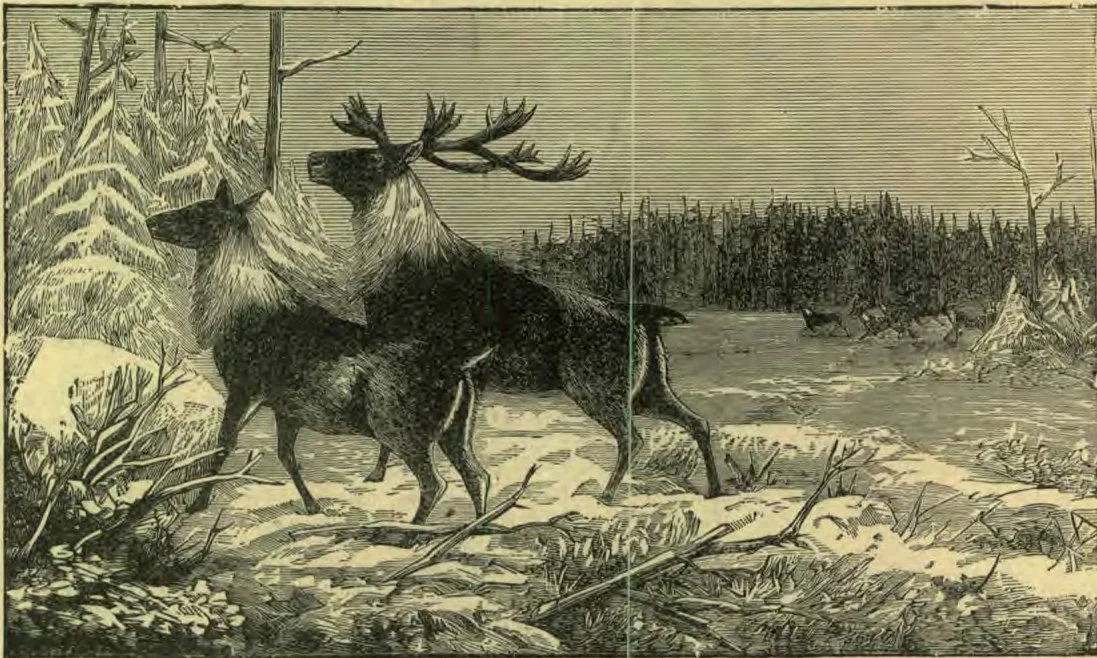
THE REINDEER.

THE reindeer lives very far north, in such a cold country! Do you know where Lapland is? It is in the northern part of Europe, near Sweden. You can find it if you look on the map.
The reindeer is the Lapp's best friend. It is his horse, and cow, and sheep, all in one. He could not live in this barren country without the reindeer.
Lapland is so cold that nothing can grow there except some moss. This moss is very short, and its grayish white color makes the ground, even in summer, look as if it were covered with patches of snow. Sometimes a few stunted pine trees manage to grow, but they are always covered with a black moss, that makes the country look very lonesome indeed.
The reindeer lives on both kinds of this moss, but it likes the kind that grows on the ground the best. It cannot live on anything else. Nowhere in the wide world will this moss grow except in the cold countries where the reindeer lives.
The reindeer is about as patient and willing an animal as can be found. He will easily draw the Laplander thirty miles a day; and when urged, he can travel sixty miles; but he is almost sure to die when he goes so fast.
As soon as the reindeer begins to grow old, the Lapp kills it. He dries its flesh in the air. Sometimes he smokes it, and lays it away for use on long journeys. But the Lapp cannot afford to live on reindeer all the time. In the spring he catches fish; and in the autumn he shoots sea-birds with a cross-bow.
Out of the reindeer skin, the Lapp makes all his clothes, even to his shoes. He also covers his sledge with the skin; and he makes his bed out of skins spread over the leaves of the little dwarfed birch trees.
Even the horns the Laplander sells to be made into glue; and he dries the sinews so as to make a very strong thread. You could hardly imagine what the Lapp would do without this useful little animal. How well it is fitted to live in the country where God placed it! W. E. L.
Continue reading: HOW FAST FRITZ GREW