In previous articles, we have seen that the Lord has provided a financial system for the dissemination of the gospel, which, when fully adopted by his people, will furnish ample means for the support of the evangelical work in both so-called Christian and heathen lands. There is, however, another phase of our denominational work that has thus far not been considered in these articles.
Early in our history, we were led to establish schools for the education of our youth and the training of workers, publishing houses for the rapid dissemination of the truths of the message, and sanitariums for the care of the sick, and the teaching of correct principles of living. This institutional phase of our work has rapidly grown until to-day we have 86 colleges and academies, 28 publishing houses, and 74 sanitariums, with 3,160 men and women engaged in operating them. These institutions carry an investment of over $6,500,000, and are important factors in our work. Their successful operation means prosperity to the denomination, and will give a great impetus to the evangelical work. On the other hand, their financial embarrassment must interfere with that which is the real object of our existence,—the saving of souls. Established for the furtherance of the message, and so intimately connected with the evangelical work, we must conclude that if right financial principles are followed in their creation and operation, we shall not only be able to avoid financial embarrassment in them, but they will prove a source of great strength to our world-wide work. If, on the other hand, wrong financial policies are followed, we must expect, with the magnitude our institutional work has attained, that instead of being a help, they will become a menace to the denomination.
This phase of our denominational finance, therefore, merits our most careful consideration. It has come to be recognized that the denomination really stands back of our regularly organized institutions. The question of establishing a school, sanitarium, or publishing house, should, therefore, not rest with a few men, nor even with a local conference, for it may affect the entire denomination, and its creation is a subject for wider consideration than can be given by those in the immediate locality where it is proposed to establish it. Early in our history instruction was given on this point:—
The medical branch of the work is the most difficult work now before us. I have received letters from presidents of conferences and from men of property, and have also had interviews with these brethren in reference to establishing health institutions in different States. I can not encourage this, after a careful consideration of the cause of God in every branch. I have brought to their minds the difficulties that we have had to meet in the institutions already established,—the discouragements which have come in, as there was such a lack of piety, of principle, of unswerving integrity, of well-balanced minds, of unselfish interests, of men who were wholly consecrated to God. Men of this character are the only ones who should have controlling power in our institutions.
I have been shown that the matter of establishing and conducting denominational and health institutions should come under the supervision of the General Conference. Such institutions should be established only after careful and prayerful consultation, and when it is decided to be essential for the advancement of the work of Bible hygiene and temperance for the good of suffering humanity. The strange movements which have been made in reference to the planning and establishing of sanitariums have not been in the order of God.—Unpublished Manuscript.
The establishment of health institutions is too important a matter to be left to the management of a few interested individuals. If the enterprise is under the control of the General Conference, the way is open for deliberate counsel, and careful consideration of the matter and its relation to the great whole; and after it is undertaken, there will be a united force to give it influence and standing. This will contribute largely to its success. Under such management, a class of workers could be enlisted which otherwise could not be secured; and thus the enterprise would prosper when it would prove a failure in ordinary hands; and, furthermore, there must be an authority to guard such an institution, so that persons who are not qualified may not be allowed to grasp responsibilities, through selfish ambitions in their professional lines as physicians.—Id. A failure to heed this instruction has brought much embarrassment. In some instances it has placed institutions12concerned, which eventually falls upon the people, and reacts upon the evangelical work of the denomination.
With the expansion of our work, the field has been divided into union conferences, whose officers and committees have the oversight of the work in the fields in which they operate. The local conferences should not feel free to establish a work that may affect the union conference, without obtaining counsel from the larger body; for while the work under consideration may promise benefit to some locality, its general effect might prove detrimental. Where its influence, financial or otherwise, would extend beyond the bounds of the union, counsel should be sought of the General Conference. Wisdom will warrant us even further than this, for as it is the people who must furnish the money for the establishment of the proposed institution, and also its support, it is due to them that their judgment and wishes should be obtained before launching the enterprise, or involving the constituency.
The world to-day is seeking in all its enterprises to eliminate competition. Without endeavoring to discuss the merits of the question in general, it is evident that there can be no excuse found for this denomination’s creating and maintaining institutions that enter into ruinous competition with one another; for while the argument is advanced that competition in commercial enterprises incites to excellency of service and is the life of trade, in denominational work the opposite effect is obtained. In our schools it results in meager facilities, inadequate faculties, and an attendance insufficient to properly support these institutions. What is needed, is a proper distribution of our schools, and a determining of the scope of work and the sphere of influence of each, so that each will become a unit contributing its share to making up a strong and efficient educational system, capable of suitably supplying the necessities of the denomination, and giving promise of securing a patronage and support commensurate with the facilities supplied.
What has been stated of our educational institutions can, in the main, be also said of our sanitariums and publishing houses. Competition should not in any sense enter into their operation. The nature of their work, with a common object for all, calls for the very closest cooperation. We are living in a time that demands the very best attainable from any line of service. Much more important, we are engaged in a work that calls for an excellency of attainment beyond the human. If, therefore, we discern anywhere in any phase of our institutional work unsatisfactory results, or financial conditions that threaten to embarrass the work; if any of our colleges or academies continually fail to secure proper attendance by reason of insufficient constituency, or because of a lack of suitable equipment, with the inevitable accompanying low standard of work; if after careful consideration, it develops that these conditions are chronic and result from an overcrowded and undesirable competition, it should be recognized that a change is called for, a change that may perhaps be attained by a readjustment as to the extent of work to be done, limiting it to fewer grades, or by a readjustment of territorial lines. It may even be necessary to discontinue some schools entirely. Better that, if the case is hopeless, than to continue for an indefinite number of years unsatisfactory service and financial loss.
As a denomination, we should be far better served, and therefore occupy a much better position educationally, with fewer strong and well-equipped colleges, doing a high grade of work, with class-rooms and dormitories well filled, and a faculty of the very best teachers obtainable, than to have a greater number of so-called colleges, none of them enjoying the patronage they should have, nor attaining the educational standard our work and needs demand.
W. T. KNOX.
As One Sees Us
LEST we come to think that the increased enlightenment of this age and a growing spirit of liberality and intellectual and religious tolerance will make it impossible for the decree of extermination ever to go forth against those who keep God's law, it may be well that we hear from time to time such expressions as the following, written to the editor of Signs of the Times by Mr. James Mullowney, a former Catholic priest. He pays his respects to Seventh-day Adventists in this manner:—
There are too many sects, too many creeds, too many fanatics; and the most dangerous of them all, in religion and in the field of labor, are the Seventh-day Adventists. Protestants and Romanists alike hate them, and some day a well-directed inquisition will terminate them. Fanaticism is the greatest danger to our country. I believe that even God hates a Seventh-day Adventist.
Therefore, in “terminating” Seventh-day Adventists by means of “a well-directed inquisition,” such a one would think he was doing God service, giving God pleasure in pouring out his hate upon such a people. There is nothing more bitter than the hate of a fanatic or bigot who thinks he is working under a divine commission when persecuting men and women on account of their religion. Mr. Mullowney is brutally frank, but so will be that decree, when it comes, declaring that all who will not worship the beast or his image or receive his mark, shall be killed.
F. H. DE VINNEY
By F. H. DE VINNEY
Japan
F. H. DE VINNEY
SINCE the general meeting at Awaji in July, I have visited every church, company, and laborer in the field. This has involved hundreds of miles of travel by rail, and not a little by foot and by jinrikisha (man-power wagon); and living native style in Japanese hotels, during all the time away from home not having a chair or bed, but sitting, eating, and sleeping on the floor. At first this is rather difficult, and is trying to one’s body and limbs; but after a time it becomes less disagreeable than might be expected by a foreigner. I rather enjoy it for a time; but on account of the strange foods upon which one must live, any long trip or continued stay in the hotels is usually followed by a few days’ illness, which detracts from the pleasure of the experience.
At Yusawa, in the northern part of the main island, we held meetings for several days with the interested ones; and as the result of the labors of Brother Matsukura, I baptized three adults in the river, near the city. Besides his regular readers, Brother Matsukura has a large class of the children of heathen parents to whom he is teaching the message.
To reach the little church company at Kuji, we had nearly five miles’ walk from the railroad station. When yet two miles distant, we began to meet members of the church, as they had appointed a meeting in a pine grove near the river. Here in God’s own temple we held a service that reminded us of Paul’s meeting on the riverside, ‘where prayer was wont to be made.’ At its close we went down into the water and baptized three young men who are just entering the prime of life.
At Kogoshima, an important city of Japan, situated in almost the extreme southeastern part, and about twelve hundred miles from Yusawa, we visited Elder H. Kuniya. He has a good interest in that place, and we hope to establish a strong church as the result of his and his colaborers’ work. We spent several profitable days visiting and holding meetings, and then with Brother Kuniya visited Miyakonojo, enjoying the interesting experience of traveling in a Japanese bashi, or stage drawn by a little raw-boned horse. For ten miles we went winding up the side of the mountain on the edge of a cliff overlooking its smoking volcano and the great bay, and then as far down the other side to the little city, where we remained two days. While we were there one man and his little boy came several miles to attend the meeting.
At Sasebo, the great naval port on the west coast, in the same waters which floated many great men-of-war, and naval vessels of all kinds gathered to prepare for the annual review before the emperor in Yedo Bay, I baptized three individuals as a preparation for a different kind of warfare than was in the minds of the thousands who were all around us intent upon war preparations.
From Sasebo, Brother Miyake, my secretary and interpreter, and I walked six miles to another port, to get a boat for Hirado, a fishing village on an island about six hours’ steaming off the west coast. While on the way we were all the time surrounded by many marines and soldiers, who were engaged in repelling a mimic attack on an enemy from the sea upon the naval station. They paid little attention to us; but it was rather trying to be in the “midst of war’s rude alarms,” when bent upon such a peaceful errand. However, we did not mind it after a time, and it served to break the monotony of the walk.
At Hirado we had a very interesting experience. In every Japanese city or large village there are many little local post-offices. The head postmaster had expressed himself to our laborer as believing that every man ought to hold some kind of religion, and that he was willing to investigate the Christian religion with a free mind. Hearing that we were in the city, he invited us to come to his house and hold a service. When we reached his house in the evening, we found that he had called in all the employees of his post-office, and as many of the local officers as could get away, and two large rooms were filled with those who gave good attention as we presented the claims of the Christian religion. After the meeting, nearly all remained for an hour, asking questions. Surely here is a fruitful field for effort.
After fourteen hours on the Inland Sea from the city of Matsuyama, where we had spent several profitable days with the workers, and where a tent effort had been held during the summer, we reached Kobe, on the afternoon of Friday. A meeting with this church is always a pleasure. After a good service Sabbath morning, we went to the sea and baptized seven of the helpers and patients from the Eisei-In, our Japanese sanitarium. Here a splendid work is being done to heal both the bodies and the souls of men, and the Lord is greatly blessing the institution.
From Kobe I was called home to prepare to attend the meeting of the Asiatic Division, at Shanghai, China. In all the places visited not especially mentioned, we had good experiences, and saw many evidences that there are honest hearts in all parts of Japan who will yet be won to the love and service of Christ.
The week of prayer has just closed as this is written, and the reports which have reached us from the different places indicate that it has been the best one ever held in Japan. Truly it was a very precious season of refreshing here in the Tokio church. There was such earnestness in the prayer seasons that we foreigners had difficulty finding a chance to pray. The Japanese brethren and sisters would begin to pray before the formal closing of the prayer preceding, while the foreigners, not being so familiar with the language, would wait for the Amen, and thus be just too late to begin. This occurred many times, and we could almost wish that some of our prayer-meetings back in the home land could have been transported here to catch the inspiration. Surely the Lord is fitting up workers to finish his work on the earth, and the signs are thickening which show the end is near.158
The great need of Japan which is pressed upon mind and heart from every visit to laborer, church, and company, is the need of men—young, devoted, consecrated laborers with some experience—who will come over and learn the language and assist us in training native laborers, and help these native laborers in binding off their work so that that which is gained will not unravel and be lost as persecution comes and the workers pass on to other parts of this great field. That such may hear the call, we are daily praying.
Tokio.
He Is Coming
By Eugene Rowell
EUGENE ROWELL
He is coming is far sounding in the raging of the sea;
On the age-decaying mountains it is graven deep in stone;
It is borne upon the tempest when the wolves of storm are free;
And the valleys far reecho, “He is coming to his own.”
In the early glow of morning and the sunset’s living flame,
All the heaven is written over with splendor of his name:
He is coming, he is coming to his everlasting throne.
He is coming. We behold it in the faces of the throng;
It is in the clanging chorus of the song that labor sings;
In the marketing of virtue and the arrogance of wrong
It is borne o’er land and ocean with the speed of eagle’s wings.
In the darkness of the midnight and the glory of the noon
Earth and sea and sky proclaim it, he is coming very soon:
He is coming, he is coming, Lord of lords and King of kings.
“He is coming,” say the banners of our legions ranked for war;
In an undertone it rumbles through the rolling of the drum;
It is in the strife of nations and the flight of wingèd car:
Lo, the proud of earth shall tremble and her kings fall pale and dumb;
And as leaves before the tempest, wicked men shall flee his wrath,
When he wraps the earth in vengeance and destruction marks his path;
But the ransomed of the Lord shall cry, “Hosanna! He is come!”
New Mission Buildings Among the Indians of Peru
In a letter written Sept. 15, 1912, the Brother F. A. Stahl speaks of their work among the Indians of Peru as follows:—
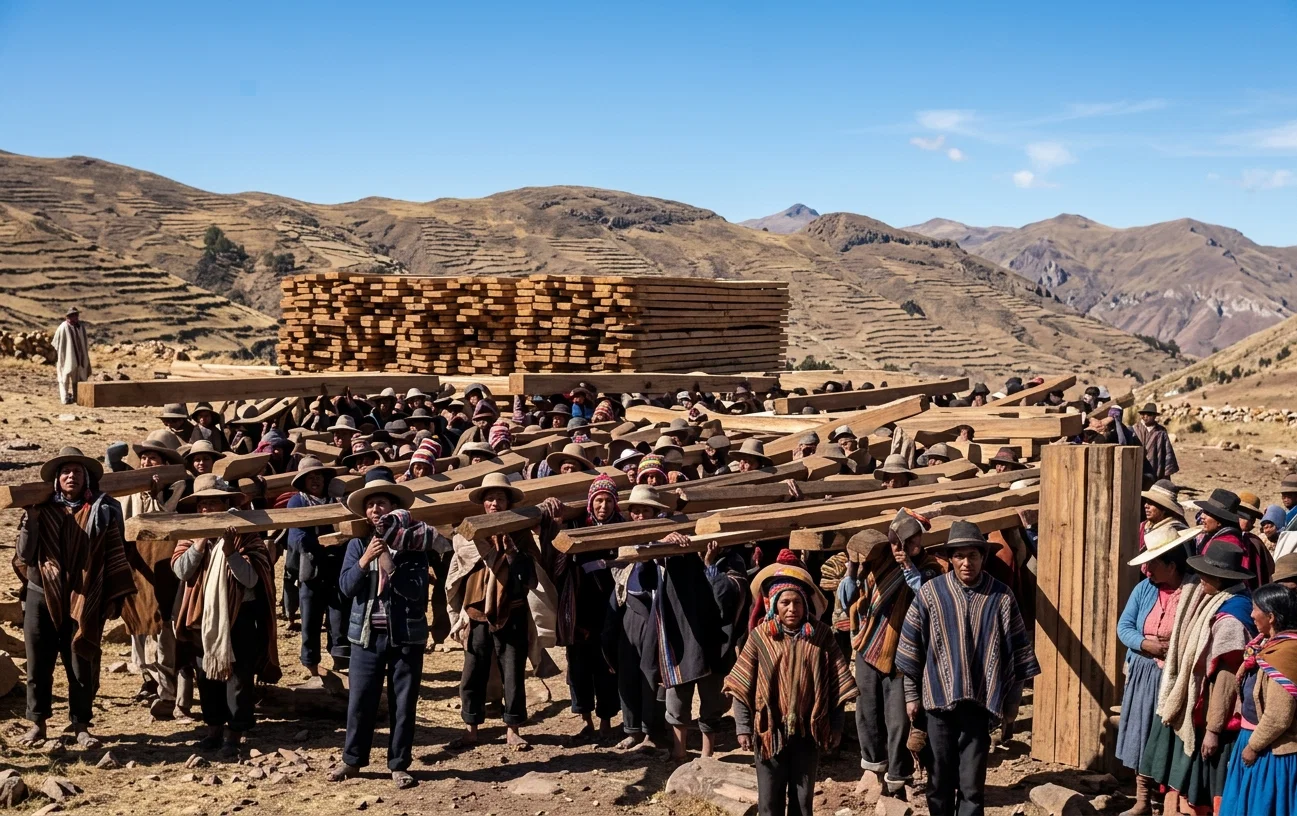
INDIANS BRINGING MATERIAL FROM PUNO, TWENTY-ONE MILES, UPON THEIR SHOULDERS FOR THE NEW MISSION BUILDING
“We are now out at Platiria, finishing the mission buildings, and there is a greater interest than ever at this place. The people now believe that this mission has come to stay, and are more ready to be friends. We have had many evidences of the Lord’s blessing.
“There is a great feast in Akora this week, but the people do not bother us. We live in the new house now, right near the road, but the Indians seem to be our friends, almost without exception.
“A little thing did happen to-day. We sent an Indian brother to Akora to buy some food, and as he was returning a man took the food away from him. We sent a letter to the governor of Akora, who reproved the man severely, and made him give back the food. The governor also sent a soldier with him to see that he did it. A large crowd saw it all. This will do us some good.”
This picture illustrates the keen interest of the Indian brethren in erecting the mission building. Note these heavy loads, and then think of what it means to carry them in this manner twenty-one miles. Surely a display of loyalty to the message.
Extracts From Mission Letters
EXTRACT from letter from Elder W. H. Anderson, Pemba, Rhodesia:—
“The air is fragrant with orange blossoms. Some of the trees look as if they had been snowed on. The magistrate told me he wanted to engage all his oranges here next year, at twenty-five shillings a hundred. I agreed to let him have what he wants.
“The cows are still doing well. We now have fifty-three young calves, and all but one are thriving.
“It is a marvel to our neighbors how healthy our cattle are. Cattle are dying all around us, but if the rains start at the usual time I do not think we shall lose any. The man on the next farm south of us, who bought one hundred of the same lot that ours came from, has lost thirty-five out of his one hundred cows. Another who had some of the same lot, has lost one half of his. I get on the mule once or twice a week and ride out to see that they have good feed and water; and if they need to be changed to new feed, I have this done, and tell the boys where to go with them. With the blessing of God they are all living.
“The lions are still plentiful. A native told me last week that a man from his kraal saw twelve in a lot about six miles south of us, and our next neighbor to the south said he saw thirteen on his way to Pemba last week. A man was coming to us on his bicycle, but saw so many lion tracks in the road between here and Mission Spur that he was afraid, so he went back and came around by Father Moreaus to get here safely. Still we have been spared, and our cattle and sheep are all right, although others about us are still losing theirs.
“There is a famine in the land, and the natives are now buying grain. Nearly every boy has gone to the south to work. This has drawn away several of our students. The magistrate who was here told me that the labor runners were determined to ruin this country in behalf of the south, in order to get the charter renewed. Hardly a day passes that I do not see a policeman pass looking for boys to work. The police are now paid no salary, but they are paid two shillings for each boy they bring in. As they wear the government uniform, they use their own ways of getting them, and there is no check on their methods, as they do not go to the native commissioner now.
“These are some of the difficulties that we have to meet, and I suppose they will not improve. Pray for us and the work here.”
Extract from letter from Geo. Hutchinson, Shangani Mission, Rhodesia:—
“I avail myself of this opportunity to report with regard to the progress of the work in this part of the Master's vineyard since my return. The attendance at our Sabbath meetings had fallen off during my absence, so on my arrival I made it my first duty to visit the people and to give stereopticon lectures, which they greatly appreciated. I am glad to state now that they attend our meetings just as well as formerly. The native commissioner visited me, and in a chat with him he told me that the natives are very much pleased that the mission is here, and that they realize and appreciate the benefit they derive from it. He tells me that we have a fine position and an important one. He is very much pleased with our work and hopes to visit us again at some future time.
“I have made inquiries regarding the gold-mine that is nearest us, with a view to future business transactions. I found that the mine is a large one, employing seventy white men and one thousand natives. To provide for these people, the manager enters into a contract with a store which is on the mine to supply grain. The man who is running this store gets most of the grain from Bulawayo by rail to a siding that is forty miles from the mine. The grain has to be hauled by wagon from this siding. This store would buy grain from us at a good price if we could supply it. I now think if we could operate a store and raise some grain, a good beginning would be made toward making this station self-supporting.
“Brother and Sister T. J. Gibson and family are with me at present. We have been discussing our work and making plans. He believes with me that the work here has a good future.”
Extract from letter from E. C. Silsbee, Kolo Mission, Basutoland:—
“There are some encouraging features in the work here. A few days ago I had a Bible study with a native minister of the New British Church, who has charge of fourteen mission stations in Basutoland. He had studied quite a little regarding the truth, having purchased several of our books. He asked many intelligent questions, which I answered as best I could. After about three hours' study he took his leave, expressing his gratitude many times over for the satisfactory Bible answers to his15questions, saying that we could soon expect him, and as many of his under ministers as he could bring, to come and ask for baptism. This man said that for some time there had been an agitation in their ranks about the question of the true Sabbath, the right way to baptize, and several other points, to which their white ministers failed to give them satisfactory answers; hence his visit to us as ‘the Sabbatarian Mission.’”
Mission Notes
THE India Mission in presenting its immediate needs calls for two nurses—a man and his wife—to assist Dr. V. L. Mann; two canvassers; a Bible worker to assist Elder G. W. Pettit as he opens work in Bombay; four couples to enter new territory, two down in the Punjab, and two for the Telegu country,—thirteen altogether.
FROM Tarsus, that city of which Paul spoke from the castle stairs, “I am a man which am a Jew of Tarsus, a city in Cilicia, a citizen of no mean city,” Brother E. E. Frauchiger, superintendent of the Turkish field, sends greetings to all the believers, and also the good word that doors are opened on every side to him to preach the message. He adds that the roads are full of soldiers who want to go on to Constantinople. He sees in that which is taking place around him the fulfilment of prophecy.
FROM Loanda, Portuguese West Africa, a large assortment of post-cards illustrating the condition of the people in that part of the Dark Continent, has been received at the Mission Board Office. We have no mission station there. The brother located at Loanda, who, with his family, is doing what he can to enlighten the people in a self-supporting manner, is calling earnestly for a missionary to come to their assistance, one who can spend all his time in working among these heathen people who worship demons and know nothing of the coming King. The work must be carried on in the Portuguese language. These scenes illustrate native home life, fetish-worship in varied forms, various industries carried on, and the final parting with their dead. A promising mission field awaits the message in this part of Africa.
J. D. MONTGOMERY
By J. D. Montgomery
Slothfulness
J. D. MONTGOMERY
SLOTHFULNESS is said to be “disinclination to physical exertion.” There is a growing tendency toward disinclination to physical exertion among certain classes. They would probably resent the idea of indolence, of being lazy, yet the disinclination to sufficient exercise seems to be present nevertheless. There is a large class of people who for one reason and another find it hard to incline themselves to proper physical exertion.
No one deserves what he does not earn; he should not expect anything for which he is not willing to labor. “Go to the ant, thou sluggard; consider her ways, and be wise: which having no guide, overseer, or ruler, provideth her meat in the summer, and gathereth her food in the harvest.” Prov. 6:6-8. She provides her necessities in a favorable time against the time of need. “If any provide not for his own, and especially those of his own house, he hath denied the faith, and is worse than an infidel.” Industry is a Bible principle, and to neglect it or reject it is to deny the faith and become worse than an infidel.
“Slothfulness casteth into a deep sleep; and an idle soul shall suffer hunger.” Prov. 19:15. Another text similar to this: “How long wilt thou sleep, O sluggard? when wilt thou arise out of thy sleep? Yet a little sleep, so shall thy poverty come as one that traveleth.” Prov. 6:9-11. The indolent man does not properly provide for his family, and consequently does not represent correctly the religion of Jesus Christ.
Besides this, there is an unfavorable effect upon the body itself if it is inactive. The effect of indolence upon the body may be gathered by this text: “The fool foldeth his hands together, and eateth his own flesh.” Eccl. 4:5. The flesh of the body is consumed by itself from too much folding of the hands. Another: “By much slothfulness the building decayeth; and through idleness of the hands the house droppeth through.” Eccl. 10:18.
The idler sees obstacles to his progress where none exist. “The slothful man saith, There is a lion in the way; a lion is in the streets. As the door turneth upon his hinges, so doth the slothful upon his bed. The slothful hideth his hand in his bosom; it grieveth him to bring it again to his mouth. The sluggard is wiser in his own conceit than seven men that can render a reason.” Prov. 26:13-16.
Bible Hygiene and Sanitation
The science of the prevention of disease is a Bible science. The art of prevention eclipses the art of cure beyond any comparison. “An ounce of prevention is worth a pound of cure,” says the old adage, and we have never heard it successfully disputed.
It is the work of true health reformers to teach the people how to live to avoid disease. It is this phase of the subject that points the patient to the One who is the author of good health. A wicked man may give medicine and enforce rules of living until health is restored to the sick; but it is only the Christian doctor or nurse who will persuade the patient to repent of his past mode of living and abandon it for that which is required by the Word of God. Health thus becomes to him “thy saving health,” and disease the result of transgression. To those who reform their mode of living merely to escape the results of bad living, this phase of the subject does not appeal.
The Bible has very little to say about the cure of disease, but has much to say about how to avoid it. God gave to Moses the best system of sanitation, and the simplest, withal, that has ever been used by mankind. The system was160merely the system of cleanliness. Modern sanitation and hygiene is merely a complicated system of cleaning up and keeping clean. In fact, if we keep matter in its rightful place, or in other words, keep clean, there will at least be no filth diseases. Dirt is matter out of place. So germ life may not be so harmful unless it gets into the wrong place. Hence the importance of cleaning up and keeping clean.
In leprosy we have what is in our time known as practically an incurable disease. Rarely indeed do we hear of a cure from leprosy. In the days of Moses, the cure of this disease was provided for, in that rules were given for the reinstating of the patient after he was cured. When he was cured, he was to show himself to the priest, who was both doctor and preacher, for examination. If he was found to be free from his infection, he was instructed to ‘wash his clothes, and shave off all his hair, and wash himself in water, that he may be clean: and after that he shall come into the camp, and shall tarry abroad out of his tent seven days.’ Lev. 14:8. Even after he was entirely free from outward symptoms, the man was to tarry away from his family yet seven days longer for fear the infection might break out again.
In Leviticus 15 is recorded the method of dealing with another infectious disease. Some very rigid restrictions were thrown around cases of this kind to prevent communication of the disease to other persons. They are rigid but very simple. Any one can understand them and carry them out. If any one even touched the patient, or his bed, or any vessel that he had used, the infected one was to ‘wash his clothes, and bathe himself in water, and be unclean until the even.’ To be ‘unclean until the even’ meant that he was to isolate himself from the presence of men for the remainder of that day to allow the air and sunshine to complete the work of disinfection.
When the patient himself recovered, he was to ‘number to himself seven days for his cleansing, and wash his clothes, and bathe his flesh in running water,’ and be clean. This isolation of infectious and contagious diseases prevented an epidemic. One man was not permitted carelessly to infect his fellows. If one became infected and failed to follow instructions for cleansing, he was stoned to death. To forget or neglect these instructions classed one as a criminal, and his execution speedily followed.
The execution of these simple methods for sanitation in the camp of Israel resulted in a camp of very low mortality. Only when the people broke away from the rules of the camp and indulged in things that caused disease, do we find any record of disease among them.
It may be that if our modern methods of sanitation included more fresh air and sunshine, we should reap greater results. Fumigation, disinfection, and other things now in use, could well add the old-time measures of air, sunshine, running water, and isolation, and profit thereby.
Newark, Ohio.
Earth’s Lesson
By C. P. Bollman
C. P. BOLLMAN
SINK to thy rest, O sun,
Behind the western hills!
Leave earth to darkness, and
To that sweet calm that falls
O’er nature with the night.
Withdraw thy heat, O sun!
Day with no break would blast
Earth’s fairest fields and make
Of gardens deserts drear.
Night brings some blessings day
Can not impart; the clouds
Shut from the earth thy rays
That garden spots may smile
In bounteous harvests,
And so our race be blessed
With food and raiment meet
For all God’s children dear.
And now, O child of hope,
Earth’s lesson quickly learn:
We need the sunlight bright,
And God’s approving smile.
We need to feel the warmth
Of love divine, and know
His keeping presence near:
But like the earth we need
The storm-cloud and the rain.
The shadows cool we need.
E’en hours of darkness deep
We need to try our souls,
To draw upon our faith,
That we like garden spots
May smile in harvests rich
With precious fruits for God.
Nashville, Tenn.
The Seriousness of Answered Prayer
By Alexander McKenzie
ONE reason we do not pray better, I suppose, is that we are afraid of being answered. It is a very serious thing to pray, because we may be taken at our word. We must consent that God should order the answer. For instance, I pray in the morning that God will make me very useful to-day; it is a hazardous prayer. I may be taken at my word. Within an hour I may be called to very great usefulness, which will take a hundred dollars from my bank-account. Now, if I don’t want to take that money if it is called for, I have made a mistake in my prayer. Let us say what we mean.—Alexander McKenzie.