Your ShelfYour Projects

Signs of the Times, Vol. 21, No. 43.

HE WILL COME AGAIN
Earlier text: HE WILL COME AGAIN

WHAT CHRIST'S COMING MEANS TO MEN.

BY A. O. T.

To His Followers.

The second coming of Christ to all his followers, both those who are living and those who are sleeping in their graves, will mean the culmination of some of the most precious promises to be found in the word of God. When Christ was with his disciples on earth he was disclosing to them little by little the fact that he was to be separated from them soon and go to his Father—a fact, however, that they should have known of themselves from the prophecies, of which the Jewish race professed to be great students; but they were nevertheless expecting that he would be a temporal Prince, and that they would reign with him upon temporal thrones, amid the ruins of the old Roman Empire, which had been, and was, the great oppressor of their race. But Christ began to unfold to them little by little, as they could understand it, his true mission, and, among other things, that he was soon to be offered upon the cross for the sins of the race, and that then he would go to his Father. As he told them these facts, they began to be filled with sorrow, but Jesus said:—
“Let not your heart be troubled; ye believe in God, believe also in me. In my Father's house are many mansions; if it were not so, I would have told you. I go to prepare a place for you. And if I go and prepare a place for you, I will come again, and receive you unto myself; that where I am, there ye may be also.”
How precious is this promise, “I go to prepare a place for you,” and “I will come again, and receive you unto myself; that where I am, there ye may be also”! Jesus was not simply going away, but he gave them the promise that he would come again, and not only that he would come again, but that he would receive them unto himself, “that wherever he was, they might be also with him.” The disciples by associating with Jesus had learned to love him. They had seen him in his everyday life, and had found him to be full of compassion and kindness, abounding in wisdom and mercy, and, in short, everything that can be found in a perfect character. And so they loved him, and it was a source of sorrow to them to think that they were to be separated from his bodily presence; but notice how the Saviour comforts them with the assurance that he would come again, and that where he was they might be. Most precious promise!
Again, in Acts 1:11, when the Saviour was leaving the earth, he was so intent upon impressing their minds with the fact that he was to come again, that he sent two heavenly beings to say to the disciples, “This same Jesus, which is taken up from you into heaven, shall so come in like manner as ye have seen him go into heaven.” How sincere was the desire of the disciples to be with Jesus! And the individual even now who has learned to know him as the Saviour from his sins, will be longingly desiring for the return of “this same Jesus.”
Again he says, “Behold, I come quickly; and my reward is with me, to give every man according as his work shall be.” Rev. 22:12. Then the second coming of Christ means to his followers not only the privilege of being with Jesus, but the inestimable privilege of receiving at that time the full reward that Jesus has for him. The first and most precious thing that he bestows upon us at his coming is immortality, for he says:—
“Behold, I show you a mystery: We shall not all sleep, but we shall all be changed, in a moment, in the twinkling of an eye, at the last trump; for the trumpet shall sound, and the dead shall be raised incorruptible, and we shall be changed. For this corruptible must put on incorruption, and this mortal must put on immortality.” 1 Cor. 15:51–53.
Notice how clear this assurance is: “We shall all be changed.” Not only those who are sleeping in the grave, but those who are alive at the coming of the Lord, will be changed; the dead shall be raised incorruptible, and we (those who are living) shall be changed, and the mortal shall put on immortality. Then the coming of Christ means to his followers the privilege of being forever with their Lord, and enjoying the blessings of immortality. But again note the inexpressible joy in that immortal existence:—
“Eye hath not seen, nor ear heard, neither have entered into the heart of man, the things which God hath prepared for them that love him. But God hath revealed them unto us by his Spirit; for the Spirit searcheth all things, yea, the deep things of God.” 1 Cor. 2:9, 10.
Nothing that eye hath ever seen—the most beautiful lakes and rivers, on whose shores are spread out the fields of living green, the most beautiful place that art and the ingenuity of man can make, will come far short of expressing to us the beauty and the joy of that place. Neither hath ear heard sounds so sweet, nor conveyed to the mind such expressions of inestimable joy as shall be found there. He does not stop with this. He says, “Neither hath entered into the heart of man.” In the loftiest flights of his imagination, when the mind has been roving in fields of ineffable light and joy, when man has pictured to himself that which is far beyond anything which he has ever seen in his life, fancy falls short of even conceiving what God has prepared for them that love him. Yet he says God has revealed these things to us by his Spirit.
Through a study of the word of God, guided by his Spirit, we may by faith know somewhat of those future joys. But even our faith, with our limited faculties for comprehending the great truths that God has for us, will come far short of presenting to our minds the unutterable reality of the joys of the redeemed state. O, the feebleness of human language, and the lack of being able to express the emotions that thrill the heart of the believer as he contemplates that glad day when Jesus will come to receive his own!
Not only will we be forever received into the personal presence of the Saviour, robed with immortality, and filled with indescribable joy, but then will be given back to us our beautiful home, the earth made new; for do we not read in his word, “And I saw a new heaven and a new earth; for the first heaven and the first earth were passed away”? Rev. 21:1.
The character of those who will dwell there is expressed in the fifth chapter of Matthew and the fifth verse: “Blessed are the meek; for they shall inherit the earth.” No person has ever yet received a foot of ground on this earth in its present condition because of his meekness, but in that new heaven and new earth those who are meek, those who possess the characteristics of the Master, will be the dwellers there.
In the thirty-fifth chapter of Isaiah, which gives a description of the earth in its renewed state, we get something of an idea of the beauty that will be so abundantly spread over its entire surface. We there learn that in this new earth the desert will rejoice, and blossom as the rose. Those who have been blind, lame, and afflicted, will be made to leap with that joy that can be found alone in the heart of one who realizes that he is in possession of everlasting life.
“And the ransomed of the Lord shall return, and come to Zion with songs and everlasting joy upon their heads; they shall obtain joy and gladness, and sorrow and sighing shall flee away.”
Volumes might be written, and yet this great subject would not be exhausted. The second coming of Christ means everything that is full of joy and blessedness to his followers. And well might it be if in contemplating this subject we need dwell only upon the beautiful picture of what the second coming of Christ brings to his followers.

To the Sinner.

While the second coming of Christ means everything that is desirable and nothing that is undesirable to his followers, it will present a very different picture to those who continue to refuse his proffered mercy. In Matt. 16:27 Jesus says, “For the Son of man shall come in the glory of his Father with his angels; and then he shall reward every man according to his works.” The character of the works, it will be observed, is that which determines the kind of reward that will be given. In the fifth chapter and the twenty-eighth and twenty-ninth verses of John the Saviour tells us again:—
“The hour is coming, in the which all that are in the graves shall hear his voice, and shall come forth; they that have done good, unto the resurrection of life; and they that have done evil, unto the resurrection of damnation.”
Then all that are in their graves come forth to the one or to the other of these resurrections.
The second coming of Christ is to demonstrate the final condition of every individual that has lived, or that shall live, on this earth; for just before his coming he says:—
“He that is unjust, let him be unjust still; and he which is filthy, let him be filthy still; and he be righteous still. . . . And behold, I come quickly.” Rev. 22:11, 12.
That is, just before his second coming the Son of man, who has given himself for the race, who has done everything that infinite power and infinite love could do to redeem us, will pronounce those awfully solemn words, showing that the guilt of the sinner and the righteousness of the Christian will remain forever fixed.
When such momentous issues are before us, what a solemn thing it is to live! How carefully should we devote ourselves to the service of the Master, that when he rises to pronounce that final sentence, we may be among those who are just and holy! It is said of those who will refuse his proffered mercy that they “shall be punished with everlasting destruction from the presence of the Lord, and from the glory of his power.” 1 Thess. 1:9. Observe how expressive is this language. Not only will they be punished, but they will be punished with destruction, and that destruction will not be something that will be simply temporal, so that they can be brought into existence again, but he says it is to be everlasting destruction, and that his everlasting destruction is from the presence of the Lord and the glory of his power.
So while the second coming of Christ brings to his followers everything that is joyful and good, and while it will be the realization of the highest hopes of eternal happiness and blessedness in the presence of the Lord, it also means to the sinner the final settlement of his doom, his everlasting destruction from God and his glory, because the destruction in and of itself would not only banish him away from the presence of the Lord, but from the presence of everything else in all the universe. His everlasting destruction brings him to nothing. “They shall be as though they had not been.” Obadiah 16. See also P. 37:9, 10, 20, 35, 36.
With that thought before us, that Jesus is soon coming again, and that one or the other of these rewards awaits every individual on the earth, how highly important it is that each one should be found devoting himself to the higher interests of eternal salvation, rather than to the transitory pleasures of time and sense!
Dear reader, one or the other of these rewards awaits you. Which shall it be? It is in your hands to decide. Now you have the privilege of choosing whether you will have all the joys that infinite love can bestow upon you in an eternal existence, or whether you will choose banishment from God and from all the joys of the blessed. May we one and all find it in our hearts to choose Christ and his righteousness now, that we may receive all the priceless treasure that his soon coming will bring to his people.

WHEN JESUS COMES.

Some people seem surprised at the eagerness which Adventists display for the return of the Lord Jesus Christ to this earth. But why should they not be eager for his return, when that return mean:—
Reunion for the parted. Health for the sick. Land for the landless. Habitations for the homeless. Plenty for the destitute. Bread for the hungry. Water for the thirsty. Sight for the blind. Hearing for the deaf. Speech for the dumb. Youth for the aged. Liberty for the captives. Riches for the poor. “Beauty for ashes.” Immortality for mortality. Life for the dead. The oil of joy for mourning. Peace for the troubled. Rest for the weary. Gladness for the sorrowing. Songs for the sighing. Society for the friendless. Perfect bodies for crippled. Crowns for crosses. Light for darkness. Strength for weakness. Harmony for discord.
“With an eternal inheritance in the kingdom of God for all his ransomed people.”

ADVENT SONG.

Thou art coming, O my Saviour! Thou art coming, O my King! In thy beauty all resplendent, In thy glory all transcendent; Well may we rejoice and sing! Coming! In the opening east Herald brightness slowly swells. Coming! O my glorious Priest, Hear we not thy golden bells!
Thou art coming! thou art coming! We shall meet thee on thy way, We shall see thee, we shall know thee, We shall bless thee, we shall show thee All our hearts could never say. What an anthem that will be, Ringing out our love to thee, Pouring out our rapture sweet At thine own all-glorious feet!
Thou art coming! Rays of glory Through the veil thy death has rent, Touch the mountain and the river With a golden, glowing quiver, Thrill of light and music blent. Earth is brightened when this gleam Falls on flower and rock and stream; Life is brightened when this ray Falls upon its darkest day.
O, the joy to see thee reigning, Thee, my own beloved Lord, Every tongue thy name confessing, Worship, honor, glory, blessing, Brought to thee with glad accord. Thee, my Master and my Friend, Vindicated and enthroned. Unto earth’s remotest end Glorified, adored, and owned!
—Frances Ridley Havergal.

WHAT CHRIST’S COMING MEANS TO THE EARTH.

BY J. H. D.
That there will be a literal, personal, second coming of Jesus Christ to this earth, has been made clear to every reader of this paper, in the previous articles on this subject. It is left for this article to consider the effect of his coming upon the earth. As we are inhabitants of this earth, whatever is said of the coming of Christ and his work as regards this world will certainly be of interest to us.
It is of this that the Lord wishes us to have knowledge; for he has given us a history of the past, concerning his dealings with this earth, as an illustration of what he will do with it again when he comes.

Noah and Lot.

“As it was in the days of Noe, so shall it be also in the days of the Son of man.” “Likewise also as it was in the days of Lot. . . . Even thus shall it be in the day when the Son of man is revealed.” Luke 17:26, 28–30. As God then dealt with the inhabitants of the earth, so shall he again deal with them. As he then dealt with the earth itself, so in results he will again deal with it. In Noah’s day he saved all that believed on him; and so in that day when he shall come in the clouds, will he save all that trust him. “And it shall be said in that day, Lo, this is our God; we have waited for him, and he will save us; this is the Lord; we have waited for him, we will be glad and rejoice in his salvation.” Isa. 25:9.
As he cut off the sinners in Noah’s day, so shall he cut off the ungodly at his second coming. “The earth shall reel to and fro like a drunkard, and shall be removed like a cottage; and the transgression thereof shall be heavy upon it; and it shall fall, and not rise again. And it shall come to pass in that day, that the Lord shall punish the host of the high ones that are on high, and the kings of the earth upon the earth. And they shall be gathered together, as prisoners are gathered in the pit, and shall be shut up in the prison, and after many days shall they be visited.” Isa. 24:20–22.
As it was in the days of Lot, so shall it be just before the Lord comes. God sent a message of warning before he sent the destruction, that all who feared his word might escape. See Genesis 18 and 19 and Matt. 24:14. Those who started out and turned back fared no better than those who remained in the city. See Luke 17:29–33.
Not only the inhabitants of the earth will be removed from the earth, but

THE EARTH ITSELF WILL BE REMOVED.

Peter, in speaking of the last-day scoffers, says: “For this they willingly are ignorant of, that by the word of God the heavens were of old, and the earth standing out of the water and in the water; whereby the world that then was, being overflowed with water, perished; but the heavens and the earth, which are now, by the same word are kept in store, reserved unto fire against the day of judgment and perdition of ungodly men.” 2 Peter 3:5–7. Then follows the description of the burning of the earth, which we will consider further on.

His Eternal Kingdom.

The object of Christ’s second coming is to set up his kingdom here and reign with his saints forever. To this end he taught his disciples to pray: “Thy kingdom come. Thy will be done in earth, as it is in heaven.” This prayer can be prayed yet, for we do not yet see the will of Christ done in earth as it is done in heaven. “I charge thee therefore before God, and the Lord Jesus Christ, who shall judge the quick and the dead at his appearing and his kingdom.” 2 Tim. 4:1. Here is clearly stated that his coming is the time when he sets up his kingdom. But his saints are to have a part in this kingdom. “And the kingdom and dominion, and the greatness of the kingdom under the whole heaven, shall be given to the people of the saints of the Most High, whose kingdom is an everlasting kingdom, and all dominions shall serve and obey him.” Dan. 7:27.
With the kingdom is to come the dominion. This was what was given man in the beginning. “Let us make man in our image, after our likeness; and let them have dominion over the fish of the sea,” etc. Gen. 1:26. “Thou hast put all things in subjection, under his feet. For in that he put all in subjection under him, he left nothing that is not put under him.” Heb. 2:8. (See also Ps. 8:4–8.) But how is it since sin came into the world?—“But now we see not yet all things put under him.” And why?—“And the devil, taking him up into an high mountain, showed unto him all the kingdoms of the world in a moment of time. And the devil said unto him, All this power will I give thee, and the glory of them; for that is delivered unto me; and to whomsoever I will, I give it.” Luke 4:5, 6. This kingdom and dominion were first given to man, but he by yielding to Satan yielded also his dominion. When Jesus Christ came in sinful flesh, as man, he had no more right to it than any fallen creature. This is why this offer would be a temptation to Christ when he was in the flesh. “If thou therefore wilt worship me, all shall be thine.” But Jesus did not want that kingdom with its sin and the curse of sickness and death resting upon it. It is not his will for his saints to possess a kingdom and dominion where everything is made dark by sin. He has a better kingdom than that for all who believe in him. “Thy kingdom come. Thy will be done in earth, as it is in heaven.” A kingdom of that character must exclude Satan and all his followers. It can not come from the devil, and he can have no part in it.
“And thou, O tower of the flock, the stronghold of the daughter of Zion, unto thee shall it come, even the first dominion; the kingdom shall come to the daughter of Jerusalem.” Micah 4:8. In order to have the first dominion this earth must be restored to its first condition. But to do this it must be recreated. But a recreated earth is a new earth. Yes, and this is just what is promised. “Nevertheless we, according to His promise, look for new heavens and a new earth, wherein dwelleth righteousness.” 2 Peter 3:13. The previous verses show that this change will take place in connection with

The Second Advent.

The second advent of Jesus Christ is composed of a series of events that are all more or less connected with the earth, from his first appearing to resurrect his saints, until the destruction of Satan and the ungodly after the thousand years. We will now briefly notice these events in their order as given in the Scriptures, that we may trace each change the earth undergoes from the time the wrath of God begins to be poured out upon it until it is renewed and the kingdom is given to the saints of the Most High.
1. Christ Receiving His Kingdom.—In the parable which Jesus gave concerning himself and his kingdom, as recorded in Luke 19:12, he said, “A certain nobleman went into a far country to receive for himself a kingdom, and to return.” By this we are to understand that Jesus is the nobleman, and his going into a far country was when he returned to heaven with his Father, and that before he returns from his Father, he is to receive his kingdom. This is in harmony with the Old Testament prophecy (Dan. 7:13, 14), “I saw in the night visions, and, behold, one like the Son of man came with the clouds of heaven, and came to the Ancient of Days [the Father], and they [the angels, verse 10] brought him [Christ] near before him [the Father]. And there was given him [Christ] dominion, and glory, and a kingdom, that all people, nations, and languages, should serve him; his dominion is an everlasting dominion, which shall not pass away, and his kingdom that which shall not be destroyed.” Just as Christ begins this reign, his voice utters the following decree: “He that is unjust, let him be unjust still; and he which is filthy, let him be filthy still; and he that is righteous, let him be righteous still.” Rev. 22:11. The next verse informs us that this takes place shortly before he is coming in glory. What is he to do with this earth and its nations?—“Ask of me, and I shall give thee the heathen for thine inheritance, and the uttermost parts of the earth for thy possession. Thou shalt break them with a rod of iron; thou shalt dash them in pieces like a potter’s vessel.” Ps. 2:8, 9. He does not convert them, but breaks them in pieces with a rod of iron. “Thou sawest till that a stone was cut out without hands, which smote the image [earthly governments or nations] upon his feet [extremities] that were of iron and clay, and brake them to pieces.” “And in the days of these [ten] kings shall the God of heaven set up a kingdom, which shall never be destroyed; and the kingdom shall not be left to other people, but it shall break in pieces and consume [not convert] all these kingdoms, and it shall stand forever.” Dan. 2:34, 44.
How does he begin this breaking to pieces, this consuming, this ruling with a rod of iron?—By pouring out his wrath upon the earth in the seven last plagues. “And I saw another sign in heaven, great and marvelous, seven angels having the seven last plagues; for in them is filled up the wrath of God.” Rev. 15:1. This wrath is spoken of in Rev. 14:10 as “the wine of the wrath of God, which is poured out without mixture into the cup of his indignation.” The only thing with which wrath can be mixed is mercy. But when these plagues are poured out, Jesus has laid down his priestly robes and the censers of mercy, and put on the kingly robe and taken the scepter of his kingdom, to rule his enemies as with a rod of iron. For a description of these plagues see Revelation 16.
While many have fallen under these terrible plagues, and the earth itself is barren, the devastation is not complete until Christ is seen descending on the cloud, and the armies of heaven following him. “Out of his mouth goeth a sharp sword, that with it he should smite the nations; and he shall rule them with a rod of iron; and he treadeth the winepress of the fierceness and wrath of Almighty God.” Rev. 19:15. See also verses 16–18.
“And then shall that wicked [man of sin, the beast] be revealed, whom the Lord shall consume with the spirit of his mouth, and shall destroy with the brightness of his coming.” 2 Thess. 2:8. In Jer. 25:30–33 we learn that they shall be stricken down in death and shall not be buried.
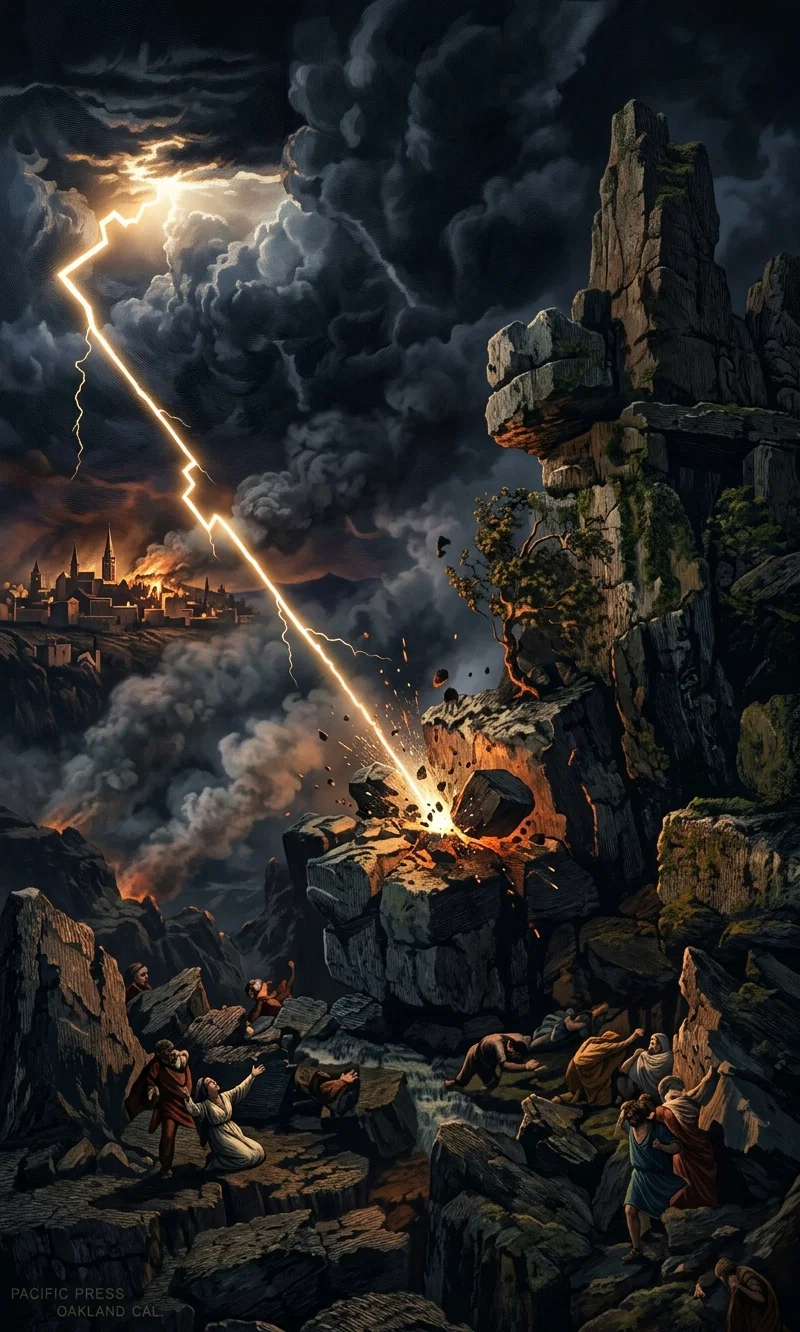
2. Christ’s Coming in the Clouds.—“And the heaven departed as a scroll when it is rolled together; and every mountain and island were moved out of their places. And the kings of the earth, and the great men, and the rich men, and the chief captains, and the mighty men, and every bondman, and every freeman, hid themselves in the dens and in the rocks of the mountains; and said to the mountains and rocks, Fall on us, and hide us from the face of Him that sitteth on the throne, and from the wrath of the Lamb; for the great day of his wrath is come; and who shall be able to stand?” Rev. 6:14–17. At this time the living saints of God will be delivered, and changed in a moment, and rise to meet their Lord in the air, and those who now sleep in Jesus will hear his voice and come forth to join the living ones who are translated without seeing death. See 1 Cor. 15:51–53; 1 Thess. 4:16, 17. These Jesus takes to the mansions (John 14:1–3) where his Father sits upon the throne until he has prepared this earth for their eternal kingdom. For after the saints are all taken to heaven and the wicked all stricken in death, Christ continues his iron rule over Satan and his angels.
3. Christ’s Dealings with the Earth during the Thousand Years.—The prophet Jeremiah evidently had a view of the earth just after all the saints were taken from it, and all the wicked lay unburied upon it: “I beheld the earth, and, lo, it was without form, and void [an abyss]; and the heavens, and they had no light. I beheld the mountains, and, lo, they trembled, and all the hills moved lightly. I beheld, and, lo, there was no man, and all the birds of the heavens were fled. I beheld, and, lo, the fruitful place was a wilderness, and all the cities thereof were broken down at the presence of the Lord, and by his fierce anger. For thus hath the Lord said, The whole land shall be desolate; yet will I not make a full end.” Jer. 4:23–27. Into this abyss or pit Satan is to be cast and bound a thousand years. See Rev. 20:1–3. He who met Jesus in the wilderness, and took him up to view the kingdoms, and was proud to say, “That is delivered unto me; and to whomsoever I will I give it,” now sees that it has lost its inhabitants and lies desolate, with its king a prisoner in it. See Isa. 24:21. The host of the high ones is cast down into the prison, with the carcasses of those he has lured to death, to meditate upon his rebellion, and the fearful ruin it has wrought.
THE DESOLATION OF THE EARTH.
4. Christ’s Return at the Close of the Thousand Years.—“The rest of the dead lived not again until the thousand years were finished.” “And when the thousand years are expired, Satan shall be loosed out of his prison.” Rev. 20:5, 7. As all that are in their graves shall hear his voice and come forth, so Jesus must again speak to the dead who lived not through that period of time. This is when he comes with all his saints with him, and his feet shall touch the Mount of Olives, and it shall separate and make a great plain for the New Jerusalem and the saints of God. See Zech. 14:5, 6. When the wicked dead shall come forth, then Satan will be loosed. He gathers all the wicked, Gog and Magog, and deceives them in making them believe they can take the city. In the valley, protected by its great mountain walls, are the saints and the beloved city, with Jesus as their King, to witness the end of the great controversy between sin and righteousness. While the saints within the valley are ascribing praise to Him who has redeemed them, the wicked are gathering around this city, and, under their leader, preparing implements of warfare to overthrow the city. How long this preparation will go on before the final attack, inspiration does not tell us. It will be long enough for all to see the goodness and mercy of God in the final destruction of sin.
5. The Closing Event in the Second Advent.—Just before the conflict ends, Jesus appears upon a great throne, and the books containing the life records of that great throng who encompass the camp of the saints, are again opened, and each one hears his sentence in a way that he has no complaint to offer to its justice. The old earth, which has passed through seven thousand years of sin, is about to be renewed. After the wicked come around the city and hear their sentence, fire comes down from God out of heaven and devours them. See Rev. 20:8–12. Peter describes this fire as follows: “The heavens shall pass away with a great noise, and the elements shall melt with fervent heat, the earth also and the works [Satan, sinners, and all the effects of sin] that are therein shall be burned up.” 2 Peter 3:10.
But out of this fire shall come forth a new earth. “Nevertheless we, according to his promise, look for new heavens and a new earth, wherein dwelleth righteousness.” Verse 13. This earth renewed is the first dominion, and it shall be given to the saints of the Most High. Dan. 7:27. This is that for which the saints have been praying for nearly six thousand years. Matt. 6:10. This is the kingdom that has no end. Luke 1:33. This is the kingdom in which the saints shall reign, not a thousand years only, but forever. Rev. 22:5. This is the reign that takes place on the earth. Rev. 5:10.
Reader, should not we be intensely interested in the second advent of our Saviour when all these important events are connected with that great event? Should we not carefully study the “sure word of prophecy,” that we may be found in the light, looking for his appearing? May we all be guided by his unerring word, that we may look up in that day and say, “This is our God; we have waited for him, and he will save us.”
Continue reading: CHRIST'S PERSONAL PRESENCE NOW AND THEN