The Youth’s Instructor, Vol. 34, No. 3.

DRY-DOCKS

The Youth’s Instructor

Jan 20, 1886

S. D. A. Publishing Association · Battle Creek, Mich. · Jan 20, 1886

DRY-DOCKS
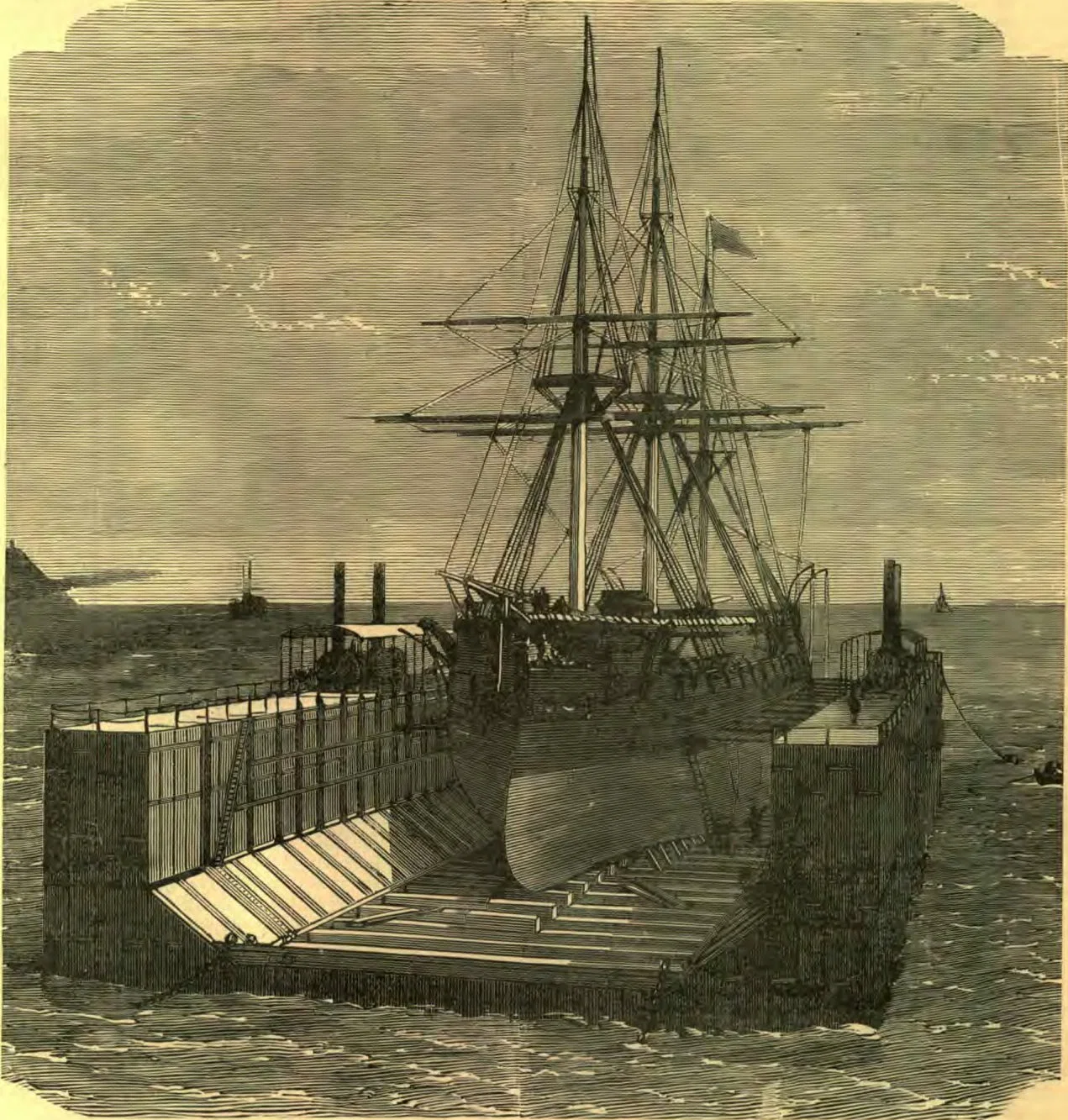
ONE of the many interesting things to be seen in our large ocean harbors, where the great ships that traverse the mighty deep are anchored, is the dry-docks, by means of which these vessels are taken out of the water for inspection, and for the purpose of making any necessary repairs. In ancient times these docks were not known; and it is only of comparatively recent date that they have become necessary. As the commerce of the ocean has increased, and the size of the ships of necessity been enlarged, some powerful and expeditious means had to be devised for this purpose.
Liverpool was the first city to construct these docks, and for a long time they were unrivaled in size and magnificence; but ere long other important harbors were building and employing them. The dry-dock at the Brooklyn navy yards is the finest structure of the kind in the United States. It was ten years in building.
One of the most common of these docks is the floating or balance dock, shown in the accompanying engraving. It is so constructed that the bottom and sides are composed of many separate compartments. The whole is securely anchored by strong chains at each corner. On the top of the walls along the sides, are placed large pumps, operated by steam engines, by means of which any or all of the compartments may be filled with water, for the purpose of sinking the platform to a sufficient depth to allow the vessel to be floated over it. When the vessel has been placed in the desired position, it is securely “shored,” or braced, on either side with heavy timbers. The water is then pumped out of the compartments in the bottom and sides, which allows the platform to rise, of course raising the vessel with it.
This style of dock received the name of balance dock from the facility with which an exact equilibrium is preserved by means of the water pumped into or out of any separate compartment. Two of these are owned by the New York Balance Dock Company, the smaller one being 210 feet long, 70 feet wide, and 30 feet deep; the larger one is 325 feet long, 100 feet wide, and 40 feet deep. The lifting power of the larger one is immense, it being capable of raising 8,000 tons. An evidence of its power, and the facility with which it is operated, can be seen from the fact that on Nov. 20, 1858, the Russian frigate, General Admiral, an immense vessel of 6,000 tons’ burden, and weighing 3,680 tons, was taken out of the water on this dock in the very short space of one and one-half hours. Docks of this description are now in use at the Portsmouth navy yard, and at Savannah, Mobile, Charleston, and New Orleans; also at Havre and Marseilles; and the Austrian government is now building one at Trieste equal in dimensions to the larger New York dock.
Other kinds of docks are used, as the sectional dry-dock, which is similar to the balance dock, having its bottom, or caisson, constructed of separate sections, which may be raised or lowered independent of the others, thus giving the required pressure upon any part of the bottom of the ship, which is often necessary in case of damage or breakage to the bottom of the vessel.
There is also the hydrostatic screw dock, consisting of a platform which is suspended from strong beams on each side, laid on the walls of the quay or slip into which the vessel is floated. These beams, from which the platform is suspended, are raised and lowered by means of heavy screws, thus lifting the vessel from the water. It is then properly braced to keep it level.
In all the great harbors of the world these docks are seen, of various construction and size, in which are handled the monster ships with the most apparent ease and safety; but in the United States are to be found the largest and finest dry-docks in the world. J. W. B.

THE LESSON JACK LEARNED.

“Here's yer Evening Jour—nal. All about the ’lec—tion. Only two cents.”
Jack sang his song outside his grandmother's gate, letting his voice fall a minor third on the last syllable of each clause, as all the other boys did. It was only by way of a joke that he sang it there; but it was as good a way as any of letting her know he was coming and would want his supper at once, so that he might be off again without any loss of time.
“You always have it ready for me, grandmother,” he said, as she placed the big bowl of bread and milk on the table. “I'll be all sold out in another hour, and then I'll have time to read to you after I've studied my lesson.”
Jack ate at first with the appetite of a hearty, hungry boy; but at length his spoon moved more slowly, and he balanced it on the edge of the bowl, looking as if some weighty matter were on his mind.
“Seems to me you have to work dreadful hard, grandmother,” he said, looking at her as she bent over her sewing.
“Well, you work hard, too, Jack.”
“Yes.” He looked grave, thinking how early he had to get up in the morning in order to have his wood cut and his other chores done before going to school.
“Don't you like work?” asked his grandmother.
“Yes, but not too much work. I think it would be pretty nice if we could have things fixed for us as they were for some one they were telling about in Sunday-school.”
“How was that?” she asked.
“Well, there was a famine. And there was a man named Elijah, and he was a good man, and first of all the Lord sent ravens to take things to him. Just think, grandmother, every morning great birds coming with all you wanted, and not cost you a cent!”
“And after that Elijah went to a widow that lived—oh, somewhere or other—and then how do you think they managed? Why, grandmother, they had a barrel with just a little bit of meal in it, and when it was gone, every day and every day there kept coming more and more. Now, what do you think of that?”
“It was a wonderful thing, my boy.”
“Yes, I guess it was!” said Jack, bringing his hand down on the table with a sounding clap. “And I don't see why the Lord don't do things that way now.”
“What more did you learn about Elijah, Jack?”
“Well, I guess that's about all I heard. He talked a lot more; but I got to thinking what a jolly thing 'twould be to lay down in the shade and sleep, or look up at the green branches or the blue sky and have those ravens bring you good things, and just have to hold your hand for 'em. And just think, grandmother, if every time you went to the flour barrel or the milk pitcher, you found more there, and just so with everything else, and you and I didn't have to work a bit!”
“I think,” said grandmother, with a quiet smile, “that if you had listened more attentively, you would have made up your mind that Elijah had a pretty hard time. You did not hear how, at the Lord's bidding, he went about warning wicked people of the wrath of God which was coming upon them if they did not repent of their sins. And of the way in which he was hunted from place to place by these very people, who were so angry at being told of it that they would have killed him. It is not at all likely that in all your life you will ever know such hardships as he did.”
“Anyway, I don't believe he ever had a better supper than that,” said Jack, pushing away his bowl and springing up to be off at his work.
“You may be sure it tastes all the better because you have fairly earned it,” said grandmother. “Don't ever get into your head the idea that it is not good to work. Work is a blessing. The happiest people in the world are those who can find plenty to do, and who do it with honest, hearty good-will. The Lord has given you active, lively feet and strong, skillful hands; do you think he meant them to lie idle? He has made good things to grow for us in fields and orchards and gardens; don't you think he intended that we should make use of them through cheery, industrious labor? ‘The hand of the diligent maketh rich—’”
“There, now, grandmother,” interrupted Jack. “I've heard you say that a thousand times; but you're always working, and you aren't rich. Look how shabby the carpet is, and think how many things we don't have that we'd like to have.”
“Not rich, Jack? Why, my boy, I would not change my riches for all the carpets and other fine things in the world. A good many years ago there was a dear, bright-faced boy very much like you. He wanted a good education, and he and his mother worked hard that he might have it, for they knew no riches were like the riches of the mind. And when the boy became a man, it was in his heart to preach the Lord's gospel; and wasn't his mother proud to work to help him to lay up such riches as the Lord's workers do? And when he was ready to begin his work, there came a call from far over the sea, and he wanted to go, but said he must stay and make a home for his mother. But she said she could work still, and he went.”
“It was my father,” said Jack, softly.
“Yes, and years after, when he sent his little son home for her to take care of, she felt sure that she could work for him, too, and worked away with a fond hope of helping him to be a man like his father. Think, my boy, what riches I am laying up.”
Jack put his arms around her neck, gave her a very earnest kiss, and thoughtfully buckled on his newspaper strap as she went on:—
“Be sure, my boy, there are no people so unhappy as those who are idle, and none who so soon come to ruin and misery. Why, you know yourself that you are never happier than when you bring me your week's earnings and feel proud of knowing that you are of some use in the world.”
“That's so, grandmother,” he said. “Only,” he paused a moment on the doorstep, “I think it's almost time you were having a little rest. When I am a man, I'm going to be the ravens bringing good things to you.”
And the next moment he was bounding out into the half-twilight, half-moonlight, singing:—
“Here's yer Evening Jour—nal. All about the ’lec—tion. Only two cents.”—Sidney Dare.

THE SNOW-STORM.

LIGHTLY and whitely As wheat from the grain, Thickly and quickly As thoughts through the brain, So fast and so dumb Do the snow-flakes come;— Swift, swift as the lays drop From glad poet-lips, Soft, soft as the days drop From Time's finger-tips. Oh, so many, so many!
Yet no sound from any. Oh, so fast, oh, so fast! Yet no track where they passed. Oh, so fragile, so frail! Yet no force can prevail To speed them or stay them. They fall where they must, Through the fathomless gray, And bring to earth's dust What of heaven they may.

DENMARK

DENMARK is a small country in Europe. It lies north of Germany and east of England. It consists of a peninsula (Jutland) and some larger and smaller islands. When we sail east from Denmark, through the Baltic Sea, we come to Russia; and across the sea to the north lies Norway.
Denmark lies as far north on the globe as Labrador and Hudson’s Bay in America. Yet the climate is not severe. The winter is much milder than the winter in Wisconsin or Iowa. One cause for this lies doubtless in the Gulf-stream, which brings warm water clear from the Gulf of Mexico across the Atlantic Ocean, and strikes the coast of England, Denmark, and Norway, thus bringing a precious blessing from God to the inhabitants of these cold countries, who would otherwise lose many of the blessings of life.
Denmark contains an area of eleven thousand two hundred square miles, about the same as Maryland and a little more than Vermont. It has two million inhabitants; that is about the same number as Missouri, although that State is about six times as large.
Formerly Denmark was inhabited by Finlanders, a small people with brown complexion, very much like the Indians in America. When the Goths came from Asia and invaded Europe, they took the country, and made the old inhabitants slaves, or drove them off to the extreme northern part of Norway and Sweden, where their children still live.
In the ninth century the kingdom was united under one king, Gorm the old. Since that time, the posterity of the Goths have inhabited the three Scandinavian kingdoms,—Denmark, Norway, and Sweden. In Denmark, two branches of them may still be traced: those who live on the islands and the eastern part of Jutland, and whose language resembles the Swedish; and those living in the western part of Jutland, whose language is so similar to the English, that English seafaring people, on visiting the coast, can make themselves understood among them.
The Danish kingdom has been subject to great changes as regards its dominion and extent. Svend Tveskjæg conquered England, and his son Kanut the Great, not only reigned over England, but also over Schleswig and Norway. He became king of the last-named kingdom in the year A. D. 1028. But fourteen years later, England struck for independence, and has ever since maintained its own government.
Five years later the king also lost Norway; but a later king, Waldemar Sejr, reigned in A. D. 1210 not only over Denmark and Schleswig, but also over Holstein and Prussia and a part of Sweden and Russia.
After some time, most of the added possessions were lost; but in the latter part of the fourteenth century, Queen Margaret reigned over the three Scandinavian kingdoms. Sweden became again independent when Gustaf Vasa was chosen king of Sweden in A. D. 1523; but Norway continued to be united with Denmark until A. D. 1814.
In the present century, England, Prussia, and Austria have each in turn done their share to weaken the power of Denmark, until it has become a very small and weak kingdom.
At last the United States of America also helped to humble Denmark, as they, some thirty years ago, refused to pay duty or toll, when their vessels passed through Oresund into the Baltic Sea. When they refused (and how could poor Denmark hinder such a refusal), all the other powers also refused, although this custom was time-honored by the lapse of many centuries, and Denmark thus lost a great source of income. This loss was the more keenly felt, because all they received in this way was clear gain; for they gave nothing at all in return. They only let the vessels pass by their coast without shooting at them. Thus you see that in this poor world of ours even justice may sometimes cause pain and tend to weaken the poor.
Once the noblemen, or lords, owned the greater part of this country; but in the present century the peasants, or farmers, have had an opportunity to buy the land on reasonable terms, and they have become an independent and thrifty class in society. Yet lords with titles as noblemen still exist as a class, and some of them have large possessions.
The clergy receive high salaries, and they have considerable influence. Yet they have lost much of their former power, and have at present less influence than the clergy in Norway and Sweden. The merchants and mechanics are generally doing well financially. But liquor, and especially lager-beer, is used very extensively, to the great detriment of all classes.
The laboring class is poorly paid, especially in the country. Many a laboring man works for thirty-five cents a day in the summer and fifteen cents in the winter. It is difficult to understand how the people can subsist on this; they live on very poor food.
Denmark has no mountains, but in some parts it is hilly. The highest elevation is five hundred and fifty feet above the sea. If the sea-level was one hundred feet higher, more than half of the country would be covered with water.
Rocks are found in very few places. There are two rocks on the coast which consist wholly of chalk. They look very pretty when the sun shines on them, as you sail by.
There are no minerals of any value, except stones. Moorland is found in many places, and from this a great deal of turf or peat is obtained. This is used as fuel to a large extent in the country. In the cities, coal and wood are used. Some timbered land is still left, with some very pretty groves of beech and oak.
The country produces considerable grain, principally barley, rye, oats, and wheat. Something over fifteen per cent of this is exported yearly. The production of butter and cheese is also extensive, and a great many cattle, horses, and hogs are sent abroad. Of the last-named, more than 50,000 are exported yearly. Besides this, the country has no small income from fishing.
The form of government is limited, monarchical, and hereditary. Every able-bodied man must serve a certain time in the army, longer or shorter according to the place assigned him. The parliament consists of two chambers. This with the king and his ministers should be the law-giving power; but of late years the government has made laws to a great extent without the consent of the parliament, and this has caused a great deal of trouble, and is at present very detrimental to the well-being of the country. Great sums are expended on the army and navy, and much greater sums are wanted. There is danger of a revolution. Thus the nations are troubled, and there is perplexity everywhere, showing that the great day of the Lord is near.
In future articles we will speak of the capital and religion of this country.
JOHN G. MATTESON.

Errors on the Safe Side

As there are some faults that have been termed faults on the right side, so there are some errors that might be called errors on the safe side. Thus,—we seldom regret having been too mild, too cautious, or too humble; but we often repent having been too violent, too precipitate, or too proud.

MADALENE

She looked in the mirror. Her features were sad,— No beauty nor loveliness Madalene had. Her eyes were tear-faded; her features were marred, And with many a sinful and selfish thought scarred. In vain is all beauty that beams from the skin, Unless it deep shineth from beauty within.
Then Madalene looked in God's mirror, the Law; Her soul was affrighted at all that she saw. Her features were marred, but her soul was far worse, All blighted and scarred by her sin and its curse; And she knew now why never a beauty could shine, When her soul was defaced of its image divine.
Her eyes she uplifted. The beautiful One, The chief of ten thousand, outshining the sun, With eyes of compassion stood lovingly by. O Madalene! look with an entranced eye. Though loathsome thou art, claim the Saviour as thine; He will clothe thee with whiteness and beauty divine.
He stands for thy model dear; patiently trace His unselfish love in thy selfishness' place. His unfailing patience write over thy heart,— His self-abnegation, his tender, deep art That seeks other's good, other's peace, and in thee His beauty will grow in its mild majesty.
Then Madalene fell at his beautiful feet. Repentance brought over her face something sweet. Self dimmed in her heart, as she patiently wrought To bring to her Lord every sin-selfish thought. As she made others glad, o'er her features there came A beauty of soul like a heaven-white flame.
Did she look in the mirror? ah! only to make Her brow more attractive for some other's sake. Did she look in God's law? it was ever to see If her soul was from hideous sin-stains more free. And not for her pleasing she looked; but to bring A smile to the lips of her Saviour and King.
FANNIE BOLTON.

POLITENESS OF GREAT MEN.

TRULY great men are polite by instinct to their inferiors. It is one element of their greatness to be thoughtful for others. The greatest men in the world have been noted for their politeness; indeed, many have owed their greatness mainly to their popular manners, which induced the people whom they pleased to give them an opportunity to show their power.
Many years ago the errand boy employed by a publishing house in a great city was sent to procure from Edward Everett the proof-sheets of a book he had been examining. The boy entered the vast library, lined from floor to ceiling with books, in fear and trembling; he stood in awe of this famous man and dreaded to meet him.
But Mr. Everett, turning from the desk where he was writing, received the lad with reassuring courtesy, bade him sit down, chatted kindly as he looked for the proof-sheets, and asked, “Shall I put a paper round them for you?” as politely as if his visitor were the President.
The boy departed in a very comfortable state of mind; he had been raised in his own self-respect by Mr. Everett’s kindness, and he has never forgotten the lesson it taught him.—Selected.

TO OUR BOYS AND GIRLS.

As our boys and girls already see, we have an article in this paper about Denmark. Arrangements have been made with our friends across the water, whereby the editors hope to give you, in almost every paper during the year, something about the many interesting places in Scandinavia, Germany, and other foreign countries. So get out your maps, and hunt up the places spoken of, that you can get some idea of the country. In this way the articles will be doubly interesting.

Diligence Is the Mother of Good Luck

DILIGENCE is the mother of good luck.

IMPORTANT BIBLE SUBJECTS.

LESSON 5.—HISTORY OF THE EARTHLY SANCTUARY.

[NOTE TO THE STUDENT.—Do not consider the lesson learned until you can give at least the substance of every text, with the correct reference for each. The references in black letters indicate those texts that should be committed to memory. A little diligent application each day will enable you to learn them, although this need not be considered a test of scholarship.]
1. How many years before Christ, did Israel leave Egypt?—1491. (See Ex. 12, margin.)
2. How long was it from the exodus to the setting up of the tabernacle by Moses? Ex. 40:17.
3. Where was it first located? Num. 9:1, 5.
4. How long did it remain in this place? Num. 10:11, 12.
5. In what place was it first pitched after entering the land of Canaan? Josh. 4:19.
6. Where was it next located? Josh. 18:1.
7. What finally took the place of the sanctuary that Moses built? 1 Kings 6:1, 2.
8. Where was this temple erected? 2 Chron. 3:1; 1 Chron. 21:14-18.
9. What remarkable event occurred on this spot nine hundred years before? Gen. 22:2.
10. When did this building cease to be their central place of worship? 2 Chron. 36:6, 7, 16-19.
11. How long was this captivity to continue? 2 Chron. 36:21.
12. After the close of this captivity, what provision was made for another temple? Ezra 1:1, 5.
13. When was the work completed? Ezra 6:15. (Margin, B. C. 515.)
14. What next occurred in the history of the sanctuary? (See note.)
15. What mournful words did our Saviour utter with reference to this building? Matt. 23:38.
16. What miraculous event occurred indicating that the sacredness of the sanctuary was forever gone? Matt. 27:51.
17. When and by whom was the sanctuary destroyed?
—By the Roman army under Titus, A. D. 70.
18. How many years had now passed since Moses set up the sanctuary in the wilderness of Sinai?

NOTE.

About 500 years after the completion of the temple by Ezra, the edifice sadly needed repairing. Herod the Great, desirous of ingratiating himself with the Jews, decided to rebuild it. The old one was pulled down to its foundation, and the building of the new begun B. C. 19. It was completed in A. D. 27.
It was to this building that the Jews referred when they said to the Saviour at his first Passover, in the spring of A. D. 28, “Forty and six years was this temple in building,” John 2:20. According to Haggai’s prophecy, the desire of all nations had now come to this temple.

THE SABBATH-SCHOOL WORKER.

The continued publication of the Sabbath-School Worker has become an assured fact, by vote passed at the recent yearly meeting of our Sabbath-school Association. We are happy to state that the first volume was not only valuable in the instruction that it gave to Sabbath-school workers, but was also financially successful, which was not expected when the paper was first started. At the close of the first volume, the subscription list numbered about 1,800. While this subscription list could pay the expenses of the first volume, it cannot be expected to do so in the future, as the expenses, for certain reasons, will be larger than they have been in the past. To sustain the paper as it should be, we ought to have a subscription list of at least 3,000. This number can easily be obtained if in all the schools an energetic effort is made to get those to renew whose subscriptions are now expiring, and to obtain as many new subscriptions as possible. While our subscription list numbered 1,800 at the close of volume one, all but a very few hundred of these expired with that volume; and unless the subscribers for volume one renew immediately, our list will be very small during the first of volume two. We earnestly ask all superintendents and secretaries to make a vigorous effort in this direction, and give us a good list for the beginning of this year. We think it is possible to make the Worker* a better paper the coming year than it has been in the past, and we cannot see how any officer, teacher, or worker can do without it.
Ministers can do much for the Worker as they go from place to place: talk it up wherever you go, see that all the Sabbath-school officers and workers are subscribers to the paper. And especially may Sabbath-school presidents, and State secretaries cast an influence, and do work which will be valuable in this line. Much time and labor are being bestowed on this paper to make it just the help which is needed in our Sabbath-schools, and we are sure that Sabbath-school workers will fail to receive a great benefit if they do not avail themselves of the instruction thus given. Let us take hold of this work promptly, and see that this paper is well sustained for the coming year.
J. E. W.

THE FLOATING GARDENS OF MEXICO.

Floating islands, formed by masses of earth breaking away from the land, are frequent in every zone. These are held together by grasses, weeds, and tangled roots, and are drifted about by the winds, increasing in size by accumulations from the sea. Probably the idea of floating gardens originated from these drifting masses. The following beautiful description of Mexican floating gardens was written for the Baptist Weekly:—
“The climate of Mexico is tropical, and its soil rich in flowers, trees, and shrubs, as in Asia; and it is no wonder that its natives learned long ago how to take pleasure in its natural beauties. Remains of gardens which might have been laid out long before Mexico was conquered by the Spaniards, still exist there, showing that the half-civilized races which dwelt in the southern part of our continent knew the art of decorating nature, and converting their wilds into delightful resorts.
“The first floating gardens consisted of masses of earth which became loosened from the mainland, and were held together by the roots which lay imbedded in them. Then the Aztecs [natives of Mexico at the time it was conquered by the Spaniards in the sixteenth century], seeing that it was possible to have floating gardens, made them of rafts of reeds and rushes closely fastened together, and upon these a deep layer of rich earth was put. Thus moving islands were formed, sometimes several hundred feet long and three or four feet deep, and launched upon the water.
“It was upon these floating islands that the Aztecs grew the fruits, flowers, and vegetables which they sold in the markets along the shore. They would push their gardens right up to the borders of the town, and so float on from one town to another.
“These strange gardens had their origin in the necessities of a people of a certain locality, who, being shut in by their enemies, were forced to resort to some means to avoid famine.
“Finding themselves on the borders of a lake, they set to work to make floating islands; and on these they planted corn and other vegetables. They, then, by means of long poles, moved the floating gardens from one shore to another, and thus supplied the hungry people.
“In this way the Mexicans were saved from conquest; and so successful was the plan of making the floating gardens, that they became common, and instead of being used solely to raise food, they were planted with trees, and with flowers of the most brilliant colors and delicious perfume.
“These floating islands may still be seen in parts of Mexico. Prescott, the historian, speaks of them as ‘moving like some enchanted isle over the water.’”
“Many of the peasants, living in humble huts of brick or reeds along the shores of Lake Tezcuco, have these islands as their only farms, whereon they raise and sell the vegetables grown in Mexico, which need but little cultivation and care.
“Up to within a hundred years, beautiful floating gardens were still to be seen on this and other Mexican lakes. Sometimes quaint little edifices peeped from among their luxuriant shrubs and flower-beds. Sometimes the pretty paths were overhung with rich clusters of tropical fruits.
“Such were the gardens of the wealthy nobles of that time, who took holiday trips on their floating gardens, and might move smoothly over the waters, the servants propelling the verdant raft with long, slender poles. They could thus travel, reposing amid flower-beds and under deep and luxuriant shadows.
“There is a large Mexican city surrounded by a lake, the streets of which are a series of canals, as are those of Venice. Instead of driving carts and carriages to and fro, the people reach the houses by water. Here the floating gardens might once have been seen moving to and fro, bearing their still growing burden of fruit, corn, and flowers. The scene on a soft moonlit night, as the gardens passed here and there among the high rushes, or glided across the open, sparkling waters, must have been a very picturesque one.”

SOME THINGS ABOUT IRON.

It is frequently said that iron is worth more to the world than all the other metals; and when one thinks of the various uses to which iron is put, the statement seems true. Fortunately for man, Providence has kindly furnished a supply equal to the demand in nearly every part of the earth. Iron ore is found in large deposits; and one of the component parts of rocks, the soil, and the natural streams and bodies of water, is iron.
Iron is also found in the ashes of plants, and in the blood of animals. The blood of a full-grown man contains only about enough to make a ten-penny nail, yet it is sufficient to give energy to the man.
The elements of this metal are iron and carbon; and the amount of carbon it contains determines whether it is pig iron, cast iron, steel, or wrought iron; pig iron having the most carbon, and wrought iron the least.
When the ore is dug from the earth, it contains more or less clay, or other impurities, and is converted into metallic iron by one of two different processes. One, known as the “direct process,” used by the ancients, and still in use in many parts of the world, was to convert it at once into wrought iron. This is much the more expensive process, but it yields the best iron. With some changes and improvements, this method is still employed in Europe and the United States.
But the common method, known as the “indirect process,” is to first convert it into pig iron, which is done something as follows: “A tall blast furnace is made, which is lined with fire-brick, and at the bottom of which are pipes for forcing in hot air. The furnace is filled with lime-stone, coal, and iron ore in alternate layers, and the fire lighted. The melted iron runs to the bottom, where it is drawn off into channels cut in the sand on the floor of the furnace.” The rough pieces thus formed are called “pigs,” and these are, by certain other processes, converted into malleable iron, steel, etc. You who have been in a furnace or foundry have no doubt seen pig iron.
Malleable iron is made by burning the carbon from cast iron in a current of heated air in a puddling or reverberatory furnace,—that is, a furnace which is so constructed that the flame in passing from the fire-chamber to the chimney, is reflected back upon the mass which is being heated. During this process the melted iron is kept in constant motion by means of long sticks called “puddling sticks.” When the metal acquires a white heat, it is taken out and beaten under a trip-hammer, and afterward passed under grooved rollers. It is now malleable, and “may be beaten into leaves so thin they may be used for writing paper; six hundred leaves being only half an inch in thickness.”
Wrought iron is the purest form of the metal. It is soft, very tenacious, and when brought to great heat, may be welded, or perfectly joined together. It is sometimes beaten into bars known as “bar iron or merchant-bars.”
The cost of iron depends upon the amount of labor bestowed upon it. A pound may be worth only a few cents; while the same quantity may be worth thousands of dollars. According to a table prepared by J. Dorman Steele, Ph. D., a pound of good iron is worth four cents; when made into inch screws, one pound is worth $1.00; made into steel wire, $3-7.; sewing needles, $14.; fish hooks, $20-50.; jewel screws for watches, $3,500., and hair springs for American watches, $16,000.
It may seem to you like a big price for watch springs; but it is not the mainspring that is meant, but the little fine hair-spring which gives motion to the balance wheel. These springs are very expensive, and they are so fine that it requires very, very many to make a pound.
At another time we may give you some facts about steel.

An Affectionate Thrush.

He must be a very cruel person, or strangely ignorant of the intelligent, affectionate ways of birds, who can wantonly harm them. Certainly it is that those persons who learn their habits, regard them tenderly; and so we desire the readers of the INSTRUCTOR to become acquainted with the birds. The following pretty story, which we copy from Golden Days, contains a good lesson for you:—
“A young Highlander, having set a horse-hair noose in the woods, was delighted one morning to find a female song-thrush entangled. He carried home his prize, put it into a roomy, open-braided basket, secured the lid with much string and many knots, and then hung the extemporized cage on a nail near the open window. In the afternoon the parish minister called in, and tried to persuade the boy to set the captive free. While the clergyman was examining the bird through the basket, his attention was called to another thrush, perched on a branch opposite the window.
“‘Yes!’ said the boy; ‘it followed me home all the way from the woods.’
“It was the captive’s mate, which, having faithfully followed his partner to her prison, had perched himself where he might see her, and she hear the sad, broken notes that chirped his grief.
“The clergyman hung the basket against the eaves of the cottage, and then the two retired to watch what might happen. In a few minutes the captive whispered a chirp to her mate’s complaint. His joy was unbounded.
“Springing to the topmost spray of the tree, he trilled out two or three exultant notes, and then the captive thrust out her head and neck. Then followed a touching scene. The male bird, after billing and cooing with the captive, dressing her feathers and stroking her neck, all the while fluttering his wings, and crooning an undersong of encouragement, suddenly assumed another attitude.
“Gathering up his wings he began to peck and pull away at the edges of the hole in the basket’s lid. The bird’s ardent affection, and his effort to release his mate, touched clergyman, mother, and boy.
“‘I’ll let the bird go!’ said he, in a sympathetic voice, as he saw his mother wiping her eyes with her apron.
“The basket was carried to the spot where the bird had been snared. The male thrush followed, sweeping occasionally close past the boy carrying the basket, and chirping abrupt notes, as if assuring his mate that he was still near her.
“On arriving at the snare, the clergyman began untying the many intricate knots which secured the lid, while the male bird, perched on a hazel bough, not six feet away, watched, silent and motionless, the process of liberation.
“As soon as the basket lid was raised, the female thrush dashed out with a scream of terror and joy, while the male followed like an arrow shot from a bow, and both disappeared behind a clump of birch trees.”

A SILVER CARRIAGE.

According to the accounts of Calcutta papers, the Maharajah of Ghened has had a carriage made for him which is probably without its rival in the world, for it is plated all over with silver, its very steps being made of the solid metal. Caligula of old shod a horse with gold; but it was reserved for an Eastern potentate to go about in a carriage of precious metal.—S. S. Classmate.

THEY BEAT STEAM.

No machine of travel that man ever invented can equal the speed of wild fowl. The canvas-back duck flies two miles a minute. The broadbills go slightly slower. The teal can fly at the rate of 100 miles an hour; and the wild goose about ninety.

Live Fishes Found in Saharan Artesian Wells

Sir Charles Lyell, in his “Principles of Geology,” notices the discovery of live fishes in some artesian wells sunk in the desert of Sahara. They were brought up from a depth of 175 feet, and were not, like those of Adelsburg, blind, but had perfect eyes.
Continue reading: FAMOUS COASTING