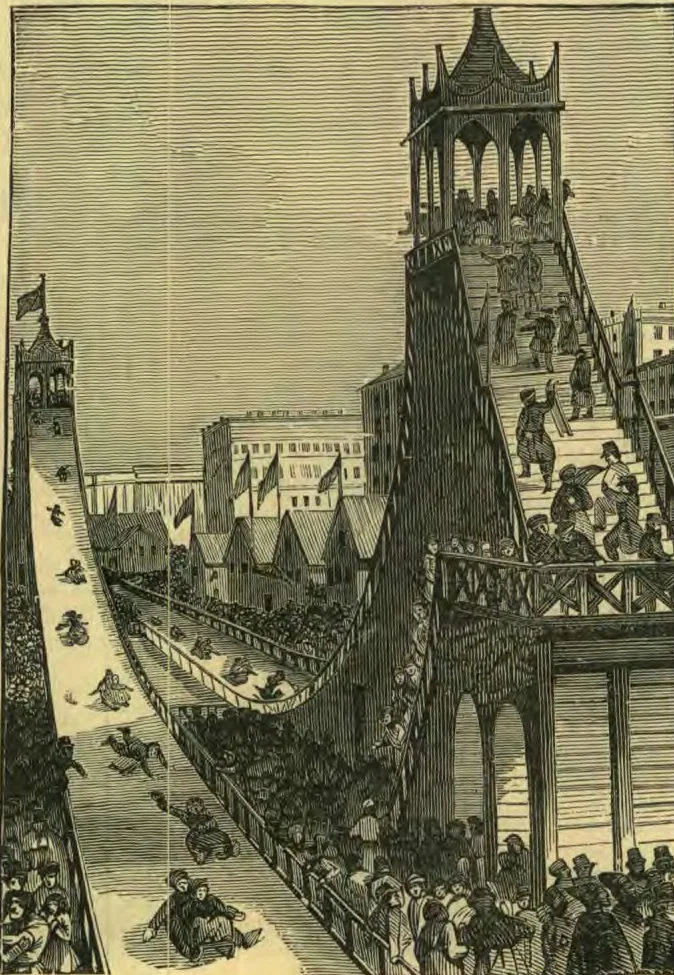
If you will look at a map of the Old World, you will find between Sweden and Russia a great body of water called the Baltic Sea. On its eastern side a long arm of the sea runs inland, and at the end of the arm is the city of St. Petersburg. This is the capital of Russia; and here the Czar and all the great men of the empire live, and make the laws for the Russians, just as the President and Congress make the laws for Americans in the city of Washington. St. Petersburg is a very large city, and in 1870 it had about 667,000 inhabitants.
Now I want to tell you about some of the good times that the little boys and girls in St. Petersburg have,—a merrier time than you have at Christmas, because it lasts for a whole week. I was going to say, for a whole long week, but it is all too short to suit the little Russians.
This good time comes in February, and it is called the “butter-week!” You wonder why it has this name? Every morning in this week the Russian mother serves up for breakfast a queer kind of pancake baked in butter, and covered with melted butter. The people are very fond of this dish. It is cooked at no other time of the year. If the poor peasants are half-starved for most of the time, they are sure to have all they want to eat during the “butter-week.” Then everybody eats all he can.
But they do something besides eating. For several days before the feast begins, sledge after sledge, loaded down with beams and planks, are seen going toward the large, open square in the city. Then the workmen with their hatchets and hammers make the frosty air echo with their hearty blows; and soon over all the square, booths and eating-houses are seen springing up, with gay flags flapping in the wind, just as you see them in the picture.
They build something else too, as you will see, and that is a hill. All around St. Petersburg the country is flat and often marshy. There is not even a high mound, and the little people have no place for coasting. So just before “butter-week” comes, the fathers and brothers put up some hills of stout beams and planks. The slide is covered with cakes of ice, and the whole is cemented together with water, that freezes as fast as it falls on the ice. The hills are built facing each other. They are very steep at the start, so that the sledges go a long way after they reach the level. On the first morning of the week the fun begins. Rich and poor, nobles and peasants, old and young, all take part in the sport together. Toward the close of the week, business stops, and merchants and business men join in the sport.
In the dooryards of the rich, ice-hills are often built, where the children can slide down hill as much as they wish. Sometimes the slides are built inside the houses; and then, instead of ice, they use polished mahogany wood to slide on.
The next morning after the feast ends, the gay square looks gloomy enough, and so do the people; for now they are to have a seven weeks’ fast. The square is all covered over with boards and rubbish strewn about in tearing down the buildings, and the workmen are quietly clearing things up. All through the seven weeks, the Russian mother uses oil instead of butter in her cooking, and allows no meat, except a little fish, to be eaten in her house. You may be sure the children do not like the fast very well.
The Russians are very strict in keeping their fasts. I suppose they hope in this way to make up for their sins. But no amount of good deeds that any one can do, will atone for the wrong things he does. These can be blotted out only when God, for Christ’s sake, forgives us.
W. E. L.
THE LAMB MERCHANT.
A SOLDIER in the Duke of York’s army, many years ago, lost his right arm and one leg in battle while fighting in Holland.
Of course he had to be sent home, when he couldn’t fight any longer; and this home was a small but cozy cottage near London.
In it was a wife and four children, who welcomed the crippled soldier with tears of thankfulness that his life had been spared.
They were all too young to go out to work. How could he earn bread to fill these little mouths?
All at once a bright thought struck him. He was a Scotchman, and remembered seeing, when a boy, the thousands of sheep and lambs that covered his native hills, and this may have put the idea of lamb-making into his head.
The children could make the lambs, and he would sell them.
It was a bright thought—for soon this poor lame soldier was a very hero in the children’s eyes.
The stamping of his wooden leg was listened for and hailed with delight by the little ones in every town and village round London.
As soon as they heard his welcome cry,—
“Young lambs to sell! young lambs to sell!
If I’d as much money as I could tell,
I’d not come here with lambs to sell!
Dolly and Molly, Richard and Nell,
Buy my young lambs, and I’ll use you well!”
they would crowd round his well-filled basket with their pennies and pull out the fleecy little “darlings,” and think that every tiny face, as they sorted them over, was the prettiest.
Fifty years ago the little boys and girls had very few dolls and toys—and some of them you would think very homely, no doubt—so it was no wonder that these lambs made by the lame soldier’s children found a ready sale among the little folks.
They were made of snowy white cotton-wool, spangled all over with Dutch gilt. The head was made of flour paste, molded into the prettiest of faces—just like a real lamb—and you know how pretty they are. There were two jet black spots for eyes; and the horns and legs were made of twisted shining tin. For a collar, a piece of pink tape was tied in a bow.
The lambs were only two cents apiece, so it was no wonder indeed that the lamb business increased until both mother and children were busy all the time, and the lame soldier became a famous lamb merchant through all the south of England.
He made a comfortable living for his dear ones in the straw-thatched cottage, and the nimble little fingers helped to make this happy home for father and mother.—Selected.
THE CHILD AND THE YEAR.
By Celia Thaxter
SAID the child to the youthful Year:
“What hast thou in store for me,
O giver of beautiful gifts! what cheer,
What joy dost thou bring with thee?”
“My seasons four shall bring
Their treasures: the winter’s snows,
The autumn’s store, and the flowers of spring,
And the summer’s perfect rose.
“All these and more shall be thine,
Dear child; but the last and best
Thyself must earn by a strife divine,
If thou wouldst be truly blest.
“Wouldst know this last, best gift?
’Tis a conscience clear and bright,
A peace of mind which the soul can lift
To an infinite delight.
“Truth, patience, courage, and love
If thou unto me canst bring,
I will set thee all earth’s ills above,
O child, and crown thee a king!”
—Celia Thaxter, in St. Nicholas.
Letter Budget.
Emma Johnson, writing from Douglas Co., Neb., says: “I want to tell the readers of the Instructor some of my new resolutions. They are ‘to obey my parents, teachers, and sisters cheerfully; to do right always, keeping all the commandments of God.’ I am trying to keep the golden rule,—to do unto others as I would have them do to me. I am trying to learn my Sabbath-school lessons and day-school lessons perfectly. I did not have a missionary garden last year, but I received a dollar on my birthday for sweeping hay last year, and I gave it to the Australian Mission. I now renew my subscription to the Instructor, which I like so well that it would be hard to be without it. There is much interesting reading in it; especially do I like the articles by Eld. Canright; for I learn so much from them. There are many things I did not think of before I read what he has written to the Instructor. I hope he will continue to point out our dangers. I am ten years old. I study my Sabbath-school lesson in Book No. 1. My oldest sister studies in the Instructor. I send my love to all, and want you to pray that I may be saved in God’s kingdom.”
Emma’s New Year resolutions are good,—cheerful obedience is what the Lord requires of us. If we cheerfully keep all his commandments, we shall honor him, and please parents and teachers.
Cora L. Lewis, of Fairfax Co., Va., writes: “I have written for the Instructor once before; but never seeing any other letters from this State, I thought I would write again. We moved to this place, a distance of about fifteen miles, a month ago. Our home now is about twenty miles from Washington, D. C., where I have been several times. I have been in the Capitol and other public buildings, and I had a very pleasant time. I go to school every day. I try to have perfect lessons, but fail sometimes. We do not have any Sabbath-school to attend on the Sabbath. Sometimes we have a little school of our own on that day. There is only one Sabbath-keeper here besides our family. My two older sisters attended the camp-meeting near Marksville, Page Co., last August, and my father attended quarterly meeting near the same place the second Sabbath and Sunday in October. I have never attended any of the meetings, but would like to. I want to be a good girl, and serve the Lord in all I do.”
Cora admits that she sometimes fails to have perfect lessons. How that reminds us all that we many times fail in being perfect before our heavenly Father. For this reason shall we give up trying to perfect character? No, indeed; we must lean harder upon the One who is able to keep us from every temptation. The readers will all be glad to have Cora relate something of interest that she saw at Washington.
Nellie M. Darling writes from Washington Co., Vt. She says: “I do not remember seeing any letters in the Budget from this State, so I thought I would write one. I am ten years old. I keep the Sabbath with mamma. I hope papa will keep it sometime. I do not go to school this winter, but I learn my lessons at home. I study reading, spelling, arithmetic, geography, history, and take music lessons. I have no brother or sister. I think the Instructor is a nice paper. I would like one every day. I like to read the Budget very much. After I have read my papers, I lend or give them away. I am trying to be a good girl so I can be saved when Christ comes.”
You need to keep quite busy, don’t you, Nellie, to learn perfectly so many lessons? Don’t forget that good motto, “Not how much, but how well;” for it pays best in the end not to try to do more than can be done well. Perhaps you are not given very long lessons.
Felicia Smith, of Ford Co., Kan., writes: “In my letter last spring I said I was going to have a ‘missionary sweet potato patch,’ and as you wanted us to tell you how our garden turned out, I will write you again. My papa gave me two dollars for my sweet potatoes, and I now send it to the Australian Mission. As there are no Sabbath-keepers here but mamma and I, we attend the Union Sunday-school. Papa is superintendent, and mamma is teacher. We use ‘Pearly Portals’ in the school, and all like it much. We tried to introduce the Instructor into the school, but did not succeed. I love to read the Budget, and the letters from Eld. Canright. I want to be a good girl, and meet the Instructor family when Jesus comes.”
Occasionally a report comes in from the missionary gardens. We like to hear from them, and that a share of the products is really appropriated to missionary purposes. Sometimes children plan to give, but when they really get something they might give, a kind of a “stingy spirit” inclines them to keep it for selfish purposes. We hope none of our readers do that way. Probably they do not. Felicia did not, surely. We hope the two dollars will gain her other two dollars in the reckoning day.