By Elder Uriah Smith, Author of “Thoughts on Daniel and the Revelation.”
THAT we are living in an age of wonders multiplying in number and growing in power, none will deny. So nothing that may here be said will be understood as offered to prove that fact. But the thought intended to be emphasized is the significance of these events as fulfilments of the prophecies of the Bible, and their efficiency as a means to carry out the work the Lord has to do in the last days, together with their potency to accomplish great revolutions, which will give existence to those conditions so clearly set forth in the Scriptures as signs and immediate precursors of the impending day of the Lord.
In view of the wonderful discoveries of the present age, and the great achievements accomplished by increased knowledge in the arts and sciences in general. The other is to apply the running to and fro to the study of the prophecies, turning back and forth in the inspired books, and so causing the knowledge of the sacred Word to be increased.
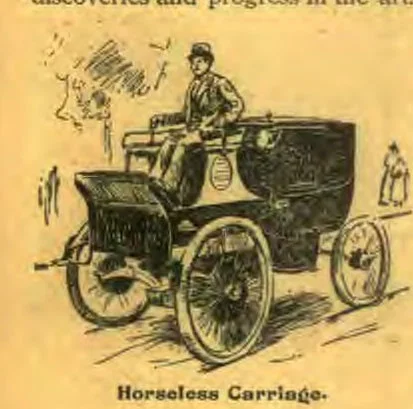
Horseless Carriage.
But in whichever way we may apply it, we have before our eyes the most emphatic fulfilment of the prediction. The “time of the end,” to which the book was to be closed up and sealed, and when, consequently, it was to be opened, commenced in 1798, an epoch marked by the ending of the two great prophetic periods, the 1,290 and 1,260 days, of Dan. 7:25; 12:4, 7, 11; Rev. 11:3; 12:6, 14; 13:5. A great prophetic era like this,—when the word of prophecy takes such prominent notice of earthly affairs, when from the book shut up by divine direction for over twenty-three hundred years the seal is lifted, and the time comes for knowledge to be increased,—can not but denote the loosing of all the shackles from the human mind which had so long restrained it from the exercise of its highest powers, and the opening of an era of progress and achievement, when the mental and spiritual endowments of men should assume a greater dominion over the lower and material forces of nature.
God said to Job, “Canst thou send lightnings, that they may go, and say unto thee, Here we are?”
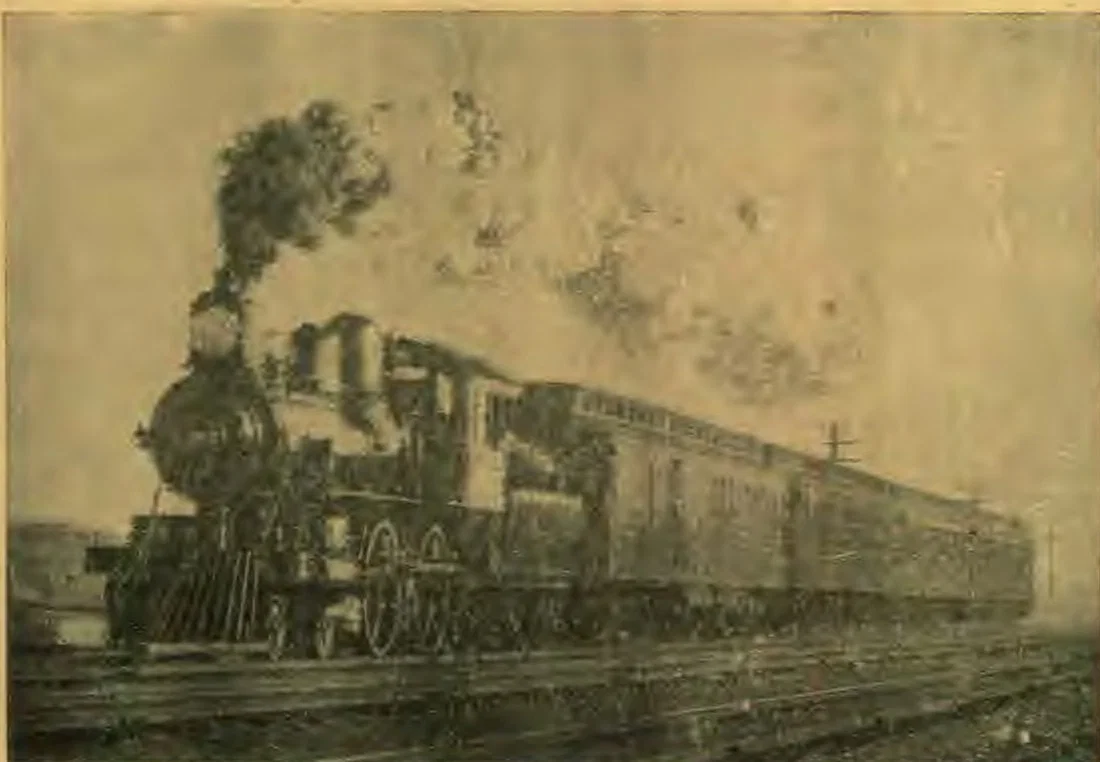
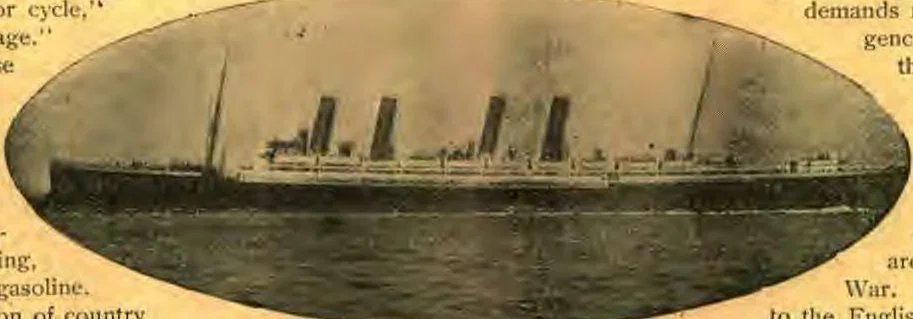
THE EMPIRE STATE EXPRESS.
Job 38:35. Though this may not be a direct prophecy of the electric telegraph, it is the seed thought of the scheme for transmitting thought to distant points, and receiving an intelligent reply, by means of electricity, or the lightning, and a suggestion that such a thing might sometime be. Nearly five million miles of wire now constitute the highway over which the nimble feet of the lightning speed to bear their messages from land to land. By steam propulsion on land and sea, defying time and distance, and the operation of the telegraph, the whole world has, as it were, been condensed from a vast expanse of terra incognita, into a little hamlet of contiguous neighbors; and national relations and conditions throughout the globe are thereby all changed.
Still other scriptures speak of the manifestation of great signs and wonders to appear in the last days; and, though these pertain mostly to the spiritual world, nevertheless they could not appear except under the very condition of civil and religious liberty which is the boast and characteristic of the present day. In the midst of the great tide of discovery and invention which has been rising so rapidly during the last fifty years, it is difficult to single out any portion of the time as preeminent over the remainder, as peculiarly a period of invention; and while the quarter century immediately past has been marked by some notable inventions of its own, it has been perhaps as much distinguished by improvements in preceding inventions, and by carrying them forward to perfection, as for new ones. Witness the multiplex system of telegraphy, by which different messages may be sent in opposite directions at the same time, on the same wire. Look also at the improvements in the steam-engine, sewing-machine, etc., etc.
It might be appropriate at this point to call attention to the fact that the electric light was invented in London, in 1874, the opening year of the quarter century now under consideration. What that has been in behalf of light in the natural world, such has the SIGNS OF THE TIMES been in the spiritual world. The experiments by which electric lighting has been brought to its present state of perfection and utility, were successfully accomplished by Thomas A. Edison, in the years 1878-1880.
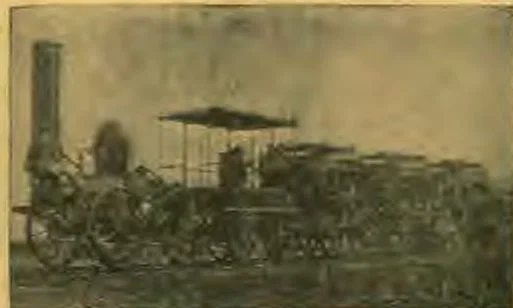
The De Witt Clinton, First Train on the New York Central Railway.
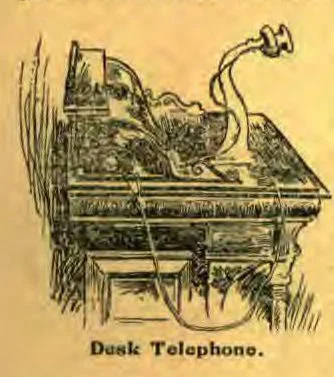
The telephone has so increased in use the past twenty-five years that, although experimented with as early as 1860, it may be considered as belonging to this period. The principle was exhibited in Frankfort, by Johann Philip Reis, doubtless the first and real inventor, in 1861. He died in 1874. But the idea was worked out into more practical shape by Professors Elisha Gray, A. G. Bell, and, later, by Mr. Edison. Professor Bell was the first to perfect his patent; and his articulating telephone was tested by experiments at Salem and Boston, Feb. 12, 1877. Edison's carbon loud-speaking telephone was brought out in 1878. Nineteen years elapsed, and the telephone statistics for 1897 show the following marvelous figures: “Total miles of wire in use, 536,845; number of instruments in the hands of licensees, 772,627; number of change connections for the year, 847,000,000; capital of the company, $23,650,000.”—World Almanac for 1898.
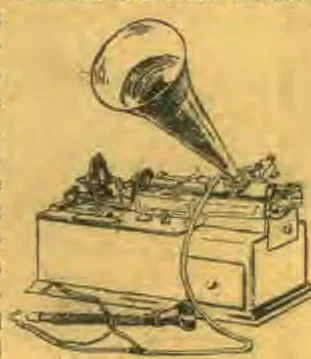
The phonograph is an invention of a similar nature. In this the vibrations of the diaphragm, under the impulse of the human voice, reproduce the voice, not by forming electric connections, sending the electric current to the other end of the wire, and causing a like diaphragm to make the same vibrations there, but by simply actuating a needle-point attached to the diaphragm, beneath which slowly revolves a cylinder coated with some soft substance, upon which it impresses its indentations corresponding to the vibrations of the diaphragm. Now when the pointer is caused to pass through the same groove again, it follows the same indentations, and causes the diaphragm to repeat its vibrations, and so the voice is heard again. It was invented by Edison in 1877.
The Phonograph.
The graphophone is simply a modification of the phonograph, involving better material and more skilful construction rather than any new principle. It was invented by Mr. Chas. S. Tainter, who, instead of tinfoil, which was less durable, used a mixture17of wax and paraffine to coat the cylinder and attached one or more trumpet-shaped tubes over the diaphragm to augment and project the voice. This instrument is able to reproduce speeches, songs, music of all kinds, even to a whole orchestra, and every kind of sound, in the most natural and pleasing manner. Thus can be brought to the rooms of the helpless and infirm, profitable addresses and all first-class entertainments.
Another invention destined to modify largely existing social conditions is the “motor cycle,” “automobile,” or “horseless carriage.”
Bicycles have proved such an immense success, the annual output having now reached the astonishing number of three-quarters of a million, that inventors are greatly stimulated to take the next logical step, which is to bring out a carriage capable of conveying two or more persons, self-propelling, and cheaply operated by electricity or gasoline.
This will change the whole complexion of country and suburban travel over common roads, said roads being necessarily vastly improved for this purpose. In anticipation of the demand which will exist for such vehicles, many manufacturing firms are preparing to embark in the business of their production. When such conveyances come into general use, as they will when they can be furnished at moderate prices, they will crowd out from cities and the highways the horse, which in many respects is considered a very “un neat and un nice animal.” This will greatly promote the sanitary condition and pleasing appearance of our cities, as is already beginning to be done through the displacement of the horse by the bicycle, motor cabs, motor delivery wagons, cable and electric cars, etc. The time may soon come when horses will be demanded only for some necessary work on the farm, and for fancy turnouts, which the wealthy will doubtless persist in maintaining. In some places, already, the price of horses has gone down to almost a nominal figure.
In the line of discoveries to alleviate the sufferings of the sick and wounded, as well as for other purposes, we have two very important achievements. One is what is known as the Roentgen or “X” rays, and the other is the production of liquid air in commercially available quantities. By the “X” rays the bones of the human body can be seen through the flesh, and any foreign substance in the body, like needles, bullets, etc., can be discovered and located. The surgical operation necessary to remove them can thus be greatly facilitated. The advantages of this discovery in alleviating human suffering and saving life can hardly be overestimated. Had this been known in the days of Garfield, the fatal bullet might doubtless have been extracted, and his life saved.
Desk Telephone.
And now comes liquefied air, called “the newest wonder of science.” Liquid air is air from which the heat has been so far extracted that the temperature is reduced to 312° below zero. In this condition it is a bluish semi-transparent fluid, and can be poured from vessel to vessel. One cubic foot of it represents 800 cubic feet of common air. When returning from its liquid to its natural condition, it evolves tremendous power, which can be utilized for any purpose for which power is wanted. Besides this, it will be of untold utility in cooling rooms, preserving food, and arresting yellow fever, which can not live within the frost line. It is thought that this discovery may even solve the problem of aerial navigation, as the only desideratum now to be supplied to carry out that conception, is the production of sufficient power without involving too much weight. The first ounce of liquid air produced is said to have cost an English laboratory $3,000. But Prof. Chas. E. Tripler, according to an illustrated article in the Cosmopolitan for June, 1898, has discovered a method by which in fifteen minutes he can have a stream of it running from his apparatus into any proper receptacle, and can keep that process up all day, at comparatively little expense. It is spoken of as “opening up immense possibilities,” “the potential applications of which are simply revolutionary.” It is further declared that “it is probable that even electricity is not destined to be of greater service to mankind.”
Still standing, as we are, within the lurid glare of the late war with Spain, it is unnecessary to speak of the phenomenal armored ships of war, and the great guns. In the fierce iron duel, for years past, and even still in progress, between defensive armor-plates and piercing shot and shells, it is still undecided which will win, the efforts to produce a steel plate which it will be impossible for any shot to pierce, or a shot which it will be impossible for any plate to resist. So far the shot have come off victorious. A thirteen-inch shell, that is, a shell thirteen inches in diameter and several feet in length, weighing over 1,100 pounds, discharged with a force that will propel it thirteen miles in a clear flight, is a terrible weapon of destruction. Such weapons, and such discharging power, could not have been, or at least were not, produced twenty-five years ago. It would seem that no floating breastworks, nothing short of solid land fortifications, could withstand the impact of such a shot. But the field of invention is still open, and stranger things than have yet been seen may come to pass.
The rapid-fire guns, carrying shot of from one to six pounds, and the machine guns, automatically loading and discharging 1,000 shots per minute, till the movement can be compared to nothing but a stream of lead like a stream of water from a powerful hydrant hose, can not be passed by. Before such a gun, an army of quivering flesh and blood falls like grass before the scythe, or, to keep up the consistency of the figure, like grass before the sweeping mowing-machines of the present day. Witness the results in the late conflict in Africa between the forces of the Mahdi and the English under General Kitchener, the latter being provided with these terrible machine-guns. By means of these, with a loss of only a few hundred men on the part of the English, 18,000 of the enemy were slain, and 17,000 wounded, in the brief engagement.
But all the changes wrought are not in the line of death-dealing weapons. Improvements in surgical instruments and practise have been marvelous; also improvements in food and sanitation, care of the sick and wounded, and all the arts of industry and peace; and many of these have grown out of the demands made upon the profession by the exigencies of war. This seems appropriate on the ground that God often causes the wrath of man to praise Him.
As an illustration, weather bureaus and signal-service, which have now come to occupy so prominent a place, and are doing such a beneficent service in behalf of property and life, arose out of an incident in the Crimean War. A terrible storm caused great damage to the English fleet. It was soon ascertained that a like storm had visited France but a few days before, and had traveled eastward. Tracing its progress, it was found that it was the identical storm; and, had it been reported, they in the Crimea would have been forewarned, and had time to prepare for it, and avoid the loss. The thought that just such things were probably happening all over the earth, and should be made a study and science for human protection, has led to official weather forecasts and weather bureaus, which are proving such a safeguard against danger to life and property.
But, alas! the tendency in human affairs is more to turn good into evil than evil into good; and so from the inventions and improved methods for producing the necessities of life in the direction of light, food, clothing, and transportation, arise the great combinations of capital, the monopolies, the trusts and syndicates, which, by crowding out individual workmen and small capitalists, are sowing such seeds of discord between labor and capital, and bringing distrust and alarm in all the industrial world. Who can not see that these causes are bringing us right into that condition of things which is to exist when “the Judge standeth before the door.” James 5:1-8; Luke 21:25-27.
But, amid the coming “wreck of matter and the crush of worlds,” there will be hope and safety in God and His promises. Joel 3:16; Acts 2:21; Heb. 12:26-29.
NOTED INVENTIONS.
QUADRUPLEX telegraphy, invented by Thomas A. Edison, in 1874.
The dynamo was constructed by Siemens & Halske, of Berlin, in 1874.
The “Ordinary” bicycle was invented in 1874.
The roller process in milling was introduced in 1876.
The Bell telephone was invented in 1876, and Edison's carbon transmitter was introduced in 1878. In 1893 there were more than 600,000 telephones in use in the United States.
The cantilever principle in bridge building was first employed in 1878.
The phonograph was invented by Edison in 1877.
In 1879 the first electric railway was operated in Berlin by Siemens.
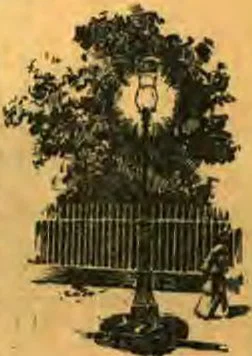
In 1879 Edison produced the incandescent electric light.
Electric Light.
In the decade from 1886 to 1896 we have the graphophone; Pullman and Wagner cars, and vestibuled trains; Harveyized armor-plates; artificial silk from pyroxylin; horseless carriages; the Zalinski dynamite gun; the Mergenthaler linotype machine; the Welsbach gas burner; the Krag-Jorgensen rifle; Langley's aerodrome (a steam flying-machine); acetylene gas from calcium18
(Continued on page 30.)
Noted Inventions.
(Continued from page 30.)
carbide; discovery of argon (a hitherto unknown element in the atmosphere); the Roentgen rays, or “X” rays; Edison's fluoroscope for seeing with the cathode ray; Tesla's discoveries in electricity; liquid air produced in commercial quantities; the kinescope; the web perfecting press; the modern bicycle; transmission of pictures by telegraph; the cash register; a fluorescent light bulb, produced by both Edison and Tesla, giving light without heat; welding of metals by electricity; development and improvement in typewriters; artificial diamonds produced from pure carbon compressed by the shrinking of heated metal; and the earphone, for detecting the direction of sounds during a fog or storm.
In 1898 Prof. Henry A. Rowland, of Johns Hopkins University, invented a device for sending eight messages over the same telegraph wire at the same time, four in each direction. In the same year Prof. S. W. Burnham, the astronomer, invented a calculating machine, by which multiplication and division and the extraction of square roots and roots up to the ninth power are accomplished by the mere movement of a hand upon a disk.
MILITARY AND NAVAL DEVELOPMENT FOR TWENTY-FIVE YEARS.
By A. O. Tait
BY ELDER A. O. TAIT.
[Author of ‘Heralds of the Morning.’]
THE inventions, the discoveries, and the general material progress of the nineteenth century have placed our day in as marked contrast with all past ages, as would be shown by the loftiest and largest mountain rising in the midst of a perfectly level plain. And in no field is this great development more remarkable than in the realm of military and naval activity.
In 1812 the great Napoleon had reached the zenith of his military strength and fame. In that year he organized an army of 475,000 men to march against Moscow. He said to one of his generals that he had never made such great preparations for a military struggle. This French army was not only the terror of Russia, against which it marched, but it spread dismay over all Europe combined.
Napoleon, however, planted some military ideas. He placed the whole of the male population of France subject to service in the army. This was a new plan, but it was some time in developing. Twenty-five years ago the French army, on a war footing, had only reached 757,747. Yet this was nearly double what it was in Napoleon’s time. His idea of organizing into immense armies all males who could carry arms was working, and in sixty years it had produced noted results.
But as the French army was increased under Napoleon’s new idea, the rest of Europe had to increase its armies accordingly. Hence the combined armies and navies of the principal nations of Europe on a war footing in 1874 numbered, according to the Statesman’s Year Book, 5,947,695. During the next eighteen years these armies were increased to 20,945,000, and in the following seven years they reached the amazing figure of 26,524,768. This shows for the last twenty-five years an increase of the men under arms in Europe of 20,577,073, of which vast increase 2,434,094 were added in the year 1897 alone.
If any of the achievements of all time deserve to be styled as marvelous, this gigantic increase of the armies of Europe during the last quarter century should stand in the front rank. And it has been our custom to speak only of military Europe; but the year 1898 was destined to cast the great America into the whirlpool, and territorial expansion, and the increase of army and navy, is the topic of the hour in the United States. Why all this mighty and world-wide arousing of the passions for bloody strife? Are not the demons of war madly driving the nations of earth to Armageddon?
But if the increase of armies during the last twenty-five years is a marvel, even in this age of marvels, the development of arms and equipments in their ingenuity of deadliness is still more appalling.
Twenty-five years ago the iron-clad man-of-war was in its infancy; to-day great battle-ships, armored with eighteen inches of steel—and a steel, too, that offers more resistance by far than anything that was known then—are patrolling all the seas.
Twenty-five years ago the muzzle-loading gun was just giving place to the breech-loading and magazine rifle.
Twenty-five years ago the automatic machine-gun had hardly materialized into a dream; to-day the automatic gun can throw from 600 to 2,000 rifle bullets per minute, 300 one-pound shells per minute, 150 six-pound shells a minute, and 60 nine-pound shells a minute.
Twenty-five years ago the old cast-iron, smooth-bore, muzzle-loading cannon, with its spherical shell, was just being side-tracked for the high-power, breech-loading, steel ordnance, with its long cylindrical projectile. These old cannon of twenty-five years ago could not drive a shell through four inches of common iron; to-day one of the big guns hurls its shell through forty-four feet of iron and oak and granite and concrete and brick, twenty-eight inches of which is compound plate and wrought iron. It took from five to fifteen minutes to load those old-fashioned cannon; but the modern 8-inch gun can be fired four times in one minute; the 6-inch gun, seven times a minute, and the 4-inch gun, fifteen times a minute.
And, while the old smooth-bore gun of twenty-five years ago could not pierce 4 inches of common iron, the big 16-inch gun of to-day uses a charge of 1,060 pounds of powder and throws a shell weighing 2,370 pounds with such terrific force that the power exerted would lift 64 of the largest locomotives 10 feet into the air; or it would hoist the great battle-ship Iowa from her dry dock 6 feet into the air. The 12-inch gun uses a power in hurling her shell that would lift such a ship as the Spanish cruiser Vizcaya 4 feet into the air; or, to make another comparison, the shell is shot out with a force equal to the driving power of a 60-ton locomotive with a train of eight cars running at fifty miles an hour.
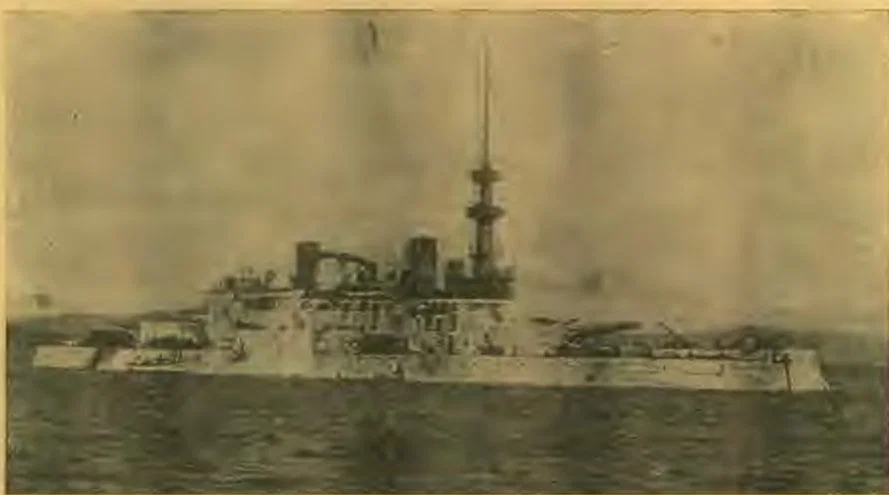
BATTLE-SHIP OREGON.
Twenty-five years ago the smokeless high-power and slow-burning powder was not invented; to-day the powder is made in large blocks that burn from the inside so that the gases are given off gradually instead of with a bursting charge, and by this means, and through the agency of the long cannon, the pressure behind the shell begins gradually and increases all the time it is passing out of the barrel of the gun, reaching its maximum force at the muzzle. And twenty-five years ago the high explosives of to-day were hardly dreamed of. But to-day such powerful explosives are made that if a ton of them is discharged it will exert a pressure of 12,000 pounds to the square inch, at a distance of 250 feet. Mr. Hudson Maxim, who has done so much in the development of these high explosives, is hard at work on a gun that will throw a shell charged with a ton of this giant explosive a distance of 5 miles. The best scientific and military authorities think that he will succeed with this murderous weapon, and when it is done, he can stand off 5 miles and by striking anywhere within 250 feet of it destroy the greatest battle-ship afloat.
If the things that are actual facts in the military world to-day had been imagined and described twenty-five years ago, they would have been regarded as more fictitiously visionary than the wildest stories that an ignorant and superstitious nurse ever made use of either to terrify or entertain her nursery charge.
Would it be outside the realm of literal fact to say that if all the invincible armies, commanded by all their illustrious generals from the days of Nimrod down to Grant and Lee and Sherman, were marched upon a great battle-field, almost any one of the great nations of the now could send out a force that could mow them down and hardly lose a man? Supposing that all this great host of former times would have the courage to continue to advance, a hailstorm of monster shells would begin to meet them when they were ten or twelve miles away, and this storm would continue to increase as the distance was lessened, and these smaller guns that hurl out steel like a hard storm of hail were brought into action.
Such is the merest outline of the appalling facts in regard to the military and naval developments of the last twenty-five years. The long roll is sounding, and armies, not of thousands or of hundreds of thousands, but of millions, are falling into line. And the weapons with which these men are armed strike terror even to the brave.
What does it all mean? Why is this awful spirit of war rising and spreading like a hurricane in these closing decades of the nineteenth century? A single passage of Scripture tells the story plainly. It reads:—
“And I saw three unclean spirits like frogs come out of the mouth of the dragon, and out of the mouth of the beast, and out of the mouth of the false prophet. For they are the spirits of devils, working miracles, which go forth unto the kings of the earth and of the whole world, to gather them to the battle of that great day of God Almighty.” Rev. 16: 13, 14.
This scripture is too plain to need comment. It clearly tells of the world-wide work of the evil spirits as they go to the kings of earth to gather them to the battle of “that great day of God Almighty.” There are other scriptures that tell with the same vivid clearness the meaning of these unprecedented preparations for war. Read them, and let the Father, who loves you and who seeks to save you from the perils of this time, impress you by His Spirit as to your needs and duties in this hour of peril.