MEDICAL PROGRESS WITHIN THE LAST TWENTY-FIVE YEARS.
By John Harvey Kellogg
BY J. H. KELLOGG, M.D.
[Superintendent Medical and Surgical Sanitarium, Battle Creek, Mich.]
TWENTY-FIVE years ago it was customary to speak of the art of medicine; to-day medicine is called a science. The science of medicine is almost wholly the product of the researches and investigations of the last twenty-five years. The discoveries which have been made through the means of the chemical, bacteriological, and physiological laboratories, in which hundreds of devoted men have patiently labored during the last twenty-five years, have accomplished more for human welfare in matters connected with the medical profession, than all the labors and all the discoveries of five hundred years previous. In this brief article it is impossible to even enumerate all the various important discoveries which have been made within the last quarter of a century, neither would such a technical enumeration be of special profit.
Perhaps we should mention, as most important of all the recent discoveries in medical science, those which relate to the causation of disease. Twenty-five years ago an epidemic of typhoid fever, of cholera, of yellow fever, of the plague, was looked upon by the majority, at least, as a sort of visitation of providence. It is nearly a score of years since Dr. Parkes, the eminent English sanitarian, made the startling assertion, “When a man dies of typhoid fever, somebody ought to be hanged.” Modern science has clearly pointed out the fact that catching diseases, infectious maladies, and epidemic disorders, are all, without exception, due to the invasion of the body by germs, organisms so minute as to be invisible to the naked eye, but capable of the direst mischief when brought in contact with the body under circumstances favorable for the development of the disorders which accompany their growth. The number of these germs which has been discovered is already legion, and bacteriologists tell us that we are only just upon the border-land of this great new branch of botany. Multitudes of new microbes are discovered yearly, and there is plenty of new territory to explore and new worlds to discover in this branch of investigation.
Incomplete as the research has been, however, we already find ourselves confronted with facts of the most startling character respecting the relation of these minute organisms to all the conditions of our daily life. For example, we have found that the motes which dance in the sunbeams, as the poets tell us, are in large part living germs, which, when received into the body, are capable of almost endless mischief. A German bacteriologist found more than a dozen different kinds of germs present in the examination of the contents of a basket of fruit left by his grocer upon his doorstep. The dust of the street is no longer to be regarded as an inconvenience, but as a great reservoir of malignant microbes, ready to lay us low when a favorable opportunity offers. Pulmonary consumption, one of the most deadly, and in civilized countries one of the most common, of all human maladies, is propagated almost wholly through the inhalation of the dried sputum of persons suffering from the disease, which contains the living organisms characteristic of this malady. Fully one-fourth to one-seventh of all the people that die in this country fall victims to this one disease, which twenty-five years ago was supposed to be hereditary and unavoidable, but is now known to be a catching malady, like measles, whooping-cough, and similar disorders.
Why all persons do not suffer from tuberculosis, typhoid fever, or other germ diseases, is a mystery hard to explain. Recent science, however, has come forward with a demonstration that germs are not the direct cause of disease, after all, but that the real cause is a weakened body, deteriorated tissues, which furnish favorable soil for the planting and growth of these malignant vegetable organisms. But while this discovery has brought forward in bold relief the fact that germs are, after all, not the cause of disease, it is clear that they are rather characteristic factors in it. The real causes of disease are to be found in those habits of life which lessen the vital resistance and deteriorate the bodily functions. For24
(Continued from Page 25.)
example, the stomach is capable of destroying any germ which may find its way into it. It destroys cholera germs very quickly, also the germs of typhoid fever. Hence, man can not contract either cholera or typhoid fever so long as he has a perfectly sound stomach. If he happens to swallow the germs of these diseases, he simply digests them as he digests potatoes, cereals, and other vegetables which he may swallow. But the man whose digestive vigor is impaired is constantly exposed to infection, not only by typhoid fever, yellow fever, or cholera germs, if he happens to come in contact with them; but, the blood and tissues being impaired, the defenses of the body are all weakened, and germ diseases, as well as other disorders of every sort, are imminent. It is thus apparent that the discoveries which have been made in relation to the nature of germs, their method of development, etc., have naturally led to an exhaustive study of the habits of life and their bearing upon human health and longevity.
In this line of research careful study has been made of foods and of their relation to stomach health and general vigor. A vast array of most useful facts in relation to foods, their nature, nutritive values, digestibility, etc., have been brought forward, and are gradually finding their way from the medical text-books to the public prints, from the laboratory to the kitchen. Twenty-five years ago a man who ate graham bread was looked upon as a crank or a lunatic. Cracked wheat, oatmeal, and similar whole-grain products, were just beginning to receive attention. Now graham bread, oatmeal, cracked wheat, and other whole-grain preparations, appear regularly upon the bills of fare of every well-ordered hotel in the country. Other equally-important dietetic reforms have been made. Mustard, pepper, pepper-sauce, and vinegar, have been critically examined by the physiologist and found to be not only detrimental to the digestive processes, but directly injurious to the stomach, and productive of gastric catarrh and other grave and obstinate maladies. The relation of fats to the digestion of starch and other food elements has likewise been studied, so that we are able to comprehend the reason why boiled rice digests in an hour, while the digestion of Saratoga chips compares favorably only with that of pebbles or sole leather.
Sir William Roberts and other English physiologists have extended their researches to inquiries respecting the nature of tea, coffee, alcohol, and other beverages, and their effects upon human digestion, with the result that facts have been elicited which condemn these articles as utterly unwholesome, pernicious, and of no possible service to the human body.
Within the last few years the study of dietetics has led to an investigation of the question of the wholesomeness or unwholesomeness of a flesh dietary. The results have been the declaration by Dr. Haig, one of the most eminent physicians and physiologists of Great Britain, that flesh-eating is without doubt the cause of rheumatism and gout, as well as neurasthenia and various other maladies, and that there is a veritable and clearly-defined disease, which may properly be termed “meat-eaters’ disorder,” which, in a great number of instances, is only the forerunner of Bright’s disease, paralysis, neurasthenia, sick-headache, and a great variety of other chronic and all but incurable maladies.
Another result of the scientific study of diet within the last twenty-five years is the development of a class of special food preparations known as health foods, particularly designed for crippled stomachs whose energies have been largely exhausted in wrestling with the dietetic abominations which appear upon the average table. The fundamental principle in these preparations (at least those which are meritorious, for there are numerous worthless imitations) is the preparation of cereal and other foods in such a manner as to lighten the burden of the digestive organs, a large part of the work of digestion being performed by the preliminary processes to which these foods are subjected in the course of manufacture. Twenty-five years ago health foods were just coming into existence, but they have gradually won their way into the public confidence, or, rather, the public have gradually come to appreciate their value and importance. The public has become so well aware of the evil effects of the ordinary dietary of tea and coffee that the demand for cereal substitutes for coffee has come to be so great in magnitude that numerous immense establishments are devoted exclusively to this line of business. It is safe to say that at the present time several hundred thousand people in the United States habitually use cereal coffee instead of Mocha, Java, and the various other brands of coffee and tea which they formerly used. The principal headquarters for the manufacture of these foods in the United States are found at St. Helena, Cal., Boulder, Colo., College View, Neb., and Battle Creek, Mich.
One of the most characteristic features of the new medical science to which the present century, and particularly the last half of it, has given birth, is the idea that health-getting is not a matter of magic or of pill-swallowing, but instead, in the majority of cases, at least, a matter of education and training. The chronic invalid is ill because he or she has violated the laws of health. Rational medicine regards disease as the result of the operation of nature’s laws, and not a consequence of chance or of supernatural agencies. It would seem self-evident that the tissue changes, the functional disturbances, the pathological processes, which result from the long-continued violation of nature’s laws, are not to be remedied by the most ingeniously-managed medicinal antidoting any more than by the mummeries of the mind-curist. Nevertheless, it is a sad fact that a large proportion of the public have failed to recognize that in its onward march of progress, true medical science has left behind the specifics and panaceas of the old régime, along with the astrology and alchemy of an earlier age, and are still engaged in combating disease on the basis of an effete and false philosophy, or else blindly following an unphilosophical and ever-changing empiricism.
The rational physician keeps ever in mind the fact that the real curative force resides, not in his medicine case, but in the constitution of the patient. Nature is the real curative agent. The physician really assists his patient toward recovery only when he studies the purpose of nature in her efforts, and supplies conditions which will aid nature in her work.
A little more than a quarter of a century ago the principles of rational medicine were so little recognized in the world that the physician who undertook to practise medicine in harmony with these principles was looked upon as a lunatic, and was compelled to depend for a living upon some other resource than the practise of medicine.
The sanitarium, a place where all physiological and rational measures of treatment are gathered together ready for application to any given case, was unknown. A scientific sanitarium represents rational medicine in its most advanced state, and is at least one of the greatest and most beneficent of all the gifts of modern medical science to humanity. As the result of the scientific study of disease which is made possible by the intimate relations of the physician in a properly-conducted sanitarium, many most valuable advancements have been made in the use of water, electricity, exercise, and other physiological agents.
The exact study of disease and sick people has made necessary the development of laboratories, in which skilled chemists, bacteriologists, and other experts are employed to aid the physician in getting at the exact morbid conditions which are present in every individual case. This precise study of conditions has led to a revision of remedial agencies, and to a more accurate adaptation of the measures approved to conditions of disease, temperament, etc. Thus a new medical science has been born, and at the present time a great number of maladies once regarded as absolutely hopeless are found to be actually curable, and scores of so-called incurables are constantly being restored to health.
Another feature of medical progress which ought, perhaps, to be mentioned, is the change of attitude on the part of the medical profession toward important questions bearing upon the public welfare. One of the most important of these is the question of the education of the laity in medical matters. The time existed when the doctor thought it necessary, in order to maintain his influence with his patients, to keep them in absolute ignorance of what he was doing or aiming to do in the administration of remedies. The adoption of rational measures has changed the attitude of the physician. Being engaged in the practise of rational medicine, he is able to give a reason for his diagnosis of the patient’s condition, and for the various directions which he may give respecting the patient’s care; and thus there is a greater readiness on the part of the physician to communicate medical facts to his patrons. The public are to-day vastly more intelligent respecting matters of this sort than twenty-five years ago. The necessity for the medical education of the people has come to be recognized, and eminent physicians are taking their stand in behalf of the enlightenment of the public upon all medical questions which can be popularized and brought within the comprehension of the ordinarily intelligent layman.
The results of the educational work of this sort which has already been done are being shown in the decline of the patent-medicine industry, which depends entirely for its success upon the ignorance and superstition of the people. A very successful patent-medicine manufacturer said to the writer not many months ago, “I am going to sell out my business as soon as I can; the patent-medicine business is doomed.” The public are without question imposed upon to a more monstrous degree in matters pertaining to the treatment of disease than in any other way. The quack, the nostrum vender, find in the chronic invalid a ready dupe; but modern medical science stands ready to educate the ignorant respecting the great principles of rational living, and the rational treatment of the sick, and emphasizes a principle which sounds the death-knell of quackery and medical humbuggery of all sorts, viz., that in dealing with the sick it is not the malady, but the sick man, that is to be treated and cured.
In conclusion, a word may be said respecting the marvelous achievements of surgery within the last quarter of a century, through the discovery of germs and the relation of suppuration and aseptic properties which were formerly known as blood poisoning, gangrene, etc. A quarter of a century ago amputation of the leg at or near the hip joint was one of the gravest and most deadly operations in surgery; amputations of all sorts were most serious. The surgeon expected suppuration to occur in the great majority of cases, and talked about laudable pus, healthy pus, etc. The abdominal cavity was invaded only by a few bold operators, who expected to lose twenty-five per cent. of their cases. The brain, the lungs, the heart, and the abdominal viscera were considered practically beyond the region of human surgery. Yet to-day, thanks to asepsis and thorough cleanliness, amputations of all sorts are regarded as scarcely more than minor surgery. The abdominal cavity is opened with comparatively little risk, under favorable conditions, and enormous tumors and other diseased structures are removed. The spleen, one kidney, a portion of the liver, and, if necessary, several feet of intestine, are removed with comparative safety when occasion requires. Even the entire stomach has been removed, and the stomach is frequently opened for the removal of foreign bodies which have been swallowed. In a recent case more than a pound of hardware was taken out of the stomach of a man who had for several years been exhibiting in a dime museum as “a human ostrich.” The list of things removed from his stomach included more than a hundred staples, cartridges, nails, etc. Portions of lung have sometimes been removed, and slight surgical operations have been performed upon the heart. The brain cavity is frequently opened for the removal of tumors and other diseased structures.
The surgeon no longer talks about healthy pus, but undertakes to maintain such cleanliness and asepsis as will secure immediate union of the wounds which he makes, without suppuration. By a combination of the most skilful surgical measures with a pure dietary, it has been found possible to save alive a much larger number of desperate surgical cases than is possible under less favorable conditions.
Certainly in medical matters the world moves, and at the present moment, progress is so rapid that it is next to impossible for a busy practitioner to keep pace with the progress which is made in various lines of research which are being carried forward in various parts of the world; and, to be thoroughly successful in his work, the physician must call to his aid the chemist and the bacteriologist to assist in his research into the exact condition of each organ and each function of the human body. Medicine is no longer an empirical art; it has become a grand and noble science, and each day adds something to the luster of its glory and to the efficiency of its service to the human race.
THE WEIGHT OF A SOUL
By Mrs. S. M. L. Henry
By Mrs. S. M. L. Henry, Author of “Studies in Home Life,” etc., etc.
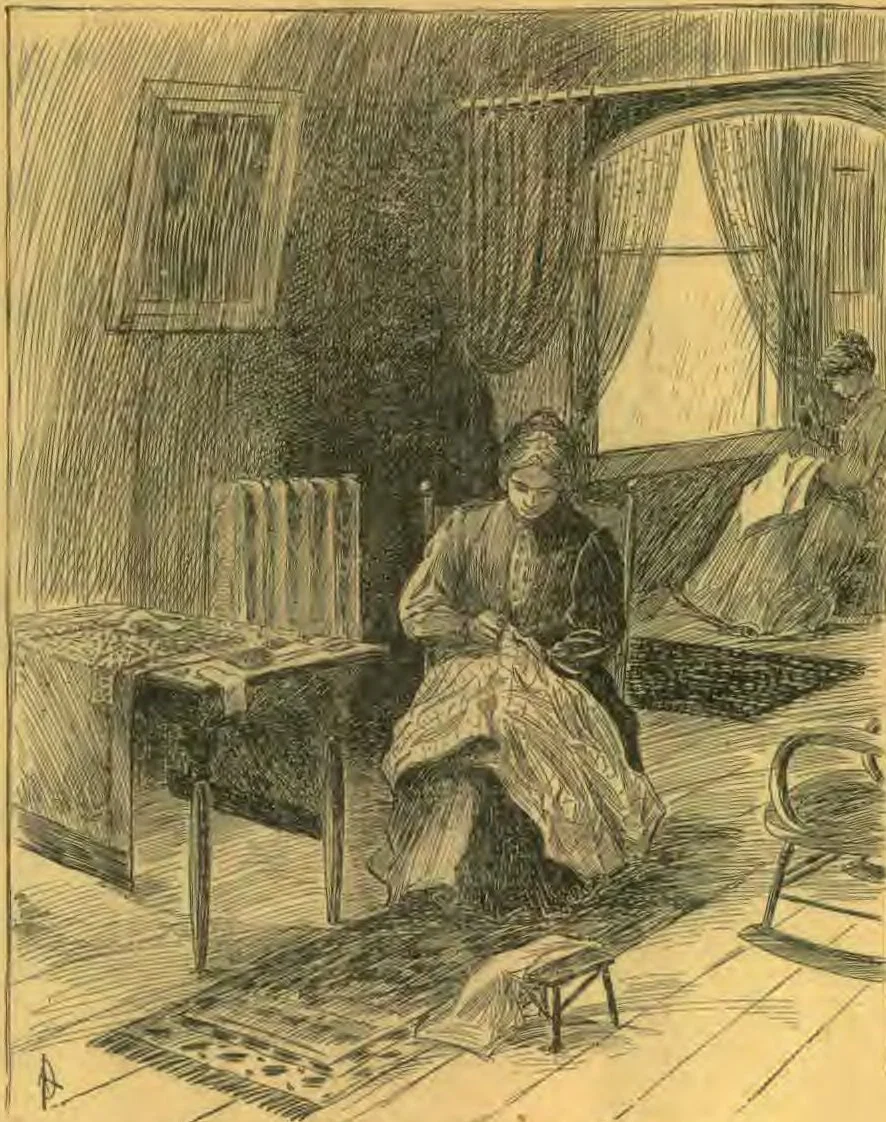
She had come and gone like the door on its hinges. She had begun as a pretty little blue-eyed seamstress, and kept on in the same room, at the same table, with the same pair of shears, pin-ball, needle-book, emery strawberry, thimble, and tape-line, until now.
Now, no one would have recognized in her the pretty little seamstress. Her eyes were faded and red at the corners—sometimes red all over, but those times she kept them bent down so that no one could see them. Her hair was thin and dry, only when she slyly slipped over to the stationary bowl and spatted the top of her head with the cold, running water. She never did that when any one was in.
The sewing-room was in a great, beautiful house—a good home for those fortunate beings who had been born into it. It was a beautiful room, and everybody thought Mary Graham was highly favored indeed to have secured and held such a place, with its comfortable little chair, its good light, its steady, beautiful work, and, more than all, such a considerate mistress,—one who never forgot that her sewing-woman might be glad of her money when the week’s work was done; who never allowed over-hours; and, if the weather was very bad, gave her her car fare.
There was also another advantage that Mary Graham had over many others of her class,—she had to become well informed about many things, for the large, pleasant sewing-room was practically the morning-room for the whole family. Mrs. Hungerford had her work-table in a little alcove which overhung the garden, and looked westward toward the beautiful river; and here she put many finishing touches to the dainty garments for her children, wrote, read, and received her intimate morning callers, and the several committees of which she was chairman. The affairs of the Woman’s Club, with its culture projects; of the W. F. M., with its many plans for converting the heathen, and of the W. C. T. U., with its reforms, philanthropies, its educational and evangelistic methods, were all discussed in open council in the presence of the little seamstress, who seemed to have even a soft pedal to her sewing-machine, so quiet and unobtrusive was she in all that she was and did.
“Mrs. Hungerford, is your little seamstress dead as well as dumb?” laughingly asked Mrs. Northropp one day. “Not that I have anything to say, you know, but she is so very quiet.”
Both ladies looked over Mary’s way, but she did not seem to hear, at least unless the slight coloring of the rim of her white ear, and a sudden little splash of red on her neck, was a sign.
“Mary is a very quiet, busy little woman,” said Mrs. Hungerford, in a kind, appreciative tone. “She never disturbs any one, and she does beautiful work. See this”—and, lifting a pile of delicate little garments, the two fell to examining them, and talking them over as women will.
“Well,” said Mrs. Northropp, “I wish I could steal your Mary Graham, or find her double—tho that sort doesn’t grow in pairs; and then it would be of no use to steal her, unless I intended to lock her in; for you have given her the best berth that any seamstress that I ever knew of, ever had. She’s a fortunate girl. Let’s see—how many years is it that she has occupied that corner?”
“Don’t ask me,” laughed Mrs. Hungerford, “for if I should go to reckoning those figures I should make gray hairs grow in all our heads. My! O, how the years have flown! It was when George was a baby, and the year that I was elected president of the Missionary Circle. We made our first missionary plans, cut out the first missionary clothes, and tried the first sewing-machine I ever owned on them. You selected that machine, Mary; do you remember?”
“Yes’m.”
“There, Mrs. Northropp, you see she is neither dumb nor deaf,” laughed Mrs. Hungerford. “But your voice sounds tired, Mary; are you tired?”
“O, no’m!”
“Very well, you ought to know; and if you are, you ought to know enough to pick up your things and go and stay till you get rested. That’s another nice thing, Mrs. Northropp; Mary knows that she can do just as she pleases with me. I never worry about her. She comes and goes, does her part, and I try to do mine, tho sometimes she does almost sew me out of house and home, so that I have to take a day off for shopping.”
“Well,” sighed Mrs. Northropp, “if one’s part was all done with the shopping—but, dear me—I am almost killed over the awfulness of responsibility sometimes.”
“That is a consideration,” said Mrs. Hungerford, “and it is a great comfort to me that my folks all seem to know how to behave themselves, from Mary down to the children and Mr. Hungerford. They all keep straight, without any bother to me, and I thank the good Lord for it every time that I hear of the goings on all about us. I am left absolutely free, without a worry, to give myself to the heathen.”
THE WEIGHT OF A SOUL
Both ladies laughed quietly, and Mary worked the treadle of her noiseless machine with her back toward them, while the heart within her seemed more stony than ever, and her lips curled in a scorn that was cruel for any face to be compelled to carry. The look of scorn, however, soon changed to anguish, and in suppressing its cry, she bit into a needle which she was holding between her teeth, and only by great effort prevented the pointed half from slipping down her throat.
“What’s the matter, Mary?” asked Mrs. Hungerford. “Did you swallow a pin again? That is a nasty habit you have of making a pin-holder of your teeth. Did you get it out?”
“Yes’m.”
“Well, I’m thankful. I expect to find you strangled with a needle some day; then what would we do for clothes?”
That night, after all the house was quiet, Mrs. Hungerford still sat at her table in the sewing-room alcove. The lights of the city reflected in the river lay in long shafts of silver from shore to shore. She was writing; but occasionally, glancing up and out, the beauty of the scene tempted her to turn the key at her hand by which the illuminating current was cut off from the room, that she might have the friendly aid of darkness within by which to gather up the tender beauty of the scene without. As she sat with her elbow on the table, her chin on her palm, thinking over the day’s work for the W. F. M., which had especially engaged her attention, suddenly a strange, new, startling thought came to her, startling only, however, because it was new. She wondered where it came from, and why just now, but more why it had never come before. It would have been a very little commonplace thought under almost any other circumstances, but under these, in which it had dropped like a lightning flash out of a cloudless sky, it was so uncommonplace as to bring her instantly upright in her chair, her hands to the edge of the table, as if to lift herself by them. She did not arise, however, but sat looking fixedly toward
the long silvery bars of light that banded the two shores of the river together. But she had forgotten them; she thought only one thing, and that was, “I wonder if Mary is a Christian.”
That was all there was to it, but since Mrs. Hungerford really had a sincere heart, small as that “wonder” looks, it was enough to fill it for the time being.
“Why, don’t I know?” was the next thought. “How is it that I have not known? I can not wait until morning to find out—and yet I shall be ashamed to ask her. How can I ask her, after all these years, and all that has gone on in this room in her hearing? But of course she is one, and she knows that I know it. I couldn’t help but know it; of course not. She will appreciate the fact that I have taken it for granted, have understood without words—yes, indeed, I shall find some perfectly natural way of introducing it so that she will not suppose for a moment that I have only just now thought about it. That would be a dreadful thing for her to know. It is dreadful, and I will see that it never happens again.”
She sat on and on, her eyes fixed on the river, until the home lights had all been called in, and only those remained that were for public safety—slender threads, few and far between, shot in through the darkness of the night, only serving to make its blackness more suggestive of dangerous depths. After a while she arose, dropped on her knees, and, with her face buried in her hands, and an intolerable burden on her heart, she groaned out the prayer for herself that she could not speak, while tears trickled through her fingers until the handkerchief which she had dropped in the seat was wet.
The next morning when Mary entered the sewing-room she was surprised to find Mrs. Hungerford before her. The expression in the face of her mistress was new. But Mary was alike indifferent to expressions new and old; so, with a civil reply to the, “Good morning, Mary,” which greeted her, she turned to the closet to lay off her wraps.
Mrs. Hungerford was, at the end of a long, sleepless25night, weighed with a burden so heavy that she could think of nothing but how to get rid of it. Every consideration of carefulness or tact had been lost hours ago; she only waited for a chance to speak.
“Mary,” she began, and her tone was so strange, with the pressure of pent-up feeling, that Mary really was moved to look at her in almost alarm, “Mary—I—I have a question to ask you; you—you—are a Christian girl, aren’t you, Mary?”
Just a moment Mary stood, her face hardening every second as she slowly took in these words, and began partly to comprehend what was back of them. Then she laughed a shrill, horrible laugh, which distorted her face, and left it paler than before; then she seemed to grow tall, and taller, her eyes became cold as steel, and in a low, sarcastic tone she answered:—
“I think it is time you asked me that question.”
“O Mary!” and Mrs. Hungerford sprang toward her as if to throw her arms about her; but Mary had slipped beyond them, and stood like an avenger beside her sewing-machine.
“O Mary, you are right! It is time—long, long past time!” she cried. “You don’t know what I have suffered all this night. Listen!”
“Listen? No, I must get to my work. Suffered, did you say? Well, suffering that can be measured by a night will not spoil your beauty.”
“Mary!”
“Yes, ma’am. Did you get the cambric yet for Miss Dorothea’s slips, and the lace to edge Master Guy’s ruffles?”
“Mary, O Mary!”
No answer.
“Mary!”
“Yes, ma’am.”
“O Mary, don’t look so hard at me! Will you not listen to me?”
“Of course I’ll have to listen to you, or”—
“Or what?”
“Why, lose my place, maybe!”
“You know better. O, how unjust! But no, I deserve it. Say what you please, my poor girl, you”—
“Mrs. Hungerford, please, whatever you do, don’t call me girl again. I’m a woman. I—was a girl once, but that was ages ago.”
“What do you mean? Are you married?”
“O, yes, I’m married!”
“And—and children?”
“Now you stop. O!”
And before Mrs. Hungerford could anticipate her purpose, she had seized her hat and shawl, was down the stairway, and off like a wounded roe, plunging through the open spaces toward the river.
The morning and the afternoon passed, but she did not return. Several committees came to meet Mrs. Hungerford, but she excused them. She spent the early part of the day looking among old papers for an address. She had once known where Mary Graham lived, but, never having occasion to look her up, she had lost the address. She humbled herself to inquire of the servants, but not one of them could enlighten her. The late afternoon found her under a pressure of anxiety that could not be longer endured; and, calling the carriage, she started out upon the almost impossible task of finding Mary Graham among the thousands of unregistered poor of a great city; for by this time she had, as she supposed, at least classified her. She was also by this time too determined to stop with half-way methods, but went directly to police headquarters, from which, after a half hour, she emerged with a list of “Mary Graham’s,” only one of which could be hers, and, giving the first order to her driver, she started on a search which, before it was ended, brought her face to face with things that gave point to all the work which she had been doing at long range; and the fire which began to burn in her breast no “reports” could ever have kindled.
It was long after midnight. She had gone through her list of “Mary Graham’s,” and sundry experiences which she would never forget. She had taken John, the old coachman, into confidence some hours before, and he stood with one hand holding the reins, and the other on the open door of the carriage, waiting. At last, suddenly a sharp cry rang out from a partly open upper window near by in the court, and then a tender woman’s voice was heard—a voice which sent a thrill through the heart of the startled listener in the carriage.
“Let me out, quick, John; that is she.”
“Are you sure, ma’am? Be careful; this is a bad part, ma’am.”
But she was out, and hastening by the light of a dim street lamp toward the crooning voice which still fell from the partly open window. How she found the way she could not have told—up the shaky stairway, and along the dark halls—but at last, without even a premonitory tap, she softly opened the door, from which the voice still came, tender, sweet, heart-breaking, with its burden of unspeakable love and pain. She was unnoticed, so she stood and took in the scene.
The room was very small. A lamp, shaded on one side by a piece of newspaper, stood on the table. On the pillow of a little bed, over which this shadow fell gratefully, was a pinched face, distorted by pain, while cry after cry came from the drawn lips. The head was thrown back, the eyes were dilating with that expression of surprise which acute and sudden stabs of pain will produce, and which is so pitiful to behold. In another corner, on a lounge, slept a man, whose heavy breathing, laden with sickening fumes, told its part of the story. Mary was sitting on the edge of the narrow bed, from which she had evidently suddenly arisen, and was bending low over the poor little face, with a Madonna look which made her beautiful, while with her hands she was supporting the suffering body.
Mrs. Hungerford waited but a moment, then, slipping softly back into the hall and closing the door, she stood and thought; then carefully she felt her way back to the street, and with a reassuring word to John, stopped under the street lamp, and, taking a note-book and pencil out of the bag on her arm, she wrote two, three, four, of the small pages full, folded, pinned them together, and stole noiselessly back, slipped them under the door, knocked softly, and returned to the carriage.
“No, not yet,” she whispered, as John opened the door, but stood with her eyes on the window.
On the thin curtain she saw first the silhouette of a woman reading, then of an erect statue, then of a bowed form, its face in its hands; then, after a long time, the curtain was parted, and the lamp was moved close to the window, so that the silhouette was blotted out.
“Thank God! O, I do thank Thee, Father!” and with a sob of gladness, Mrs. Hungerford started quickly toward the light. But, stopping a moment, she whispered, “John, where are we?—what part of the city?”
“Well, not so very far from home now, ma’am, just off the avenue, on Gray Street. That, where the light is, is Lost Court.”
“Well, then, you drive quickly home, tell Mr. Hungerford where I am, then come back. I will see you, and come down to tell you what to do.”
She went up, and in a moment had Mary sobbing in her arms.
“O, did you really mean it enough for this? Then I believe—I do believe; I will come back to the God of my childhood. I had made up my mind there was no God,” she whispered, “for, you see—you see him—and, O, my baby, my baby! I began to sew for you for her sake, for he hurt her, and I had her in the hospital until they gave her up, years ago; and, O, I thought nobody cared only for—you know—”
“Yes, I know; you had reason to think we only considered you as a sewing-machine; but God laid your soul upon me last night; I have found out how much it weighs, and if you had not lifted it off by beginning to believe, I think it would have crushed the life out of me. O, I never want to feel that sort of a burden again! But now we will see, dear heart, what can be done for yours.”
“Everybody thought Mary Graham was highly favored.”
THE RANSOMED OF THE LORD.
By Francis Eugenia Bolton
BY FRANCIS EUGENIA BOLTON.
O ANGELS who have looked upon our woe,
And read in earth sin's dire malignity,
And read in men how it can plunge us low,
And read God's love in Christ on Calvary,
To-day I think with thrilling heart that soon
Ye'll see love's consummation and reward,—
The church of Christ made fairer than the moon,
The ransomed, the redeemed ones of the Lord.
Ye've seen the lepers spotted in the glooms,
Ye've seen the paralytic, helpless, mute,
Ye've marked the madmen raving 'mid the tombs,
And seen the world-wide bearing of sin's fruit.
Ye've seen how innocence is burnt from brows,
Seen lovely eyes with hate grow wild and hard,
And sorrowed gentle ones; but now hope glows;
Ye soon shall see the ransomed of the Lord.
Ye've seen the mighty bear away his prey
To death's foul prisons of decay and gloom,—
Nations swept down as harvests of a day,
To feed the world-wide gaping of the tomb.
Ye've seen the broken-heart, the mourner's tear,
The God-like glory lost, the image marred;
But, O, the great Deliverer's army's near,
Ye soon shall see the ransomed of the Lord!
Down the great skies that open from the throne,
The choirs of heaven will march with harps-a-ring,
And fair Emmanuel come to claim His own
From a usurping and despotic king.
The hosts of ill will wither at his eyes;
His brow by crown within a crown be starred;
His voice will bid the captive hosts arise;
The tomb will yield the ransomed of the Lord.
Then principalities and powers will fail,
And prostrate fall before the King of kings.
The ransomed of the Lord, now sad and frail,
Will rise triumphant as on angels' wings.
From continent and isle and ocean cave,
Like doves that fly the golden sky toward,
The church of God that Christ has died to save,
Will rise to Him, the ransomed of the Lord.
O, how ye'll sing, ye angels, how ye'll sing!
And how our voices, too, will swell the strain!
And how the heavenly worlds above will ring,
That we, the captives, wear no more a chain!
Ye'll hail us conquerors in the city fair,
Where never more shall sin or pain retard.
Will ye not whisper to each other there,
And say “How fair the ransomed of the Lord”?
Through world on world, with Christ our King above,
We'll pass, reflecting His divine, sweet grace,
And how ye unfallen powers will look and love,
And marvel at the glory of each face.
Once earthly, sensual, now sweet beauty given,—
The image fair of Christ, untouched, unmarred!
O angels, 'twill be joy enough for heaven
To contemplate this mystery of the Lord!