ETHIOPIA shall soon stretch out her hands unto God. She is now doing it. Her very condition, her open doors to commerce, sin, and religion, her breaking up, are appeals to the servants of God to enter and proclaim the Gospel.
The area of Africa is over 11,500,000 square miles. Its population is 168,500,000. It is divided into nearly forty States, provinces, colonies, and districts, a half dozen of which are independent.
It is the home of the black race, many of them sunken in pagan ignorance and the grossest superstition; many of them Mohammedans; some of them, as in South Africa and Abyssinia, nominally Christians, but with few real followers of Christ.
Native Egyptian Woman and Child.
There are to be met fevers, pestilences, violence, cannibalism, poisonous insects, death-dealing reptiles, wicked, treacherous nations, and hearts as hard as steel and dark as night. Missionaries are demanded who are wholly consecrated to God; who know how to care for the body as the temple of God; who have faith in God for physical as well as spiritual life; who are full of the Word and Spirit, to win souls.
WESTERN SOUTH AMERICA.
By G. H. Barber
BY ELDER G. H. BARBER.
This field consists of four republics, Chile, Bolivia, Peru, and Ecuador, thus extending from the equator to Cape Horn, four thousand miles, in a direct line, varying in width from one hundred to eight hundred miles, containing one and a half million square miles, and more than eight million people. Among all these millions true Christianity has done but little. But the larger part of the people are Roman Catholics.
Over these millions is the Roman hierarchy, composed of four archbishops, nineteen bishops, thousands of priests, monks, and nuns, financially and otherwise supported by the civil governments. Many are sunken in worse than heathen darkness. With what but the power of God through His preached Word, can it be hoped to accomplish anything against such a stronghold?
In this field the people are taught that they are Christians, having been made such by unconsciously receiving baptism during infancy; hence it is rather a Gadarenian than a “Macedonian cry” we usually hear. However, there are some genuine exceptions, and for these we thank God, and labor, and pray.
THE WEST INDIA FIELD.
By C. A. Hall
BY ELDER C. A. HALL.
Typical Chilean Woman.
THESE hundreds of islands lying off our southern coast have been brought into prominence by the events of the past few months. Their history is a peculiar one, embracing, as it does, discovery, wars, conquest, and oppression in varied forms. At the present time their territory is divided among five powers,—Great Britain, France, Denmark, Holland, and the United States, with the island of Haiti as an independent republic. They contain about 93,000 square miles, with a population of 5,000,000. Of this number, two-thirds are black; and the remaining one-third consists of whites, Chinese, coolies, and the colored or mixed people. Cuba, with its one and a half millions, has one and a quarter millions of blacks and colored, the others being of Spanish descent. Haiti is credited with but few whites, while Puerto Rico is about equally divided between the two races. In Barbados the whites average one in eighty-five, while Jamaica is credited with three per cent. of whites in her population of 700,000.
The moral condition of the masses is indicated in the fact that the official record of births in Jamaica shows that over sixty per cent. are illegitimate.
The great need of a message that will change men's hearts and lives, and of pastoral work that will bring preacher and people into closer relationship, is everywhere apparent. The message of a soon-coming Saviour, and the call to obey all God's commandments, altho much opposed by the clergy, are well received by the people; and, tho they have been proclaimed here but a few years, yet many are rejoicing in a new-found hope and a changed life. And now, with wide-open doors, all these islands demand at our hands the saving message that God has intrusted to us.
ISLANDS OF THE PACIFIC.
By Captain J. E. Graham
BY CAPTAIN J. E. GRAHAM.
THE islands of Polynesia number thousands, and their inhabitants millions, of various races. Apart from the large groups and islands adjacent to Southeastern Asia, their inhabitants are estimated at 5,600,000. The Philippines, now open to the Gospel, let us hope, add from 7,000,000 to 10,000,000 more. Yet it is said that the population of Polynesia is much less since the vices brought by the white man were introduced.
A little over one hundred years ago the London Missionary Society was organized, and the Duff, the first known missionary ship that ever plowed the ocean, carried a company of missionaries from England to the South Sea islands. After sixteen years of toil and patient waiting, the first-fruits of the Gospel seed appeared at Raiatea, one of the Society Islands. Soon the mass of the people of the entire group renounced idolatry and professedly accepted the Christian religion. From there the message of peace was carried to the Cook, Samoan, Tongan, Fijis, and adjacent groups of islands. Much has been done for the people, but much still remains to be done. While many of the people have the outward form of the Christian religion, the heart retains its idols. Within the past two years a white trader was killed and eaten by the cannibals of the Northern New Hebrides. The Solomon islanders still engage in head-hunting. When a new war canoe is launched, it is christened with the skulls taken from the heads of neighboring tribesmen.
Typical West India Natives.
Two years ago, when I visited the Santa Cruz Islands, there were but two white men there. One of the men, Mr. Forest, had spent eight or ten years in the group, had acquired the language, reduced it to writing, and had translated portions of the Scriptures into the native tongue. Three mission schools had been opened, and some of the people were being taught to read their own language. Of the 6,000 inhabitants, seventy or eighty were professed adherents to the Christian faith.
In New Guinea, the mass of the people still cling to their idols and are sunken in heathenism. Mission stations have been established on the22southeastern and eastern shore of New Guinea, but the western end and the interior of that vast island have scarcely been touched by the missionary. There are yet millions of heathen in these islands to hear the Gospel. “The Isles shall wait for His law.” How long must they wait?
EUROPE
By W. T. Bartlett
By W. T. BARTLETT, London, England.
FROM a religious standpoint, Europe falls into three great divisions, Protestant, Roman Catholic, and Greek. The Protestants, numbering some 88,000,000, are found principally in Germany, Scandinavia, Switzerland, and the United Kingdom; but the religious standard is generally low. In Germany, with a total population of 53,000,000, there are nearly 18,000,000 Roman Catholics, and of the Protestant portion, at least 10,000,000 must be without even a portion of the Scriptures. The Lutheran pastors, in many instances, discourage the reading of the Bible among their flocks, and Socialism, associated almost invariably with avowed infidelity, makes rapid growth in numbers and influence.
The principal Roman Catholic countries are Austria, Belgium, France, Italy, Spain, and Portugal. The Church of Rome has in Europe 170,000,000 adherents; but, notwithstanding ecclesiastical tyranny and the poverty of people largely dependent upon charities administered by priests, there is, in more than one country, an evident breaking away from Rome. While this too often develops into a violent hatred for all religion, the faithful and persistent efforts to circulate the Scriptures are, in many places, beginning to bear fruit. In Italy, Rome is rapidly regaining her old influence over the populace, yet priests and monks are leaving her ranks and preaching the Gospel to large audiences. The same is true in France, where a number of the priests, desiring the purification of their church, have formed an Evangelical Reform Association, which publishes a paper of its own. In France, as in other countries, the secularist hatred for all forms of religion grows more and more bitter. One missionary says that nine-tenths of the so-called Liberals would cast out any member of their family who would dare to read the Bible. There are 700 Protestant pastors in France, as against 43,000 Roman Catholic officials. Nearly 8,000,000 of the population refuse to make any declaration of religious belief; yet the Gospel finds a footing. The McAll Mission, now in its twenty-sixth year, has established eighty-two stations where the Word is preached. It also sends a floating mission hall, Le Bon Messager, which will seat 160 persons, up and down the rivers and canals of France.
In priest-ridden Spain various societies distribute nearly 100,000 copies of the Bible annually, and fruit occasionally appears.
The Greek Church comprises the Slavonic races in Russia, Greece, and the Balkan Peninsula, and has a following of 88,000,000. This church, tho showing little mercy to Dissenters, unlike the Roman encourages the circulation of the Bible, and the Russian Government offers many facilities to the societies engaged in this work, such as free passes over the railway for books and colporters. In view of this friendly attitude toward the Bible, it is easy to see how the Lord can turn to good account the rapid expansion of the Russian Empire over Northern Asia.
In Turkey there are, besides Greeks, about 6,000,000 Mohammedans. These are mostly in deep poverty and a continual state of revolution. If any among them receive the Gospel, they are subjected to considerable persecution; but the seed is being sown.
There are also about 7,000,000 Jews scattered throughout Europe, for whose conversion to Christianity a number of societies are laboring, with very small success.
Europe is abundantly supplied with ecclesiastical organizations, but, considered as a missionary field, its need is not less than that of any other dark continent.
MEDICAL MISSIONS IN THE LAST TWENTY-FIVE YEARS.
By Mrs. E. H. Whitney
BY MRS. E. H. WHITNEY.
[Editor of the Medical Missionary, Battle Creek, Mich.]
The world seems rushing on in these closing years of the century with rapidly-accelerating pace. Forces which have been slowly gathering strength through preceding years seem suddenly to have reached a climax of power, and the resultant changes thrust themselves upon our attention with almost bewildering rapidity. As Daniel saw in prophetic vision, men are “running to and fro,” and knowledge is marvelously “increased.”
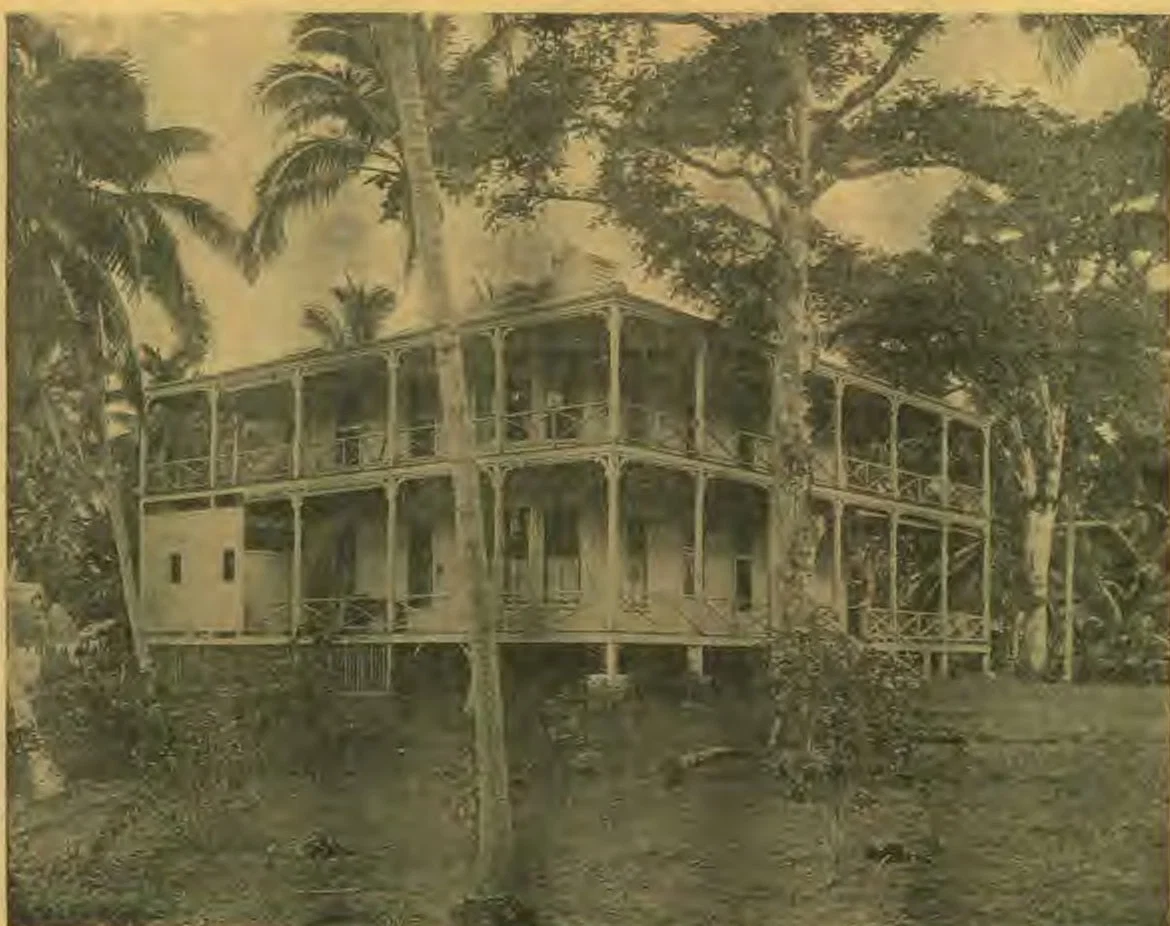
A MEDICAL MISSIONARY SANITARIUM.
While this is especially true in lines of scientific discovery and application, it is hardly less so in the direction of religious thought and methods. Old faiths are being tested to their foundations, and old methods set aside; new thoughts pervade and new methods enter into every line of Christian activity.
In religious work the new methods that prove successful are really the old methods that Christ used. Christ was the perfect missionary, combining in Himself both the healer and the teacher, and He taught the sacredness and value of the human body. These methods, which fell into disuse in the apostasy of the church, are, in these latter days, taken cognizance of anew.
Prominent among these revivals of the old ways is the recognition of late of work for the body as a factor in missions. It has been asserted that medical missionary work is to the Gospel message what the right arm is to the body. If this be so, we have had, ever since the passing away of the apostolic church, the lamentable spectacle of a church grappling left-handed with the problem of a world’s evangelization, with its strong right hand bound helplessly to its side by prejudice. Might not this of itself account for the failure of the church of Christ to keep in vitalizing touch with the world lying in darkness and misery, as compared with the success of the primitive church in proclaiming a risen Christ to “all the world?”
In order better to appreciate the progress of the last twenty-five years in this branch of the work, let us note a few points in the early history of medical missions, no farther back than the present century. Dr. John Scudder, the first medical missionary from America, went to India in 1819 and labored till 1835. The next fifty years furnish a few notable examples, like Dr. Peter Parker, who went to China in 1834, and instituted a work which has been all these years like a mighty wedge, cleaving the rock of Chinese superstition and prejudice. The first effort at organized coöperation in medical missionary lines was the organization of the Canton Medical Missionary Society, in 1838, including both English and American medical missionaries, an organization which has reached its sixtieth year of steadily-increasing usefulness.
The Edinburg Society for the training of medical missionaries was instituted through Dr. Parker’s efforts, and has exerted its influence since 1841. Slowly, very slowly, to the shame of the church be it said, the tide gathered strength, and the mid-century found only forty medical missionaries among all the millions of heathen misery. Of these forty, twenty-six were Americans. These physicians received no mention as such in general mission reports,—they were only “lay workers.” Even as late as ten years ago, one interested in medical missions might have searched the missionary periodicals of the day almost in vain for information, so few and incomplete were the references as to the medical missionary work done under the auspices of the respective boards.
In large edifices there is always a long preparation of foundation-laying before the superstructure appears. After three-quarters of a century of pioneer work, out of sight, the last quarter shows how grandly the foundation was laid by the rapidity with which medical missions are taking a front rank in the work of the kingdom. The London Medical Missionary Association took definite form about 1878, with Medical Missions at Home and Abroad as its exponent to the public. A movement was made in 1876 to establish scholarships in New York for those preparing for medical missionary work, followed in 1881 by the organization of the International Medical Missionary Society in New York City, with Dr. G. D. Dowkontt as director; its organ, the Medical Missionary Record, to which in more recent years is prefixed the name of the Double Cross. In 1855 was organized, in Chicago, the American Medical Missionary Society, with the Medical Missionary Journal as its organ. In 1893 was organized, in Battle Creek, Michigan, what is now known as the International Medical Missionary and Benevolent Association, the organ of which is the Medical Missionary.
All these associations have the three objects of training men and women for their work, in both medical and missionary lines, of establishing medical missions, home and foreign, and of disseminating information concerning the progress of medical missions. With each of them are connected a chain of dispensaries, and systematic visitation of the sick poor; and growing out of these there are other Christlike instrumentalities for the help of those whom misfortune or vice have thrust down to the level of what are known as the “depressed classes,” such as day nurseries, work for mothers, homes for the friendless and fallen of both sexes, rescue missions, shelters, industrial training for the young, etc. Not that many of these means of help to the unfortunate did not exist before, or do not exist independently now, but in the steadily-increasing light upon the relation between the physical nature and the spiritual development, the medical-missionary idea has grown to embrace all that can help in the development of the entire being.
The five or six societies which have been mentioned are by no means the limit of organized medical missionary work, but they are the parent stock,23from the ramifications of which many others have sprung up in foreign lands, or in the cities of the home land, and they have been, directly or indirectly, an inspiration to independent work in many instances.
The youngest of the organizations mentioned has had an almost phenomenal growth. Organized in 1893, it has at present associated with it 16 sanitariums in this and other lands, 8 foreign medical missions, 8 training-schools, a medical college, just entering its fourth year with over 100 students, 65 missionary physicians, of whom 15 are already in the foreign field, and others connected with home missions, 85 nurses in the home field, and 49 in the foreign, besides several hundred under training. About 30 city missions have sprung up in the United States and elsewhere within the last two years as a direct result of its influence, in all of which medical or relief work, or both, are prominent features. One special feature of this organization is that it makes much not only of healing the sick, but of educating all men everywhere in the laws of life and health, using the healing art not so much to make sinners willing to listen to the Gospel message, as to clear minds darkened by physical infirmities so that they may comprehend the Gospel in its fulness.
As to the present status of medical missionary work, there are few large cities in the United States that have not some form of medical missions established; not simply free dispensaries, but places where ministrations to the sick are coupled with earnest efforts to cure also the sin-sick soul.
There are at present in the foreign field 487 missionary physicians, men and women, working under the auspices of different boards. About one hundred of these were students of the International Medical Missionary Society of New York. The increase for the last five years alone has been 122, nearly one-fourth of the whole number, besides nurses and hospital assistants, whose number we can not give even approximately. The above figures do not include the native converts who have prepared themselves for medical work in the mission colleges or in Western schools.
The American Board now has medical missionaries in almost all of its twenty missions. Of the missionaries of the Presbyterian Board, one in twelve is a physician, and the attitude of these two boards illustrates that of other societies toward this phase of the work. At present nearly every missionary society at work in China has established medical missions. Patients come a thousand miles in some instances, and carry away seeds of Gospel truth. Some of these missions are daily thronged with patients. Nearly every missionary periodical of to-day contains more or less information concerning the medical work carried on under the auspices of its board, and there are eight or ten monthly or quarterly journals devoted to this branch of mission work, where ten years ago there were but two or three.
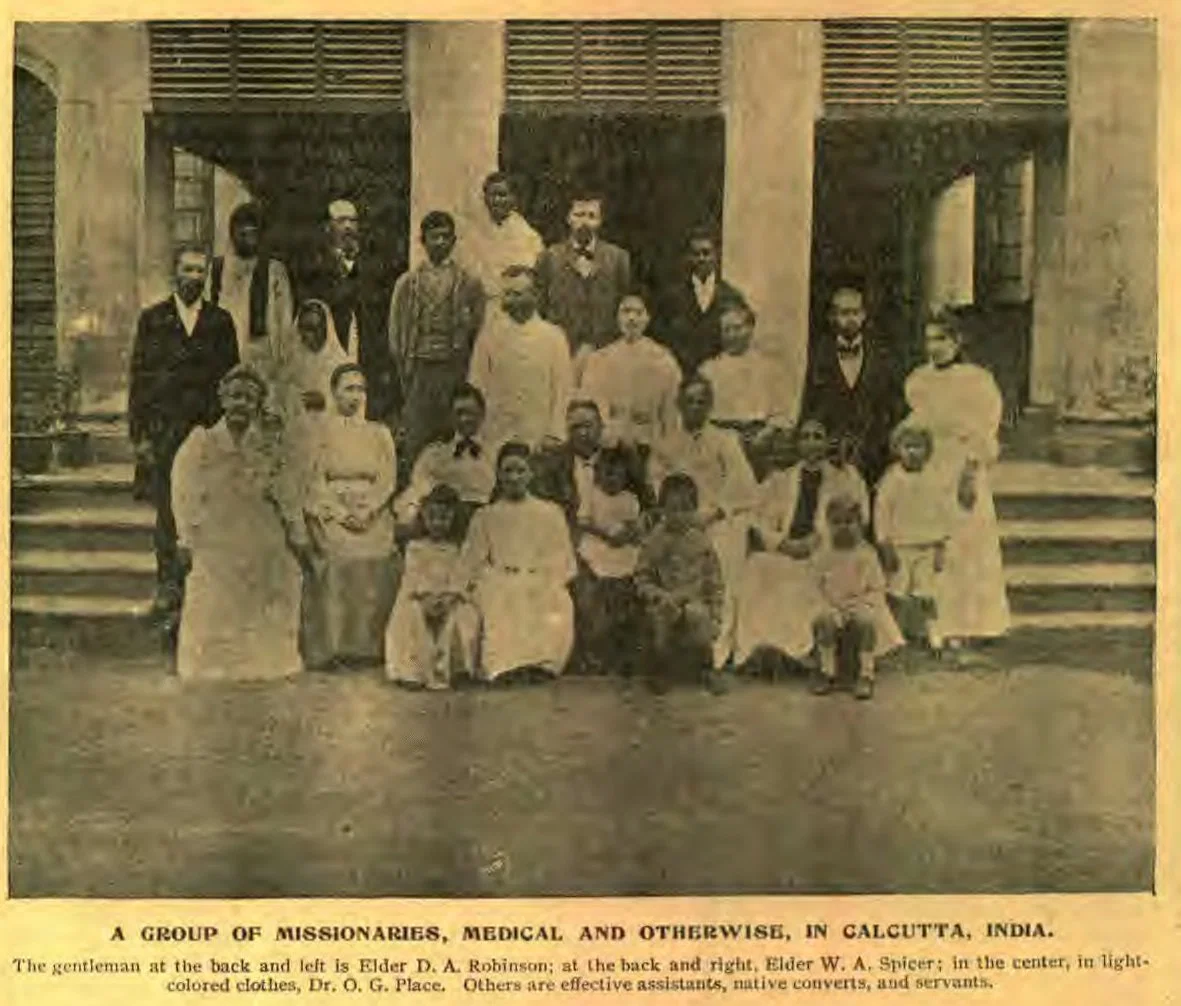
A GROUP OF MISSIONARIES, MEDICAL AND OTHERWISE, IN CALCUTTA, INDIA.
The gentleman at the back and left is Elder D. A. Robinson; at the back and right, Elder W. A. Spicer; in the center, in light-colored clothes, Dr. O. G. Place. Others are effective assistants, native converts, and servants.
Missions to lepers, in India and elsewhere, are necessarily classed with medical missions. They represent a courage on the part of the missionaries which places them in the front rank of heroism. In the leper asylums of China, India, Burma, Japan, and Ceylon there are over one thousand poor, dying creatures who have received the light of a new life.
Experiences of most thrilling interest in connection with some of the medical missions are of common occurrence. The statistics, too, are wonderful, to those who can read between the lines. Dr. J. G. Kerr, of Canton, China, completed a half century of medical service this year, most of it in the foreign field. His surgical cases, several years ago, reached 40,000; many of them would, in Western lands, be called “brilliant” operations. Men and women of thorough preparation and consecration, but otherwise of the ordinary people, have, because of medical successes, been chosen as court physicians and confidential advisers to the chief ruler in several Eastern countries, and the way for the Gospel has thus been opened in lands in which the evangelistic missionary had for years besieged almost in vain. China, Korea, Persia, Siam, and Afghanistan, are all illustrations of the power of medical missions to open a way to the hearts of the rulers.
All this is but a return to the “old paths,” the paths which the model Missionary trod. We do not ignore the noble work done by faithful evangelists and teachers, work which God has accepted and most signally blessed. Many events in the development of God’s work have their set time in history, and are only made manifest when “the fulness of the time” has come. It may be so with this fuller development of the Gospel,—the good news of salvation not only for the souls of men, but for their bodies also; their redemption not only from moral sin, but from physical sins which hamper men in their strife for better things, and defile God’s temple on earth, “which temple ye are.”
“Hark! the voice of Jesus calling,—
Who will go and work to-day?
Fields are white, the harvest waiting,
Who will bear the sheaves away?”