Your ShelfYour Projects

Signs of the Times, Vol. 25, No. 1.

SIGNS OF THE TIMES
Earlier text: PARALLEL BETWEEN PHYSICAL AND SPIRITUAL DISEASE

ADVANCEMENT IN ASTRONOMY

By Prof. Charles Burckhalter, F.R.A.S., Director of Chabot Observatory, Oakland, Cal.
THE progress of astronomy during the last twenty-five years is largely owing to two causes,—great advancement in the perfection and power of the instruments, to which many important discoveries are entirely due, and the new methods by which problems have been successfully and easily solved, but which were entirely impossible of solution by any of the methods employed a quarter of a century ago. Hard work along the beaten paths, with superior instruments, and ingenious methods by which old problems have been attacked from new standpoints, divide the honors in perfect harmony.
It may be said with much truth that we now have two astronomies, the Old Astronomy, or the Astronomy of Position, as it has been called, and the New Astronomy. In the first the great question was, "Where is it?" that is, In just what part of the sky was the given object at a given instant? And by the aid of these positions—more or less imperfect—astronomers have been able to make their wonderful predictions and achieve results almost beyond belief; while the leading question in the New Astronomy seems to be, "What is it?" or, Of what is it made? What is its physical condition? And a world of questions and problems are awaiting their turn to be investigated by the most ingenious methods and instruments.

Superior Instruments.

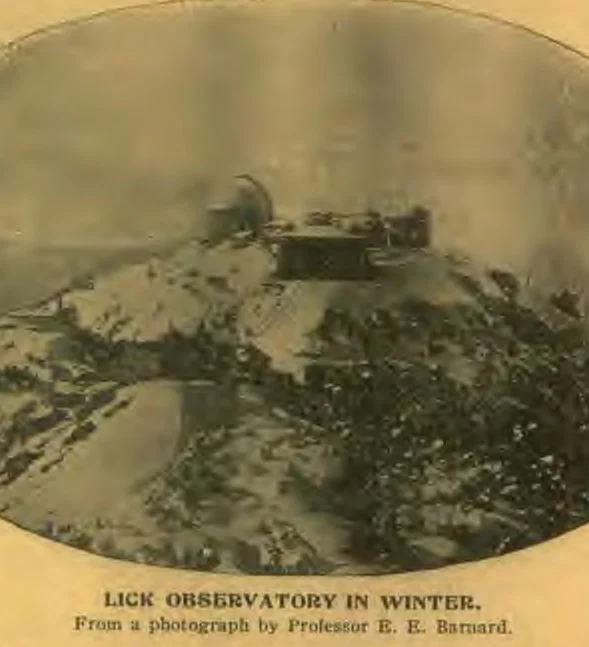
The progress in telescopes has been extremely gratifying. In 1862 the 18-inch lens for the Dearborn refractor was considered a triumph of optic art; but, in 1870, a 25-inch telescope was erected in England, and this has been exceeded since by no less than seven great telescopes in Europe from 26 to 32 inches, and five in America from 26½ to 40 inches, the 36-inch refractor of the Lick Observatory and the 40-inch of the Yerkes Observatory being the largest in the world. The great Lick telescope was put to work in 1888, and the Yerkes during the past year. The latter, in the opinion of competent astronomers, has nearly reached the limit of usefulness and fair returns for the vast cost; but the present state of our knowledge of optics and mechanics will readily respond to the persuasive influence of a heavy purse. In reflectors the 5-foot mirror of Mr. Common is, at present, at the head; but even larger ones have frequently reached the paper stage, and it would not seem unreasonable to hear of some of them becoming realities.
I present the following list of the thirteen largest refractors, including the photographic corrector of the Lick Observatory:—
Aperture. Focal length. Observatories. Maker. Date of erection.
40.0 in. 62.9 ft. Yerkes, Wisconsin. Alvan Clark (1) 1897
36.0 " 57.8 " Lick, California. Alvan Clark (1) 1888
33.0 " 49.2 " Lick, California. Alvan Clark (1)
32.5 " 53.0 " National, Meudon. Henry Bros. (2) 1891
31.1 " 39.4 " Astrophysical, Potsdam
30.3 " 52.6 " Bischoffsheim, Nice. Henry Bros. (2) 1889
30.0 " 42.0 " Imperial, Poulkova. Alvan Clark (3) 1882
28.0 " National, Paris. Martin
28.9 " 28.0 " Royal, Greenwich. Sir H. Grubb (4) 1894
27.0 " 34.0 " Imperial, Vienna. Sir H. Grubb 1878
26.0 " 26.0 " Royal, Greenwich. Sir H. Grubb 1897
26.0 " 32.5 " Naval, Washington, D.C. Alvan Clark (1) 1871
26.0 " 32.5 " Leander M'Cormick, Va Alvan Clark 1874

Methods.

It is hardly possible to touch upon the subject of methods in this brief article; but the velocity of light and the constant of aberration methods have given, perhaps, the most satisfactorily the distance from the earth to the sun. This great fundamental value (for the sun's distance is the "yardstick of the astronomer") has been in an extremely unsatisfactory state, on account of the great error that was known to exist; for, as the accepted distance was too small or too great, so was the distance of all bodies in space (where the distance has been measured) too small or too great, the sun's distance from the earth being the measuring-rod. The accepted, or, better, the assumed value, has been anywhere from ninety to ninety-five millions of miles, within the past twenty-five years, while the present value of 92,975,500 miles is probably correct within 50,000 miles, or thirty times nearer the truth than the value of 1874. The velocity of light is 186,330 miles per second, with a probable error of less than twenty-five miles.

Photography and Spectroscopy.

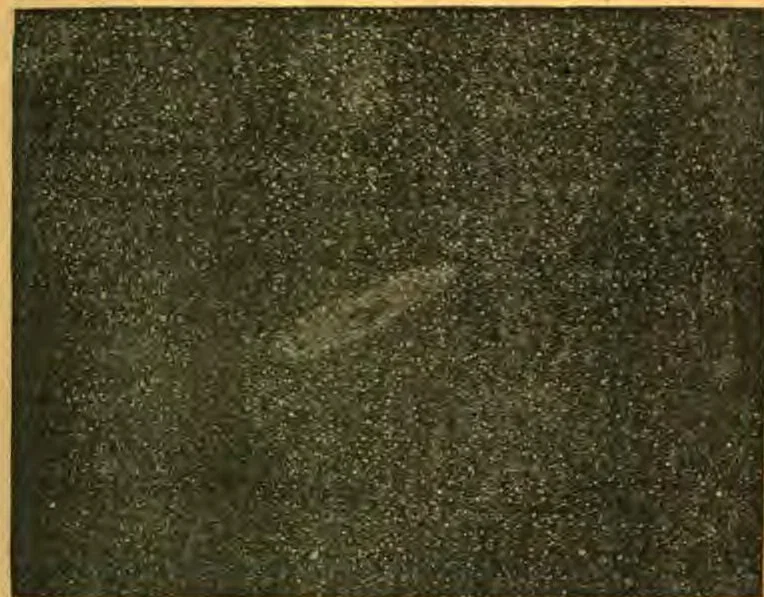
In certain lines of research, however, the greatest advance has been made by the aid of photography; and this new, powerful, and wonderfully versatile agent has completely revolutionized many older methods; as, for illustration, a photographic plate made in two hours, showed 2,200 stars in the Pleiades group, against the work of an astronomer occupying about six years to correctly measure and chart six hundred (all he could see) in the same cluster. Photography in from two to four hours, with a 6-inch lens, revealed stars that are beyond the reach visually of the giant refractor on Mount Hamilton.
This marvelous result has a double explanation. First, the eye will see at once all it is capable of seeing, and persistent effort only tires it and lessens its sensitiveness to light, while the photographic plate is tireless, and receives the light and allows it to pile up, or accumulate, so that an amount of light that is not effective at once may be in minutes or hours, as the case may be, and the image of the star is seen upon the plate. Increased exposure never fails to add fainter and still fainter stars, until the whole heavens are ablaze with these distant suns. The other reason is that some stars are rich in actinic (photographic) rays, but weak in visual rays, or the rays that affect the eye, and vice versa. Thus Aldebaran while a brilliant red star rating as a first magnitude, is, photographically, only a sixth-magnitude star, showing no brighter on a photographic plate than a white or blue star that is barely visible to the sharpest unaided eye. Altho photographic methods have been known and practised for fifty years, ninety-nine per cent. of the results have been obtained within the last eighteen years, or since the dry plate has come into use.
Photography has also been applied to spectroscopic methods with extremely satisfactory results. A few minutes is sufficient to photograph the spectrum of a star, the time required depending upon the brightness of the star selected; and the resulting lines can then be studied at leisure; and not only can the spectrum be compared directly with known terrestrial substances, by which many of the substances composing the star become known beyond a doubt, but the abnormal positions of the lines give unquestioned evidence whether the star is approaching or receding from our system. In the case of stars whose motion in the "line of sight" (that is, toward or from us) amounts, say, to fifty miles per second, the rate of speed is determined with an exactness admitting an error of not more than one or two per cent.

Discoveries.

About ten years ago a very close double star was observed, showing that the two bodies were revolving around each other in the remarkably short period of about eleven years, the shortest period then known, but by the combined efforts of spectroscopy and photography, double stars have been found so close together that no telescope ever made could show their duplicity, and whose periods are to be counted in days and hours instead of years, one having a period of less than a hundred hours. To properly appreciate this astounding result, it is only necessary to say that no astronomer would admit that our present telescopic power can ever be doubled (on account of the disturbances ceaselessly going on in our atmosphere), yet this result could not be obtained visually with a telescope hundreds, and, perhaps, thousands of times more powerful than any now existing.
The family of asteroids, those wee little worlds that have their place in the solar system between Mars and Jupiter, have been discovered by dozens and scores. While the first was not discovered until the first day of this century, and 135 had been added to the known bodies of the system by 1874, at present over 400 are known, and the 500 mark may be reached by the end of the century; and it should be remembered that their detection is constantly increasing in difficulty, for the reason that the larger and consequently brighter ones were discovered first.
More important, however, than many asteroids, was the discovery by Hall, of Washington, in 1877, of the two satellites of Mars; and "moonless Mars" is an obsolete expression. The estimated diameters are only five and seven miles—the smallest bodies, probably, known in the solar system; and in September, 1892, a still more brilliant discovery made by Barnard, of the Lick Observatory, added a fifth moon to Jupiter. When it is considered that the four well-known satellites of Jupiter were the first bodies discovered by Galileo with the first telescope, and that all telescopes have since that time, now nearly three hundred years ago, been turned upon the giant planet, this splendid discovery is all the more creditable.
Charles Burckhalter
*Since this article was handed in to the SIGNS, an asteroid has been discovered whose orbit is between that of the Earth and Mars, which is entirely unique. Very little is known concerning it as yet, but it is of unusual interest to astronomers.

SABBATH REFORM—TRUE AND FALSE.

BY ELDER G. E. FIFIELD. [Author of "God Is Love."]
IN order that we may understand the difference between true and false Sabbath reform, we must first see clearly what the true Sabbath is, to whom it belongs, and what is its real significance. In the most ancient record given to man (Gen. 2:2–4) it is plainly revealed that the true Sabbath is the seventh day of the week, on which the Son of God rested after creating the heavens and the earth. It is plainly stated that He blessed it, and sanctified [[FIGURE]] it, or set it apart from the other days for a sacred and holy use. That this Being who here created, and then rested upon and blessed, the Sabbath, or rest-day, was the Son of God, is clearly shown by such scriptures as Heb. 1:1–3; Col. 1:12–19, and John 1:1–11.
To the authority of the record in Genesis is added the words of the Son of God when He spoke the law from Sinai, and the example of His whole life while incarnate on this earth. All these unite to prove that the seventh day of the week is the only true and hallowed Sabbath.
This Sabbath, while belonging to all men before sin entered the world, after the fall pertained especially to the Israel of God. "Speak thou also unto the children of Israel, saying, Verily My Sabbaths ye shall keep; for it is a sign between Me and you throughout your generations; that ye may know that I am the Lord that doth sanctify you." "Wherefore the children of Israel shall keep the Sabbath, to observe the Sabbath throughout their generations, for a perpetual covenant. It is a sign between Me and the children of Israel forever." Ex. 31:13, 16, 17.
Who this Israel here spoken of is, Paul plainly tells us. He declares that it is not Israel after the flesh, or the Jewish nation merely, but the children of faith, who, like Jacob, prevail with God. These are the true Israel, the spiritual seed of Abraham, the father of the faithful. He asserts that the Gentiles by faith are grafted into this Israelitish tree, and that therefore all who are Christ's are Israelites, or the seed of Abraham. He positively declares that to this spiritual Israel belong not only the Sabbath but the whole law, and the glory, and the covenants, and all the promises of God. See Rom. 9:4–8, 11; Gal. 3:29; Gen. 32:24–28.
Now we have found thus far that the true Sabbath is God's blessed and sanctified seventh day, and that it belongs to the spiritual Israel in all ages. Next, we must inquire what is the real meaning, or significance, of this institution.
The scripture already quoted plainly states that it is the sign between God and His people of His perpetual or everlasting covenant with them. What that covenant is is plainly told us in the book of Hebrews: "Now the God of peace, . . . through the blood of the everlasting covenant, make you perfect in every good work to do His will, working in you that which is well-pleasing in His sight, through Jesus Christ." This covenant is personal and individual, and God holds it out lovingly and longingly to every soul, waiting but that soul's submission to Him to seal this contract with him on His divine word and oath. It is the covenant by which He raised David from the sheepcote to be conqueror of Goliath, musician, poet, king, and type of the King of kings. And God says: "Ho, every one that thirsteth, come ye to the waters, and he that hath no money; come ye. . . . Incline your ear, and come unto Me; hear, and your soul shall live; and I will make an everlasting covenant with you, even the sure mercies of David." Isa. 55:1–3.
Whenever a soul will cease from its own labors, and rest itself——quietly, trustingly, in God's hands, agreeing to give Him the glory for all that is accomplished, God seals His covenant with that soul to work out His ideals in that life, or, in other words, to make that soul perfect "to do His will," working in him "that which is well-pleasing in His sight." When God seals that covenant with a soul, that person is no longer a Gentile sinner, but an Israelite indeed, and of the house-hold of God." Eph. 2:19, 20.
Now the Sabbath is God's sign of this everlasting, or perpetual covenant. On God's part it is the sign of His creative power, which alone can transform the trusting, tho sinful, soul into His divine ideals of purity and righteousness. See Ex. 20:8–11; 31:17. On the man's part, it is a sign of his resting from His own labors and fruitless strugglings to make himself better, and submitting his soul to God, as clay in the hands of a potter, that God may work out His will in him." Heb. 4:10.
Every man who keeps the Sabbath conscientiously, as he understands it, does so to acknowledge God's authority over him, and submits the soul to Him. [[FIGURE]] Thus the Sabbath is a sign, on both sides, of this covenant, or agreement. As the Lord says, "It is a sign between Me and you, . . . that ye may know that I am the Lord that doth sanctify you."
The only thing that prevents God from sealing this covenant with every soul, and working out His ideals in every life, is that men will against God, instead of submitting their wills to Him. God has made men of free will, that character might be possible, and when men will not yield to Him, He can not against their will make them righteous, or sanctify them.
But God sees the oak in the acorn, and when men submit to Him and allow Him to have His way in the life, from that time He sees in them the perfect righteousness which He is working out in them by every after experience of their lives.
From all this we can clearly see that all true Sabbath reform must ever be brought about by preaching to men the everlasting covenant, which alone can bring to their souls Christ-righteousness. Whenever a man by his own free will ceases from his own futile efforts to realize his own poor ideals, and, submitting himself to God, learns to pray, "Thy will, not mine, be done in my life," taking hold of God's everlasting covenant, and of God's Sabbath, which is the sign of that covenant, there is one true Sabbath reform. From that on, if that man continues to submit to God, he is an Israelite and a Sabbath-keeper, and God pledges His infallible Word, and even His infinite life, to work out His divine ideals in that soul.
It can now also be readily seen that true Sabbath-keeping can never be forced upon any person by any human power; for true Sabbath-keeping is not the slavish submission of the body to human ordinances through fear of fines and penalties, but it is the free submission of the sovereign will and of the repentant soul to God's own precepts, thus permitting God to work His will in the life. Wherever, then, these principles are taught and adhered to, there, and there only, is true Sabbath reform. And, thank God, He has a people who are preaching the Gospel of the everlasting covenant to earth's remotest bounds. All over the world men and women, in spite of scorn and persecution, are laying hold of that covenant and of the righteousness which it only can bring. They accept the sign of that covenant, which is God's blessed and hallowed seventh day, and, while absolutely refusing to submit the conscience to the dictates of any earthly prince or potentate, they rejoice in an obedience to the divine precept which is but a submission of the heart's love to that Infinite Love which has won it, from wandering in a far country, back to the Father's house.
But, tried by this same divine standard, how utterly false and fraudulent is the popular, so-called sabbath reform of the day! In the first place, the sabbath (?) they seek to compel men to keep, is a false sabbath, and therefore no sabbath at all. It is not God's blessed and sanctified seventh day, the sign of His creative power, and of the soul's submission to Him; but it is the first day of the week, the pagan sun festival, which came into the church only when, as the historian Gavazzi says, "a pagan flood, flowing into the church, carried with it its customs, practises, and idols." This institution has no scriptural authority, and never was observed by Christ, the apostles, or the early Christians. It was brought in by what Paul calls the "mystery of iniquity," and it stands in all ages as a sign of apostasy. It marks the departure of the church from the worship of the true God, the Creator, to the worship of the sun, and is the sun's day, or, as the North British Review so aptly calls it, "the wild solar holiday of all pagan times."
The meaning of this institution is plainly stated by those who have brought it into the church:—
Question—How prove you that the church hath power to command feasts and holy days?
Answer—By the very act of changing the Sabbath into Sunday, which Protestants allow of; and therefore they fondly contradict themselves by keeping Sunday strictly, and breaking most other feasts commanded by the same church.—Abridgment of Christian Doctrine (Roman Catholic).
Q.—Have you any other way of proving that the church has power to institute festivals of precept?
A.—Had she not such power, she could not have done that in which all modern religionists agree with her,—she could not have substituted the observance of Sunday, the first day of the week, for the observance of Saturday, the seventh day, a change for which there is no scriptural authority."—Doctrinal Catechism (Roman Catholic).
This language is unmistakable. It plainly sets forth the Sunday sabbath as it really is, not as a sign of the power and authority of God over the human heart, but as a sign of the blasphemous assumption by a human authority of the power to command the human conscience—the conscience, that sole last sovereignty in man, supreme above every human power, owing allegiance to God alone. Whenever God commands the consciences of men, He does it as a father, to set men free, and bring them to the control of the inner principle of love alone. Whenever man blasphemously seeks to climb into the throne of God and assume the right to command the consciences of mankind, it is always done by force to enslave men, and bind them in the chains of superstition and priestcraft.
This Sunday sabbath, true to its origin and meaning, seeks to gain obedience, not so much by teaching and preaching as by force. It is not the intellect and heart that are appealed to, so much as the so-called civil power. In every civilized land professed Christian people are denying the very principles of Christianity, by petitioning for laws to compel men to observe this day. This is a direct tho unwitting confession of the absolute fraud and falsehood of the institution, and of all such so-called Sabbath reform. For the institution is thus boldly put before the world, not as a Christian institution, not as belonging to the true Israel, not as the sign of the soul's free-will submission to God, but as the sign of the slavish outward submission of all men, good and bad, to a human authority which assumes the power to command them. So far from this being any part of the new or everlasting covenant through which the soul secures righteousness by submission to God and trusting in Him, it is a gigantic old-covenant scheme. By it men seek to do collectively what they have found impossible individually. They seek to compel themselves and others to be righteous, but it is only to be righteous after their own ideals. But neither collectively nor individually can man lift himself heavenward by the boot-straps of his own aspirations or imaginings; and God's plain words to all such are, "Their webs shall not become garments, neither shall they cover themselves with their works; their works are works of iniquity, and the act of violence is in their hands."
Finally, all Sabbath reform which seeks to introduce a false, man-made Sabbath is false reform; or, rather, it is deform. All Sabbath reform which seeks to appeal to force or any other motive save that of the soul's loving submission to God, while it rests from its own labors,—all such reform, even tho it should seek to compel men to keep the true Sabbath, would still be false and fraudulent.
The Sabbath is for Israel, that is, for those who freely submit themselves to God and take hold of this everlasting covenant by faith. May God grant, dear reader, that we all be of that Israel.
From a photograph by Prof. E. E. Barnard, of the Great Nebulae in Andromeda, taken at Lick Observatory. Time of exposure, 4 hours 18 minutes. During the time of these exposures the eye of the photographer is fixed upon some star, inserted by cross wires in the eye-piece of the telescope. In this small section of the sky but one star, we believe, is visible to the naked eye, but Professor Barnard estimates 64,000 visible to the camera.
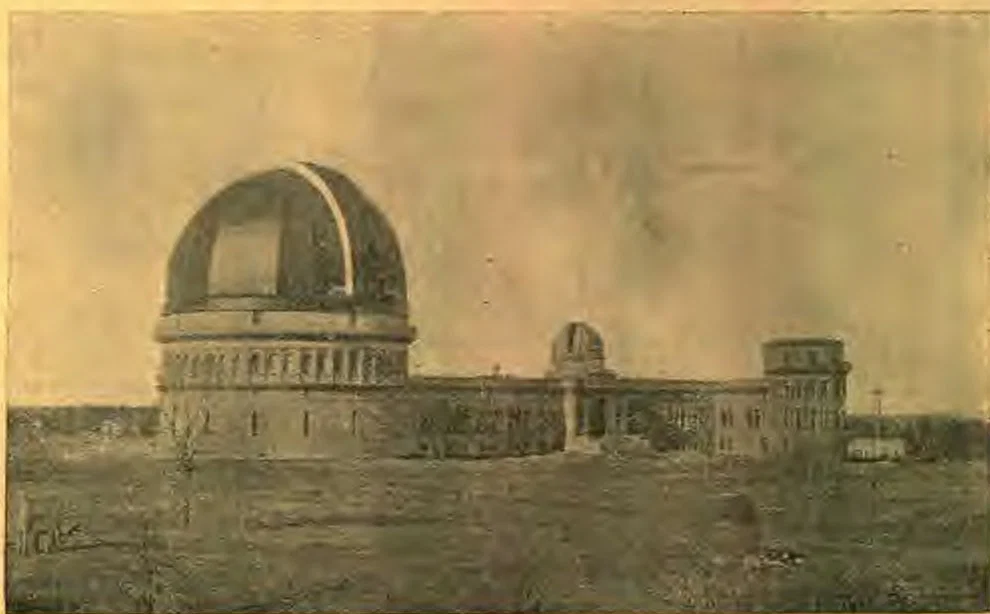
YEBREH OBSERVATORY.
From a photograph by Prof. E. E. Barnard. Reproduced from Popular Astronomy.
YEBREH OBSERVATORY. From a photograph by Prof. E. E. Barnard. Reproduced from Popular Astronomy.
Continue reading: The Changing Face of Wealth