[Editor of the Medical Missionary, Battle Creek, Mich.]
THE world seems rushing on in these closing years of the century with rapidly-accelerating pace. Forces which have been slowly gathering strength through preceding years seem suddenly to have reached a climax of power, and the resultant changes thrust themselves upon our attention with almost bewildering rapidity. As Daniel saw in prophetic vision, men are "running to and fro," and knowledge is marvelously "increased."
While this is especially true in lines of scientific discovery and application, it is hardly less so in the direction of religious thought and methods. Old faiths are being tested to their foundations, and old methods set aside; new thoughts pervade and new methods enter into every line of Christian activity.
A MEDICAL MISSIONARY SANITARIUM.
In religious work the new methods that prove successful are really the old methods that Christ used. Christ was the perfect missionary, combining in Himself both the healer and the teacher, and He taught the sacredness and value of the human body. These methods, which fell into disuse in the apostasy of the church, are, in these latter days, taken cognizance of anew.
Prominent among these revivals of the old ways is the recognition of late of work for the body as a factor in missions. It has been asserted that medical missionary work is to the Gospel message what the right arm is to the body. If this be so, we have had, ever since the passing away of the apostolic church, the lamentable spectacle of a church grappling left-handed with the problem of a world's evangelization, with its strong right hand bound helplessly to its side by prejudice. Might not this of itself account for the failure of the church of Christ to keep in vitalizing touch with the world lying in darkness and misery, as compared with the success of the primitive church in proclaiming a risen Christ to "all the world"?
In order better to appreciate the progress of the last twenty-five years in this branch of the work, let us note a few points in the early history of medical missions, no farther back than the present century. Dr. John Scudder, the first medical missionary from America, went to India in 1819 and labored till 1855. The next fifty years furnish a few notable examples, like Dr. Peter Parker, who went to China in 1834, and instituted a work which has been all these years like a mighty wedge, cleaving the rock of Chinese superstition and prejudice. The first effort at organized coöperation in medical missionary lines was the organization of the Canton Medical Missionary Society, in 1838, including both English and American medical missionaries, an organization which has reached its sixtieth year of steadily-increasing usefulness.
The Edinburg Society for the training of medical missionaries was instituted through Dr. Parker's efforts, and has exerted its influence since 1841. Slowly, very slowly, to the shame of the church be it said, the tide gathered strength, and the mid-century found only forty medical missionaries among all the millions of heathen misery. Of these forty, twenty-six were Americans. These physicians received no mention as such in general mission reports,—they were only "lay workers." Even as late as ten years ago, one interested in medical missions might have searched the missionary periodicals of the day almost in vain for information, so few and incomplete were the references as to the medical missionary work done under the auspices of the respective boards.
In large edifices there is always a long preparation of foundation-laying before the superstructure appears. After three-quarters of a century of pioneer work, out of sight, the last quarter shows how grandly the foundation was laid by the rapidity with which medical missions are taking a front rank in the work of the kingdom. The London Medical Missionary Association took definite form about 1878, with Medical Missions at Home and Abroad as its exponent to the public. A movement was made in 1876 to establish scholarships in New York for those preparing for medical missionary work, followed in 1881 by the organization of the International Medical Missionary Society in New York City, with Dr. G. D. Dowkontt as director; its organ, the Medical Missionary Record,25to which in more recent years is prefixed the name of the Double Cross. In 1855 was organized, in Chicago, the American Medical Missionary Society, with the Medical Missionary Journal as its organ. In 1893 was organized, in Battle Creek, Michigan, what is now known as the International Medical Missionary and Benevolent Association, the organ of which is the Medical Missionary.
All these associations have the three objects of training men and women for their work, in both medical and missionary lines, of establishing medical missions, home and foreign, and of disseminating information concerning the progress of medical missions. With each of them are connected a chain of dispensaries, and systematic visitation of the sick poor; and growing out of these there are other Christlike instrumentalities for the help of those whom misfortune or vice have thrust down to the level of what are known as the "depressed classes," such as day nurseries, work for mothers, homes for the friendless and fallen of both sexes, rescue missions, shelters, industrial training for the young, etc. Not that many of these means of help to the unfortunate did not exist before, or do not exist independently now, but in the steadily-increasing light upon the relation between the physical nature and the spiritual development, the medical-missionary idea has grown to embrace all that can help in the development of the entire being.
The five or six societies which have been mentioned are by no means the limit of organized medical missionary work, but they are the parent stock, from the ramifications of which many others have sprung up in foreign lands, or in the cities of the home land, and they have been, directly or indirectly, an inspiration to independent work in many instances.
The youngest of the organizations mentioned has had an almost phenomenal growth. Organized in 1893, it has at present associated with it 16 sanitariums in this and other lands, 8 foreign medical missions, 8 training-schools, a medical college, just entering its fourth year with over 100 students, 65 missionary physicians, of whom 15 are already in the foreign field, and others connected with home missions, 85 nurses in the home field, and 49 in the foreign, besides several hundred under training. About 30 city missions have sprung up in the United States and elsewhere within the last two years as a direct result of its influence, in all of which medical or relief work, or both, are prominent features. One special feature of this organization is that it makes much not only of healing the sick, but of educating all men everywhere in the laws of life and health, using the healing art not so much to make sinners willing to listen to the Gospel message, as to clear minds darkened by physical infirmities so that they may comprehend the Gospel in its fulness.
As to the present status of medical missionary work, there are few large cities in the United States that have not some form of medical missions established; not simply free dispensaries, but places where ministrations to the sick are coupled with earnest efforts to cure also the sin-sick soul.
There are at present in the foreign field 487 missionary physicians, men and women, working under the auspices of different boards. About one hundred of these were students of the International Medical Missionary Society of New York. The increase for the last five years alone has been 122, nearly one-fourth of the whole number, besides nurses and hospital assistants, whose number we can not give even approximately. The above figures do not include the native converts who have prepared themselves for medical work in the mission colleges or in Western schools.
The American Board now has medical missionaries in almost all of its twenty missions. Of the missionaries of the Presbyterian Board, one in twelve is a physician, and the attitude of these two boards illustrates that of other societies toward this phase of the work. At present nearly every missionary society at work in China has established medical missions. Patients come a thousand miles in some instances, and carry away seeds of Gospel truth. Some of these missions are daily thronged with patients. Nearly every missionary periodical of to-day contains more or less information concerning the medical work carried on under the auspices of its board, and there are eight or ten monthly or quarterly journals devoted to this branch of mission work, where ten years ago there were but two or three.
Missions to lepers, in India and elsewhere, are necessarily classed with medical missions. They represent a courage on the part of the missionaries which places them in the front rank of heroism. In the leper asylums of China, India, Burma, Japan, and Ceylon there are over one thousand poor, dying creatures who have received the light of a new life.
Experiences of most thrilling interest in connection with some of the medical missions are of common occurrence. The statistics, too, are wonderful, to those who can read between the lines. Dr. J. G. Kerr, of Canton, China, completed a half century of medical service this year, most of it in the foreign field. His surgical cases, several years ago, reached 40,000; many of them would, in Western lands, be called "brilliant" operations. Men and women of thorough preparation and consecration, but otherwise of the ordinary people, have, because of medical successes, been chosen as court physicians and confidential advisers to the chief ruler in several Eastern countries, and the way for the Gospel has thus been opened in lands in which the evangelistic missionary had for years besieged almost in vain. China, Korea, Persia, Siam, and Afghanistan, are all illustrations of the power of medical missions to open a way to the hearts of the rulers.
All this is but a return to the "old paths," the paths which the model Missionary trod. We do not ignore the noble work done by faithful evangelists and teachers, work which God has accepted and most signally blessed. Many events in the development of God's work have their set time in history, and are only made manifest when "the fulness of the time" has come. It may be so with this fuller development of the Gospel,—the good news of salvation not only for the souls of men, but for their bodies also; their redemption not only from moral sin, but from physical sins which hamper men in their strife for better things, and defile God's temple on earth, "which temple ye are."
"Hark! the voice of Jesus calling,—
Who will go and work to-day?
Fields are white, the harvest waiting,
Who will bear the sheaves away?"
MEDICAL PROGRESS WITHIN THE LAST TWENTY-FIVE YEARS.
By John Harvey Kellogg
BY J. H. KELLOGG, M.D.
[Superintendent Medical and Surgical Sanitarium, Battle Creek, Mich.]
TWENTY-FIVE years ago it was customary to speak of the art of medicine; to-day medicine is called a science. The science of medicine is almost wholly the product of the researches and investigations of the last twenty-five years. The discoveries which have been made through the means of the chemical, bacteriological, and physiological laboratories, in which hundreds of devoted men have patiently labored during the last twenty-five years, have accomplished more for human welfare in matters connected with the medical profession, than all the labors and all the discoveries of five hundred years previous. In this brief article it is impossible to even enumerate all the various
important discoveries which have been made within the last quarter of a century, neither would such a technical enumeration be of special profit.
Perhaps we should mention, as most important of all the recent discoveries in medical science, those which relate to the causation of disease. Twenty-five years ago an epidemic of typhoid fever, of cholera, of yellow fever, of the plague, was looked upon by the majority, at least, as a sort of visitation of providence. It is nearly a score of years since Dr. Parkes, the eminent English sanitarian, made the startling assertion, "When a man dies of typhoid fever, somebody ought to be hanged." Modern science has clearly pointed out the fact that catching diseases, infectious maladies, and epidemic disorders, are all, without exception, due to the invasion of the body by germs, organisms so minute as to be invisible to the naked eye, but capable of the direst mischief when brought in contact with the body under circumstances favorable for the development of the disorders which accompany their growth. The number of these germs which has been discovered is already legion, and bacteriologists tell us that we are only just upon the border-land of this great new branch of botany. Multitudes of new microbes are discovered yearly, and there is plenty of new territory to explore and new worlds to discover in this branch of investigation.
Incomplete as the research has been, however, we already find ourselves confronted with facts of the most startling character respecting the relation of these minute organisms to all the conditions of our daily life. For example, we have found that the motes which dance in the sunbeams, as the poets tell us, are in large part living germs, which, when received into the body, are capable of almost endless mischief. A German bacteriologist found more than a dozen different kinds of germs present in the examination of the contents of a basket of fruit left by his grocer upon his doorstep. The dust of the street is no longer to be regarded as an inconvenience, but as a great reservoir of malignant microbes, ready to lay us low when a favorable opportunity offers.
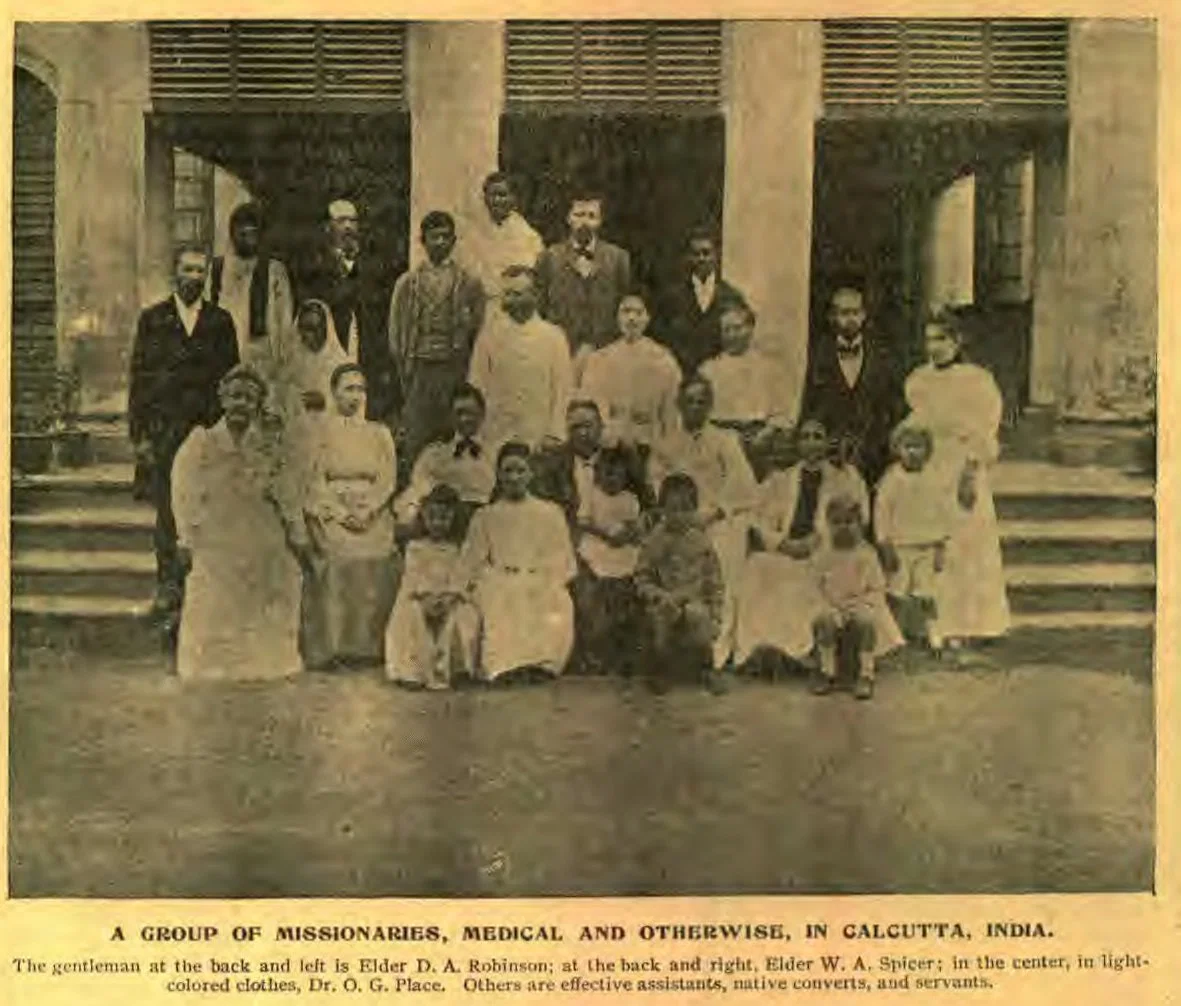
IN CALCUTTA, INDIA.
Elder W. A. Spicer; in the center, in light-colored clothing, native converts, and servants.
Pulmonary consumption, one of the most deadly, and in civilized countries one of the most common, of all human maladies, is propagated almost wholly through the inhalation of the dried sputum of persons suffering from the disease, which contains the living organisms characteristic of this malady. Fully one-fourth to one-seventh26of all the people that die in this country fall victims to this one disease, which twenty-five years ago was supposed to be hereditary and unavoidable, but is now known to be a catching malady, like measles, whooping-cough, and similar disorders.
Why all persons do not suffer from tuberculosis, typhoid fever, or other germ diseases, is a mystery hard to explain. Recent science, however, has come forward with a demonstration that germs are not the direct cause of disease, after all, but that the real cause is a weakened body, deteriorated tissues, which furnish favorable soil for the planting and growth of these malignant vegetable organisms. But while this discovery has brought forward in bold relief the fact that germs are, after all, not the cause of disease, it is clear that they are rather characteristic factors in it. The real causes of disease are to be found in those habits of life which lessen the vital resistance and deteriorate the bodily functions. For
example, the stomach is capable of destroying any germ which may find its way into it. It destroys cholera germs very quickly, also the germs of typhoid fever. Hence, man can not contract either cholera or typhoid fever so long as he has a perfectly sound stomach. If he happens to swallow the germs of these diseases, he simply digests them as he digests potatoes, cereals, and other vegetables which he may swallow. But the man whose digestive vigor is impaired is constantly exposed to infection, not only by typhoid fever, yellow fever, or cholera germs, if he happens to come in contact with them; but, the blood and tissues being impaired, the defenses of the body are all weakened, and germ diseases, as well as other disorders of every sort, are imminent. It is thus apparent that the discoveries which have been made in relation to the nature of germs, their method of development, etc., have naturally led to an exhaustive study of the habits of life and their bearing upon human health and longevity.
In this line of research careful study has been made of foods and of their relation to stomach health and general vigor. A vast array of most useful facts in relation to foods, their nature, nutritive values, digestibility, etc., have been brought forward, and are gradually finding their way from the medical text-books to the public prints, from the laboratory to the kitchen. Twenty-five years ago a man who ate graham bread was looked upon as a crank or a fanatic. Cracked wheat, oatmeal, and similar whole-grain products, were just beginning to receive attention. Now graham bread, oatmeal, cracked wheat, and other whole-grain preparations, appear regularly upon the bills of fare of every well-ordered hotel in the country. Other equally-important dietetic reforms have been made. Mustard, pepper, pepper-sauce, and vinegar, have been critically examined by the physiologist and found to be not only detrimental to the digestive processes, but directly injurious to the stomach, and productive of gastric catarrh and other grave and obstinate maladies. The relation of fats to the digestion of starch and other food elements has likewise been studied, so that we are able to comprehend the reason why boiled rice digests in an hour, while the digestion of Saratoga chips compares favorably only with that of pebbles or sole leather.
Sir William Roberts and other English physiologists have extended their researches to inquiries respecting the nature of tea, coffee, alcohol, and other beverages, and their effects upon human digestion, with the result that facts have been elicited which condemn these articles as utterly unwholesome, pernicious, and of no possible service to the human body.
Within the last few years the study of dietetics has led to an investigation of the question of the wholesomeness or unwholesomeness of a flesh dietary. The results have been the declaration by Dr. Haig, one of the most eminent physicians and physiologists of Great Britain, that flesh-eating is without doubt the cause of rheumatism and gout, as well as neurasthenia and various other maladies, and that there is a veritable and clearly-defined disease, which may properly be termed "meat-eaters' disorder," which, in a great number of instances, is only the forerunner of Bright's disease, paralysis, neurasthenia, sick-headache, and a great variety of other chronic and all but incurable maladies.
Another result of the scientific study of diet within the last twenty-five years is the development of a class of special food preparations known as health foods, particularly designed for crippled stomachs whose energies have been largely exhausted in wrestling with the dietetic abominations which appear upon the average table. The fundamental principle in these preparations (at least those which are meritorious, for there are numerous worthless imitations) is the preparation of cereal and other foods in such a manner as to lighten the burden of the digestive organs, a large part of the work of digestion being performed by the preliminary processes to which these foods are subjected in the course of manufacture. Twenty-five years ago health foods were just coming into existence, but they have gradually won their way into the public confidence, or, rather, the public have gradually come to appreciate their value and importance.
The public has become so well aware of the evil effects of the ordinary dietary of tea and coffee that the demand for cereal substitutes for coffee has come to be so great in magnitude that numerous immense establishments are devoted exclusively to this line of business. It is safe to say that at the present time several hundred thousand people in the United States habitually use cereal coffee instead of Mocha, Java, and the various other brands of coffee and tea which they formerly used. The principal headquarters for the manufacture of these foods in the United States are found at St. Helena, Cal., Boulder, Colo., College View, Neb., and Battle Creek, Mich.
One of the most characteristic features of the new medical science to which the present century, and particularly the last half of it, has given birth, is the idea that health-getting is not a matter of magic or of pill-swallowing, but instead, in the majority of cases, at least, a matter of education and training. The chronic invalid is ill because he or she has violated the laws of health. Rational medicine regards disease as the result of the operation of nature's laws, and not a consequence of chance or of supernatural agencies. It would seem self-evident that the tissue changes, the functional disturbances, the pathological processes, which result from the long-continued violation of nature's laws, are not to be remedied by the most ingeniously-managed medicinal antidoting any more than by the mummeries of the mind-curist. Nevertheless, it is a sad fact that a large proportion of the public have failed to recognize that in its onward march of progress, true medical science has left behind the specifics and panaceas of the old régime, along with the astrology and alchemy of an earlier age, and are still engaged in combating disease on the basis of an effete and false philosophy, or else blindly following an unphilosophical and ever-changing empiricism.
The rational physician keeps ever in mind the fact that the real curative force resides, not in his medicine case, but in the constitution of the patient. Nature is the real curative agent. The physician really assists his patient toward recovery only when he studies the purpose of nature in her efforts, and supplies conditions which will aid nature in her work.
A little more than a quarter of a century ago the principles of rational medicine were so little recognized in the world that the physician who undertook to practise medicine in harmony with these principles was looked upon as a fanatic, and was compelled to depend for a living upon some other resource than the practise of medicine.
The sanitarium, a place where all physiological and rational measures of treatment are gathered together ready for application to any given case, was unknown. A scientific sanitarium represents rational medicine in its most advanced state, and is at least one of the greatest and most beneficent of all the gifts of modern medical science to humanity. As the result of the scientific study of disease which is made possible by the intimate relations of the physician in a properly-conducted sanitarium, many most valuable advancements have been made in the use of water, electricity, exercise, and other physiological agents.
The exact study of disease and sick people has made necessary the development of laboratories, in which skilled chemists, bacteriologists, and other experts are employed to aid the physician in getting at the exact morbid conditions which are present in every individual case. This precise study of conditions has led to a revision of remedial agencies, and to a more accurate adaptation of the measures approved to conditions of disease, temperament, etc. Thus a new medical science has been born, and at the present time a great number of maladies once regarded as absolutely hopeless are found to be actually curable, and scores of so-called incurables are constantly being restored to health.
Another feature of medical progress which ought, perhaps, to be mentioned, is the change of attitude on the part of the medical profession toward important questions bearing upon the public welfare. One of the most important of these is the question of the education of the laity in medical matters. The time existed when the doctor thought it necessary, in order to maintain his influence with his patients, to keep them in absolute ignorance of what he was doing or aiming to do in the administration of remedies. The adoption of rational measures has changed the attitude of the physician. Being engaged in the practise of rational medicine, he is able to give a reason for his diagnosis of the patient's condition, and for the various directions which he may give respecting the patient's care; and thus there is a greater readiness on the part of the physician to communicate medical facts to his patrons.
The public are to-day vastly more intelligent respecting matters of this sort than twenty-five years ago. The necessity for the medical education of the people has come to be recognized, and eminent physicians are taking their stand in behalf of the enlightenment of the public upon all medical questions which can be popularized and brought within the comprehension of the ordinarily intelligent layman.
The results of the educational work of this sort which has already been done are being shown in the decline of the patent-medicine industry, which depends entirely for its success upon the ignorance and superstition of the people. A very successful patent-medicine manufacturer said to the writer not many months ago, "I am going to sell out my business as soon as I can; the patent-medicine business is doomed." The public are without question imposed upon to a more monstrous degree in matters pertaining to the treatment of disease than in any other way. The quack, the nostrum vender, find in the chronic invalid a ready dupe; but modern medical science stands ready to educate the ignorant respecting the great principles of rational living, and the rational treatment of the sick, and emphasizes a principle which sounds the death-knell of quackery and medical humbuggery of all sorts, viz., that in dealing with the sick it is not the malady, but the sick man, that is to be treated and cured.
In conclusion, a word may be said respecting the marvelous achievements of surgery within the last quarter of a century, through the discovery of germs and the relation of suppuration and aseptic properties which were formerly known as blood poisoning, gangrene, etc. A quarter of a century ago amputation of the leg at or near the hip joint was one of the gravest and most deadly operations in surgery. Amputations of all sorts were most serious. The surgeon expected suppuration to occur in the great majority of cases, and talked about laudable pus, healthy pus, etc. The abdominal cavity was invaded only by a few bold operators, who expected to lose twenty-five per cent. of their cases. The brain, the lungs, the heart, and the abdominal viscera were considered practically beyond the region of human surgery. Yet to-day, thanks to asepsis and thorough cleanliness, amputations of all sorts are regarded as scarcely more than minor surgery. The abdominal cavity is opened with comparatively little risk, under favorable conditions, and enormous tumors and other diseased structures are removed. The spleen, one kidney, a portion of the liver, and, if necessary, several feet of intestine, are removed with comparative safety when occasion requires. Even the entire stomach has been removed, and the stomach is frequently opened for the removal of foreign bodies which have been swallowed. In a recent case more than a pound of hardware was taken out of the stomach of a man who had for several years been exhibiting in a dime museum as "a human ostrich." The list of things removed from his stomach included more than a hundred staples, cartridges, nails, etc. Portions of lung have sometimes been removed, and slight surgical operations have been performed upon the heart. The brain cavity is frequently opened for the removal of tumors and other diseased structures.
The surgeon no longer talks about healthy pus, but undertakes to maintain such cleanliness and asepsis as will secure immediate union of the wounds which he makes, without suppuration. By a combination of the most skilful surgical measures with a pure dietary, it has been found possible to save alive a much larger number of desperate surgical cases than is possible under less favorable conditions.
Certainly in medical matters the world moves, and at the present moment, progress is so rapid that it is next to impossible for a busy practitioner to keep pace with the progress which is made in various lines of research which are being carried forward in various parts of the world; and, to be thoroughly successful in his work, the physician must call to his aid the chemist and the bacteriologist to assist in his research into the exact condition of each organ and each function of the human body. Medicine is no longer an empirical art; it has become a grand and noble science, and each day adds something to the luster of its glory and to the efficiency of its service to the human race.