The Youth’s Instructor, Vol. 29, No. 11.

SUGAR-MAKING

The Youth’s Instructor

Mar 16, 1881

S. D. A. Publishing Association · Battle Creek, Mich. · Mar 16, 1881

SUGAR-MAKING
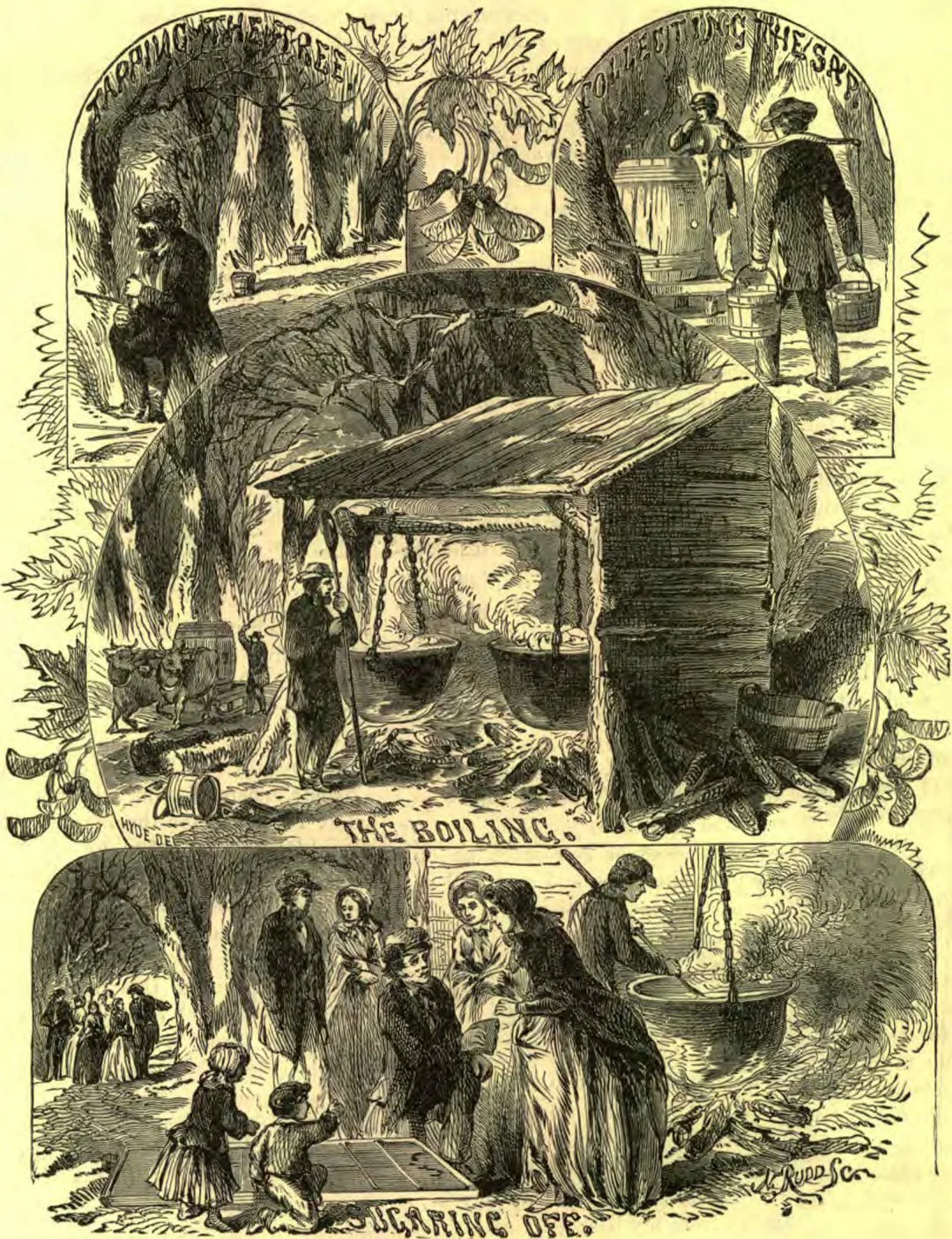
SUGAR is obtained in several different ways. That most commonly used is made from the sugar-cane, a plant somewhat resembling our common Indian corn. The stalks are cut while yet tender, and taken to a mill, where they are crushed; and from the juice obtained, sugar and molasses are made. In some countries, sugar is made from the beet-root, and it is said that it is just as clear and sweet as the best white sugar made from the sugar-cane.
But another very nice sugar is made from the juice of the sugar-maple tree, which grows in some parts of this country. In the early spring, when the winter begins to break up, is the time when this sugar is made; for then there is an abundance of juice, or sap, in the trees. Some other trees yield even more sap than the sugar-maple, but it is not as sweet. The different processes of maple-sugar-making are so well represented in our picture, that a description of them scarcely seems necessary. When the sugar-makers think that the proper time has come, the trees are tapped, as it is called. This is done by cutting or boring a small hole in the side of the tree. Into this hole is placed a grooved piece of wood, called a spile. This is to carry the sap into the bucket which is placed underneath. Several hundred trees are usually thus tapped, and these taken together are called the “sugar-bush.” Sometimes the sap trickles slowly, and at other times it runs very fast, filling the buckets in a few hours.
The next thing in order, is to “gather” the sap. Sometimes this is done “by hand,” as represented in the upper right-hand corner of the picture; but usually it is done with a team, as shown below. The sap is now taken to the camp, or boiling-place, where it must first all be strained, after which it is placed in large iron kettles over a very hot fire, made by rolling together logs and chunks of wood. It is frequently, however, boiled in large sheet-iron pans, placed above a rude furnace, or “arch,” made of clay and stones; and under this the fire is built. Sometimes the boiling-place is covered by a shelter, as in the picture, and sometimes it is out in the open air.
The sap is boiled until it becomes a thin syrup, when it is taken from the pans and put into large jars to settle. As it takes some fifty pails of sap to make one of syrup, the boiling must be kept going on constantly, night and day, and even then considerable sap sometimes runs to waste. So the sugar-makers must stay up all night, out in the grand old woods, and keep the fires burning brightly, and watch that the sap does not boil over. The firelight reflected on the white snow and the old forest trees, must form a pleasant picture; and the sound of the sap trickling into the buckets makes pleasant music for them. And withal there is doubtless just enough romance about it to take away the irksomeness of the task; for the “run” does not usually continue many days.
The last and perhaps most interesting process is “sugaring-off.” The syrup, which has now settled clear, is put into a clean kettle or pan, and boiled until it becomes sugar. Now the friends and neighbors are invited to come to the bush to eat warm sugar, and a right merry time they have. The hot sugar is made into wax by putting it on the snow, or is stirred into grain in a saucer, or other dish. Finally, when it is boiled sufficiently, it is turned into pans and left to cool, or cake; when it may be removed, and the cakes stowed away for use. Those who depend upon maple sugar must make enough to last through the year, as it can be made but once in a year, and then only for a few days.
But we hear many of the boys and girls who have helped make sugar, saying, “I could tell a better story than that about making sugar, myself.” And we do not doubt it, as it isn’t the easiest thing to describe what you have never seen done.
E. B.

WAITING FOR SPRING.

Haste, gentle spring! we are waiting for thee,— Waiting the gleam of thy garments to see, Waiting and watching to welcome thee here; Tarry no longer, sweet pet of the year.
Surly-faced March has no right to thy name; Year after year he is ever the same; Frost, snow and ice and wild winds in his train— Fitter companions for stern Winter’s reign.
Come, crowned with garlands of leaves and of flowers, Send thy soft breath through forests and bowers; Bring all the singing birds back once again, Scatter sweet odors on hillside and plain.
Quicken our frames with thy life-giving clasp, Chilled into torpor by Winter’s cold grasp; Waken fond memories, our spirits to thrill, Hopes that, though slumbering, have left in them still, Thoughts that shall grow ’neath the spell of thy power, Dreams, like thy days, mingled sunshine and shower, Fancies which from thy soft odors have birth, Longings that seem to be scarcely of earth.
Haste thee! oh, haste thee! why longer delay? Thou wilt be welcomed by grave and by gay; Hearts have grown weary in waiting for thee, But in thy loved presence all sadness shall flee.
—Transcript.

Ancient Britain: Roman Influence and the Coming of Christianity

ANCIENT BRITAIN.—NO. 3.

The ancient Romans not only made London the capital of their British dominion, but it became the center of all their measurements and descriptions of places in the kingdom; and in order to secure complete accuracy, there was erected in the very center of London a stone post, which was the point from which all their measurements were counted. This Roman stone still remains as a relic of “ye olden time.” It is walled into the side of a building, yet so as to be seen. It is on Canon street, just opposite the Canon-street Railway Passenger-station.
When the Romans had subdued the Britons, they employed them in building their houses of brick and stone, in plowing and sowing the land, and in digging the tin, copper, and other materials from the mines. Although it seemed hard to them to be thus ruled over by others, yet in this very servitude they were taking steps in civilization. Learning how to perform useful labor was not all, for the Romans brought teachers and established schools, and taught the youth of Britain to read and write. But greater benefit still came of this Roman occupation, for after a time good men came bringing to these islands the Bible, the knowledge of the true God, and the glad news of salvation through his Son. They taught the people to love and serve God instead of savagely fighting one another.
In the early writings of the Welsh, called “triads,” it is said that Brân was the first who brought the Christian faith to the Welsh. Brân, with his son Caractacus, was sent to Rome, and retained there as a hostage for seven years. In A. D. 56, according to Eusebius, St. Paul was sent to Rome by Nero, and according to St. Luke (Acts 28: 30), he had his own hired house in Rome for two years, and taught all that came to him. It is claimed that Brân received the gospel from St. Paul while he was in Rome. It is certain that he received the religion of Christ while there. These “triads” of the Welsh, state that when Brân was released, in A. D. 58, and returned to Britain, he brought with him three Christian teachers,—Iltid, an Israelite; Cyndaf, and Arwystli, which is the Welsh for Aristobolus, to whom St. Paul sends salutation, Rom. 16: 10.
These early British Christians were numerous in Wales, Northumberland, and Cornwall. Through their teachings many of the Druids were converted to Christ, and the true worship of God was established in their stone circles, where previously the sun and serpent had been worshiped. One of these circles thus used still remains in Carn-y-groes, in Glamorgan-shire. Near to it stands also a stone cross erected by these early Christians.
By degrees the Britons forgot the Druids, and ceased to pray under the oaks; and in fact the college of the Druids, in the island of Iona of the Hebrides, where Druid priests had been instructed without books, and where their kings had been buried, became a safe retreat for the Christians from the strife of war in lower Britain, and a spot where they could study the Holy Scriptures, and from whence they sent forth at last their missionaries to all parts of Britain.
J. N. Loughborough.

A LESSON TAUGHT.

Once upon a time an Arabian princess was presented by her teacher with an ivory casket, exquisitely wrought, with the injunction not to open it until a year rolled around. Many were the speculations as to what it contained, and the time when the jeweled key should disclose the mysterious contents was impatiently awaited. It came at last, and the maiden went away alone, and with trembling haste unlocked the treasure; and lo! reposing in delicate satin linings, lay nothing but a little rust; the form of something beautiful could be discerned, but the beauty had gone forever. Tearful with disappointment, she did not at first see a slip of parchment containing these words:—
“Dear pupil: May you learn from this a lesson in your life. This trinket, when inclosed, had upon it only a single spot of rust; by neglect it has become the useless thing you now behold, only a blot on its pure surroundings. So a little stain on your character will, by inattention and neglect, mar a bright and useful life, and in time will leave only the dark record of what might have been. If you now place within, a jewel of gold, and after many years seek the result, you will find it still as sparkling as ever. So with yourself; treasure up only the pure, the good, and you will ever be an ornament to society, and a source of true pleasure to yourself and your friends.”

SPEAK KINDLY.

A YOUNG lady had gone out to take a walk. She forgot to take her purse with her, and had no money in her pocket. Presently she met a little girl with a basket on her arm.
“Please, miss, will you buy something from my basket?” said the little girl, showing a variety of bookmarks, needle-books, watch-cases, etc.
“I am sorry I cannot buy anything to-day,” said the young lady. “I haven’t any money with me. Your things look very pretty.” She stopped a moment and spoke a few kind words to the girl; and then, as she passed on, she said again, “I’m very sorry I cannot buy anything from you to-day.”
“Oh, miss,” said the little girl, “you’ve done me just as much good as if you had.”

EXPERIENCE WITH THE INSTRUCTOR.

It was noon as the writer entered a school-room in a far western village, where he found the teacher and pupils very pleasantly passing the intermission. After an introduction to the teacher, who seemed to be an American by birth, I showed him the YOUTH'S INSTRUCTOR. The pupils, on learning that a youth's paper was offered for examination, grouped around to hear what remarks would be made about it. The teacher was pleased with it, and so subscribed for his little girl.
The next day my course led to the residence of a Scotchman. Here was a group of cheerful children. Maggie, the eldest of the company, could read English. The mother thought well of the paper, and sent one of the children to call the father. He came and looked over the paper until he found an article which seemed to startle him, and he suddenly handed me back the sample copy.
I asked what there was that he did not like.
“Why,” said he, “there is an article in it about tobacco.”
“Indeed! But you would not object to it on that account? You do not wish your children to use tobacco when they are grown up?” He was silent. Afterward, to the great delight of the child, he let Maggie subscribe for the paper.
The same day I visited a German family, where the Stimme der Wahrheit had been taken for several months. The father was absent. The mother could read only in her own dialect, but the children had learned to read in English. There were Lizzie, Laura, Ida, Mary, Vina, the baby, and the mother—all at once eagerly inspecting the first English paper introduced into this family. Laura could read quite readily, and three of them could understand much of the meaning of what she read.
My journey now led to the house of a Swede, where, finding a hearty welcome, I tarried for the night. The Harold had been taken by our host for nearly two years. The children examined the YOUTH'S INSTRUCTOR in the evening, and in the morning subscribed, thus introducing the first English paper into this family also.
The same day I came to the residence of a Dane, who seemed to be quite intelligent. He had borrowed a few copies of the Tidende and read them, and it was easy to get him to subscribe for this. This man had no Danish Bible, and I sold him one. Learning that his oldest child could read English, the INSTRUCTOR was presented. The boy then read to his parents, which resulted in their allowing him to subscribe for it.
Thus in three days the YOUTH'S INSTRUCTOR is brought into the families of five different nationalities. Are there not many places where the children of foreigners could thus easily be led to take our good little paper? Let it go out into the highways and hedges—to every nationality. Its mission is love and joy and peace to the children.
J. S.

“MY INFLUENCE.”

“Gather up my influence and bury it with me,” were the dying words of a young man to the weeping friends at his bedside. What a wish was this! what deep anguish of heart there must have been as the young man reflected upon his past life!—a life which had not been what it should have been. With what deep regrets must his soul have been filled, as he thought of those young men he had influenced for evil!—influences which he felt must, if possible, be recalled, and which led him, faintly but pleadingly, to breathe out such a dying request—“Gather up my influence and bury it with me.”
My young friends, the influence of your lives, for good or for evil, cannot be gathered up by your friends after your eyes are closed in death, no matter how earnestly you may plead in your last moments on earth. Your influence has gone out from you; you alone were responsible; you had the power to govern, to shape; your influence no human being can withdraw. Such a request cannot be fulfilled. It is impossible. Your relatives and friends cannot “gather up your influence and bury it with you.” Young men, live noble, true, heroic lives. Possess “moral courage” in full proportions, and at all times—everywhere.—Dr. Wise.

LITTLE BY LITTLE.

“Little by little,” the tempter said, As a dark and cunning snare he spread For the young, unwary feet; “Little by little and, day by day, I will tempt the careless soul away Until the ruin is complete.”
“Little by little,” sure and slow, We fashion our future of bliss or woe; As the present passes away, Our feet are climbing the stairway bright Up to the regions of endless light, Or gliding downward into the night, “Little by little, day by day.”

A CHILD'S FAITH.

A LITTLE child was once taken to a funeral of one of his young companions. He had never seen a dead body before. He looked long and earnestly on the beautiful form of his friend, as it lay, like a piece of wax-work or of polished marble in the dark coffin, with flowers all over it. He did not go to the graveyard. His mother took him home, and let him stand at the window, where he could see the funeral procession of his playmate go by. He looked at it with fixed attention for a while; then he turned to his mother, and his face all lighted up with gladness as he said, “O mamma! how beautiful it will be when Jesus says, ‘Baby, come forth!’”
The little fellow was thinking, no doubt, of what he had heard about Jesus standing by the grave of his friend, in Bethany, when he said, “Lazarus, come forth!” That dear child was making the right use of what the Bible teaches us about Jesus and the resurrection. In the morning of the resurrection, Jesus will speak in that way to all the dead children and to all his people who have died believing in him; and it will, indeed, “be beautiful when they come forth!”—Dr. Newton.

MARCH

MARCH wind, blow your best! Set all your trumpets calling, Send rain, and hail, and mist, and snow Across the landscape falling. A little while, a little while, And down the meadow, May will smile.
O sullen sky, stoop down, Bend low, the hills dividing. Who cares if dark clouds come and go? The sun is only hiding! And by-and-by, ah, by-and-by, Both storm and shadow far will fly.

NOTES ON THE LESSON.

THE POOL OF BETHESDA.—The exact site of this place travelers have never been able to agree upon. There are several remarkable pools in and about Jerusalem, and at different times they have been known by different names; but which of them is the real pool of Bethesda at which Jesus healed the impotent man, no one assumes to know. Almost every traveler has his theory about it, but those who have made the most careful researches are least positive in their statements.
“MY FATHER WORKETH HITHERTO, AND I WORK.” JOHN 5:17. We give below the opinions of some of the best commentators as to the meaning and application of this passage.
“God created the world in six days: on the seventh he rested from all creating acts, and set it apart to be an everlasting memorial of his work. But, though he rested from creating, he never ceased from preserving and governing that which he had formed: in this respect he can keep no sabbaths; for nothing can continue to exist, or answer the end proposed by the divine wisdom and goodness, without the continual energy of God. So I work—I [Christ] am constantly employed in the same way, governing and supporting all things, comforting the wretched, and saving the lost, and to me, in this respect, there is no Sabbath.”—Clarke’s Commentary.
“The rest of the Sabbath is not the rest of idleness or mere cessation of labor, else God himself, who is always at work (verse 17) would be a Sabbath-breaker as well as Christ. It is rather rest in God,—a rest from ordinary work in order to a higher and holier activity for the glory of God and the good of man. We must cease from our earthly work, that God may do his heavenly work in and through us.
“The Sabbath law, like the whole law, is truly fulfilled by love to God and love to man. Christ refutes the false conception of Sabbath rest, as a mere cessation from labor, in various ways, now by the example of David eating the show-bread, now by the example of the priests working in the temple, now by the readiness of the Jews to deliver an ox out of a pit on the Sabbath. Here he takes higher ground, and claims equality with the Father, who never ceases doing good. God’s rest after creation was not a rest of sleep or inaction, but a rest of joy in the completion of his work and of benediction of his creatures. His strictly creative activity ceased with the Hexaëmeron [the six days of labor]; but his world-preserving and governing, as well as his redeeming activity continues without interruption; and this is properly his Sabbath, combining the highest action with the deepest repose. . . . In the case of man while on earth, acts of worship and acts of charity are proper works for the Christian Sabbath, and are refreshing rest to body and soul, carrying in themselves their own exceeding great reward.”—Schaff’s Commentary.
“Jesus stated to them that the work of relieving the sufferings of the afflicted was in harmony with the Sabbath law, whether it was relative to the salvation of souls or the removal of physical pain. Such work was in harmony with that of God’s angels, who were ever descending and ascending between Heaven and earth to minister to suffering humanity. Jesus answered their accusations by declaring, ‘My Father worketh hitherto, and I work.’ All days are God’s, in which to carry out his great plans for the human race. If the Jews’ interpretation of the law was correct, then Jehovah was at fault, whose work had upheld and quickened creation since first he laid the foundations of the earth, when the morning stars sang together, and all the sons of God shouted for joy. He who pronounced his work good, and established the institution of the Sabbath to commemorate its completion, must put a period to his labor, and stop the never-ending routine of the universe.
“Should God forbid the sun to do its office upon the Sabbath, cut off its genial rays from warming the earth, and nourishing vegetation? Must the system of worlds stand still through that holy day? Should he command the babbling brooks to stay their course from watering the fields and forests, and bid the advancing and receding waves to still their ceaseless ebbing and flowing? Must the wheat and corn stop growing, and the ripening cluster defer its purple bloom for a single day? Must the waving trees and the delicate flowers put forth no bud nor blossom on the Sabbath?
“Surely in such a case man would miss the fruit of the earth and the blessings that make life desirable. Nature must continue her unvarying course; God must not stay his hand a single moment, or man would faint and die. And, in a like proportion, man has a labor to perform on this day. The necessities of life must be attended to, the sick must be cared for, the wants of the needy must be met. God does not hold him guiltless who stays his hand from relieving the suffering on the Sabbath-day. The holy Sabbath was made for man; and acts of mercy and benevolence are always in order upon that day. God does not desire his creatures to suffer an hour’s pain that may be relieved upon the Sabbath or any other day.
“Jesus sought to impress upon the narrow minds of the Jews a sense of the folly of their view of the Sabbath. He showed them that God’s work never ceases. It is even greater upon the Sabbath than upon ordinary occasions, for at that time his people leave their usual employments and spend the time in prayerful meditation and worship. They ask more favors of him upon the Sabbath than upon other days, they demand his special attention, they crave his choicest blessings, they offer importunate prayers for special favors. God does not wait for the Sabbath to pass before he grants those requests, but he deals to the petitioners, with judicious wisdom, whatever is best for them to have.
“Heaven’s work never ceases for a moment, and men should never rest from doing good. The Sabbath law forbids labor on the sanctified rest-day of the Lord. The toil that gains a livelihood must cease; no labor for worldly pleasure or profit is lawful upon the Lord’s day, but the work of Christ in healing the sick did honor to the holy Sabbath. Jesus claimed equal rights with God in doing a work equally sacred and of the same character with that which engaged his Father in Heaven.”—Mrs. E. G. White, in Great Controversy.

LESSONS ON NEW-TESTAMENT HISTORY.

LESSON 21.—CHRIST’S MIRACLE AT THE POOL OF BETHESDA.

In John 5:1, we read, “After this, there was a feast of the Jews, and Jesus went up to Jerusalem.” This feast is understood to have been the yearly celebration of the passover. It was the second passover attended by our Lord after his baptism. The sacred narrative continues as follows: “Now there is at Jerusalem by the sheep-market a pool, which is called in the Hebrew tongue Bethesda, having five porches. In these lay a great multitude of impotent folk, of blind, halt, withered, waiting for the moving of the water. For an angel went down at a certain season into the pool, and troubled the water; whosoever then first after the troubling of the water stepped in was made whole of whatsoever disease he had. And a certain man was there, which had an infirmity thirty and eight years. When Jesus saw him lie, and knew that he had been now a long time in that case, he saith unto him, Wilt thou be made whole? The impotent man answered him, Sir, I have no man, when the water is troubled, to put me into the pool; but while I am coming, another steppeth down before me. Jesus said unto him, Rise, take up thy bed, and walk. And immediately the man was made whole, and took up his bed, and walked; and on the same day was the Sabbath.
“The Jews therefore said unto him that was cured, It is the Sabbath-day; it is not lawful for thee to carry thy bed. He answered them, He that made me whole, the same said unto me, Take up thy bed, and walk. Then asked they him, What man is that which said unto thee, Take up thy bed, and walk? And he that was healed wist not who it was; for Jesus had conveyed himself away, a multitude being in that place. Afterward Jesus findeth him in the temple, and said unto him, Behold, thou art made whole; sin no more, lest a worse thing come upon thee. The man departed, and told the Jews that it was Jesus which had made him whole. And therefore did the Jews persecute Jesus, and sought to slay him, because he had done these things on the Sabbath-day. But Jesus answered them, My Father worketh hitherto, and I work. Therefore the Jews sought the more to kill him, because he not only had broken the Sabbath, but said also that God was his Father, making himself equal with God.
“Then answered Jesus and said unto them, Verily, verily, I say unto you, The Son can do nothing of himself, but what he seeth the Father do; for what things soever he doeth, these also doeth the Son likewise. For the Father loveth the Son, and showeth him all things that himself doeth; and he will show him greater works than these, that ye may marvel. For as the Father raiseth up the dead, and quickeneth them, even so the Son quickeneth whom he will. For the Father judgeth no man, but hath committed all judgment unto the Son; that all men should honor the Son, even as they honor the Father. He that honoreth not the Son honoreth not the Father which hath sent him. Verily, verily, I say unto you, He that heareth my word, and believeth on Him that sent me, hath everlasting life, and shall not come into condemnation; but is passed from death unto life.”

QUESTIONS.

1. When and how was the passover instituted?
2. How often and in what manner was it celebrated?
3. By what acts did Jesus distinguish the first passover after his baptism?
4. What noted miracle did he perform at the second passover? John 5:1–16.
5. What particular place in Jerusalem was the scene of this miracle?
6. Describe the pool of Bethesda.
7. What constantly recurring miracle was witnessed there?
8. Describe the company of people that Jesus found assembled at that place.
9. Relate the conversation which Jesus had with a man who had suffered from an infirmity for thirty-eight years.
10. When the Jews saw the man that had been healed, walking, and carrying his bed, what did they say to him?
11. What reply did he make?
12. What admonition did Jesus give the man when he afterward saw him in the temple?
13. What course did the Jews take when they learned who it was that had healed the man?
14. What did Jesus say to them? Verse 17.
15. How did they receive this saying? Verse 18.
16. How did he explain the unity of action between himself and his Father? Verse 19.
17. How does the Father honor the Son? Verse 20.
18. What did Jesus say they might expect to see?
19. Had he at this time raised any from the dead?
20. What statement is made in verse 22?
21. How may this statement be reconciled with Daniel 7:9–14?—God the Father gives the decisions of the Judgment, and Christ executes them.
22. Why has God committed the execution of judgment to Christ? Verse 23.
23. Can we honor God the Father, if we refuse to honor his Son Jesus Christ?
24. What promise is made to every one who receives the word of Christ, and believes on the Father who sent him?
25. What must this statement imply?—That the faith of the believer is strong enough to lead to obedience.
26. How has such a one passed from death unto life?—That transformation called the new life has begun in him.

SCENES IN THE LIFE OF CHRIST.

LESSON 8.—REVIEW OF LESSONS 5-7.
  1. Describe the hill on which Bethlehem stands?
  2. Describe the surrounding country.
  3. For what remarkable events is Bethlehem celebrated?
  4. Describe the visit of the angels to the shepherds near Bethlehem.
  5. What good news was there made known?
  6. How did the shepherds find out the truth of what the angel had said?
  7. How did the people feel when they heard the shepherds' story?
  8. When Jesus was brought into the temple at Jerusalem, who knew him to be the Saviour?
  9. What did the servants of God say about him?
  10. Not long after this who came from the East to Jerusalem?
  11. What question did they ask?
  12. Why had they come on such a long journey?
  13. How was it found out where Jesus was to be born?
  14. How were the wise men guided to the exact place where the infant Saviour was?
  15. Describe their visit.
  16. How did Herod try to destroy Jesus?
  17. Why did he wish to kill him?
  18. How was he prevented from taking the life of Jesus?
  19. Describe the visit to Egypt.
  20. Describe the return.
  21. How far is Egypt from Bethlehem?
  22. In what direction does it lie?
  23. Which way is Nazareth from Bethlehem?
  24. How far distant is it?
  25. Into what three parts was the Holy Land divided, or rather that part of it lying west of the Jordan?
  26. Give a brief description of each part.
  27. In which of these provinces was Bethlehem?
  28. In which was Nazareth?
  29. How far was Nazareth from the northern border of the plain of Esdraelon?
—About two miles.
  1. Describe the valley in which Nazareth is situated.
  2. Describe the view from the top of the hill behind the village.
  3. For what purpose did all the people journey to Jerusalem every year?
  4. How long did they remain at this feast?
  5. What happened at the one held when Jesus was about twelve years of age?

Teaching Biblical Geography to Children

A KNOWLEDGE of Biblical geography is not essential to salvation, but it is necessary to a complete understanding of the Scriptures as the Holy Spirit has given them. In spite of the attention given to these subjects, many scholars are deplorably ignorant of the location and relative position of places mentioned in Bible stories. One very effective way of attracting children’s attention and securing their interest is to draw an outline of Palestine, and then to mark every new place as it is first mentioned in the lessons. If this sheet is looked at two or three minutes every Sabbath, with a brief review of the places noted, the Scriptural topography can easily be fixed in the minds even of the dullest scholars.—S. S. World.

ALECK GRAHAM'S LITTLE FOX.

“I've done my level best, and there's no use trying any longer;” and Aleck Graham threw himself into a chair and his cap on the floor, with quite the air of one who thinks himself a martyr.
Brave sister Mollie, who had twice as hard a time as Aleck, with the two little ones to look after, gave a merry little laugh as she looked at the disconsolate figure in the chair, and went on making her biscuits.
“You need n't laugh,” he said. “It isn't any use; I can't do it.”
“I won't laugh,” said Mollie from the pantry. “But what about the foxes? That ‘I can't’ is one of the ugliest, meanest little foxes I know,—a regular cheat. He's spoiled heaps of vines, and I'm afraid he'll do yours lots of mischief if you don't look out for him. He's around pretty often, I think.”
Mollie said no more, and presently Aleck got up, and, taking down his cap, walked to the window.
Just beyond their bit of garden was Squire Allen's farm, and at the right was his cornfield. If Aleck finished hoeing it by Saturday night, he was to have five dollars,—a big sum to Aleck, and big to Mollie, who since last spring had been the only mother to the three younger ones; and a hard time she had of it, making their tiny income meet their many wants.
Aleck stood looking at the corn waving in the sunlight, and thought of patient Mollie and the foxes. It seemed almost an age to Mollie, when Aleck walked to the pantry door and said in a quick, decided tone, “That fox shan't spoil my vines this time,” and marched off.
“Bravo!” exclaimed Mollie; and that was all she had time to say before he was out of sight.
Saturday night Aleck brought home the five dollars and gave it to Mollie. A tear glistened in her eye as she said, “The best of it is, Aleck, that you didn't give up.”
“I wish I could kill that fox,” he said soberly. “He just torments me. It's so easy to think I can't, and stop work.”
“I think he is wounded already,” said Mollie, “and I am sure that with God's help you can conquer, if you don't kill him.”—Selected.

TWENTY IMPOLITE THINGS.

  1. Loud and boisterous laughing.
  2. Reading when others are talking.
  3. Reading aloud in company without being asked.
  4. Talking when others are reading.
  5. Spitting about the house, smoking or chewing.
  6. Cutting finger-nails in company.
  7. Leaving church before worship is closed.
  8. Whispering or laughing in the house of God.
  9. Gazing rudely at strangers.
  10. Leaving a stranger without a seat.
  11. A want of respect and reverence for seniors.
  12. Correcting older persons than yourself, especially parents.
  13. Receiving a present without an expression of gratitude.
  14. Making yourself the hero of your own story.
  15. Laughing at the mistakes of others.
  16. Joking others in company.
  17. Commencing to talk before another has finished speaking.
  18. Making remarks upon other people's dress.
  19. Commencing to eat as soon as you get to the table.
  20. Not listening to what any one is saying in company.—Children's Friend.

THE CANNON-BALL TREE.

One of those singular productions of nature which seem to us so inexplicably puzzling when we seek their use or object in being, is the cannon-ball tree, a native of the West Indies, and found in the primeval forests of the islands of Trinidad, and, therefore, nurtured under the blaze of a tropical sun, enjoying the full immunities of tropic heat. When the man in the old story wondered why pumpkins did not grow on trees, he did not suppose a thing more improbable than that which we see in this singular tree. It grows to great height, and bears an abundance of its strange fruit. The blossom is shaped much like that of a pumpkin, is slightly colored with purple, grows directly out of the bole or thick branches upon a short stem which curves downward; and when the fruit forms, it carries the blossom upon it after the manner of an apple, until the fruit, having swollen to considerable size, falls off. At this stage it resembles a large green walnut, but as it advances to maturity, it grows rapidly, and at last attains the size of a thirty-two pound shot, is of a dark, dull green, verging upon brown, and, being dense and solid, is extremely heavy.
Charles Kingsley tells a story of an army officer, who, being ambitious to possess one of these natural cannon-balls, stood beneath the tree looking up at the unattainable, though not forbidden, fruit, when down it came on the bridge of his nose, giving him a pair of black eyes, which prevented his appearing upon parade for more days than one.—S. S. Visitor.

HE COULD BE TRUSTED.

REUBEN was missing one evening about sunset. Mother was getting anxious, for she always wished him to be home early. A neighbor coming in, said a number of boys had gone to the river to swim, and he thought it likely Reuben was with them.
“No,” said the mother, “he promised me he would never go there without my leave, and he always keeps his word.”
But seven o’clock came, then eight, and mother was still listening for Reuben’s step; but it was half-past eight before his shout and whistle were heard, as he ran in at the gate.
“Confess now,” said the neighbor, “that you have been to the river with the other boys, and so kept away till late!”
How the boy’s eyes flashed, and the crimson mounted to his cheeks!
“No, sir! I promised my mother that I would never go there without her leave, and do you think I would tell a falsehood? I helped Charlie to find the cows that had strayed in the wood, and didn’t think I should stay so late.”
Charlie coming up the street just then, came in to say he was afraid they had been alarmed; he and Reuben had been so far in the wood, that it made them late in getting home.
“I think,” said the neighbor, turning to the mother as he took his hat to go home, “there is a comfort in store for you, by him. Such a boy as that will make a noble man.”—Sel.

Forgiving Others and the Lord's Prayer

People who will not forgive the faults of others, have no use for the Lord’s prayer; it will do them no good to pray it.

WORDS ARE WONDERFUL THINGS.

KEEP a guard on your words, my darlings, For words are wonderful things; They are sweet, like the bee's fresh honey, Like the bees they have terrible stings. They can bless like the cheering sunshine, And brighten a lonely life; They can cut in the strife of anger, Like an open, two-edged knife.
Let them pass through your lips unchallenged, If their errand is true and kind; If they come to support the weary, To comfort and help the blind. If a bitter, revengeful spirit Prompts the words, let them be unsaid; They may flash through the brain like lightning, Or fall on the heart like lead.
Keep them back if they're cold and cruel, Under bar, and lock, and seal; The wounds they make, my darlings, Are always slow to heal. May peace guard your lives, and ever, From this time of your early youth, May the words that you daily utter, Be the beautiful words of truth.
—Selected.
Continue reading: LETTER BUDGET