Not long ago in a conversation I heard this remark made by a young married woman concerning domestic affairs: “I do not intend to make a drudge of myself for any man; I shall take life easy, and not slave myself to death.” Her friend replied, “I did not look upon housework as drudgery, and never felt myself a drudge, in doing my own work and in making my home pleasant.”
The wife who finds housework a drudgery is to be pitied. True, one often gets very tired in the daily round of household duties; but I never feel to complain, but rather to be thankful for health and strength sufficient to do my work. Experience teaches that much of the so-called drudgery in housekeeping may be dispensed with by a little system and forethought. There is a happy medium between extreme neatness and slovenliness. It may not always be possible to keep the house in “apple-pie order.”
I have lived the greater part of my life on a farm, and know full well the work required of a farmer’s wife; but still in my busiest days, when caring for a growing family, I was very happy, and never thought of my work as drudgery.
By being systematic, by doing one’s work up each day, whether one feels just like it or not, the housewife can keep ahead of her work. A plain table, with plenty of plain, well-cooked food, is far better than a table loaded with rich foods and pastries. It is better for those who eat and for those who prepare the food.
Both boys and girls should be taught to help with the housework, to put away their own things, and wait upon themselves as far as possible, thereby saving much work some would call drudgery.
Never retire leaving the sitting-room and kitchen in confusion. It is very much easier in the long run, even if tired at night, to put things in order before retiring. Books and papers put away, chairs set in place, scraps picked from the sitting-room floor, make quite a pleasing change from an untidy, littered room. In the kitchen, after the little feet were at rest, I have often cleaned the floor, and felt well repaid in the morning, as I would begin the work of another day.
By taking thought, we may save ourselves many unnecessary steps, thereby saving time in which to read the Bible and other good books. And here let me say, Keep plenty of clean reading-matter on your table. It is poor economy to starve the mind.
The brides of to-day begin housekeeping under far more favorable conditions than did those sixty and seventy years ago. Yet I do not remember of hearing any complain of drudgery. That wife undervalues her home work, who looks upon it as drudgery.
In the hand of every wife is put a scepter of power, which she wields for good or ill. Destinies most sacred are entrusted to her keeping. Will she prove faithful to her trust, taking the words of Paul as her incentive, “And whatsoever ye do, do it heartily, as to the Lord, . . . for ye serve the Lord Christ”?
Could every wife do this, and seek to glorify God in making her home pleasant, she would enjoy her work, and feel she was doing what God had given her to do, as much as those who are apparently doing a greater work in the world.
By properly performing our humble, every-day work we are serving God just as surely as is the person who is doing “great and noble things for him.” It has been said by one, “The good, old-fashioned home life is dying out.” Men and women forget the great responsibilities resting upon them. Money-getting, pleasure-seeking, and fashion are first and foremost in far too many of our homes.
May God help the fathers and mothers to realize, before it is too late, the magnitude of the work of training their children in the way they ought to go.
Grand Ledge, Mich.
Hope On
By J. W. Vallandingham
Hope on, my soul, though sorrow’s waves
Beat hard upon thy breast;
The storm will cease, a calm will come,
Life’s sea will be at rest.
Beyond the clouds that darken now,
The friendly sunbeams smile
That sometime soon will light thy way;
Hope on, and wait the while.
Hope on, my soul, though foes assail
At morn, at noon, at night;
The unseen power that rules the world
Will guide thy steps aright.
Be strong in him, and in thine heart,
Let come no thought of guile;
For he will turn aside each dart,
And keep thee safe the while.
Hope on, my soul; the unseen way
Will open as you go.
Thy future path thou needst not see
Nor even care to know.
Thy steps are ordered by the One
Who on thy life doth smile;
He’ll lead thee safely to thy rest,
Hope thou in him the while.
Hope on, my soul, in fight of faith,
With helmet, sword, and shield;
Fight on, to no assailing foe
For e’en-one moment yield.
Press on in life’s great battle march
Until you cross the stile,
And enter heaven’s golden gate
In God’s great after-while.
— J. W. Vallandingham.
The Last of Earth
By T. DeWitt Talmage
God bless all the aged women up and down the land! What a happy thing for Pomponius Atticus to say, when making the funeral address of his mother: “Though I have resided with her sixty-seven years, I was never once reconciled to her, because there never happened the least discord between us, and consequently, there was no need of reconciliation.” Make it as easy for the old folks as you can. When they are sick, get for them the best doctors. Give them your arm when the streets are slippery. Stay with them all the time you can. Go home and see the old folks if you are away from them. Find the place for them in the hymn-book. Never be ashamed if they prefer styles of apparel a little antiquated. Never say anything that implies that they are in the way. Make the road for the last mile as smooth as you can. O, you will miss her when she is gone! I would give the house over my head to see my mother. I have so many things I would like to tell her, things that have happened in these many years since she fell asleep. Morning, noon, and night let us thank God for the good influences that have come down from good mothers all the way back.
Don't forget your mother; don't forget your grandmother. And hand down to others this patrimony of blessing. Pass along the coronets. Make religion an heirloom from generation to generation. Let the mothers of America consecrate themselves to God, and they will help consecrate all the ages following. Do not dwell so much on your hardships that you miss your chance of wielding an influence that shall look down upon you from the towers of an endless future.— T. DeWitt Talmage.
Simple Remedies Better Than Drugs
By Mrs. Martha M. Allen
If people wish to avoid being drugged, with dangerous preparations, they will do well to observe some of the simple rules of living which conserve health and make medicines unnecessary. Fresh air, simple but nutritious food properly cooked, and not too much of it, clothing suited to the weather, the avoidance of worry, with trust in God, sufficient sleep, and proper exercise, will drive away most of the ordinary dis-eases of the body. When will people learn that they are better without drugs than with them? Let the W. C. T. U. learn this great lesson thoroughly, that drugs do not cure disease; then teach it to others. The great Nathan S. Davis, M. D., said to the writer years ago: “Teach the women that the best remedies are simple,—fresh air, pure water, digestible food, and rest. These,” he said, “are nature’s restoratives, and the sooner both physicians and people begin to rely upon them instead of upon drugs, the better it will be for all.”—Mrs. Martha M. Allen.
Our First Acquaintance with India
By GEO. F. ENOCH
GEO. F. ENOCH
AFTER a long journey of nine weeks, we landed November 15, at Bombay, the “Gateway of India.” The harbor is large, and the docks are excellent. We were soon ashore, and found ourselves plunged into a current of humanity, seemingly endless, dressed in almost every possible way, and some hardly dressed at all. Bombay is a busy center of nearly one million souls. At one’s first introduction to India, the idea of quantity is crowded in upon him from every side.
Brother J. S. James had come to meet us, with the report of the decision of the recent committee meeting, which recommended that we locate on the west side, suggesting Poona, one hundred seventeen miles from Bombay, as a possible location. But this suggestion was not to be carried out. Before the west side should become our home, we were destined to pass through some experiences that would try our souls. Not that there was nothing to do, nor any open doors to enter; but rather, before the Lord allowed us to settle down, he was to give us a little broader glimpse of India’s great need. Our hearts have been mightily stirred by this brief glimpse, and we would pass on to the readers of the REVIEW an account of a few of the things we have seen and heard.
The way closed up so far as Poona was concerned, and it seemed best that my family should stay a time with the family of Brother James, at Bangalore, while the matter of location was being definitely settled. This decision took us across the Western Ghauts, through three hundred miles of pure Marathi territory. There are about eighteen million people speaking this language. Those we saw were of good physical appearance. The Marathis occupy quite an important page in India’s history. They were among the first of the Aryan people to come into west India. When the English subdued the country, they found this nation one of the most stubborn to conquer. It was while fighting against them that the Duke of Wellington learned some of the lessons of war that afterward helped him in his wars in Europe.
When we reached Bangalore, and had time to look carefully into the situation, two openings were so pressing the hearts of those in charge of the work in India, that it was not easy to decide what to do. West India, with its eighteen million Marathi people and ten million Gujarati, demanded immediate attention. South India, with its Dravidian languages, divided into four principal groups, having more than fifty million people to hear the message, was also loudly calling; and one could not with only human wisdom tell which call should just now be answered.
In South India there are the Tamils, one of the most interesting people of India, numbering nearly seventeen million, with a very ancient civilization, and a literature antedating the birth of Christ. Among these are the Christian Sabbath-keepers of whom the REVIEW family has heard already. There are also many of these over in Ceylon. Just north of the Tamil country is a people speaking another Dravidian tongue—the Telugus. They number more than twenty million. Among them in recent years Christianity has made great strides. Thousands have accepted Christ—so many that the missionary societies have been taxed to the utmost to care for them. It is true that the quality of many of these converts leaves much to be desired; yet this success shows that there is a wide-spread interest there. No steps have yet been taken to put a representative of the third angel’s message among them. Then on the southwest coast, in one of the most beautiful parts of India, so far as tropical verdure is concerned, live the Malayalam people, numbering seven million, and speaking a language closely related to the Tamil. They are interesting, because among them were the first Christians in India. No one knows just when or how Christianity first gained a foothold here. Tradition has it that one of the twelve—St. Thomas—was the gospel messenger who first bore the tidings of the Saviour’s love to India’s shores. In the Madras Presidency, near the city of Madras, is a place called St. Thomas Mount, where it is claimed that this disciple lies buried. By a strange irony, he who in his lifetime was known as the doubting disciple, is destined to have his name to the present day associated with “doubtful” tradition. It is not certain that he ever came to India.
One difficulty in the matter is the lack of any written records dealing with the first centuries in a way that can make us certain of the facts. There are faint traces that make us think that at one time the knowledge of the true Sabbath was among these people. However this may be, it is certain that the first Christianity in India came from Syria, and the first knowledge of Jesus Christ was brought in the language of the Syriac translation of the Bible. I was interested in reading of the first meeting between these Syrian Christians, as they were called, and an educated Protestant missionary. The Syrian Christians had met only the Roman Catholics; and as their worship was much purer, and they had been very badly treated by the Romans, they were very suspicious of this first Protestant missionary, and would not listen to his reading from the English Bible. They claimed that their version was the most ancient, and therefore the most accurate, and would not consent to listen to anything that was read out of the English.
Finally the missionary suggested that some chapter be selected, and be translated from each language into the Malayalam for comparison. The chapter was also translated from the Greek, a copy of which the missionary had with him. I believe that the native Christians selected the third chapter of the Gospel of John. The translation proved entirely satisfactory.
Another interesting incident in connection with the Malayalam country is the fact that Joseph Wolf visited this country previous to 1844, and preached the doctrine of Christ’s second coming, stirring up great interest. He seems to have taught a number of the local preachers, inspiring them with his great enthusiasm, insomuch that for years after he had left, the message of the second advent was preached with great power among these people. We are sorry to have to record that as yet there is no representative of the third angel’s message here. It is interesting to add that among the Tamils, Telugus, and Malayalams, are one half of all the native Christians of India.
Bangalore, India.
A New German Conference
By Guy Dail
GUY DAIL
The last of the new fields to be formed in the German Union this season, was the Saxon Conference, which was organized at Leipsic, Feb. 12-16, 1908. Aside from the local workers, there were present at the meeting Brethren L. R. Conradi, H. F. Schuberth, O. Lüpke, Dr. Meyer, W. Ising, G. W. Schubert, J. T. Boettcher, J. Erzberger, and J. Huenergardt, who attended the sessions of the German Union committee that were held here at the same time.
Forty-one delegates represented the following eleven Saxon churches: Auerbach, Chemnitz, Dresden, Eibenstock, Leipsic, Meissen, Ober-Lungwitz, Ober-Schlema, Plauen, Wurzen, and Zwoenitz. This conference has a membership of three hundred ninety-seven. Aside from these delegates there were about one hundred fifty others in attendance; the evening lectures were well visited by strangers, who manifested a deep interest in the word spoken.
The duties of a conference were plainly set before the delegates. They were also told their privileges, and cheerfully promised to take an active part in the spread of the message in their densely populated kingdom. They were reminded also of the great need in the mission fields of the German Union, to which they give two tenths of their tithe. They also gladly promised all their offerings to the General Conference for missionary work in other parts14of Europe, in Asia, and in Africa. In May, 1907 they had a tithe of 19,893.49 marks; their Sabbath-school donations were 1,779.72 marks; their weekly offerings, 1,232.35 marks; and their annual offerings amounted to 1,261.39 marks.
Eighty persons were received into our membership in this part of the field during 1907; the net gain was thirty-three. At the beginning of last year, there were four workers here, while at the end of the year, there were five. At the conference just held, papers were granted to three ordained ministers, one licentiate, five Bible workers, and sixteen colporteurs.
The territory of this conference formerly belonged to the East German field. It includes simply the kingdom of Saxony, with a population of about four million five hundred thousand. Dresden, the capital city, contains five hundred thirty thousand inhabitants; the second city in point of population is Leipsic, the center of the German book-trade, with five hundred four thousand people. Two thirds of the Saxonians are engaged in manufacturing. Their large coal fields give them cheap fuel. This is one of the most thickly settled countries in the world. It is said to have seven hundred forty-three persons to the square mile.
The resolutions passed were, in general, such as have already been referred to in our former reports concerning the German midwinter meetings. However, there was one resolution of special interest:—
“As we are commanded to fear God, and honor the king, and to be subject to the civil government in all things within its sphere; therefore,—
“Resolved, That we petition the government of the kingdom of Saxony, for incorporation rights also in this land, such as we recently were granted in Bavaria. We assure the government not only of our thanks, but also of our intercessions (for those in authority) before the throne of grace.”
It would be instructive, could we take the time to give our readers a view of the manner in which the truth has been carried here in this small kingdom. Suffice it to say, there are many difficulties confronting the workers, which are unknown in other and more favored lands,—lands where we as a people enjoy unrestricted liberty. However, let us hope and pray that the same Father who has given us freedom in Russia, in Bavaria, and now partially in Austria, will work on the hearts of the rulers here, that we may enjoy the same rights as are accorded us in other parts of the field.
The ordination of three church elders and two deacons took place Sabbath afternoon. It was a season of refreshing to those present. The nominating committee suggested Elder K. Sinz as the first president of the Saxon Conference, and he was unanimously elected.
The brethren returned to their homes with thankful hearts to God for his bounties, and full of hope for the future growth of the work in their young field. May God give his blessing in still greater measure to the spread of the message here.
Hamburg, Germany.
Korea
By W. R. Smith
W. R. SMITH
Our school work is progressing as nicely as we anticipated. We now have twelve in the boys’ department, and six in the girls’. During their New-year’s time, which is about the first of February, we dismissed school for one week. This gave me an opportunity to make a short trip among the churches. I went alone, on horseback. It is not often that a foreigner travels alone here; not that it is not safe, but because it is not pleasant to do so.
The first night I spent in a little Korean hut, where the one small room was shared by five persons besides myself. At first a nameless, far-away feeling began to steal over me; but I engaged in conversation with the others, and soon began to feel quite at home.
The middle of the next afternoon I arrived at Chinnampo, where I was to spend the Sabbath. Notwithstanding that smoke from their fires filled the room, I enjoyed meeting the people and studying the Bible with them. Some of the truths the Koreans seem to grasp quite readily, while it seems very hard for them to understand others.
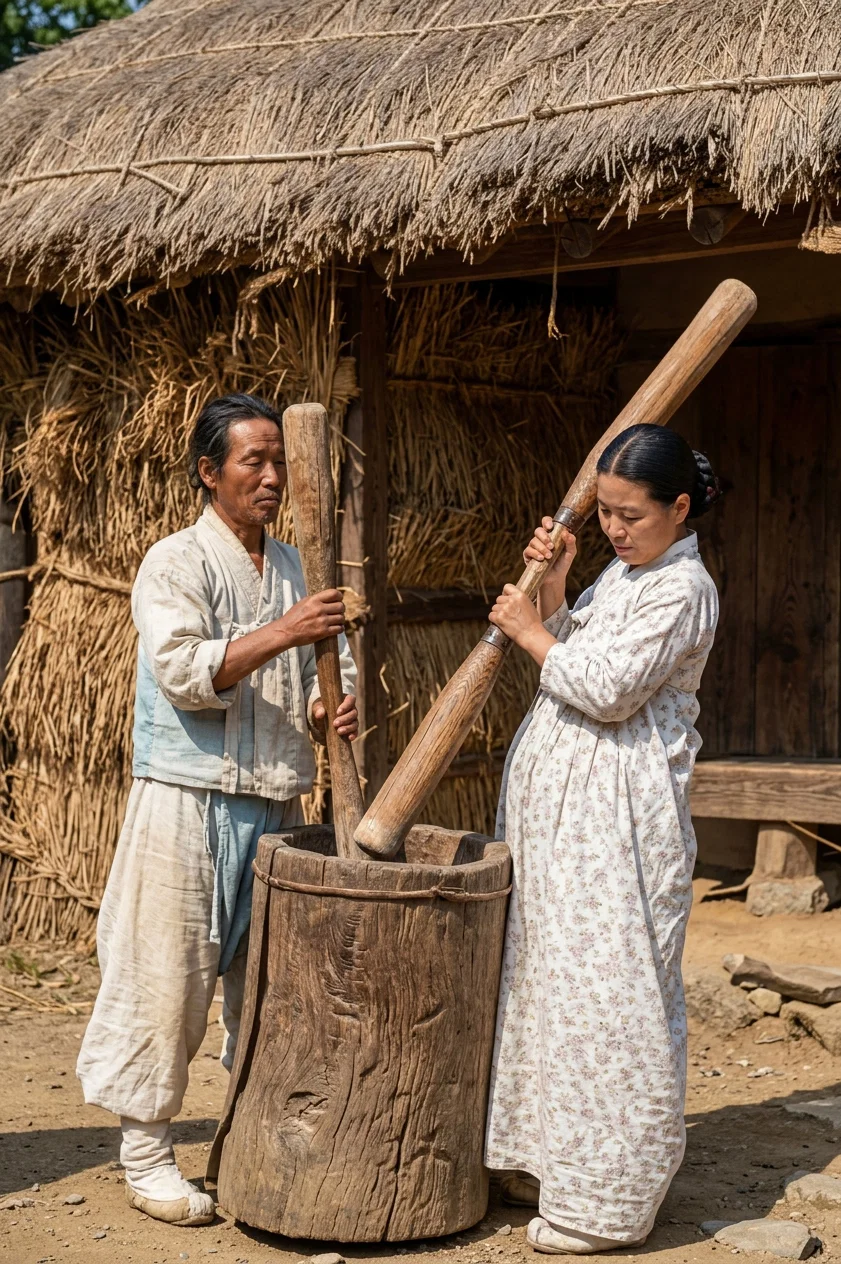
NATIVE KOREAN GRIST-MILL
I went around, and saw the different workers, and we appointed a meeting here at Soonan, where they and others might come together, and spend some time in studying the different points of present truth, and how to present them to others. The Sabbath is about all they lay much stress upon. Altogether about forty attended the studies. I made an outline of the different subjects, about as they should be taken up in a course of meetings. Then each of the laborers took his turn in presenting them to the people, and the others would take notes. Before any subject was presented, I went over it with the one who was to deliver the discourse. We all felt that we had spent a profitable time together, and the Korean workers expressed themselves as well pleased, and asked that they have a similar meeting the coming fall. Some of them walked fifty miles. One woman walked thirty-five miles, carrying her baby, to attend. We shall be glad when other workers are sent here.
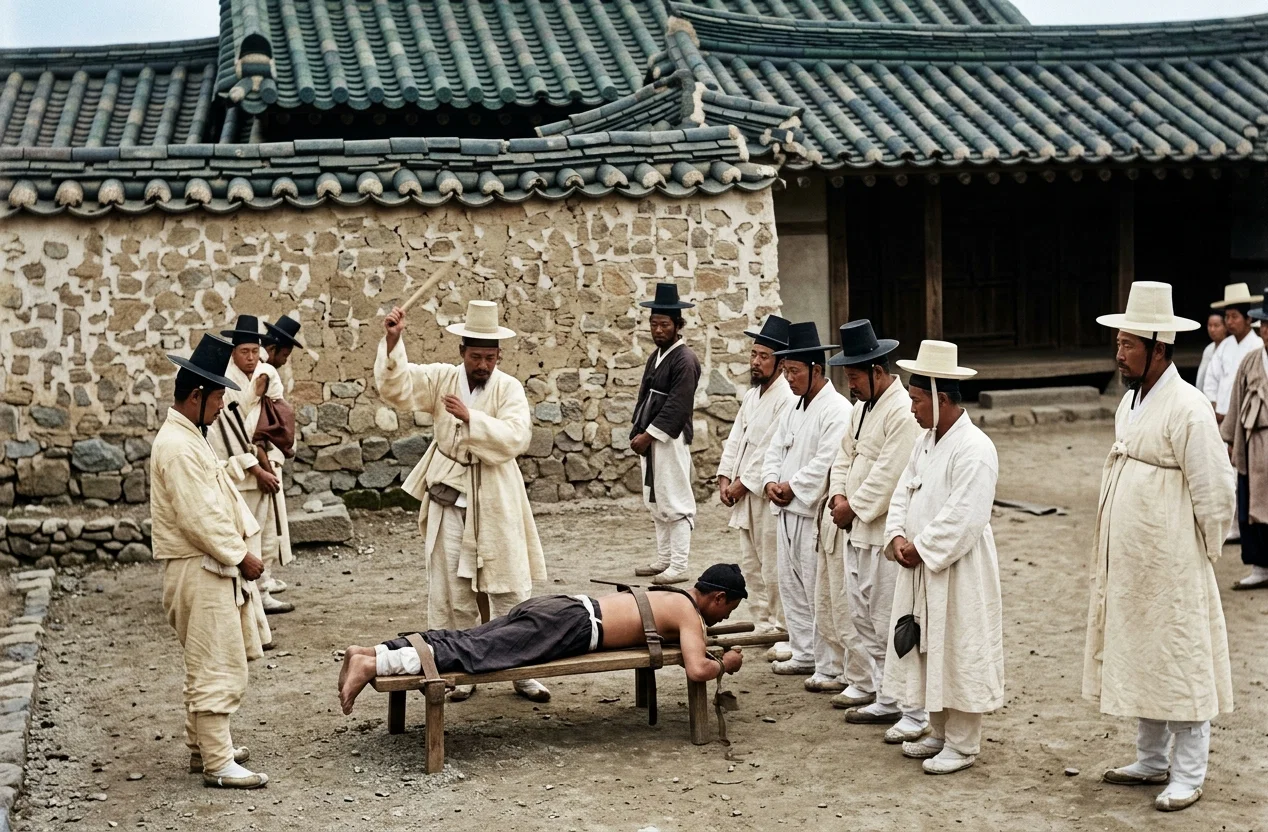
PUNISHING A CRIMINAL
Soonan, Korea.
Our Voyage to the Philippines
By M. SCHOWE-CALDWELL
M. SCHOWE-CALDWELL
At many of the Australian railway stations, our eyes have often rested upon the well-known advertisement containing the words, “The East is Calling.” It is indeed calling—calling for the truth, which alone gives light. This impresses one vividly in looking at these dark-skinned people, who, sad to say, have not been uplifted by the example of the white man.
After leaving Brisbane our first call was at New Britain. It was refreshing to view the land with its tropical richness of green. But one’s attention is drawn from this picture to nearer scenes. The wharf was thronged with natives, a strange sight to one unaccustomed to it. It was here that we spent the second Sabbath on the voyage. In the morning we took a quiet stroll on the shore, passing through a cool cocoanut grove. On returning we viewed a very strange scene. It was market morning; numbers of native women and girls had gathered from the surrounding neighborhood, bringing their products, which they exchanged among themselves. What a scene and a chatter! Without an exception, women and girls were smoking, and chewing the beetle-nut. Their products consist of yams, bananas, cocoanuts, pa-paias, melons, besides much of which we knew nothing. The remainder of the Sabbath was spent on the “Waldemar.”
New-year’s morning our boat arrived at Friedrich-Wilhelmshafen, German New Guinea. A little after sunrise we were alongside the wharf. Securing a boat, we, with two other missionaries, set off to visit the nearest mission station. This mission is owned by the Rhenish Lutherans, and is pleasantly situated on a small island. Our boat was noticed, and we were heartily welcomed as we landed. At once we were surrounded by children. We learned that school was just over for the day. It was then about 9:30 A. M. A church built of iron,15with plenty of ventilation, served for the schoolroom. The children were gathered in, and at our request sang for us. It pleased them very much when we sang in return the familiar hymn, “Jesus Loves Me.”
Close by the mission are some native dwellings, and here we learned something of their home life. The houses, consisting of only one room, are built off the ground about three or four feet; the walls are of bamboo; and the roof of cocoanut leaves. Here live not only the family, but beneath each home live the swine and dogs. The surroundings were very unclean, and we little wonder that so many are troubled with sores and skin diseases. From inquiries we learned that this mission had been in operation for fifteen years. The converts number twenty-seven. As far as outward appearance goes, one can not see the change, for they still smoke and chew. We are led to ask, “Is the whole gospel taught them by precept and example?” We trust that some day these poor people will learn more of the saving power of the gospel and of the special message for this time.
On this trip we visited two new ports of call, one being Iloilo, situated on the island of Penay. Next to Manila, it is the most important town in the Philippine group. We were interested not only in seeing the town, but in learning much that would be of use in view of our future work. It is an old town. A railway of twenty-five miles has been constructed, and eventually will cross the island. For the purpose of extending this railway, we landed eight thousand railway ties from Australia.
During our voyage we experienced some rough seas and strong winds, with rain. Considerable anxiety was felt, especially at Manila, concerning our boat. But, though seven days behind, we arrived safely, and all were well. We are now in our field of labor, which is not an easy one. We ask your prayers, that much may be accomplished. With God all things are possible, and to him alone we look.
Manila, P. I.
Two Pennsylvania Institutes
By I. D. Richardson
The canvassers’ institute in eastern Pennsylvania opened March 15, at Scranton, with a good number of canvassers, which increased until we had the largest class of the season. The institute was splendidly provided for. Elder W. H. Heckman, and his committee were very liberal in providing a good, old-fashioned institute; yet it was so managed that the expense was not large. Elder Heckman was with us part of the time, and rendered very acceptable help, giving some practical suggestions which were appreciated by all. Having been a practical canvasser, his remarks were right to the point.
The institute was held in some large rooms formerly occupied by the Y. W. C. A., having kitchen, dining-room, recitation-room, and three large bedrooms, which accommodated all very nicely. This kept all the canvassers together so we always had a full class. Brother Holman and his wife kept the house, and furnished us with a good, healthful diet, and also kept good order.
Brother Holman, who was elected State agent at the conference in November, has been working hard for the canvassing work in eastern Pennsylvania, and with the co-operation of other conference workers has been successful in persuading quite a number to enter the work. All in attendance seemed to sense the great responsibility resting upon them in placing before the people the warning of the third angel as quickly as possible.
We were much pleased to have with us S. W. Curtiss, of the Review and Herald Publishing Association, who seemed anxious that there should be no missing link, from the call-boy in the publishing house to the canvassers in the field, but that a golden thread should pass from heart to heart. All agreed that we as workers in the field should remember at the throne of grace the faithful workers shut up in the publishing house.
As the coming camp-meeting is to be held at Scranton, it was thought best to hold the institute there,—a wise plan, for several of the Scranton church who kept dropping into our meetings became interested, and will join our force of workers, and work in Scranton; we trust that in this way many may be interested in the truth, and led to attend the camp-meeting. Much canvassing has been done in the vicinity of Scranton, and it is believed that the camp-meeting will be well attended.
At the close of the institute each canvasser was able to give a good, fluent canvass of his book, besides managing many other difficult problems which generally confront a canvasser, especially at the door.
The institute closed with a good, live meeting, and every canvasser present was determined by the help of God to be faithful, and put in good time, working forty hours a week.
The western Pennsylvania institute opened March 29 with some earnest students, and a number of experienced canvassers present. The acting president, Elder I. N. Williams, was present the first part of the institute, and conducted some excellent Bible studies for us, but was compelled by press of other duties to leave soon. Elder J. W. Watt, a member of the conference committee, continued with us, and gave an interesting course of studies on the law of God. The institute was held at Johnstown, in the Seventh-day Adventist church. As at Scranton, some of the Johnstown members became quite concerned over their inactivity, and one took training for the work, and will enter it at once; another will, I think, arrange to enter the field soon.
We had an earnest class of students, and I believe that we shall see western Pennsylvania do good work with our good books from this time forth. The mining outlook seemed a little dark for a time, but now the cloud looks bright and shining.
Brother Bigelow has worked hard to build up the canvassing work, and we are pleased to see a number responding with the answer, “Here am I; send me.” Some in western Pennsylvania are taking up the health books; those who have been handling them report excellent success, though they have not been working in the best of territory.
Our institutes this spring have proved a great blessing to the churches where they have been held; on the last Sabbath of the institute we held a revival service for the Johnstown church, which proved a great blessing to all; feathers, ribbons, and jewelry were spoken against; the reproof was received kindly, and a whole-hearted consecration followed. There was a real sorrow for sin, and all felt that they must do all in their power to warn the people of Johnstown of a greater calamity than they have ever experienced,—the wrath to come.
We shall look with interest for some good reports from western Pennsylvania in the near future.
I. D. RICHARDSON, General Agent,Columbia Union Conference.
Asia Minor
By A. BUZUGHERIAN
TARSUS.—From January 7 to March 2 I had a rejoiceful visit to Tarsus. We studied in the Word of God together with the five brethren and three sisters, and the Lord came near and blessed us. Outsiders also would unite with us in the studies, among whom there are souls ready to obey. A brother who was residing in Mersine came to Tarsus for a short time to participate in the studies. Also a Greek brother attended our meetings, having come from sixty hours' distance, the most part of which he walked. This brother knows well the Greek language, and is learning the English language with great zeal. Now he is with me in Adana. He earnestly studies all our truths, and is very happy in the knowledge he has gained. We expect that he will return to his home to proclaim16the warning message for our time. Our brethren in Tarsus also are very desirous of learning the English language so that they may read our papers. One of them takes the Bible Training School, and as his wife knows English, they study it together. One of the brethren desired to be baptized while I was there, but because of the cold weather and of his weakness, it was delayed. We expect that many who have accepted the truth in this country will be ready to meet our Lord at his coming.
A. BUZUGHERIAN.
Progress of the Hindustani Work
Of the three hundred million in India, over eighty million speak the Hindustani language. Something is being done to get the truth before these people. From Sept. 1, 1905, to Dec. 31, 1907, 22,500 Hindi and Urdu booklets were sold or given away, also many smaller tracts; thirteen different native men came directly under the careful training of our laborers, with a view of preparing themselves to give the message to others; seven of these natives are now actively engaged in selling Hindi and Urdu literature; while during the time mentioned, $2,413.64 was raised by donations for the Hindustani work, and all except about $400 was expended in the support of laborers or in circulating the printed truth among these people. Thus a good beginning has been made, and God is greatly blessing both the work and workers.
New Zealand
By Ole Andres Olsen
At the close of our good camp-meeting at Cambridge West, I accompanied Pastor Cobb on a brief tour to Wellington to look after various matters, and to secure a location for their tract society and conference office, as they have sold the Beulah Hall property on Taranaki Street in Wellington. We secured a very favorable location at Lower Hutt, a small village some eight miles from the city of Wellington. The location is favorable, being convenient to the railway, the post-office, and having banking facilities. It will also be much better for the work than was the crowded city.
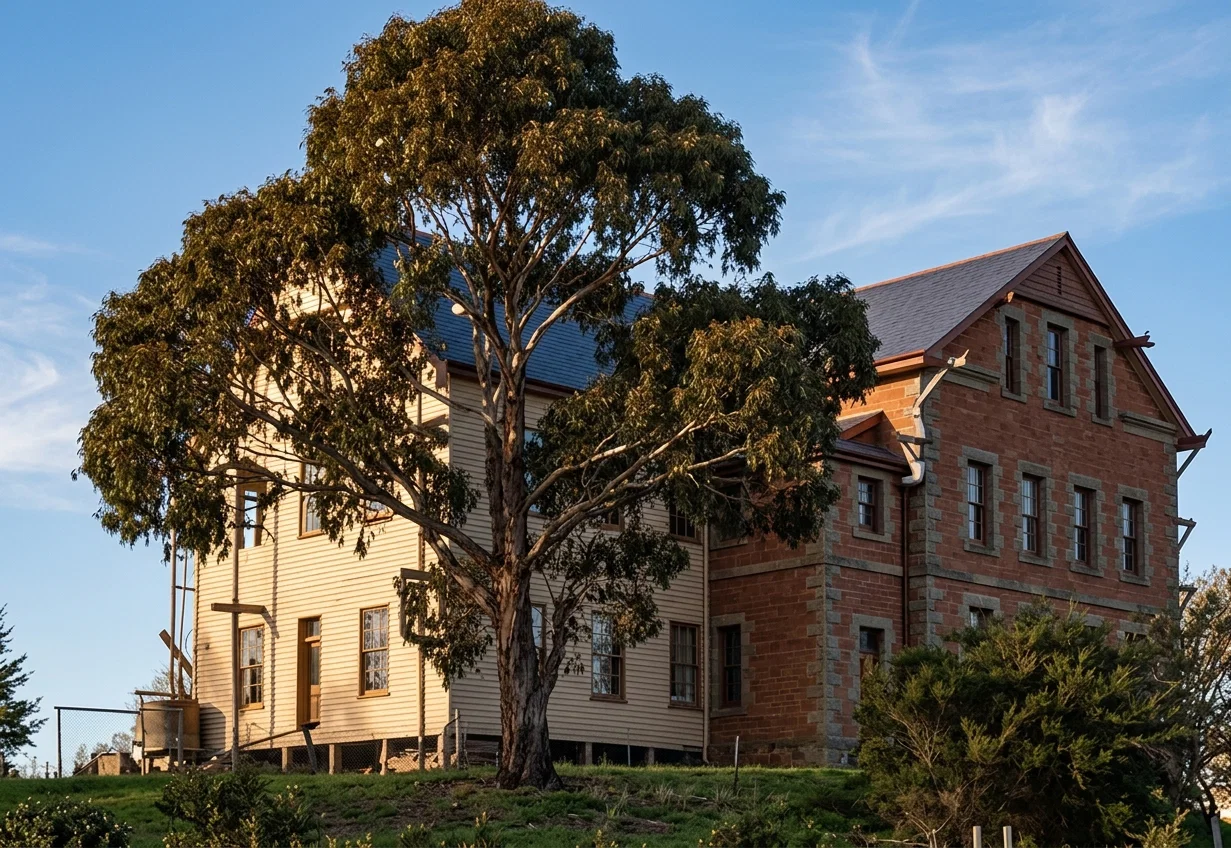
CAMBRIDGE SCHOOL BUILDING
During our stay we had meetings on the Sabbath with the church at Wellington and Petone, with a good interest. The time from Wednesday, January 29, to Monday, February 3, was spent at Auckland, where I held seven meetings. I enjoyed my visit at Auckland very much, and would have been glad to remain longer to follow up the interest with further meetings and visiting, but duty called me elsewhere.
There are greater blessings to be experienced if we will reach out after them, but many times we stand in our own way. Unity and love of the brethren is an important condition for the outpouring of the Holy Spirit on the church. This fact is made very prominent in the first few chapters of Acts. See Acts 4:32, 33. Christ has set forth love among the brethren as a test of discipleship. See John 13:35. The Lord is waiting for his people to get into a position where he can bestow greater blessings and power upon them. Our learning of Jesus, and becoming meek and lowly in heart as he was, would open the way for many blessings and greater efficiency in the church.
February 3 I returned to Cambridge to be present at the dedication and opening of the school, which had been set for that day. The weather was all that could be desired. While the school building was not fully completed, still everything was in readiness for the opening. Before the time set, 3 P. M., vehicles of almost every description, from the modern motor-car to the one-horse cart, came rolling in, filled with people, old and young. The village of Cambridge, and the neighborhood about the school farm, turned out in large numbers to show their interest and sympathy in the school and its enterprises, that were now to be launched. At the hour of opening, the chapel was full to overflowing, as also was the hallway at the entrance, and I was told that there were many below who could not obtain admittance. The exercises passed off very pleasantly, and made a good impression.
The mayor of Cambridge was present, and had a place on the platform. After the address by the principal, opportunity was given for remarks from any that were present. The mayor was the first to improve the opportunity, and spoke very kindly of the enterprise and its purpose, and wished us the best of success in our work. Then followed a number of speeches by prominent business men of Cambridge, and others in the community. They could hardly have given the enterprise a more hearty welcome than was extended on this occasion. After the close of the exercises in the chapel, refreshments were served in the dining-room.
The school is starting out under favorable conditions, and with an attendance of fifty to begin with. This is certainly very encouraging. The teachers are: F. L. Chaney, principal; W. J. Smith, Mrs. F. L. Chaney, Miss Mabel Piper, and Miss Nellie Sisley.
May the special blessing of the Lord be with this school, and make it a great blessing to both young and old of New Zealand, and to the work as a whole.