The Youth's Instructor, Vol. LII, No. 43

Voyage of Life

The Youth's Instructor

October 25, 1904

Review and Herald Publishing Assn. · Washington, D. C. · October 25, 1904

Voyage of Life

Our Father's will we all may do, And his commandments keep, If actuated by his love, And his requirements meet; But many times while on our way We lose our Guiding Star. We struggle on in depths of sin Till we have wandered far;
And then at last we find ourselves By Satan sorely tried. He seeks to drown our little craft, And sweep us 'neath the tide. How sad it is to lose the way That leads to joys above, Where all the saints of God will sing Of his redeeming love.
But if we've gone in ways of sin, And tossed upon the sea, Let's turn to God, who loves us still, And then forgiven be. “For good all things together work To those who love the Lord.” He's told us all to look to him, And feast upon his word.
So then if we have lost the way To that immortal shore, Let's steer our craft in waters sure, And not our sins deplore; But thank the Lord for strength divine To thwart satanic ruse; For we are his, and he is ours, If heaven's way we choose.
J. F. OLMSTEAD.

“My Country, ’Tis of Thee”

OLIVER WENDELL HOLMES wrote many poems for the reunions of his class at Harvard, the famous class of 1829, and one of them, written when all the class were gray-heads, contains these lines:—
“And there’s a nice youngster of excellent pith,— Fate tried to conceal him by naming him Smith; But he shouted a song for the brave and the free,— Just read on his medal, ‘My country,’ ‘of thee.’”
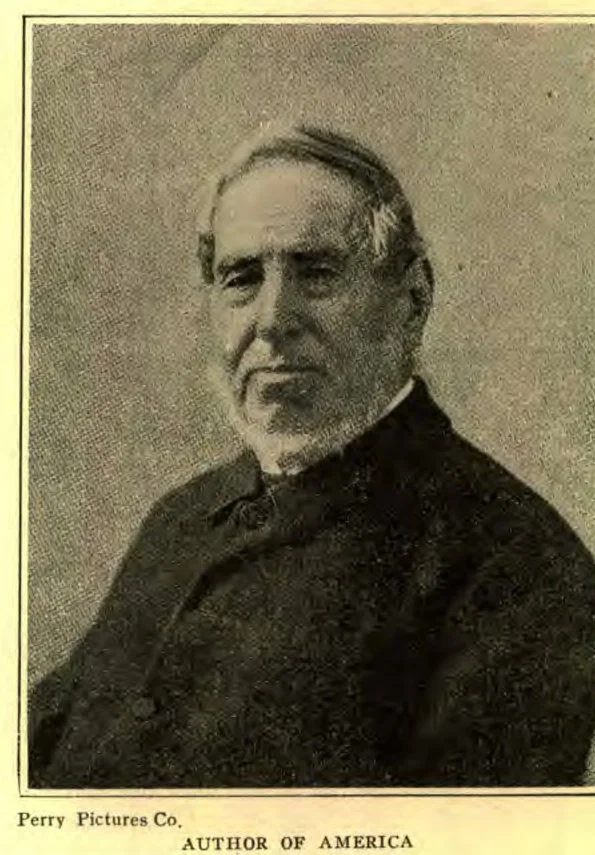
This “Smith” was Samuel Francis Smith, who wrote our American national anthem. He was born in Boston, Oct. 21, 1808; was graduated from Harvard, and studied for the ministry at Andover, becoming a Baptist clergyman.
It was while he was at Andover that he wrote the famous hymn. Lowell Mason, the eminent composer, had given him some collections of German songs for children, that he might translate them into English. “One dismal day in February, 1832,” Dr. Smith wrote long afterward, “about half an hour before sunset, I was turning over the leaves of one of the music books when my eye rested on the tune which is now known as ‘America.’ I liked the spirited movement of it, not knowing it, at that time, to be ‘God Save the King.’ I glanced at the German words, and saw that they were patriotic, and instantly felt the impulse to write a patriotic hymn of my own, adapted to the tune. Picking up a scrap of waste paper which lay near me, I wrote at once, probably within half an hour, the hymn ‘America,’ as it is now known everywhere. The whole hymn stands to-day as it stood on the bit of waste paper, five or six inches long and two and a half wide.”
AUTHOR OF AMERICA
AUTHOR OF AMERICA
This is the hymn:—
“My country, ’tis of thee, Sweet land of liberty, Of thee I sing; Land where my fathers died, Land of the pilgrims’ pride, From every mountainside Let freedom ring.
“My native country, thee, Land of the noble free, Thy name I love; I love thy rocks and rills, Thy woods and templed hills; My heart with rapture thrills Like that above.
“Let music swell the breeze, And ring from all the trees Sweet freedom’s song: Let mortal tongues awake; Let all that breathe partake; Let rocks their silence break, The sound prolong.
“Our fathers’ God, to thee, Author of liberty, To thee we sing; Long may our land be bright With freedom’s holy light; Protect us by thy might, Great God, our King.”
“I never designed it for a national hymn,” Dr. Smith said afterward; “I never supposed I was writing one.” Many of the best things come in just that unconscious way.
On the fourth of July of that same year, 1832, the hymn was first sung, under Mr. Mason’s superintendency, at a children’s celebration in Park Street church, Boston, and soon the song of the young poet became popular everywhere. It has never been adopted by our government as a national anthem, but it has been adopted by the people themselves, which is far better.
Dr. Smith became an honored pastor in several important churches. At one time he was a professor of modern languages, for he was familiar with fifteen languages, and some one who visited him in his eighty-sixth year found the vigorous old man looking around for a text-book with which to begin the study of Russian!
At one time he was editor of The Baptist Missionary Magazine, at another time of The Christian Review. For fifteen years he was secretary of the American Baptist Missionary Union. He was deeply interested in missions, and only second in fame to his national anthem is his missionary hymn, “The morning light in breaking.” It was he who did much toward saving the “Lone Star” mission in India, by writing his poem with that title. Other well-known hymns of his are “To-day the Saviour calls” and “Softly fades the twilight ray.”
The fact that “My country, ’tis of thee” is written to the same tune as the English national anthem, “God save the King,” has given rise to many stirring scenes at our Christian Endeavor conventions all over the world. Very often one stanza of each anthem is sung, the conclusion being one stanza of “Blest be the tie.”
This was done at the magnificent meeting on Boston Common, at the Christian Endeavor Convention of July, 1895. Eleven thousand persons were present in the great tent, and Dr. Smith probably never received such an ovation as when he came forward to read the poem which he wrote for the occasion, “Arouse ye, arouse ye, O servants of God.” The noble verses were read with much fervor, though in a voice whose strength had been stolen by many years.
On November 19 of that same year the aged poet passed away. He died in the harness, just as he was taking the train to preach in a neighboring town on the following Sunday. And so passed from earth the Christian patriot, whose love for his country widened out into the missionary love for all the world.— Amos R. Wells, in Christian Endeavor World.

Count Leo Tolstoi's Maxims for Boys

ONE of the greatest thinkers and advocates of a pure life in Russia is Count Leo Tolstoi. While his books and papers have been written for grown-up folk, in them are found many sentences intended for boys who have not yet gone out into the work of life.
Count Tolstoi, who is immensely wealthy, lives a simple life. He plows in the fields, eats only plain food, dresses like a peasant, and is a profound student of the life and work of Christ. His life is very pure. Some of the best things he has written to boys are translated herewith from his recent letters and papers:—
“A boy who will work for others will always work for himself, and the world be that much better.
“A boy that is tempted can overcome the temptation, and also make himself nobler, by work.
“Christ intended that young and old should always work; idleness is not natural; it is a disease which eats up the soul as well as the body.
“One of the first books I would give a boy who is starting to read would be the life of Christ. If he will read that once, he will read it again and again until he has made it a part of himself.
“We can not do wrong always if we accept the teachings of Christ rightly, and Christ's teachings and life were always for purity and work.
“The young should take out of their minds envy, selfishness, and false pride. We gain everything by being humble in spirit and acts.
“Let a boy guard his thoughts. He can not be too careful to have them always pure. The best manhood is always pure.
“I like to see a boy love the soil. The farmer's life is a noble one. Wonderful stories of life are to be found in the growing of a single kernel of wheat.
“Good books are well in their place, but the flowers, the grain in the fields, the trees, contain greater lessons than any book but the Bible can teach.
“Nations that ignore their boy life and do not uplift it must inevitably perish.
“I am an old man, and my time to go must soon come, but I would have all children live simply, think simply, and act simply. Christ's life was one of simplicity.”
Count Tolstoi is one of the strongest opponents of war in the world. He does not believe that war ever was or ever is necessary. Most of his famous writings are against war, and for universal peace.—Boys' World.

Be Courteous

Not long ago I attended church service in a city not far distant. I was a stranger to most of those present, but I shall not soon forget a young boy who sat near me. When the hymn was given out, he found it each time, and gracefully handed me his book. He was not tall enough to share it with me, so he gave it wholly for my use. As I took the book, I could but think, Here is a boy who is courteous; he has been well trained by a careful mother, who has taught him to be kind to strangers. His earnest face has often been in my thoughts since then, and my prayer is, “God bless him;” and as he grows in years, may he not forget to remember others, and seek to make them happy.
When a young girl, I was standing one afternoon with a group of young friends at the forks of a road, when a stranger rode up, and being undecided which road to take, asked the way. One girl gave him a pert answer, which would have misled him had he followed her direction. A quiet, plain-looking girl then stepped out from the group, and answered his question. With a smile he thanked her, and said, as he turned and rode away, “You reflect credit upon your mother and on your home training.” This incident made a deep impression on my mind, and led me to ask myself whether my conduct to others was such as to bring honor or dishonor upon my own dear mother; would people judge of my home training by my manners abroad? Have you ever thought of this? If you are rude and boisterous on the street, will it be said, “She has been brought up in a refined home”? “that boy has been gently trained”? Sometimes young people do not follow their good teaching; they get into bad company, and say and do things that they would be ashamed to let their parents know. Mother is not to blame for their rudeness; but some will condemn her, and she will have to bear the penalty of their ill-behavior.—Selected.

Seedless Potatoes

LONG ago, when the ancestors of our potatoes were yet snugly ensconced in Peru, ignorant of their coming fame, they were tiny affairs, hardly larger than a walnut, but they produced seed abundantly. Now that cultivation has enlarged their growth to lordly proportions, it has almost succeeded in depriving them of their seeds, so that potato seeds are very difficult to obtain in quantity, and growers must depend upon the familiar cuttings from the tuber itself.
Cultivation has in a similar way produced the seedless cucumber, the seedless or nearly seedless tomato, the seedless mango, the seedless orange, and many another seedless fruit.—Selected.

The Joy of Working

Rudyard Kipling wrote in one of his poems:—
“And no one shall work for money, and no one shall work for fame, But each for the joy of working.”
The ring of these lines is unmistakable. They are of true mettle. Every boy who is just facing life should memorize them for future inspiration.
The story is told of an Arabian monarch, who, having a son whom he wished to succeed him on the throne, took the lad one day to the foot of a high mountain, and said to him:—
“It is not well for the body or the soul to be idle. You will come here each day and cut perfect steps in the mountainside until you have reached the top. Then will I speak to you of other things.”
So the lad daily cut steps in the rocky front. At first his work was rough, but as he came better to understand his tools, he made more nearly perfect steps. In the morning, at noon, and often into the night, he toiled, until one day he found himself at the summit, and there, spread over the peak, were jewels of marvelous beauty and wonderful value.
He gazed at them in amazement, until his father came and said:—
“These, my son, are yours. You have earned them because your labor was done without thought of other regard than my good opinion. Now, indeed, are you fitted to rule my people.”
Simple as the legend is, it contains the gist of what the English poet wrote. That work is the best that is done because work is right.
Idleness, wasting of bright hours, complaining, dreams of impossible things, weaken and ruin the mind and soul. The making of slavery out of work is folly, because it embitters the heart and destroys faith and hope.
But accepting work as the best for all human beings, doing it, whether in the field or shop, because it is good to be busy, to help and be helped, brings its own dear reward to every person.
Work because it is right to work; because the God above us all meant that none should ever be idle; that all should be up and doing for the love of having a pure mind, strong arms and limbs, a firm determination for every difficulty.—Boys’ World.

Cultivation of Cocoa

THE cocoa, or cacao, plant is entirely propagated from seed. Two principal varieties are recognized in trade as profitable,— the red and the yellow. The latter is preferred because it is thought to yield a larger percentage of seeds than the red variety, and it requires less time to prepare it for the market. Although grown in a tropical climate, the young plants must be protected from too great heat, in the shade of trees, for some months.
The trees begin bearing in their third or fourth year, giving an increase of pods each year until twelve years old, when they are supposed to be at their best. A good average tree at this age yields from eighty to one hundred or more pods each year. Counting a dozen pods for each pound of cured cocoa, one can readily estimate the value of these plants. Although showing fruit more or less all the season through, yet there are but two real crops each year, the first in May and June, and the second in October and November. In Venezuela these harvests are designated as the St. John's and Christmas crops. The fruit is not all gathered at the first picking, but the ripe pods only are carefully cut from the trees. These are recognized either by their color or by the hollow sound emitted by gently tapping them. At the point where each pod grows, a soft cushion, or “eye,” appears, from which subsequent fruit is grown. Should the ripe pods be rudely torn from their setting, so as to injure this eye, the tree at this point would become sterile. It is therefore necessary to take them from the tree with considerable care; so those who gather the pods do so by cutting them off with a sharp hook, when the pods are in the tops of the trees, and with a cutlass when they grow down near the ground.
When cut from the trees, the pods are gathered into large heaps, near some open space, where they may be conveniently “broken” and “drawn.” This task is performed by a man and two or three women working at each heap. The man breaks the pods by striking them with a cutlass, and the women remove the beans with large wooden spoons, clean them of all attending fibrous tissue, and then deposit them in heaps on plantain leaves spread out in the open space. This done, the beans, or seeds, are conveyed away, and placed in a “sweating” house. This fermenting process is for the purpose of altering the status of the bean both as regards its taste and color. This sweating operation entirely relieves the beans from pulp, softens their native bitterness, and changes them from the pale crimson tint, to one of a rich mahogany color.
The method of this treatment is to put the beans into a hermetically closed room, densely packed together, and covered with plantain leaves, where they remain from four to seven days, according to the variety of the beans being treated, and commercial quality of the product desired. While undergoing this treatment the temperature of the place rises to about one hundred and forty degrees, which has the effect to throw off the carbonic acid, as well as some moisture.
When the rich brown color appears, the cocoa is taken out, and spread on barbacue trays, after being carefully assorted for the removal of foreign substances. They are then covered with red earth, and left for one day, in order to complete the process of fermentation. This last act assists to rid the beans of gummy matter, and imparts a deep-red color. They are then rubbed through the hands of women, until pronounced clean, when they are spread out on drying trays.
Great care must be exercised during the drying season, to have the beans frequently turned, in order to have them evenly cured. The length of time to be devoted to this part of the work can be determined only by an experienced planter.
J. O. CORLISS.

Bees—More Popular Than Nations

“BEHOLD, there was a swarm of bees in the body of the lion, and honey.” Judges 14:8.
The prophet here gives us an illustration of one of the typical characteristics of the honey-bee. Although this was during the days of Samson, about three thousand years ago, we find this same instinct in the honey-bees of to-day—that is, a tendency to take up their abode in the first convenient place they happen to find.
There is probably no one genus of the great order of membranous-winged insects that is more widely known than the apis, or honey-bee. Both the wild and domesticated species are thickly scattered all over this country, and also throughout the rest of the world.
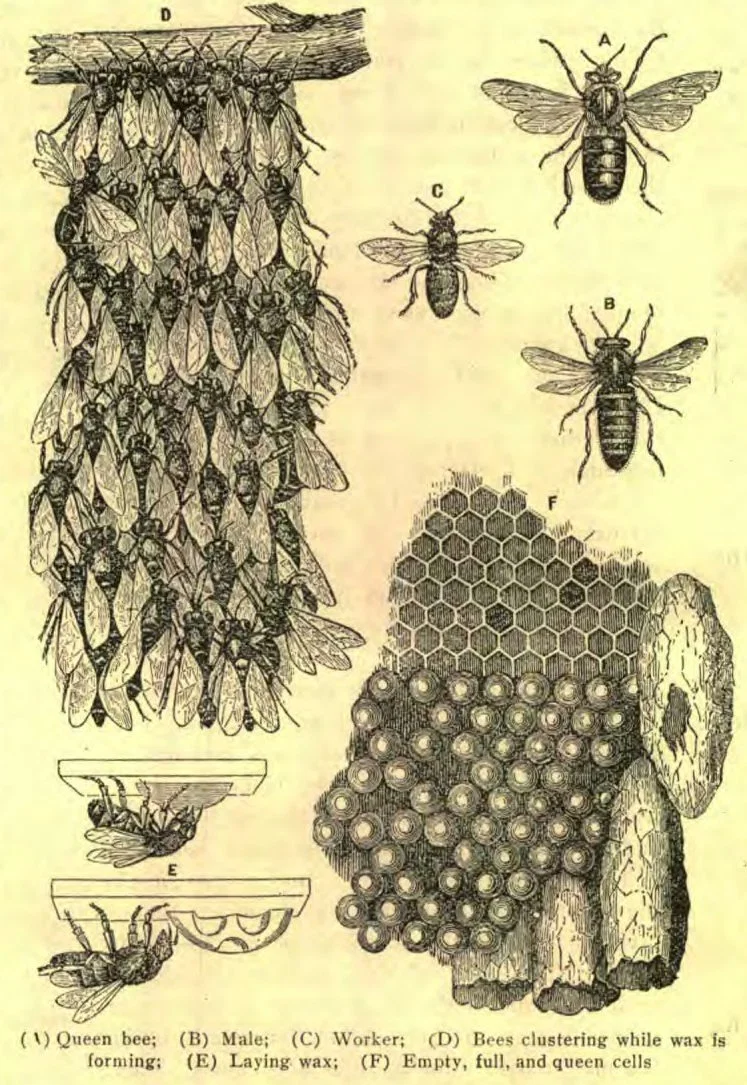
(A) Queen bee; (B) Male; (C) Worker; (D) Bees clustering while wax is forming; (E) Laying wax; (F) Empty, full, and queen cells
The bees of the United States are all foreigners to this land. I will mention only a few of the most common.
The black, or German bee, was imported to this country during the seventeenth century, and has spread from the Atlantic to the Pacific Ocean. Several other races were imported later—the Italian in 1860; and afterward the Egyptian, Cyprian, Syrian, and the Corniolian.
The black and Italian bees are to be found in the majority among the different bee keepers of this country; but during the last few years, since the raising of honey for commercial purposes has assumed such large proportions, many experienced bee men are testing the merits of the different races, trying to find the one best adapted to this country. There are several qualities which must be considered in testing bees. These are as follows: their honey-producing power, their ability to stand the winters, manner of storing the honey, and last, but not least, their general disposition.
The Cyprians, which are natives of the island of Cyprus, have the record in this country of producing the largest yield of honey, from a single colony,—one thousand pounds in one season. But because of the appearance of the comb honey, and the extremely sensitive nature of these bees, they have failed to become popular.
The Corniolians, or gray bees, from the Alpine province of Corniola, Austria, have the mildest temper of all, and can be readily handled without the aid of smoke. As they are good honey producers, and cap the combs whiter than some other races, and require less skill in handling than the Italians, they have justly retained their popularity.
There has been some effort to get a race of bees without stings, but it has not been very successful thus far. Absence of stings would be a very redeeming feature of the bees to many persons who are fond of honey, but do not like to raise the bees because of their stinging propensity. Like human beings, these little toilers receive a great deal of unjust criticism and condemnation. This is due, perhaps, to the tendency some persons have of judging bees from their first experience with them. I will not, however, say much in this respect, nor pass judgment upon those who have no interest in the little workers, because several times during my first experiences in bee keeping, I might have so thought myself. But after becoming thoroughly acquainted with them, I see no reason why one should fear their stings any more than he fears the heels of his pet horse, or the horns of his good-natured Jersey cow.
Many of the INSTRUCTOR readers will probably be surprised to know how much work is required to prepare a pound of honey from the nectar, as it is brought in from the flowers by the bees. To give you a faint idea of this work the following figures are given: The smallest number of bees that can carry a pound of honey is 10,154, by actual weight of the bees. This result is obtained by weighing the bees just before they start out on their journey, and then weighing them again on their return. The largest number required to carry a pound is 45,642. On an average about 20,000 bees are needed to carry one pound of honey, or in other words, one bee will carry one-twenty-thousandth of a pound. Just think how long one bee would have to work, and how many miles he would have to fly, and the number of flowers he would have to visit in order to supply one mouthful of honey for one of us!
After the raw material, or nectar, is brought into the hive from the flowers, it has to go through a ripening process. This nectar at first is quite thin and watery, and has a strong, rank taste, generally the flavor and odor peculiar to the plant from which it is gathered. The buzzing sound which one observes on closely approaching a hive, has to do with one process of ripening the honey. By the incessant moving of the wings, the bees drive currents of air in and out of the hive and around the honeycombs. This, together with the heat generated by the bees, causes the evaporation of the water and volatile oils from the nectar, and thus reduces it to the desired consistency; and also removes the disagreeable odors and flavors. They also add an antiseptic,—formic acid,—which is secreted by glands in the head of the bee. The honey is then capped, and left for further use.
Bees use several different kinds of material in their work, the main one being the wax used in building the combs for the honey. This wax is secreted in the abdomen in small pockets, and exudes between the rings on the under side of the bee in the form of little pearly disks somewhat resembling fish scales. These are picked off and formed by the bees into the proper shape. They also have a glue called “propolis,” which they obtain from the buds and crevices of trees. This is used to stop up holes and glue movable parts fast, and also to put around the top of the cells to strengthen them.
The bee is very self-sacrificing in many respects. After working hard during the honey season, for nothing but his board, he very soon dies, without receiving any compensation whatever for his labor, and leaves all his treasure for others. Quite often during the height of the harvest days he flies so much that he gradually wears off his wings until they become so short that he can not carry a load. He then crawls away and dies, having thus sacrificed his life.
What an incentive to Christian service should this example of disinterested labor be to us who have an intelligent view of the great work to be done in the field of the world, which is now ripe, ready for harvest. If the bee would stop to think that he would have to make twenty thousand trips and visit many more than that number of flowers before he would have a pound of honey, he might well be discouraged. But he thinks of nothing save the work in hand.
The hunting of bee-trees is not only desirable because of the fine, outdoor recreation that is secured in rambling through the woods, up hill and down, and across the creeks and streams, but it is also quite profitable, especially when one makes a good “find.” I can distinctly remember a number of trips I made with my father in search of bee-trees. It is best to go in the fall after the bees have had a chance to work all summer, and lay up a large supply of honey. The apparatus needed is very simple, consisting of three or four small boxes, a bottle of honey, and a field-glass or telescope.
One warm, sunny day father and I walked up the river, about three or four miles, where there is a heavy forest of large oak and elm trees. These trees are well suited for homes for wandering swarms because they so often have hollow places in them, especially the elms. Upon arriving at our destination, we began to look for a good location. After a little search we found upon a hill a small clearing, in which was a number of flowers. Bees were busy at work upon these. We soon found a large stump to place our boxes upon, and give our “guides” a good place from which to start. Each little box had some comb and honey in the bottom, and a thin cover for the top. As soon as I saw a bee looking for honey in a flower, I immediately caught him in the box. This I accomplished by holding the box underneath the flower on which he was perched, and then suddenly closing the cover over them both. For a few minutes my bee was badly frightened, and gave vent to loud exclamations. In a short time, however, he became aware that there was some honey near, and began to look for it. When I raised the cover slightly and peeped in, he was so busy loading up with honey, worth more than gold to him, that he did not notice me.
I then set the box on the stump, and waited for him to start home. It was but a little while until I saw him crawling up the side of the box, evidently well pleased with his liberal treat. At first he could hardly fly, so heavy was his load, but after a few trials he finally got a fair start, and away he went. Such a discovery during that time of the year, was worth keeping track of, so he circled round and round, taking his bearings carefully so he would know the place on his return. After satisfying himself as to the exact location, he made a “bee-line” for home.
When he started, our work began, because we wanted to know where that home was. We soon learned that he was going directly to a farmhouse, where bees were kept, therefore we had to try again.
After several unsuccessful trials, we observed several bees all going in the same direction, and decided there must be a “tree” down the hill by the creek. We were quite sure it was there because the bees went down the hill instead of keeping up in the air. So we walked slowly along, looking at every large tree, and watching closely to see whether any bees were around. At last my father said, as he saw a large elm tree, about three feet in diameter, “I believe we shall find a bee nest in that tree;” and sure enough, about thirty feet up the trunk there was an opening, from which the bees could be seen coming and going. As it was nearly noon, and our tramp had given us a good appetite, we decided to go home, first, however, cutting our initials on the tree, which would show to any other bee tree hunter that it had already been found. CLAUDE HOLMES.

THE WEEKLY STUDY

Paul Visits Jerusalem to Attend the Council

OPENING EXERCISES.
SCRIPTURES FOR STUDY: Acts 14: 27, 28; 15: 1-5; Gal. 2: 1-10.
REFERENCE STUDY: “Sketches from the Life of Paul,” pages 63-66.
A PERSONAL ADMONITION: Acts 20: 28-32.
OUTLINE OF TOPICS: —
Missionary meeting at Antioch.
Church disturbed by false teachers.
Paul and Barnabas contend with them.
Sent with others to council at Jerusalem.
Visit believers in Phenicia and Samaria.
Arrive at Jerusalem.
Missionary meeting with the church.
Question before the council.

Notes

Barnabas, a Jew and Levite by birth, and Titus (Gal. 2: 1-5), a convert from heathenism, accompanied Paul to Jerusalem to the council.
Paul calls the Judaizing teachers “false brethren,” who it seems did not work openly, but clandestinely. They “crept” in to “spy” out the liberty of the people, by teaching salvation by works instead of through faith. It is sometimes necessary to combat heresy which creeps into the church, and contend for the faith once delivered to the saints. Paul did this promptly and effectually.
The devil is continually at work seeking to divide the church. Controversies, then as now, disturbed the church. Unsanctified minds seek to draw away disciples after them. Among the apostles was a Judas. In the early church was an Ananias and Sapphira, and the murmurings of the Grecians and Hebrews. Now another heresy is disturbing the believers; but the truth will prevail.
“Moses of old time hath in every city them that preach him, being read in the synagogues every Sabbath day.” Jewish teachers were everywhere reading their written law. They abhorred the Gentiles and their worship. The barriers built up were similar, perhaps, to that of caste among the population of India, and race prejudice in other places.
Besides this the speculations of Greek philosophy—the teachings of Plato, Aristotle, and others—were discussed in the schools. Yet with all these obstacles, the gospel made its way in a few short years to “every creature which is under heaven.” Col. 1: 23; Rom. 10: 17, 18.
When Paul and Barnabas returned to Antioch from their first missionary tour, they “gathered together the church, and told them how God had worked for them, and how he had opened a door of faith to the Gentiles.” This was a real missionary meeting, full of life and power. Missionary meetings are lifeless only when the church ceases to engage in missionary work. When, like Paul and Barnabas, we have been laboring for souls, missionary meetings will be an inspiration to the soul.
Luke informs us of five distinct visits made by the apostle to Jerusalem after his conversion. “First, when he escaped from Damascus, and spent a fortnight with Peter; secondly, when he took the collection from Antioch with Barnabas in the time of famine; thirdly, on the occasion of the council, which is now before us in the fifteenth chapter of the Acts; fourthly, in the interval between his second and third missionary journeys; and, fifthly, when the uproar was made in the temple, and he was taken into the custody of the Roman garrison.”—Conybeare and Howson.
As Paul and Barnabas passed through Phenicia and Samaria, they visited a number of the brethren, and in every place held missionary meetings, “declaring the conversion of the Gentiles.” This caused “great joy” among the brethren. Titus was with them, who no doubt was a good sample of the Gentile convert.
“But certain Jews from Judea raised a general consternation among the believing Gentiles by agitating the question of circumcision. . . . This was an important question, and one which affected the church in a very great degree. Paul and Barnabas met it with promptness, and opposed introducing the subject to the Gentiles. They were opposed in this by the believing Jews from Judea. The matter resulted in much discussion and want of harmony in the church, until finally the church at Antioch, apprehending that a division among them would occur from any further discussion of the question, decided to send Paul and Barnabas, together with some responsible men of Antioch, to Jerusalem, to lay the matter before the apostles and elders. There they were to meet delegates from the different churches, and those who had come to attend the approaching annual festivals. Meanwhile all controversy was to cease until a final decision should be made by the responsible men of the church. This decision was then to be universally accepted by the various churches throughout the country.”—“Sketches from the Life of Paul.”
G. B. T.

The Youth's Meeting

Martinsville, Indiana
A BEAUTIFUL and inspiring scene presented itself to the view of the visitor to the camp Wednesday evening. It was the hour of the youths’ meeting; and, as the sun was sinking in the west, long shadows fell across the northern half of the encampment. Spread about in a semicircle on the greensward of the gently sloping rise north of the pavilion, were one hundred and fifty earnest, enthusiastic young people, with bared heads and bright faces. Outside these, was another broad circle of campers and visitors, listening, with deep interest, to the service. Standing at the foot of this natural amphitheater, was the leader of the meeting, Miss M. Bessie DeGraw, of Emmanuel Missionary College. The clear, melodious strains of song, the fervent prayer, and the earnest words of praise and exhortation to faithfulness in service, at such an hour, and under such circumstances, was a picture long to be remembered by all who saw it, and reminded one of those days of primitive worship when the sky was the vaulted dome of man’s earliest temple.
Many who have been in attendance at this camp-meeting, and others who have visited the grounds, could not fail of being deeply impressed with the earnestness of many of the young people. Seventh-day Adventists believe we are living in the last days, and that a great work is being done, and yet remains to be done, to warn the world of the soon-coming Saviour; and the youth of the denomination realize that a large share of this important work devolves upon them; hence their earnestness and devotion to the cause. Many of these are preparing themselves to enter the great harvest-field as ministers, Bible workers, teachers in Christian schools, and colporteurs; and this meeting was one of many held during this encampment at Martinsville, characterized by the same spirit of consecration, holy zeal, and earnest endeavor.
As the retreating sun drew after him the last rays of light beyond the western hills, and the first shades of evening prevailed, there arose, in the united chorus of voices, the strains of that grand hymn: “I would be, dear Saviour, wholly thine,” and the meeting was over.—Mrs. R. W. McMahan.

Christ Born in the Soul

Though Christ a thousand times in Bethlehem be born, If he's not born in thee, thy soul is still forlorn. — Johann Scheffler.

A Word to the Young People

WHERE are the young men and women who are learning to co-operate with God in soul winning? The world's greatest need is young men and women whose hearts and lives are consecrated to God's service; who, when he calls, will say, “Here, Lord, all I have I give to thee,—time, talents, and worldly treasures. Use me in thy service.”
Now is the time for you to begin making preparation for the work God has for you. Begin just where you are. Make up your mind that you will do these three things,—study your Bible every day, talk with Jesus every day, and work for others every day. Do not forget to pray. “Remember that prayer is the source of your strength.”
Self-sacrificing, energetic young people are the ones needed. “With all who bring forth fruit as workers together with Christ, self-love, self-interest, must perish; the life must be cast into the furrow of the world's need.”—“Education.” “The living force that conquers the world for God is the fresh enthusiasm of opening life. Years may counsel and stimulate and provide the means, but the hard work must fall on young strength and zeal.”—Geikie.
Just now we are surrounded with the beauties of nature, the beautiful trees and flowers, the velvety grass, all of which God has given to make this home delightful for his children. But soon winter will claim its own. Even so, dear young people, golden opportunities are fast passing. Do not permit it longer. You may need a better education, you may need more experience in personal work, you may need a closer communion with God. Begin now to plan how you may obtain a better education; souls around you are waiting for that kindly invitation to give their hearts to God, for that gentle word of encouragement and pleasant smile to lighten the burdens of life; seek earnestly for that closer communion with God. Let there be a rallying of our young people to the forefront, and a corresponding harvest of souls. KATIE COLEMAN.
Continue reading: Bible Enigmas