Your ShelfYour Projects

Review and Herald, Vol. 90, No. 37.

The Need of Power
Earlier text: Jewish Reckoning

Shut Doors and Open

VERA CHILTON
Rashke Jahan Regam and Babee Sahab are two bright, intelligent Indian girls belonging to Mohammedan families of good standing. From the beginning of my visits they took deep interest in their Bible lessons, and gradually began to awake from the drugged stupor of the Mohammedan religion. The workings of the Spirit were soon made manifest by the forsaking of many long-revered Mohammedan customs. The Naharram and Ramzan were neglected. The call of the faithful to prayer, five times daily, by the muezzin, from the minaret of every mosque, was no longer heeded, but a special time was set apart for prayer to the Saviour, whom they freely acknowledged to be the Son of God.
What holy, thankful triumph fills the heart, when once that fact is confessed by one of the adherents of the “false prophet”! As time went on, they read the lesson of the Saviour’s baptism, and this opportunity was used to bring baptism before them,—all it means, and the need to be born again. This lesson, through the working of the Holy Spirit, was accepted, and both girls felt the need of baptism and expressed their desire to receive it. What happy seasons were spent!
THE COMPANY OF MISSIONARIES WHO SAILED FROM SAN FRANCISCO FOR CHINA AND MANCHURIA ON AUG. 16, 1913
It then seemed that if these two girls could be brought together, it would be an opportunity for strengthening and encouraging each other. Their families were on calling terms, but some bitter family feud had separated them for some time. Nevertheless, the two girls managed to secure little seasons together on the roofs of their respective houses, and they strengthened and encouraged each other and were full of joy at the thought that when they came out they would be together. It was not possible for several reasons that they should take the step at once, but they asked me to teach them how to be true Christians in their zenanas. I gave them each a Bible—how glad they were to have it!—and soon they were having daily reading and prayer, each one by herself, midst the midnight darkness of Mohammedanism.
Then comes the sad part of this true little story, and ’twere well to be brief—O, the pathos of it! How jealous is Satan of the workings of the Holy Spirit! When these girls began to leave off their Mohammedan customs, it did not long remain unnoticed by the members of their households, and their hearts were stirred up by the evil one and filled with hatred and suspicion. Persecution to some extent followed, but the girls were not daunted. Rashke’s people said she had been baptized in her heart already. Stronger measures were adopted. Their Bibles were taken from them, and I was forbidden to teach them any longer. I still continued to call; though not allowed to teach, it seemed possible to help them by word and exhortation. But they were always mounted guard over, and now they have been removed far from my sphere of influence, and I know not where they are.
There remains little to be said, but it makes the heart bleed even to write—“O thou afflicted, tossed with tempest, and not comforted, behold, I will lay thy stones with fair colors.” Just a few weeks after, Rashke’s beautiful baby boy, the joy of the whole house and the pride of his mother’s heart, died after a few days’ illness. And what did they say? Who but Satan could invent such a fiendish weapon of torture in their hands to tempt this dear tried one to the uttermost? But surely God can overrule, and the thought of the Saviour’s bringing back her baby boy for her when he comes will surely be a great help to keep her faithful.
The sad part does not end here. A whole mohalla (district) has now closed its doors to the entrance of God’s Word because of these two girls, and another one seems at the point of being closed. I have had this experience before. As soon as the reader has reached the stage of accepting Jesus and wants to step out, it means that the worker is banished and the door is shut. But none of these things move me, as I believe firmly that in opening these dear women’s hearts to the reception of the message, God is opening a great door and effectual.
“Behold, I have set before thee an open door, and no man can shut it!”

MRS. MARY L. HANLEY

Love

MRS. MARY L. HANLEY

SUSAN was serving little Mary and Chester their suppers, when, becoming displeased, Mary declared she didn't love Susan any more.
“Don’t you love me?” questioned Chester.
“Yes, I love you.”
“Well, I’ll take your love and give it to Susan.”
Quickly flashed back the reply, “You can’t do it, for my love is in my mouf.”
Ah! how true this is. Our love does not extend beyond our mouths in many cases. It is easy to utter kind and pleasant expressions, and they are delightful to the ear; but why not have them come from the heart?
Even the children notice the superficial words and assumed sweetness of manner, and they quickly discern whether they are truly heartfelt or simply, as little Mary expressed it, “mouf love.”
How does our Father regard us when with our lips we declare, “I love thee,” and by our actions show that our thoughts are engrossed in worldly matters and selfish desires?
Thomas, Okla.

The Noon-Hour Prayer

“Evening, and morning, and at noon, will I pray, and cry aloud: and he shall hear my voice.” “And the Lord turned the captivity of Job, when he prayed for his friends.”
“To realize the full value of prayer, we must realize it as not only a means but an end; what boon or privilege we ask in prayer could be higher than the privilege of prayer itself,—the privilege of holding communion with the Most High?” The following lines from the pen of Howard Arnold Walter may prove helpful to some troubled heart:—

Answered Prayer

“The way was dark, I prayed for light To guide my soul through deeps of night; But God in wisdom knew me best, He sent the dark and bade me rest. “Beset by storms that would not cease, In agony I prayed for peace; God heard my prayer, but sent me more, The storm waxed wilder than before. “At last I cried, with humble breast, ‘Lord, grant no prayer that is not best. Henceforth thy will, not mine be done’— Behold, he granted every one.”

Requests for Prayer

273. A friend in New York requests prayer that her daughter may be so strengthened in mind and body that she will be able to attend school this year.
274. An afflicted brother in Switzerland, suffering from partial paralysis, desires prayer for healing. It has been very difficult for him to walk during the last fourteen months.
275. “I ask the noon-hour prayer band to remember my sister, who is in very deep trouble; my son, who has left this truth; and my little daughter, who is very ill,” writes a Michigan sister.
276. A sister in Montana desires healing from heart, throat, and lung trouble, if it is God’s will. She asks for prayers.
277. Another sister in the same State (Montana), who is suffering from catarrh, requests prayer that she may be healed of that affliction.
278. Still another Montana sister begs us to remember her invalid daughter in prayer.
279. From Ohio a sister writes requesting that we pray for her father, who is in a critical condition, and must soon submit to a very dangerous operation.

The Hygiene of Deep Breathing

W. J. CROMIE
Deep breathing highly oxygenates the blood and eliminates waste products from the body. There is an exchange of gases which takes place between the capillaries and the tissues, in which the blood from the lungs parts with its oxygen, and absorbs carbon dioxide, which is thrown out in the breath.
The brain is affected by deep breathing, as is shown by its tendency to cause giddiness, but this feeling soon wears off in those who cultivate the habit.
W. Marcet, M. D., F. R. S., says that deep breathing increases the power of sustained nervous effort. He claims that a man who in ordinary breathing lifted a weight of four pounds two hundred and three times in succession, after a rest and deep breathing for two minutes lifted the same weight seven hundred times.
Deep breathing quiets the nerves, and is useful in neurasthenia, as it increases the will-power. When troubled with insomnia, I have secured sleep by going to an open window and taking deep breaths for five minutes. I know of many others whom the same treatment helped.
Deep breathing will very often relieve constipation and indigestion, due to the vigorous rise and fall of the diaphragm. Add to this the influence of powerfully oxygenated blood, and the intestines perform their peristaltic movements, which are necessary for digestion, with more energy.
Exercise is especially effective in relieving constipation. In medical gymnastics deep-breathing exercises are used in anemia, nervous and digestive disorders, and disorders of the circulation.
In deep-breathing exercises we should aim for the following results: to strengthen the muscles of ordinary breathing, as the diaphragm; to strengthen the extra muscles of breathing, such as those of the shoulders, arms, and back; to preserve and increase the elasticity of the lungs, to develop evenly all their parts, to heighten permanently their capacity. Still other objects should be to expand the chest, to deepen the ordinary breathing and reduce its rate, and to stimulate the circulation of the blood.
There are thousands of air-cells in the lungs that ordinarily are inactive, and are used only in the act of deep breathing. If one persists in deep breathing for some time, these dormant cells eventually associate in the ordinary act of breathing. As without breathing one ceases to exist, so in proportion as one fails to breathe deeply one fails to live properly.

Pleasant Religion

“No person has enough religion unless he has sufficient to make him pleasant.”

The Friends Who Come Too Late

MRS. L. R. REYNOLDS
Just a poor little bird with a broken wing; It never could fly, but it tried to sing. So it sang a sweet song one bright summer day, And that song wakened echoes in hearts far away. In those tones full of pathos from the little bird's throat Was his heart poured forth in each plaintive note. Soon the birds all came flocking from field and from lane To join in the music and swell the refrain; And they chirped and they twittered as much as to say, We'll hold a bird concert with you every day. But that suffering bird that never could soar Chirped his dying note, and was lonely no more.
Just a soul that was feeble, decrepit, and old, Without any pleasures or friends or gold, Felt a pang in his heart that never would cease Till he put it in words, or in verse, if you please; Then he set it to music. 'Twas not very grand, But the quavering notes by the breezes fanned Went forth on their mission till an echo they stirred That touched other hearts, like the song of the bird. It awakened past memories which long had slept In their worldly hearts while the old man wept. And they haste, now too late, their neglect to atone: With that plaintive song went his last sad moan.
Ah! these friends who come late are of little account. So heedless are we when we're on the mount And they in the valley with broken wing, Or feeble and old and unable to sing. And many a heart is now lonely and sad Which we by our efforts should cheer and make glad.
Forgetful are we; and our minds so engrossed With our every-day cares that those things which count most Are neglected by us till at length there is heard Some quavering notes and our heartstrings are stirred; Then, too late, we oft flock, like the birds on the wing, At the feet of the singer our garlands to fling.
Wichita, Kans.

The Little That Helps

Give a little, live a little, try a little mirth; Sing a little, bring a little happiness to earth; Smile a little, while a little idleness away; Care a little, share a little of your hol- day.
Play a little, pray a little, be a little glad; Rest a little, jest a little if a heart is sad; Spend a little, send a little to another’s door — Give a little, live a little, love a little more. — Douglas Mallock.

Hawaii

HONOLULU.— We are glad to report an encouraging outlook in the work here. The attendance at our regular meetings has been good, and we always have eight or ten visitors Sunday nights, which is good for Honolulu.
Several are studying the truth regularly. Among these is a young woman, a member of the British consulate, with whom I hold Bible readings twice each week. Miss Scharffenberg, of Korea, met this lady en route from the East, and introduced the third angel’s message to her. As the British consul was to be stationed here for some time, she left me to complete her work; and I am deeply thankful for the blessings received in teaching this dear sister this glorious truth. Thus far she has accepted every phase of the message eagerly and earnestly, and desires baptism as soon as Elder Conway comes. My husband also has several Hawaiian Bible readers.
Our weekly jail meetings are greatly appreciated by the men there, and I am sure some of the seed sown is falling on good ground and will bear fruit in the kingdom.
Last Sunday night, by invitation, my husband spoke to the Christian Endeavor Society at the Kaumakapili church (one of the large Hawaiian churches), while I assisted in the singing. We then hurried to our own services. Once each month the Sunday forenoon service is conducted in English at this church, and my husband was urged to fill the next appointment, using any subject he may choose. This opportunity he is glad to improve.
In our Sabbath-school we have classes in Hawaiian, Portuguese, and Chinese, besides the English classes. Our Russian brother tries to learn through the interpretation of his little boy.
Next Sabbath we expect to organize our first Young People’s Missionary Volunteer society, and anticipate a good interest. One young Portuguese lad sold “Heralds of the Morning” to the amount of $1.50 in about six hours, his first day in the field. I am sure he will earn his scholarship. He and his sister are very successful in selling our papers and magazines.
The medical work is growing, and Brother and Sister Bartholomew endeavor to improve every opportunity to teach the truth. I am sure this work will help to build up the church here.
How we may warn the other islands of this group in the best way is a question still. One of our Hawaiian brethren has offered to equip us with an automobile-bus and to accompany us on a missionary tour of the islands, preaching as we go. This plan may be a good one.
Yesterday Elder Piper, Elder Fulton and his wife, and Brother Allum spent the day with us, en route to Australia. We greatly appreciated the encouragement they brought us. We expect to greet a large company next month also. It is indeed a privilege to be stationed on “the crossroads of the Pacific.”
The progress of the work as reported in the General Conference Bulletin cheers our hearts, and we ask an interest in your prayers that we may ever prove faithful to the work committed to us.
MRS. MABEL MARVIN-McKEAGUE.

Prosperity in Drought

THE following report of E. E. Covey, field agent of the New York Conference, again demonstrates that drought and poor crops do not hinder the work of giving the message through the circulation of our literature. We can always sell books in times of prosperity, and in times of adversity our possibilities seem unlimited; so there appears to be no hindrance to the prosperity of this work when the workers work.
We quote the following from Brother Covey’s letter of August 27:—
“I was out last week delivering books with one of our boys, and we were in one of the drought districts in our part of the State, but had good success.
“On one of our trips we found where there was a herd of cattle all dead in a large pasture from lack of feed and water. This was a pasture that was never before known to lack either feed or water, but this time both were entirely gone, and about sixty or seventy head of cattle were lying dead upon the ground. Under these terrible conditions we are taking orders in nearly ten out of every fifteen homes. Monday we called at nine homes and took five orders. Tuesday morning in two and one-half hours we visited four homes and took a good order in each one of them.
“Another young man, whom I was helping to get started in the work, and I called at ten homes and secured ten orders. This is the kind of results the Lord has been giving us here in eastern New York ever since this drought has been at its worst.
“I am writing of those with whom I have been out in the field during a short time. But all of the workers are having good success when they are alone.”
D. W. REAVIS.

Wiser Than Some Men

The snapping turtle will endure many indignities, but he draws the line at the blowing of tobacco smoke in his face. Long-suffering human victims of that very common practise will find it easy to applaud the spirit of the snapper as illustrated in the following incident reported from Homer City, Pa. The offender was an Italian:—
“Me out in woods and see funny box walking along creek. Me pick him up and shake him. Sometimes he have legs and sometimes not. He have no head. Me take him home and show him to my pal, Antonio. Antonio he say him animal lives in water sometimes, sometimes on land, and carry house on his back. Me tap house and find him hard, hard, but no head, no eyes, no mouth. Antonio shake him, but no head. Me get my pipe, light him, and make big smoke. Me take funny box from Antonio, shake him more and look in him, but no head. Me blow smoke in him, out comes head quick, bites off my face, and jumps back in box. Me no like that animal, and tell Antonio take him back to woods.”—United Presbyterian.

The Value of Persistent Earnestness

“SYSTEMATIC and persistent earnestness seldom fails to accomplish something worth while.”

No Neutral Ground in Christ

“IN the matter of our relations to Christ there is no neutral ground. Every man in the world is a Christian or he is not a Christian. He is either a friend to Christ or he is an enemy to him. He must be either the one thing or the other. Jesus’ own words are, ‘He that is not with me is against me; and he that gathereth not with me scattereth abroad.’ ‘Choose you this day whom ye will serve.’

Meetings of the Scandinavian Union

From June 18 until July 20 the five Scandinavian conferences held their annual meetings. The Denmark Conference and the Union District had their meeting at Aalborg, the Finland Conference at Tavastehus, the Swedish Conference and the Swedish Mission fields at Gotenborg, the West Norway Conference in Stavanger, and the East Norway Conference at Christiania. Besides Elder J. C. Raft, who attended all the meetings, Elder J. T. Boettcher assisted at Aalborg and Tavastehus. The writer helped at Aalborg, Gotenborg, and Stavanger; Elder L. Muderspach in the Christiania meeting; also Brother Erik Arnesen assisted in most of these meetings. The former officers were reelected throughout, with the exception of those of the Swedish Conference. Though Elder S. F. Svensson had served the conference for a number of years, yet in view of the fact that Mrs. Svensson preferred to remain in the States, a change was made, releasing Elder Svensson; and Elder O. Nelson was selected in his place.
The meetings were well attended by our people, and in most of the places there was also an excellent outside attendance. A splendid interest was shown in our missionary work. The ten-cent-a-week plan received considerable attention, and all promised to do their best to reach this standard the present year.
There was quite a harvest of souls in all these conferences. In Finland, 46 were baptized, in Denmark 23, in West Norway 12, in Sweden 4. During the first quarter of 1913 there were 47 additions in the union, during the second quarter 166, or 213 in the first six months of 1913. Their net gain was 113. There seems to be a steady emigration of our people to the States, five members having moved to America during this period.
The tithe during the two quarters amounted to $15,700, quite an increase over last year. The offerings amounted to $2,950.
This was my first visit since the Christiania house had been enlarged. I was much pleased indeed to find that the treatment-rooms, which now occupy a good part of the old publishing house, have proved so successful. The publishing work is also constantly developing with the increased success of the canvassing work in Denmark and Norway. The property returns not only a good rent, but with the prosperity of the publishing house and the treatment-rooms, they are able constantly to lessen their debts and increase their present worth.
We spent some time also at Skodsborg, and were pleased to find such excellent patronage; at times as many as seventy first-class patients have to wait for weeks to obtain a room in the sanitarium. As the treatment-rooms are rather primitive, and more room is needed for patients, it was decided that a new building should be put up, uniting the present school building with the sanitarium, and giving not only better treatment-rooms, but also more rooms for patients. It was well understood that, though we had to incur some debt in providing this increased facility, no further enlargement should be made until this new building was entirely paid for. The food business in Copenhagen has developed so well that they had almost sufficient money to put up the much-needed building.
On my way from Stavanger I also called at the Frydenstrand Sanatorium, which formerly was used as our college, and later was run as a sanitarium, but has been taken over recently by Brother P. A. Hansen and been considerably improved. There was a good patronage there at the time, and we hope that much good may also be done by this institution.
We were pleased to learn of the prosperity of the school work at Skodsborg. Brother Arnesen was reelected director, and there seems to be a far better outlook for securing young people for workers in this field—the greatest lack indeed of all.
We were also glad to learn that the work is advancing so well in the Icelandic field; there we have only two workers. Brother Olaf Olsen was able to baptize ten persons the first quarter, bringing up their membership to forty-two. The total membership in the Scandinavian Union now is 3,496. Their total active working force is sixty-five. We hope that in two years more Scandinavia will not only become a sturdy factor in building up the finances of our union, but also prove an excellent recruiting-ground for workers both at home and abroad. L. R. CONRADI.

B. JUDGE

Sumatra

We wish we could transport the readers of these few lines across to the land where they were written, Sumatra, that they might see some of the sights and scenes that abound on its shores.
Passions burn deep in the hearts of the people who inhabit this land,—passions in their multifarious forms which degrade the soul and bring man down to the lowest depths. Perhaps you ask, Then why should you like to transport us to see such sights as these? Ah! not that you might see these scenes without seeing in its contrast the soul that has been won from such depths and translated into the kingdom of God's dear Son.
I have in mind one young man who was so bad that his parents, having exhausted all other plans at reformation, tried to bring him under the influence of Christianity, thinking there might be something in it that would restrain their son. However, they only wanted him to become a good young man; they did not want him to become a Christian and cast off his parents' religion. Just as long as his parents tried to bring him under Christian influence, he did not want anything to do with it. But one day, when they were no longer interested regarding the influence of Christianity upon him, God touched his heart, changed it, and today he is a worker for God. At times when he is at work among the people, they remind him of his past life; then springs forth his testimony, “I am not ashamed of the gospel of Christ: for it is the power of God unto salvation to every one that believeth.”
Here is a work that is worth giving your life for, here is a cross worth lifting high above the world, here is the gospel worth proclaiming to earth's remotest bounds. By your prayers, by your means, by your own surrendered life, to go, to do, to be what he may bid you,—by these means will you not help us to give it? Perhaps God is making his last call to you for help.

B. JUDGE

Important Meetings

AT the recent good camp-meeting held at Corry, Pa., it was arranged to hold eighteen or twenty general meetings in the West Pennsylvania Conference, in October and the early part of November. But a small portion of the membership in our conference was present at the camp-meeting, not more than one hundred and fifty adults being in attendance from the churches. It was felt that the blessings of the camp-meeting should be shared by all the brethren and sisters not present at the meeting; besides, our neighbors and friends in every community would greatly enjoy these general meetings, and we hope that they will prove a great blessing and encouragement to the work in this conference.
Those representing the churches expressed a strong desire that meetings should be held as follows, ranging from two to four days in length:—
Millport, October 1, 2; Shinglehouse, October 3-5; Sunderlinville, October 7, 8; Jimtown, October 9-12; Coudersport, October 15-19; Ridgway, October 23-26; Lock Haven, October 28, 29; Clearfield, October 30 to November 2. These meetings are to be attended by Elders B. F. Kneeland, I. N. Williams, and G. L. West.
Photo by Conrad F. Haeseler
GOSPEL TENT IN PHILADELPHIA
Photo by Conrad F. Haeseler GOSPEL TENT IN PHILADELPHIA
Bradford, October 2-5; North Warren, October 9-12; Erie, October 16-19; Corry, October 23-26; to be attended by Elders W. F. Swartz and W. A. Westworth.
Huntingdon, October 1, 2; Six Mile Run, October 3-6; Altoona, October 7-12; Johnstown, October 16-19; to be attended by Elders J. W. Watt and C. F. Ulrich.
Brother V. O. Punches will attend such of these meetings as he thinks will best advance the book work in the conference.
A large meeting will be held in Pittsburgh a little later, at the dedication of the church now undergoing repairs. Also a general meeting will be held with the German brethren in that city and its locality, and another with the colored brethren, besides one at Washington. The dates of these latter meetings in Pittsburgh and Washington will be announced later, but our brethren in the conference should plan to attend them on the first day. The meetings will begin on the evenings of the first day named, and both day and evening services will be held until the close. Let there be earnest prayers for great blessings at each of these meetings. Invite your friends and neighbors to attend. Where there is a paper published in the place, see that public notice is given of the meetings in advance, and also during the time of the meetings. We should pray for and expect great blessings. I shall attend as many of these meetings as consistent with other duties.
We shall make an effort to follow up the meetings with longer efforts wherever the interest among those not of our faith demands it. Therefore, brethren, do all you can to make these meetings a great blessing to yourselves and the community. R. A. UNDERWOOD.

In the Bahamas

Having received an invitation on June 19 from the Mission Board to make the Bahamas our field of labor, and follow up the work of Elder W. A. Sweany, we accordingly set sail from New York on the “Seguransa” of the Ward line on July 11, and reached Nassau, the capital of the Bahamas, on the fifteenth.
The members of the little church here, having been notified by cablegram when to expect us, were at the docks and gave us a very hearty welcome. Brother J. P. Simms, being there in his motor-car, soon took us over the city, and helped us to select a place in which to make our home. As our goods were on the same boat that we came on, it did not take long to get settled.
We found a very earnest company of believers here. I think I have never seen their equal for faithfulness and liberality in the States. They are also awake to the responsibilities that rest upon them to give the message to the people around them.
Many are ready to listen to the truth for these times, but the tendency to stick to old habits and ways makes it hard for them to obey. We have been holding meetings for the public in the little chapel in which our people meet, and they have been well attended. Several are stirred to investigate the Scriptures. We feel quite sure God will give us some fruit as a result of these efforts. For the past two weeks we have been trying to secure the use of the Masonic hall, the largest and most popular hall in the city, in which to hold a series of meetings, and now we are quite sure we shall get it, and begin services next Sunday evening. Here we can invite the most influential and respectable people in the city. We find that as the result of the careful work done by the former laborers here the cause of truth is held in esteem by most of the people. It is with courage that we take up the work, and our desire is that we may leave nothing undone that we can do to make it a success, that when the Lord makes up his jewels, many may come from the Bahamas. JAS. H. SMITH.

R. E. HARTER

Pennsylvania

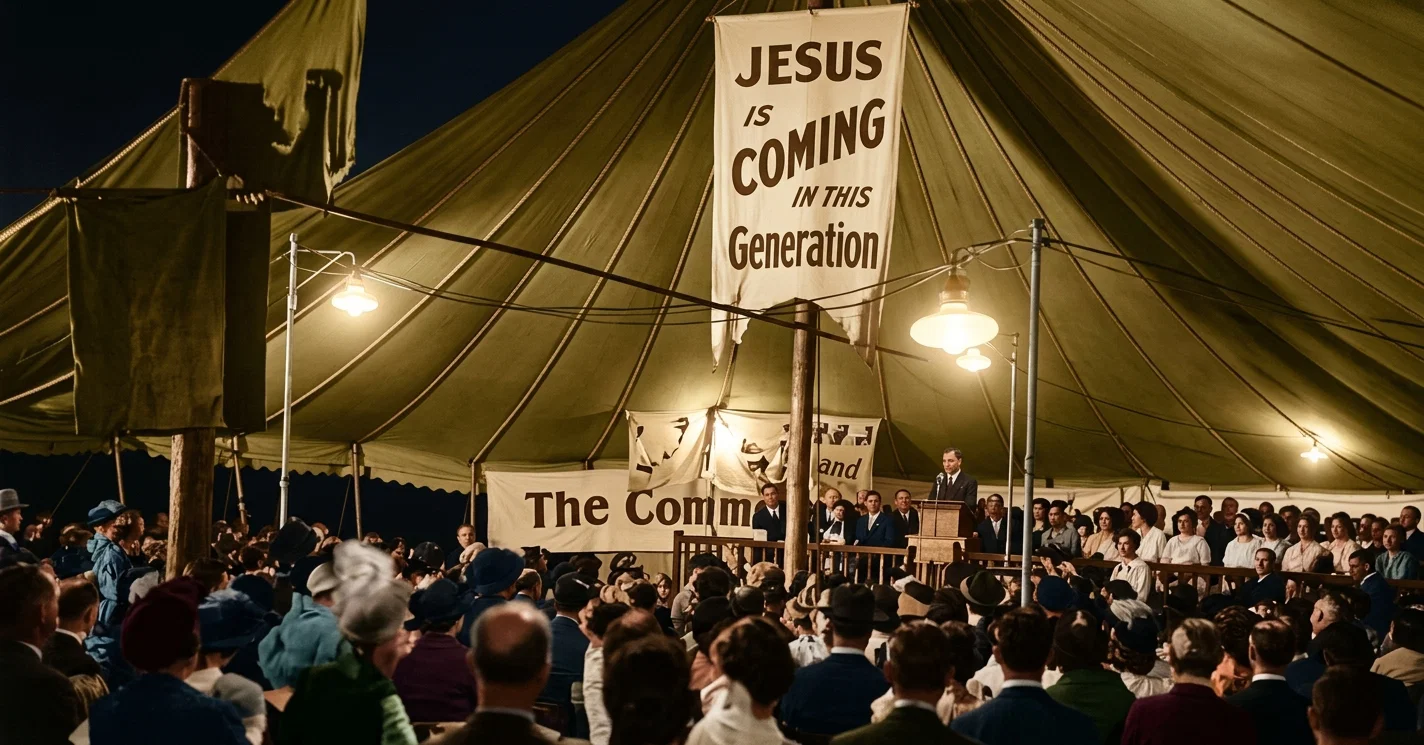
PHILADELPHIA.—On July 13 a strong effort was started in the heart of the best residential section of West Philadelphia, on Thirty-eighth and Christian Streets. A large new tent was secured, and fully equipped with electric lights, good seats, and in fact, everything that would give attractiveness and provide comfort for those who would attend the services.
From the very first, the interest has been good, the attendance on Sunday nights reaching as high as five hundred persons. Last Sunday night, however, the subject, “The Battle of Armageddon,” drew nearly seven hundred. The accompanying illustration gives a sectional view of the tent at the close of a service.
One interesting feature of the meetings is the way the people crowd to the front at the close of the service to receive the literature which is freely distributed, and to examine the many books we keep on display, of which a large number have been sold. A club of one hundred Signs is sold each week from house to house, and subscriptions are taken by our faithful Bible worker, Miss Jenette Morris, assisted by Mr. Harold Richards, who also helps in the evangelistic work. Mr. Charles Gourlay has rendered good service as tent master.
The meetings begin promptly at 7:30 P. M., every member of the tent company being in his place, the large choir, led by Henry De Fluter, opening the service with song. The influence the singing has upon the people is manifested by the way they remain after the meeting is dismissed, to listen to and join in the singing of old, familiar gospel hymns. Elder J. S. Washburn, of Memphis, Tenn., has recently connected with the effort. We hope to see many others take their stand with those who have already accepted the truth.

R. E. HARTER

The Arkansas Camp-Meeting for the Colored People

This meeting was held on the campus of our intermediate industrial school, which is located about five miles from the village of Devall Bluff, Ark. There was quite a full attendance of the believers in the State. We expected some outside help, but no ordained ministers were present except the conference president and myself. Therefore I had to do all the preaching at night, as it was not thought best for any white Seventh-day Adventist to be on the premises even, at night. But during the day, as often as it seemed wise to do so, the president and State missionary agent were with us, and rendered valuable help, returning to the village every night, where they had a rented room.
This might seem strange when I state that the greater part of our audience every night was composed of white people, and one night there was not a single colored outsider present, the white people filling the tent so full that we could scarcely find room for our own folks who had come from different places. These country white people came in wagon-loads, and some in buggies; some of them I learned came as far as five and six miles to attend our meetings. I never witnessed the like before. And they were as orderly as if it had been a meeting conducted by white people. Of course our manner of carrying on the services was something uncommon for colored people, who usually connect much emotionalism with their worship; hence these white people were constrained to respect us and our services. How I wished I could shift this white audience over to our white brethren there! But it was out of the question, as the meeting was distinctly colored, and held on the premises of a colored institution.
The Spirit of the Lord was in our meeting in a marked manner from the beginning to the close. The first manifestation of his presence was the voluntary confessing and putting away of sins. There was a marked degree of harmony and fellowship generally among those on the ground. Some doubted our success in holding a camp-meeting out here in the country, but when it closed, it seemed to be the unanimous opinion that this was the best camp-meeting we ever held in Arkansas, from almost every point of view.
J. W. DANCER.
Continue reading: Spreading the Message in India