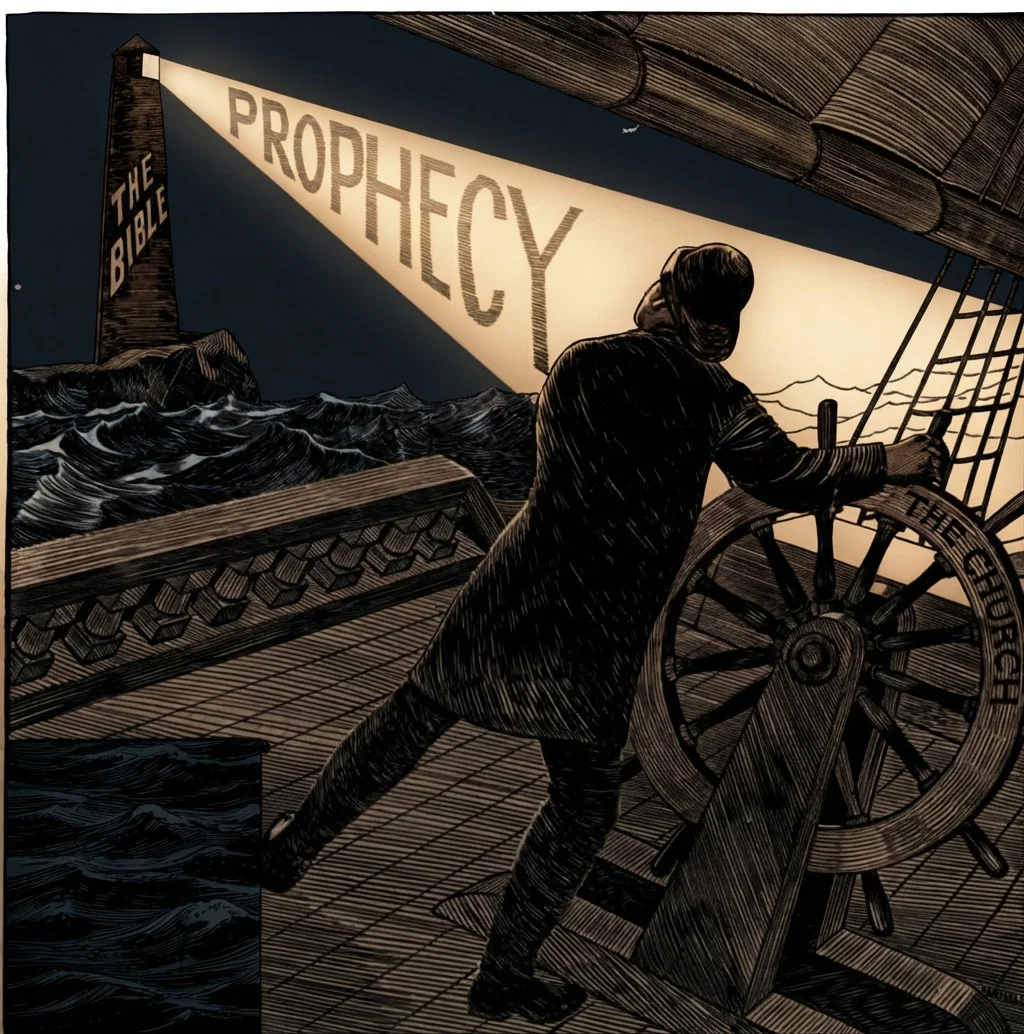
We must examine ourselves by a proper standard. To find standards by which to try our intellectual treasures is easy. But what is the standard of morals?
The common measure of character to-day is not a safe standard. Tares and wheat grow together till the harvest, but the angel-reapers will make a fearful separation in the day that shall burn as an oven. A man without a wedding garment may seat himself at the supper of the Gospel; but detection, exposure, and confusion await him at the inspection of the guests. Not a few will say, "Lord, Lord, have we not prophesied in Thy name?" to whom the Judge will reply, "Depart from Me," "I never knew you."
Nor is sincerity the standard of innocence. We may unintentionally err through ignorance; but this ignorance may be culpable. It certainly is so if it is owing to a neglect of our own faculties or of our means of information.
The subject is bound to obey the government. This obligation involves the duty of inquiring into the law. If the law has not been placed within his reach, or if he is unable, with all the aid he can obtain, to understand it, he is exonerated from obedience; otherwise, "ignorance of the law is no excuse."
Suppose a criminal objects to receiving sentence, because he did not know the law. The judge would respond, "It was your duty to know it; and where knowledge is duty, ignorance is crime."
Paul was sincere when he consented to the death of Stephen, and breathed out threatening and slaughter against the disciples of the Lord; but was he innocent? He might have known better.
We may sincerely desire to do right, yet err because of deficient sensibility of conscience. You ask, "If my moral sense fails to admonish me of obligations, am I not absolved from them?" This depends upon the question whether you have previously obeyed all its monitions. Conscience owes its power, in a great measure, to the treatment it receives.
The Standard
Where, then, is the standard by which we are to try our morals? — It is the law of God. It is easy to show that if this is not the standard, there is none. What is this law? — The one given amid the thunders of Sinai — a law which relates not merely to the overt act, but requires purity in the inner man, claiming him a homicide who merely hates his brother. And while it broadens before our vision so as to sweep the compass of the moral world, it narrows to enter the breast and span the incipient thought of the most solitary man. It is in substance, "Thou shalt love the Lord thy God with all thy heart, and thy neighbor as thyself."
Whoever will examine his heart or life by the law thus explained, will see the appalling truth, that the carnal mind is enmity against God. Thus the law will be a schoolmaster to bring him to Christ.
Then Why Not Do Them?
From Western Watchman (Catholic)
God has given men certain precepts that they must follow, and He has given them certain counsels that they are free to accept or reject. The precepts of God bind all men; they constitute the sum and substance of the moral law. If men do not observe the precepts, they are lost; if men do not conform their lives to the precepts of God, then they are condemned by God, who imposed those precepts. And these precepts are universal, they apply to all men. The king on his throne is no more obliged to observe the precepts of morality than is the beggar at his gate. The rich and the poor, the high and the lowly, are all bound by the same laws. There is no royal road to heaven; all must travel the same way. We have no one law for the rich and the powerful, and another law for the poor and the simple. No; Christianity has the same law for all men.
—**—
To a Vine
By Delwin Rees Buckner
Which Gave Me Comfort in an Hour of Deepest Trial
By Delwin Rees Buckner
Full, never-failing fount of fruitfulness,
Regaling rare aroma everywhere
Through the unfavored, bleak autumnal air,
Vine, marked by maiden modesty, I bless
Thee for the train of pensive thoughts which press
For covert now within my heart, aware
That, missed the inspiration of thy prayer,
I should have known my Lord to-day the less.
Oft tempest-bruised, still do thy branches twine
About the gnarled tho friendly trunk, enticed
To let thy tendrils anchor to its bark.
And O, as thou dost cling, most favored vine,
So closely would I cleave unto my Christ
Through this sad, dismal world, ofttimes full dark.
Diffusing God's Glory
"I CAN not, I dare not, go up to the judgment till I have done the utmost God enables me, to diffuse His glory through the world."
Giving Our Best to Prayer
By The S. S. Times
THERE is no other activity in life so important as that of prayer. Every other activity depends upon prayer for its best efficiency. And not our activities only, but the very condition and attitude of our whole being, are determined by our prayer-life. How important it is, then, that prayer should get our first attention and our best attention! The safest way to insure this, would seem to be by keeping the “morning watch;” giving regular and ample time to prayer at the very beginning of the day, before breakfast, and before taking up the day’s duties. The practise has been wonderfully blessed in many lives. It can revolutionize lives at the points of their greatest weakness,—not the “morning watch,” but Christ through the “morning watch.” To give from half an hour to an hour at the start of the day to a quiet time alone with God, feeding on His Word under the guidance of His Holy Spirit, and talking freely with Him about His work and the needs of the day—our needs and others’ needs—sends one forth into the day from the very courts of heaven. All day long we may, in Christ’s strength, live in the blessing that was thus won at the start. And we shall pray the more through the day, and at night-time, because of the morning-time alone with God. The pressure of other duties only increases the need of prayer at the start. In the midst of one of His most crowded seasons of activity, Jesus “in the morning, a great while before day, . . . rose up and . . . prayed.” If life has been barren or defeated, let us give this remedy a fair trial.—The S. S. Times.
A good conscience, void of offense, is an excellent preparation for an approach into the divine presence
Political War-Cries and Prophecies
By T.
ONE of the phrases coined concerning this country is that it is "a government of the people and by the people and for the people." No better governmental sentiment was ever cast into human language, provided it is understood in the light in which the fathers of this Republic believed and taught it. But it is an easy matter to see that this splendid sentiment, as well as any other great doctrine of government or of religion, may be readily subverted. It is quite possible and absolutely natural for us to slide into a position where we are still shouting for the literal wording of the old and approved doctrine, while in practise we are going in the opposite direction, and doing untold mischief at every step of the way.
Appealing to the People
There has come down to us from the Romans Vox populi, vox Dei; that is, "The voice of the people is the voice of God." And while this has not been admitted generally in the past as a sound American doctrine, yet in practise we are swinging more and more toward it during the last few years. One of the great political war-cries of the present time with a large and constantly growing number of men and women is, "the people," "the people;" let us appeal the whole matter to "the people," and let them decide. And thus the "initiative, referendum, and recall" are growing in popularity, and we are sure that the popularity is destined to increase greatly, notwithstanding the fact that some strongly influential men are opposing the doctrine with all their might.
Are the People Always Safe?
It is comparatively easy for a fluent talker to take a superficial view of public questions in a representative government, and by the mere bewilderment of his words, become a great popular idol that the people will follow as an authority. He appeals to their passions and prejudices, and not to their sense and reason. He arouses and inflames them until they are ready to form a great crusading host to march against they know not what. These orators can make every popular movement of the past that has gained the approval of history fit into their schemes.
Not all the people can be touched by these superficial word-artists. There is always a great body of men who do not move by mere sentiment; they think. But it is safe to say that when conditions are favorable, a majority of the people may be incited to take positions that history will not approve. Even these same people may be led into taking contradictory positions from day to day as public sentiment is shifted from side to side. Ambition for position and power, or some other selfish interest, can be made to glitter and shine forth as the loftiest patriotism. And one of these demagogic leaders can so present his themes as to make "the people" think they are having their own way and doing the governing, when in reality they are simply following him blindly and by the sheer force of numbers making it possible for him to have his own way.
We should learn to distinguish between the genuine rule of the people where they have calmly thought out the important problems and principles of government, and the rule of passion, fired by oratory that is blinded by selfish ambition.
A Monument in History
The French Revolution is one of the monumental mountain peaks of history. There were in the nation many glaring wrongs that were oppressing the people. There was a striking similarity between the governmental wrongs and the problems of that time and the abuses and problems of this time. The generation that produced that great revolution in France was also noted for its appealing orators, and scribes, with powers of vivid portrayal. "The people" were stirred. "The people" finally took things in their own hands, and one of these orators or scribes might be the popular idol of to-day; to-day they would laud him as a god, until the intoxication of applause would lead him to think that he was secure as the "leader of the people." But on the morrow these same "people," having found a new object of idolatry, would hilariously march the idol of yesterday, with perhaps a score of his most influential followers, to the guillotine and chop off their heads. It was "the people" who applauded yesterday, and it is the same people who decapitate to-day. History abounds with similar illustrations, which ought to teach the man who aspires to be a popular idol of the people, that it is a singularly dangerous thing.
When the Lord Jesus Christ Himself was crucified, it was because of the popular demand of "the people." Designing and ambitious priests and rulers had worked upon the populace until they raised the popular cry that was so general as to be almost deafening, "Away with Him, away with Him, crucify Him."
Moses is reckoned by all to be one of the greatest characters of history. He was a mighty leader, a great jurist, and yet so kind, unselfish a man that his thoughts were never of himself, but always of the people whom he was seeking to serve while he led them. He was so true in all the principles of his great manhood, that history, both secular and divine, accords him a place of perfection, of power, and of influence, next to Christ. And yet, on more than one occasion, designing and ambitious characters worked among "the people" until they stood ready to stone to the death the man whose every moment, with all his masterly powers, was devotedly given to their true service.
"The people" are the perpetrators of all the persecutions of all the ages. "The people" put Jeremiah in the filthy dungeon and fed him with bread and water. "The people" whipped the Quakers and ill-treated and banished Roger Williams in the early history of this country. "The people" mobbed and imprisoned the Wesleys. "The people" have dragged men to the stake and burned them alive, not only in the times of the persecutions of the Dark Ages, but in these very days and in this very country in which we now live. For whenever the mob is excited to the point of burning or hanging a culprit, it is all because "the people" in that particular locality have become inflamed to the point of lawlessness.
The expression "the people" is purposely placed in quotation marks in the foregoing paragraphs, because in times of social or political intensity there are numerous characters that are excitable, and can be wrought up to a high stage of violent activity, while the people who are worthy of the name are trampled beneath the feet of this mob. There seems to be little that can be done at such times except to let the mob, that passes for the time being for "the people," exhaust itself with its own excesses. Then after the storm, the true people assert themselves to right things up, and in the reaction no one can be found who cares to acknowledge that he was among "the people" that formed the erstwhile mob.
The Example of Lincoln
Lincoln is often appealed to as a man that was of the people and for the people. But many of those who hold Lincoln forth as an example are going in the opposite direction from the whole course of his noble and useful life. Lincoln was himself one of the common people. He had the good of the whole people at heart, and his life-work was with that end in view. But Lincoln appealed to the reason and sense of the people. His speeches were models of calmness, logic, and dignity. No American has ever arisen who was a more profound student of the true principles of the Constitution and government of these United States. And altho he was called to lead the nation through the great storm-period of its history, and altho a cruel war was fought while his hand was on the helm of state, and11altho the majority of the people were with him (else he could not have done the work that he did), yet he and his associates had them so educated that they all were guided by the principles for which he stood, rather than by the personality of the man. There was excitement in the controversy, it is true. It could not have been otherwise. But it was not allowed to break entirely away from the control of reason.
Even the great Lincoln, who was one of the best champions of the real people that the nation has ever produced, recognized that it was possible for the people to go wrong; for he it was who framed the expression that has become a classic, "You can fool all the people some of the time, and some of the people all the time, but you can not fool all the people all the time."
There is something highly intoxicating about popular applause. Not only the individual who is applauded becomes intoxicated, but the people who are doing the applauding are intoxicated as well. They applaud, very frequently, not because their reason is touched and their admiration is aroused by something that is highly commendable, but because they want to be in style. Whom they are applauding and why they are doing it, is not so much the question as to know that it is the style to do it. Men frequently jest about the women following the styles in dress, but it is one of the weaknesses of humanity to try to follow the styles of thinking as well as of dressing. And more dangerous than anarchists are demagogs who excite the populace. For when the populace becomes intoxicated by excitement and passion, like the drunken man, you can never tell what they will do. When great popular movements, like that of the French Revolution, once get under way, they soon become uncontrollable, and the men who are to blame for starting them are soon without power to guide.
A Prophetic Picture
At the very close of time there is to be a popular movement that will swing all the world into it, with but very limited exception. This statement is made on the basis of the following prophecy:
And I saw another beast coming up out of the earth; and he had two horns like unto a lamb, and he spake as a dragon. And he exerciseth all the authority of the first beast in his sight. And he maketh the earth and them that dwell therein to worship the first beast, whose death stroke was healed. And he doeth great signs, that he should even make fire to come down out of heaven upon the earth in the sight of men. And he deceiveth them that dwell on the earth by reason of the signs which it was given him to do in the sight of the beast; SAYING TO THEM THAT DWELL ON THE EARTH, that they should make an image to the beast who hath the stroke of the sword and lived. And it was given unto him to give breath to it, even to the image of the beast, that the image of the beast should both speak, and cause that as many as should not worship the image of the beast should be killed. And he causeth all, the small and the great, and the rich and the poor, and the free and the bond, that there be given them a mark on their right hand, or upon their forehead; AND THAT NO MAN SHOULD BE ABLE TO BUY OR TO SELL, save he that hath the mark, even the name of the beast or the number of his name. Rev. 13:11-17.
Please observe that the foregoing language calls for a movement in which all the people on all the earth will be appealed to, to make an image to the beast. This popular movement will have power and signs and miracles connected with it. It will also use the boycott, for it will not allow any one to buy or sell who has not its mark. If language can be made to mean anything, the foregoing language from the prophet shows that the last great stroke of the powers of this world will be a world-wide “people’s movement.” The evidence is clear, and we should think about what we are doing.
Against this great popular movement among the people we have one of the most startling warnings that may be found in the Word of God. It reads:
And another angel, a third, followed them, saying with a great voice, If any man worshipeth the beast and his image, and receiveth a mark on his forehead, or upon his hand, he also shall drink of the wine of the wrath of God, which is prepared unmixed in the cup of His anger. Rev. 14:9, 10.
It may be exhilarating to some minds to start great, ambitious schemes and try to carry them by telling “the people” that they are infallible. But it will ever remain true that the Master has said that “wide is the gate, and broad is the way, that leadeth to destruction, and many there be which go in thereat: because strait is the gate, and narrow is the way, which leadeth unto life, and few there be that find it.” Matt. 7: 13, 14.
The people who are strong enough and calm enough to refuse to be frenzied by excitement, may be trusted to listen to reason and be guided by intelligence. But the foregoing prophecy indicates that there will be enough of the other class to make a great world-wide movement that will finally come to grief. It is well to be careful to stand on the safe side.
Inventions and Affairs
By Editor
Exhibits at the Museum of Anthropology of the University of California in San Francisco show that some of the aboriginal tribes supposed to be densely ignorant showed remarkable skill in invention. Among these are the Eskimo with his oil heater and cook-stove, his water-tight boat, the arch in building, the water-proof overcoat, the best fish-spear ever invented, the spear thrower, and the harpoon. From Peru comes a whistling jar said to be twenty-two hundred years old. One pulls a string and "chirp, chirp," goes the little bird on the cover of this pre-Inca relic. The jar is double, Siamese-twin fashion, and when partly filled with water and tilted by the pulling of the string, the air rushes out the little slit in the bird's mouth, producing a call like a live bird. All the inventions are not to be credited to this generation. The museum is open all days except Mondays, from 10 to 4.
The trouble in Mexico grows worse day by day. The Mexicans seem wholly unable to settle their difficulties, and the necessity for intervention by the United States is strongly talked. Some troops of cavalry have already been sent to the border, and it is believed that this is only the beginning of a general move. If intervention by the United States is declared, there is no telling the tangles with other powers that may result. The Old World is not anxious for this country to get any advantages in Mexico.
The Government has installed a new wireless station at Arlington, near Washington, D. C., which is said to be the highest power station in the world. A despatch was sent from this station on February 29, clear across the continent to San Francisco, and was taken clearly and accurately. By means of this high power station, it is believed, the secretary of the navy will be able to keep in personal touch with all the war-ships within a radius of five or six thousand miles.
The new library building of the University of California was dedicated on March 23. Mr. Herbert Putnam, for twelve years the librarian of the Congressional Library in Washington, was present and was one of the chief speakers. The new building will house one of the finest collections of books on the Pacific Coast, and the doors are thrown open wide to the public.
The United States is spending $50,000,000 a year in fighting the tree blight, and there are many more millions of loss in the forests that are being destroyed. One form of the blight seems to attack particularly the chestnut-tree, and it is believed that this useful specimen of the forest will soon be almost wholly destroyed unless some remedy can be quickly applied.
Crime Waves.—A despatch from Chicago to a Pasadena paper, under date of February 29, says that "Chicago is in the throes of one of the greatest crime waves of its history, and this is laid primarily to the fact that so many hundreds of men are without employment." We need not wonder.
Some surgeons in the Bellevue Hospital recently used a piece of gold wire to re-enforce the aorta of a patient suffering of disease of this main artery. At last reports the patient was doing well. Continued advancement is being made in the already marvelous achievements of surgery.
According to the reports of the United States Geological Survey, there are a number of anthracite beds in Colorado, New Mexico, Montana, and Washington, besides the great anthracite deposits in Pennsylvania.
On March 12 two lives were lost and a tank steamer was wrecked by one of the hardest windstorms that has ever swept over Southern California.
The earnest, eloquent appeals of Miss Florence Miller of Louisville, Kentucky, it is reported, have raised $1,000,000 for foreign missions.
The exports from this country for 1911 were over $100,000,000 greater than during any previous year.
The World Going on a Strike
THE great labor war in England that was waged so strongly last summer, and that has been held in the condition of an armistice during the recent months, is now on again in earnest. All the mines are closed in Great Britain, and that means much to that empire, for her coal mining industry is one of her leading enterprises. It is said that one million miners are on strike, and one million other workers are out of employment. The first ten days of the conflict has created great suffering throughout England; and what will it be if the struggle is prolonged? General rioting to get food will be among the difficulties that will have to be confronted, for already in some sections stores are plundered by the idle and hungry people.
One hundred seventy-five thousand miners have walked out in Germany in one district alone, and other districts are said to be awaiting the word for a general strike.
The miners in France struck for just twenty-four hours in order to impress the government that they are united and mean business. The miners there are dissatisfied with the old age pension law for working men, and the strike may be resumed any day and become general.
In Spain the lack of British trading steamers has caused the closing of many industries and thrown many thousands of people out of employment.
In the United States the anthracite operators are conferring with their men, and a strike is quite a strong probability.
It is also asserted that if the miners in France declare a general strike, the miners in Belgium will refuse to work. And besides, there is general uneasiness all through the south of Europe, and from the present outlook the strike may become general throughout Europe and the United States as well.
There is an awful uneasiness in the world. The feelings of men are stirred, and it seems impossible to quiet them. And as we have pointed out on many occasions before, if the prophecies of the Bible amount to anything, these stormy conditions will get worse and worse, and more and more violent. Only he who knows for himself the sheltering protection of the divine Father, will be able to keep calm and free from terror in the days that lie just before. “‘Thou shalt not be afraid for the terror by night; nor for the arrow that flieth by day; nor for the pestilence that walketh in darkness; nor for the destruction that wasteth at noon-day. A thousand shall fall at thy side, and ten thousand at thy right hand; but it shall not come nigh thee.’” Ps. 91:5-7.
San Francisco's Wealth
San Francisco is said to be the richest of the eleven principal cities of the United States.
Cheerfulness as a Health Restorer
By Benjamin Keech
By Benjamin Keech
HEERFULNESS is a great factor in health improvement. If you don't believe it is, try it and see. If you have been in the habit of looking on the blue, pessimistic side of your afflictions, and have seen only increased troubles, why not view the bright, optimistic side for a while, and tell us what you think of that? After you have tried it, you will find it is just as easy to look for good as for bad, and it is a great deal more sensible, too, and beyond a doubt it will improve your health.
Our poor, sensitive bodies are wonderful affairs. All the organs are in sympathy with one another; and when one gets out of tune, the others are sure to "play" inharmoniously. If I crowd my stomach with too much improper food, my veins will be filled with bad blood, and my mind can't help but contain bad thoughts—or at least very gloomy ones. If I am naturally nervous and irritable, I am sure to suffer just so much more keenly. And unless, at the first moment I discover things going wrong, I bring healing cheerfulness to my aid, and hold faithfully to it, I am likely to be very sick.
But how can a person invite the stranger, cheerfulness, when he is melancholy, blue, and "all run down"? By cultivating good cheer. Resolve at once to cut the acquaintance of all weak, morbid, destroying thoughts that have heretofore been making you miserable. And after you have cut them, strive energetically to keep them outside of your mind. When you discover a bad thought prowling round among the good ones, promptly crowd it out with some more good ones. Then make a leap toward your high ideals, and lovingly cultivate goodness.
Understand, unless you faithfully put your resolves to practical use—that is, put them to work—cheerfulness can not aid you. "She" will desert the moment you backslide. "She" will also come again when you repent. About the first thing a cheerless person does is to sit down and mope. This will never do. Get up and take a walk, or "perform" on the piano or something. If you do the former, cheerfulness can show you many interesting things along the way to take your mind off yourself. Thus, while the doctors are rearranging your stomach, cheerfulness can assist in fixing up the rest of your make-up. And before you know it, you'll be singing songs to the accompaniment of your restored "organs."
Cheerful work, in more or less large quantities, is an excellent thing for most invalids. There was once a melancholy gentleman who had never known what it is to be cheerful. He had been born melancholy, and he expected to die that way. He had two different kinds of heart disease, and at least four of his other organs were likewise deranged. But one day, in a big sanitarium, he met a bright, patient sufferer who made him ashamed of himself.
She—the sufferer—was incurable—that is, all but her cheerfulness. Nothing could kill that. She suffered terribly with her back at times; but the things she did for God and humanity were amazing. By making exquisite little pen-wipers, she had raised thousands of dollars for mission work. But she hadn't raised her head from her pillow without pain for fifteen years.
The melancholy gentleman, who for thirty years had spent most of his time being blue and pitying himself, at last became disgusted with his profitless life. As it was New Year's, he decided to turn over not only one new leaf, but a whole volume of new leaves. He began by bringing a smile to his face for the benefit of the other patients, and taking a healthful ramble for the benefit of his own patience. He ended by founding two asylums for little children, and becoming well, happy, and cheerful.
The two heart troubles disappeared—one was only a dis-ease of the affections anyway,—and he soon rejoiced in a fine new stomach. The people began to call him "the cheerful man," and to wonder at the change. At such times he would reverently refer to the little patient sufferer, and say, "You'd better do likewise, friend."
And I think you would, myself. For unless you are a hopeless invalid, you can most certainly change yourself into a healthy, hopeful individual. And even if your case is helpless, you can also "do likewise," and make a glorious success out of an otherwise useless, wasted life. It is easier to experience the change to which reference has been made than to tell how to do it. But some good rules to follow are these:
"Get in harmony with God." Cultivate all of God's good forces. That means a great deal. Do nothing bad. Hate nothing—not even your own aches and pains. Let boundless, healing love grow up permanently in your heart; and in time you will find that your nature is actually changing. Then, even if your crooked back or your deranged stomach never completely straightens out, you will still have grace to bear your defects cheerfully and to be happy in spite of unhappiness.
Beyond a doubt, thoughts breed conditions. Good brings good, and evil brings evil. Which will you take? Will you, by thinking ill of it, let your health go from bad to worse? or will you, by treating it cheerfully, assist it to go from better to good? Without half trying, you can worry yourself into chronic invalidism. But with little more effort you can cheer yourself into good health. Which will you take? Cheerfulness is a great health restorer.
What Is "Bob Veal"?
By Humane Press Bureau
Bob veal is the flesh of immature calves, and is most unsuitable for food. It contains poisons which were in its tissues before it was born and which the milk of the mother cow is designed to remove.
Men in the milk business will raise no needless calves. They know that if the offspring can be removed from its dam at birth, there is almost no worriment caused the cow by the removal, and there will be just so much more milk for the market.
Even when the law prohibits the slaughter of very young calves, there are always men ready to deal in "bob veal"—shipping the animals over the border into another State if near-by officers are an obstacle in their business. The flesh often becomes sausage or "canned chicken," even when laws prevent its exposure for sale in the butcher shops.
We Are Afraid of "Bob Veal"
This traffic is vitally related to the public health. It causes serious illness and even death. Thousands of persons who do not care particularly for the calves or their shipment or semi-starvation or slaughter, are vitally concerned when they learn they are in danger themselves.
The interstate law names three weeks as the earliest age at which calves may be killed. California cities pass their own laws on this subject.
Dr. F. H. Rowley, president of the American Humane Education Society, in a paper read in San Francisco before the State Humane Association of California, said that there is scarcely a more imperative duty resting upon the animal societies of the United States than to make a united, determined effort to break up this cruel and disreputable traffic in "bob veal," hundreds of thousands of immature calves being killed and eaten each year.
Diary of a Rumseller
MONDAY.—Took ragged Bill's last dime for whisky.
Tuesday.—Had a visit from Charlie Piper, who swore off three months ago and signed the pledge; gave him three drinks on tick.
Wednesday.—That poor nervous fool, Dick Plaster, who gets wild and nervous after one drink, came in to-day; sold him a quart. P. S.—Hear he killed his wife in a drunken rage.
Thursday.—Johnny Slogan's wife begged me never to sell another drop to him. She cried till I promised. P. S.—Sold him enough this very day to make him smash furniture and beat his children. Ha, ha, ha! Business is business.
Friday.—Phil Carter had no money;13took his wife's wedding ring and silk dress for an old bill; sent him home gloriously drunk.
Saturday.—Young Sam Chap took his third drink to-day. I know he likes it, and will make a speedy drunkard, but I gave him the value of his money. His father implored me to help break up the practise before it became a habit, but I told him if I didn't sell it some one else would.
Sunday.—Sold beer and wine to some boys, but they'll be ashamed to tell it. Guess my till is fuller to-night than the church baskets are.
N. B.—My business must be respectable, for real gentlemen patronize my bar—and yet, I guess I won't keep a diary, for these facts look very queer on paper.—Selected.
HOME AND FIRESIDE
To Those Who Fall
By Anonymous
Courage, brave heart, nor in thy purpose falter;
Go on and win the fight at any cost.
Tho sick and weary after heavy conflict,
Rejoice to know the battle is not lost.
The field is open still to those brave spirits
Who nobly struggle till the strife is done,
Through sun and storm, with courage all undaunted,
Working and waiting till the battle's won.
The fairest pearls are found in deepest waters,
The brightest jewels in the darkest mine;
And through the very blackest hour of midnight
The star of hope doth ever brightly shine.
Press on! Press on! The path is steep and rugged,
And storm-clouds almost hide hope's light from view;
But you can pass where other feet have trodden;
A few more steps may bring you safely through.
—Anon.
Discipline in the Home
"THE best regulated home is always that in which the discipline is the most perfect, and yet where it is the least felt."
A New Plan
By Editor
Our Sabbath-school offerings have now reached so large a sum that it is thought we may safely have a special object for which we may set apart the gifts of—
One Sabbath in Each Quarter
without crippling the work that must be supported in the "most needy fields," for which purpose the Sabbath-school offerings have been used for some time. The General Conference Committee has set apart the last Sabbath in each quarter as a day when the Sabbath-schools in the home land may donate to a special field, the field to be designated from quarter to quarter by the General Conference Treasury Department.
Thirteenth Sabbath Offering for India
By Editor
March 30, 1912
The new plan goes into effect the thirteenth Sabbath of the present quarter—March 30, 1912. The first special enterprise is the cities of India. Perhaps some will remember the intense interest that was manifested in Calcutta in the winter of 1898-99, when Elder D. A. Robinson began his work in that city. When he began his lectures on the signs of the last days, and the coming of the Lord, the street in front of the theater where the meetings were held was fairly blocked with the carriages that came, bringing the people to hear the message. His death stopped that work. Since that time calls have repeatedly come for evangelists to enter Calcutta and other cities of India. Each year the call has grown more urgent and more imperative. From the standpoint of the treasury the enlargement of the work in this way seemed quite impossible, but the need was so urgent that Brethren G. W. Pettit and J. M. Comer with their wives have been sent to India to open up work in the cities. They are now there. The need for means to carry on this work is immediate and most urgent. It is hoped that the Sabbath-school offerings on the thirteenth Sabbath of this quarter may be so liberal that this work may be quite fully established. Let the unconscious call from the millions of India sound in our ears until it is our chiefest delight to respond to that call. Brethren Pettit and Comer understand that on March 30 the Sabbath-schools in this country will remember them and their work in a substantial way. Let us not disappoint them.
Pray As You Give
Let every giver pray on that day that God will bless his gift and bless the work in India. By intelligent, prayerful, cheerful giving our gifts may be multiplied as were the five loaves and the two fishes, and a multitude blessed thereby. Pray as you give. On that day let there be a season of prayer in every Sabbath-school in behalf of the cities of India.
How to Send the Money
By Mrs. L. Flora Plummer
The offering is to pass through the regular channels to the mission field. In sending Sabbath-school money for missions to the treasury, state how much of it should be set apart as the thirteenth Sabbath offering to the cities of India. This, as well as other Sabbath-school offerings to missions, will be counted on the fifteen-cent-a-week fund. May God give us liberal hearts. May we each receive the blessing that comes to him who by self-sacrifice is hastening the footsteps of the coming King.
Mrs. L. Flora Plummer,
Cor. Sec. S. S. Dept. of General Conference,
Takoma Park, D. C.