Your ShelfYour Projects

The Youth’s Instructor, Vol. 47, No. 14.

We Have Made It Easy

The Youth’s Instructor

Apr 6, 1899

Review and Herald Publishing Company · Chicago; Battle Creek, Michigan; Atlanta · Apr 6, 1899

We Have Made It Easy

... FOR YOU TO SECURE THIS $4.00 ...

Self-Pronouncing

S. S. Teachers’

Reference Bible.
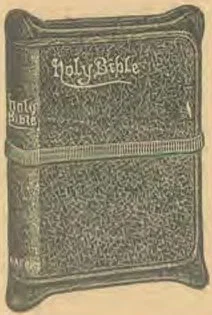
By Offering to Send it Post-paid, and the “Youth’s Instructor” for One Year, to any Address in the United States FOR ONLY $2.50.
If your INSTRUCTOR subscription is about to expire, you may send us the $2.50 for another year’s subscription and the Bible.
Last but not least, we offer to send the Bible, post-paid, to any address in the Postal Union, for only FOUR NEW YEARLY SUBSCRIPTIONS to the INSTRUCTOR, at $1.00, or for EIGHT NEW SIX-MONTHS’ SUBSCRIPTIONS, at 50 cents.
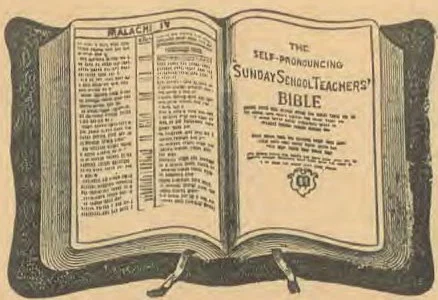
Specimen Page of the S. S. Teachers’ Bible. Size, 5 x 7¼ inches.
They that sealed the covenant. NEHEMIAH, X. The points of the covenant.
gavest before them, neither turned they from their wicked works. 36 Behold, d we are servants this day, and for the land that thou gavest unto our fathers to eat the fruit thereof and the good thereof, behold, we are servants in it: 37 And e it yieldeth much increase unto the kings whom thou hast set over us because of our sins: also they have f dominion over our bodies, and over our cattle, at their pleasure, and we are in great distress.
B. C. 443. d Deut. 28. 48. Ezra 9. 9. e Deut. 26. 33, 51. f Deut. 28. 8. g 2 Kin. 23. 3. 2 Chr. 29. 10; 34. 31.
25 Rē'hŭm, Hā-shāb'nah, Mā-g-sē'-iah, 26 And Ā-hī'jah, Hā'nan, Ā'nan, 27 Māl'luch, Hā'rim, Bā'g-nah. 28 ¶ e And the rest of the people, the priests, the Lē'vītes, the porters, the singers, the Nēth'i-nīms, and all they that had separated themselves from the people of the lands unto the law of God, their wives, their sons, and their daughters, every one having knowledge, and having understanding;
The Text Conforms Exactly to the Oxford Teachers’ Edition. The self-pronouncing feature enables the reader to pronounce all proper names at a glance. Contains the celebrated Oxford Teachers’ Helps, comprising nearly 400 pages. Also a complete series of fifteen new maps.
All the above features render this Bible especially desirable to Teachers and students of the Holy Scriptures.
Style No. 14.—Imperial Seal Binding. Tuck Edges, known as “Divinity Circuit.” Linen Lined. Rounded Corners, Full Gilt Edges, Publishers’ Price, . $4.00
Send at once for free INSTRUCTOR canvassing outfit. Only FOUR new names, and the Bible is yours.
For 20c. extra we will stamp your name in gold upon the cover. ☞ Send all money by Draft, P. O. or Express Order, or by Registered Letter.

TWO LETTERS.

(Many more might be given.)
The Bible was received two weeks ago. It is a very nice book. My daughter is very much pleased with it.
W. S. MILES, Monte Vista, Colo.
I received the Bible, and find it answers in every respect to the description. I should like very much to get one more just like it. Have you any left?
Mrs. C. M. LAKE, Orient, Ore.

GRAND TRUNK RAILWAY SYSTEM.

Time Card in Effect February 5, 1899.
C. & G. T. DIVISION.

WEST-BOUND FROM BATTLE CREEK.

LEAVE.
No. 11, Mail and Express, to Chicago... 12.00 M. No. 1, Chicago Express, to Chicago... 9.00 A. M. No. 3, Lehigh Valley Express, to Chicago... 3.40 P. M. No. 5, Pacific Express, to Chicago, with sleeper... 12.55 A. M. No. 75, Mixed, to South Bend... 7.30 A. M.
Nos. 11 and 75, daily, except Sunday. Nos. 1, 3, and 5, daily.

EAST-BOUND FROM BATTLE CREEK.

No. 10, Mail & Exp., to Pt. Huron, East, and Detroit 3.45 P. M. No. 4, Lehigh Express, to Pt. Huron and East ... 8.27 P. M. No. 6, Atlantic Exp., to Pt. Huron, East, & Detroit ... 2.25 A. M. No. 8, Lehigh Express, to Saginaw, Bay City, Pt. Huron, and East ... 6.50 A. M. No. 74, Mixed, to Durand (Starts at Nichols) ... 7.35 A. M.
Nos. 10 and 74, daily, except Sunday. Nos. 4, 6, and 8, daily.
E. H. HUGHES, A. G. P. & T. Agt., Chicago, Ill.
A. S. PARKER, Ticket Agent, Battle Creek.

SUBSCRIPTION ORDER

CUT THIS OUT AND RETURN TO US WITH YOUR RENEWAL OR A NEW SUBSCRIPTION.

SUBSCRIPTION ORDER.

REVIEW & HERALD PUBLISHING CO., Battle Creek, Mich.
Enclosed find One Dollar, for which please send THE YOUTH'S INSTRUCTOR for one year to the following address:—
Name
Street
Town
County
Begin Subscription
State

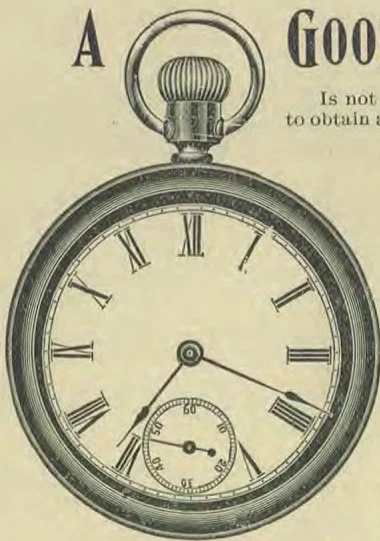
A GOOD WATCH

Is not such a difficult thing to obtain after all. Notice what we now have to offer you. A— Genuine American Jeweled Watch with German silver (white metal) case, stem wind and pendant set, small, thin size, enameled dial (not paper), and solid steel cut pinions.
The smallest watch for the money. Just the thing for boys or men. Not a clock in watch shape, but a real watch.

OUR OFFERS.

NUMBER ONE.— We will send this watch and the INSTRUCTOR one year to old or new subscribers sending us only $2.50.
NUMBER TWO.— We will send the watch alone for only FOUR new yearly subscriptions to the INSTRUCTOR, at $1.00 each, the regular rate.
NOTICE.— Your own subscription will not count on the above offers.
Send for free INSTRUCTOR canvassing outfit, and begin work at once. We have only a very few of these watches on hand. Address—
THE YOUTH'S INSTRUCTOR, Dept. “W.” Battle Creek, Mich.

SHOW THIS PAGE TO YOUR FRIEND,

Then Ask Him to Subscribe for His Children's Sake.

Some Valuable Testimonials for “The Youth's Instructor.”

Franklin, O. We appreciate and esteem the YOUTH'S INSTRUCTOR very highly. THE EDITOR.
Chicago, Ill. I regard the YOUTH'S INSTRUCTOR as the most ably conducted youth's paper in the country. T. B. ARNOLD. Publisher of S. S. Literature.
We think the YOUTH'S INSTRUCTOR is a very bright, clean little sheet, and wish it all success. M. C. WOOD-ALLEN, Bus. Mgr., New Crusade.
Topeka, Kan. I commend the YOUTH'S INSTRUCTOR as worthy a place in every family. It is replete with attractive lessons for children, tending to mold and develop manly and womanly character. F. G. ADAMS. Sec. Kansas Historical Society.
St. Louis, Mo., August, 1898. The YOUTH'S INSTRUCTOR is one of the brightest, strongest, purest publications that comes to our table. No young person can read its well-filled, beautifully illustrated pages without profiting greatly. Send for and see it. WORD AND WORKS.
Flint, Mich. I have looked over, with pleasure, the copies of your magazine, the YOUTH'S INSTRUCTOR. It is a beautiful publication, and does great credit to you all. I hope for you great success. JOHN M. HALL, Editor Bay View Magazine.
Kansas City, Mo., March 14, 1898. It is filled with vigorous, spicy articles especially interesting to the young. It is purely a moral and religious journal, and is rapidly finding favor with an appreciative public. The name in itself is suggestive of the character of the paper, and right ably does it fulfil all that the name implies. THE NORTH AND WEST.
Chicago, Ill., May 5, 1898. The YOUTH'S INSTRUCTOR is still published weekly. And well does it fulfil its mission, especially since assuming a magazine form. It is very attractive, with its bright, illustrated pages, which, through story, poetry, science, and Bible truth, breathe a spirit of consecration and earnest purpose that is inspiring. THE ILLINOIS RECORDER.
84 Hough Ave., Cleveland, Ohio. I can not speak too highly of the contents of the INSTRUCTOR. It bears out perfectly its name. God speed you in your good work. ADA BLENKHORN, the well-known religious song writer, author of “Let the Sunshine In.”
St. Louis, Mo., April, 1899. The YOUTH'S INSTRUCTOR is virtually what its name indicates. It is an illustrated weekly journal, containing interesting and instructive articles for young people. It is entirely free from the blood-and-thunder stories of the average young folk's papers, and thoroughly pure and elevating in tone. Published at Battle Creek, Mich. ALEXANDER D. DE MENIE, Editor “The Jefferson.”
Oakland, Cal., Jan. 5, 1899. In this age wherein there are so many snares to entrap the feet of young people, it is important that they should be supplied with the best of reading-matter; for what our youth read, as much as any other one thing, is either elevating or degrading them. Among all the young people's papers with which we are acquainted there is none that is equal to the YOUTH'S INSTRUCTOR, published at Battle Creek, Mich. Its columns are always clean, interesting, and instructive. The publishers will be glad to send sample copies on application. SIGNS OF THE TIMES. Quarter-Centennial Number.
Fond Du Lac, Wis., Jan. 19, 1898. The YOUTH'S INSTRUCTOR needs and deserves the hearty support of all Christian people. It has recently been changed to magazine form, and will place before its readers the truths of religion, science, history, biography, and music in an interesting manner. All other youths' papers cater to the public demand for fiction, and tend to unfit the young for the real duties of life, and especially for the enjoyment of the truths of God's word. Nothing would be more appropriate, as a present to your friends, than a year's subscription to this magazine. THE WISCONSIN REPORTER.
Shorey, Kan., June 26, 1898. We expect to talk YOUTH'S INSTRUCTOR at our camp-meeting. It certainly is the best youth's paper in the world. An education in itself. MRS. BELLE EMERSON.
Eagle Cliff, Ohio. The YOUTH'S INSTRUCTOR is a fine journal. It ranks high,—in my opinion, above The Youth's Companion, and that is the finest worldly youth's paper in the world. W. S. CHAPMAN.
Franceville, Ind. We wouldn't take six other papers for this one, it is so instructive. I think it the nicest paper ever published. Every youth ought to get it. KATIE AHRBRECHT.
Quitman, Ga., June 12, 1898. We are much pleased with the INSTRUCTOR. It is the best magazine of the kind printed, and should be in every home where there are children. TIMOTHY CARROLL.
La Junta, Colo., May 17, 1898. I received four copies of the INSTRUCTOR, and gave them all away. We take six copies for our little Sabbath-school. MRS. ELSIE LONGACRE.
Bridgewater, S. Dak., May 5, 1898. We supply the Young Men's Christian Home with a copy of the INSTRUCTOR each week, and they are glad to get it. I will always do all I can for the paper. MRS. O. E. BURGESS.
Greenfield, Ind., March 17, 1899. What do I think of the INSTRUCTOR? Will say that one of our best testimonials in its behalf is that the editor's scissors are often used on it. D. H. COBLE, Editor Home and School Visitor.
Fountain Inn, S. C. I am very much pleased with the magazine. I am so well pleased with it that I enclose $1, for which you will please send the magazine until the time expires. I shall be glad if you can afford to send me a few sample copies of the INSTRUCTOR to distribute. JOHN A. MARLAR.
San Pasqual, Cal. I now write a few lines and send a dollar for my YOUTH'S INSTRUCTOR. I can't do without it. I enjoy it very much. Every time I read it the more I like it. I have been sending mine away, and have taken some subscribers. I will send their names as soon as I get the money to pay. MISS ANNA POTTS.
Garden Grove, Cal. By accident one of my children picked up in the road an issue of your paper, dated Dec. 9, 1897. I like the tone of the paper much, and want it, as we have eight children that need such instruction, and I find it as good for the older children as well. REV. IRA WOODMAN.
Church Hill, Md. I can heartily recommend the INSTRUCTOR. It is the best paper for young people I ever saw, and it gets better all the time. I am an ex-teacher, forty-two years old, and I read it for my own instruction and amusement, and then lend my copy each week to a friend. We indorse it for both old and young. M. E. HUPLOCK.
White Sulphur Springs, Mont. The cover is exceedingly pretty, and the paper and type of the very best. The articles are of a high order, including something in almost every line of popular literary taste; and science is well represented, while the bits of thought interspersed here and there are gems. The moral tone is above reproach, as an examination assures us. The homes into which the Rocky Mountain Husbandman goes would be greatly benefited if they could also welcome this bright young people's weekly magazine with its artistic engravings and entertaining and instructive pages. ROCKY MOUNTAIN HUSBANDMAN.
Vineland, N. J., June 1, 1898. Our young people are delighted with the paper. IDA M. TOWER.
Maple Lake, Minn. The INSTRUCTOR is a splendid magazine. I wish it success. WINFIELD NARY.
Rockford, Ill. I greatly enjoy reading your magazine, and wish you success. MISS KATE BROWN.
Porter, Minn. I am very glad to get the paper every week, and I think everybody likes it. BERT HANSEN.
Manchester, Iowa, June 6, 1898. We are taking the INSTRUCTOR, and are very much pleased with it. L. E. JUNE.
39 East Ave., Rochester, N. Y. I wish I had a hundred dollars to send for such a good paper. I enjoy it very much. G. B. JONES.
Dayton, Ohio, May 11, 1898. The Dayton Sabbath-school values the INSTRUCTOR above all other magazines for the young. ROBERT THURBER.
Berthoud, Colo., May 15, 1898. We all appreciate the INSTRUCTOR very much, and our school has never been without it since it was organized. MISS ROSA BEELER.
Lake Run, Pa. I must say that it is rightly named. I appreciate it highly, and think no better educational journal can be found. I wish you success. JOS. DICKENS.
Passaic, N. J., May 8, 1898. We like the INSTRUCTOR very much in its new dress, and we find our scholars like it very much, too, as it is very attractive and full of good things. F. H. HICKS, Supt. Sabbath-School.
Oak Shade, Ohio. I am always on the lookout for possible subscribers, as I believe it has no equal as an instructor for the youth. Success to the INSTRUCTOR. MRS. RETTA WEATHERBY.
Manistee, Mich. I received the premium fountain pen at last. I am well pleased with it. Many thanks. The children who get the INSTRUCTOR think it is very nice. MRS. MARGARET ELLIOTT.
Bird Island, Minn. Enclosed find order blank for six months' subscription to the YOUTH'S INSTRUCTOR. It is a splendid paper, and we like it very much. Will you please send the INSTRUCTOR for last week. OSCAR HANSEN.
Alcester, S. Dak., May 9, 1898. We like the paper very much, especially in its new form. We think it one of the best magazines published. We love to read the little paper, and wish many more could do so. IDA L. PETERSON.
Lyndon, England. The December INSTRUCTORS have arrived, and are as delightful as ever. I enjoy reading them, and am thankful for them. Shall pass them on to others when we are through with them. I would like a year's edition bound. MRS. GEO. E. M. TAYLOR.
316 Fillmore St., San Francisco, Cal. I wish to let you know that I am very much interested in the YOUTH'S INSTRUCTOR, and wish to continue my subscription so as not to miss any of the numbers. I kept a file last year, and wish to keep one this year. SOPHIA VERKOUTEREN.
Marshalltown, Iowa, May 23, 1898. We enjoy the paper very much, and I am sure that the children and young people would be sad indeed to miss its weekly visits. We think it is a most excellent paper for both old and young. May God bless it to the good of many souls. MRS. JULIA SANTEE.
Would you like to become our YOUTH'S INSTRUCTOR agent for your town? If so, write us at once, giving references. Upon hearing from you we will be pleased to furnish you with a free agent's outfit for securing new subscriptions; also with our recent 40-page premium number (for Dec. 8, 1898). The above bona-fide testimonials will help you materially in getting orders. Address—THE YOUTH'S INSTRUCTOR, Dept. “C,” Battle Creek, Mich.

THE MAN-POWER CARRIAGE.

Early one morning late in December, 1887, I lay in my bunk, aboard the “Rajputana,” as she moved along the shore of the lower Malay Peninsula. I heard the ringing of the “four bells,” which ended what the sailors call the “dog-watch.” For an hour or more I had been dozing, my slumbers disturbed by the grating of the holystone and the swish of water on the deck overhead when a knock at my cabin door aroused me fully to consciousness. The steward brought me my chota-hazri (little breakfast), as it is called in Hindustani, consisting of a cup of tea, and some dry, buttered toast. The captain had notified the passengers at the supper-table that we would enter port soon after daylight; and as this is an interesting experience to most travelers, I was soon dressed in a clean white suit, and covered with a solatopi, or sun-hat, stood on the deck, inhaling the bracing air, which blew softly across the straits from the direction of Sumatra, whose shores were fifty or sixty miles below the western horizon. The slanting rays of the early sun were reflected from the pale-green waters of the straits, and gave a mellow tinge to the summits of the mountains that lay far inland, receding in the dim haze that always overhangs them. The lascars were scurrying about the deck, getting the ship in readiness for the landing at the wharf, which was more than twelve miles ahead of us, and entirely lost to view behind the little islands that flank the harbor.
There is no more charming scene or delightful experience than early morning on board an ocean steamer as she enters a harbor in the tropics. There is a rhythm about the many confusing sounds that rise from the labors of the sailors, the hum of the deck passengers, and the clear, sharp tones of the captain as he issues his commands from the bridge. An interest and excitement attend all these preparations, which keep the saloon passengers on the qui vive; nobody can snooze with any comfort while listening to these sounds, which give warning of the arrival of the vessel in port, particularly if that port is the haven for which one has been sailing.
As I stood watching the lascars pulling ropes, furling awnings, and making their preparations for the disembarking of the passengers and the unloading of the cargo, my attention was arrested by the approach of a steam-launch alongside the ship; and soon the pilot, who was to bring us into the harbor, was aboard the ship and on the bridge. Half an hour later another launch brought the health officer alongside.
In the distance several Malay boats were scurrying across the horizon. The green, superabundant vegetation, in all its tropical luxuriance, was outlined more and more clearly upon the islands that began to shut us in. The narrow entrance to the harbor was now discernible, and frowning from the elevated crest of the bluffs on either hand could be dimly seen the muzzles of threatening cannon. Presently we found ourselves in the harbor, and approaching the wharf, which extends for more than a mile along the shore.
A dozen or more canoes, filled with well-nigh naked boys, who, in very bad English, begged the privilege of diving for coin, thronged the ship. As this was the first exhibition of the kind some of the passengers had ever seen, there were plenty of coppers forthcoming; and as the coins disappeared beneath the surface of the water, there followed them a perfect cascade of graceful, brown-skinned lads of varying ages, whose movements could be seen beneath the water as they struggled to secure the coveted treasure. Wonderful indeed was the agility which they displayed, and frequent were the exclamations of astonishment which escaped the passengers.
In another half-hour we had drawn alongside the wharf, and the shore-lines were attached.
I made all possible haste to arrange for the delivery of my luggage; declining the importunate offers of the native ghari-wallas, I chose to ride in the world-famed jinrikisha. As I walked out of the steamship company’s grounds, I saw a garrulous crowd of half-naked Chinamen, upon their heads large bamboo hats, with sharp-pointed crowns, who were clamoring for my patronage. They hedged me in on every side, and outrivaled the most offensive hackman that ever worried a sightseer at Niagara. I selected the neatest and tidiest vehicle, and at the same time the most robust runner I could find.
At this point I will give a brief history and description of the jinrikisha. As the Japanese name indicates, the jinrikisha is a “man-power carriage.” It is interesting to know that an American missionary at Hong-Kong was the inventor of this now popular mode of travel. Hong-Kong is built on the side of a mountain that forms a little island, which bears that name, and lies off the entrance to the river that leads up to Canton. The streets of Hong-Kong, which run parallel with the seashore, rise in terraces, while those which retreat inland are so steep that no horse and carriage could possibly ascend them.
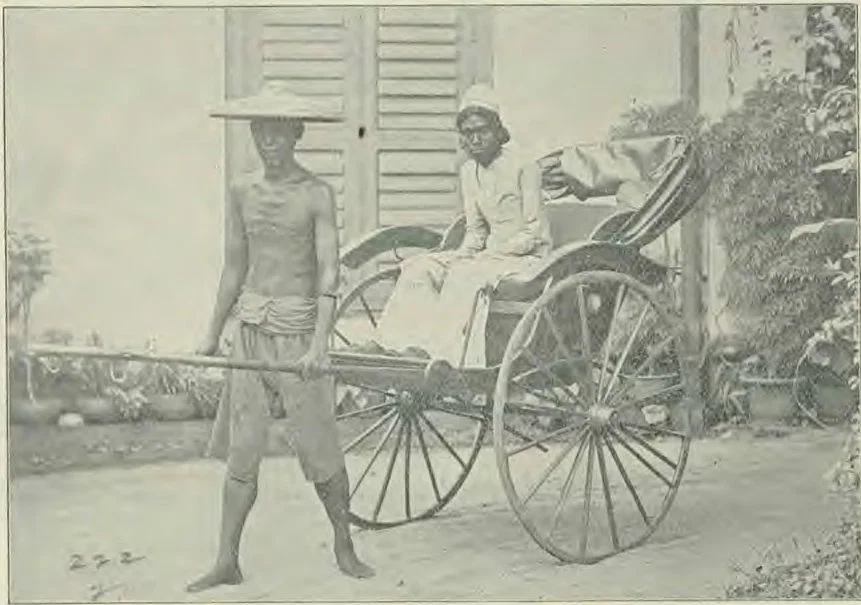
For these reasons, travel was at that time, and to a great extent, is still, mostly accomplished by means of the sedan-chair, for which at least two men are required. The missionary, whose purse was scant, but whose native genius for invention came to his relief, determined to cut his expenses in two, and this he did by making a very light road-cart of diminutive dimensions. The jinrikisha is now in use in all the Japanese and Chinese coast cities, down as far, indeed, as Singapore and Colombo, Ceylon; and tens of thousands of them are in constant use, to the great comfort of the traveler and the advantage of the poor coolie. Its form is graceful, having a comfortably cushioned seat, and a hood, like an ordinary buggy, constructed of bamboo frames covered with oilcloth; the seat is upholstered, and mud-guards cover the wheels. The only peculiarity which strikes the newcomer is the absence of a dashboard.
The coolie placed the shafts upon the ground, and I stepped in, and seated myself upon the forward-slanting seat. With much alacrity, the “puller” stepped within the shafts, which are united in front, and suddenly lifting them, gave me a terrible scare; for I thought I was going to get out of the back of the carriage much more quickly than I had entered the front; but a moment later I found myself resting comfortably in a seat which, for comfort and ease, resembled a cozy rocking-chair. I was surprised at the pace of the coolie, and my surprise increased to wonder as he passed carriages and other vehicles, not slackening his pace until the four miles which lay between the wharf and the business quarter of the city had been covered. After reaching the mission house, which nestled snugly at the foot of a hill from whose summit British cannon commanded the harbor, I alighted, and consulting my watch, found that in less than half an hour we had covered the distance mentioned.
As I was about to pay him, the missionaries recognizing me, emerged from the bungalow, and cautioned me about the amount I ought to pay. I had been meditating as we sped along the smooth road, and had concluded that if I had to change places with the coolie, a dollar would be the least that I would think of accepting for such a service; but the missionary, knowing there were eight or ten thousand other coolies ready to perform a similar service for one fifth that sum, assured me that twenty cents was ample compensation. I therefore gave him that amount, though not without some self-reproach; and when the Chinaman, who was streaming with perspiration, begged for some additional coppers, I could not forbear adding another dime, which amounted, all told, to fifteen cents in American gold. Dollars and cents are the standard of currency in this colony; but it is the Simon-pure silver dollar, and is worth only fifty cents in exchange for American currency.
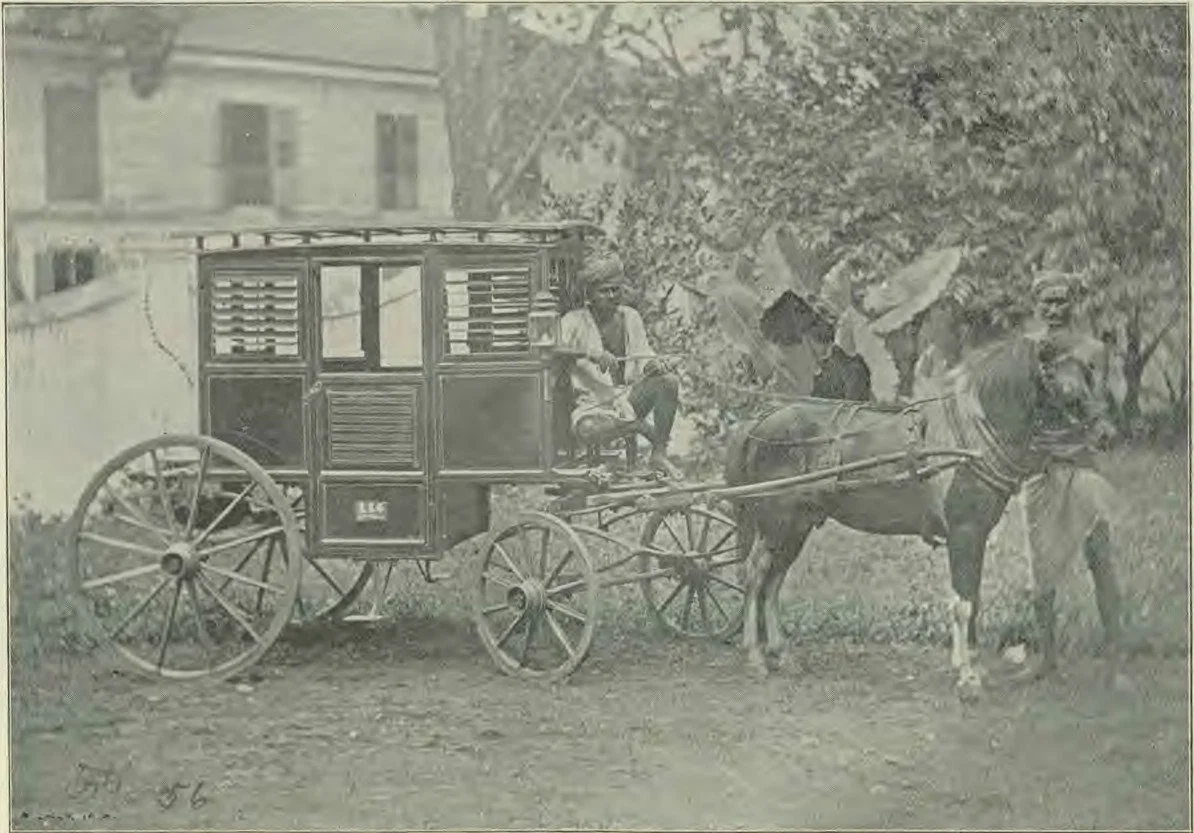
A SINGAPORE PONY CARRIAGE.
These Chinese coolies consider themselves extremely fortunate to obtain a jinrikisha; for notwithstanding the excessive competition, they are able to earn from ten to fifteen dollars a month, which is at least five times what their labor would command in China. Many of these poor fellows are the unhappy victims of the opium habit, from which source the colonial government derives an annual revenue of several million dollars. As a result, thousands of Chinese have fallen victims to the direful practice of opium-smoking. By way of illustration, I will narrate an experience that befell me several years later:—
In Singapore our house was on the crest of a hill, the road from which ran straight down one side, and at the bottom made a sudden turn to the right into one of the public streets. It had been raining, and the road was slippery; my little boy and myself were on our way to church one Sunday morning. The coolie was an opium-smoker, and allowed the jinrikisha to gain too much headway, and on reaching the bottom of the hill, found that he was unable successfully to make the turn; and as he could not stop, he was forced across the street at a sharp pace, and the shafts of his jinrikisha struck the brick wall that enclosed the grounds of the Japanese consulate. The shafts were splintered up to the body of the vehicle, and we were thrown out with considerable force, and would have received serious injury had not our progress been impeded by the body of the coolie. He, unfortunately, suffered the heaviest loss; for besides bodily injury, he had to make good the cost of the repairs on the jinrikisha.
In Japan the authorities require a rigid test of every man who applies for a license as a jinrikisha-puller. The officers require the candidate to draw a jinrikisha with a passenger around a track provided for the purpose at a rapid pace for a half-hour, at the close of which he must be in as good wind as if he had been walking. Thus it will be seen that it is no easy task to be a “human horse” in the cities of the far East. In Singapore the jinrikisha made the street-car business unprofitable, and was the cause of their abandoning the field, being unable to compete with these spry little go-carts.
When the missionaries first came to Singapore, it was considered a well-nigh disgraceful thing for a European to be seen riding in a jinrikisha, but to-day everybody uses them; and private vehicles of elegant pattern and costly finish may be seen, in the early morning or evening, proceeding to and from the European residence quarter, drawn by liveried Chinamen.
Sometimes very laughable occurrences take place in connection with the passenger traffic in which the jinrikishas are engaged. One day as I was going down-town, I noticed, at a crossing of two of the principal streets, two portly Chinamen in a jinrikisha drawn by an under-sized coolie. The coolie was either weary or was weak from the opium habit, and with difficulty maintained an equilibrium of the carriage and passengers; suddenly he lost control of it, and was lifted off his feet by the weight of the two passengers who were sinking backward. An instant later they were dumped in a heap in the middle of the road, and the coolie was thrown on top of them. For a few minutes there was a wriggling, squirming mass of legs, arms, and cues, which suggested a one-horse railroad accident. Traffic was temporarily suspended, while everybody stopped to laugh heartily, and the merriment was punctuated with exclamations that formed a part of the altercation between the passengers and the puller. They soon saw that others were laughing at them; and grinning good-naturedly, they moved on, clearing the street for the traffic that surges along it. R. W. MUNSON.
A JINRIKISHA.
A JINRIKISHA.
Continue reading: THE RESURRECTION OF LAZARUS